Having a Ball to Celebrate the Army’s 234th Birthday

(Photo from PictureBook Directory of Children’s Illustrations)
As a child, I grew up with stories of dressing up in beautiful gowns and going to the ball – didn’t you see Cinderella when you were a child? My mother would dress in wonderful gowns to go out with my father to balls; I still remember her kissing me goodnight, dressed is midnight dark blue velvet with rhinestones scattered on the gown; it reminded me of a starry night in Alaska. She wore White Shoulders perfume.
We always thought they had so much fun when they went out – they would bring us small swords and umbrellas. We would ask “what did you do with these?” imagining sword fights or something equally interesting, but they would say they were just decorations for fancy drinks. We knew they were lying; we knew it must be some adult thing that they couldn’t tell us about.
This weekend AdventureMan and I went to the Army Birthday Ball, and realized it may be the last ball we go to. We were prepared, or mostly. Unlike Cinderella, I didn’t have my glamorous shoes with me. I remember taking them out of the closet, but somehow they got packed in my household goods. I did have a pair of sandals with me that matched my gown closely enough, but they were far from glam.
AdventureMan was dressing in his evening wear and discovered he had no black socks! Horrors! We found a pair of very dark green socks that he usually wears traveling in Africa, and his pants were long enough to cover them, both standing and sitting, as long as he didn’t cross his legs, LLOOLLL!
So, off we went to the ball, not in a glorious carriage but in air conditioned comfort, thank God. The air conditioning matters when you are all dressed up, made up, and want to be cool.
Cool we were. As we sat shivering in the giant decorated warehouse where the ball was held, I laughed at AdventureMan and said “I have NEVER been cold at a ball before!” Even at the winter balls we used to attend in Germany, the heat would be on, and with 300 – 400 people attending, all crowded in, things heated up in a hurry. The summer balls in Germany were often sweltering – there was never any air conditioning, and a big heat wave always seemed to hit around the time of the balls. There is nothing so unglamorous as sweating in a ball gown!
Here, in Doha, where the temperatures at night sometimes don’t even drop below 90°F, the air conditioning was working great.
The food was also surprisingly good. Most of the time at grand occasions the food can be rubbery, or blandly disappointing. The food was pretty good.
Best of all, this was a ball put on by soldiers, for soldiers. It was really fun seeing all the soldiers and civilians in their finery, all glammed up and having a great time. It was even more fun having some of the soldiers out of the war zones, on R&R, in their battle-dress-uniforms – after all, the ball was to celebrate the Army, the Army’s 234th birthday, and those who serve.
The program was excellent, and moving. Great honor was given to those who serve, who sacrifice, those who have been wounded, the families that support them, and to those who give their lives in service to our country. There were many solemn moments. It gave the occasion gravity. It was impossible not to be moved. They did a great job.
When I was younger, before marrying AdventureMan, my sister and I were in the right place at the right time. All the young officers needed respectable dates for the balls, and we attended a lot of balls. I guess we “cleaned up good.” 😉 Many of the balls were held in the Heidelberg Castle, or other castles, it was always a very fun time, lots of dancing.
After getting married, I realized that what I thought was just a great romantic evening out was really all about politicking. The wives were left stranded at their tables while the husbands were out renewing acquaintances, getting introductions to new potential bosses and angling for their next assignment. So much for an evening of dancing and romance! As the music blared, you couldn’t even have a good conversation, just sit at the table or walk around with a friend, wondering when your husband was coming back!
So, for me, this ball was the best. AdventureMan made his rounds during dinner, while I chatted with other wives whose husbands were also out making the rounds, but before the loud music had started. The program didn’t end until late, and after making our rounds of farewells, we made our escape, hoping we would not turn into pumpkins!
Here is a wonderful video, made by a 15 year old girl, to honor our Armed Forces:
Dar Al Thaqafa in Doha, Qatar
I have very special feelings about Dar Al Thaqafa. When I was new in Qatar, as I started to read a very special book, it fell out of the binding. Maybe the heat has melted the glue, I don’t know, but it was not my book! It was loaned to me by the Ambassador to Qatar from Japan, and holy smokes, I had ruined it!
I went ahead and read the book, and then I had to figure out how to get it re-bound. I asked around, no one had any idea. Finally, I asked at one of the Dar al Thaqafa stores (there are several in Doha) and they told me about the Dar al Thaqafa printing plant, which was not far from where I lived.
I took the book there. They said they could rebind it. It would take about a week. I didn’t even ask the cost; it didn’t matter, I had to return the book in good condition.
When I went to pick up the book, they wouldn’t let me pay them. The man who gave it to me – with beautiful bindings and end-papers – had a big prayer bump on his head. He told me he wanted me to remember that not all religious Muslims were terrorists. I almost cried. Maybe I did, a little, when I got back to the car, it is just such a perfect example of God’s grace, and how we are supposed to love one another and be kind to one another.
So this weekend, as I drove around familiarizing myself with my old secret back ways to get places, I came across the first Dar Al Thaqafa book store I ever visited, with Little Diamond, down near the Dira’a fabric souks. You would hardly know it was there, if you didn’t know it was there. We only found it because the toy vendor outside had some dancing Saddam Husseins and Osama bin Ladens – I have never seen them anywhere else. Then we spotted the bookstore – and oh, what heaven, all kinds of books, a bookstore any book lover would love:

Qatar is a conservative country. You might be wondering how I can take pictures so freely – I always ask.
So I asked if I might take photos of the bookstore.
“Why” asked the man at the desk.
“I love this bookstore,” I responded, “and I take photos of places that might not exist in the next five or ten years. I try to record what was special and unique in a country.”
He beamed with delight!
“This is the oldest bookstore in Qatar!” he exclaimed! “This is the original of all the Dar al Thaqafa bookstores!” He gladly gave me permission to photograph.

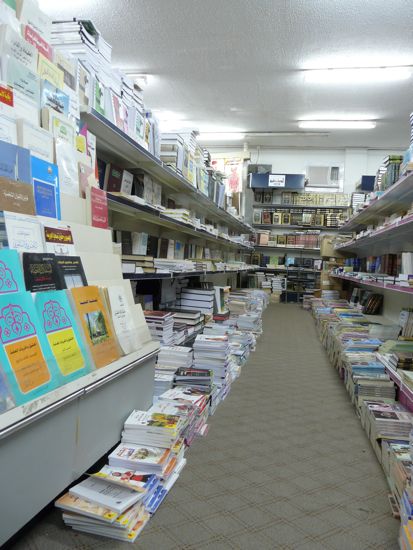
They carry textbooks, reference books, religious books, children’s books, and all kinds of school supplies, from the most elementary grades through the most specialized university courses.
You know I read and write Arabic on a very very basic level. I can proudly say my niece, Little Diamond reads and writes on a fluent level, and as we leave book stores, we are often staggering under the load of the books she buys to take home and read. This store, and the Jarir bookstores, are a couple of our favorite stops.
I had a family cookbook printed with all our best of the best recipes – the Dar al Thaqafa on Merqab did the printing and cover and binding for me. They did a great job.
As much as I like going to a Barnes and Noble, you walk into just about any Barnes and Noble and it is like walking into the same one, whether you are in Pensacola, Seattle, Houston, Charleston – they all pretty much follow the same pattern. It is calculated and more than a little sterile. Not so the Dar al Thaqafa, where books are piled here and there, pens are all in one place, children’s books in piles – you kind of have to search for what you want, but they usually have it, or can find it for you, or tell you where to go for it.
Enmegahbowh
Yesterday, one of the songs we sang was an oldie but goodie, To Be a Pilgrim, written by John Bunyan, who wrote Pilgrim’s Progress while serving a jail term for preaching without a license. We sang the old fashioned version:
Who would true valour see,
Let him come hither;
One here will constant be,
Come wind, come weather
There’s no discouragement
Shall make him once relent
His first avowed intent
To be a pilgrim.
Whoso beset him round
With dismal stories
Do but themselves confound;
His strength the more is.
No lion can him fright,
He’ll with a giant fight,
He will have a right
To be a pilgrim.
Hobgoblin nor foul fiend
Can daunt his spirit,
He knows he at the end
Shall life inherit.
Then fancies fly away,
He’ll fear not what men say,
He’ll labor night and day
To be a pilgrim.
(Actually, I may have drifted off because I don’t remember singing the part about the hobgoblins or foul fiends . . . or maybe we sang a slightly more updated version . . .)
Yesterday’s reading in The Lectionary had a great prayer, which also included the word “pilgrim:
Almighty God, thou didst lead thy pilgrim people of old with fire and cloud; grant that the ministers of thy church, following the example of blessed Enmegahbowh, may stand before thy holy people, leading them with fiery zeal and gentle humility. This we ask through Jesus, the Christ, who liveth and reigneth with thee in the unity of the Holy Spirit, one God now and forever. Amen.
And it had this wonderful story of an American Saint, Enmegahbowh – A saint from the original inhabitants of our country:
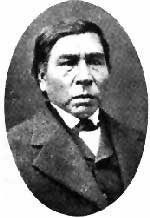
ENMEGAHBOWH
PRIEST AND MISSIONARY (12 JUNE 1902)
[James Kiefer has no bio for Enmegahbowh. Below is a biography from A Pioneer History of Becker County Minnesota by Alvin H. Wilcox (1907). Enmegabowh was the first Indian ordained in the Episcopal Church.]
In 1851, the Rev. Dr. Breck, a great missionary, whose name must be known to every reader of the “Soldier,” [“Christian Soldier”] began a mission at Leech Lake, among the Ojibwa Indians of Minnesota. This mission, from various circumstances, had only a partial success, and in the winter of 1855-56 troubles with the government agents roused the Indians to such madness that Dr. Breck was forced to leave, and the mission buildings were burned.
Two years later the Rev. Mr. Peake went to Crow Wing to establish another mission, and young Indian deacon, John Johnson, his Indian name Enmegahbowh, came to assist him. This man had beeen a catechumen under Dr. Breck, and had been baptized by him. He must have been born to some position in his tribe, as he had been set apart for a “Medicine Man” in youth, and his Indian name, Enmegahbowh, meant “The man who stands by his people,” a significant name, which in time proved to be a true one.
In 1861 Mr. Peake resigned the mission into the hands of Enmegahbowh. Crow Wing was then a settlement of very bad repute on the frontier. In 1862, the year of the Sioux outbreak, Hole-in-the-day, a leading Ojibwa chief, a bad man, full of craft and cunning, collected five hundred warriors, and prepared for a general massacre of the white people. Enmegahbowh, having prevented, by his influence, some other bands from joining these, was made a prisoner, but succeeded in escaping, and, through the midst of great perils, made his way to Fort Ripley, and by his timely information, such measures were taken that bloodshed and a more fearful massacre than that of the Sioux were prevented.
For a few years the mission work seemed at a stand still. From Canada Enmegahbowh received earnest invitations to go where comfort and hopeful work awaited him, but Bishop Whipple encouraged him, standing in the forefront for an unpopular cause and a hated people, and Enmegahbowh would prove the fitness of his name — he would not desert his people.
At last the government made new arrangements, and seven hundred Ojibwa were moved to what is called the White Earth Reservation, a tract thirty-six miles square in northern Minnesota. Of these seven hundred about one hundred and fifty were French half-breeds, or Roman Catholics. Amongst the remainder Enmegahbowh labored earnestly, the government now aiding in the work by encouraging the Indians in civilized ways. A steam sawmill was built at White Earth Lake, where Indians were taught to run the machinery, and from which lumber was furnished for building purposes. Eastern churchmen assisted the mission, and a church and parsonage were built.
At the time of the consecration of the church in August, 1872, quite a party of the clergy and laity, through the kindness of Bishop Whipple, were enabled to visit White Earth.
The consecration was on Thursday. Friday morning, the chiefs signified to the bishop their wish to meet with him in a council, which was therefore held, that afternoon, on the hillside in front of the church. It was a picturesque scene — the lovely landscape, the sunlight glancing through the tall oak trees on the bishop and Enmegahbowh, who sat in the centre, the chiefs and five or six clergymen grouped around. Behind the bishop three chairs were placed for the ladies of the party — the first time, I think, that ladies were ever admitted to an Indian council.
The chiefs spoke in turn, as they had themselves arranged, and were interpreted by Enmegahbowh. — Christian Soldier.
The Rev. John Johnson was born in Canada and died at White Earth on the 12th of June, 1902, at the age of 95 years.
God had someone in mind who was already set aside by his people to serve him, and he had the most wonderful name for a priest – The one who stands by his people. How cool is that? His heart was ready, when he heard the words, and he served mightily.
Baking Cookies for Palestine
When I was just starting out my own life, I had an idea what kind of life I wanted, but I had no clue how to get it. When AdventureMan and I met, we had the same vision, it was so cool, so unbelievable. We married, and this amazing life has unfolded.
Not everyone is born to move. You have to be good at change. Change can be daunting. Some people are better at staying in one place, sinking deep roots, developing lifetime relationships. Some people – like AdventureMan and me – have a need for stimulation, and we get it by changing locations. We feel so blessed.
It is always painful leaving the place we have been living, pulling up roots is just plain painful. The transplantation process takes time for the organism to adjust, for new roots to develop and take hold. Sometimes, the plant fails. In our case, we have had our failures to thrive, but for the most part, every move has helped us to learn and grow in new ways. We feel truly blessed; we have the lives we were born to lead.
Arriving back in Doha, I called my good friend. We have never lost touch, with e-mail and visits we have stayed in contact, and now I am calling her so she has my new number in Doha.
“You must come Tuesday morning!” she enthused, “We are baking cookies for Palestine!”
This wonderful woman was my teacher for reading and writing Arabic, and she did a great job. I read and write about as well as a five-year-old, but I can sound out words, and can write my name. Best of all, I adored this teacher, and when she called and asked me if there was something I could teach her daughters during the long hot Doha summer, I said “yes” and a new adventure began.
One of the things that happened is that I learned I never really knew what the day might bring. Getting to know her, her daughters, and her family better, I learned now ignorant I am of how totally differently others live their lives and see the world. I was learning all the time, and most of it was from the daughters. On one occasion, the daughters called me at 6 in the morning – they are never up at six! They asked if I would take them to the hospital to see their mother, and I sleepily said “Yes, of course,” and asked what time they wanted to go.
“Now!” they replied, joyfully, for this was a birth.
My sweet daughter-in-law was visiting, with our son, and so the two of us rushed over to pick up the girls, who came loaded with carafes loaded with coffee, boxes of finjan (tiny Arabic coffee cups) and sweets, loading up the car with goods and joyful laughter. When we got to the hospital, we had a quick visit with the Mom and then – the guests started arriving.
First – the room. Our friend was in a king sized bed, surrounded by lush curtains which could be pulled. She had a marble floor and a marble private bathroom with private shower, and a small dressing room. There was a visiting area with velvet covered seating for around 16 people, and mahogany paneling everywhere. This is the poshest maternity ward I have ever seen.
Many of the guests were stopping on their way to work. “When you visit someone in the hospital,” the girls informed me, “a thousand angels pray for you, for having made this visit.” These visits are de rigueur, an absolute must. We were there an hour, a constant stream of women came and went, staying around ten minutes, each receiving a small coffee. Then, the girls told us we could go, that they would stay to take care of serving the coffee and sweets.
The entire episode, we never had one clue as to what we were doing, or what was going to happen next. I learned just to go with whatever was happening, stay quiet, watch and learn. Sometimes, I ask questions, if there is a quiet moment.
So when my friend says come bake cookies, I go. I remember when she first baked her first cookie; she called me to come. She didn’t have a mother, growing up, and there were gaps – like how to bake cookies. We spent a morning learning how to make mamool, and it took me three days to get the smell of butter out of my hands. It was so much fun.
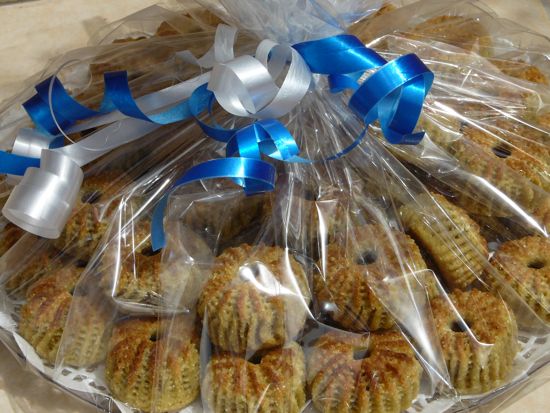
As I entered the workroom twenty pair of eyes looked up at me. Everyone was neatly dressed in aprons and headscarves, but my friend wasn’t there! I found my friend, we exchanged greetings, and she came to workroom to get me started. I had my own apron with me, and they provided me with a headscarf; we all looked a lot alike, little baker women. As a beginner, I got to put out the dough, later put the date paste on each piece of dough, later roll the dough around the date paste and put a hole in the top.
Most of the women, vastly more experienced than I, were using little tweezer tools to crimp the dough into the fabulous tiny ridges you can see in the photo. My friend explained that one of the women’s husbands had made the special tools for making the holes in the dough, and the table for them to use packing up the cookies and wrapping them, another had provided a portable oven for baking the cookies, another donated semolina (the flour) and another the dates.
Working once a week, making these beautiful cookies, (biscuits, if you are British trained) the women have built two wells in Palestine, and are currently building a bakery. They took their grief and outrage over Al Raza and turned it into the most amazing effort for good. They feed the hungry, give water to the thirsty, they clothe the poor, they take care of families whose men are imprisoned.
“You must come back!” one woman says as I am heading out the door. “You are a good worker!”
I wouldn’t miss it for the world. 🙂
Truly Humbling
Tonight, just for grins, I took a look at all the search terms that brought people to Here There and Everywhere.
These are the top twenty-five, in the almost three years this blog has been up and running:

Do you notice anything? Not a single reference to Kuwait? Not a single reference to expat living? LLOOLLLL, my whole point in doing the blog was to write about cross-cultural living, and my biggest hits are birthday cakes and funny cats and hummers? Yes, it is truly humbling. 😉
I’ve shown you mine – show us yours. What search terms bring people to your blog?
Who Is My Neighbor?
You would think when someone so special is talking, people would listen. You would think that when he is trying to tell us what God expects from us to enter into his kingdom in the after life, people would be listening, and indeed, they listened, many listened. There were others who did not. There were also those closest to him who misunderstood! That always baffles me, that those closest could misunderstand.
Today’s lesson is one of my very favorites in the world. You can substitute any two races who hate one another and the story is equally clear. The man who was asking the question was setting Jesus up, or trying to, and Jesus used the occasion to teach a stunning truth – that love is stronger than hate.
Luke 10:25-37
25 Just then a lawyer stood up to test Jesus.* ‘Teacher,’ he said, ‘what must I do to inherit eternal life?’
26He said to him, ‘What is written in the law? What do you read there?’
27He answered, ‘You shall love the Lord your God with all your heart, and with all your soul, and with all your strength, and with all your mind; and your neighbour as yourself.’
28And he said to him, ‘You have given the right answer; do this, and you will live.’
29 But wanting to justify himself, he asked Jesus, ‘And who is my neighbour?’
30Jesus replied, ‘A man was going down from Jerusalem to Jericho, and fell into the hands of robbers, who stripped him, beat him, and went away, leaving him half dead. 31 Now by chance a priest was going down that road; and when he saw him, he passed by on the other side. 32 So likewise a Levite, when he came to the place and saw him, passed by on the other side. 33 But a Samaritan while travelling came near him; and when he saw him, he was moved with pity. 34 He went to him and bandaged his wounds, having poured oil and wine on them. Then he put him on his own animal, brought him to an inn, and took care of him. 35 The next day he took out two denarii,* gave them to the innkeeper, and said, “Take care of him; and when I come back, I will repay you whatever more you spend.” 36 Which of these three, do you think, was a neighbour to the man who fell into the hands of the robbers?’
37He said, ‘The one who showed him mercy.’ Jesus said to him, ‘Go and do likewise.’
I have seen this in my own life. I have seen hopeless situations, with no solution in sight, totally change because one person chooses to love, instead of to hate. Choosing to love, in the face of hatred, takes a lot more character, a lot more strength. It has the potential for changing everything.
Prayer Reshapes Your Brain
This is a very small excerpt from a much longer article I found on National Public Radio News, a special series on The Science of Spirituality. This article (you can read it all by clicking on the blue type, above) talks about measuring brain activity while a person is praying, how the brain changes. Fascinating stuff.
A Sense Of Oneness With The Universe
Newberg did that with Michael Baime. Baime is a doctor at the University of Pennsylvania and a Tibetan Buddhist who has meditated at least an hour a day for the past 40 years. During a peak meditative experience, Baime says, he feels oneness with the universe, and time slips away.
“It’s as if the present moment expands to fill all of eternity,” he explains, “that there has never been anything but this eternal now.”
When Baime meditated in Newberg’s brain scanner, his brain mirrored those feelings. As expected, his frontal lobes lit up on the screen: Meditation is sheer concentration, after all. But what fascinated Newberg was that Baime’s parietal lobes went dark.
“This is an area that normally takes our sensory information, tries to create for us a sense of ourselves and orient that self in the world,” he explains. “When people lose their sense of self, feel a sense of oneness, a blurring of the boundary between self and other, we have found decreases in activity in that area.”
Newberg found that result not only with Baime, but also with other monks he scanned. It was the same when he imaged the brains of Franciscan nuns praying and Sikhs chanting. They all felt the same oneness with the universe. When it comes to the brain, Newberg says, spiritual experience is spiritual experience.
“There is no Christian, there is no Jewish, there is no Muslim, it’s just all one,” Newberg says.
Wives, be subject to your husbands
This part of today’s reading, among my set and the things we discuss, is one of the most controversial. We can debate this for hours.
What does being subject mean? If we, as wives, are subject to our husband, just as our husbands are subject to God, does it mean we can’t argue? We can’t disagree?
I saw a husband say to a wife the other day “I forbid you.” I think this is more common in Gulf culture than in our culture. I am sorry, but the thought of a husband daring to say this to a wife in the west is unthinkable. What I have also noticed is that when a husband says “I forbid you” here, it is not the end, but the opening skirmish. 🙂
There is a lot of food for thought in this reading, and I publish it to give you insight into what we read, and because I suspect you have similar readings.
Colossians 3:18-4:18
18 Wives, be subject to your husbands, as is fitting in the Lord. 19Husbands, love your wives and never treat them harshly.
20 Children, obey your parents in everything, for this is your acceptable duty in the Lord. 21Fathers, do not provoke your children, or they may lose heart. 22Slaves, obey your earthly masters* in everything, not only while being watched and in order to please them, but wholeheartedly, fearing the Lord.* 23Whatever your task, put yourselves into it, as done for the Lord and not for your masters,* 24since you know that from the Lord you will receive the inheritance as your reward; you serve* the Lord Christ. 25For the wrongdoer will be paid back for whatever wrong has been done, and there is no partiality. 41Masters, treat your slaves justly and fairly, for you know that you also have a Master in heaven.
2 Devote yourselves to prayer, keeping alert in it with thanksgiving. 3At the same time pray for us as well that God will open to us a door for the word, that we may declare the mystery of Christ, for which I am in prison, 4so that I may reveal it clearly, as I should.
5 Conduct yourselves wisely towards outsiders, making the most of the time.* 6Let your speech always be gracious, seasoned with salt, so that you may know how you ought to answer everyone.
Breaking all the rules
I’m breaking all the rules I made for myself. I didn’t know how to tell you I was leaving, but I thought I would tell you after I left.
Actually, I am not gone yet. My husband and I just grabbed an opportunity for a quick Mother’s Day getaway (Americans celebrate Mother’s Day this coming Sunday) and I am in France, drowning my sorrows 🙂 and walking and eating really delicious salads and pretending I am not up to my ears in boxes.
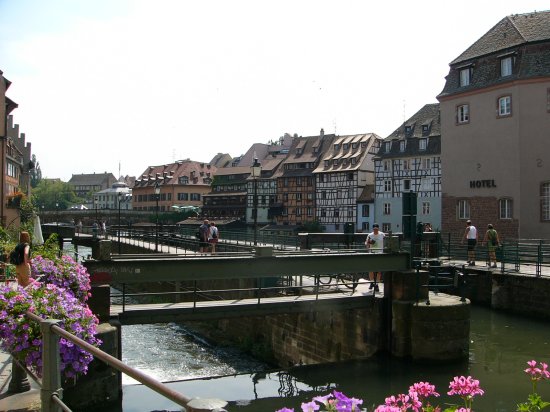
There are lilacs blooming everywhere, and wisteria. There are still some tulips. There are hydrangea. It is a riot of new life, color and growth. I am enjoying myself immensely. Very soon, it will be over and I will be back in Kuwait, packing boxes.
I will tell you more later, and even share some photos with you.
You are all so dear to me. I can’t tell you how much it hurts to move on. Usually, I cope by not thinking about it, just doing it. Somehow, in this situation, I don’t think that’s going to work very well.
Thank you for all your sweet thoughts. I haven’t decided if I will keep blogging; circumstances change . . . I will have to see if I even have anything to blog about!
An Interview with Chimamanda Ngozi Adichie
This interview is with a woman I admire very much, Chimamanda Ngozi Adichie, who has a new book out, a collection of stories, called The Thing Around Your Neck. Her most recent prior book, Half of a Yellow Sun, which tells of the three year struggle of the Igbo people to secede from Nigeria to create the independent nation of Biafra, and won the Orange Prize for Literature in 2007. The book is a total WOW.
Recent Comments
intlxpatr on Shampoo Ginger tigerbutterya0c5ff1d… on Shampoo Ginger intlxpatr on British Soldier Kidnapped, Esc… John on British Soldier Kidnapped, Esc… intlxpatr on British Soldier Kidnapped, Esc… Wikipedia Donate Button

Amazina


Early Voting in Florida


 Here There and Everywhere