Underwear Uproar in Saudi Arabia
There is an article today on BBC News (you can read the entire article by clicking here) on the underwear uproar in Saudi Arabia – that to buy underwear, women have to deal with male clerks. And more – there is nowhere to try on a bra to make sure you get the right fit! You have to pay, go to the public restroom, try it on and bring it back if it is not right.
One of the most amazing things to me, besides having only men selling underwear in Saudi Arabia, was the fact that the most amazing lingerie was in the most public windows. My favorite I-would-love-to-take-this-photo moments was watching abayed and niqabed women standing next to some of the tiniest, most sexy underwear you could imagine.
i know you think we are looser in the west, but you would laugh to know how restrained we really are. For the most part, we just don’t discuss underwear.
And have you noticed – in the United States, the mannekins don’t have nipples? I was shocked the first time I saw mannekins in Europe and the Middle East – the females had nipples! I had to look away! We are prudish in funny ways, in ways you can’t begin to imagine, and in ways we don’t even realize until we are confronted with our own what-we-think-is-normal.
I cannot imagine men in the ladies lingerie section. I buy all my underwear back in the US; I am too shy to buy underwear from a man! In Kuwait, they have females selling La Perla, very nice underwear, but most of the really good ready-made clothing in Kuwait is for size 00 – 2 girls – not for grown up women. It’s just easier buying my “unmentionables” discreetly on my trips back home. I carry a list. Most of us do. 😉
Here is the article:
Saudi lingerie trade in a twist
By Stephanie Hancock
BBC News, Jeddah
It would be bizarre in any country to find that its lingerie shops are staffed entirely by men.
But in Saudi Arabia – an ultra-conservative nation where unmarried men and women cannot even be alone in a room together if they are not related – it is strange in the extreme.
Women, forced to negotiate their most intimate of purchases with male strangers, call the situation appalling and are demanding the system be changed.
“The way that underwear is being sold in Saudi Arabia is simply not acceptable to any population living anywhere in the modern world,” says Reem Asaad, a finance lecturer at Dar al-Hikma Women’s College in Jeddah, who is leading a campaign to get women working in lingerie shops rather than men.
“This is a sensitive part of women’s bodies,” adds Ms Asaad. “You need to have some discussions regarding size, colour and attractive choices and you definitely don’t want to get into such a discussion with a stranger, let alone a male stranger. I mean this is something I wouldn’t even talk to my friends about.”
In theory, it should be easy enough to get women to staff lingerie shops, but parts of Saudi society are still very traditional and don’t like the idea of women working – even if it’s just to sell underwear to each other.
Rana Jad is a 20-year-old student at Dar al-Hikma Women’s College, and one of Reem Asaad’s pupils and campaign supporters.
“Girls don’t feel very comfortable when males are selling them lingerie, telling them what size they need, and saying ‘I think this is small on you, I think this is large on you’,” she says.
“He’s totally checking the girls out! It’s just not appropriate, especially here in our culture.”
Kuwait Attorneys Defend Constitution
From today’s Al Watan:
Attorneys defend the Constitution
A group of young attorneys gather in front of the Palace of Justice on Tuesday to declare a new movement to defend the Constitution and its values. Nearly 100 female and male lawyers took part in the gathering. (Al Watan)
Last updated on Wednesday 18/2/2009
That’s it. That’s all there is. This photo, and the above two-sentence article:
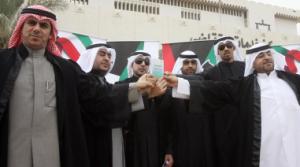
It feels significant, but the significance is opaque to me. Can someone give me an idea why this group formed, and against what encroachments are they are defending the Kuwait Constitution?
Don’t Trash My Kuwait
You know how ideas are . . . they some in flashes sometimes, and other times they trickle through a lot of material before appearing . . . you catch glimpses, and then one day the idea is complete.
Kuwaitis are proud people, and they love their country deeply.
That’s why I can’t understand how they can allow Kuwait to be so covered in trash and filth. I don’t understand why people just inches away from a trash can will toss a tissue on the ground. I don’t understand why there are plastic bags blowing around in the desert.
So here is a public service campaign idea. It puts Kuwaitis at the center. I would love to see a series of magazine ads, billboards, bus ads, etc. with real Kuwaitis who are making a difference, with the theme Don’t trash my Kuwait.
I know there is a new recycle group in Kuwait, who pick up recyclables – for free. I don’t know their name, but my heart was so happy when I heard about this group. Start with them, one photo, showing them holding things like plastic milk jugs and bags, newspapers, and give them a little free publicity, and get the campaign started. Their information is small print, big campaign slogan Don’t Trash My Kuwait.
Second photo, the volunteer group that goes underwater and rids the gulf of abandoned nets and trash, still in the water, holding the kinds of trash they collect, trying to rescue the Gulf: Don’t Trash My Kuwait.
Third photo, one of the volunteer beach clean-up groups with their bags and bags of litter: Don’t Trash My Kuwait.
Fourth photo – guy in traditional Kuwaiti dress with a falcon on his arm, trite, yes, but I still love it. I just don’t know how to tie it in to the campaign, LOL.
Fifth photo: 3baid, holding up handsfull of flyers, computer in the immediate background with PaperDump on the screen: Don’t Trash My Kuwait.
Don’t you just love it?
Your turn: additional photos/ groups / ideas for the Don’t Trash My Kuwait campaign.
Here’s how it started. At the top of an exit ramp the other day, we saw a man unbuckle his seatbelt, exit his car and place a bag in the trash receptacle. We clapped; he pumped his arms in the Rocky-esque victory signal. It was a glorious moment. I’d love to have more of them.
Yes, I’m an ex-pat, but I live here. Don’t Trash My Kuwait!
Cartoon from Kuwait Times

I am embarrassed to tell you, I don’t understand this cartoon. I can identify Obama. I can identify some terrorist. Who is represented by the guy in front of the terrorist?
When AdventureMan Retires
“When we retire,” AdventureMan begins as we are driving down the street, “I want a tree like that in our front yard.”
This isn’t the first time he has said such a thing.
You know, where you live there are rules, and sometimes those rules aren’t written down. If you violate the rules, people say mean things like “they must not be from around here.”
Like in my neighborhood, most of the houses have some grey in their color. It’s the Pacific Northwest. The sky is grey. Sometimes the sea is grey. People get used to grey, and they paint their houses grey, like blue-grey or brown-grey or green-grey, but always some kind of grey in the color. It’s just the way things are done.
Here, sometimes a house is painted very brightly, like egg yolk yellow, not a hint of grey. Bright bright orange, not a hint of grey. At first, it is shocking to the eye, but in six months, the color mellows with the bright sunlight, and fades to a soothing sand-yellow, or sand-orange.
This is what AdventureMan thinks would look great in our front yard:
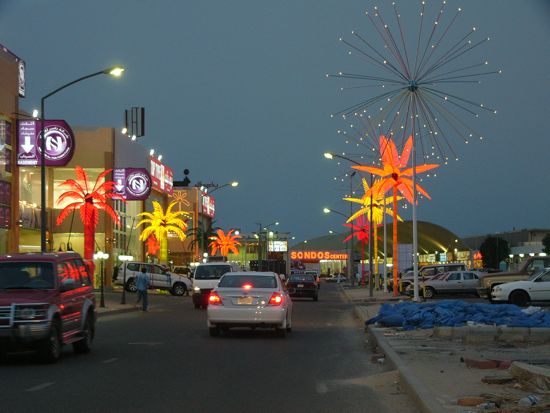
Or maybe he is just yanking on my chain? 😉
“Ban Valentine’s Day Celebrations”
(Yawn)
I hate it when I can’t find the entry all typed up for me in one of the local online versions of the newspaper; it means I have to type the whole thing in by myself. I guess all the newspapers felt this was to ho-hum to put on the online edition.
Live from the Kuwait Times:
Ban Valentine’s Day Celebrations
KUWAIT: MPs have spung to action earlier than usual. They have urged the government to ban any form of Valentine’s Day celebrations on February 14. Lawmakers have asked the MInister of Commerce and Industry to see it that Kuwaiti traditions and values are fully observed, reported Al Watan. Speaking in this regard, MP Mohammed Hayef al-Mutairi urged the Commerce minister, Ahmed Baqer to ban the import of merchandise related to celebrating the “heathen occasion” (allusion to Valentine’s Day). He also warned local companies against displaying any of these goods for sale.
“This is against Islam and misleads our youth” he said. MP Abdullatif Al Omairi said that celebrating this day was a ‘blind imitation of the West.’ It is something that does not belong to us, something that is completely alien to our society, morals and traditions,” he warned. He urged the government to interfere and preserve Muslim values. “There are only two Eids in Islam. We should not celebrate Christians’ festivities because they do not celebrate ours,” he said.
As if celebrating Valentine’s Day could be stopped! As if a loving husband doesn’t invite his wife to dinner, or as if a loving wife doesn’t fix something special for her husband just because, just because. As if you won’t buy chocolates for your sweetheart, or flowers, whether or not there is a Valentine’s Day (February 14th) advertisement in a window. As if you can forbid the joyful celebration of a relationship. It’s not about a Christian holiday; this stopped being a religious holiday long ago, if it ever was, this holiday is purely about the joy of living. Not unlike Liberation Day, or a national day, neither of which are Islamic, and both of which are joyfully celebrated.
When will these lawmakers (and I include the lawmakers in all nations) learn that when you forbid something, you only make it more attractive?
In my country, we have some very serious national issues to tackle. I prefer that my lawmakers focus on national issues and not issues-of-choice to private individuals. (AdventureMan already knows where he is taking me on Valentine’s Day. 🙂 See you there!)
Spoiling Dinner – Malcolm Thompson
An add-on for the Market Magic Challenge, unfortunately not in time for the poll, but a wonderful addition. Thank you, Malcolm Thompson, for helping us see Kuwait through your private lens:
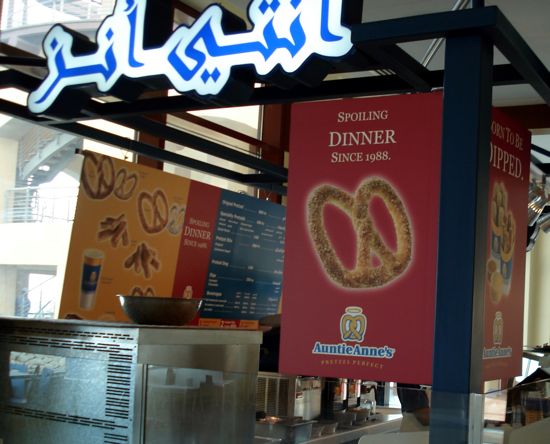
He adds that this was taken in a recent visit to the Al Kout/Manshar Mall Market area. Welcome, Malcolm!
Obama’s Inaugural Address (Complete)
The New York Times published a complete transcription of Obama’s Inaugural address. He wrote most of it himself. Did you notice, he delivered it without looking at his notes? You can watch him give the speech by clicking on the blue type above. It isn’t too long.
Barack Obama’s Inaugural Address
Published: January 20, 2009
Following is the transcript of President Barack Obama’s Inaugural Address, as transcribed by CQ Transcriptions:
PRESIDENT BARACK Thank you. Thank you.
CROWD: Obama! Obama! Obama! Obama!
My fellow citizens: I stand here today humbled by the task before us, grateful for the trust you have bestowed, mindful of the sacrifices borne by our ancestors.
I thank President Bush for his service to our nation…
(APPLAUSE)
… as well as the generosity and cooperation he has shown throughout this transition.
Forty-four Americans have now taken the presidential oath.
The words have been spoken during rising tides of prosperity and the still waters of peace. Yet, every so often the oath is taken amidst gathering clouds and raging storms. At these moments, America has carried on not simply because of the skill or vision of those in high office, but because We the People have remained faithful to the ideals of our forbearers, and true to our founding documents.
So it has been. So it must be with this generation of Americans.
That we are in the midst of crisis is now well understood. Our nation is at war against a far-reaching network of violence and hatred. Our economy is badly weakened, a consequence of greed and irresponsibility on the part of some but also our collective failure to make hard choices and prepare the nation for a new age.
Homes have been lost, jobs shed, businesses shuttered. Our health care is too costly, our schools fail too many, and each day brings further evidence that the ways we use energy strengthen our adversaries and threaten our planet.
These are the indicators of crisis, subject to data and statistics. Less measurable, but no less profound, is a sapping of confidence across our land; a nagging fear that America’s decline is inevitable, that the next generation must lower its sights.
Today I say to you that the challenges we face are real, they are serious and they are many. They will not be met easily or in a short span of time. But know this America: They will be met.
(APPLAUSE)
On this day, we gather because we have chosen hope over fear, unity of purpose over conflict and discord.
On this day, we come to proclaim an end to the petty grievances and false promises, the recriminations and worn-out dogmas that for far too long have strangled our politics.
We remain a young nation, but in the words of Scripture, the time has come to set aside childish things. The time has come to reaffirm our enduring spirit; to choose our better history; to carry forward that precious gift, that noble idea, passed on from generation to generation: the God-given promise that all are equal, all are free, and all deserve a chance to pursue their full measure of happiness.
(APPLAUSE)
In reaffirming the greatness of our nation, we understand that greatness is never a given. It must be earned. Our journey has never been one of shortcuts or settling for less.
It has not been the path for the faint-hearted, for those who prefer leisure over work, or seek only the pleasures of riches and fame.
Rather, it has been the risk-takers, the doers, the makers of things — some celebrated, but more often men and women obscure in their labor — who have carried us up the long, rugged path towards prosperity and freedom.
For us, they packed up their few worldly possessions and traveled across oceans in search of a new life. For us, they toiled in sweatshops and settled the West, endured the lash of the whip and plowed the hard earth.
For us, they fought and died in places Concord and Gettysburg; Normandy and Khe Sahn.
Time and again these men and women struggled and sacrificed and worked till their hands were raw so that we might live a better life. They saw America as bigger than the sum of our individual ambitions; greater than all the differences of birth or wealth or faction.
This is the journey we continue today. We remain the most prosperous, powerful nation on Earth. Our workers are no less productive than when this crisis began. Our minds are no less inventive, our goods and services no less needed than they were last week or last month or last year. Our capacity remains undiminished. But our time of standing pat, of protecting narrow interests and putting off unpleasant decisions — that time has surely passed.
Starting today, we must pick ourselves up, dust ourselves off, and begin again the work of remaking America.
(APPLAUSE)
For everywhere we look, there is work to be done.
The state of our economy calls for action: bold and swift. And we will act not only to create new jobs but to lay a new foundation for growth.
We will build the roads and bridges, the electric grids and digital lines that feed our commerce and bind us together.
We will restore science to its rightful place and wield technology’s wonders to raise health care’s quality…
(APPLAUSE)
… and lower its costs.
We will harness the sun and the winds and the soil to fuel our cars and run our factories. And we will transform our schools and colleges and universities to meet the demands of a new age.
All this we can do. All this we will do.
Now, there are some who question the scale of our ambitions, who suggest that our system cannot tolerate too many big plans. Their memories are short, for they have forgotten what this country has already done, what free men and women can achieve when imagination is joined to common purpose and necessity to courage.
What the cynics fail to understand is that the ground has shifted beneath them, that the stale political arguments that have consumed us for so long, no longer apply.
The question we ask today is not whether our government is too big or too small, but whether it works, whether it helps families find jobs at a decent wage, care they can afford, a retirement that is dignified.
Where the answer is yes, we intend to move forward. Where the answer is no, programs will end.
And those of us who manage the public’s dollars will be held to account, to spend wisely, reform bad habits, and do our business in the light of day, because only then can we restore the vital trust between a people and their government.
Nor is the question before us whether the market is a force for good or ill. Its power to generate wealth and expand freedom is unmatched.
But this crisis has reminded us that without a watchful eye, the market can spin out of control. The nation cannot prosper long when it favors only the prosperous.
The success of our economy has always depended not just on the size of our gross domestic product, but on the reach of our prosperity; on the ability to extend opportunity to every willing heart — not out of charity, but because it is the surest route to our common good.
(APPLAUSE)
As for our common defense, we reject as false the choice between our safety and our ideals.
Our founding fathers faced with perils that we can scarcely imagine, drafted a charter to assure the rule of law and the rights of man, a charter expanded by the blood of generations.
Those ideals still light the world, and we will not give them up for expedience’s sake.
And so, to all other peoples and governments who are watching today, from the grandest capitals to the small village where my father was born: know that America is a friend of each nation and every man, woman and child who seeks a future of peace and dignity, and we are ready to lead once more.
(APPLAUSE)
Recall that earlier generations faced down fascism and communism not just with missiles and tanks, but with the sturdy alliances and enduring convictions.
They understood that our power alone cannot protect us, nor does it entitle us to do as we please. Instead, they knew that our power grows through its prudent use. Our security emanates from the justness of our cause; the force of our example; the tempering qualities of humility and restraint.
We are the keepers of this legacy, guided by these principles once more, we can meet those new threats that demand even greater effort, even greater cooperation and understanding between nations. We’ll begin to responsibly leave Iraq to its people and forge a hard- earned peace in Afghanistan.
With old friends and former foes, we’ll work tirelessly to lessen the nuclear threat and roll back the specter of a warming planet.
We will not apologize for our way of life nor will we waver in its defense.
And for those who seek to advance their aims by inducing terror and slaughtering innocents, we say to you now that, “Our spirit is stronger and cannot be broken. You cannot outlast us, and we will defeat you.”
(APPLAUSE)
For we know that our patchwork heritage is a strength, not a weakness.
We are a nation of Christians and Muslims, Jews and Hindus, and nonbelievers. We are shaped by every language and culture, drawn from every end of this Earth.
And because we have tasted the bitter swill of civil war and segregation and emerged from that dark chapter stronger and more united, we cannot help but believe that the old hatreds shall someday pass; that the lines of tribe shall soon dissolve; that as the world grows smaller, our common humanity shall reveal itself; and that America must play its role in ushering in a new era of peace.
To the Muslim world, we seek a new way forward, based on mutual interest and mutual respect.
To those leaders around the globe who seek to sow conflict or blame their society’s ills on the West, know that your people will judge you on what you can build, not what you destroy.
To those…
(APPLAUSE)
To those who cling to power through corruption and deceit and the silencing of dissent, know that you are on the wrong side of history, but that we will extend a hand if you are willing to unclench your fist.
(APPLAUSE)
To the people of poor nations, we pledge to work alongside you to make your farms flourish and let clean waters flow; to nourish starved bodies and feed hungry minds.
And to those nations like ours that enjoy relative plenty, we say we can no longer afford indifference to the suffering outside our borders, nor can we consume the world’s resources without regard to effect. For the world has changed, and we must change with it.
As we consider the road that unfolds before us, we remember with humble gratitude those brave Americans who, at this very hour, patrol far-off deserts and distant mountains. They have something to tell us, just as the fallen heroes who lie in Arlington whisper through the ages.
We honor them not only because they are guardians of our liberty, but because they embody the spirit of service: a willingness to find meaning in something greater than themselves.
And yet, at this moment, a moment that will define a generation, it is precisely this spirit that must inhabit us all.
For as much as government can do and must do, it is ultimately the faith and determination of the American people upon which this nation relies.
It is the kindness to take in a stranger when the levees break; the selflessness of workers who would rather cut their hours than see a friend lose their job which sees us through our darkest hours.
It is the firefighter’s courage to storm a stairway filled with smoke, but also a parent’s willingness to nurture a child, that finally decides our fate.
Our challenges may be new, the instruments with which we meet them may be new, but those values upon which our success depends, honesty and hard work, courage and fair play, tolerance and curiosity, loyalty and patriotism — these things are old.
These things are true. They have been the quiet force of progress throughout our history.
What is demanded then is a return to these truths. What is required of us now is a new era of responsibility — a recognition, on the part of every American, that we have duties to ourselves, our nation and the world, duties that we do not grudgingly accept but rather seize gladly, firm in the knowledge that there is nothing so satisfying to the spirit, so defining of our character than giving our all to a difficult task.
This is the price and the promise of citizenship.
This is the source of our confidence: the knowledge that God calls on us to shape an uncertain destiny.
This is the meaning of our liberty and our creed, why men and women and children of every race and every faith can join in celebration across this magnificent mall. And why a man whose father less than 60 years ago might not have been served at a local restaurant can now stand before you to take a most sacred oath.
(APPLAUSE)
So let us mark this day in remembrance of who we are and how far we have traveled.
In the year of America’s birth, in the coldest of months, a small band of patriots huddled by nine campfires on the shores of an icy river.
The capital was abandoned. The enemy was advancing. The snow was stained with blood.
At a moment when the outcome of our revolution was most in doubt, the father of our nation ordered these words be read to the people:
“Let it be told to the future world that in the depth of winter, when nothing but hope and virtue could survive, that the city and the country, alarmed at one common danger, came forth to meet it.”
America, in the face of our common dangers, in this winter of our hardship, let us remember these timeless words; with hope and virtue, let us brave once more the icy currents, and endure what storms may come; let it be said by our children’s children that when we were tested we refused to let this journey end, that we did not turn back nor did we falter; and with eyes fixed on the horizon and God’s grace upon us, we carried forth that great gift of freedom and delivered it safely to future generations.
Thank you. God bless you.
(APPLAUSE)
And God bless the United States of America.
(APPLAUSE)
Chinese Astrological Calculations
I’ve never really been sure what my Chinese birth year was. For a long time I thought I was one thing, then another long time I thought I was another, and it turns out it is more complicated than I thought. I am between a solar year and a lunar month – or was it a lunar year and a solar month?
Here is my picture:

I am like a white metal chicken.
Way more complicated than I knew!
If you would like to find out who you are according to Chinese astrology, there is a wonderful website where you enter your birthdate and they can tell you what you are – and who you should be friends with and who you should marry.
You can click on Chinese Fortune Calendar and find out all about yourself.
“Mister, Take Picture!”
My friend, Q8Dutchie asked if we were truly allowed to take photos in the souks, and I answered “Carefully.” I added that if you are photographing a person, to ask, and especially if it is a woman. There is usually no problem photographing vegetables, fruits, hardware. clothing, food, etc. If I have any doubt, I ask, and if they say “no,” I don’t photograph.
Yousef, from Some Contrast answered slightly differently, saying most of the people working in the souks are not Kuwaiti, and most don’t mind a photo.
Actually, we often have the experience that when people in the souks see my camera, they say “Mister! Mister! Take photo!” (yes, they call me mister sometimes, mostly madame, but sometimes they get confused.)
Here are some recent examples:


Have fun, Q8Dutchie!
Recent Comments
intlxpatr on Shampoo Ginger tigerbutterya0c5ff1d… on Shampoo Ginger intlxpatr on British Soldier Kidnapped, Esc… John on British Soldier Kidnapped, Esc… intlxpatr on British Soldier Kidnapped, Esc… Wikipedia Donate Button

Amazina


Early Voting in Florida


 Here There and Everywhere