Several years ago, I ordered a book recommended by Amazon. I do that from time to time, and I will tell you honestly, some of them are real stinkers.
This book, Bruno, Chief of Police, by Martin Walker, was delightful. So delightful I started looking for more of the series, some of which I was able to find used. So delightful, I shared the Bruno, Chief of Police with my husband, and he, too, was hooked.
If there is a genre I like, it is detective novels set in foreign locations, dealing with crimes that have to do with social issues current in the locale. The first I can remember is the Eliot Pattison series about Inspector Shan, a Chinese detective who falls on the wrong side of Chinese political correctness and ends up in a Tibetan jail, where he begins a series long association with Tibetan monks and the threat to Tibetan civilization that the Chinese pose. It is eye-opening reading.
The next series I discovered were the Barbara Nadel series set in Turkey with Inspector Cetin Ikhmen. Then the fabulous and prolific Donna Leon and Commisario Guido Brunette, set in Venice.
And actually, I don’t read all this books in sequence. I watch for books by these authors, and read them when they come out, not unlike my addiction to James Lee Burke and Dave Robicheaux, set in New Iberia, Louisiana and Montana.
That was a very long introduction to the idea that it makes travel in foreign lands much more user-friendly to have read books that put you on the ground, seeing what the people who live there might see. When we went to Venice, we went off the beaten track to eat at a restaurant that Commissario Brunetti recommends to a touring couple who witnessed a crime and made a report to him. It was a great adventure just finding this restaurant, Rossa Rosa (“Guido Brunetti Sent Us”) and it had delicious local food, no tourists. In Venice. Imagine. Now, too, when we read the newest Brunetti novel, or watch the German production of the Brunetti series, we feel a closer connection with Venice, a familiarity, because we have a “friend” on the inside. Or so we feel.
Bruno Correze, the Chief of Police in the fictional French village of St. Denise, along the Vezere river close to where it links with the Dordogne, loves his small town. In the very first volume, we meet his friends, we visit his home, we are with him when he prepares meals and entertains his friends (he uses a lot of duck fat) and we get to visit the markets and cafes with him. Every book, like the best of this genre, introduces us to at least one issue, social and/or criminal, past or present, which is manifesting itself as a problem in the Dordogne. The actual crime may or may not be the point of the novel, and the solutions are often very French.
We have devoured this series. We felt like we had been there. So we decided we needed to go there.
We visited the Dordogne – it seems like a short time ago – the last time, 35 years ago, when our son, now grown, was around 9. We made a special effort to make this a trip which was relevant to him, too. We visited Castelnaud, and spent hours with the trebuchets and mangonels, old weapons once the ne-plus-ultra of fighting off the enemy. We visited the old caves with early paintings, when they were still open to visitors.
We love France, we love traveling in France and we have never had a negative experience in France. While I once spoke French fluently – we lived in French speaking Tunisia – but language skills get rusty when they don’t get exercised. Oh, really, any excuse will do. Martin Walker’s books made us hungry, hungry for French foods and hungry just to be in France.
We booked a cruise out of Bordeaux, eight days of cruising on the Gironde, Dordogne and other rivers, visiting villages older than our entire nation, learning about major appellations, eating some fine food and drinking some very fine wine.
And then we picked up a rental car in Bordeaux and headed to the Dordogne. I’m going to tell you all about it, but first I want to share Martin Walker’s books with you. He, and Bruno, have a wonderful website where he tells you all his favorite places. As we read the Bruno books, we also take notes – which wine he chose to serve with the duck course, where he and his friends gathered for the wedding feast, etc. It was like having a friend who says “Oh, I am desolate I won’t be there, but here are all the places you need to go, restaurants you will like and oh, be sure to try this wine!” Hotel and restaurant recommendations are on the website under “Bruno’s Perigord”
Martin Walker’s Bruno, Chief of Police website
Here are the Bruno, Chief of Police books, in order, from a resource called How to Read Me, which puts the books in order. http://www.howtoread.me/bruno-chief-of-police-books-in-order/
1 Bruno, Chief of Police – Meet Benoît Courrèges, aka Bruno, a policeman in a small village in the South of France who has embraced the pleasures and slow rhythms of country life. But then the murder of an elderly North African who fought in the French army changes all that. Now, Bruno is paired with a young policewoman from Paris and the two suspect anti-immigrant militants. As they learn more about the dead man’s past, Bruno’s suspicions turn toward a more complex motive.
2 The Dark Vineyard – When a bevy of winemakers descend on Saint-Denis, competing for its land and spurring resentment among the villagers, the idyllic town finds itself the center of an intense drama. Events grow ever darker, culminating in two suspicious deaths, and Bruno finds that the problems of the present are never far from those of the past.
3 Black Diamond – Something dangerous is afoot in St. Denis. In the space of a few weeks, the normally sleepy village sees attacks on Vietnamese vendors, arson at a local Asian restaurant, subpar truffles from China smuggled into outgoing shipments at a nearby market—all of it threatening the Dordogne’s truffle trade and all of it spelling trouble for Benoît “Bruno” Courrèges, master chef, devoted oenophile, and, most important, beloved chief of police.
4 The Crowded Grave – It’s spring in the idyllic village of St. Denis, and for Chief of Police Bruno Courrèges that means lamb stews, bottles of his beloved Pomerol, morning walks with his hound, Gigi, and a new string of regional crimes and international capers. When a local archaeological team searching for Neanderthal remains turns up a corpse with a watch on its wrist and a bullet in its head, it’s up to Bruno to solve the case.
5 The Devil’s Cave – It’s spring in St. Denis. The village choir is preparing for its Easter concert, the wildflowers are blooming, and among the lazy whorls of the river a dead woman is found floating in a boat. This means another case for Bruno, the town’s cherished chief of police.
6 Bruno and the Carol Singers (short story) – Bruno is occupied with his Christmastime duties. From organizing carolers to playing Father Christmas for the local schoolchildren, Bruno has his hands full . . . at least until some funds raised for charity go missing.
7 The Resistance Man – First, there’s the evidence that a veteran of the French Resistance is connected to a notorious train robbery; then, the burglary of a former British spymaster’s estate; and, finally, the murder of an antiques dealer whose lover is conveniently on the lam. As Bruno investigates, it becomes clear that they are connected.
8 The Children Return (also known as Children of War) – Bruno’s village of St. Denis has been called many things, but a hotbed of international intrigue has never been one of them . . . until now. When an undercover agent is found murdered just as a prodigal son is set to retun from a grim tour in the Middle East, the small town suddenly finds itself host to a determined global tribunal, threatening the usual cheer brought by St. Denis’s annual wine festival.
9 A Market Tale (short story) – As summer blooms, the newest talk of the town is the rapport between Kati, a Swiss tourist, and Marcel, a popular stall owner whom Kati meets over his choice strawberries. None are happier than police chief Bruno to see Marcel interested in love again, but as his friend’s romance deepens, Bruno senses trouble in the form of Marcel’s meddlesome sister Nadette.
10 The Patriarch (also known as The Dying Season) – Bruno Courrèges is thrilled when he receives an invitation to the lavish birthday celebration of his childhood hero, World War II flying ace Marco “the Patriarch” Desaix. But when the party ends in the death of one of Marco’s longtime friends, Gilbert, it turns into another day on the job for St. Denis’s chief of police.
11 Fatal Pursuit – It’s the start of summer, and Bruno’s found himself the last-minute replacement navigator in a car rally race. The event has attracted a spate of outsiders with deep pockets, big egos and, in the case of one young Englishman, an intriguing story about a lost Bugatti Type 57C. When a local scholar turns up dead, Bruno suspects unnatural causes.
12 The Templars’ Last Secret – When a woman’s body is found at the foot of a cliff near the idyllic French town of St. Denis, chief of police Bruno Courrèges suspects a connection to the great ruin that stands above: a long-ago Knights Templar stronghold. With the help of Amélie, a young newcomer to the Dordogne, Bruno learns that the dead woman was an archaeologist searching for a religious artifact of incredible importance.
13 A Taste for Vengeance – When a British tourist fails to turn up for a luxurious cooking vacation in the idyllic village in the south of France that Bruno Courrèges calls home, the chief of police is quickly on the case. Monika Felder is nowhere to be found, and her husband, a retired British general, is unreachable.
14 The Chocolate War (short story) – Police chief Bruno enjoys wandering the stalls of the weekly market in the village of St. Denis as they are being loaded with wares. But when Bruno’s old friend Léopold from Senegal start selling African coffee and chocolate more cheaply than Bruno’s old friend Fauquet at his café across the square, a competition erupts between the vendors.
15 The Body in the Castle Well – When Claudia, a young American, turns up dead in the courtyard of an ancient castle in Bruno’s jurisdiction, her death is assumed to be an accident related to opioid use. But her doctor persuades Bruno that things may not be so simple. Thus begins an investigation that leads Bruno to Monsieur de Bourdeille, the scholar with whom the girl had been studying, and then through that man’s past.
How to read me: Bruno, Chief of Police
http://www.howtoread.me/bruno-chief-of-police-books-in-order/
I owe a big thanks to Martin Walker for giving us so much inside information which enhanced our trip so much. I will try to remember to give him credit along the way as I take you along with us on our trip.
December 15, 2019
Posted by intlxpatr |
Adventure, Blogging, Books, Crime, Cross Cultural, Cultural, Fiction, Food, France, Quality of Life Issues, Road Trips, Travel, Tunisia | Aquitaine, Bordeaux, Bruno Chief of Police, Dordogne, Martin Walker, Vezere |
Leave a comment

Sometimes I tease my husband about going on and on about a series he watches. He watches a lot of programs and movies via the internet. I tend to read books. I mentor a class requiring a lot of reading, and I run a book club. OK. I’m “bookish.” I always have been. I own it.
He went on and on about A French Village, until he had to skip Season 3 because he couldn’t access it, and went on to Season 4 and had problems understanding what was going on because significant events had happened in Season 3.
As I was trying to find a way to work around it, or find the most economical way to watch it – for him – I started watching the first episode. AdventureMan joined me. The beginning is full of events, it moves fast and – did I mention it is entirely in French with English subtitles?
I speak French. Well, I used to be fluent, now I am slow, and have forgotten a lot of little grammatical details. I can still speak, I can still understand, when people will speak more slowly. A French Village was so French it took my ear a long time to regain all that I have lost; I had an idea what they were saying but was not really tracking with accuracy. I needed the subtitles.
The first year, the first episode starts off with a normal day in the village; the population knows the Germans are miles away, approaching Villenueve, a fictional village in the Jura, close to the Swiss border. No one seems very concerned until all of a sudden, the Germans are there, in the village, and all hell breaks lose. We meet our main characters, Dr. Larcher (who becomes, by default, the village mayor) and his wife, Hortense, Lucienne, a school teacher, Raymond Swartz, his wife, Jeannine, and his lover, Marie, and several more characters.
People are herded into the church, where Dr. Larcher tends to the wounded under chaotic conditions, and during which he also agrees, without enthusiasm, to become mayor and to try to create some way to protect the people of the village from the demands of the Germans.
It is confusing – a lot like it would be in real life. At the beginning, it is a struggle to figure out who all the people are, but . . . you have seasons and seasons and episodes and episodes to figure it all out.
We started watching on Amazon Prime, for seasons 1 – 4, then subscribe to Mhz ($7.99/mo) for season 5 and six, but for season 7, we had to pay Amazon Prime $14.99 for these final episodes. Mhz was a good find for us; it has several foreign mystery and dramatic series – and movies – and is right up our alley. The Amazon payment was annoying, but we figured was the cost of lunch for one person, not such a large sum for seven episodes.
There are SEVEN seasons of A French Village. The first five years have 12 one hour episodes each. Seasons 6 and 7 are shorter, and deal with tying up loose ends.
What we love about this series (as well as the sheer French-ness of it all) is that the characters are allowed to be textured and layered. No one is all good, or all bad. They make mistakes. They have human failings and weaknesses. They have some moments of heroic goodness. They are very real people. Well, maybe very real French people; there are a lot of complicated love interests throughout the series, some of which are inexplicable and to me improbable, but I just shrug my shoulders and say “It’s a French production,” and guess that their ways are not our ways.
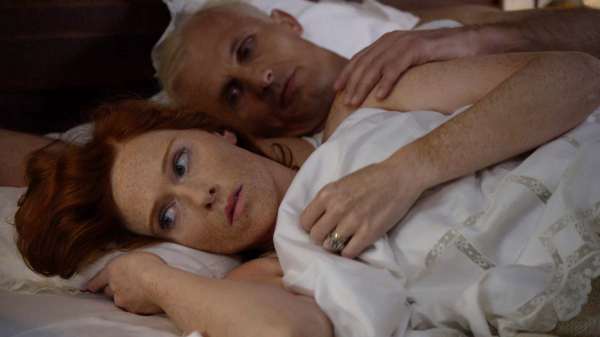
It’s a quick education to the experience of WWII, The German blitz of France, of Belgium, of the Netherlands, Poland, and the dread among German officers of serving on the eastern front. It’s horrifying to watch the passive response among the French to the round-up and eviction of the Jews (read a little of our own history before you go getting all judge-y), the petty competition for foods in the black market, the role of “renunciation” and anonymous letters accusing friends and neighbors of dark deeds, and the endless bickering which went into the cooperative operations for the French resistance.

Who collaborates? Almost everyone at one point or another; the consequences of standing on your principles are often fatal.
It is a little uncomfortable seeing Americans through the eyes of the French. They are not so impressed with our efforts in North Africa, they are not so happy to have Americans in their town. One episode of rape in Villeneuve involves American soldiers and a French girl.
We cannot wait for evening, when we can watch two or three or four episodes. We are slowing down a little in Season Seven, not wanting to series to end. It has been a wonderful excursion into a whole new and different world. At the end of which, I am understanding the French-spoken-at-normal-speed much more easily, and even spotting a small flaw or two in the translations.
There are two episodes I love. One involves a parade on November 11th. The other involves the execution of two Villeneuve inhabitants, one an unscrupulous and despicable mayor and the other a heroic leader of the Resistance. I know, I know, you’ll have to watch it yourselves to see what I mean.
October 10, 2019
Posted by intlxpatr |
Community, Counter-terrorism, Cross Cultural, Entertainment, France, Interconnected, Social Issues, Survival | A French Village, collaboration, French resistance, German occupation, Jewish pogrom, Jura, Villenueve, WWII |
13 Comments
 I had a group in town this last week, a group I loved, and the head of the GCCDC did a fabulous itinerary for them, matching their needs for information with the best resources available in Pensacola. I am proud to say that Pensacola did herself proud taking care of these visitors, giving them meetings with people who understand their particular needs and facing similar challenges. The focus of this group was governance and fiscal responsibility; I always love these subjects and learn a lot with every visit I facilitate.
The group was friendly, and made friends everywhere they went. They were superb ambassadors for their country.
I thought the group coffee was going particularly well; important topics were being discussed openly. Then one of our local participants asked one of my favorite questions:
“What about your visit to our country has surprised you the most?”
There were several answers about the kindness of the people, the beauty of the area, and then one very experienced and thoughtful delegate said “Please, tell me, how do we cope with the ignorance of the American citizen?”
By this, he was referring to the fact that although his country and our country have long been close allies, most Americans have no clue where the country is on the map, much less the serious issues and challenges which have faced this country for decades. A few might know the name of their leader.
It’s not as if we don’t have resources. We can Google anything. We can find enormous amounts of information of world geography and events. We don’t. Our schools teach a very limited amount of world geography, world history, world civilization, with little emphasis on any importance of understanding how our nation intersects with others.
His question echoes in my mind.
I once thought as more Americans lived overseas, as they travelled, as a nation our policies would broaden, become more sophisticated, more global, more oriented to the greater good.
While there are many people still working toward the goal of the greater good, I am feeling like moving forward has mostly halted; that the concept of “the greater good” has lost its compelling motivation to the reversion to a narrow focus on national interest.
I fear for the lack of international studies and understanding of global geography being taught our children, that the ignorance of today might be compounded in the citizens of tomorrow.
April 14, 2019
Posted by intlxpatr |
Counter-terrorism, Cross Cultural, Cultural, Geography / Maps, Gulf Coast Citizen Diplomacy Council, Interconnected, Jordan, Pensacola, Political Issues, Relationships, Stranger in a Strange Land |
Leave a comment
My husband used to travel in and out of Doha for years before we actually moved there. He would tell me stories about “sleepy little Doha,” before-natural gas Doha, in a country that was not the richest country in the world. The international community then was so small that they would gather at the American Ambassador’s residence on Fridays for drinks and a cook-out, casually exchanging information and gossip on a lazy afternoon. This was also pre 9-11, when the need for mind-numbing security was not so imperative.

I received the above photo in the mail today, and I laughed out loud and showed AdventureMan. We were there when the Sheraton Hotel was “way out there” in the middle of no-where. A new mall with a Carrefour had opened near the Sheraton and was visible from the dhow parking in mid-Doha.
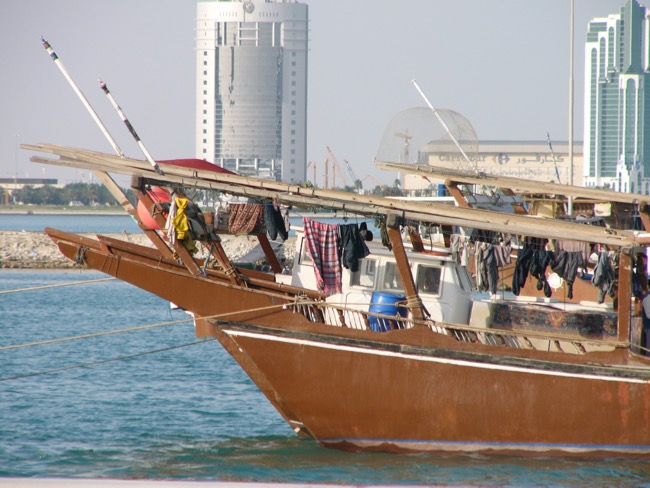
Look just above the dhows, to the left of the white building with green windows and you will see a flat building and Carrefour on it.

The pyramid on the right is the Sheraton, once the hottest hotel in Doha. To the left, you can see the white building with the green windows, which almost disappears now. I want you to notice how relatively bare the skyline is, and this is 2005.

These two buildings used to be the tallest on the Corniche.

You can see them in the lower right of this photo, dwarfed by all the new sky-scrapers. At the far left, you can see one of my very favorites, a (formerly) tall building with a mosque built jutting out in the middle. You can barely see it now; it used to be one of the most prominent buildings on the Corniche.

This is what the building looks like when not surrounded by giants.

This is what it looks like now, almost indistinguishable from the buildings surrounding and overwhelming it.
I used to meet a friend every Tuesday morning and walk the Corniche. We watched the buildings going up, tributes to the huge amounts of cash pouring into the Doha economy and the huge egos that need to build huge towers to put their names on. As they were being built, there were constant fires, mostly electrical, which challenged the fire department and killed the low-paid laborers. American firms seeking office space brought in experts to inspect buildings before renting them, to be sure modern, safe construction practices had been used. Most of the new high rises had been built with severe deficits, unsafe concrete, unsafe wiring, failure to allow people to evacuate safely in case of an emergency and elevators that barely worked even when brand new.
We particularly laughed at the giant phallic silver building front and center.
The extreme heat and humidity of Doha is hard on even good construction, drying out sealants on the windows (allowing dust and water to penetrate), peeling facades, making buildings a mere twenty years old look dingy and severely weathered. One relatively new building had windows popping out in its first five years.
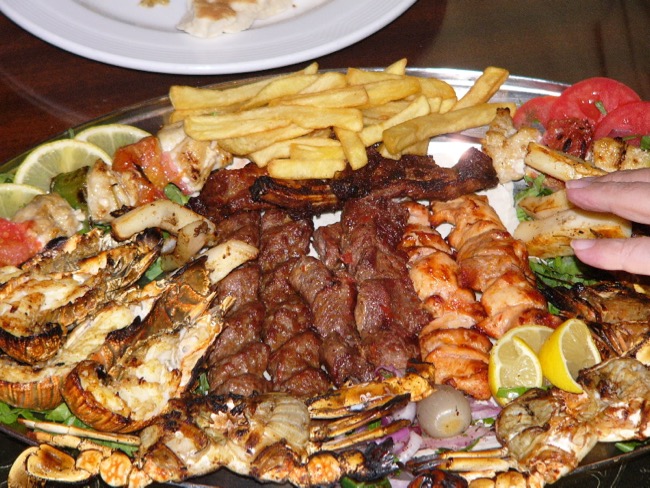
On a hot night AdventureMan and I would have dinner downtown, often at The Majlis, and then go out to the Corniche and board one of the dhows decorated with strings of Christmas lights for a cooling ride along the coastline, where the breezes would blow and Sleepy Little Doha would sparkle.
September 23, 2018
Posted by intlxpatr |
Adventure, Building, Cross Cultural, Doha, ExPat Life, Living Conditions, Qatar |
1 Comment
I lived through the 70’s and the ’80’s and as I have watched the young of our generation grow to maturity, I have had hope for a different kind of world. I believed I saw it coming, a new way of thinking, where women had equality, where all people had respect regardless of skin shade. I suspected it would be slow, but the dinosaurs my age and older would die off, leaving the more enlightened young people in charge.
When Obama was elected, I danced for joy. I saw it as a sign – a man of color elected President of the United States! To me, he embodied what our nation was established to attain. Freedom. Liberty. Justice for ALL. Equal opportunity.
This morning, AdventureMan and I were talking; as I was leaving his office I tweaked his photos by mere centimeters. They had shifted and were just a little crooked.
“I hope you don’t mind,” I said (and I had already done it.)
(Barely perceptible pause, but a pause none the less) “Oh no, my dear.”
We both broke out laughing. Sometimes people who have been married for a long time lie to each other in such a way, to be polite, not to rock the boat, but at the same time letting the other person know exactly how you feel about something.
That barely imperceptible pause had meaning. Nothing was something.
When you are a teen-age girl, there are a lot of things you tell yourself when trying to figure out what to do.
“Really, nothing happened . . . .”
“I wasn’t supposed to be at that party”
Maybe I shouldn’t have worn that bathing-suit. Maybe it was my fault”
“I know Mom and Dad would back me, but they would also be really pissed.”
“Do I want to be known as ‘that girl?'”
Maybe you talk to your friends. Most girls won’t talk to their parents, unless it is really severe and you can’t hide it.
I now – I worked with rape victims for two years at a Rape Crisis line. We listened. We offered information. We listened. We offered to go with them if they wanted to tell someone, like the police. We educated – police, hospital workers, first responders, parents. We listened. We went to court with the victims who chose to file charges. We listened.
The bravest woman I ever met was in Doha. I had agreed to meet with her when her mother told me she had been assaulted. She had been offered a ride home, the guy was the big brother of a school friend, driving her and her sister home. Instead, he and his friend drove deep into the desert, forced the girl out of the car and told her to co-operate and they would leave her little sister alone.
She negotiated. She wouldn’t do all that they tried to force her to do. Then they took her home.
She talked to a couple friends, who told her she needed to tell her parents because it had happened before, and could happen again. The young girls were like prey to these guys.
She went to the police, she named names. They were arrested, and when she saw them in the line-up, she told the police she needed for them to take off their clothes so she could tell for sure that it was them. She knew it was them. She also knew that they were from a good family and that nothing serious was going to happen to them no matter what the charges, but she wanted a moment where she could humiliate them in some small way for the way she had been abused and mistreated.
It was one of those unequal power moments, but she used what little power she had.
“I wanted to get this on the record,” she told me, “I wanted to make sure that when they go to get married, that their names will be on the record, and if not, people in Doha have long memories. Who will want to marry their daughters to these men?”
She was 16.
Her family suffered. Her father was heart-broken that he had brought his family to Doha and that he had, as he saw it, failed to protect his daughter. The family left Doha soon thereafter.
I still honor that girl, her courage, her wisdom, her dry-eyed willingness to speak out.
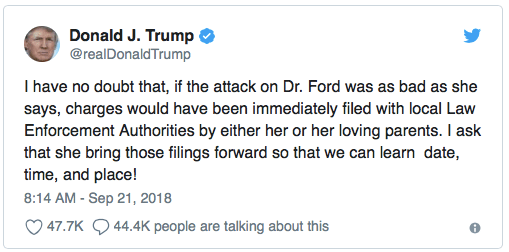
And I believe Dr. Ford. I believe she kept it to herself, maybe sharing a little with close friends. She was terrified and she was 15. She carried it for a long time. For most rape victims, like my 16 year old friend, the sexual violation pales in comparison to the violation of personal boundaries and the fear that you may not survive. You are in shock. You often blame yourself. You want to move on, and you don’t want to be known as “that girl that got raped.” She was younger than Kavanaugh, less powerful, a teen-ager.
President Trump, you are just an ignorant oaf. You think you are something, but you are nothing. It’s not like women are assaulted and men aren’t. A thousand Catholic boys can tell you differently, and they feel the same shame as female victims feel. I hope everyone in America reads your ignorant, hateful, smarmy tweet and see the horror in having you as a President.
September 21, 2018
Posted by intlxpatr |
Character, Civility, Cross Cultural, Doha, ExPat Life, Family Issues, Generational, Interconnected, Leadership, Mating Behavior, Privacy, Quality of Life Issues, Rants, Relationships, Survival, Values, Women's Issues | Brett Kavanaugh, Christine Blasey Ford, Sexual assault |
Leave a comment
Welcome! Grab a flute, come on in and mingle.

Who knew, when I held my breath and posted my first post in September of 2006, that I would still be blogging – with the same blog (!) – twelve years later.

I miss my life. It’s hard to remember that it wasn’t perfect, and it wasn’t. When I started blogging in Kuwait, I was once again going up against the steep learning curve of starting over in a new place, discovering where to buy groceries (milk and dairy at the local Co-op, fresh vegetables at a huge vegetable market to the south of Fintas, western staples – a luxury – at the Sultan Center. I bought what I needed, most of the time, but occasionally, a price would be so shockingly out of line that I couldn’t bring myself to do it – like a package of chocolate chip cookies that you just cut and bake for something like $15 when I could make them from scratch by myself. But I digress.

Blogging was new and fresh, and I loved reading the thoughts of other bloggers. I learned so much, and I learned to think differently. Their thoughts were not my thoughts, and I got a very clear view of my own cultural blinders.

I also met some wonderful Kuwaitis. It was a world I loved, a world of ideas and discussions. It was fun. I quickly felt at home in Kuwait; I felt I was gaining perspective from many minds, and it helped me form a more complex picture. I laugh to think it will never be a complete picture; you know how even people you’ve known for a long time can surprise you?

AventureMan told me today I had surprised him. He was talking about how good we are at doing our homework for trips, and how we “roll with the punches.” In my very direct way, I said “No we don’t! We gripe with the punches.”

First I got a stunned silence, then the guffaw of laughter, and then we were both laughing. I love it that I can still catch him by surprise.


So welcome to the celebration of 12 years sharing lives, sharing ideas, sharing our common humanity. This year, in addition to the beautiful cakes I have so much fun enjoying in virtual world, I have added cupcakes, in honor of a five year old granddaughter who has a great eye.


Please stay as long as you’d like . . .

September 5, 2018
Posted by intlxpatr |
Adventure, Arts & Handicrafts, Blogging, Civility, Community, Cross Cultural, ExPat Life, Interconnected, Kuwait, Pensacola, Shopping |
10 Comments
I always like to see where my visitors are coming from. Lately, I’ve had a surge in visitors from Hong Kong/ SAR / China.
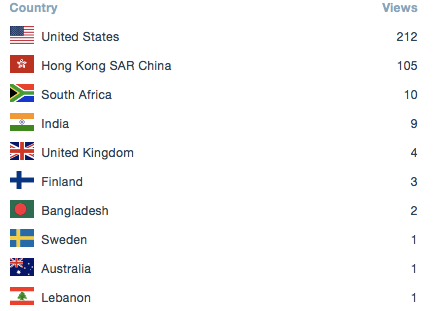
Usually, most of my visitors are from the USA, Canada and Kuwait. If you are Chinese, Hong Kong Chinese or SAR, could you give me a clue as to what has drawn your attention to this blog? I’m just curious.
September 5, 2018
Posted by intlxpatr |
Blogging, Cross Cultural, Uncategorized |
Leave a comment
The Psalm from today’s Lectionary readings:
140 Eripe me, Domine
1 Deliver me, O Lord, from evildoers; *
protect me from the violent,
2 Who devise evil in their hearts *
and stir up strife all day long.
3 They have sharpened their tongues like a serpent; *
adder’s poison is under their lips.
4 Keep me, O Lord, from the hands of the wicked; *
protect me from the violent,
who are determined to trip me up.
5 The proud have hidden a snare for me
and stretched out a net of cords; *
they have set traps for me along the path.
6 I have said to the Lord, “You are my God; *
listen, O Lord, to my supplication.
7 O Lord God, the strength of my salvation, *
you have covered my head in the day of battle.
8 Do not grant the desires of the wicked, O Lord, *
nor let their evil plans prosper.
9 Let not those who surround me lift up their heads; *
let the evil of their lips overwhelm them.
10 Let hot burning coals fall upon them; *
let them be cast into the mire, never to rise up again.”
11 A slanderer shall not be established on the earth, *
and evil shall hunt down the lawless.
12 I know that the Lord will maintain the cause of the poor *
and render justice to the needy.
13 Surely, the righteous will give thanks to your Name, *
and the upright shall continue in your sight.
Yesterday, several news sources discussed the rapid growth of the American Civil Liberties Union; this one is from Politicus USA:
Thanks to the election of Donald Trump as President of the United States, the American Civil Liberties Union (ACLU) has more than quadrupled its membership, according to an article in The New York Times.
Before Trump’s election the group had just 400,000 members and most of its actions were out of the public eye. But now, after 15 months of the Trump presidency, the membership is over 1.8 million and it has become one of the most active and visible opponents of Trump’s agenda.
Donations to the nonprofit group have also increased exponentially. The ACLU’s executive director, Anthony Romero, said that the organization has raised over $120 million since the 2016 presidential election. Before that watershed election, he said, donations had been in the range of just $3 million to $5 million annually.
Romero said that concerns over Trump’s attack on constitutional rights and civil liberties have brought a whole new generation of political activists into their group. “Until Trump most of our support came from people who have been with us since we challenged Nixon,” Romero told the Times. “Now we’re kind of cool. Cool’s not a word generally associated with us.”
The surge in membership, coupled with the massive increase in contributions, has for the first time given the ACLU all the resources it needs to fight Trump and other administration officials in court and elsewhere. They have been involved in more than 100 legal actions against Trump administration policies, including the White House’sseries of travel bans on the citizens of several Muslim-majority nations, which happened shortly after he took office.
More recently, the group has been challenging the Justice Department’s family separation policies, Trump’s voter fraud commission and the president’s reversal of an Obama-era contraception mandate.
According to Romero, his group has over 170 times taken what he calls “Trump-related legal actions” since he became president. This number includes the filing of 83 lawsuits, Romero said.
As the Trump administration steps up its attacks on refugees and asylum seekers, the ACLU has been filing class action lawsuits and also seeking injunctions to attempt to make the government stop separating families and incarcerating children. In some cases they have already been successful, and they are continuing to fight for the legal rights of people who may have been illegally detained and deprived of due process.
The large increase in ACLU membership is a good sign for American democracy. It shows that many Americans not only disapprove of Donald Trump’s policies and actions but are willing to support the fight against them. Ultimately this may be what saves our country from becoming a dictatorship and what preserves and protects the Constitution of the United States of America.
I’m one of those people. I used to think the ACLU was extreme, that was until I saw them first to man the tables offering free legal advice to incoming passengers the night Trump implemented his first travel ban. I sent my first check. I was asked why I had joined, and I told them because they are now our front line against thugs with no moral values, oppressors of the poor, led by a heartless, selfish, man who must be reined in. They sent me a sweet little ACLU pin, which I don’t dare wear in Pensacola.
July 6, 2018
Posted by intlxpatr |
Bureaucracy, Character, Civility, Crime, Cross Cultural, Cultural, Faith, Free Speech, Leadership, Lectionary Readings, Lies, Political Issues, Values | ACLU, American Civil Liberties Union |
Leave a comment
On Sunday, the organist played “America the Beautiful” in a minor key. It reflected what many of us are experiencing. We love our country. We hate what we are seeing.
An excerpt from an article from the Washington Post about declining democracies in the world, this part focused on the USA, land that I love:
Democracy declined precipitously in the United States
The United States fell 24 places in the country ranking on liberal democracy over the past two years, from seventh in 2015 to 31st in 2017. When we compare the United States’ score in 2017 with its average score over the past 10 years, the drop is precipitous and unprecedented.
 Liberal democracy in the United States: changes from the 10-year average.
Experts lowered their estimates of democracy in the United States because they began to be skeptical that the U.S. Congress will rein in executive overreach. Similarly, experts lost faith that the opposition party can contribute to overseeing, investigating or otherwise checking the majority party. The U.S. executive branch was assessed as showing less respect for the Constitution and compliance with the judiciary, two indicators that the judicial branch can restrain the executive.
For all four indicators, the score for the United States declined. The downward trend in the United States is much worse than in other countries. In terms of government compliance with decisions of the Supreme Court, the United States used to rank among the top countries of the world — but has now declined to No. 48.
I remember living in Kuwait, self-censoring my blog entries so I wouldn’t be expelled from the country, even blogging under a pseudonym. I think of the ICE officer who resigned, and was visited by law enforcement as he gave an interview to national news explaining why he (and others) were quitting ICE, disgusted and disheartened by the un-American practices they were being forced to engage in to export “illegals.” Yes, we still have freedom of speech, but we also look over our shoulders, now, never sure what new low will strike next.
July 5, 2018
Posted by intlxpatr |
Bureaucracy, Character, Civility, Cross Cultural, Cultural, Interconnected, Law and Order, Leadership, Living Conditions, Political Issues, Privacy, Quality of Life Issues, Social Issues, Values, Women's Issues, Work Related Issues | Democracy in decline |
Leave a comment
Ramadan for Non-Muslims, through the years on Here There and Everywhere
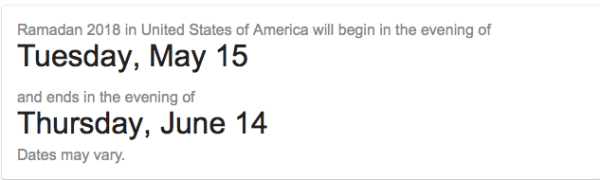
Checking my stats, I can see a sudden upswing on Friday, the day off in almost all Moslem countries. I haven’t posted in the last couple days, but it seems to me, it is just about time to be thinking about Ramadan starting.
When I was still living in the Middle East, I would write an annual entry explaining Ramadan to my non-Muslim readers. Even better, my Moslem friends and readers would add comments, correcting anything I had gotten wrong and adding more.
Bottom line – while for non-Muslims, it is easy to perceive the month-long fast as impossible deprivation, to the Moslems, it is a month of loving celebration, visiting with family, fabulous meals at the end of a long day of fasting, and an opportunity to devote one’s thought to God/Allah/Yahweh and to serve him in the holy tradition of fasting. Many times, overseas, I had Moslems serve me food during Ramadan; I would beg them not to, but they would tell me there was joy in serving food to others and not partaking themselves; they did it as an act of worship, a sacrifice. I could see their joy in their eyes and their visible pleasure in serving.
The traditional words of greeting to a Moslem during Ramadan are “Ramadan Mubarak” and “Ramadan Kareem.” The first is a wish that Ramadan be a blessing to the worshipper, the second a wish that Ramadan be generous, supply all the needs, spiritual and otherwise.
Ramadan Mubarak, my friends, and Ramadan Kareem.
May 5, 2018
Posted by intlxpatr |
Civility, Community, Cross Cultural, ExPat Life, Faith, Ramadan |
Leave a comment


 Here There and Everywhere