Indian Drivers the Worst
When it came time to get a driver’s license, it wasn’t important to me. I was living in a place with great public transportation. When I finally decided to learn to drive, I took driving lessons. My best friend, still my friend to this very day, would take me out driving. One time my car stalled in the middle of a crowded intersection, the light changed, and I was almost out of my mind with panic.
My friend calmly said “You’re doing just fine. Take a breath. You have time. Start the car, and complete the turn.” She didn’t sound worried at all – only later did I discover how terrified she was. She held it together. I will owe her to the end of my life for her loyalty to me and for her patience with me.
This is from the Arab Times. My mistake – I thought Kuwait was the deadliest spot on earth to drive. Not so – the Indians take that cake:
Good luck needed as Indians drive themselves to death
MUMBAI, Oct 23, 2008 (AFP) – The Good Luck Motor Training School in Mumbai is aptly named, according to its owner, Sohail ‘Raja’ Kappadia, who says luck is exactly what you need to drive on India’s roads.
Kappadia knows it only too well: a friend recently became another of the country’s shocking fatal road accident statistics, while one of his pupils has just rammed into the back of another car during a lesson.
‘Sometimes you just don’t know if the guy in front is going to brake,’ he told AFP with a shrug. ‘Presence of mind is a must here. Most of the accidents in Mumbai are due to rash negligence.’
India has the dubious distinction of being the deadliest place in the world to drive.
The country has 10 percent of the estimated 1.2 million road deaths worldwide, according to the International Road Federation in Geneva.
Mortality rates on Indian roads are 14 per 10,000 vehicles, compared to less than two per 10,000 in developed countries, the World Bank has said.
And by the end of the next decade, the organisation predicted that road deaths will overtake those from deadly diseases and most of the fatalities will be pedestrians.
It is not difficult to see why.
Drivers here run the gauntlet of speeding taxis, weaving auto-rickshaws, trucks and buses as well as hand-carts and cows on congested, pot-holed roads, some of which have remained largely unchanged since the end of the colonial era more than 60 years ago.
At the same time they have to be on their guard against stray dogs and jaywalking pedestrians, forced into the road by the clutter of street vendors, crumbling pavements or crossings.
Meanwhile laws governing the wearing of seatbelts and a ban on using mobile phones at the wheel are frequently flouted, indicators are seldom used and at night drivers often fail to switch on their headlights.
Motorcyclists riding without helmets with pillion passengers perched behind are a common sight.
For a learner driver, Shahik Arqam looks unfazed by such experiences.
‘It’s a little bit difficult but I know how other drivers work,’ the 24-year-old architect said.
During an hour-long lesson in a battered right-hand drive Hyundai Santro, Arqam has had to be alert.
Other drivers made no allowance for the red L-plates and warning triangle displayed prominently on the car.
Instead he was treated like any other road user and blasted by a chorus of car horns for driving too slowly, failing to pull away quickly enough from traffic lights or for stalling.
Filtering vehicles from the left failed to give way as he headed down the main road to Churchgate railway station, and he had to hold his nerve as cars swerved in and out of lanes in the tussle for pole position.
Mohsin Ali, an instructor for 12 years, takes Mumbai’s chaotic roads in his stride, gently issuing either verbal instructions or hand signals to his pupil as the car picked its way through the heavy mid-afternoon traffic.
‘If you follow the traffic rules then it’s very easy,’ the 39-year-old said afterwards. ‘Compared to Calcutta (Kolkata) and Madras (Chennai) the traffic is better here.’
To be sure, the Mumbai authorities have been trying to make the roads safer.
Roadsigns reminding drivers to belt up, only use the horn when necessary — rather than in constant cacophony, as encouraged by the ‘horn please’ request painted on the rear of many vehicles — and not use their mobile phones have appeared across the city.
Signs also remind motorcyclists to wear helmets and there has been a crackdown on drink-driving.
Some 632 people died in what the Indian media calls road traffic ‘mishaps’ in Mumbai in 2007, but by the end of August that had fallen to 377, according to police figures.
Kappadia agrees that better driver training is a must if safety is to be improved on India’s roads, particularly as private car ownership increases on the back of the country’s strong economic growth.
The 33-year-old said he would ban heavy goods vehicles from cities during the day, toughen sentences for drink-drivers, improve road infrastructure and spread the message that speed kills, especially among the young.
Some welcome measures have been taken, such as raising entry standards and lowering age limits for truck drivers, but more needs to be done, he said.
In the meantime, the Indian driving mantra of ‘good brakes, good horn, good luck’ will have to do.
Kuwait Activists Reject MPs” Hijab Ruling
Activists reject MPs” hijab ruling
”Wearing of veil is not prerequisite for ministerial post”
KUWIAT: Political activists have expressed their great disappointment at the Parliament”s Legislative Committee”s decision which stated that the positions held by Minister of Education and Minister of Higher Education Nouriya AlـSubaih and Minister of State for Housing Affairs and Minister of State for Development Affairs Moudi AlـHomoud as female ministers were unconstitutional.
In a symposium entitled “Who protects personal freedom,” eminent activist Najla AlـNaqi said that the committee should have paid attention to more serious issues rather than focusing on marginal issues such as wearing the veil. She urged the committee to reconsider its decision.
Sheikha Dr. Maymouna AlـSabah made the Constitution a point of departure for her argument, stating that it did not distinguish between genders when it came to the qualification of a voter and never mentioned any preference of one over the other. She demanded for the appointment of more female ministers since it is the only way for them to reach the Parliament.
Historian Ghanima AlـFahaid outlined the role of Kuwaiti women and their contribution to society in different fields including defending the State from invaders. She reminded the audience of the brilliant work of both ministers and that they tirelessly endeavor to serve the community in every possible way.
Kuwait University lecturer Dr. Layla AlـSabaan regarded the decisions as regrettable at a time when women should be encouraged and commended for their work. She stressed that the Kuwaiti society believes in equal opportunities for all regardless of gender and that personal freedom should be respected as long as it doesn”t jeopardize the culture and traditions of the society.
Journalists Society consultant Dr. Ayed AlـManna discussed the legality of female ministers, highlighting that gender equality in a country like Kuwait is extremely important. He added that Kuwait is a liberal society in many ways, pointing out that the Constitution does not specifically say that women must wear veils as a perquisite to taking up their ministerial posts.
Meanwhile, political activist Najat AlـHashshash questioned the nature and background of the decision asking if this ruling applied to all female staff working in the Parliament or ministers only.
Last updated on Friday 24/10/2008
Operation Hope Needs Shoes, Blankets and Men’s Clothing
Thanks for getting the word out! Seems we’ll be getting the shoe drive going as of November 1st with AUK as our drop point. Bazaar will be featuring an article with the details in their November issue so to plug in I encourage you to pick up a copy of the magazine.
Blankets & trousers are also high on the “need” list. Serious donors should email us on operationhopekuwait@yahoo.com for details on where to drop your new or gently used items.
Blessings,
Sheryll Mairza
OPERATION HOPE – KUWAIT
Founder & Director
“Where You From?”
AdventureMan calls, full of chat, wanting to tell me what he is seeing at the airport. Normally, it’s a good time for a chat, but today, I’m having none of it.
“I just called the police again.” I told him.
(I can hear him thinking “Oh oh.”)
First I dialed the neighborhood police number, and nobody answered – again.
We have accidents in front of our house all the time. Sometimes I can see everyone with their phones out and I don’t call. This time, I called. No answer. I dialed 777. Thank God, they have WOMEN who answer, women who speak a little English, and I speak a little Arabic, and together we figure things out. They are smart, they are competent and they are sweetly polite, not officiously bureaucratic.
I tell her about the accident, tell her the neighborhood.
Two minutes later, my phone rings. He doesn’t speak English.
“Bolice?” I ask.
“Bolice” he affirms, and says my neighborhood.
I start telling him, in Arabic, the block, the street and the cross street. See? I’ve gotten so smart!
“Where you from?” he asks in amazement, and I can hear him grinning.
“I’m from (the neighborhood)” I answer.
He leaves the phone, and he is yelling and everyone is laughing in the background. Someone else comes.
“Where you from?” he asks. He just wants to hear me talk.
I tell him – in Arabic – the block, the street and tell him “CAR CRASH! TOO MUCH TRAFFIC. NEED BOLICE!” He is laughing. He calls someone else.
This guy speaks English.
“Car crash?” he asks.
“Yes!” I respond, glad to be on topic.
“Why you call me?” he asks.
(I didn’t call him. I called 777 {the emergency number here.} They called me!)
“Car crash.” I repeat. “Too many cars” (I say this in Arabic) Need BOLICE!”
He is laughing.
“Where you from?” he asks.
I say I am from the neighborhood.
“You in car?” he asks.
“No, I see from my house.”
“Come to station.” he says.
“No, BOLICE COME HERE!” I say, and tell him again the street, block and cross street – in Arabic.
He laughs and hangs up.
Forty five minutes later, traffic is still snarled up, no one is managing traffic, there are any number of near accidents as a result, and it is just a mess. No BOLICE.
For my non-Kuwaiti readers, the law in Kuwait is that when there is an accident, you cannot move your cars, not even out of the way, until the police have come. Until they come, everything stays as it is except for an ambulance can come and take away someone who is hurt.
Rejected Suitor Rapes Kuwaiti Woman
Al Watan staff
KUWAIT: A young Kuwaiti woman has filed a case against a man who raped her after she rejected his marriage proposal. The woman explained that the young man who asked to marry her had been found out to be a liar. Among other things, he lied about his nationality, claiming to be Kuwaiti when he was not. He also claimed to have huge sums of money when in fact he was not as well off as he initially claimed. After being rejected, the man reportedly waited outside her house and kidnapped her as she walked towards her car. He then drove her to a remote area and raped her.
What incredible courage this young woman has going public. What backing she must have from her family. This is, unfortunately, not a rare occurance. What on earth are these men thinking? Is he trying to ruin her chances of marrying anyone else? Is this rape a punishment?
Bone Mountain by Eliot Pattison
Several times I started Bone Mountain and couldn’t get into it. I love Pattison’s books – they are mysteries, but his mysteries are more about the process of solving the puzzle than it is about the solution. The process is indirect – we travel around Tibet with Shan Tao Yun, Chinese, but who crossed the bureaucracy in his investigation of corruption and ended up exiled in a Tibetan prison camp (Water Touching Stone) where, under the very worst circumstances, he finds a new way of looking at life, as he gets to know and respect the Tibetan monks in prison for their beliefs.

This time, when I started the book, it was as if I had never picked it up before. I picked it up and couldn’t put it down. I kept finding passages I wanted to share – with you, with my other friends – this is an amazing book.
Shan and a a couple monks are on a mission to return a Tibetan relic to the valley from which the Chinese stole it, and are traveling with a group of sheep herders and salt gatherers to disguise themselves. The artifact gets stolen from them, but they continue on to the valley, discovering a hidden passage through the mountains, visiting a destroyed and partially rebuilt monastery, and learning about healing herbs and practices in Tibet, as we see medical practices in a whole new way.
One of the themes in each book has to do with the Chinese bureaucracy, harvesting Tibetan resources relentlessly, timber, minerals, etc. with no regard to the devastation their techniques leave behind, no regard for replenishment.
The other issue is the Chinese hijacking of the Bhuddist religion. The Chinese “re-educate” the monks, bringing Bhuddist thought into alignment with Chinese government goals. The new monasteries are no longer teaching true Bhuddist teachings, but are teaching corrupted and even heretical teachings. The true monks are roaming the country disguised as sheep herders, dung carriers, but are the true carriers of the teachings to the people. The bureaucracy grinds their teeth in frustration as the true monks continually slip through their fingers.
“Has this foreigner been gathering salt too?” he asked Lhandro in Tibetan.
“Just along to enjoy the fresh air,” Winslow quipped in Tibetan, and the monk stared at him, his eyes wide with wonder.
“An American who speaks Tibetan?” he exclaimed, and looked back with intense curiousity, at Lhandro and Shan, as though the news somehow changed his perspective on the party.
As you can imagine, I laughed out loud when I read that passage. We get that all the time, when my husband speaks Arabic and I can follow the conversation. We call it “the dog can talk!” look.
Avoiders. It was part of their particular gulag language, stemming from a teaching given in their barracks by an old monk, in his twenty fifth year of imprisonment, just before he died. Guns were avoiders, he said, and bombs and tanks and cannons. They allowed the users to avoid talking with their enemy, and allowed them to think they were right just because they had more powerful technology for killing. But those who could not speak with their enemies would always lose in the end, because eventually they lost not only the ability to talk with their enemy, but also with their inner deity. And losing the inner deity was the greatest sin of all, for without an inner deity, a man was an empty shell, nothing but a lower life-form.
Pattison hikes us through mountains and valleys, shows us medicinal plants, and talks about how it matters where and when and how they are mixed. We learn of the evil that exists in the best of us, and the good that exists in the worst of us. On our journey to solve a mystery, we gain a wealth of new understanding.
Available from Amazon.com for $10.17 plus shipping. (Yep, I disclose once again, I own stock in Amazon.com. 🙂 )
All Female Ministers Must Cover Hair, or Female Ministers are Unconstitutional? Or?
I am pretty good at reading the news, but all this is a little too Byzantine, even for me. This is from today’s Al Watan. I think it says that females who do not cover their hair can still be ministers, in spite of some members of parliament saying that females who do not cover their hair are not allowed to be ministers. You read it and tell me what YOU think it says.
Maybe some of the Ministers of Parliament lack so much self contol that they fear the sight of the hair of Nouriya AlـSubaih and/or Moudhi AlـHumoud will impede their performance?
There is an Islamic dress code? Like if you do not wear an abaya and niqab, or hijab, you cannot be Moslem?
Panel brands female ministers” appointment ”unconstitutional”
Court freezes MPs” suspension from Parliament
Al Watan staff
KUWAIT: Parliament”s Committee for Legislative and Legal Affairs, during its meeting on Sunday, signed off on a report stating that the appointment of female Cabinet ministers Nouriya AlـSubaih and Moudhi AlـHumoud is unconstitutional. The decision is said to stem from the fact that both women do not conform to the Islamic dress code because they refuse to cover their hair.
The committee”s convener, Ali AlـHajeri, announced that the report has been unanimously endorsed by the committee”s members, which include, among others, MPs Nasser AlـDuwailah, Mohammed AlـHatlani and Mohammed Hayef, and that it is backed up by Article 82 of the Constitution and Article 1 of the Elections Law that stipulates that women should adhere to the Islamic dress code.
On the eve of the inauguration of the new parliamentary term on Tuesday, the National Assembly is expected to grapple with a wide range of burning issues, including a decision by the Constitutional Court to strip two former MPs of their parliamentary seats.
Sources have reported that there has been a bizarre twist concerning this particular issue with Speaker of Parliament Jassem AlـKharafi announcing that he has received a letter from the Administrative Court informing him about a decision to suspend the Constitutional Court”s verdict that revoked the membership of Mubarak AlـWalaan and Abdullah AlـAjmi. He also revealed that the Administrative Court is due to look into the case today.
AlـKharafi affirmed that he will take measures in accordance with the ruling issued by the Administrative Court.
A constitutional expert affirmed that the newly reinstated MPs should be allowed to take their seats in Parliament unless the Administrative Court issues another verdict ruling in favor of the lawmakers whose membership was revoked.
Reacting to this new development, MP Askar AlـEnezi affirmed that verdicts issued by the Constitutional Court are final and unchallengeable.
He argued that the Administrative Court has no jurisdiction to look into constitutional matters.
Last updated on Monday 20/10/2008
Update 21 October
Female minister reacts to panel decision
Comply with Islamic attire or resign, urges MP
Al Watan staff
KUWAIT: The Chairman of Parliament”s Legislative and Legal Committee Nasser AlـDuwailah has described comments made on Monday by the Minister of Housing and Minister of State for Housing Affairs Moudhi AlـHumoud as “unacceptable”, after she attacked a decision by the committee that considers the appointment of the two female Cabinet ministers as unconstitutional because they do not follow the Islamic dress code.
“The minister”s remarks are irresponsible and unacceptable,” he firmly said, while calling on the minister to tender her resignation immediately.
Noting that the committee has thoroughly looked at the legal aspects of the female ministers” appointment, he pointed out that the members have concluded that the duo have failed to comply with regulations regarding the Islamic dress code that is deemed acceptable inside the Abdullah Salem Chamber (Parliament).
He explained that the ministers are free to wear to whatever they want outside the Parliament, noting that the law which gave women their full political rights stipulates that female candidates or appointees comply with certain set regulations.
Insisting that the law was passed by Parliament rather than the committee, he explained that the committee”s response is consistent with the spirit of the Constitution.
He concluded by expressing hope that the government will express regret over the minister”s remarks.
Last updated on Tuesday 21/10/2008
Sweet October Morning
Goooooood Morning, Kuwait!
It is a sweet morning, a beautiful morning. You can see almost all the way to the horizon, and the lethal layer that hangs over it is somehow thinner this morning:

One of my favorite places, Weather Underground: Kuwait tells us we have five more days below 100°F coming up and here is what it looks like this morning:

The house still smells of cinnamon and clove and Mom’s Fruit Cakes which I spent all day yesterday chopping, pitting, baking, and wrapping in the crisp Kuwait Autumn weather. 😉 I fell into bed last night around eight, and slept almost straight through until 0600 this morning, an exhausted Qatteri Cat snuggled up between AdventureMan and me. No, no, we don’t eat the fruitcakes yet. You make them around the end of October and you store them, heavily wrapped, in the refrigerator until Thanksgiving (4th Thursday in November) when you are allowed to taste the first one. They mellow as they age in the refrigerator.
In other countries, not Kuwait, you wrap them in cheesecloth soaked in brandy, and you can open them now and then and brush on a little more brandy with a pastry brush. Sigh. I am not much for drinking, but I miss the smell of the brandy soaking into the fruitcakes.
Mangaf, Paradise Garden and Beit Ash-Shar
Last week, AdventureMan and I were out looking for the private farm in Mangaf / Abu Halifa that blogger Bu Yousef wrote about. Imagine – fresh produce, locally produced. It is unbelievable that it exists in a burgeoning house-to-house suburb like Mangaf. Once Bu Yousef wrote about it, we couldn’t wait to find it and try it for ourselves. We LOVE local, and I am waiting for Yasmine Farms spinach to re-appear in the Sultan Center.
It is an OASIS!
AdventureMan said “it looks like Paradise!”
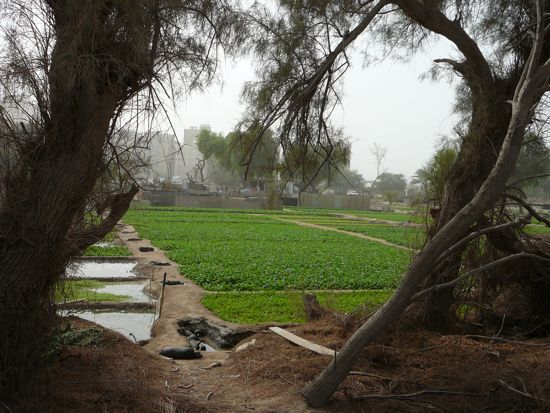
We got a little lost trying to find it – thank God! As we were driving around, looking for this farm/garden we spotted this:
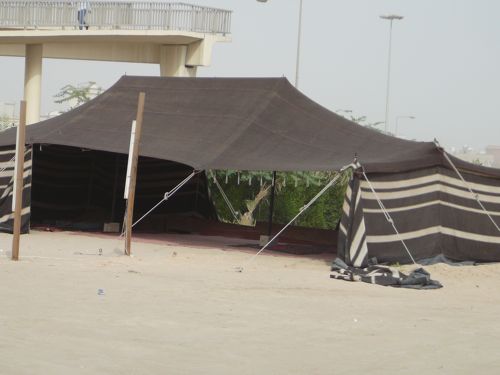
In Jordan, these were called Beit (Beyt) ash-Shar, House of Hair. The panels of the tent were woven on small looms by the Bedouin women – the looms were made of sticks that could easily be assembled and disassembled. They had herds of sheep and goats, and the tent panels were woven of hair from their own sheep and goats. In Jordan, the nomads lived in these tents, picking up and moving as it was time to pasture their sheep and goats in the next place.
I can’t tell you how much this thrilled our hearts. Someone is using this tent – we believe – as an outdoor diwaniyya.

It’s a great day in Kuwait.
Hearts, Hands and Hope
Opportunities for you from Operation Hope – Kuwait:
Thank You all baking volunteers:
We at Operation HOPE want to express our thanks to all our baking volunteers for their beautifully packed and labeled donations. We appreciate your extra effort and work of excellence to support our mission. And a special thanks to Jaye Lynn and Emily Lester for manning the sales table!
Thank You all Tent clearance and inventory volunteers:
What a blessing when men, women and children, who represent multiple nations can come together for the good of mankind. Many hands did make for lighter work. As our tent was cleared, inventoried and then restocked. We are able to do what we do because of you.
Volunteers needed:
We are happy to announce our very first packing schedule for winter apparel for this year on Saturday October 18, 2008 from 7am to 10:30 am. At this time our goal is to pack 3000 bags each, with a set of thermal underclothing, pair of socks, pair of gloves and cap. Lend your help packing a few bags or all 3000 bags; but DO lend us your help. Please RSVP your commitment ASAP.
Flea market Saturday October 25, 2008:
Operation HOPE will have a Flea market at the OH head quarters (Rumaithiya, Block 9, Street 92, House 23) at 7am to 12 noon. We will be selling books, small appliances, electronics, gently used household items etc. All proceeds of the sale go to Operation Hope. We encourage you to spread the word around and bring in at least one friend with you.
Volunteers needed: to set up the items for the flea market, Friday, October 24, 2008 at 3 PM. Please RSVP your commitment to help as soon as possible.
Volunteers needed: to help at the Flea Market with sales and clean-up, Saturday, October 25th from 6:30 AM – 12:30 PM. Your RSVP is appreciated as soon as possible.
Laptop Needed:
The Operation HOPE administration has grown considerably and we require a mobile tool to keep on top of our busyness. We appreciate your consideration towards the contribution of a NEW laptop.
Recent Comments
ExpatAlien on What Country am I Living … intlxpatr on Yellowstone: Old Faithful to C… Michelle on Yellowstone: Old Faithful to C… Cathy on No Grown-Ups in Charge intlxpatr on Waiting for Snow Wikipedia Donate Button

Amazina


Early Voting in Florida


 Here There and Everywhere