Kuwait Textile Arts Show
The Kuwait Textile Arts show has been postponed, because of the mourning period, and will not be opening tonight at the Dar Al Cid, but will open Monday night. It will run from Monday through Wednesday at the Dar al Cid.
Many many women in Kuwait learned Sadu weaving this year, and you will be astonished and amazed to see the results of their efforts at the show, along with embroidery, hand crafted bags, and a large number of gorgeous quilts.
The Dar al Cid is located in Jabriya, near the New English school, the Tarek Rajab Museum, and on the same street as the Tarek Rajab Museum of Islamic Calligraphy.
How We See Things in Kuwait
AdventureMan and I have an ongoing discussion over the cell phone ban while driving in Kuwait. I see people pulled over to the side of the road, at traffic circles, along the major north/south routes, pulled over in complicated neighborhoods. I love to see them – many are using their hands to help understand the directions, waving left, then straight, then left again – it warms my heart.
AdventureMan, on the other hand, he who loves the efficiency of being able to do two things at the same time, drive and do business or talk to me, says he sees people all the time using their cell phones while they are driving.
So I think we are seeing what we want to see.
He kids me, as I track diwaniyyas, where they used to be, those still being dismantled. Friends are telling me that they can now see around dangerous corners where someone had built an illegal little cabin for their driver to sleep in, trees and foliage have been cut back, neighborhoods have a new look. I find it exciting – obeying the law can be tough, it can be inconvenient, and the temptation in all of us is to say “it’s a great law for them, but it doesn’t apply to me.”
AdventureMan scowls when he has to obey a law that he doesn’t think should apply to him. I say scowling is OK, as long as you do it. There are times I am tempted to skirt the law, but this blog keeps me honest – how does it look if I’m always talking about law and order, and then I choose to break the law, too? Having a child keeps you honest – when you face temptation, you know those little eyes are watching you, and it gives you that little extra boost to make the right choice.
Pearls mentioned she thinks people are sticking closer to the speed limits with the new fines in force, and that the roads are much more enjoyable these days. I agree, with one exception, and that is when traffic slows on the major north/south roads, there are still those idiots who use the emergency lanes to get to the front of the line. We need some BIG fines for those guys.
Last but not least, my Co-op seems to be enforcing the no parking in the handicapped section once again, thanks be to God. The poor manager, I keep going in and telling him that “big strong men” should not be using those spots. He keeps thinking I want the spot and I laugh and say no, I am a strong woman and I can walk, but what about the heavily pregnant woman with her five children, or the old man with his walker or cane, or the one with emphysema.
Finally, I suggested that he have grocery packers assigned to watch, and to run out and insist on assisting anyone who parks there, a special service for the handicapped. Sometimes you can accomplish with kindness what you can’t hope to accomplish with signs and harsh words. Whatever he has chosen to do, it appears to be working, people are not parking in the handicapped spots. 🙂
Expats Run More Red Lights
This is from today’s Kuwait Times.
KUWAIT: The Interior Ministry defended a new policy of deporting expatriates who run red lights by arguing that “the highest percentage of traffic violations are committed by expats, adding that this constitutes a hazard on the lives of motorists,” reported Al-Jarida.
The ministry in a statement said it had the legal right according to the Foreigners Residency law to deport expats for such offenses. And added that the ministry used this right as it is its administrative right according to the law. (sic)
I am blown away that they can say this with a straight face.
Abandoned Baby
This is for my friend, Mrm, or Mirim the Mirim, a blogger friend with a fiendish eye for the sublime and the ridiculous. She hasn’t blogged for a while and I am concerned about her absence. I am hoping this photo, dedicated to her, will lure her back into the blogging world.
Actually, AdventureMan spotted the baby sitting on a garbage bin, but it was I who whipped the camera out and shot a photo.
Who would abandon this beautiful baby?

Who Will Tell the People?
This was the #5 e-mailed article from this week’s New York Times. It is a hard-hitting warning to Americans in an election year, and it has some analogies to election time in Kuwait.
By THOMAS L. FRIEDMAN
Published: May 4, 2008
Traveling the country these past five months while writing a book, I’ve had my own opportunity to take the pulse, far from the campaign crowds. My own totally unscientific polling has left me feeling that if there is one overwhelming hunger in our country today it’s this: People want to do nation-building. They really do. But they want to do nation-building in America.
They are not only tired of nation-building in Iraq and in Afghanistan, with so little to show for it. They sense something deeper — that we’re just not that strong anymore. We’re borrowing money to shore up our banks from city-states called Dubai and Singapore. Our generals regularly tell us that Iran is subverting our efforts in Iraq, but they do nothing about it because we have no leverage — as long as our forces are pinned down in Baghdad and our economy is pinned to Middle East oil.
Our president’s latest energy initiative was to go to Saudi Arabia and beg King Abdullah to give us a little relief on gasoline prices. I guess there was some justice in that. When you, the president, after 9/11, tell the country to go shopping instead of buckling down to break our addiction to oil, it ends with you, the president, shopping the world for discount gasoline.
We are not as powerful as we used to be because over the past three decades, the Asian values of our parents’ generation — work hard, study, save, invest, live within your means — have given way to subprime values: “You can have the American dream — a house — with no money down and no payments for two years.”
That’s why Donald Rumsfeld’s infamous defense of why he did not originally send more troops to Iraq is the mantra of our times: “You go to war with the army you have.” Hey, you march into the future with the country you have — not the one that you need, not the one you want, not the best you could have.
A few weeks ago, my wife and I flew from New York’s Kennedy Airport to Singapore. In J.F.K.’s waiting lounge we could barely find a place to sit. Eighteen hours later, we landed at Singapore’s ultramodern airport, with free Internet portals and children’s play zones throughout. We felt, as we have before, like we had just flown from the Flintstones to the Jetsons. If all Americans could compare Berlin’s luxurious central train station today with the grimy, decrepit Penn Station in New York City, they would swear we were the ones who lost World War II.
How could this be? We are a great power. How could we be borrowing money from Singapore? Maybe it’s because Singapore is investing billions of dollars, from its own savings, into infrastructure and scientific research to attract the world’s best talent — including Americans.
And us? Harvard’s president, Drew Faust, just told a Senate hearing that cutbacks in government research funds were resulting in “downsized labs, layoffs of post docs, slipping morale and more conservative science that shies away from the big research questions.” Today, she added, “China, India, Singapore … have adopted biomedical research and the building of biotechnology clusters as national goals. Suddenly, those who train in America have significant options elsewhere.”
Much nonsense has been written about how Hillary Clinton is “toughening up” Barack Obama so he’ll be tough enough to withstand Republican attacks. Sorry, we don’t need a president who is tough enough to withstand the lies of his opponents. We need a president who is tough enough to tell the truth to the American people. Any one of the candidates can answer the Red Phone at 3 a.m. in the White House bedroom. I’m voting for the one who can talk straight to the American people on national TV — at 8 p.m. — from the White House East Room.
Who will tell the people? We are not who we think we are. We are living on borrowed time and borrowed dimes. We still have all the potential for greatness, but only if we get back to work on our country.
I don’t know if Barack Obama can lead that, but the notion that the idealism he has inspired in so many young people doesn’t matter is dead wrong. “Of course, hope alone is not enough,” says Tim Shriver, chairman of Special Olympics, “but it’s not trivial. It’s not trivial to inspire people to want to get up and do something with someone else.”
It is especially not trivial now, because millions of Americans are dying to be enlisted — enlisted to fix education, enlisted to research renewable energy, enlisted to repair our infrastructure, enlisted to help others. Look at the kids lining up to join Teach for America. They want our country to matter again. They want it to be about building wealth and dignity — big profits and big purposes. When we just do one, we are less than the sum of our parts. When we do both, said Shriver, “no one can touch us.”
Reading Signs for the Future
This article from The Washington Post caught my eye for a couple of reasons. While I like Harry Potter, and am delighted to see children reading just about anything, I wondered if some of the oldies but goodies were still being read – and this study says that they are.
What is the number one factor that encourages children to read? Living in a family where books and magazines are everywhere, where parents take their kids to libraries and bookstores. Computer use also encourages good reading – and writing – skills.

What Do Children Read? Hint: Harry Potter’s Not No. 1
By Jay Mathews
Washington Post Staff Writer
Monday, May 5, 2008; 2:32 PM
Children have welcomed the Harry Potter books in recent years like free ice cream in the cafeteria, but the largest survey ever of youthful reading in the United States revealed today that none of J.K. Rowling’s phenomenally popular books has been able to dislodge the works of longtime favorites Dr. Seuss, E.B. White, Judy Blume, S.E. Hinton and Harper Lee as the most read.
Books by the five well-known U.S. authors, plus lesser-known Laura Numeroff, Katherine Paterson and Gary Paulsen, drew the most readers at every grade level in a study of 78.5 million books read by more than 3 million children who logged on to the Renaissance Learning Web site to take quizzes on books they read last year. Many works from Rowling’s Potter series turned up in the top 20, but other authors also ranked high and are likely to get more attention as a result.
“I find it reassuring . . . that students are still reading the classics I read as a child,” said Roy Truby, a senior vice president for Wisconsin-based Renaissance Learning. But Truby said he would have preferred to see more meaty and varied fare, such as “historical novels and biographical works so integral to understanding our past and contemporary books that help us understand our world.”
Michelle F. Bayuk, marketing director for the New York-based Children’s Book Council, agreed. “What’s missing from the list are all the wonderful nonfiction, informational, humorous and novelty books as well as graphic novels that kids read and enjoy both inside and outside the classroom.”
Renaissance Learning’s Accelerated Reader software for monitoring reading progress online was the source of the survey. Twenty-two years ago, Judi Paul invented on her kitchen table a quizzing system to motivate her children to read. With her husband, Terry Paul, she turned it into a big business. Truby, a former executive director of the National Assessment Governing Board, which oversees the leading federal reading test, said the company’s learning programs are used in more than 63,000 U.S. schools.
Students read books, some assigned but many chosen on their own, and then take computer quizzes, either online or with company software, to see whether they understood what they read. Students compile points based on the average sentence length, average word length, word difficulty level and total words in each book, and they sometimes get prizes from their schools. Some critics have questioned giving many more points for a sprawling Tom Clancy thriller than a tightly written classic such as Stephen Crane’s “The Red Badge of Courage,” but many educators and parents have praised the system for motivating children to read.
In response to the survey data, some Washington area English teachers said they were bothered by the relatively few books read by each student, particularly in the upper grades. Seventh-graders averaged 7.1 books in 2007, which steadily declined to 4.5 books for 12th-graders. “I wish more schools did what we do and treated independent reading as vital to the curriculum, especially for boys, who seem to be sharing very few books,” said Lelac Almagor, a seventh-grade teacher at the KIPP DC: AIM Academy, a public charter school in Southeast Washington.
Although some experts thought children needed more reality, the fifth-most-popular book among high school students, “A Child Called ‘It’ ” by Dave Pelzer, was too real for Rachel Sadauskas, who teaches English at Yorktown High School in Arlington County. “The true story is based on a brutal case of child abuse,” she said. “A friend who is a social worker recommended it to me, but I could not finish it because it was so emotionally difficult to read.”
Teachers and book editors were pleased at the resilience of Lee’s 48-year-old novel, “To Kill a Mockingbird,” No. 1 for ninth- through 12th-graders, although Mary Lee Donovan, an executive editor at Candlewick Press in Somerville, Mass., said she thought it owed much of its success to the fact that “teachers make it part of the curriculum.” Rafe Esquith, teacher and author of best-selling books about teaching, makes it required reading in his Los Angeles fifth-grade class. He said he thought older students preferred it to Harry Potter because it fits with their growing realization that “life is not a fairy tale” and because of the moral fiber of its hero, lawyer Atticus Finch.
Yorktown High 11th-grader Ashley Samay said the Lee book “taught me to see things from others’ points of view.” Yorktown 12th-grader Matthew Bloch said, “It speaks to small-town ideals and racism, which are very important topics.”
The survey, at http://www.renlearn.com/whatkidsarereading, breaks down results by gender and section of the country. Overall, Dr. Seuss’s madly rhyming “Green Eggs and Ham” was the most popular first-grade book. Second-graders preferred Numeroff’s “If You Give a Mouse a Cookie,” which Donovan praised for its humorous take on cause and effect. White’s timeless tale of a girl, a pig and a spider, “Charlotte’s Web,” was the third-grade favorite. Blume, not surprisingly, won over fourth-graders with her “Tales of a Fourth Grade Nothing,” the first of several books about Peter Warren Hatcher and his younger brother, Farley, who prefers to be called “Fudge.”
Fifth-graders read most often Paterson’s story of two children and a magical forest kingdom, “Bridge to Terabithia.” Sixth-graders preferred “Hatchet,” about a boy stranded in the wilderness, by Paulsen, whom Donovan called “Jack London for kids.” The most-read book among seventh- and eighth-graders was “The Outsiders,” a story of rival gangs in Tulsa published in 1967 when its author, Hinton, was 18 years old.
NYT: In Democracy Kuwait Trusts, but Not Much
The New York Times had a full length article on the upcoming Kuwait election yesterday:
KUWAIT — In a vast, high-ceilinged tent, Ali al-Rashed sounded an anguished note as he delivered the first speech of his campaign for Parliament.
“Kuwait used to be No. 1 in the economy, in politics, in sports, in culture, in everything,” he said, his voice floating out in the warm evening air to hundreds of potential voters seated on white damask-lined chairs. “What happened?”
It is a question many people are asking as this tiny, oil-rich nation of 2.6 million people approaches its latest round of elections. And the unlikely answer being whispered around, both here and in neighboring countries on the Persian Gulf: too much democracy.
In a region where autocracy is the rule, Kuwait is a remarkable exception, with a powerful and truculent elected Parliament that sets the emir’s salary and is the nation’s sole source of legislation. Women gained the right to vote and run for office two years ago, and a popular movement won further electoral changes.
Despite those gains, Kuwait has been overshadowed by its dynamic neighbors — Dubai, Abu Dhabi and Qatar — where economies are booming under absolute monarchies. Efforts to overhaul Kuwait’s sclerotic welfare state have stalled in its fractious and divided Parliament, and scandals led the emir to dissolve the chamber last month for the second time in less than two years, forcing new elections.
All this has left many Kuwaitis deeply disenchanted with their 50-member elected legislature. The collapse of the Bush administration’s efforts to promote democracy in the region and the continuing chaos in Iraq, just to the north — once heralded as the birthplace of a new democratic model — have also contributed to a popular suspicion that democracy itself is one Western import that has not lived up to its advertising.
“People say democracy is just slowing us down, and that we’d be better off if we were more like Dubai,” said Waleed al-Sager, 24, who is advising his father’s campaign for Parliament.
Like many Kuwaitis, Mr. Sager quickly distanced himself from that view. But as the May 17 parliamentary elections approach, with near-constant coverage in a dozen new newspapers and on satellite television stations, candidates refer again and again to a “halat ihbaat” — state of frustration. His father, Mohammed al-Sager, a longtime member of Parliament, delivered his own opening campaign speech shortly after Mr. Rashed two weeks ago, and spent much of it urgently reminding his listeners of the need for an elected assembly.
“Some people have called for a permanent dissolution of Parliament,” he said, his face telecast on an enormous screen to a thick overflow crowd outside the tent. “But everywhere in the world — in Africa, in Palestine, in the old Soviet Union — people have turned to elections to solve their problems, not away from them. Whatever problems we have in our Parliament, we must remember that it is much better than no Parliament at all.”
One source of frustration has been the failure to reform Kuwait’s state-controlled economy. After the 2006 elections, many Kuwaitis were hoping for changes to cumbersome government rules that allow land to be allocated for business projects. Instead, the effort was blocked in Parliament. The slow pace of efforts to privatize the national airline and parts of the oil sector has also caused disappointment.
Many Kuwaitis also complain about government neglect of public hospitals and schools. Problems with the power grid caused brownouts last summer.
Although parts of Kuwait City were rebuilt after the Iraqi invasion of 1990, much of it looks faded and tatty, a striking contrast with the gleaming hyper-modernity of Dubai, Abu Dhabi and Qatar.
The current political malaise is especially striking because most Kuwaitis take pride in their nation’s relatively democratic traditions. The ruling Sabah family acquired its position not through conquest, but with an agreement among the coastal traders of the region in the mid-18th century. After Kuwait gained independence from the British in 1961, the emir approved a written Constitution that sharply limited his power in relation to Parliament.
The article is long – you can read the rest HERE.
Coen and No Country for Old Men
AdventureMan and I watched No Country for Old Men last night, and oh! it held us on the edge of our chairs. At the end, we ran for the phone to call our son and ask “Whoa! What happened??”

In short, we loved the movie (and I can hardly wait to read the book, although Cormac McCarthy goes a lot darker than I care to go). The Coen brothers also go darker than I care to go, but we find ourselves drawn to their movies because there is so much thought put into them, so many references to other genres, other films, and because the characters are so true to life. We first met them in Fargo, a movie we pull out and watch again from year to year – that’s a rare movie. We love the characters, even the bad guys are so human.
It’s the same in No Country for Old Men. Set in the desolation of West Texas, there are whole minutes when you listen to the wind whistling in the desert as the hero hikes down to a drug-exchange-gone-bad.
There is a good guy, a sherif played by craggy-faced Tommy Lee Jones, and an ordinary guy who finds a whole lot of money, and we really want him to get away with it, and then there is a really really bad guy, who is also smart, and . . . well, something inside of him is just bent. He’s not right. The Coen’s have a way of making him both appalling and just a guy doing his job very well. It’s not personal, but we wish he wouldn’t enjoy inflicting harm so much.
What I love about the Coen films is that they can capture the essence of a character so sparely, with just a few words, a few lines. There is a trailer park manager who refuses to give the very very bad guy an address. You hold your breath; she could get blown away, she doesn’t know it. She holds firm. In another scene, an older woman tells a Mexican man who has just helped her “You don’t see too many Mexicans in suits.” So so so politically incorrect, and so ordinarily normal, the plain-spokeness of the elderly. The Coen’s capture the West Texas-ness which permeates the film.
This movie is worth watching again.
Warden Message and More
Fresh in the mailbox from the Embassy comes this warning:
Embassy of the United States of America
Kuwait City, Kuwait
May 4, 2008
MEMORANDUM
To: All American Wardens
From: Consular Section
Subject: Warden Notice 2008 – 9
Please circulate the following message without additions or omissions
immediately to all American citizens within your area of responsibility.
Begin text.
The Minister of Interior, Sheikh Jaber Khaled Al-Sabah, has issued a Ministerial
decree that prohibits drivers in Kuwait from using a cellular phone while
driving a vehicle. This decree (number 76/81) is intended to keep drivers in
Kuwait focused on driving and not talking on a cellular phone. This decree is
consistent with what is going on in our own country in many states that are
enacting laws prohibiting cellular phone use while driving.
This decree goes into effect on May 1, 2008. As a practical matter, drivers
should not be talking on cellular phones while driving at any time. They should
find a safe place to pull over and stop their vehicles before talking on the
cellular phone. Keep in mind this new decree is an amendment to a previous law
already in effect that includes eating or drinking while driving a vehicle an
offense in Kuwait.
You should expect some increased vigilance on the roads by police in the coming
weeks to enforce this decree. Our information from MOI is the fine for use of a
cellular phone while driving will be 15KD.
Comments: There is already a law in effect that bans eating and drinking while driving??? Who knew?
Waaaaaayyyyy back in February, a chart started circulating, said to be a fraud, that pretty accurately defined the new laws in effect 1 May. Looking at it now, I am betting it is a list of new laws that went into effect in JORDAN, and Kuwait used it as a template for changes in Kuwait. I know new traffic laws – very similar – went into effect in Syria on May 1st.
I can’t help wondering how all this came about, but most of all, for your protection and mine, I am thankful for these new laws and the commitment on the part of the government to enforce these laws equally, across the board. The statement we keep hearing is “no one is above the law.” Wooo Hooo, Kuwait!
The only funny thing is – the chart I have seen most often in Kuwait says the fine is KD 50 for driving while on a cell phone. This message says KD 15. The announcement in the paper said KD 5. If anyone out there has been charged for taking on a cell phone while driving, will you let us know what the real fine is?
Is the ban being enforced equally against all drivers? The Kuwait Times says 200 people were charged on the first day of enforcement.
Pyramid Mosque and Gulf Road
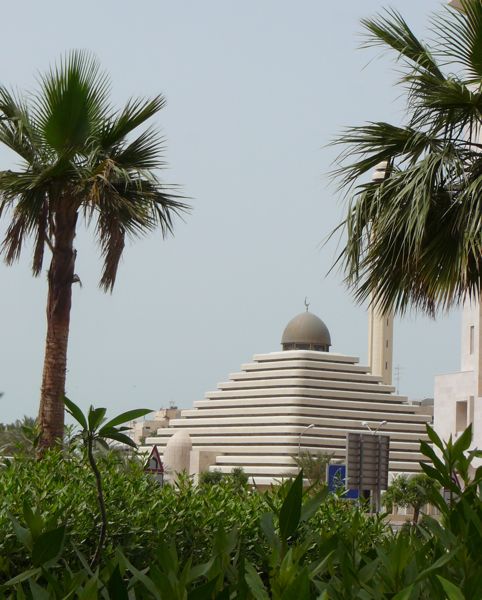
My friend and I were driving by this mosque when she sighed.
“We used to think this mosque was huge,” she said. “You could see it from far away. Slowly, slowly, it just disappeared.”
The mosque is now surrounded by tall buildings, and, indeed, if it weren’t for it’s unusual shape, you might barely notice it across from the Holiday Inn, while driving on Gulf road. There are all kinds of buildings along Gulf road, apartments, hospitals, office buildings. They are doing amazing things, twisting glass and concrete spires up into the heavens. The pyramid mosque is dwarfed by these towering buildings.
We also saw these amazing signs along Gulf Road:

If there were one or two, I would not have taken a photo, but there are like EIGHT of these, four on each side of the road, and a lot of flashing lights. I checked the red sign – remember my Arabic is basic – and I could see two “mamnuas” (forbidden) but I didn’t see “foto” or “suraa” so if it says “no photos” will someone please tell me right away so I can take this photo out?
Recent Comments
ExpatAlien on What Country am I Living … intlxpatr on Yellowstone: Old Faithful to C… Michelle on Yellowstone: Old Faithful to C… Cathy on No Grown-Ups in Charge intlxpatr on Waiting for Snow Wikipedia Donate Button

Amazina


Early Voting in Florida


 Here There and Everywhere