Not New News
Just as the Qatteri Cat monitors traffic in front of our place, I monitor my blog traffic – a lot like Qatteri Cat, sort of lazily, desultory.
Yesterday, I got the most hits – a lot – on MOC bans Porno Film Sites, a post I wrote almost a year ago.
80 hits. That’s a lot for a post almost a year old. Why so much interest? Are there new movements afoot in the Ministry of Communication to ban undesirable content? Are there new technologies available that make that possible?

I knew exactly the kind of photo I wanted to include here, so I googled “saudi censorship image” and found this wonderful blog: Your World Today. I really like his blog.
Ethnic Clothes and Mental Health
The studies findings surprised them – they were expecting that people who maintained their own traditions in a foreign country would experience more stress rather than less. BBC Health News reports that the choice to wear traditional clothes probably reflects family support, and strong family ties:
Ethnic clothes mental health link
Teenage girls from some minority communities who stick to their family customs have better mental health, researchers say.
Queen Mary University of London found Bangladeshi girls who chose traditional rather than Western dress had fewer behavioural and emotional problems.
The team said close-knit families and communities could help protect them.
Pressure to integrate fully could be stressful, the Journal of Epidemiology and Community Health reported.
Traditional clothing represents a tighter family unit, and this may offer some protection against some of the pressures that young people face
Professor Kam Bhui, report co-author
Adolescents are particularly vulnerable to mental health problems, and the researchers said that identity, often bound up in friendship choices or clothing, played a role.
They questioned a total of 1,000 white British and Bangladeshi 11 to 14-year-olds about their culture, social life and health, including questions designed to reveal any emotional or mental problems.
Bangladeshi pupils who wore traditional clothing were significantly less likely to have mental health problems than those whose style of dress was a mix of traditional and white British styles.
When this was broken down by gender, it appeared that only girls were affected.
No similar effect was found in white British adolescents who chose a mixture of clothes from their own and other cultures.
Professor Kam Bhui, one of the study authors, said that the result was “surprising” – he had expected that girls who were less fully integrated to show signs of greater strain.
“Traditional clothing represents a tighter family unit, and this may offer some protection against some of the pressures that young people face.
You can read the rest of the article HERE
Un Joyeux Anniversaire
Today is one of those happy-sad days for AdventureMan and I, happy because our son found a sweet, beautiful, smart woman with whom to share his life and with whom he was married two years ago today, and sad, because we can’t be there to take them out to celebrate.

It was a beautiful day, we all had so much fun!

The Event Planner at the Panama City Beach Marriott, when she learned we were coming in from Kuwait, told us she has many Moslem wedding parties at that hotel, and that her biggest problem is finding enough female servers to take care of the bridal parties. Who knew? There is a huge Moslem population in PCB, enough to support private a private, segregated school.
We are missing you too much, and we wish you the happiest celebration!

Housing Collapse and Demographics
From The New York Times:
DUBLIN — The collapse of the housing bubble in the United States is mutating into a global phenomenon, with real estate prices swooning from the Irish countryside and the Spanish coast to Baltic seaports and even parts of northern India.
This synchronized global slowdown, which has become increasingly stark in recent months, is hobbling economic growth worldwide, affecting not just homes but jobs as well.
In Ireland, Spain, Britain and elsewhere, housing markets that soared over the last decade are falling back to earth. Property analysts predict that some countries, like this one, will face an even more wrenching adjustment than that of the United States, including the possibility that the downturn could become a wholesale collapse.
To some extent, the world’s problems are a result of American contagion. As home financing and credit tightens in response to the crisis that began in the subprime mortgage market, analysts worry that other countries could suffer the mortgage defaults and foreclosures that have afflicted California, Florida and other states.
Citing the reverberations of the American housing bust and credit squeeze, the International Monetary Fund last Wednesday cut its forecast for global economic growth this year and warned that the malaise could extend into 2009.
“The problems in the U.S. are being transmitted to Europe,” said Michael Ball, professor of urban and property economics at the University of Reading in Britain, who studies housing prices. “What’s happening now is an awful lot more grief than we expected.”
You can read the entire story HERE
Yes, some banks made loans to a few people who really couldn’t afford the housing, and yes, a small percentage have been foreclosed. Is the entire downturn in the housing market caused by the sub-prime loan debacle?
In the USA, there is a HUGE demographic, the baby boomers, who have already started retiring. As they retire, many are downsizing, looking for a simpler way of life. Could it be that there is more than one factor acting here? Could housing demand be dropping? Wasn’t there a similar post World War II baby boom in Europe? How will the boomers’ retirement effect the US economy?
Kuwait has one long continuous baby boom – seems to me the housing prices here continue to go up!
Cynthia’s Praline Cake
My friend Cynthia, who knows I love mysteries, confessed to me that it was HER praline cake featured in JA Jance’s Joanna Brady series, and that she was the Cynthia who, in the book, brings it to the community potluck supper. And . . . she shared the recipe with me!
My friends, it is an easy recipe if you have the ingredients on hand (oats, brown sugar, butter) but I warn you – no substitutions! Yes, it is full of sugars and fats – why do you think it tastes so good??
Cynthia’s Praline Cake
(This is another one you can make in two 8″ round pans, and freeze one for later.)
1 cup quick-cooking oats
1 cup cold water
1 cup white sugar
1 1/4 cups brown sugar
1 cup oil
2 eggs
1 1/2 cups flour
1 teaspoon baking soda
1 teaspoon cinnamon
1/4 teaspoon salt
Icing
1 stick butter (1/2 cup)
2 Tablespoons milk
1 cup packed light brown sugar
1 1/4 cut chopped pecans
In a small bowl combine the oats and water, set aside. In another small bowl, combine and mix the dry ingredients – the flour, soda, cinnamon and salt.
In a larger mixing bowl, cream together the sugars, oil and eggs. Beat, add the oat mixture alternately with the mixed dry ingredients. Mix well.
Pour into greased and floured 9 x 13 inch baking pan. Bake at 350 degrees for 35 – 40 minutes.
For the icing: Just before the cake is done, combine butter, milk, and brown sugar in a saucepan, bring it to a boil and boil for one minute. Add the pecans and mix. Spread over cake.
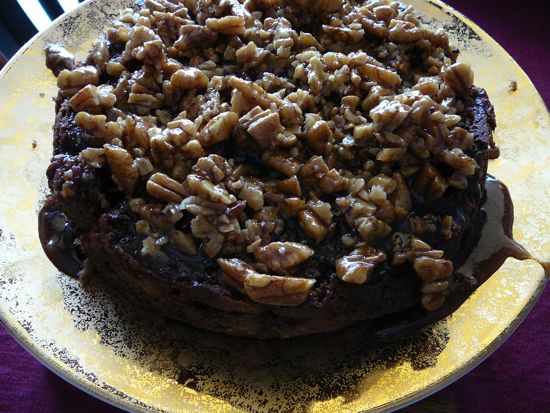
For Jewaira, who always asks for pictures, this is what the finished cake looks like:
Election Excitement
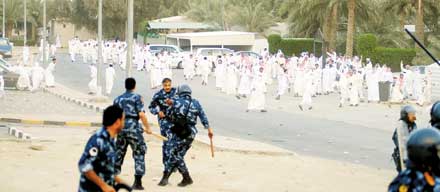
Coming home from church on Friday, we saw a Ministry of Interior Land Rover at a stoplight, with its lights revolving. That got our attention immediately, because if the lights are flashing, it usually means someone is in a hurry, but this guy was waiting patiently for the light to turn. As we noticed him waiting patiently, we also noticed he had his window open, and . . . he was wearing a balaclava, a face mask worn while skiing to keep your face warm but you can still see and breathe. The temperature was at least in the 80’s, and a ski mask to keep your face warm in Kuwait . . . well, that doesn’t make sense. Maybe if he was using his air conditioning, and it was too strong, and hurt his sinuses, well maybe . . .
Saturday we read this article from the Arab Times, which explained a little about what we were seeing:
Two Kuwaitis, officers hurt in Sabahiya clash; ‘Awazem’ battle securitymen
KUWAIT CITY : Two Kuwaitis and a number of securitymen were injured in a violent clash during which the Awazem tribesmen used sticks and stones against security forces, who were trying to stop them holding a primary in Sabahiya. The fighting took place Friday when about 5,000 securitymen from the Special Forces and Riot Police, supported by vehicles and helicopters, surrounded the Diwaniya of former MP and candidate in the upcoming elections from the fifth constituency, Ghanim Al Mei. The securitymen used tear-gas and rubber bullets to disperse the rioters. No arrests were reported. A similar incident some time back had prompted the then Minister of Interior to recall his forces from the Diwaniya of a former MP.
Sources said a large number of securitymen and CID officers were deployed as backup at a nearby cemetery. Security forces and election candidates are exchanging charges, each pinning the blame for the incident on the other. Former MP and candidate from the fifth constituency Abdullah Rai Al-Fahma in a press statement said, “Tribes are an integral part of the Kuwaiti society. They have the right to consult and choose their representatives to the National Assembly like the political blocs and other political organizations.” The government must stop this repressive measure before things take a serious turn, Al-Fahma added. Some observers and a number of candidates have opined the government is exacerbating the issue intentionally to prolong the election indefinitely by issuing ‘emergency decrees.’
My own country is also in an election year this year, and we have our own very strange ways of doing things. We have things like caucuses, and primary elections and delegates, and conventions to choose our candidates.
It is fascinating for me to watch what is going on in Kuwait and to try to figure out what is going on. Even reading reports in the newspapers, even gleaning from the blogs, it is hard for me to figure out why certain things are significant.
So I am guessing here that the tribes/families are acting as political parties and attempting to narrow the field by voting in secret diwaniyyas (diwaniyyas are spaces built in houses for either males or females to gather for visiting back and forth, but not mixed groups, or only very very rarely. They function like the benches on the town square, where people – mostly men – come and discuss issues, often reaching consensus on how an issue should be approached) for candidates that they can agree are electable. Once all the tribe/families have a chance to vote, they will select a slate of candidates to run in that district. This is my guess, based on what I read and see.
But in the districts, there are more than one family/tribe . . . so how do you agree to vote outside your tribal / familial boundaries? It is hard for me to understand how one tribe can gather enough influence to win. I am guessing that these diwaniyya “primaries” are being so actively discouraged because if one family wins too much, then they distribute favors among their own members, and others go without help? Is this a wasta issue? How do the tribes form alliances to win elections?
I would love to tell you that modern western countries don’t have these problems. It would be a lie. We have our own names for “wasta” and one is a term I can never imagine being used in Kuwait, Pork Barrel Legislation which means it doesn’t make sense from a big-picture point of view, it is legislation passed to benefit a few, and to insure that the elected guy can get elected again.
Will banning by-elections make a difference in the outcome of the election? What is the goal of the diwaniyya elections? How do the females get to vote if it is only men attending? What is the government’s goal in banning the by-elections?
Parking Problem
From the Arab Times:
Kuwaiti brothers critically hurt in gang attack over parking row
KUWAIT CITY : Eight persons broke into a Kuwaiti family’s house in Salmiya and attacked three brothers with knives, machetes, sticks and similar weapons just because the brothers did not allow a female student of a nearby institute to park her car opposite their house.
The brothers were critically wounded and had to be admitted to the Intensive Care Unit of Mubarak Al-Kabeer Hospital.
Securitymen, who rushed to the scene after receiving a call from their mother, managed to arrest one of the attackers but the rest of them bolted from the scene.
A case was registered.
By Mizyed Al-Saeedi
Special to the Arab Times
People here can get pretty riled up over parking. One time, my husband and I were attending a social event, and we parked on – well, it looked like a public street to us, and public streets, unless they have numbered, private parking, you are allowed to park on public streets because you are the public. That’s what we thought anyway.
When we came out, we had cars literally blocking us, forward and rear, from getting out. My husband approached the owner of the house in front of whom we were parked, who was around the corner in his diwaniyya (on the public sidewalk) and when my husband said he was sorry, the man said he could put his “assif” (sorry) in his pocket!
Not one to give up easily, AdventureMan schmoozed for a while. The man said he would have his driver take me home, and AM asked him if he would put HIS wife in a car with a strange driver. That got an appreciative grin. Long story short, finally he allowed us to leave. He had some legitimate gripes – the facility where we had attended the performance has people who block his parking access to his house all the time.
My husband visited him again the next day with a parcel of dates to express his appreciation for the guy having let us go, and visited the facility and helped arrange to insure that people would not park in front of this guy’s house again. He and the man became – well, not friends, but cordial acquaintances.
I’ve always been glad AM handled it in a gentlemanly fashion. Imagine, breaking in and stabbing people over a parking spot!
Schism vs Fitna
On the front of the Friday Kuwait Times (kind of the weekly tabloid edition) there is a headline article about Saudi Blogger Raed Al Saeed, who made a 6 minute video picking out verses from Samuel, Numbers, Deuteronomy, etc. to illustrate horrorific illustrations from the Bible, to parallel Geert Wilder’s movie, Fitness, which picks out verses from the Qura’an to illustrate the violence of Islam.
He says” It is easy to take parts of any Holy book that are out of context and make it sound like the most inhuman book ever written. This is what Geert Wilders did to gather more supporters to his hateful ideology.”
He’s right. It’s easy to point fingers, and to create fear and hate. It’s a whole lot harder to try to build bridges of understanding and compassion, to find similarities, to find ways to respect one another, to work together, to try to build a better world, and to agree to disagree when our books take different directions.
Traffic ENFORCEMENT
Whoda thunk?
I am (almost) speechless!
Can this be a turning point in Kuwait? Are we going to have laws that might actually be meant to be followed? Wooo Hoooo, traffic police, Woooo Hoooooo, court of law!
From The Arab Times: Kuwait Crime:
‘Deport motorist’ – Driving on E-lane
KUWAIT CITY : Assistant Undersecretary for Traffic Affairs, Major-General Thabet Al-Muhanna has ordered the deportation of an Arab man who was caught driving at 140 km/h along the Fifth Ring Motorway, reports Al-Seyassah daily.
According to a security source Al-Muhanna saw the motorist driving along the emergency lane and ordered his immediate arrest.
After his arrest the man admitted to committing the offence. He apologized and said he was in a hurry. However, the man will be administratively deported, say sources.
Questions and Comments: Woo Hooo, al-Muhanna!
Suggestion: With the great advent of tiny, easily carried cameras and cell phone cameras, photographic evidence is easy to provide. How about the Ministry of Interior setting up a website where we can send them photos of people WE see in flagrant violation of the laws?
Warden Message
If this was a warden message, I didn’t get it. I get most of them. I found this in today’s Arab Times:
Terrorists may target Americans
Following is the full text of the Kuwait 2008 Crime & Safety Report released by the US State Department in March, 2008
Overall Crime and Safety Situation
The Department of State rates Kuwait as low threat for crime. The incidence of crime in Kuwait City remains low. The Government of Kuwait (GOK) maintains a high police profile, with large numbers of uniformed and plainclothes officers on the streets. Each district and governate has police stations operating under the direction of the Ministry of Interior (MOI) Directorate of Public Safety. Street crime does occur and incidents have been reported to the embassy’s Regional Security Office (RSO) recently that required monitoring and security notice dissemination.
Of particular concern are an alarming number of crimes involving individuals impersonating police officers and then assaulting victims, who are primarily third-country nationals (TCNs) and more susceptible to intimidation. The evolving modus operandi (MO) involves a male in plain clothes and an unmarked vehicle stopping a TCN, whether on foot or in a vehicle, asking for his ID, then demanding the person get into the impostor’s vehicle without any explanation of his offense or their destination. The TCN is then driven to a deserted area and assaulted.
The British Embassy released a Warden Notice about an assault that took place in February 2007 that did not involve a British national, but occurred in the Manghaf neighborhood where a large number of British citizens reside. In this case, a TCN was taken in broad daylight from a public area by a police impostor and assaulted, employing the aforementioned MO. A second Warden Notice from the British Embassy in March detailed an incident occurring behind the US Embassy Kuwait, at a shopping center in Mishref, where two young men believed to be local nationals forced a British male teenager into their vehicle late one evening and made sexual advances toward him. The victim escaped by throwing himself from the moving vehicle, where a passing Kuwaiti military vehicle offered assistance and returned him home safely. Based on a long-standing relationship of mutual cooperation and information-sharing, the Regional Security Office (RSO) at US Embassy Kuwait distributed security notices based on the British reports advising staff of these specific instances and included personal security guidance for all employees and their family members.
Violent crime is primarily confined within the TCN community, which comprises the majority of the manual labor force in Kuwait – approximately two-thirds of Kuwait’s residents. It is probable that a high percentage of crimes in the TCN community go unreported. The threat of immediate deportation looms large for many of these guest workers who generally prefer maintaining a low profile so as to avoid unwanted attention from the GOK.
Although several districts within Kuwait City are known to have higher incidences of crime, only one area (Jahra) remains generally off-limits to official embassy personnel. One factor contributing to the high rate of crime in Jahra is the inability of the police to enforce laws in areas where tribal customs take precedence. Known offenders regularly intimidate foreign guest workers, including workers employed by US companies and US military bases, by damaging vehicles, starting fires in trash cans and harassing them while they enter and exit their residences.
Harassment is not due to any affiliation to the United States or US military efforts; instead, it is generally due to criminalsbelieving they can act with impunity. Young Bedouin men who comprise the majority of these gangs are subject to their tribal mores first, but the tribal structure has proven ineffective in controlling these individuals which hinders the efforts of police to crack down on their illicit activities.
Residential crime remains low. There have been no reported break-ins at any official embassy residences within the past year, nor have any vehicles been stolen. A domestic employee of an embassy officer had her purse stolen from an individual on a motorbike outside of the officer’s residence. The perpetrator was later captured by police in the same neighborhood days after the attack. It is not uncommon for embassy staff and dependents to report suspicious persons in their neighborhoods to the RSO, but the majority of these instances have been resolved without any criminal or other hostile intent discovered.
There are no reports of petty thefts against the official American community in any of the popular outdoor markets or shopping malls frequented by tourists and Westerners living in Kuwait. However, the potential for such crime does exist. Individuals should remain aware of their surroundings at all time and assume that no venue is safe from crime. Additionally, vehicle break-ins, although rare, do occur if valuables are left in plain view. Visiting Americans are urged to take the same security precautions in Kuwait that they would practice in the United States. Hotel room doors should be locked and valuables should be stored in hotel safes when available. Visitors should instruct the hotel management not to divulge their room numbers over the telephone to any callers, but only to connect them to their room or to take a message.
Incidents of harassment and road rage, although infrequent, do occur and appear to be on the rise. Females have reported being occasionally accosted or harassed by Arab or South Asian males, particularly while driving alone in the morning or nighttime hours. In an incident involving an Embassy spouse in the fall of 2007, a local male harassed the spouse in a local shopping center, which prompted a security notice by the RSO and a Warden message by the Consular Affairs Section. Women who are the victim of harassment should immediately seek a public area and notify either store management or security personnel. Women should not travel home alone.
Male drivers using their personal vehicles forcefully to stop a female driver or attempting to gain the female’s attention for socializing purposes have been reported. Often this action is meant only to acquire a telephone number or arrange a date. However, reports of males impersonating police or military officers and utilizing his authority to command compliance from unsuspecting females have been increasing. Determining who is a legitimate police officer and who is an impostor is troublesome. In the reports received by the RSO, the individual initiating the contact was not wearing a uniform and was not driving in a clearly marked official GOK police or military vehicle.
Kuwaiti police have the authority to make traffic stops while in civilian clothes and driving in their personal vehicles but must identify themselves with their police ID, which has both Arabic and English writing on it. To ensure that the stopping officer is a legitimate police officer, individuals should remain in their own vehicles with the doors locked, lowering the window only enough to receive the person’s police identification. While checking the bona fides as best as possible, we advise staff to use their mobile phone to alert someone of their situation and if at all possible travel to their location. Tell the person you will agree only to follow him to a police station, and specify which one, keeping your mobile phone open so the person you called can hear the destination.
Lastly, relay the license plate number for the person’s vehicle to your colleague on the phone if at all possible. While Kuwait is in many ways a tolerant country, allowing women to drive, vote, and run for public office, Kuwait is still an Islamic country where conservative customs and dress are the norm. Potential harassment can be reduced if visitors dress conservatively and maintain a respectful demeanor and a low profile. Visitors should avoid confrontational situations, and move away from angry, threatening or aggressive persons, either on foot or in vehicles.
Incidents of vehicle pursuit, extremely aggressive and reckless driving, and vehicle gamesmanship, in which vehicles play a form of high-speed cat and mouse on the freeways, may force vehicles off the road or result in a collision with other vehicles. Speed is the most common cause of vehicle accidents in Kuwait. Apart from periodic storms, road conditions and weather are favorable in Kuwait. Drivers must remain defensive and alert to the hazards posed by others who neglect to yield in merges, cut across lanes to exit, drive aggressively and at excessive rates of speed, pass on shoulders and often operate without headlights at night.
Unexploded bombs, mines, and other ordnance from the 1991 Gulf War remain present in some desert areas in Kuwait. US Embassy Kuwait urges caution if traveling off paved surfaces outside of Kuwait City. A TCN worker was recently killed by unexploded ordinance located near a border checkpoint with Iraq. The unexploded ordinance exploded while the TCN was attempting to remove wiring from the device. Unexploded ordnance has also been discovered in piles of sand used at construction sites, including at Camp Arifjan, the largest US military base in the country.
During the cooler months in Kuwait (October-March) Kuwaitis often travel to the desert to camp. Many of these campgrounds are located very close to the major roadways, but some Kuwaitis travel long distances to camp in isolated areas. Camping in established camp areas decreases the potential for coming into contact with unexploded ordnance. Visitors should avoid camping away from population centers. The US Embassy and the GOK have received threat information indicating official and private Americans may be targeted for terrorist attacks. Soft targets such as western hotels and restaurants can be considered vulnerable to terrorist attack, although many are making improvements to their perimeter and internal security. American citizens are advised to avoid apartment complexes where Americans or other Westerners are generally known to congregate in large numbers. We recommend that Americans maintain a low profile and vary routes and times for required travel to avoid predictable schedules.
Political Violence
For several years after the September 2001 on the US, Kuwait City experienced no major demonstrations or other related violence. During this time, Kuwait has remained a strong ally of the United States, even after the US military invasion into Iraq and the subsequent onset of insurgent violence began to reverberate throughout the region. In early 2006, the controversy over Danish cartoons of the Prophet Mohammed provoked several demonstrations in the country, but these remained peaceful and uneventful. However, when Israel attacked Lebanon in the summer of 2006, several large protests occurred, including two at the US Embassy. Demonstrators expressed an unprecedented amount of anti-US hostility during these protests. While there were no injuries or damage during the protests, the police were not prepaired for how quickly the second demonstration materialized and grew in number. Demonstrators numbering in the hundreds burned American and Israeli flags, while waving the yellow flag of Hezbollah and chanting “Death to Israel and Death to America.” Since the end of the summer 2006 war, there have been no major demonstrations in Kuwait City. While these events were isolated, they clearly illustrate how quickly certain events can evoke an emotional response even in a country not known for political demonstrations or violence.
The primary terrorist threat to US personnel in Kuwait comes from individuals with links to al-Qaeda and regional jihadist networks. In January 2005, Kuwaiti police and Special Forces attempted to arrest members of an indigenous terrorist organization known as the Peninsula Lions. In July 2004, Kuwaiti security forces arrested up to 20 individuals who were engaged in recruitment, training and financing of local youth or terrorist operations in Iraq and Kuwait. These arrests demonstrate the development of extremist elements in Kuwait. In 2002 and 2003, individuals were able to conduct lethal attacks against US military and civilian contractors in Kuwait. While there have been no lethal attacks in the last 12 months, the presence in Kuwait of a growing number of US military and contractor personnel in support of Operation Iraqi Freedom continues to make Kuwait a potential target.
Post-specific Concerns
American citizens traveling to Kuwait should be aware that possession of drugs and alcohol is illegal. Additionally, pornographic materials, weapons, and pork products are confiscated if discovered during customs checks at the airport. Customs authorities will x-ray and search luggage upon entry into the country. While in Kuwait, both women and men should dress conservatively at all times. Shorts and sleeveless shirts are discouraged from being worn in public.
Throughout Kuwait the chances of being involved in a motor vehicle accident are far greater than being a victim of criminal or terrorist act. Driving in Kuwait is hazardous. Embassy employees are briefed upon their arrival in Kuwait that driving is very dangerous in Kuwait. Night driving is particularly dangerous because many drivers do not turn on their headlights. A good general rule to follow while driving in Kuwait is to avoid driving in the number one (far left) lane on Kuwaiti highways, as this lane normally has the drivers traveling at the highest rate of speed. Number one-lane drivers are extremely aggressive and will flash heir headlights rapidly in order to encourage slower-moving drivers to change lanes. Drivers should so be prepared to see camels or other livestock near the side of major highways.
Tips on How to Avoid Becoming a Victim
Americans should maintain a low profile, vary routes and times for all travel to the extent possible, and treat mail and packages from unfamiliar sources with suspicion. All Americans are urged to be suspicious of unexpected visitors and to pay particular attention to suspicious vehicles. Any suspicious activities or vehicles should be reported to the local police as soon as possible. The neighborhoods of Khaitan and Farwaniya, located on the outskirts of Kuwait City International Airport, are recognized and identified as high-crime areas due to criminal elements operating drug, prostitution, gambling, and black market enterprises. These areas are largely populated by TCNs who are poorly paid and may turn to crime for financial gain. Incidences of rape, theft and murder are usually not directed at Americans and Western personnel but largely involves TCNs. Americans are urged to avoid this area altogether, especially at night.
For further information
The main Embassy phone number is +965 259-1001. The Regional Security Officer can be reached by calling +965 259-1001 ext 1704. To contact Consular/American citizen services please call +965 259-1001 ext 1581. The Consular Section Chief can be reached by calling +965 259-1001 ext 1278. The Foreign Commercial Office can be reached by calling +965 259-1001 ext 1392.
The embassy’s working hours are Sunday – Thursday 8:00 am-4:30 pm. During this time, visa applications for travel to the Untied States are accepted. Personal interviews are required and appointment times are requested online. Interviews are conducted at the embassy Monday-Thursday from 8:00 am-12:00 pm. American Citizen Services operates Sunday-Thursday from 9:00 am-11:00 am and 1:00 pm-3:00 pm for routine services, and will generally see any American citizen for emergency services anytime during the workday. The section is closed Monday mornings.
Recent Comments
ExpatAlien on What Country am I Living … intlxpatr on Yellowstone: Old Faithful to C… Michelle on Yellowstone: Old Faithful to C… Cathy on No Grown-Ups in Charge intlxpatr on Waiting for Snow Wikipedia Donate Button

Amazina


Early Voting in Florida


 Here There and Everywhere