“So Many Christians!”
My Kuwaiti friend was shaking his head in disbelief. He had been to the old city to pay a condolence call on a Friday, and happened by the Lighthouse compound near the Sheraton circle on a Friday morning, just as some of the services were getting out.
“I had NO idea!” he looked at me in absolute amazement.
I just laughed. When we first got here, we attended church on that compound; our church moved off only months ago, when the road construction work got seriously under way and parking increasingly became a problem. It was the most amazing experience on earth – there were the Indian Men’s Catholic services and the Philipine Evangelical service and the rock-music evangelical service and the staid Anglican services and the family Philipine Catholic services and . . . well, you get the picture. There are an amazing number of expatriate Christians in Kuwait. At any one time on the compound, there are about twelve different services going on, and no sooner does one finish and the participants exit, than the new group is coming in.
Now, churches meet all over Kuwait. They met in villas, they meet in schools, they meet in every neighborhood. Today, in our church, we asked for blessings on Kuwait, on the Emir and his family, and those in leadership positions in Kuwait. We prayed for the leaders of all the countries in our congregation (English, Irish, Scottish, South African, Chinese, Indian, Nigerian, Kenyan, Dutch, Egyptian, Ethiopian, American, Australian {I have forgotten a few, I am sure} . . . lots and lots of blessings!) Most of all, we thank God for the freedom to worship in Kuwait.

(This is not our church in Kuwait. This is the Church of the Holy Sepulcher, in Jerusalem. I was looking for a church that looked more Middle Eastern than Western, and this is what I could find!)
Our pastor also has a blog, q8bridge about which he says “The purpose of this blog is to enable a bridge to be built between Christians and Muslims, especially those living in Kuwait. Through questions and dialogue we hope to promote deep friendships and mutual understanding.”
He examines the beliefs we have in common, and where we differ, and some of the reasons why we differ. I urge you to have a look.
Leap Year Reversals
Here it is, gals, a chance that only comes up once every four years – and only one day – February 29.
In Western culture, it is the day that women can propose to men!
I don’t know anyone who has actually done this, proposed on February 29, but it’s an old legend.
The below is from About.com: Leap Year Traditions where you can read all kinds of information about today’s uniqueness.
Leap Year has been the traditional time that women can propose marriage. In many of today’s cultures, it is okay for a woman to propose marriage to a man. Society doesn’t look down on such women. However, that hasn’t always been the case. When the rules of courtship were stricter, women were only allowed to pop the question on one day every four years. That day was February 29th.
Children Damaged by Materialism
A recent study discussed in BBC Health News:
Children ‘damaged’ by materialism
Some 89% of adults think children are more materialistic than ever
Most adults in the UK believe that children’s well-being is being damaged because childhood has become too commercial, a lifestyle poll has found. Some 89% of adults in the GfK NOP survey of 1,255 people believed today’s children were more materialistic than previous generations.
The poll is one of the contributions to a continuing inquiry into childhood.
The Children’s Society said adults had to “take responsibility for the current level of marketing to children”.
Bob Reitemeier, chief executive of the society, said: “A crucial question raised by the inquiry is whether childhood should be a space where developing minds are free from concentrated sales techniques.
“To accuse children of being materialistic in such a culture is a cop-out,” he said.
Mr Reitemeier said: “Unless we question our own behaviour as a society we risk creating a generation who are left unfulfilled through chasing unattainable lifestyles.”
The children’s market is worth an estimated £30 bn a year.
As chief executive of the National Schools Partnership, Mark Fawcett brings business and marketing into schools, and he believes you cannot shield children from the real world.
“We have to live in the current communications era where children can see a huge amount of information,” he told BBC TV news. “We have to use our judgement and we have to, as an industry, make sure we are working with children and families, and not exploiting them.”
Selling lifestyles
The evidence on lifestyle is part of a six-part series of investigations published by the Children’s Society for a continuing inquiry into childhood in the UK which brings together the views of academics, religious communities, teachers, local authorities and authors.
Dr. Rowan Williams, the Archbishop of Canterbury, who is patron of the inquiry, said: “Children should be encouraged to value themselves for who they are as people rather than what they own. “The selling of lifestyles to children creates a culture of material competitiveness and promotes acquisitive individualism at the expense of the principles of community and co-operation.”
Comment: It’s not just children. We are ALL damaged when we start to measure ourselves by what we own. You can read the entire article Here.
History of Architecture in Old Kuwait City (5)
One last quote from this wonderful book by Saleh Abdulghani Al-Muttawa, because it summarizes his ideas on what makes house practical for the weather and customs of this region:
Cultural Response
. . .the major critical cultural and customs problems which concern housing are;
1. Privacy for female inhabitants
2. Separation between female and male guests, and separation between guests, in general, and house members.
3. Future family expansion
. . . The approach to solving those critical problems are as follows:
1. To assure privacy for family members, and especially female members. The family part of the house has been pushed all the way to the back; in other words, it is on the north side far away from the street. It is difficult, or impossible, for anyone passing by the house to be able to look through and see the inside, especially with all those trees and plants placed in front of the house. Another conservative step has been taken by separating the family entrance from the guest’s entrance, and placing the family entrance close to the driveway and the garage for easy and private access. All that gave the female members of the family more free and secured mobility inside the house.
2. The prototype design provides a separate quarter for the guests, “Dewania.” The “Dewania” is placed on the southern side of the house away from the family entrance, to provide privacy for both family members and guests. The “dewania” is actually divided into two “dewanias,” female “dewania” and male “dewania.” For more seclusion and privacy of both sexes, the entrance of the female “dewania” is placed on the west side and the entrance of the male “dewania” is placed on the east side. Both entrances are close to the main road to make it more convenient and easy for the guests to come in and out. Each “dewania” has its own bath. There is only one dining room, because most of the time only men stay for dining. (Women have to go home to cook for their families.) If it happens that both sexes stay for dining, women can be accomodated in their “dewania.” A collapsible partition is placed in between the two “dewanias.” In big events like wedding parties or feasts, the partition can be collapsed, so the space would be large enough for a sizable number of people.
In a post last week, How decisions are made in Kuwait we had a long discussion about diwaniyas in the comments section. What I like about al-Muttawa’s concept is that collapsible wall in between the female and male diwaniyya. It could allow the females to listen in on major political discussions – what? You think we aren’t interested? You are wrong! – and participate.
“How can they participate while separated?” my western friends will be asking.
There are emmisaries. When sitting with the women, in Saudi Arabia, I wondered at first how my husband and I would both know when it is time to go. In western society, we have a meeting of the eyes and my husband will give an almost imperceptible nod and I know it is time to begin to make our farewells. As the hour got later and later, and still later, I finally asked one of the women how I would know when my husband wanted to leave.
“You want to leave?” she gasped in horror!
“No, No!” I assured her, “I just don’t know how I will know when my husband wants to leave!”
“Your husband will send for you! The children will tell you!” she laughed, and I stopped worrying. The children were running back and forth from room to room, reporting on the happenings in the men’s diwayya, where a holy man was discussing morality and requirements of morality.
This was one of my favorite places in Saudi Arabia, the house of friends. In the women’s majlis, there was only a TV, and seating around all the walls. There was nothing on the walls, nothing, not a picture, not a calligraphy, nothing, but the furniture was strong and comfortable, and the hospitality never-ending. When dinner time came, we went to an adjacent entirely bare room, bare except for the lavish dinner laid on the floor, where we all sat and ate, and one huge cupboard, full of mattresses. The dining room became one of the sleeping rooms when all the guests departed.
I didn’t get a tour of the house; I only know what I saw from my entrance through the family entrance into the female part of the house, my brief glimpse of the kitchen area – large and utilitarian. What I remember most clearly was the love and joy in the family, and that all the walls were totally devoid of anything decorative.
+ + + + + +
When I came to live in Kuwait, the real estate people showed me 20 villas and one apartment. The villas, each and every one, were HUGE! Most of them were three or four floors, more than one had an elevator, and several had their own swimming pools.
Most of the houses had a large kitchen – separate from the house, outside! Alongside it were the quarters for the maids, the drivers, the guard, etc. Most of the houses had at least five bedrooms, at least two diwaniyyas.
In the newer areas, there was barely two feet between houses, so windows on the sides of the houses were non-existent, or heavily curtained over, making those rooms very dark. In the older houses, the bathrooms were small and the spaces were divided strangely, by western ways of thinking.
Mostly, though, the villas were lovely, full of luxurious materials and beautiful touches. As I would walk though, sounds bounced off the thick cinderblock walls and the marble floors.
AdventureMan works long hours. I would think of me and the Qatteri Cat bouncing around in the huge house like two little peas in a big bowl, and where would I find him if he hid out for a while? The villas were just too much space for our little family, and we opted for the apartment, although the apartment is bigger than many homes in the United States. AdventureMan and the Qatteri Cat still look at me accusingly from time to time; they always enjoyed an hour or two together in the garden on Friday mornings, and now we have no garden. . . all we have (I can’t even keep a straight face as I write this) is that glorious 24-hour-a-day 180° view of the Arabian Gulf. 😉
+ + + + + + +
If I ever see this book for sale, I will come back here and update. If YOU see it for sale, please come back here and let us know!
History of Architecture in Old Kuwait City (2)
I love this book. It is such a treasure. For those of you who have ever wondered about the construction of old Gulf dwellings, this book is a MUST have – so much detail, so much to help us understand what we are seeing.
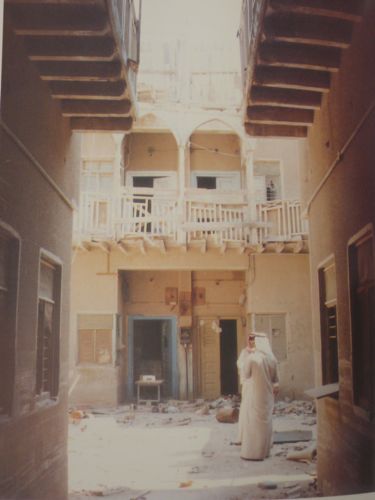
More from author Saleh Abdulghani Al-Mutawa, Architect:
House design and location specified unity existing in the Kuwaiti society. In old times, the poor livednear the rich, where no differences between them. The only difference was that the houses of the rich were vast. Ordinary Kuwaiti house, occupied by the majority of Kuwaitis, consisted of a vast courtyard, surrounded by many rooms, and a hallway secured privacy to the family by separating the house from the street. In that architectural design, the courtyard ventilated the house to find it cool at night and after sunset. This was due to the exchange of radiation between the floor of the courtyard and the outer space. At night the house became cool and sleep was comfortable. During summer, the majority of Kuwaitis prefer to sleep in the courtyard or on the roof. Usually, there is a room on the roof used to store mattresses in or sometimes for napping. A small bath is usually located beside that room. . .
Walls were built of rock and mud, and decorated internally with white gypsum. Ceilings consisted of rows of jandal (trunks), basajeel (bamboo) and manqour (straw mats), covered with a 30cm or a 40cm layer of mud. In winter, when rain was heavy, that layer should be attended to and maintained by adding more mud. Houses of the rich used gypsum for protection. When wood was used in fixing the ceilings, thejandal was only 4 m long, and for the wide rooms they used square pieces of wood of 6m. The floor was covered with mud, then with tiles which was imported from neighboring countries. To let the water flow from the roofs, they used the wooded marazims (gutters) which extended from the roofs to the outside. In the houses there were wells for supplying the underground water, and there were pools to store water in.
As regards the houses of the rich, they were divided into a number of courtyards, each serving a certain purpose. There was a courtyard used to include a Diwaniya for male guests, consisting of a large room annexed with other buildings needed to accomodate the servants or for other purposes.
The other courtyard was located for family female members, including a number of rooms and bathrooms. A third courtyard was used as a kitchen, including the kitchen, storage room for fuel and a store room for the different kinds of food. There were more courtyards for the animals: goats, cows, horses. Kuwaiti houses also had a “baqadeer” (wind tower) which was a natural air-conditioner, not one Kuwaiti house was without it.
History of Architecture in Old Kuwait City
When I came to live in Kuwait, my resourceful niece, Little Diamond went online and found all kinds of fabulous books about Kuwait, books you can’t find in Kuwait. Five interesting books, mostly about an earlier era in Kuwait, when my Kuwaiti friends tell me it was still one community.
“It was like paradise” they say, and they sigh.
I found another book recently, a book I have never seen before, although it was published in 1994, so it is not old. It is The History of Architecture in Old Kuwait City (and the influence of it’s elements on the Architect) by Saleh Abdulghani Al-Mutawa.
Although I intend to give this book as a gift to a friend, I couldn’t resist taking a peek inside, first. Should have resisted – I ended up reading the whole book.

This man loves architectural details the way I do, but he has studied them, and he is on a mission to bring back elements of uniquely Gulf architecture to the Gulf. One reason I love this book is that I know the buildings he has designed; I had a friend who lives in one, and we all marveled at it’s architectural elements.

I particularly love the wind towers.
I lived in Jordan for two years with no air conditioning. I don’t know why, but we didn’t miss it. We had our windows open all night and early mornings, we had rolled down shutters to keep the harsh sunlight out and we had ceiling fans – we managed.
Life would be different without A/C; life styles would change, but it would be manageable.
I want to quote from this book for you. Kuwaiti readers, you probably know all these things, but my readers in other parts of the world – like me – may find this fascinating.
Architecture and Building Materials in Old Kuwait City
Building materials were taken from materials available in nature: sea rock, mud, limestone and gypsum. As old Kuwait’s economy depended on the two journeys for diving and travel to Africa and India, Kuwaitis imported teakwood from India, and jandal (trunk) and basajeel (bamboo) from Africa (Mombassa – Kenya). These completed the elements of the construction. The shape of the old Kuwaiti architecture came to suit the environment and circumstances. Houses were adjacent in a manner that indicated the unity and cooperation of the people. Streets were narrow in such a way that the sun did not fall on the full street, and that made the streets cool and shaded. Mosques were the places for prayers, where they pray five times a day, were near the houses. There was a mosque in each district to enable the elders from walking to it without trouble. Kuwaitis care much for their religion.
Construction depended on Kuwaitis themselves. The engineer, called “ustad’ at that time, supervised the building and the laborers of Kuwaitis prepared for it. They carried rocks, prepared mud bricks, and started building.
Kuwait city was spontaneously and simply divided. In this it is similar to many old world cities, like London. There were three districts: Sharq (east), where the sun rises, Qibla, where the sun sets, and Wosta, which lies between them. The three districts were surrounded by their fence which the Kuwaitis built to defend their city.
By jandal, the author means trunks of trees, which you will see incorporated in the illustration above, painted black. When he talks about the fence around old Kuwait, he is talking about the wall which once existed. You can still find the (re-creations) of the gates to the city, except we can’t fine the one that is supposed to be around B’naid al Gar.
More to follow!
National Day Crazies
How was I to know?
Where was I last year on Liberation Day?
Yesterday, I was finishing up a project around 6 and heading to my next appointment when I turned onto Gulf road. Big mistake. I should have taken my clue from the barriers guarding entry to the left on Gulf road, but as I was turning right, I didn’t give it more than a second thought.
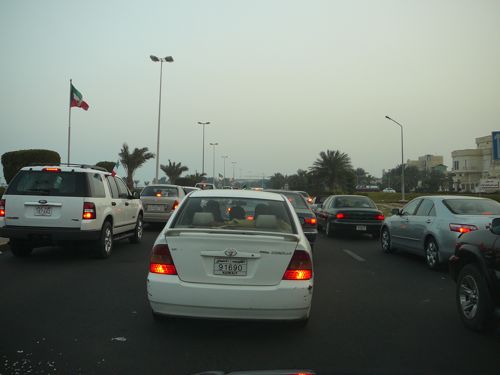
Big mistake. Suddenly I am caught in semi-gridlock, and the worst kind, gridlock with gangs of adolescents wandering the sidewalks on both sides of the car, gridlock with main routes being barred, gridlock with people in adjacent cars spraying each other with high arching streams of foam – it’s like suddenly being in the middle of a nightmare.

Except this is a very contained nightmare. These people are having a lot of fun. Although we are inching along, children are hanging out of windows, I suddenly realize – yes, their parents know where they are – their parents are driving.
No one sprays foam at me. There seem to be rules; the only spray I see exchanged is between people foaming at each other; they leave me alone. As we inch along, horns start the beep-beep beep-beep-beep of weddings and soccer cup wins,
and people seem to be relaxed, not anxious, not speeding and aggressive. Although it takes me about half an hour to make my turn on to the expressway (the turn lane is blocked by celebrants) I eventually get through.
Later, I get a desperate call from AdventureMan.
“The roads are blocked! I can’t get through! I have to get over to the right turn lane and I don’t think I can get through all these cars! It’s gridlock!”
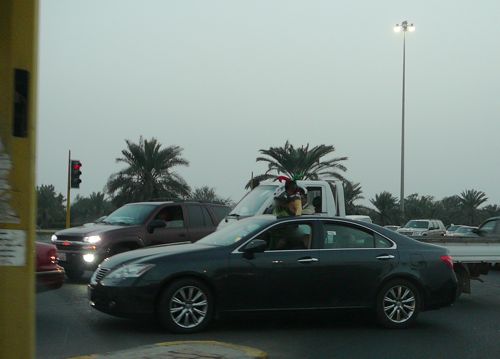
He is in a different part of the city, but same problem.

Where were we last year on National Day/Liberation Day? We don’t remember the traffic being so heavy, so gridlocked! And at the same time, it is fun seeing everyone having such a great time.
Kuwait Tradition?
Last night, out along Gulf road, we got to see first hand all the celebrations for Kuwait National Day and Kuwait Liberation Day. I’m like a kid; I love to see the bright lights! Sorry if these are a little fuzzy, but there is no place to stop when you are dragging along Gulf Road. There are some fabulous lights in downtown Kuwait, sparkling and BRIGHT but impossible to photograph while you are driving along, and – well, you know what it is like to try to find a parking spot, right? Ho ho hohohohho!
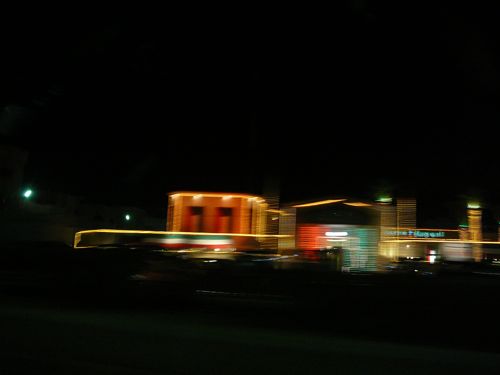

I love to see people out having a good time, I love all the cars covered with Kuwaiti flags – even motorcycles with flags. It’s like one continuous long parade. I love all the decorated buildings, I love the atmosphere of celebration and gaiety. . .
And I found myself wondering how this one particular “traditon” started? How does it get to be something you expect? Those skinny little adolescent boys with their cans of spray foam? People driving with their children hanging out the windows? People in convertibles with their kids sitting on the back seats, goofing off? Where are their parents???
Where traffic is jammed up I can understand that the kids aren’t really in any danger, but once traffic gets going, parents, please, pull your children into the seats where they belong!
Also, I have never seen such a huge police presence. While everyone else is having a five-day holiday, these guys must all be on duty! There were police everywhere, trying to make sure the jubilation didn’t get out of hand. They were polite, they were kind to the youngsters, and they kept a highly visible presence which, I am convinced, is probably necessary. I think they are doing a great job. I like it a lot when protection is gently provided. 🙂
Saudi Men Arrested for Flirting
This is in today’s BBC News.
Saudi men arrested for ‘flirting’
Relations between the sexes outside marriage is against the law
Prosecutors in Saudi Arabia have begun investigating 57 young men who were arrested on Thursday for flirting with girls at shopping centres in Mecca.
The men are accused of wearing indecent clothes, playing loud music and dancing in order to attract the attention of girls, the Saudi Gazette reported.
They were arrested following a request of the Commission for the Promotion of Virtue and Prevention of Vice.
The mutaween enforce Saudi Arabia’s conservative brand of Islam, Wahhabism.
Earlier in the month, the authorities enforced a ban on the sale of red roses and other symbols used in many countries to mark Valentine’s Day.
The ban is partly because of the connection with a “pagan Christian holiday”, and also because the festival itself is seen as encouraging relations between the sexes outside marriage, punishable by law in the kingdom.
You can read the whole article HERE.
I wonder . . . is this what is going to happen in Kuwait? So like they segregate the university. . . then they segregate all the schools, EVEN THE PRIVATE SCHOOLS, so there is no choice. . . then they start patrolling the malls?
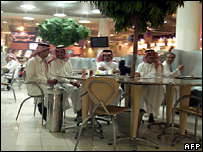
I lived in Saudi Arabia, and I remember the mutawaaeen were NOT police, but sometimes they took on the prerogatives of the police. So I have to wonder, like who made the arrest in the malls? Was it the police? Was it the mutawa hitting the boys with their little sticks? Did they call the boys parents? I have SO many questions!
How Decisions are Made in Kuwait
Here is the problem expats have in any country: you don’t know what you don’t know.
If you know you don’t know something, you can learn it. If you don’t know that you don’t know, there is this huge void in your understanding. Many times you can suspect there is a void, and if you ask, people will look at you like you are a little odd, and they will tell you there is no difference.
There IS a difference.
Working together with people of different nationalities, I have learned that some nationalities just forge on ahead and do things. Some nationalities use a more consultative process. Some nationalities expect to be told what to do and don’t do what they are not told to do.
In Friday’s Kuwait Times (February 21) is a column by Shamael Al-Sharikh, called The red, white, green and black. She talks about Kuwait National and Liberation Days, she talks about the shared heritage of all Kuwaitis (honestly, I would love to link you directly to this article but the website is still down) and then – I got a huge “AHA!” She talks about how decisions are made in Kuwait. I will quote a brief section, but I urge you all to find this column and read it in it’s entirety.
“. . . it has become painfully clear that there are nationals of this country who have no sense of belonging to it whatsoever.
However, the storm is about to subside. In a move that shows just how ready Kuwaitis are to mobilize for the sake of their national pride, a few diwaniyas in Kuwait signed a petition and sent it to the Takatul Shaabi political alliance at the National Assembly. It stated that unless MPs Adnan Abdulsamad and Ahmad Lari are asked to withdraw their membership from the Takatul Shaabi, none of it’s members will be welcome in Kuwait’s diwaniyas nor at weddings and funerals.
The move worked: the MPs have been asked to leave. . . the petitions included diwaniyas from all corners of the Kuwaiti society, both Sunni and Shiite, and it covered all sorts of ethnic backgrounds. . . I have never been more proud to support the red, white, green and black than I have now, and I am so proud to be a Kuwaiti.”
Not being welcome in diwaniyas, at weddings or at funerals is not something I would have considered political pressure. It matters here. It mattered enough that when diverse communities within Kuwait made the threat, it was effective. Who knew? Thanks to this column, I learned something I didn’t even know I didn’t know.
Recent Comments
ExpatAlien on What Country am I Living … intlxpatr on Yellowstone: Old Faithful to C… Michelle on Yellowstone: Old Faithful to C… Cathy on No Grown-Ups in Charge intlxpatr on Waiting for Snow Wikipedia Donate Button

Amazina


Early Voting in Florida


 Here There and Everywhere