Parting the Waters

We all know how Moses parted the Dead Sea to allow passage for the departing Israelites, but in today’s reading from the Old Testament, we are reminded that two other great prophets, Elijah and Elisha, were also able, with God’s help, to part the seas. This is from the Bible; does the Qur’an have a similar reading?
2 Kings 2:1-18
2Now when the Lord was about to take Elijah up to heaven by a whirlwind, Elijah and Elisha were on their way from Gilgal. 2Elijah said to Elisha, ‘Stay here; for the Lord has sent me as far as Bethel.’ But Elisha said, ‘As the Lord lives, and as you yourself live, I will not leave you.’ So they went down to Bethel. 3The company of prophets* who were in Bethel came out to Elisha, and said to him, ‘Do you know that today the Lord will take your master away from you?’ And he said, ‘Yes, I know; keep silent.’
4 Elijah said to him, ‘Elisha, stay here; for the Lord has sent me to Jericho.’ But he said, ‘As the Lord lives, and as you yourself live, I will not leave you.’ So they came to Jericho. 5The company of prophets* who were at Jericho drew near to Elisha, and said to him, ‘Do you know that today the Lord will take your master away from you?’ And he answered, ‘Yes, I know; be silent.’
6 Then Elijah said to him, ‘Stay here; for the Lord has sent me to the Jordan.’ But he said, ‘As the Lord lives, and as you yourself live, I will not leave you.’ So the two of them went on. 7Fifty men of the company of prophets* also went, and stood at some distance from them, as they both were standing by the Jordan. 8Then Elijah took his mantle and rolled it up, and struck the water; the water was parted to the one side and to the other, until the two of them crossed on dry ground.
9 When they had crossed, Elijah said to Elisha, ‘Tell me what I may do for you, before I am taken from you.’ Elisha said, ‘Please let me inherit a double share of your spirit.’ 10He responded, ‘You have asked a hard thing; yet, if you see me as I am being taken from you, it will be granted you; if not, it will not.’ 11As they continued walking and talking, a chariot of fire and horses of fire separated the two of them, and Elijah ascended in a whirlwind into heaven. 12Elisha kept watching and crying out, ‘Father, father! The chariots of Israel and its horsemen!’ But when he could no longer see him, he grasped his own clothes and tore them in two pieces.
13 He picked up the mantle of Elijah that had fallen from him, and went back and stood on the bank of the Jordan. 14He took the mantle of Elijah that had fallen from him, and struck the water, saying, ‘Where is the Lord, the God of Elijah?’ When he had struck the water, the water was parted to the one side and to the other, and Elisha went over.
15 When the company of prophets* who were at Jericho saw him at a distance, they declared, ‘The spirit of Elijah rests on Elisha.’ They came to meet him and bowed to the ground before him. 16They said to him, ‘See now, we have fifty strong men among your servants; please let them go and seek your master; it may be that the spirit of the Lord has caught him up and thrown him down on some mountain or into some valley.’ He responded, ‘No, do not send them.’ 17But when they urged him until he was ashamed, he said, ‘Send them.’ So they sent fifty men who searched for three days but did not find him. 18When they came back to him (he had remained at Jericho), he said to them, ‘Did I not say to you, Do not go?’
Friday Surf Fishing
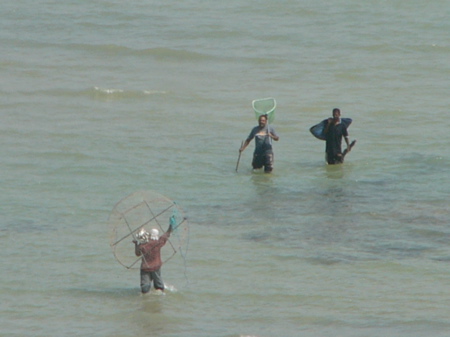
The fishermen brought in a lot of fish, just fishing near the shore. Later, at low tide, they also gathered shell fish. I would love to smell and taste the feast they had after sundown!
Tuna Tunisienne
I didn’t dare publish this photo before the day’s fast had ended. Doesn’t it look just yummy?

We all know what tuna salad is all about, right? A can of tuna, maybe some pickle, and some mayo, slosh it on the bread and you’re done? If you’re getting fancy, you can grill it?
When I moved to Tunisia, I learned a whole new way to eat tuna – I still add the sweet pickle, but now, I also add a LOT of parsley, a little lemon juice, some finely chopped onion, coarse pepper and salt, and then, just a little mayo.
It has a fresh flavor. You can taste all the individual tastes, but together they are magnificent. If you have any capers, you can throw them in, too. C’est magnifique!
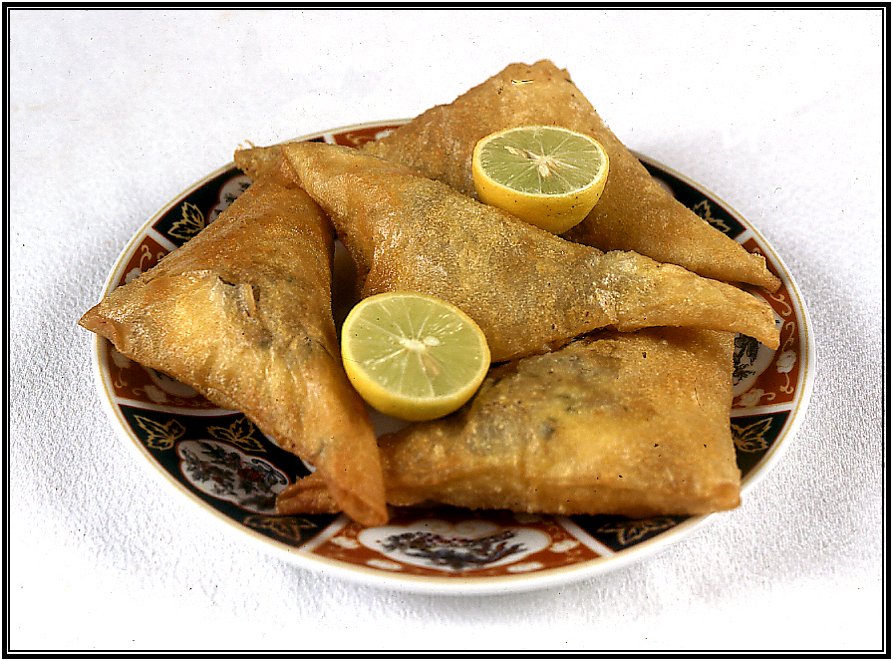
This is how the Tunisians fix their tunafish, in a very common appetizer dish called brik (breek), probably distantly related to the Turkish borek. Sometimes made with just egg, sometimes with tuna and egg, it was the inspiration for my own tuna salad sandwich.
I can actually make brik, but there is no substitute for fresh Tunisian brik, made in Tunisia, with the special very thin brik skins that fry up thin and crisp in the best Tunisian olive oil. The photo is from PromoTunisia.
Rock Star Parking
Ya’ll know that a lot of this blog is about cross-cultural experiences, but this one is cross-cultural in our own family.
You know, every family, every tribe of us, has its own rituals and ways of doing things, and even when you marry someone you think you know very very well, you are in for some surprises.
One of the surprises in our marriage was that my husband thought I was supposed to fill the gas tank. Hello? Fill the gas tank? That’s MENS stuff, don’t you know? We had some tense moments in our first couple months of marriage working that one out, especially when I would leave him with nearly empty gas tank. My husband was rightfully flummoxed by my ability to be both a feminist and a princess, thinking that filling the tank and fixing car problems was HIS work. I learned *huge sigh* to watch the level of gas, to fill the tank, and to take the car in for services. *another big sigh*
But one thing that drove my husband right up the wall was my thing about parking close to the door. Well, I will give him this, he did not grow up in Alaska or in Seattle, he doesn’t know about freezing cold winds and mounds of snow and driving rain and winds that turn umbrellas inside out. My husband didn’t know that husbands, like daddies, are supposed to find the perfect spot as close to the entry as possible, every single time, or to drop us off and meet us inside. No, given I was a feminist, he expected to just take any old spot and I would just walk with him to wherever we would go. We never got that one worked out.
Not until a couple years ago. I learned that my mistake was all in trying to explain the irrationality of family culture. I learned that it was all about marketing, about positioning, something that normally I am very sensitive to and very good at doing. I was hopelessly blind in my approach and hopelessly single tracked.
It all changed when we were taking a new employee on a sight seeing tour of Kuwait. When we got to the grocery store, suddenly a spot opened up right in front of the store.
“Wooooo Hoooooo!” hooted the new guy, “ROCK STAR PARKING!”
I could see my husband straighten up and preen a little as he thought of himself as a person who got “rock star parking.” The light went on. Once he started thinking of himself as a “rock star parking” kind of guy, I never had to walk a long distance to the entry again.
(Woooo HOOOOOOOOO!)
A Thousand Splendid Suns
Once I picked up Khaled Hosseini’s A Thousand Splendid Suns, I barely put it down again until I was finished. I found myself thoroughly involved in the lives of Mariam and Leila, unwilling even to stop to fix dinner! The author of Kiterunner has hit another home run.
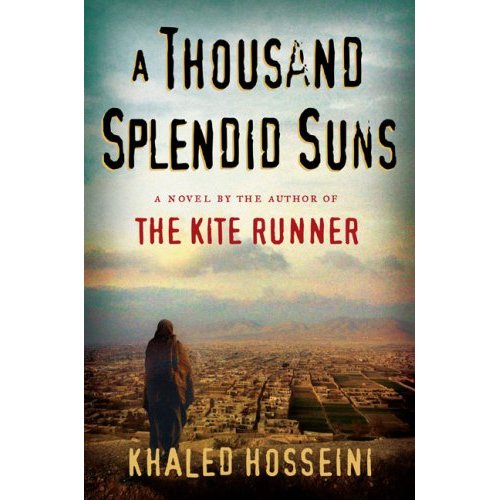
There was a time when we would listen to older state department types talk – with enormous longing – about their tours of duty in Afghanistan, pre-Soviet invasion, pre-Taliban, pre-American occupation. Have you ever read James Michener’s Caravan? There are two countries I long to vist, but the countries they are now are not the countries I heard people talk about – Afghanistan and Ethiopia. Our friends loved their times in these two countries.
A Thousand Splendid Suns opens in a small village outside Herat, and then takes us to Kabul. Mariam is born harami, a bastard, of a village cleaning woman in the house of a very wealthy man. Her father builds a small hut for her mother and herself in a remote part of the small village, and visits Mariam every week. Life is simple, and difficult, but also full of kind people who visit and who are concerned with Mariam’s welfare.
After marrying, Mariam goes to Kabul and learns a new way of life with her husband, Rasheed. What fascinates me with Hosseini is that while Rashid is one of the villians of this novel, he is just a man, doing the best he can given his own upbringing and limitations. In a sense, he is “everyman”, the strutting, domineering, sometimes brutal and abusive husband we find in every culture. But Hosseini also gives him transient bouts of kindness which blow through a little less often than the transient bouts of cruelty.
He also gives us good men, in this book, in the person of Jalil, the father of Mariam, who steps up to the plate in acknowledging Mariam and supporting her and her mother, but fails to nurture in the very real way women need nurturing from their fathers in order to reach their full potential in life. Hosseini also gives us a very strong man in the book, Tariq, who, although he has only one leg, is more wholly a man than any other man in the book. I imagine that this is not unintentional. (How Kissingerian is that for a double negative?!)
Written almost entirely in the Afghan world of women, we see through the eyes of Mariam, and later Leila, the transitions in Afghanistan and their impacts on daily life. We experience happiness with them, and peaceful scenes in quiet moments, raising the children, stepping outside into the garden at night to share a cup of tea and a shared bowl of halwa.
Between the moments of peacefulness, we also experience incoming morter rounds, explosions, marauding bands of warlords, and starvation. We go into a women’s hospital under Taliban control, where there are no medications, no running water, no instruments, and an Afghani female doctor does a C-section with no anaesthesia and is required to keep her burqa on. We watch a mother abandon her role and take to her bed when her two sons are killed fighting the Soviets, we experience betrayal and we experience helplessness, and we experience a Kabul women’s prison. A Thousand Splendid Suns is a rich feast of experiences, juxtaposing the everyday chores of women around the world – cooking, raising children, laundry – with events on the world stage.
(Available from Amazon for $14.27 plus shipping.)
K-Ville premiers tonight
Notice today from Amazon:
we thought you’d like to know that K-Ville, the new crime action series starring Anthony Anderson and Cole Hauser, premieres Tonight at 9/8c on FOX.
From writer and executive producer Jonathan Lisco (NYPD Blue, The District) comes K-Ville, a new police drama set and filmed in New Orleans. Marlin Boulet (Anthony Anderson) is a brash veteran of the NOPD’s Felony Action Squad, the specialized unit that targets the most-wanted criminals. He also held his post during Hurricane Katrina, spending days in the water saving lives and keeping order, even after his partner deserted him. Boulet’s new partner, Trevor Cobb (Cole Hauser), was a soldier in Afghanistan before joining the NOPD. Though committed to his new job, he’s less than comfortable with Boulet’s methods – and is harboring a dark secret.
Here is the official website:
I don’t know how to get these things and it just isn’t that important to me, but you tech-savvy people might have some fun with this. And it IS New Orleans! The music is worth a visit, just to view “Anthony gives Cole some advice about gumbo.” 😉
Peter Bowen: Wolf, No Wolf
“You have to take this. You’ll really like it,” Sparkle insisted as I inwardly groaned, thinking of the TWO stacks of unread-must-reads by the side of my bed, and my already bulging suitcases.

“I know it doesn’t sound like something you’ll like,” she went on, slightly frustrated with me, with herself, “but once you start reading, you’ll get into it.”
Not exactly a ringing endorsement, but good enough for me. I always KNOW what I think she will love, and she has done me many a favor in return, introducing me to authors and series worth reading.
“It’s about Montana. The main character is mixed Indian and French and some other things, a grandfather, and it all takes place in a small town in Montana . . . ” she sort of fizzles out. “I’m really not doing a very good job of making this interesting.”
And she sighs in frustration.
So, about a month later, just because I love my sister, I pick the book up and start reading while waiting for my husband to get home for dinner. As it turns out, he is very very late – and I am very very glad. I don’t want to stop reading!
When you first jump into Wolf, No Wolf by Peter Bowen, it takes you a minute to adjust your ear to the way they talk. These aren’t people most of us have met before. Gabriel DuPre´ is m´etis, a mixed blood. His ancestors are French who came early to the great continent that is now the US, Canada and Mexico, and they trapped and hunted, married native American wives, and developed a culture all their own. His language pattern is similar to that of the Cajun in Louisiana.
He is a cattle brand inspector in this small Montana town. His children are grown, he has so many grandchildren he can’t remember all their names. Every now and then, he pins on his deputy sherrif badge to solve a mystery in the small town of Toussaint, Montana.

Here is how Wolf, No Wolf opens:
Du Pre´ fiddled in the Toussaint Bar. The place was packed. some of Madelaine’s relatives had come down from Canada to visit. It was fall and the bird hunters had come, to shoot partridges and grouse on the High Plains.
The bird hungers were pretty OK. The big game hunters were pigs, mostly. The bird hunters were outdoors people; they loved it and knew it, or wanted to. The big game hungers wanted to shoot at something big, often someone’s cows.
Bart had bought a couple thousand dollars’ worth of liquor and several kegs of beer and there was a lot of food people had brought. Everything was free.
Kids ran in and out. The older ones could have beers. Bart was tending bar. Old Booger Tom sat on one of the high stools, cane leaned up against the front of the bar.
“You do that pretty good for someone the booze damn near killed,” said Booger Tom. “I know folks won’t be in the same room with the stuff.”
“Find Jesus,” said Bart. “It’s not too late to save your life.”
He went down to the far end of the bar and took orders. Susan Klein, who owned the saloon, was washing glasses at a great pace.
One of Madelaine’s relatives was playing the accordion, another an electric guitar. They were very good.
Du Pre´ finished. He was wet with sweat. The place was hot and damp and smoky, so smoky it was hard to see across the room. The room wasn’t all that big, either.
Madelaine got up from her seat, her pretty face flushed from drinking the sweet pink wine she loved. She threw her arms around Du Pre´ and kissed him for a long time.
“Du Pre´,” she said, “you make me ver’ happy, you play those good songs.”
. . …
Someday this fine woman marry me, thought Du Pre´, soon as the damn Catholic church, it tell her OK, your missing husband is dead now so you can quit sinning, fornicating with DuPre´.
I’ve never hung out in a bar in Montana, fiddled, or had a girlfriend named Madeleine (!), but already I feel like I know these people and this life. Peter Bowen is the Donna Leon of Montana, introducing us to the kind of crimes that happen in those sleepy looking towns we drive past on the superhighways, glancing at, or stopping to fill our gas tanks.
DuPre´ is a good man, and, like many a good man, sometimes has to do a bad thing to protect those he is sworn to protect. Policing is not pretty business.
The first story has to do with the re-introduction of wolves back into the Montana highlands, something not at all popular with those who have been raising cattle there. The second book in this two-book collection has to do with serial killers, how they stay under the radar, and how very difficult it is to catch them.
In both books, it is as much about a new way of living and thinking as it is about solving the crime. DuPre´ consults often with his friend Benetsee, the local medicine man, who sees things we don’t see. One of the FBI Agents is Harvey Wallace, also more than half native American, whose real name is Harvey Weasel Fat. The books are about how men and women fight, the nature of male friendships and female friendships, and very much about the human condition wherever we may be.
Life is short. I can never live in all these places long enough to even scratch the surface of the flavor of each variety of life. But these books help, they give us glimpses into another way of thinking, another way of doing things, and stretches our little minds just a little so that we learn to think more flexibly.
So who is going to write the Kuwait detective series? Who will take us into the diwaniyyas seeking information, who will take us out on the shoowi to gather information against those delivering drugs to Kuwait, with whom will we camp in the desert, avoiding explosives left over from the Iraqi invasion? I think his name is Anwar al Kout (the light of Kuwait!) and his wife is Suhail (the Yemeni Star!) – somewhere out there is someone who can take us into Kuwait and bring it alive. Where are you?
(You were right, Sparkle. I loved it!)
Wooo Hooooo Doctor Diamond!
I am bursting with pride. And she’s not MY daughter, I have nothing to do with her success, she’s done this all on her own. My niece, Little Diamond is now DOCTOR DIAMOND!
I don’t imagine I will remember to think of her as Doctor Diamond all the time; I will probably still call her Little Diamond.
Little Diamond, Doctor Diamond, we are all so proud of you. We dance of joy at your accomplishment, and your determination, and how very very GOOD you are! Wooo Hooooooooo!

So here is something very cool. There is a Wikipedia article that tells you all about academic dress for different levels of educational attainment. In the olden days, and at a very few universities today, gowns (like robes, kind of like abyaa3t) are worn to classes. With each level you attain – Bachelor’s degree, Master’s degree, Doctorate – you get to wear different additions – capes, hoods, etc.
Most of the time you never get a chance to wear them again after graduation. Unless you are an academic, and then you wear them for every university graduation. It is particularly colorful when all the professors troop in, very medieval, wearing their university colors and their degree colors (yes, those are different.)
Woooo Hooooo, Doctor Diamond, c’mon over here and we will have a robe made of silk with sparkles on it! Adventure Man asks if we get a family discount for consultations?
Feeding Stranded Bangladeshis
In today’s Arab Times is an op-ed piece by the Rev. Andy Thompson on the continuing plight of Bangladeship workers, whose employers stopped paying their 20KD salary PER MONTH (can YOU imagine?) and who now – only want to go home.
Over the summer, many people from many walks of life in Kuwait worked together to help try to see that these men got some food, and then tried to find a more equitable and lasting solution.
By Rev Andy Thompson
St Paul’s Anglican Church, Ahmadi
JUST before the summer holidays started, the Arab Times recorded a disturbing story about the plight of over a thousand Bangladeshi workers who had not been paid their paltry KD 20 a month for many months and so they consequently went on strike. With no money, no hope and living in appalling conditions these workers were at the end of their tether. A subsequent Arab Times article called “You can make a difference”, challenged readers to respond by at least making sure that the Bangladeshi workers did not go hungry. The story had clearly touched the hearts of many Arab Times readers and the response was fantastic. Over the last two months, food has been flowing into the Bangladeshi workers residence. I wish I could publicly acknowledge the many people who helped, but typically they gave generously and anonymously. They include both Kuwaiti and expatriate, rich and poor, Christian and Muslim. They were united in their repulsion of the inhuman and unacceptable treatment by a greedy and unscrupulous company who traded human misery for profit
You can read the rest of the article (and it is worth reading) HERE.
Ramadan Date Night
It’s the first night of Ramadan, and it is also Thursday, which is date night for Adventure Man and me. We hustle around all week, involved in our lives, grabbing ten minutes here and a phone call there, sitting down to dinner and that’s about it. But Thursday nights, we have the sweet luxury of time together. We go out to dinner somewhere, and we talk on the way there, we talk all through dinner and we talk on the way home. We both love date night.
Date night on the first night of Ramadan is REALLY special. Here is why:

“What’s so special?” you are asking in puzzlement. “That’s just an empty parking lot.?”
“EXACTLY!” I exclaim, triumphantly. “At seven in the evening, there are PARKING SPACES!” In a mall built for thousands of people that has only forty parking spaces! And we get Rock Star Parking!”
And unlike countries where they start putting up Christmas decorations in October, the Ramadan decorations began going up seriously yesterday, the beginning of Ramadan. They are still finishing up tonight.

I love the crescent moon and stars twirling down from these –


And look at these GORGEOUS lanterns!

There is no one around to object to my photo-taking. All the Westerners are eating or shopping while the mall population is so light.
Traffic is so light that we even stop for gas on the way to dinner, and drive right up to a pump with no wait at all. All the good Muslims are at home, or with friends, breaking the fast together, celebrating their triumph over the first day of fasting.
If you lived in Kuwait, you would know what a triumph it is. The weather is cooling, but still very hot – around 111°F/44°C every day this week. It is dry, and on some days there are sandstorms. Even when you are not fasting, you yearn for a cold drink of water.
The women often cook all day. They do the shopping. Many are around food most of the hours of their fast, so that they might provide a feast for their family when the sun sets, and they resist the temptation, just smile and say “It’s a test.” There is a custom that they can taste the food, to make sure it is OK, but they cannot swallow, or the fast is broken.
Recent Comments
ExpatAlien on What Country am I Living … intlxpatr on Yellowstone: Old Faithful to C… Michelle on Yellowstone: Old Faithful to C… Cathy on No Grown-Ups in Charge intlxpatr on Waiting for Snow Wikipedia Donate Button

Amazina


Early Voting in Florida


 Here There and Everywhere