Cooking Up That Angry Food
I have a friend that helps me keep my house clean. I started out as her employer, and now we have become friends. She lives a very different life from me, and I learn from her. Sometimes her perceptions will catch me by surprise.
As we were talking about volunteers and volunteering in churches, we found our churches to be very similar – and I am betting these experiences are universal.
“I’ve always liked washing dishes,” I tell her, “because nobody else wants the job, nobody is telling me how to do it, and I can just keep my head down and stay out of the uproars.”
“Yeh,” she says, “arguing over the little things, cooking up that angry food.”
“Angry food?” I ask.
“”Yeh, you know, you can taste it. When people are calm and happy, they cook differently, and the food comes out good, you can taste the love in it. When they in a hurry, or upset about something, food come out angry.”
Yep. I’ve cooked an angry meal or two myself. It’s a waste of good ingredients. You might as well just open a can of soup as cook angry food.
Viking Sea: Katakolon – Low Expectations, High Return
We know from all our previous travels that this is a good day to have a down day. When you tour every day, details begin to blur, and enthusiasm wanes. We’ve lived amidst ancient ruins in Tunis, and Jordan, and while we love them, we don’t want to be trapped in groups of 40, unable to set our own pace.

We opt not to take a tour, and have a leisurely breakfast in Mamsen’s discussing what, if anything, to do.
For many hours, we are the only ship in port, and then the Aida Bella also berths. They have their sound system on continuously, October-Fest sort of lively German song fill the air. It is hilarious, and we are really glad not to be on that ship.


We think the design on her bow is hilarious.
There is a little town where we are docked, and we are eager for a walk.

There are a lot of shops, most of which we are immune to because we shopped in Corfu. Then we find the Katakolon Museum of Ancient Greek Technology. This museum is small, but packed with very cool things. It has just opened, we are the only visitors, and the young woman at the desk shows us how a lot of the beautifully hand-build models demonstrate the old discoveries and how they were applied. I took this one blurry photo before AdventureMan pointed out the sign that said “No photos.”
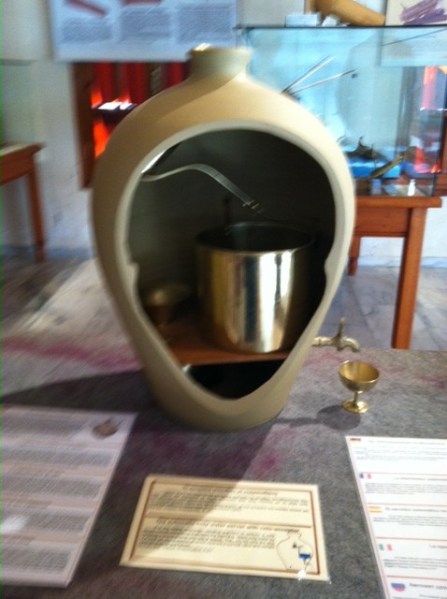
The creator of this museum in a man we would love to meet. We are nerds. We recognize and love talking with other nerds. This man happens to be an engineering nerd who wants the world to understand natural principles and how they have been discovered and applied to make our lives easier. He built the models, he created all the visual explanations.
The high point is a poster showing how each discovery and application is still used in the creation of modern cars.
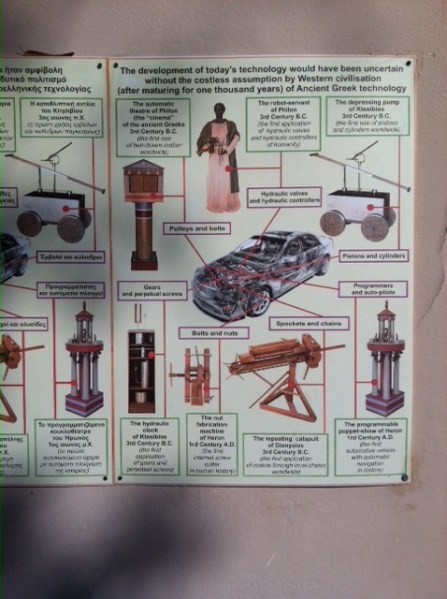
That poster was outside, and it was allowed to photograph it.
We walked back toward the ship, found a coffee shop alongside the port and settled in over Greek coffees to watch passers-by.
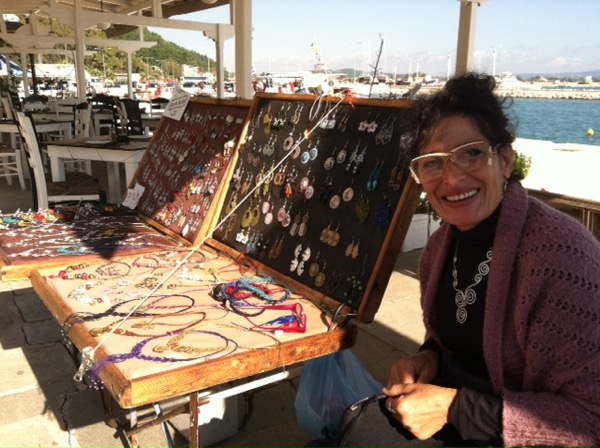
Nearby was a woman with some earrings I loved, in the “long life” pattern. She gave me a good price. I told her they were for my daughter-in-law, and she drew back, astounded, and told me she didn’t speak English well, so she must have mis-understood me, they must be for my daughter. I explained “no, I really love my daughter-in-law as if she were my own daughter and she gave me another pair of earrings for my mother, and lowered the price. (!) She told me it is the end of the season, these are the last cruise ships, and people are selling off their wares. It was such an unexpected blessing to meet her and talk with her.

Late in the day, we leave Katakolon. The ship got under way so quietly, I didn’t even realize we were moving.

“You Will Eat Every Bite, and You Will Smile”
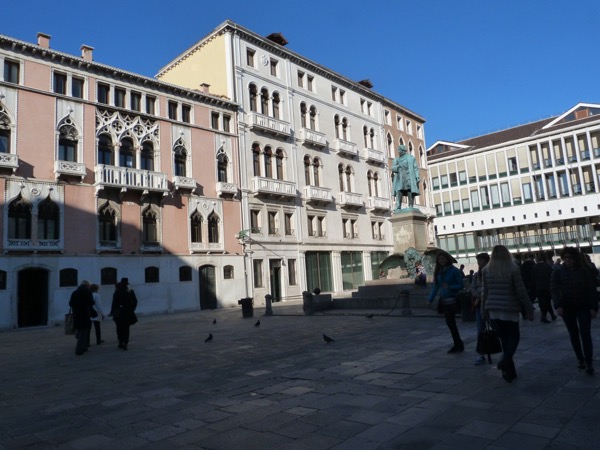
We wander the streets, following Guido Brunetti’s path, and then wander back towards San Marco and our shuttle back to the hotel. We’ve spent the day wandering, on foot and on vaporetto, and we are beginning to feel a need for a nap before dinner. Wandering in Venice is sheer delight:
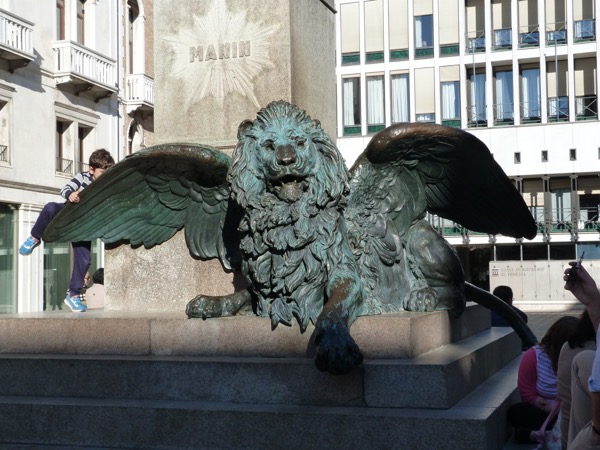

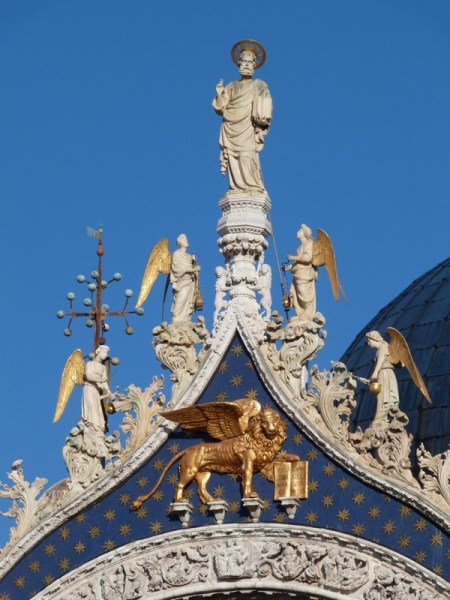

When we get to where the shuttle is supposed to be, there are, literally, hundreds of touristy looking people, and fortunately, several Viking people. We ask about the shuttle back, and they say it will come in half an hour. We head for the nearest cafe and check to make sure it has a ladies room, which it does, but oh-my-goodness, no seat, no lid, and a pull thing to flush, just like the old days when we lived in Germany when I was a kid. These people know the value of location – take a look at the prices.
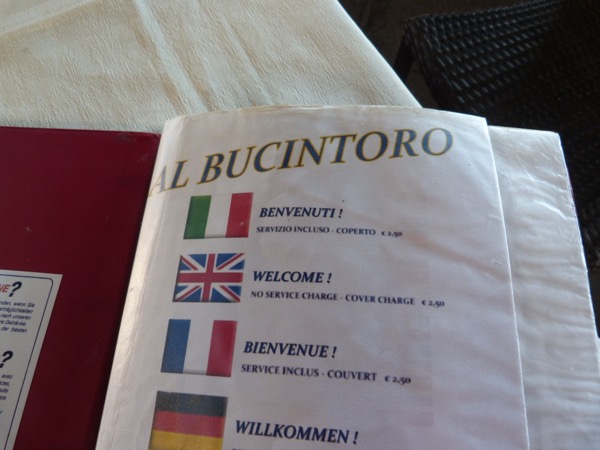
The waiter was shocked! Shocked! when we asked for ice cream. No! No! Never in October! (LOL, we didn’t know!) I ordered a coffee and AdventureMan ordered a Tiramisu.


The Tiramisu was fabulous, everything we have dreamed of so long. It had liqueur in it! It had that unforgettable taste!

We tell a story in my family of our first trip to Italy, when I was 15 and my sisters were younger. It was my Mother’s birthday, and at the hotel where we were staying, they presented her with a surprise birthday cake. It was all so lovely and so gracious. My Mother cut the cake and the waiters brought pieces of it to us, and then, as my mother bit into her piece, she grimaced – the cake was soaked with liqueur. She told my father in a low voice, and he looked at us girls, with a fixed smile that told us he meant business and said “You will eat every bite, and you will smile.”
We were raised to be gracious, and to have grateful hearts. I don’t remember being so all-full-of-gratitude at the time, but I grew to like the Italian style. and didn’t realize how much I had missed it until I tasted this REAL tiramisu.
I remember that also, very graciously, after we had each eaten our piece, even my little 6 year old sister, choking down that liqueur soaked cake, my mother asked the management to please share the joy of her birthday by sharing the rich cake with all the employees and guests (it was a large cake).
“Guido Brunetti Sent Us” (Rosa Rossa Restaurant)
AdventureMan and I read a series of detective novels set in Venice by author Donna Leon, who lives there. Commissario Guido Brunetti is a patient, thoughtful and smart detective, working under a lazy, corrupt and greedy boss in a country rife with corruption. Each book has a social issue in Venice as its topic, and not lightweight topics – the arrogance of dumping trash, boatloads of trash, off the coast of Somalia (had you ever heard of that before? Neither had I. But it is true, and it has ruined traditional Somali fishing), big pharma and tainted drugs, sex tourism and human trafficking, governmental bribery – Donna Leon fearlessly tackles them all.
Guido Brunetti loves Venice, and he loves his family. His solace in life is his wife, a professor of literature at the university, and his two children. His wife cooks meals that make the reader’s mouth water as they read, or Guido and one of his lieutenants will stop at a restaurant for lunch.
In one of the books, “Blood From a Stone,” American tourists give evidence to a stabbing they witness on their way to dinner. To thank them for their help, he directs them to a GOOD Venetian restaurant, and tells them to say Guido Brunetti sent them.
We don’t say that. No matter how real Guido Brunetti has become to us, we know he is not real, and we don’t say he sent us. But we do take the tiny winding back lanes to find Rosa Rossa, and while we order familiar salads, we also order Venetian specialities for our main courses.
Rosa Rossa on a tiny but busy street:

AdventureMan’s favorite salad; he loves Caprese:

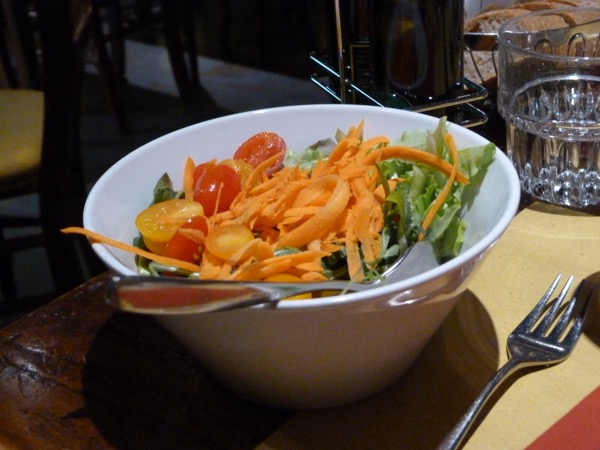
I had a garden salad:
I love black spaghetti, or Pasta Nero. It is made with squid, and squid ink, and I first had it at a lovely dinner a long time ago in Damascus, Syria, served by a beautiful Italian who swore t me that this dish is Southern Italian. If so, I ordered it anyway, in honor of Beatrice, and it was delicious.

AdventureMan ordered Pasta with Squid and pepperoncini, and he said it was very piquant, and that he has never eaten so much squid in his life at one time.

We passed on dessert, knowing we still had miles to walk, and possibly a gelato toward the end. We had such a short time to enjoy Venice, searching for and finding Rosa Rossa was a lot of fun, and a great adventure. They took good care of us, and the food was delicious.
Peaceful Transfer of Power: It’s What We Do

President Obama acted with his customary graciousness, quick to invite the new President-Elect to the White House to discuss the transition. Once the election is over, we do the right thing. It doesn’t matter what your feelings are, or the words spoken in the heat of the election, the vote has been taken, and the winner becomes President. We pride ourselves in an orderly transition.
It is not, however, a mandate, no matter how many times the Republicans say it. In most states where Trump won, it was by one tenth of one percent – or less. He lost the popular vote; Hillary Clinton won that by about 200,000 votes. So while more people voted for Hillary overall (this has happened before, with the George Bush v Al Gore election), Trump won the electoral college. No one expected this, not even Trump supporters. A mandate requires a substantial victory. This was a squeaky victory.
But a victory. On. On. Those of us who did not support Trump have a lot of work to do in the following months, shoring up agencies who support immigrants, reproductive rights, gender issues, regulations of air quality, water quality, food quality and restraint of corrupt financial practices by banks and lending organizations. We will need to truly be Stronger Together to combat the onslaught against the common citizen.
Deborah: Not a Childrens’ Story
Following the nomination of Hilary Clinton, the first female nominee of a major political party, we have this reading in the Lectionary from Judges. As I read it, I am thinking “I wonder why we don’t have more daughters named Deborah? Or Jael? And I am also thinking this is not – yet – a story for our 6 year old grandson and almost three year old granddaughter.
Love it that the Lord’s general was Barak, blessing in both Aramaic and Arabic, brother languages, brother cultures, divided by a dismal and long lasting fight about inheritance. Alas, there is no fight as bitter as a family fight.
Judges 4:4-23
4 At that time Deborah, a prophetess, wife of Lappidoth, was judging Israel. 5She used to sit under the palm of Deborah between Ramah and Bethel in the hill country of Ephraim; and the Israelites came up to her for judgement. 6She sent and summoned Barak son of Abinoam from Kedesh in Naphtali, and said to him, ‘The Lord, the God of Israel, commands you, “Go, take position at Mount Tabor, bringing ten thousand from the tribe of Naphtali and the tribe of Zebulun. 7I will draw out Sisera, the general of Jabin’s army, to meet you by the Wadi Kishon with his chariots and his troops; and I will give him into your hand.” ’ 8Barak said to her, ‘If you will go with me, I will go; but if you will not go with me, I will not go.’ 9And she said, ‘I will surely go with you; nevertheless, the road on which you are going will not lead to your glory, for the Lordwill sell Sisera into the hand of a woman.’ Then Deborah got up and went with Barak to Kedesh. 10Barak summoned Zebulun and Naphtali to Kedesh; and ten thousand warriors went up behind him; and Deborah went up with him.
11 Now Heber the Kenite had separated from the other Kenites,* that is, the descendants of Hobab the father-in-law of Moses, and had encamped as far away as Elon-bezaanannim, which is near Kedesh.
12 When Sisera was told that Barak son of Abinoam had gone up to Mount Tabor, 13Sisera called out all his chariots, nine hundred chariots of iron, and all the troops who were with him, from Harosheth-ha-goiim to the Wadi Kishon. 14Then Deborah said to Barak, ‘Up! For this is the day on which the Lord has given Sisera into your hand. The Lord is indeed going out before you.’ So Barak went down from Mount Tabor with ten thousand warriors following him. 15And the Lord threw Sisera and all his chariots and all his army into a panic* before Barak; Sisera got down from his chariot and fled away on foot, 16while Barak pursued the chariots and the army to Harosheth-ha-goiim. All the army of Sisera fell by the sword; no one was left.
17 Now Sisera had fled away on foot to the tent of Jael wife of Heber the Kenite; for there was peace between King Jabin of Hazor and the clan of Heber the Kenite. 18Jael came out to meet Sisera, and said to him, ‘Turn aside, my lord, turn aside to me; have no fear.’ So he turned aside to her into the tent, and she covered him with a rug. 19Then he said to her, ‘Please give me a little water to drink; for I am thirsty.’ So she opened a skin of milk and gave him a drink and covered him. 20He said to her, ‘Stand at the entrance of the tent, and if anybody comes and asks you, “Is anyone here?” say, “No.” ’ 21But Jael wife of Heber took a tent-peg, and took a hammer in her hand, and went softly to him and drove the peg into his temple, until it went down into the ground—he was lying fast asleep from weariness—and he died. 22Then, as Barak came in pursuit of Sisera, Jael went out to meet him, and said to him, ‘Come, and I will show you the man whom you are seeking.’ So he went into her tent; and there was Sisera lying dead, with the tent-peg in his temple.
23 So on that day God subdued King Jabin of Canaan before the Israelites.
Cross Culture at the Y: “Don’t Ever Say That to an African American”
I had just finished chatting with Leilani and was getting ready for class to start when my class friend who in in front of me came up to me and put her arm around me. We are always joking around, so I was laughing, and she said “I have something to tell you.”
I pulled back a little because I could see she was serious, and I wanted to see her face.
She said “Last week in the pool you said you were gonna kick my butt. Don’t ever say that to an African-American.”
She is black.
She could see I was confused. I did say it. We joke around, and sometimes there isn’t a lot of space. Her behind was right in front of me, a tempting target. I did say it.
“We never say that in the black community,” she continued. “Our Mama’s never allow that kind of statement. Remember, we were slaves. We’d be on the ground, and people would put their feet on us. People would kick us. To say that to a black person is one of the worst things you could say.”
“I am so sorry. I didn’t know.”
“I know you didn’t. That’s why I’m telling you.” She still had her arm around me. “We hear you people saying that to each other like it’s nothing. It’s something to us.”
I was so thankful she told me, and so embarrassed.
“I was oblivious,” I said. “I had no idea. I am so sorry.”
Later, as we usually do, we talked during class.
“Do you really just say that to each other?” she asked me.
“We do! It’s the kind of thing we say to friends; I would say that to my sister, it’s sort of mock-rivalry sort of talk,” I responded, thinking to myself ‘but I will never never never ever say that again to anyone!’
Later, I thanked her for telling me, and she said she knew I had no idea how offensive it was; it was a cultural thing. I am grateful she trusted that enough to clue me in.
As uncomfortable as that conversation was, I admire her for initiating it, and correcting me in a loving way, for telling me how it feels, and why. I am grateful that she trusts who I am, a person who would never choose to offend, but a person who had, nonetheless, offended, and who would want to know. I feel like it was a genuinely friendly thing to do, and she did it with good will in her heart.
So even in my own country, there are cultural crevasses I can fall into in oblivious unawareness.
And all of that in one morning at the YMCA.
Cross Culture at the Y: Hawaiian Heart
For a year now, I have taken this class next to Leilani, who stands just a little shallower in the pool than I. Today, as we were warming up, one topic led to another. We were talking about getting rid of “things” and she told me a niece had asked for her lighthouse collection, and how was she going to mail them all to her, some of them were almost two feet high?

“Easy-peasy,” I said, “You know those storage tubs people buy at Target? You can use bubble wrap and ship them in those containers. They give fragile items a lot of protection.”
Leilani laughed and said how funny it was she didn’t know that because her husband had been a postman after his retirement from the military.
“Nice!” I said. “Two pensions!”
“Not really,” she said, “The day he retired he came home and handed me divorce papers. He’d been planning this for a long time. ”
“Another girl?” I asked.
“No,” she laughed sadly, “He was greedy. He said ‘You’ll never see a penny of my money.”
“I hope you got a good lawyer” I said.
“I did.” She didn’t look happy. “I had raised the four children, so I got parts of both pensions AND alimony. I don’t need a lot. I was happy.”
I asked if he had been the kind of man who had planned to walk out on her and leave her with nothing, if he had also been mean and stingy during their marriage, and if a part of her found peace when he left. She said because of the four children she would never have left him, but that yes, her life was better when he was no longer there.
“Money doesn’t make a person happy,” she said. “Things don’t make a person happy. You know he went and got a beautiful luxury apartment, and died just a few years later. He had emphysema from smoking all the time. No one to help him. So I went there every day, took him a meal because he couldn’t do for himself. I sat with him at night. I was there when he took his final breath.”
“And you know what he would do while I was out of the room? He would take out his money and count it. It never brought him any happiness.”
My pool friend is one of the sweetest hearted women I have ever met. In all this time, she has never said a bad word about her husband, and she was there by his side as he died. There is no bitterness in her, no anger; she didn’t resent him, she let all those feelings go and did the kind thing for a dying man.
I call this cross-cultural, because she is Hawaiian, and I have seen this kind of serenity in my Hawaiian friends and acquaintances. They are willing to let go of grudges, they are willing to move on. They have generous hearts. I feel like I learned something from her today.
Cross Culture at the Y: “It’s OK to Feel Sad”
My first encounter this morning was in the locker room, with the young water aerobics instructor I really like. I was glad to have a moment with her. I needed to thank her for helping me out the week before, when I started swimming classes with my little “I’m two, almost three” adorable granddaughter.

(This is a photo from the Prescott YMCA, this is not me and my granddaughter )
These are those classes where the parent/grandparent/foster parent is in the pool with the little one, helping them to be slithery fishes, or to safely enter and exit the pool, and we were having a great time until, in her two year old way, she suddenly looked at me and wished I were her mother.
Her face got all screwed up, and I was afraid she was going to cry, so I tried distracting her and it just made things worse.
“I want Mommy!” she cried, little tears streaming down her face. “I want Mommy!”
So I’m trying to explain that Mommy has to work, and that Mommy is not at home, I’m being all rational and my friend, who is also instructing that class, comes up and looks her in the eye and says “It’s OK to be sad! It’s OK to want your Mommy.”
It is?
I am so embarrassed to tell you this, but this was news to me. I grew up with a Dad who said “Stop crying or I’ll give you something to cry about.” It wasn’t just my Dad, it was a generational thing. Crying was unacceptable. I think maybe being sad was unacceptable.
Little grand-daughter stopped crying. Her face showed such yearning. My friend, the instructor told her it’s OK to miss her Mommy and that for today, maybe she could have fun with her Grandmama, me, and little grand-daughter agreed.
From then on, everything was fine.
So I said “thank you for helping me out. We had a great class together Thursday. I’ve been thinking about how you handled her crisis, and how we never said things like that to our kids, but what a difference it made!”
My friend, the instructor also has a two year old, and just grinned. She explained to me about the effects of validation, and that we all need to express our feelings, and to have our feelings acknowledged, and then we can move on. It’s not something I know how to do very well, but I have seen it how effectively it works and I think I am going to learn how to do it myself.
Really, this was more a cross-generational difference, but generational differences are also a sort of cultural difference, are they not?
Cross Culture at the Y
It’s a day I like in Pensacola; it may be summer and still hot and humid, but a little cooler today, with a cloud cover. I woke up refreshed, relaxed, having slept well, and actually, I sort of hoped for thunder so I could skip going to the YMCA for Water Aerobics, and stay home and finish up some quilting.
No such luck – no thunder. The skies were threatening, and leaky, but without the drama of thunder and lightning. No matter. The truth is, I don’t just go because I want to stay fit and strong, I also go because I feel better and more energetic after I’m done.
In retrospect, I would have missed a lot if I had missed today. In the fifteen or twenty minutes before the class, I heard some powerful messages, and I knew I was meant to be there. So my next three posts are about my cross-generational, cross-cultural experiences at my water aerobics class this morning.
Recent Comments
intlxpatr on Shampoo Ginger tigerbutterya0c5ff1d… on Shampoo Ginger intlxpatr on British Soldier Kidnapped, Esc… John on British Soldier Kidnapped, Esc… intlxpatr on British Soldier Kidnapped, Esc… Wikipedia Donate Button

Amazina


Early Voting in Florida


