More Souk Mubarakiyya Art
There’s just something about this market that feeds the photographer’s soul! I love the public art . . .

Whoda thunk that the butcher would be wearing glasses? I love the quirkiness of this art.

The flag the man is carrying says “Kuwait” (for my non-Kuwaiti readers).I think this one has to do with the liberation of Kuwait, but I am not sure . . . anyone? I remember from reading Jihan Rahab’s book on the Invasion of Kuwait that the market was totally trashed and at least partially burned, and a lot of damage was done out of sheer malice.

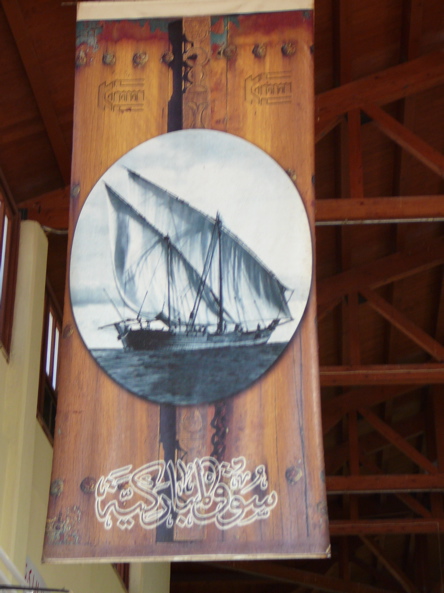
I have this thing about ships!
Just look how CLEAN this place is. Every time I go into any of the markets, I think of France. These markets in Kuwait are cleaner!

Backbiting
Our New Testament reading for today included this passage:
Galatians 5: 13-15
13 You, my brothers, were called to be free. But do not use your freedom to indulge the sinful nature; rather, serve one another in love. 14The entire law is summed up in a single command: “Love your neighbor as yourself.” 15 If you keep on biting and devouring each other, watch out or you will be destroyed by each other.
I love the way this passage describes the truly awful way the things we can say about one another can destroy. “Devour” is a very strong word, and fits perfectly with backbiting, doesn’t it?
I remember one of my first Ramadans, and my friends who were explaining Ramadan to me explained how one of the most important things during Ramadan was absolutely NO BACKBITING.
Answers.com says this:
Back·bit·ing
n.
Secret slander; detraction.
Backbiting, and bearing of false witness.
so I wonder if this is exactly the same in Arabic as in English. The impression I got is that backbiting in Arabic is more like gossip. Backbiting seems to imply that it is not true, but gossip can hurt even if it has a thread of truth. My impression from what my friends were telling me was that saying anything negative or unkind about another during Ramadan was severely discouraged, true or not.
Can you clarify this for me?
Kuwait Detains Teacher
I received the following e-mail this morning; it is being forwarded throughout the Western communities. If this continues, it will make recruiting teachers for Kuwait much more difficult. And what does a child learn, when his parent exacts revenge for a mild – and justified – discipline? This was not a physical act of harm to the child, only an in-school suspension – for fighting!
It is shameful that this is happening, it is an outrage that the embassy is not outraged. I am sure they are doing their best to achieve an incremental diplomatic solution, and the injustice of it is palpable.
I have deleted names because I don’t want any trouble . . . I even considered not publishing it at all. I publish it because people read my blog and want to come to Kuwait to work – and it would not be even-handed not to reveal some of the risks involved. This woman was doing her job, and has become the focus of a vengeful, angry parent. Not good!
International Schools Review received this letter on June 23, 2007
from an international educator being detained in Kuwait. If you can
help her, or know of someone who can, please act immediately.
________________________________
FROM: Al-Bayan Bilingual School Middle School
Deputy Principal, Kuwait
TO: Whom It May Concern
DATE: June 21, 2007
RE: Detained in Kuwait/In Fear for My Safety
I am a Middle School Vice-Principal at Al-Bayan Bilingual School in
Kuwait. I have been employed in Kuwait for 6 years at the same
school.
One of my primary responsibilities is student discipline. On March 8,
2006, three boys in grade 5 were suspended for fighting. I
interviewed the boys, met with my principal and followed normal procedure. There
is no stigma here regarding suspension. Students spend the day in the
office where they study, are visited by teachers, and are taken to
the canteen, etc. It’s a normal consequence for fighting; all students
are aware of this and the procedure is clearly defined in our Parent
Handbook.
In the afternoon of March 8th, I received a phone call from one of
the boys’ fathers, (name deleted) who is a powerful man in Kuwait. He
called to inform me that this situation was “personal,” that he is
“friends with the emir” and that he planned to “destroy” me. This
conversation, which last about 9 minutes, was littered with
profanities and threats.
On March 11, 2006, the parents met with me, my principal and our
director, (name deleted), to discuss the suspension. The father
requested that if there was an issue involving his child that I would
call him immediately.
On April 27, 2006, I was requested to write a synopsis of events and
to visit the Ministry of Education to answer questions regarding the
suspension, describe the room in which the boys spent the school day
and provide a copy of our handbook.
In June 2006, the father transferred his children to a different
private school in Kuwait. Also, we received notification from the
Ministry of Education that in-school suspensions were no longer to be
applied; instead, parents must be contacted to take their children
home.
In February 2007, I learned that a case had been filed against me at
the Jabriya Police Department in Kuwait; the charge was “illegal
detainment” of his son on March 8, 2006. I answered questions in my
director’s presence and the Consul from the US Embassy, (name deleted). My lawyer was also present. The police did not suggest that
there was any reason for me to be concerned as all of the questions
were answered to the apparent satisfaction.
On June 13, 2007, I was at the Kuwait International Airport intending
to fly to Bahrain. I was stopped at immigration where I was informed
that there was a case against me, pending further investigation and
that a travel ban had been placed on me. I had not been informed. My
lawyer had not been informed. This travel ban was placed upon me
15 months after the boy was suspended. The parent said that he would
make this personal and this seems to be what he is intent upon doing.
On Saturday, June 16, 2007, I visited the American Embassy where I
met with the Vice Consul, (name deleted), who informed me that he
sympathized but could do nothing to lift the travel ban. He suggested
that I get an older Kuwaiti man to appeal to Mr. M. I was told
on Wednesday that my file would be transferred to another agency for
review so the ban could be lifted. Five working days later, the
whereabouts of my file are uncertain. I have been told that my file
is in 2 different places; this seems to be a delay tactic. Why? Because
I angered an influential Kuwaiti national who is at the top of the
social register both locally and at the US Embassy?
On I visited the office of a police inspector named (name deleted,)
whose office is in Salmiya. He is a police official who was to
evaluate my file and determine if I could leave or not. He stated
that he didn’t have my file. I visited him on June 17th and 18th. On June
18th, not five minutes after I left his office with my director, the
Business Officer of my school and another school representative, I
called Mr. C, Vice-Consul at the US Embassy to gain his
insight into the situation and to see if any progress had been made
to help me leave. He was completely aware of my visit to Mr. (name deleted)
office and instructed that I not return as it “interfered.”
Several Kuwaiti families are aware of my situation but they are not
in a position to help or they don’t want to get involved. They have ALL
said that I should go to my embassy because my embassy can help me.
The fact that the embassy can’t seems shocking to everyone. Many
people also question why this accusation from Mr. M is placed
solely on me – not the school, not the principal, not the director of
school. I feel that I am being used as an example because I am a
single, American woman and he wants to show others that he can do
what he said which is to “destroy” me.
Yesterday, June 20, 2007, I received a paper from Mr. (name deleted)
office in Salmiya which lifted the travel ban. This waiver had been
granted by the Kuwait Minister of the Interior. Not long after the
Minister released me, he reversed his decision at the request of the
(name deleted) family or his representatives. I went to the airport last
night, only to learn that I couldn’t leave.
I am in fear for my safety. If the Embassy can’t help me, then who
can? I contacted the FBI in Riyad, Saudi Arabia yesterday and talked
to (name deleted) who couldn’t give me his last name. He was non-committal
but did suggest that he thought the embassy should be able to get me out.
(name deleted) has informed me that they are “working on it.” That
seems a little vague and I am not sure if the US Embassy completely
realizes the level of danger that I feel that I am in. Why does Mr.
M want me in Kuwait during the summer when no one from my
school will be in country to offer their support? To make me feel
vulnerable?
He is well-connect and his friends are supporting his mission to
damage me in any way that he can. What’s next?
I do not feel safe. I am not safe. I need someone from the US to
acknowledge the urgency of my situation and coordinate my release. I
committed no crime. I am simply the victim of “wasta” which roughly
translates into “influence/pressure” at a high level.
For the inside word on International Schools
InternationalSchoolsReview.com
This message was sent from International Schools Review
The Nativity of John the Baptist
This will be a long, technical post that you can skip if religious matters don’t interest you. It is aimed at my colleagues who enjoy comparing points of religion.

This week, we celebrated the feast of the birth of St. John, known as The Baptist. There were several scriptural readings (see below which is from the online Lectionary on my blogroll)
We had a reading I hadn’t heard before:
An account of the mercy of thy Lord bestowed upon his servant Zachariah, when he called upon his lord in low tones, praying: My Lord, my very bones have become feeble and my head has turned hoary with age, but never have my supplications to Thee, Oh Lord, remained unfruitful. I am apprehensive of the behavior of my relations after my death, and my wife is barren. I beg Thee, therefore, do Thou bestow upon me from Thyself a successor to be my heir and to be the heir of the blessings of the House of Jacob; and to make him one who should be pleasing in Thy sight, O Lord . . . .
(it tells of Johns conception and birth)
We commanded Yahya (John): Hold fast the Book; and we bestowed upon him wisdom while he was still young, as a token of tenderness from Ourself and to purify him. He grew up righteous, and was dutiful towards his parents and was not haughty or rebellious. Peace was on him on the day of his birth, and on the day of his death, and peace will be on him on the day he will be raised up to life again.
As I am hearing this reading, I am thinking “I am pretty familiar with our scriptures, and while it sounds familiar, I don’t think I have ever heard this reading before,” and I thought maybe it was from one of the less often read books that not all churches agree is part of the scripture.
And then – the reader said “This reading on John is from the Qu’ran.”
I was amazed. First – I had no idea John was mentioned in the Qu’ran. I know Jesus is in the Qu’ran, and my Saudi women friends told me Jesus’ name is in there more than the name of the Prophet Mohammed. (Peace be upon all the prophets!) But I had no idea John was in the Qu’ran, Chapter 19, which is called the book of Maryam, and also tells of the life and ministry of Jesus.
Second – I’ve never heard the Qu’ran read in a Christian church service before, but why not? It added, not subtracted, from our understanding of John. I thought it was pretty cool.
Here is what our Lectionary has to say about John the Baptist:
THE BIRTH OF JOHN THE BAPTIST
(24 JUNE NT)
Our principal sources of information about John the Baptist are
(1) references to his birth in the first chapter of Luke,
(2) references to his preaching and his martyrdom in the Gospels, with a few references in Acts, and
(3) references in Josephus to his preaching and martyrdom, references which are consistent with the New Testament ones, but sufficiently different in the details to make direct borrowing unlikely.
According to the Jewish historian Josephus (who wrote after 70 AD), John the Baptist was a Jewish preacher in the time of Pontius Pilate (AD 26-36). He called the people to repentance and to a renewal of their covenant relation with God. He was imprisoned and eventually put to death by Herod Antipas (son of Herod the Great, who was king when Jesus was born) for denouncing Herod’s marriage to Herodias, the wife of his still-living brother Philip. In order to marry Herodias, Herod divorced his first wife, the daughter of King Aretas of Damascus, who subsequently made war on Herod, a war which, Josephus tells us, was regarded by devout Jews as a punishment for Herod’s murder of the prophet John.
In the Book of Acts, we find sermons about Jesus which mention His Baptism by John as the beginning of His public ministry (see Acts 10:37; 11:16; 13:24). We also find accounts (see Acts 18:24; 19:3) of devout men in Greece who had received the baptism of John, and who gladly received the full message of the Gospel of Christ when it was told them.
Luke begins his Gospel by describing an aged, devout, childless couple, the priest Zechariah and his wife Elizabeth. As Zechariah is serving in the Temple, he sees the angel Gabriel, who tells him that he and his wife will have a son who will be a great prophet, and will go before the Lord “like Elijah.” (The Jewish tradition had been that Elijah would herald the coming of the Messiah = Christ = Annointed = Chosen of God.) Zechariah went home, and his wife conceived. About six months later, Gabriel appeared to the Virgin Mary, a kinswoman of Elizabeth, and told her that she was about to bear a son who would be called Son of the Most High, a king whose kingdom would never end. Thus Elizabeth gave birth to John, and Mary gave birth six months later to Jesus.
After describing the birth of John, Luke says that he grew, and “was in the wilderness until the day of his showing to Israel.” The people of the Qumran settlement, which produced the Dead Sea Scrolls, sometime use the term “living in the wilderness” to refer to residing in their community at Qumran near the Dead Sea. Accordingly, it has been suggested that John spent some of his early years being educated at Qumran.
All of the gospels tell us that John preached and baptized beside the Jordan river, in the wilderness of Judea. He called on his hearers to repent of their sins, be baptized, amend their lives, and prepare for the coming of the Kingship of God. He spoke of one greater than himself who was to come after. Jesus came to be baptized, and John told some of his disciples, “This is the man I spoke of.” After His baptism by John, Jesus began to preach, and attracted many followers. In fact, many who had been followers of John left him to follow Jesus. Some of John’s followers resented this, but he told them: “This is as it should be. My mission is to proclaim the Christ. The groomsman, the bridegroom’s friend, who makes the wedding arrangements for the bridegroom, is not jealous of the bridegroom. No more am I of Jesus. He must increase, and I must decrease.” (John 3:22-30)
John continued to preach, reproving sin and calling on everyone to repent. King Herod Antipas had divorced his wife and taken Herodias, the wife of his (still living) brother Philip. John rebuked him for this, and Herod, under pressure from Herodias, had John arrested, and eventually beheaded. He is remembered on some calendars on the supposed anniversary of his beheading, 29 August.
When John had been in prison for a while, he sent some of his followers to Jesus to ask, “Are you he that is to come, or is there another?” (Matthew 11:2-14) One way of understanding the question is as follows: “It was revealed to me that you are Israel’s promised deliverer, and when I heard this, I rejoiced. I expected you to drive out Herod and the Romans, and rebuild the kindom of David. But here I sit in prison, and there is no deliverance in sight? Perhaps I am ahead of schedule, and you are going to throw out the Romans next year. Perhaps I have misunderstood, and you have a different mission, and the Romans bit will be done by someone else. Please let me know what is happening.”
Jesus replied by telling the messengers, “Go back to John, and tell him what you have seen, the miracles of healing and other miracles, and say, ‘Blessed is he who does not lose faith in me.'” He then told the crowds: “John is a prophet and more than a prophet. He is the one spoken of in Malachi 3:1, the messenger who comes to prepare the way of the LORD. No man born of woman is greater than John, but the least in the Kingdom of God is greater than John.”
This has commonly been understood to mean that John represents the climax of the long tradition of Jewish prophets looking forward to the promised deliverance, but that the deliverance itself is a greater thing. John is the climax of the Law. He lives in the wilderness, a life with no frills where food and clothing are concerned. He has renounced the joys of family life, and dedicated himself completely to him mission of preaching, of calling people to an observance of the law, to ordinary standards of virtue. In terms of natural goodness, no one is better than John. But he represents Law, not Grace. Among men born of woman, among the once-born, he has no superior. But anyone who has been born anew in the kingdom of God has something better than what John symbolizes. (Note that to say that John symbolizes something short of the Kingdom is not to say that John is himself excluded from the Kingdom.)
Traditionally, the Birth of Jesus is celebrated on 25 December. That means that the Birth of John is celebrated six months earlier on 24 June. The appearance of Gabriel to Mary, being assumed to be nine months before the birth of Jesus, is celebrated on 25 March and called the Annunciation, and the appearance of Gabriel to Zechariah in the Temple is celebrated by the East Orthodox on 23 September. At least for Christians in the Northern Hamisphere, these dates embody a rich symbolism. (NOTE: Listmembers living in Australia, New Zealand, South Africa, southern South America, or elsewhere in the Southern Hemisphere, press your delete keys NOW!) John is the last voice of the Old Covenant, the close of the Age of Law. Jesus is the first voice of the New Covenant, the beginning of the Age of Grace. Accordingly, John is born to an elderly, barren woman, born when it is really too late for her to be having a child, while Jesus is born to a young virgin, born when it is really too early for her to be having a child. John is announced (and conceived) at the autumnal equinox, when the leaves are dying and falling from the trees. Jesus is announced (and conceived) at the vernal equinox, when the green buds are bursting forth on the trees and there are signs of new life everywhere. John is born when the days are longest, and from his birth on they grow steadily shorter. Jesus is born when the days are shortest, and from his birth on they grow steadily longer. John speaks truly when he says of Jesus, “He must increase, but I must decrease.”
(Of course, it is to be noted that none of this symbolism proves anything, since the Scriptures do not tell us that Jesus was born on 25 December. The symbolism of the dates is used by Christians, not as evidence, but as material for the devout imagination.)
FIRST LESSON: Isaiah 40:1-11
(Isaiah speaks of someone who will cry out, “Prepare the way of the LORD.”)
PSALM 85
(The long exile is over, God has retored his people, mercy and truth are reconciled.)
SECOND LESSON: Acts 13:14b-26
(Paul preaches about Christ, and how the prophets, including John the Baptist, all pointed forward to him.)
THE HOLY GOSPEL: Luke 1:57-80
(The birth of John the Baptist; his father Zechariah’s song of praise.)
by James Kiefer
Family Beach
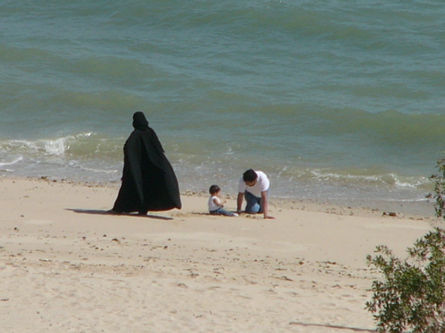
Every now and then, I get a good giggle. Usually it is a European family, and it only happens once . . . they go to our local beach. They are in normal beach attire – swimsuits. And they head for the “Family Beach.”
They haven’t been here long enough to know that “Family” is a little different here, it means mostly women in abayas and scarves, or some form of head covering.Even for those not in abayas, it means body parts are modestly covered, at the very least, with a Tshirt. You will see women swimming in abayas and scarves, floating in inner tubes, fully covered.
There is usually a wide circle of empty space around the European family; people regarding them with fascinated horror. I rarely see them come back. I am hoping they find other beaches, maybe more private.

Friday Fun: Wishin’ and Hopin’
To hear this dusty old Dusty Springfield classic, you can go down to the U-Tube video below, or you can put on My Best Friend’s Wedding, just for the intro, where the song is acted out, all in pink if I remember correctly, a very 50’s rendition.

Here are the words, found at stlyrics.com. And a big thanks to Little Diamond who by finding all the lyrics to “Put the Lime in the Coconut” for me, taught me that anything, ANYTHING is available on the internet, if you have the time to search!
Artist: Dusty Springfield Lyrics
Song: Wishin’ and Hopin’ Lyrics
Wishin’ and hopin’ and thinkin’ and prayin’
Plannin’ and dreaming each night of his charms
That won’t get you into his arms
So if you’re lookin’ to find love you can share
All you gotta do is
Hold him and kiss him and love him
And show him that you care
Show him that you care just for him
And do the things he likes to do
Wear your hair just for him, ’cause
You won’t get him
Thinkin’ and a-prayin’
Wishin’ and a-hopin’
Just wishin’ and hopin’ and thinkin’ and prayin’
Plannin’ and dreamin’ his kiss is the start
That won’t get you into his heart
So if you’re thinkin’ heartbreak
True love is
All you gotta do is
Hold him and kiss him and squeeze him and love him
Yeah, just do it and after you do, you will be his
(You gotta)
Show him that you care just for him
Do the things he likes to do
Wear your hair just for him, ’cause
You won’t get him
Thinkin’ and a-prayin’
Wishin’ and a-hopin’
Just wishin’ and hopin’ and thinkin’ and prayin’
Plannin’ and dreamin’ his kiss is the start
That won’t get you into his heart
So if you’re thinkin’ heartbreak
True love is
All you gotta do is
Hold him and kiss him and squeeze him and love him
Yeah, just do it and after you do, you will be his
You will be his
You will be his
So on this lazy Friday morning, ponder this – Is My Best Friend’s Wedding really a comedy? Is there both truth and fiction in the above song lyrics (the song itself is a hoot – irresistable! Go take a listen!) And while we are laughing, to what extent do you sacrifice who you really are to attain a mate?
Update: Holy smokes, Skunk, it’s THAT easy???? Thanks again!
Best Dates in Kuwait
I often look at the Search Engine Terms part of my Blog stats to see what searches brought people to my blog. Some of them are hilarious, and some of them – I wish I had the answers!
One of yesterday’s questions was “What are the best dates in Kuwait?”
I am not an expert on dates. I remember our first visit in a Kuwaiti house, and how at the end of dinner, the host brought out dates. There must have been ten different kinds, some dry, some moist, one very soft sugary one that I adore) it probably has about 10,000 calories in each date, but oh my, what a taste!) All the dates were from his own trees – he has a date plantation all his own! What luxury!
I remember that when I lived in Qatar, and had a date tree in my yard, the date harvest usually occurred somewhere around now – or maybe July.
So I ask my Kuwaiti readers and fellow bloggers, on this lazy Friday, to help me out. And not just me, but the likes of me, people who read my blog because they are fascinated with life in another country and learning more about different ways of life – What is your very favorite Kuwaiti date, and why?
Dusk in Kuwait
Dusk anywhere is one of my favorite times of day. In Riyadh, my husband and I would head down to the Dira’a souk, usually arriving just before the Isha call to prayer. We would buy a couple felafel sandwiches and a juice drink and sit in the large courtyard by the fort and eat our sandwiches while all the shops were closed for prayers. The sky would go from deep blue to a very deep blue purple, and it was that moment we waited for – the stars just visible and this just-before-black incredible color.
In my mind there is also a hush, but that is unlikely, as there were usually women and their children waiting in the same area for the men to finish their worship, and the children would be playing.
We are still looking for felafel sandwiches that taste that good. We would laugh; eating out for under $2 and it felt like such luxury.
In Kuwait, we are usually on our way to meet up with friends or somewhere around dusk. I always have my camera handy – you just NEVER know what you might see.
This isn’t really dusk, but it is dusky, in the interiors/exteriors shop as you enter the Free Trade Zone in Shwaikh – I can’t help it, I love this shop:

Not crisp, but the skyline is so eccentric:

Dwarfed in downtown Kuwait:

Almost dark – the mosque in the circle, downtown Kuwait:

Donna Leon Crossing Cultures
I’m in the middle of a Donna Leon read-fest. When I wrote the reviews the last time, I saw three books by her I had never seen – and I comb the aisles of Barnes and Noble when I am in the US, and Half Price Books, looking for titles by her. I am guessing some of her books haven’t been printed in the US, but I was able to find them from the UK Amazon.com.
The two latest books I have read by Donna Leon are timely. The first, Fatal Remedies, starts out being about Commissario Guido Brunetti’s wife, Paola’s crusade against the sex tours to undeveloped countries, her outrage against trips that allow grown men to exploit the poverty and need that the poorest of families will sell their own daughters and even young children to satisfy these men’s uncontrolled lusts. Her outrage leads her to a jail cell in her own husband’s precinct.
But just when you think you know where this story is going, it turns, as many of Leon’s books do, and tackles another subject, one very much in the eye of the news – falsified medications. There is a huge profit to be made, and huge wrongdoings in the medical supplies field, as expired medications are shipped to the most needy countries, and prescription and over-the-counter medications contain ingredients that are at best, harmless, and at worst – poisonous!
Guido Brunetti follows the money, and exposes the cheats.
In the second book, The Death of Faith, the issue – corruption in the church – comes close to home, as Brunetti’s daughter gets a low grade from her religious education instructor for asking questions, logical questions, about the dogma of the Catholic faith. Leon also tackles the issue of the order of Opus Dei, the same mysterious order featured in The DaVinci Code, an order that does exist, but about which solid knowledge is murky. What is known is that the order, in jihadist fashion, seeks to establish the Catholic church as the supreme guide to behavior on earth, it’s own version of sharia law to be the ruling principle in every country.
This is an anethema to Commissario Brunetti, and to all thinking Italians who savor the separation of church and state. He asks the eternal question – who decides? Who decides what behavior is acceptable, what questions are allowable? Religious belief, or the lack of it, is so very personal – this is a very timely issue that all nations are struggling with. Religious rule? Secular rule?
Underlying all the Donna Leon books is the sweetness of daily life with Brunetti’s family, his beautiful and principled wife, his teenaged children, the food they eat, the family discussions they have, the flowers he brings home and the strength of the connection they have with one another. The Venetian setting weaves its own magical thread through every novel, as we ride with Brunetti in the vaporetto on the canals, as we sit with him in a local bar for a quick coffee – or something stronger – and as he walks the streets from home to office, or to talk with a witness.
And last, but not least, the utter corruption in the Venetian system reminds us that veniality is not restricted to the United States, or to Kuwait, or to Nigeria, or Italy, or to any one country, but wherever man seeks to impose order, the chaos of corruption must be slowly and surely overcome by the building of an honest bureaucracy, people like you and me, serving in seemingly hopeless situations, but doing our best, day by day, like Guido Brunetti, to build a better world for our children.
Blarney Blarney Blarney
There is a two syllable word that starts with “b” and has to do with bulls and excrement and you use it to imply that someone is saying something that is not true. It is not a polite word, but there is a perfectly good two syllable word that also starts with a “b” and that is “blarney.”
When Adventure Man is chatting me up about something, and I can see where it is going, him spinning all these illusions and wanting my buy-in and this is the perfect “b” word to use: Blarney, Blarney, Blarney. We always end up laughing.
And Blarney is the word-a-day for today:
This week’s theme: toponyms coined after places in Ireland.
blarney (BLAHR-nee) noun
1. Flattery.
2. Misleading talk.
[After the Blarney stone, a stone in Blarney Castle in Blarney village,
near Cork, Ireland which, according to legend, gives the gift of the gab
to anyone who kisses it.]
A Word a Day is in the blogroll to the right, or you can subscribe to A Word a Day here.
Recent Comments
ExpatAlien on What Country am I Living … intlxpatr on Yellowstone: Old Faithful to C… Michelle on Yellowstone: Old Faithful to C… Cathy on No Grown-Ups in Charge intlxpatr on Waiting for Snow Wikipedia Donate Button

Amazina


Early Voting in Florida


 Here There and Everywhere