Tire Killer DeFanged
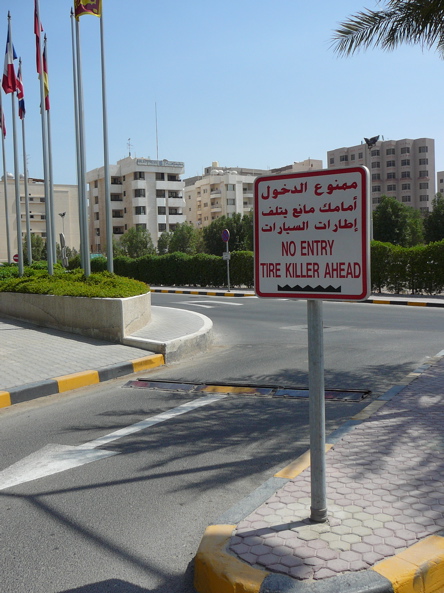
My husband is willing to bet that too many people ignored the sign and then got mad at the Holiday Inn when their tires shredded! The teeth are gone, but the sign remains:
Emergency Service in Kuwait
I had an emergency. Now YOU may not consider it an emergency, but I have a piece of equipment, and I have a major project and a deadline, and to meet that deadline, I need that piece of equipment. And, of course, that piece of equipment began to fail me.
Not to worry. I had heard of a place in Kuwait that could fix my machine. I had that pit in the stomach feeling, like “why didn’t I do some homework and find this place before my machine needed fixing. . . ” Do you ever say things like that to yourself?
And of course, because I was desperate, when I would go into stores and ask if they knew where this place was, I was told, over and over, there was no such place.
Until one brave young Pakistani guy contradicted his employer and told me where he thought the place might be. Because of one way streets, and a convoluted traffic pattern, it took me several more passes before I spotted the place – which fortunately had one very small sign in English, as I can’t read Arabic very quickly, I still have to sound out all the letters until it sounds like a word I know. Like I am really good at “sharia” being street, but not very good at things I don’t see all the time.
And, by the grace of God, not only do I see the store, but there is – and this is truly a miracle – a decent parking spot fairly close to the shop. Thanks be to God.
I went into the shop, and there is another woman there, with her machine. I tell the man behind the counter that I have a small emergency. He doesn’t understand me, but he understands my tone, and sends a man to help bring in my machine.
It’s like the stand-off at the OK Corral. She looks at my machine, evaluating whether her’s is better, or mine. Seconds tick by, and she smiles, and the crisis is averted. She tells the man she will be back for her machine, which he sets aside to take a look at mine.
My machine is one of those simple machines, you are supposed to be able to do almost everything yourself. He does everything I have already done, and sits back, stumped. We both know what the problem is, and I know he can’t fix it. He calls a friend. He orders tea. We sit and talk as customers come in and out, checking on their machines, asking prices on new machines. We are speaking in Arabic, a language we both speak badly, so conversation often lulls. I’m not sure his friend is coming.
Finally, I pack up my machine, and of course, as soon as I get ready to leave, the friend arrives, and we need to unpack it again. Ten minutes, and my machine is good as new. He tells me what the replacement part would cost in Kuwait (if he hadn’t been able to fix it) and I gasp in horror – I will have to look for a replacement part this summer, back in the US, because I have checked online and yes, they are expensive, but cost about the same in dollars as it would in KD – i.e. $49 vs KD 40. Aaarrgh.
I’ve spent two hours sitting and drinking tea in a shop that is sort of air conditioned, but the door was always open. I am hot, and sweaty, but my machine is fixed, at least enough that I can work on my project.
This is not the way it would happen in the United States. In the United States, I might get some sympathy, but I would not get same day service. I would have to leave my machine, I would have to be served in order, and I would not get my machine back until it were fixed, if it were fixed – people are not so good at fixing old things in the United States, you have to be really lucky. Mostly, when machines break, you buy a new one.
So I am feeling really lucky, really lucky, really blessed, to have had my machine emergency in Kuwait, where things are done differently, and my machine could be fixed on am emergency basis, while I waited.
P.S. The man who fixed my machine earns KD 80 a month – $280 for my US readers.
Hats off to Saudi Women
Last week in the May 10th Kuwait Times, Dr. Sami Alrabaa wrote a fascinating article on Saudi Women, Saudi Arabia and some shifts in press coverage in Saudi Arabia.
This is how the article starts:
Anti-Woman Culture
More and more Saudi women are speaking out against preachers in their country. Fatma Al-Faqih, a columnist at the daily Saudi Al-Watan accuses preachers (April 17) of “denigrating women” and “inciting discrimination against women.” “Day in day out, our preachers flood us with accusations against women and beg men to defend the virtues of society that women corrupt,” Al-Faqih writes. This “anti-woman culture”, Al-Faqih continues, causes women to feel mentally and psychologically inferior, “like a quarrelsome child who must be constantly supervised, intimidated, and punished into performing her duties.”
It is also unprecedented that the Saudi print media are allowing women to air their indignation and frustration. Al-Faqih also writes, “Women are good Muslims as men are. But our preachers insist on producing a distorted picture of women, which has nothing to do with true Islam. The Prophet Mohammed (PBUH) never discriminated against women. He respected them. He valued their opinions and occasionally sought their advice. He treated them as full-fledged human beings. Our preachers however, depict women as spoilt minors who have got to be constantly instructed to behave themselves. They cannot be trusted.”
Al-Faqih also wonders, “Where is it written in the holy Quran and Hadeeth that women are not allowed to drive their own cars? Where is it stated that women are forbidden to travel alone, leave their houses, or travel alone with the family’s chauffeur? Where is it stated that women are forbidden to have a passport without permission from their male closest relatives, forbidden to go to school or university without permission, forbidden to take a job without permission, forbidden to open a bank account without permission, forbidden to name their own children without their men’s approval?”
Further, Al-Faqih complains, “Where is that divine law which does not allow women to sue their husbands for divorce? Where is it written that women’s voice is a sexual organ and hence she is not allowed to speak in public and express her concerns? Where is that sacred law that does not allow women to keep their own children after divorce? Where is it written in Islam that women are not allowed to vote or run for office?”
Al-Faqih concludes, “Are we in Saudi Arabia a special brand of Muslims? In other Muslim countries, women have become presidents (in Bangladesh for example), prime ministers (in Turkey and Pakistan), ministers in Egypt, Syria, Morocco, Kuwait and other Arab countries. In all Muslim countries, women have the right to vote and run for office. No, we are not a special brand of Muslims. It is our preachers who interpret Islam their own way.”
You can read the rest of the article by clicking HERE.
My comment: When I lived in Saudi Arabia, my eyes were opened. My Saudi Arabian women friends were SO smart, and they really knew their Quran. They also knew hadith, and they knew the weight of each hadith, which were strong and which were weak. They didn’t just memorize suura; they thought about them, they discussed them and analyzed them.
Through them, I understoon Islam in a whole new way, and understood the revolutionary thinking of the Prophet, who was kind to women, took council from women, and treated women fairly. In an age when female babies were routinely killed, he stood against the tide of tradition, and forbid the killing of female babies, and insisted on rights of inheiritance for females (and this in the 7th century).
And no one found it more ironic than the Saudi women that Saudi Arabia has become a worldwide symbol for repression of female rights. My Saudi sisters claim that in the birthplace of Islam, Islam has become distorted, a weapon used against women.
My Saudi women friends often told me I was not required to wear a scarf. My embassy told me the same thing, that it was a voluntary sign of submission to Islam. The embassy also told me to carry a scarf, and if accosted by the mutawa,(religious police, the “The Committee for the Promotion of Virtue and the Defense Against Vice” or something like that) to put it on until he was out of view, and then to take it off again, that the scarf was not mandatory. The mutawa felt differently, and would boom out in loud, offended voices: “MADAME, COVER YOUR HAIR!”
I would comply. But the unfairness never failed to rouse my ire. Excuse me? My hair might cause YOU to have a lustful thought? You control YOURSELF and your thoughts, and let ME worry about my morality.
So my scarf – errr hat – is off to these Saudi women who have the bravery to write these well thought out position papers to the Saudi papers.
The interesting thing to me is that the Saudi press is printing the women’s complaints now. . . perhaps, insh’allah, some changes are in the air.
And a muse – So when a Saudi woman comes to Kuwait, for example, or to France – is she allowed to drive? We know it is illegal for her to drive in Saudi Arabia, but is it also immoral for her to drive in Saudi Arabia? Or is it immoral for her to drive anywhere? So like is it immoral for all us women to be driving anywhere?
Bo9agr’s Kuwait Accident Photos
This is for my non-Kuwaiti friends, who don’t believe me when I tell them about the wrecks along the side of the road, new ones every day, in Kuwait.
This blogger, Bo9agr has taken to documenting the wrecks he sees. You would think it is funny, but it is only funny because it is so so awful. You can view his collection at Kuwait accident photos.
What a waste – especially the young lives taken or damaged in this wreckage.
Government limits freedom of expression
In the United States, news that people want buried comes out on Saturday night, when people are busy with other things and not paying a lot of attention. Does that happen in Kuwait?
I watched for anyone blogging on this yesterday, but saw nothing. I showed the newspaper to my Kuwaiti friends, who were shocked, and hadn’t heard anything about this. Some of it, I get. I am flummoxed by the forbidding of any mention of veterinary medicine!
From yesterday’s Kuwait Times.
KUWAIT: All newspapers, magazines, publishing houses and printing presses in Kuwait were yesterday issued a list by the government of the types of articles, advertisements and banners that can no longer be printed or published without official approval. Following is the list of the banned topics and the ministry concerned:
Interior Ministry:
1. Publication or display of slogans that glorify some countries against others.
2. Displaying pictures that glorify some political personalities or religious figures of countries where political or religious conflicts exist.
3. Publications or displaying slogans that glorify or support some political or religious parties outside Kuwait.
4. Publication of personal interviews with citizens who support or oppose a certain policy which may place the state at war with other countries.
5. Publication or displaying slogans that glorify or support some religious or political parties in Kuwait.
6. Announcement of seminars that may probe tribal or sectarian conflicts.
7. Sale of books on sorcery and magic.
8. Spiritual healing (without a licence).
9. Sorcery and ability to heal.
10. Massage without a licence (because those activities are subject to Law No. 15/1960 dealing with commercial companies).
11. Sale and trade of weapons by commercial companies, individual establishments and individuals (swords, sabers, daggers, spears, knives, arrows and arrowheads, pointy rods, spiked clubs, knives, brass knuckles, electric sticks), because licenses from the Interior Ministry to import these.
12. Sale of airguns without a licence from the Interior Ministry.
13. Fireworks and explosives.
14. Sale of surveillance cameras and listening devices (bugs) of all types without obtaining a licence from the concerned authority.
Education Ministry:
1. Publication of ads for private tuitions.
2. Publication of supplementary school notes.
3. Ads of private institutes and universities that are not accredited by the Ministry of Education.
Ministry of Health:
1. Conventional and veterinary medicine.
2. Botanic, animal or chemical formulae.
3. Foods that have health-enhancing effect, claimed to be prepared for treatment.
4. Preparations that claim to provide energy or reduce or increase weight.
5. Change of structures of body parts. (It is a must that a license be obtained from the licenses committee on advertisements related to health and nutrition).
Ministry of Social Affairs and Labor:
1. Donation and blood money ads.
2. Charity homes’ advertisements.
3. Ads for lectures, cultural and religious gatherings (unless a permission is obtained from the ministry).
The order was signed by Fahd Sayyah Al-Ajmi, Director of Local Press Affairs at the Ministry of Information.
Scenes from Villa Moda
The sale continues at Villa Moda
“For you, Madame, this special Manolo . . .”

“Or this sweet gown?”

Stormy Petrel
The following is from WordaDay, to which I subscribe, and which often delights me with words and meanings I have never known. Today’s is so particularly good, I will share this website again. You can see it on my blogroll to the right, and you can subscribe also by copying and pasting the address from the e-mail below.
Starts here:
Birds get little respect. We tend to look down at non-human animals in
general, but we are particularly unfair when it comes to birds (although
we have to look up at them).
We call a stupid fellow a “bird brain”. Australians call him a galah
(a type of cockatoo). Something useless is said to be “for the birds”. We
name someone vain and self-conscious a peacock. One who is talkative or a
hoarder is labeled a magpie. A cowardly or fearful fellow is a chicken…
the list is endless.
We even kill two birds with one stone. I’d rather the idiom be to feed two
birds with one grain.
This week we feature five terms coined after birds. Catch as many of these
bird words as you can. After all, a word in the head is worth two in the book.
stormy petrel (STOR-mee PE-truhl) noun
1. Any of various small sea birds of the family Hydrobatidae
having dark feathers and lighter underparts, also known as
Mother Carey’s Chicken.
2. One who brings trouble or whose appearance is a sign of coming trouble.
[The birds got the name storm petrel or stormy petrel because old-time
sailors believed their appearance foreshadowed a storm.
It’s not certain why the bird is named petrel. One unsubstantiated theory
is that it is named after St Peter who walked on water in the Gospel of
Matthew. The petrel’s habit of flying low over water with legs extended
gives the appearance that it’s walking on the water.]
Today’s word in Visual Thesaurus: http://visualthesaurus.com/?w1=stormy+petrel
-Anu Garg (words at wordsmith.org)
“A colourful stormy petrel of the Conservative Party, Anthony
Beaumont-Dark frequently found himself at odds with the party
line in the Commons, and was well known for expressing his dissent
in memorably quotable form.”
Obituary: Sir Anthony Beaumont-Dark; The Times (London, UK); Apr 4, 2006.
………………………………………………………………….
In some circumstances, the refusal to be defeated is a refusal to be
educated. -Margaret Halsey, novelist (1910-1997)
Discuss this week’s words on our bulletin board: http://wordsmith.org/board
Remove, change address, gift subs: http://wordsmith.org/awad/subscriber.html
Pronunciation:
http://wordsmith.org/words/stormy_petrel.ram
“Who Am I?”
As DNA testing becomes more and more common, surprises are popping up everywhere. This article from BBC is about two Englishwomen who discover they have Native American blood when they send their DNA in for testing.
It’s fascinating to think that migration and trade has left it’s traces generations later. I love the work that is being done with bloodlines these days.
Native American DNA found in UK
DNA testing has uncovered British descendents of Native Americans brought to the UK centuries ago as slaves, translators or tribal representatives.
Genetic analysis turned up two white British women with a DNA signature characteristic of American Indians.
An Oxford scientist said it was extremely unusual to find these DNA lineages in Britons with no previous knowledge of Native American ancestry.
Indigenous Americans were brought over to the UK as early as the 1500s.
It rocked me completely. It made think: who am I?
Doreen Isherwood
Many were brought over as curiosities; but others travelled here in delegations during the 18th Century to petition the British imperial government over trade or protection from other tribes.
Experts say it is probable that some stayed in Britain and married into local communities.
Doreen Isherwood, 64, from Putney, and Anne Hall, 53, of Huddersfield, only found out about their New World heritage after paying for commercial DNA ancestry tests.
Mrs Isherwood told BBC News: “I was expecting the results to say I belonged to one of the common European tribes, but when I got them back, my first thought was that they were a mistake.
“It rocked me completely. It made think: who am I?”
You can read the rest of the article at BBC Science/Nature News, here.
Changing Times
The Kuwait Times has a different look these days – a lot more advertising. Now that the LuLu has opened, grocery stores are starting to advertise. Just wait until Carrefour opens! Choice has come to Kuwait, and things are going to start to get much more interesting!
In yesterday’s Kuwait Times is a FULL PAGE ad for the Villa Moda sale starting today with prices up to 90%! It does not say “up to 90% off” it says “LUXURY DESIGNER STOCK CLEARANCE SALE UP TO 90%” and it goes on to say the sale is today, Sunday, May 6 from 10 am to 10 pm “while stocks last.”
It also encourages Villa Moda fans to go to at http://www.villa-moda.com for more information and special offers and events, and to send you e-mail with your full name, mobile number and date of birth to NEWS@villa-moda.com.
Save the Dates: May 31, June 1 + 2

A friend asked me to publish this. Did you know there was an international group in Kuwait for people who love textiles? The Sadu House is a part of this association, and the local quilting group, with over 50 members, and people who weave, knit, do tapestry work, needlepoint, embroider, sew, collect hand loomed carpets – they all belong to this group.
As you can see, their annual exhibit is coming up at the end of this month. You won’t want to miss it if you love original work, especially work with textures. There may be items for sale; many items will be on display only so that you can see of the original and artistic work being done in your community. There is a glorious quilt being raffled, and tickets will be available at the exhibit.
The KTAA holds meetings once a month with lectures on textiles from various parts of the world – this year they had lectures on the Miao Chinese, Afghani carpets, Indian marriage costumes, art embroidery, hand dying fabrics and several others – all embellished with bright examples of the works lovingly collected by KTAA members. It is a richly artistic group, meeting at the Dar al Cid, just around the corner from the Tarak Rejab Museum.
Recent Comments
ExpatAlien on What Country am I Living … intlxpatr on Yellowstone: Old Faithful to C… Michelle on Yellowstone: Old Faithful to C… Cathy on No Grown-Ups in Charge intlxpatr on Waiting for Snow Wikipedia Donate Button

Amazina


Early Voting in Florida


 Here There and Everywhere