Some Misery Unavoidable
Accepting the bad times could make for a happy marriage
From BBC Health News
The key to a happy relationship could be accepting that some miserable times are unavoidable, experts say.
Therapists from California State University, Northridge and Virginia Tech say accepting these problems is better than striving for perfection.
And they blame cultural fairytales and modern love stories for perpetuating the myth that enjoying a perfect relationship is possible.
The report was published in the Journal of Marital and Family Therapy.
The authors, Dr Diane Gehart and Dr Eric McCollum say it is a “myth that, with enough effort we can achieve a state without suffering.”
And they say healthcare professionals may not be helping the situation.
“The field of mental health perpetuates this myth with the very concept of “mental health,” which implies a state without suffering,” they say.
Potentially damaging
But this belief can eventually cause people to believe that with enough effort they can eliminate suffering.
And experts say this is an unrealistic aim in relationships, and striving to achieve it can lead people to feel they have failed.
Jan Parker of the Association of Family Therapy said: “The authors are right to point out that the pursuit of relationship nirvana can be potentially damaging.”
She said it was important to explore what people mean by a happy and healthy relationship, because nobody’s life or relationship can be in a permanent state of happiness – there will always be more difficult times.
She said couples need to build strengths, such as understanding, in their relationships to help them cope in these hard times and appreciate the good times.
Mrs Nadine Field, a consultant psychologist, said it was a “fantasy” that any relationship could be perfect and that striving for such an impossible state could lead to bitter disappointment.
She said this disappointment could then cause people to focus on the negative aspects of a relationship, and lead to more disappointment and resentment.
She said: “People need to try to understand their partners through communication, rather than demanding perfection of them.”
Read the rest of the article here.
Competitive Family Values
Even within national cultures, there are family cultures. You don’t really think about it when you are a kid, you think all families are like your family. It isn’t until you get older that you understand just how unique – even quirky – your own family is.
In our family, we were bred to be competitive. We started early, with simple card games and board games. We swam on swimming teams, we competed for grades. Doing well, doing our best was expected of us.
And then, we turned around and did it to our own children!
We used to have big family reunions in a small town along the Oregon beach. We stayed in an old complex, where there were two large units that shared a deck, and then several small cabins. The very social parts of the family shared the two large units – my mom and dad, and her brother and his wife – and the rest of us had the cabins, one to each family, althought the kids roamed from cabin to cabin – our children have always had the freedom of belonging to one great tribe!
Daytimes would be full of adventures – not everyone doing the same thing, but smaller groups having dodge-boat competitions, groups going on shopping expeditions to nearby towns, hiking in the parks, having some beach time – jumping the amazingly high waves in the amazingly cold Pacific ocean.
Around 5, people would start to gather on the big deck in preparation for dinner. Dinner might come out of the kitchens, or we might order food in, but once dinner was out of the way, the BIG competitions would begin.
Every year there was a huge hearts tournament, and a Liar’s Dice tournement. The family took these very seriously, from oldest to youngest, everyone entered, everyone competed. We took it so seriously that we had trophies that would be engraved with the winner’s names and passed along from year to year. We took it so seriously that sometimes there would be injured feelings when someone lost. Everyone wanted to be the winner, and in a family full of people used to winning, feelings ran high.
Giving up needing to win all the time has been seriously hard. There are still times when I am in a situation where I feel the adrenelin start pumping and I have to stop myself and say “Do you want to win this battle or do you want to win the war?” i.e., like chess, sometimes you have to sacrifice a pawn to achieve a greater victory down the road. Do I need to win every arguement at the cost of losing a friend? Do I need to win at the cost of my community?
I also think needing to win takes its toll in one’s health – when I allow myself NOT to need to win all the time, I feel calmer, more serene, and happier. I can’t help but think that being calm, serene and happy are probably good things to be in terms of health. Competition gets your heart beating faster, pumping through the veins, but can also take it’s toll in bad eating, bad sleeping and bad exercise habits.
My parents did a good thing encouraging us to be our best, to seek personal excellence and to strive for personal achievements; I honor them for that. When it comes to winning, however, I want to stop and count the cost before I proceed full steam ahead.
What does your family value? What attributes did they encourage you to develop?
Widad Kawar’s Passion
Many years ago, in another life, I was honored to visit the collection of Widad Kawar in Amman, Jordan. I was so young, and so completely in awe of Widad, who had made it a life mission to collect traditional clothing of the area, Palestinian, which was her own heritage, and nomadic.
It was like being a little girl and getting to play dress up as we oooohed and aahhhed over these gorgeous old dresses and head dresses. I had no idea she had become an institution, until I began to research a style of hijab I had seen there which I found very elegant.
LIttle Diamond, these are for you. They are from several sources, including The Arab Heritage site on Widad Kawar which I urge you to peruse when you have a spare hour or half a day or . . . a lifetime. She has created a monumental body of work with her passion for preserving these fabulous textiles.
From Widad Kawar’s collection: North Jordan

Shows a little of the glitz – this one is from Salt, photo from Widad Kawar’s collection: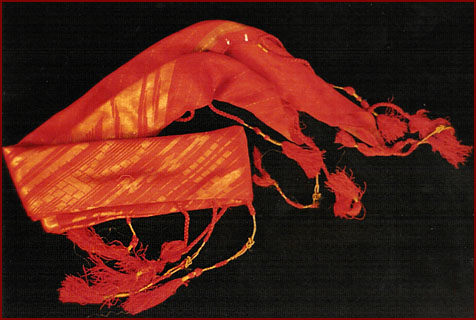
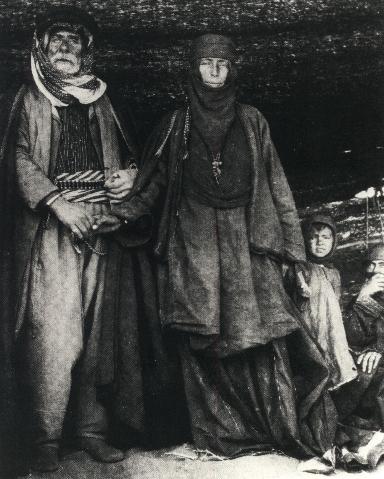
I love this photo. The woman has a plain version of the headdress, and is wearing a double dress . . . and her husband is holding her hand!
Blog Complaints
My family and friends outside Kuwait tell me I don’t publish enough Kuwait photos. These two are for you, and I will try to work on this. 😉 These are from a recent trip to the Al Kout mall in Fehaheel, just south of Kuwait.
Ladies leaving the Al Kout Mall

I think this mosque is one of the most beautiful I have seen:

Is this not one of the most beautiful Starbucks you have seen? It sits on overlooking a small marina. Greetings to all my Seattle friends.

Palestinian Embroidery
There is a richness in the textile heritage of this region, the clothing, the embellishments, the techniques . . . influences from Africa, from India, from Europe all meeting and blending in the most spectacular ways. This is textile heaven!
Today I was trying to find an example of a traditional Jordanian head-dress so I could show Little Diamond but instead I found this blog Arabesque Rhapsody and her beautiful article on everyday Palestinian embroidery. When you look at these women, wearing dresses that took hours, days and months to create, it is a feast for the eyes.
Rare Case of Lying
In today’s Kuwait Times is an article I found utterly hilarious – WHAT WAS HE THINKING????
Exam Fraud Discovered
Kuwait: The director of a secondary school in Khaitan discovered a first of a kind cheating case wehre an unidentified young man sat for a Quran exam instead of one of the school students, reported Alam Alyawm, noting that being unable to identify the young man and suspecting him, the director requested an ID to verify his true identity.
Sources said that the examined young man confusingly showed a driving license belonging to the student he had substituted. Realizing his fraud had been discovered, the young man fled the school leaving his exam paper and driving license behind.
Upon contacting the real student, he told the police that his driving license had been missing and that he had lodged a report with the police in this regard. Further investigations are in progress.
Uh . . . yeh, I bet they are. 🙂
I am sorry, this just gives me such a giggle. Cheating on a Quran exam? ? ?
Before I wrote the above, I had to do a lot of thinking . . . like the bible, our book, does not say “thou shalt not lie” as one of the 10 commandments, neither is it one of the two great commandments in our New Testament (love the one true God before all others, love your neighbor as yourself), so what does the bible say about lying? Fortuntately for us, there is Google, and the internet, and you can click on What the Bible has to say about lying if you want the specifics. It reminded me that Satan is called “The Father of All Lies.” *shiver* That’s good enough for me.
There are several places in the bible, however, when even good people lie, like because they are scared or because they don’t want to face the wrath of God. One is Sarah, when the messengers tell her she is going to have a baby and she is something like 80 or 100 years old and she laughs, she can’t help it, Sarah laughs. And God says “Sarah! Are you laughing at me! I can do anything!” and Sarah lies and says “oh no, Lord, I wasn’t laughing.”
Since the Bible and the Quran spring from the same spiritual source, I am willing to bet the Quran also has a few things to say about lying and dishonesty, and fraud, and how you can’t fool Allah or cheat him.
Anyone out there willing to step up and educate us?
Al Qaeda Fed Up With Ground Zero Construction Delays
If I knew how to embed video replays in my blog, I wouldn’t have to make you click on Al Qaeda Fed Up with Ground Zero Construction Delay to watch a video interview with two critics of the Ground Zero construction so far, saying almost identical things, but with a twist, oh what a twist.
The video interview is hysterically funny. Give yourself a grin for the day. It’s from one of my favorite websites: The Onion.
Heat Lagging

The heat has hit me like a building crashing down around me. It changes everything I do. Somehow I don’t remember last year being so hot, but I know it was, and I think I just didn’t go out very often. Now that I am driving all over town, man, the heat KILLS me.
I just checked Weather Underground for Kuwait and the temperatures (Fahrenheit for my US readers) is going to be between 107 and 114 for the next five days. Kuwait DOES cool down at night more than Doha, but if you are outside after nine in the morning, you feel like a steak thrown into a hot frying pan to sear. It is sizzling hot!
I find myself trying to get everything done I need to get done early in the day. Sometimes when I get home, get the groceries put away – I need a NAP! I feel like I’ve run a marathon! It’s embarrassing to be so effected by the heat, but I am.
If I have had things going on and don’t get a nap, then by nine my head is nodding. I can be in the middle of a great book, a thrilling movie or a nail biting tv program . . . it doesn’t matter. Sleep calls me like a siren; I can’t resist, I crash. Around three in the morning, having had six hours of great sleep – Hey! here I am! wide awake!
Even my husband, born in the heat of the south, who gets cold easily, even my husband who never complains about the heat – told me this morning he hated the thought of having to walk today from here to there because of the heat. I can hear him wheezing a little at night. We no longer have the dust storm of earlier this week, but the residual dust has made breathing a little harder. I hear a lot of my friends wheezing mildly, too.
It’s just like jet lagging. I’ve got to get it under control, and I’m at a loss. I think most of my friends cope with the heat – by leaving! Others stay inside most of the summer – even the thought of meeting up with a friend for coffee during the day just seems like too much trouble, when I think of the hot hot hot walk from car to air conditioned mall or restaurant!
How do you cope with the heat?
Does your life change?
Do your hours change?
Cat Meat Rumors Refuted (Ho ho ho ho ho)
Front page of todays Kuwait Times is this article:
KUWAIT: A ministry of Commerce official denied rumors that a local restaurant has been closed for selling cat meat. According to Ali Baghli, assistant undersecretary for commercial supervision affairs at the Ministry of Commerce, no violation has been registered against the Arabic restaurant in the Jahra governate as of yet. . . .
My comment – So here is what we know for sure:
A ministry official says the restaurant has not been closed for selling cat meat.
He says no violations has been registered AS YET.
He does not say the restaurant was not selling cat meat; he is saying the restaurant was not closed for selling cat meat.
What was interesting, is that both the Kuwait Times and Arab Times, when they reported this cat meat restaurant closing, said that because of connections in the government, this restaurant was unlikely to stay closed.
It is not unlike Make This Case Go Away where two youths are caught with a maid they have abducted and raped, they fight the arresting officer and bite him on the hand, they confess to what they have done . . . and no violation is registered, because the police officer is pressured by his superiors to drop the case.
It’s not like your next schwarma is guaranteed not to contain fresh cat meat. It’s only guaranteed not prosecuted.
If I sound angry, I am. Police and law enforcement officials are supposed to protect the public – that’s you and me. When the system is broken so badly that laws are not enforced against the transgressors, and worse, when courageous policement are punished for doing their job, it is a very very sorry state of affairs.
And I am convinced that God has a very special place in hell for those who abuse the trust the public places in them.
I sure wouldn’t eat any schwarma in Jahra.
“How’s That Working For You?”
I love watching language shift and segue like the waves at sea. One moment there will be a gust of adjectives (“cool” “hot!” “baaaadddd!” “fly”) and another there will be typhoon of localisms, like the Valley Gal phenomenon, and from time time time, apparently quiet times. If you are watching closely, however, you will see the waters twitch and a new word or phrase surface, create a few ripples, and then most of the time, fade away.
“How’s that working for you?” is a phrase that doesn’t mean what it seems to mean. Yes, it is a very neutral way of asking how a person is doing.
Underneath, however, it implies disbelief.
Language is so subtle. It’s one of the reasons I will never be fluent in French, or German, or Arabic – I can skim the surface, I can even dive beneath the surface, but there are depths that you have to be a native to plumb.
“How’s that working for you?” keeps the conversation going when an addict defends his addiction.
“How’s that working for you?” keeps the door open when your daughter defends an inappropriate relationship.
“How’s that working for you?” is the response to someone with big talk of big dreams who never gets organized enough to put the dreams into action, but wants credit, although nothing was accomplished.
“How’s that working for you?” is a compassionate response to someone who is lying to herself about an important issue and you don’t want to burst her balloon.
Most people ask the question when there are clear signs that it is NOT working. It returns the ball the the court of the person who needs to deal with the problem.
A person who is not willing to face the problem will respond “Great!” The appropriate response to “great” is “Glad to hear it!”
(“Glad to hear it!” used in this context means “I don’t believe a word of it.”)
If someone asks you “how’s that working for you?” they have sent you a signal that it’s time to re-examine what you’re doing.
Recent Comments
intlxpatr on Shampoo Ginger tigerbutterya0c5ff1d… on Shampoo Ginger intlxpatr on British Soldier Kidnapped, Esc… John on British Soldier Kidnapped, Esc… intlxpatr on British Soldier Kidnapped, Esc… Wikipedia Donate Button

Amazina


Early Voting in Florida


