Better Faster Smarter Solution
My husband jokes that when I have a sore throat, it is the beginning of a common cold, but when he has a sore throat, it is a rare tropical disease and he should be babied and coddled and have tea and soup brought to him, and warm washcloths, and we should speak in sweet soft voices in case he is breathing his last.
Last night I had a tickle. My husband, God bless him, knows that what makes me all better is miso soup, so I had miso soup for dinner last night.

Today, I think I have the rare tropical disease kind of sore throat. It was just a tickle yesterday, but by night I was in the grips of a no-kidding, no sleeping sore throat and stuffed nose, coughing, and feeling rotten. I feel like something the Qatteri Cat dragged in.
I rarely get sick. I don’t have time to get sick now. Please, dear readers, share your top “get rid of a cold” solutions, and do it NOW! I need your help!
Mystery Back Again
Several months ago I posted a photo of a . . . something . . . out in the Gulf. I can’t figure out what this is, what it is doing. It is a large sturdy raft with mechanical equipment. It is visited several times a day by a couple different serious looking modern fishing boats – maybe coast guard boats. I can’t really tell.
It may be a dredge, as it is in shallow water and has all those tubes connected to floats. Or it may have to do with fishing. I don’t see any sand coming up, nor do I see fish. This is a great mystery to me. (Idly musing . . . )

I keep hoping one of you will recognize it and tell me what it is. Otherwise, the comment section is open for idle speculation.

Breakfast at Paul’s
It’s a great thing, being a grown-up. A lot of the things that were hard and fast rules as you are raising children get thrown out the window once it is just you and your husband once again.
When I was little, I remember Saturday nights. We would have hamburgers with all the trimmings, and watch a favorite TV show while we ate. It was the only night of the week we could eat in front of the TV.
There was a price to be paid, though. My mother would never allow a bottle on the table. There were special small bowls for the mustard, ketchup, relish, sliced onions, tomatoes, lettuce, etc. Putting condiments IN the bowls was no big deal, but I hated spooning the ketchup back into the narrow necked ketchup jar.
I will never forget my horror visiting my parents home with my son, and seeing a ketchup bottle on the table. I couldn’t believe it! I said “we were never allowed to put a ketchup bottle on the table when we were growing up!” and my Mom just laughed and said “now that we have raised you correctly we can do as we please!”
I totally get it. Now that it is just my husband and me, we also break the rules. We go out to eat more often. Sometimes we stay up late, even on a work night. Sometimes we leave a mess in our project room. I heard my husband tell the cat “Mom is going on a trip and we won’t even have to make the bed!” We’re easier on ourselves and we are easier on one another.
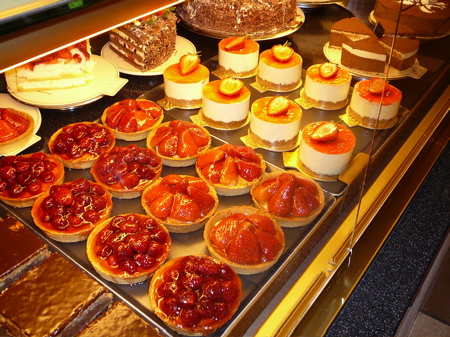
But best of all, when my husband wants a strawberry tart, even for breakfast, he can have a strawberry tart. He loves the ones from Paul’s. We don’t have breakfast there often, but we always enjoy it when we do.
Japanese Breakfast
This is for my husband. I know he reads my blog now and then, and I wonder how long it will be before he sees this?
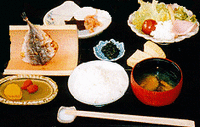
The other night, we were out for our favorite “fast” food, which is Japanese food. Not just sushi, we love miso soup. When I am sick, miso soup makes my throat feel better. I feel like I am eating good health, with all those little tofu squares and that seaweed, I feel like the miso soup will make me better. I also love salmon teriyaki, and chawan moushi, and a variety of lesser known Japanese foods.
And my husband said “isn’t miso soup what Japanese people have for breakfast?” and I didn’t know. He though miso soup and rice, so today I looked it up on Google, “Japanese breakfast”, and here is what I found:
Japanese breakfast consists of steamed rice, miso (soy bean paste) soup, and side dishes. Common side dishes are grilled fish, rolled omelet, pickles, dried seaweed, natto, salad, and more. Actually, you can make any dishes to go with rice and miso soup in Japanese breakfast. As you see in the photo, it’s an etiquette to place a bowl of rice on your left and to place a bowl of miso soup on your right side at the table.
It was on Japanese Breakfast About.com, along with ads for Japanese condoms (they are different from others?), a sushi making robot, a Samurai hotel and recipes for steamed rice, miso soup, natto (fermented soy beans), Nori (dried seaweed), Tamagoyaki (rolled omelet), grilled fish and pickles.
It seems to me that Japanese food is going through an internationalization process – sushi used to be all about rice and fish, and main dishes were simple, often stir fried, but all in all, very healthy. Now, I am seeing sushis with fried stuff in them, mayonnaise (?????), and we were offered a green tea ice-cream for dessert . . . that just doesn’t strike me as Japanese. Is it?
But this is for my husband – in case you really read all the way down – YOU WERE RIGHT. (I am obligated by family law to say that.)
Visit to Skyscraper City
As I was preparing to move to Kuwait, and searching the blogs and internet for any information I would find on living conditions, I came across this quirky website called Skyscraper City which has forums on buildings and developments going up all over the world.
My favorite area, of course, is the forum devoted to the Middle East and Africa within which I love to visit Kuwait and Qatar.
Here you find all the latest news, information and GOSSIP about what’s going up, who has applied for permits, and why projects have stalled. It is one of those gems of the internet.
If you want to post, or reply, you have to join the City. There is a Sky Diwaniyya in the Kuwait section that is always entertaining reading.

Palm Island Resort, UAE from Skyscraper City Forum
Kitchen Souk?
A reader wrote asking about where to find a cast iron skillet in Kuwait. I brought mine with me (if you use a cast iron skillet, you’ll understand*) so I haven’t been paying any attention to cast iron skillet availability here. I’m pretty sure I haven’t seen any in the local co-ops, and I can’t remember seeing any cast iron pans in the Sultan Center. City Center?
Is there a Kitchen souk in Kuwait, a place with lots and lots of pots and pans?
(A cast iron skillet is heavy metal, and a shiny grey when you buy it. You season it by rubbing it with oil and putting it in an oven on low heat for hours, even overnight. You never wash the skillet with soap, only with water and scouring pads, so you don’t lose the seasoned coating. When you have a well-seasoned pan, you carry it with you so you don’t have to start the process over! You can see a photo of my skillet at Cornbread and Chili)
“I’m A Third Culture Kid, Are You?”
Most of those who read my blog are not Kuwaiti, and it is for you that I am writing this post. So many of you who read me are also “Third Culture Kids.” My blogging friend Amer just wrote a post by the above title, and whoa! The responses will blow you away! Please go to I am a Third Culture Kid, Are You? and check in with your story – where you came from and where you are today.
And how being a third culture kid has affected your life. This is one of the best blog entries I have read.
The book from which the term Third Culture Kids comes from is mentioned in an earlier blog entry of mine, Chicken Nuggets and Big Macs and is by David C. Pollock and Ruth E. Van Reken. You can find it at Amazon.com. If you are a third culture kid, you might want to buy two or three – you will keep giving them away. The book is that good.
Germany’s culture of shopping slowly changing
Little Diamond forwarded this to me from the Chicago Tribune. The battle to extend shopping hours in Germany has been going on for years. As the hours increase, the annual birthday celebrations described in the preceding blog entry will pass into “olden day traditions.”
By Tom Hundley
BERLIN – Unlike America, Germany has not yet adopted the shop-till-you-drop lifestyle, but things are starting to change.
Even in bustling cities like Berlin and Frankfurt, retailers used to roll up the sidewalks at 6:30 p.m. On weekends, Germans had to scramble to get their shopping done by 2 p.m. on Saturday. Sunday shopping was strictly verboten.
But a long battle over longer store hours is slowly being won by retailers who believe that more hours mean more money in the cash register. They are opposed by Germany’s powerful trade unions whose leaders say workers’ rights must be protected.
The gradual loosening of strict rules governing store hours also reflects a larger battle to loosen up a German economy that suffers from sluggish growth and 9.6 percent unemployment. Chancellor Angela Merkel’s government says it is eager for reform, but it has decided to leave the issue of store hours to local governments.
These days, the Galeria Kaufhof, a newly renovated department store in the heart of the former East Berlin’s shopping district, is crowded with customers until 10 p.m.
“Seven years ago we started a small revolution here in Berlin when we said we are opening on Sundays,” said Detlef Steffens, the store manager.
“We discovered a loophole: according to the law, you could open on Sunday if you were selling souvenirs, so we put stickers that said `souvenirs’ on all the merchandise,” he said.
“We were sued by other store owners. But that started an avalanche.”
Steffens’ store took its case to Germany’s federal constitutional court. The court rejected its arguments but said the particulars of Sunday shopping hours should be regulated by local authorities.
The Berlin city government decided to allow stores to open on six Sundays a year. Last year, it extended the number to 10, plus three extra Sundays during the World Cup soccer tournament.
Last November, Berlin threw caution to the wind and adopted a modified version of America’s 24/7 consumer ethos. Call it 24/6 – non-stop shopping for six days of the week and 10 Sundays.
The Galeria has opted to stay open until 8 p.m. Monday through Wednesday and until 10 p.m. Thursday through Saturday. The extra hours have increased revenue and enabled the store to hire 50 more employees, for a total of 1,080.
Steffens says his employees have generally been supportive of the longer hours.
“It’s an East-West thing,” he said, referring to the lingering psychological divide that still separates Germans who grew up in prosperous West Germany from those who experienced communist East Germany.
Almost all of Steffens’ employees are from the East. Those from the West, he said, are more likely to resist changes proposed by management.
“The trade unions are not so different from East to West, but worker councils in the East are more realistic. Here there’s more of a collective mentality: We are one team; it means our jobs,” he said.
Cornelia Hass, a spokeswoman for Ver.di, a large trade union that represents service employees, says the union’s position is that “everyone should have the liberty to work (non-traditional hours), but nobody has to work these hours.”
Hass disputes the argument that more hours mean more revenue and more jobs.
“People don’t buy more just because they can do it 24 hours a day. You can only spend the euro in your pocket once,” she said.
While acknowledging that store hours have to reflect people’s changing lifestyles, she said Germany already has “more square meters of shopping opportunity per consumer than Europe or the United States” and that fierce competition among retailers was forcing them to trim personnel.
There’s also a quality-of-life issue.
“I really believe that Sunday is the day when everyone who doesn’t need to work, shouldn’t work,” Hass said. “Society needs to lay back for one day, to find time for friends and family.” She also noted that of the 3 million retail workers represented by Ver.di, 80 percent were women, and most had families.
“They need their Sundays,” she said.
The union is supporting three retail workers who have filed a lawsuit challenging Berlin’s new Sunday opening hours.
But most of Germany’s 16 federal states appear to be following Berlin’s example and extending store hours.
Some small merchants are worried, fearing that extended hours by large retailers will force them to attempt the same.
“It’s a problem for us,” said Michael Turberg, who owns a Berlin toy store famous for model trains.
“We are rather specialized and we need staff of high quality. When you are open longer, you need more staff of high quality. It’s not easy to find staff, and it’s not easy to pay them.”
That’s not a problem for Mohamed Wehbe and his family. Immigrants from Lebanon, they run a small shop that sells snacks, groceries, cigarettes and newspapers. It’s open 365 days a year.
When they started their business a few years ago, and kept it open until midnight, they got a polite letter from Berlin authorities advising them to observe the legal opening hours.
“We didn’t know about such laws,” said Wehbe.
Under the new law, the shop is open from 6 a.m. until midnight.
For Wehbe and many other immigrant entrepreneurs, there are scarcely enough hours in a day for earning money.
“This summer,” he said, “we’re going 24/7.”
A Special Birthday in Germany
Birthdays aren’t my favorite days, and in spite of that, I’ve had some really good ones. The best birthday I can remember, ever, came as a gift of sharing that totally blew me away.
I was living in a small German village. Little by little, I mastered enough German to be able to interact with the villagers, who were very kind to me. They included my husband and I in the village events, including private birthday parties, which in Germany, are a BIG deal.
Birthdays are YOUR day. Every woman in the village brings a cake – or two. Competition to provide the fanciest, most lucious cake is keen. The cakes are not overly sweet, but are incredibly full of fresh cream. And of course, it is rude not to try a little of everyone’s cakes . . . all eyes are all watching.
The two women in the village who took care of me were my landlady and her mother-in-law, who lived in a house just across the courtyard. My landlady sang in the village choir, which performed at a variety of locations throughout the year – festivals, local events, schools – and at 50th birthday parties. The 50th Birthday Party was very special. The whole choir would sing JUST for the birthday girl.
It was a very small village. Everyone knew everyone. Some people didn’t speak because their grandmother didn’t speak to someone else’s grandmother. People carried grudges for a long time. Memories were long, and tongues were longer. My landlady’s protection was very valuable to me, an outsider in the village, who might, from time to time, violate customs without even knowing about it.
My husband and I were leaving Germany, after four years in the village. It was around this time of the year, the cold cold of winter in Germany. One evening my landlady came down and asked us to come to her birthday party the next night – our birthdays are only two days apart, and we had often celebrated together. We were delighted for the invitation, as we knew the choir would be seranading our landlady.
There was a lovely catered sit-down dinner. Everyone was in dress-up clothing, and the wine and beer were flowing. We knew it would be our last dinner in the village, and we felt so honored to be included.
And then the choir arrived. The choir master made a speech to our landlady, congratulating her on her special birthday and giving her a long list of good wishes. And then he turned to us, and said that tonight our landlady was sharing her birthday with me, and they would sing two songs for us on our departure.
This was her special day. Her 50th birthday is the day the whole village would honor her. It only happens once in your lifetime. And she shared it with me.
The choir sang “The Gypsy Wanderers”, and truly, it was appropriate for my husband and I, departing for our next life in Doha. From the first notes, I cried. I’ve never minded my vagabond life, but for that brief moment, I regretted not having the kind of deep roots that kept me anchored in one place. I would never have a village singing for my 50th birthday; I had never earned that honor. And my landlady gave it to me, simply, without fanfare, sharing the honors she had earned day by day, living in the village. She gave it expecting nothing in return for it, sheerly for the joy of sharing.
A Tale of Two Cities: Kuwait and Doha
Departing Kuwait was chaos. The gates down which you walk straight into the plane seem to be non-operational, and the teeming hoardes are shipped out to the planes in buses. At gates 22-23, security was clearing people for flights to Dubai, Muskat, China and Doha, all at the same time.
People would crowd toward to gate, only to be told “Not Now! Not Now! Now is Muskat!” “Now is Doha!” “over there is China!” but as some people spoke neither English nor Arabic, there was mass confusion. Planes, unable to depart on time because passengers had not been boarded, were only steps from the airport, but still, passengers were boarded onto buses and taken out. Sheer chaos.
Arrival in Doha was smooth, if quirky. In Doha, if your baggage is marked Priority or Business, it comes off the plane last. Not just this time, but the entire time I lived in Doha, this uniqueness was the rule rather than the exception.
Doha has the Miss America entrance just like Kuwait, and fortunately my friends were there to greet me and whisk me away. But in Doha, unlike Kuwait, the exit is chaos. Private cars are waiting for arrivals, taxis, limos, and a thousand laborors stand dazed at the exit, waiting to be told what to do. Threading our way through the chaos, we race for the car and exit, making our way into the city where we meet our husbands for dinner.
It was a very short trip, but I have a few more Doha photos to share with you. The Doha skyline is changing dramatically. Here is the new Museum of Islamic Art, due to open shortly – notice anything?

This is the new Qatar Center for the Presentation of Islam building – it includes a mosque, library, coffee shop and meeting rooms (the one on the left):

This is the first we have seen of dhows being built in the old way in Doha:

Last, the continually changing Corniche skyline:

Recent Comments
ExpatAlien on What Country am I Living … intlxpatr on Yellowstone: Old Faithful to C… Michelle on Yellowstone: Old Faithful to C… Cathy on No Grown-Ups in Charge intlxpatr on Waiting for Snow Wikipedia Donate Button

Amazina


Early Voting in Florida


 Here There and Everywhere