The Tiger’s Wife by Tea Obreht
The Tiger’s Wife was the perfect book to get me from Pensacola to Seattle, and through the Atlanta airport, full of bustle on a Sunday, packed flights, no quiet, no privacy. Thank God for a good, engrossing book, that takes you totally out of where you are to a world where things are not always what they seem.

The book is set in an unnamed country in East Europe which has just come out of a war, and the main character and her best friend are en route across a border which did not exist before the war, on an aid mission to immunize children who were once neighbors, and are now in a different country.
The primary relationship in the book is the bond between a young girl and her grandfather, and the stories he tells her as they walk up to the zoo, the Jungle Book he reads to her as they visit the animals, and the stories she finds for herself as she participates in the post-war rebuilding. It is a fascinating book because what she is writing about is not always what she is really writing about; the stories and legends and experiences are metaphors for another reality and a life lesson.
I don’t want you to think that this is one of the mindless airport books I sometimes tell you about. If it were, I would tell you “this is not great literature; this is an airport read.” Not this book. This book is literature. This book has meaning, and events you will think about and talk over with other readers long after you have finished the book.
In the back of The Tiger’s Wife is an interview in which one of my favorite new authors, Jennifer Egan (A Visit From the Good Squad) interviews Tea Obreht about her writing process, her life, her vision, etc. Fascinating reading, too, and also reader’s guide questions help you see things you might need to see and might otherwise miss.
Boss Oyster in Apalachicola
Many years ago, Boss Oyster was our favorite place to go in Apalachicola. One time we went there and just ate oysters. Oyster stew, a whole variety of raw and steamed oysters, then some fried oysters. That was lunch. When dinner came, we didn’t even want any dinner, oysters are so rich.
This time, we didn’t pig out. 🙂 And we still love Boss Oyster 🙂

I don’t know any word to describe it but funky. It isn’t all modern and it is not pristine. It’s funky. It has character. It has charm. Some people would hate it, some would turn up their noses at it. Not us. We love Boss Oyster.
This is our table:

And here is what I ordered this time: Gouda Gouda Oysters. Oh Yummm.

I barely remembered to take a picture of the oysters. I totally forgot to photograph anything else. Sorry! We just got carried away having a good time!
The Day I Might Have Died
“I have a photo you might want.” my Mom said, rummaging under the bed in the office, where I am sleeping while I have a working holiday here in Seattle, running errands and helping her with things she can no longer do easily for herself. I have two sisters living here who take good care of Mom, and I want to do some small part, too.
She pulled out an envelope and looked through it.
“No, not this one, but you might want this one,” and she handed me this photo.

I know to you it looks like a very strange photo; it looks like a very strange photo to me, too. Old photo, probably taken with some kind of brownie box camera, you cannot tell anything, it looks misty and indistinct.
It was taken at an airport ‘lake,’ like a water retention pond, in Juneau, Alaska, when I was around three. In Juneau, the lakes and ponds might stay very cold the entire summer, but these man-made lakes were fairly shallow, and might warm up a little when the temperatures reached the 70’s (F), like in July or August.
What I remember is dropping off, but not being afraid. I was under water, but my eyes were open, and the colors were beautiful and I was just watching the play of color and light, and I just kind of bobbed along.
My aunt tells me that she saw me drop out of sight and not return. She ran out into the water, found me, and pulled me to the shore. She saved my life. Later, when I was grown, she told me the old Chinese adage that if you save a person’s life you are responsible for them as long as you – or they – live. I always felt a special connection to that sweet aunt.
I wonder now if my memory is as I have always remembered it? I can still see the green and gold flickering, just as clearly as when it was happening. I can remember the shock of being grabbed, and hustled to shore, and fussed over, as everyone wanted to make sure I was OK. I remember having to stay on the blanket for what seemed like a lifetime, and then only being allowed to play in the very shallow water. And I wonder if I remember it all, or if I have heard the story so many times that I just think I remember it?
I love this photo. I love the indistinct nature, and mistiness. It is a metaphor for my memory of that day, and I am delighted that a photo exists.
Islamic cleric bans women from touching bananas, cucumbers for sexual resemblance
Thank you, John Mueller, for the following article, which is sadly hilarious:
An Islamic cleric in Europe says that women should avoid bananas, cucumbers, zucchini and other phallic fruits and vegetables. They may arouse sexual thoughts and that would be horrible.
Bikamasr reported, via ROP:
An Islamic cleric residing in Europe said that women should not be close to bananas or cucumbers, in order to avoid any “sexual thoughts.”
The unnamed sheikh, who was featured in an article on el-Senousa news, was quoted saying that if women wish to eat these food items, a third party, preferably a male related to them such as their a father or husband, should cut the items into small pieces and serve.
He said that these fruits and vegetables “resemble the male penis” and hence could arouse women or “make them think of sex.”
He also added carrots and zucchini to the list of forbidden foods for women.
The sheikh was asked how to “control” women when they are out shopping for groceries and if holding these items at the market would be bad for them. The cleric answered saying this matter is between them and God.
And what about the poor Moslem men, handling peaches, grapefruits, pomegranates . . . . . . ? Ah yes, between them and God.
You can read the entire article in it’s origin by clicking BIKYAMASR HERE
Hilarious Carlsberg Commercial
Thank you Hayfa – where do you find these???
More From the Word Nerd: Tabby
This is from today’s A Word A Day, and I love it because it describes both cat, plain weave cloth and silk – and it stems from Arabic.
A.Word.A.Day
with Anu Garg
tabby
PRONUNCIATION:
(TAB-ee)
MEANING:
noun:
1. A domestic cat with a striped or brindled coat.
2. A domestic cat, especially a female one.
3. A spinster.
4. A spiteful or gossipy woman.
5. A fabric of plain weave.
6. A watered silk fabric.
7. A building material made of lime, oyster shells, and gravel.
ETYMOLOGY:
For 1-6: From French tabis, from Medieval Latin attabi, from Arabic attabi, from al-Attabiya, a suburb of Baghdad, Iraq, where silk was made, from the name of Prince Attab. Cats got the name tabby after similarity of their coats to the cloth; the derivations of words for females are probably from shortening of the name Tabitha.
For 7: From Gullah tabi, ultimately from Spanish tapia (wall).
USAGE:
“I was playing whist with the tabbies when it occurred, and saw nothing of the whole matter.”
Charles James Lever; Jack Hinton, the Guardsman; 1857.
“Kay Sekimachi uses tabby and twill weaving to contrast black and beige linens.”
Stunning 30-year Retrospective at San Jose Museum of Quilts Textiles; Independent Coast Observer (California); Jan 4, 2008.
“Mayor Carl Smith suggested that tabby fence posts be used around the cemetery’s perimeter because the oyster-based concrete would better fit the island’s character.”
Jessica Johnson; Group Restoring Cemetery; The Post and Courier (South Carolina); Jan 21, 2010.
You can subscribe to A Word A Day by going to their website (you can click on it in my list of Links to the right of these blog entries). It is free, and it is amazing.
Saudi Arabia: Women Driving Will Have Sex, Report Says
I am sorry, but if this were a joke, it would be hilarious. It IS hilarious, or it would be, if it didn’t impact so darkly on the lives of so many women.
So my friends in Saudi Arabia, here is the solution. Let the women drive. Tell the men not to have sex with these driving women, not until they are married. Tell the men that no matter how much the women beg, to keep themselves pure, and not to let these women tempt them away from their purity. Teach the men that it is a CHOICE, and that they can behave themselves honorably, and withhold themselves from these driving women who want to have sex with them.
That’ll teach those women 🙂
From the Huffington Post
Saudi Arabia: Women Driving Will Have Sex, Report Says
RIYADH, Saudi Arabia — A report given to a high-level advisory group in Saudi Arabia claims that allowing women in the kingdom to drive could encourage premarital sex, a rights activist said Saturday.
The ultraconservative stance suggests increasing pressure on King Abdullah to retain the kingdom’s male-only driving rules despite international criticism.
Rights activist Waleed Abu Alkhair said the document by a well-known academic was sent to the all-male Shura Council, which advises the monarchy. The report by Kamal Subhi claims that allowing women to drive will threaten the country’s traditions of virgin brides, he said. The suggestion is that driving will allow greater mixing of genders and could promote sex.
Saudi women have staged several protests defying the driving ban. The king has already promised some reforms, including allowing women to vote in municipal elections in 2015.
There was no official criticism or commentary on the scholar’s views, and it was unclear whether they were solicited by the Shura Council or submitted independently. But social media sites were flooded with speculation that Saudi’s traditional-minded clerics and others will fight hard against social changes suggested by the 87-year-old Abdullah.
Saudi’s ruling family, which oversees Islam’s holiest sites, draws its legitimacy from the backing of the kingdom’s religious establishment, which follows a strict brand of Islam known as Wahhabism. While Abdullah has pushed for some changes on women’s rights, he is cautious not to push too hard against the clerics.
In October, Saudi Arabia named a new heir to the throne, Prince Nayef, who is a former interior minister and considered to hold traditionalist views, although he had led crackdowns against suspected Islamic extremists. His selection appeared to embolden the ultraconservative clerics to challenge any sweeping social reforms.
Prince Nayef was picked following the death of Crown Prince Sultan.
Eating after 8 PM? Higher BMI
I found this today on AOL Healthy Living; bad news for my friends in the Middle East who rise late, dine late and sleep late. You can read the entire article for yourself by clicking on the blue type above.
It seems to me that there needs to be more testing; the group studied was very small.
Sleeping Late, Eating Late Leads to Gaining Weight
A message to night owls: There’s news that your bedtime — and those late-night snacks — may be preventing you from dropping those stubborn extra pounds. A recent study took on an important, and under-examined, aspect of the sleep-weight loss connection: how the timing of sleeping — and of eating — can affect weight. Researchers at Northwestern University examined the effects of sleep timing on diet and body-mass index (BMI), and found that late bedtimes and late mealtimes can lead to less healthful diets and to weight gain.
A group of 52 adults — 25 women and 27 men — spent seven days keeping food logs and having their sleep and waking activity measured by a wrist sensor. The researchers divided participants into two categories of sleepers:
“Normal sleepers” reached the midpoint of their night’s sleep before 5:30 a.m. These sleepers were asleep by shortly after midnight, and woke around 8 a.m. Among the study group, 56 percent were normal sleepers.
“Late sleepers” reached the midpoint of their nightly sleep after 5:30 a.m. They went to sleep in the middle of the night, well after midnight, and woke in the mid-to-late morning. Among the study group, 44 percent were late sleepers.
Researchers tracked the eating habits of these two types of sleepers through the information provided to them from the participants’ food logs. Not surprisingly, “normal sleepers” and “late sleepers” were on very different schedules, in terms of when they ate throughout the day:
Normal sleepers ate breakfast by 9 a.m., lunch at 1 p.m. and dinner at 7 p.m., on average. These sleepers reported being finished with eating for the day by 8:30 p.m.
Late sleepers reported eating their first meal of the day at about noon. They ate again in the middle of the afternoon, and did not eat dinner until after 8 p.m. Late sleepers did not finish their eating for the day until 10 p.m., on average.
What were the consequences for sleeping later and eating later? Researchers found that late sleepers suffered across the board, in terms of the quality and quantity of both their daily sleep and eating:
Late sleepers slept less overall than normal sleepers — an average of more than an hour less per night.
Late sleepers consumed more calories at dinnertime than normal sleepers. They also consumed significantly more calories after 8 p.m.
Late sleepers had poorer quality diets than normal sleepers — they ate more fast food, drank more sugar-laden soda, and ate fewer vegetables.
These habits of late sleepers — sleeping less, going to sleep later in the night, and eating more after 8 p.m. — were all found to be associated with a higher body mass index. Among these habits, eating after 8 p.m. was the strongest predictor of a higher BMI. What does this mean? It’s not just what you eat, but when you eat, that can affect your ability to lose weight. And your sleep habits can have a significant influence on the timing of your eating, as well as on how much you eat.
My First Chevy – the Full Ad
Thank you, Hayfa. We’ve ween this ad on TV, and it is always moving, but it is totally cool to be able to see the whole story. I love this ad!
Where is Apalachicola, FL and Why Would You Go There?
We fell in love with Apalachicola, FL back when our son was in school at Florida State, and we would be in-country visiting him. During the day, he had college student things to do (like his own life to lead, LOL) so we would go out exploring, and one of our favorite places to end up was Apalachicola, one of the great oyster capitals of the world.
Where is Apalachicola, FL? (Hint: look down at the lowest point of land on this photo and you will see it; it is at the mouth of a wide estuary)
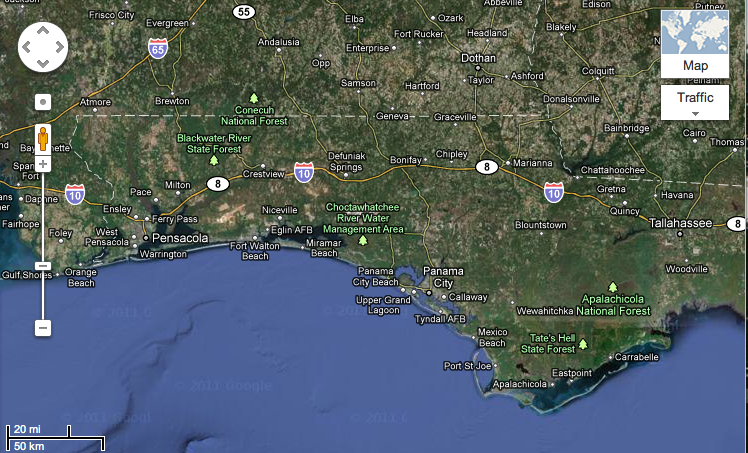
Apalachicola is another one of the oldest cities in Florida, and has a long history relating to shipping and warehousing. Before, we have always gone there to eat oysters at a really funky place, Boss Oyster. This time we actually took a tour on a golf cart, which was really fun, and took a nature hike, and ended up learning a lot more about a place we really like.
We went to Apalachicola, too, to avoid the Black Friday craziness that seems to have taken over. I know a lot of people are still hurting, economically, and it is painful to me to hear people being encouraged to CONSUME to the point of mindlessness. I understand some of the prices are unbelievably low, I understand that. It makes no sense to me that stores would be open all night, that they would require their employees to come in for an opening Thanksgiving night, or at midnight, or 3 a.m. or 4 a.m. That is sheer consumerist craziness, and I won’t have any part of it.
Apalachicola is just a lovely place. I want to share so me photos with you. This is approaching Apalachicola from the East, on highway 98, which comes in over a long long bridge:

The Apalachicola working boat marina:


An old merchant mansion, The Ormond House, now a State museum, beautifully decorated for Christmas:



The Nature Walk out to the Estuary is hidden behind the shrimp boat marina; you have to know it is there – as our guide did. It was a really nicely done walk, with just a few mosquitos (ouch!)

This is a detail from the Vietnam War Memorial in Washington DC, the only place in the United States allowed to have this statuary just like the original monument:

Trinity Episcopal Church, founded in Apalachicola by John Gorrie, the same man who originated the thinking behind modern air conditioning. He had patients with cholera, and he figured out that they got better when it was cooler, so he designed ways to keep patients cooler in the long, humid, hot summers of Gulf Florida . . .
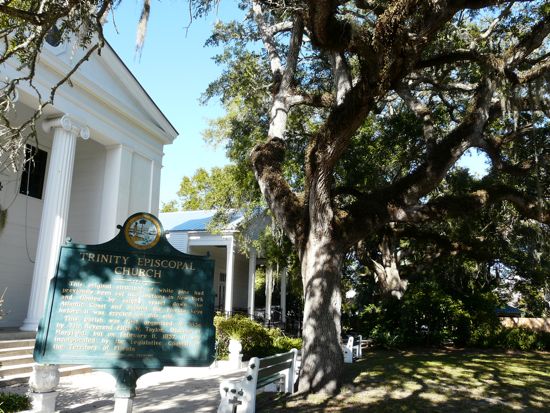
There are many beautiful old homes, and a lot of money going into restoring them to their old grandeur in Apalachicola. You can stay in many of them; they are now hotels and bed and breakfasts or inns. Many, however, remain private residences, and retain their allure.
Recent Comments
ExpatAlien on What Country am I Living … intlxpatr on Yellowstone: Old Faithful to C… Michelle on Yellowstone: Old Faithful to C… Cathy on No Grown-Ups in Charge intlxpatr on Waiting for Snow Wikipedia Donate Button

Amazina


Early Voting in Florida


 Here There and Everywhere