Uyen Nichole Duong: Mimi and Her Mirror
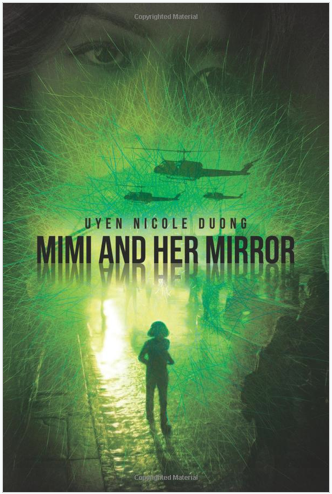
I must be on a streak. I really wanted to like this main character, Mi Chou (Mimi) but I found her obsessive, impulsive, overly emotional, self-absorbed and boastful. Her strongest relationship in the book is with her three way mirror. She specifically claims not to be narcissistic, and I think the story tells us otherwise.
The book is supposed to be fictional, and I truly hope some parts are fictional, but the strengths of the book lie in the ‘coming to America’ experience, which she captures well. She has a strong eye for ironies, hypocrisies and cultural differences. Her beginnings are vague, as is often the case when an immigrant goes through the shell-shock of being cut off from their own culture and grafted into another. I believe the author drew strongly on her own experiences to write this part of the book, and to me, it is the strongest part.
Mi Chau and her family leave Viet Nam during the great evacuation, and are given a spot on the planes that should have gone to someone else. Her entire family, mother, father, sister and brother all escape together, leaving behind a beloved grandmother who refuses to leave. Their entry into the US goes smoothly. They are the first wave of Vietnamese, the lucky ones. They have support, they have jobs. They have lost their own world, and they struggle. All this is part of the normal immigrant experience.
Neither is it abnormal that the children thrive through their struggles, and achieve excellent eduations. What is distracting to me in the book is how Mimi bases her self worth first on her academic excellence, and later in life on what she owns, and on her status. She has accomplished so much, she owns high-status symbols, but she is miserable and her life is empty.
Is it because of her experience as she evacuates out of Vietnam? Is it a character defect? There are no meaningful relationships in her life, she lives an empty and soulless existence, focusing on work and accomplishment and status symbols. Her major problem, as I see it, is an unwillingness to connect, to step out of herself and see through other’s eyes.
It’s an interesting book. There are, in my opinion, better books about the Vietnamese coming-to-America experience, and one is Anne Fadiman’s The Spirit Catches You and You Fall Down about immigrant Hmong, which is rich in cultural teachings, rich in relationships, and I still remember details more than ten years after I first read it. It is only available in Kindle format now, through Amazon, although they may have a used copy from time to time. Way better book than Mimi.

Anne Enright: The Gathering
What is it with my problem with Man Booker Award winners? The last one I remember is White Tiger, which we read in our Kuwait book group, and I hated. Actually, it was the main character I hated . . . and possibly that is what is happening with me and The Gathering, now that I think about it.

We meet Veronica, Irish, from a large Irish family, as she learns of the death of her brother Liam. Through claiming the body, preparing for the funeral, the funeral and the aftermath, we are there with Veronica as she whines and complains, as she disparages her family members while ignoring her own husband and family, and she drinks too much. She gets up at noon, and stays up all night, avoiding her husband. Her language is frightful, and her sexual episodes are crude and explicit . . . offensive, but maybe it is the utter distraught nature of a woman in the throes of the deepest grief?
Slowly, slowly, the story unfolds. For me, I was never sure what was truth and what was imagination, in terms of the story. Were the children abused, molested, neglected? Or are these the creative imaginings of a troubled woman? There seems to be a thread of insanity in the family – can we trust that she is a reliable narrator?
As little as I liked the main character – hmmmm, that seems to be a problem I am having a lot right now, or at least I’ve had a run of main characters I don’t like very well – I finished this book. I’m glad I read it so that I can talk about it if it comes up in a discussion, but it did not inspire or elevate me in any way, and I didn’t even feel a lot of compassion for the narrator.
Emergency Message for U.S Citizens: Demonstration Notice 14-2011
Emergency Message for U.S Citizens � Demonstration Notice 14-2011
September 20, 2011
Please circulate the following message without additions or omissions
immediately to all U.S. citizens within your area of responsibility.
An anti-corruption demonstration is planned for the early evening hours at
Determination Square on Wednesday, September 21 in downtown Kuwait City. An
increased police and security presence is expected in and around the capital.
There are also reports of possible demonstrations in support of Bidoon rights on
Wednesday, September 21 in the cities of Jahra, Al-Sulaibyah and Al-Ahmadi. An
increased police and security presence is also expected in these areas.
Spontaneous and planned demonstrations take place in Kuwait from time to time in
response to world events or local developments.
At times, even demonstrations intended to be peaceful can turn confrontational and possibly escalate into violence. Do not let curiosity get the best of you; avoid the areas of demonstrations and exercise caution if within the vicinity of any large gatherings. Please stay current with media coverage of local events, be aware of your surroundings, and practice personal security awareness at all times.
For the latest security information, U.S. citizens living and traveling abroad
should regularly monitor the Department of State’s Bureau of Consular Affairs
Internet website, where the current Worldwide Caution, Travel Warnings, Travel
Alerts, as well as the Country Specific Information for Kuwait can be found.
Up-to-date information on security can also be obtained by calling
1-888-407-4747 toll-free in the United States and Canada or, for callers outside
the United States and Canada, a regular toll line at 1-202-501-4444. These
numbers are available from 8:00 a.m. to 8:00 p.m. Eastern Time, Monday through
Friday (except U.S. federal holidays). You can also download our free Smart
Traveler App for travel information at your fingertips and follow us on Twitter
and the Bureau of Consular Affairs page on Facebook as well.
The U.S. Embassy is located at Al-Masjid Al-Aqsa Street, Block 6, Plot 14,
Bayan, Kuwait. If you are a U.S. citizen in need of emergency assistance in
Kuwait, you may reach the U.S. Embassy by calling +965-2259-1001 and requesting
the duty officer.
U.S. citizens living or traveling in Kuwait are encouraged to enroll in the
Department�s Smart Traveler Enrollment Program (STEP) so that they can obtain
updated information on travel and security. U.S. citizens without internet
access may enroll directly with the nearest U.S. Embassy or Consulate. By
enrolling, U.S. citizens make it easier for the Embassy or Consulate to contact
them in case of emergency. For additional information, please refer to “A Safe
Trip Abroad”.
This message may be accessed on the Embassy website, http://kuwait.usembassy.gov
Please note that the Consular Section is closed for U.S. and most local
holidays. The current holiday schedule for 2011 is posted on
http://kuwait.usembassy.gov/holidays.html
Emily Arsenault: In Search of the Rose Notes
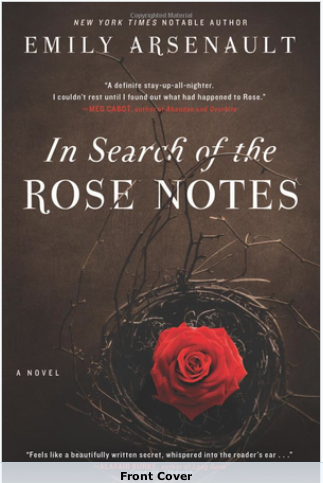
I think I got this book because I saw some of my book-loving friends on Good Reads reading it. When I started reading it, I thought, “Hmmm, big print, short chapters and the main character is a pre-teen, hmmm, this has the feel of a teen-book,” but by then it was too late, I was already hooked, so I read the whole book and I am glad I did.
So the writing is not all that complex. I actually like teen books because teens and twenties deal so much with making moral choices. They are at that wonderful age when they think about things and decides what matters to them. There are many of those I would rather hang around than people my own age who want to talk about shopping or shoes or aches and pains.
(You can find this book at Amazon.com)
Nora hangs out a lot with Charlotte, her best friend, while her single mother works full time. Charlotte is bossy, but never boring, as they explore the pre-teen world together. They have a babysitter, Rose, who watches over them and keeps them out of trouble. Until one day Rose disappears.
The book switches back and forth from these pre-teen experiences to a later time, maybe 15 years later, when Rose’s body is unearthed, and once again Nora experiences a lot of feelings she had buried. I loved the depiction of high school, where so many kids are suicidal, and life is cruel. High school just isn’t a kind place, even for those who look like they are having a great time.
At the same time, there were some good relationships, and you get to look back with Nora at people who were kind, but you were too absorbed in your own feelings to notice. It’s a complex world, and we get to go back and explore it once again through Nora’s eyes.
I’m glad I read it. This book did not change my life, but it is a great book for people who either are younger, or who like younger people, as I do.
Contagion
As we rushed into the house, we both headed immediately to our bathrooms to wash our hands. Twice. And I also washed my face.
Contagion is a very intelligent movie. It is scary, but not in the Friday the 13th kind of scary, or in the Night of the Living Dead kind of scary, although come to think of it, there were some elements in common with the original Night of the Living Dead. No, what makes Contagion scary is that it could happen so easily.
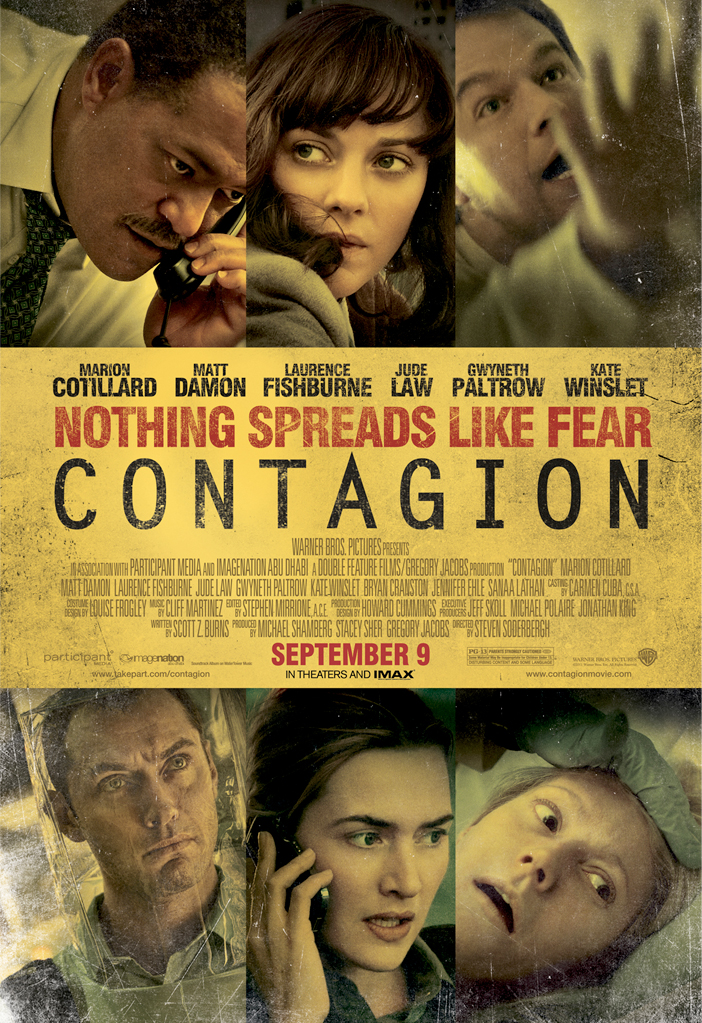
I had no idea that we touch our faces, on the average, of three to five times a minute, more than 3,000 times a day, and that with every surface we touch, we transfer (germs) (bacteria) (things that could make you sick) close to an entry to your body, like your nostrils and your mouth. Once you start thinking about NOT touching your face, you become aware of how often you touch your own face, unaware. Like flipping hair out of your eyes, or covering your mouth when you laugh, or a million other things like that. You become aware of all the things you touch between the time you wash your hands and touch your food. You think about who may have touched your fork, and how well it was washed.
For me, the scariest part of the movie, beyond how quickly the virus mutated and spread, was how quickly civil society broke down when cities were quarantined, when people were concerned food was growing scarce, when people thought they had to fight for survival. The rules for avoiding spreading the virus were not to meet, not to touch, to stay apart. It’s hard to help one another when those rules are in play, but those rules make it easier for those without rules to attack and take what they can.
I liked the music in the movie, too, very edgy.
Before I ever saw this movie, I heard an interview with the author on NPR. She was saying that when they came to her wanting to make this movie, she said “it cannot start in Africa. . . (there were a whole bunch of rules, which were hilarious because they were like every plot for a movie like this ever made) I knew I needed to see this movie, to see how it could be done and still be dramatic, and follow her rules.
There is one hilarious quote. A blogger in this movie gains enormous following. As he is tracking down one of the scientists for information, the scientist says to him:
Blogging is not writing. It’s just graffiti with punctuation.
Excuse me, gotta go wash my hands again.
Jennifer Egan: A Visit From the Goon Squad

Amazon.com kept telling me I needed to read this book, so finally, I ordered it and waited a couple months before I was ready. I just finished a major project AND I caught a miserable cold, so what better time?
I loved this book. It had a lot going against it; you know irrational factors like how you feel when you have a cold and your sinuses are all stuffed up and your chest is tight? A Visit From the Goon Squad took me out of my misery. While it appears random, it is tightly plotted, and I loved seeing how different strands intertwined. I also loved the effects of the goon squad (no, I am not going to tell you anything specific) and I loved how technology drove differences in how different generations thought and acted.
The last act takes place in a future where (this makes total sense) there is a high value placed on “pure”, no tattoos, no swearing – it is truly hilarious, the lengths to which we will go to NOT be our parents. Babies have their own hand-helds, which is already happening. My eyes have been opened, watching our own 18 month old grandson working an iPad and iPhone. It’s amazing to me the aps that are created to entertain, divert and teach our little ones.
This is not a straight line book, so there are times I had to go back and read a section again to remind myself where I met this character before, and how he tied into the plot earlier. It is a fascinating creation, this book, and I would love to sit down for coffee with this author, and her outside-the-box kind of thinking.
In The Middle of the Storm
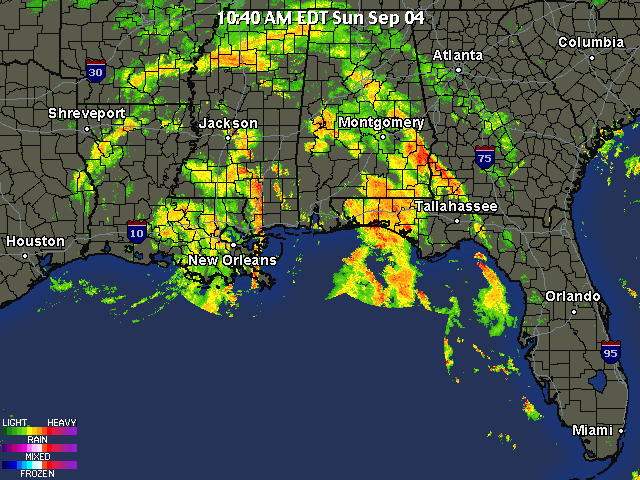
When you’re in the middle of the storm, it is hard to imagine just how BIG it is. It isn’t a hurricane, because the winds are not high enough, but oh man, the rain. Poor Pensacola has been about 10 – 15 inches short of its annual average, and I think we are getting all caught up this weekend.
AdventureMan is outside, picking up dead tree branches that came down last night. On our way to church, early this morning, we saw the electrical crews out trying to fix a line that went down. God bless these heroes who get out of bed on a national long weekend, early in the morning, so that people might have lights, and power, and air conditioning. We take them for granted, and yet they are everyday heroes.
Sobering Reading on Wealth
It’s a long weekend, Labor Day weekend, and Pensacola awakes to rain-sodden streets and forecasts of a rain soggy three day weekend (bad for hotels and restaurants at the beach who hope for a sell-out Labor Day) and high surf from off-shore storms.
The reading for today from James is equally gloomy. I always think of “Insh’allah” when I read it, because it probably has an equivalent somewhere in the Quran, and my Muslim friends say “Insh’allah” (As God wills, or If God wills it) when they state a planned event.
While we are not rich, we have a large homeless population in Pensacola, sleeping out under the skies in hidden camps, scrounging for food, often with a dog, seeking handouts, seeking scraps. They are a constant reminder, to me, of how comfortable we are, and how comfort wars with the religious spirit. When we are too comfortable, we often fail to keep our focus on God, and are distracted by our toys and interests.
(I told you this would be gloomy.)
On the other hand, I wonder how spiritual I would be if I were hungry, worried about getting enough to eat, worried about my safety sleeping out in one of the camps. I wonder if their community looks after one another, or if it is a brutal and chaotic life. I wonder how you can keep your mind on things of the spirit when the search for basic necessities takes up a large part of your life.
James 4:13-5:6
13 Come now, you who say, ‘Today or tomorrow we will go to such and such a town and spend a year there, doing business and making money.’ 14Yet you do not even know what tomorrow will bring. What is your life? For you are a mist that appears for a little while and then vanishes. 15Instead you ought to say, ‘If the Lord wishes, we will live and do this or that.’ 16As it is, you boast in your arrogance; all such boasting is evil. 17Anyone, then, who knows the right thing to do and fails to do it, commits sin.
5Come now, you rich people, weep and wail for the miseries that are coming to you. 2Your riches have rotted, and your clothes are moth-eaten. 3Your gold and silver have rusted, and their rust will be evidence against you, and it will eat your flesh like fire. You have laid up treasure* for the last days. 4Listen! The wages of the labourers who mowed your fields, which you kept back by fraud, cry out, and the cries of the harvesters have reached the ears of the Lord of hosts.
5You have lived on the earth in luxury and in pleasure; you have fattened your hearts on a day of slaughter. 6You have condemned and murdered the righteous one, who does not resist you.
Neighbors Key to Survival
“Americans don’t know their neighbors” my dinner guest said, in response to my asking him what surprises him most in his visit to this country. “In my country, we all know our neighbors. It’s important to know your neighbors.”
I agreed, and quoted him this article supporting his view that I heard on National Public Radio, one of those ideas I hear so often on NPR because they cover news other news sources ignore.
Below is just a portion of the story, which you can read in whole by clicking on this blue type. Even better, if you want, you can listed to the story yourself by clicking on the “Listen to the Story: All things Considered” button on this same page.

When Hurricane Katrina struck in 2005, one victim was political scientist Daniel Aldrich. He had just moved to New Orleans. Late one August night, there was a knock on the door.
“It was a neighbor who knew that we had no idea of the realities of the Gulf Coast life,” said Aldrich, who is now a political scientist at Purdue University in Indiana. He “knocked on our door very late at night, around midnight on Saturday night, and said, ‘Look, you’ve got small kids — you should really leave.’ ”
The knock on the door was to prove prophetic. It changed the course of Aldrich’s research and, in turn, is changing the way many experts now think about disaster preparedness.
Officials in New Orleans that Saturday night had not yet ordered an evacuation, but Aldrich trusted the neighbor who knocked on his door. He bundled his family into a car and drove to Houston.
“Without that information we never would’ve left,” Aldrich said. I think we would’ve been trapped.”
In fact, by the time people were told to leave, it was too late and thousands of people got stuck.
Because of his own experience in Katrina, Aldrich started thinking about how neighbors help one another during disasters. He decided to visit disaster sites around the world, looking for data.
Aldrich’s findings show that ambulances and firetrucks and government aid are not the principal ways most people survive during — and recover after — a disaster. His data suggest that while official help is useful — in clearing the water and getting the power back on in a place such as New Orleans after Katrina, for example — government interventions cannot bring neighborhoods back, and most emergency responders take far too long to get to the scene of a disaster to save many lives. Rather, it is the personal ties among members of a community that determine survival during a disaster, and recovery in its aftermath.
When Aldrich visited villages in India hit by the giant 2004 tsunami, he found that villagers who fared best after the disaster weren’t those with the most money, or the most power. They were people who knew lots of other people — the most socially connected individuals. In other words, if you want to predict who will do well after a disaster, you look for faces that keep showing up at all the weddings and funerals.
“Those individuals who had been more involved in local festivals, funerals and weddings, those were individuals who were tied into the community, they knew who to go to, they knew how to find someone who could help them get aid,” Aldrich says.
My visiting guest was from Lebanon, where neighbors have relied on one another for years as civil unrest rocks the country.
“I am guessing we move more often than your family and friends,” I ventured. “You are right, it is harder to establish long-lasting neighborly relations here where people come and go more often.”
Actually, we have settled in a fairly established neighborhood, where many people around us have lived for years and years, some all their lives. But we have only been here a year, and it takes time to build strong neighborly relations. But we are aware that connecting with our neighbors and staying connected is important in a part of the country vulnerable to life-threatening hurricanes and other natural emergencies.
You can listen to the entire report in 6 minutes and 3 seconds here.
“Is Your House Always This Clean?”
We had guests this week, visitors from overseas, and it was so much fun. One woman was full of questions. This was her first time out of her own country, and you know how it is when you are in a foreign culture, people think differently. Some of her questions bordered on impolite, according to our culture, but we could tell she was asking because she really was interested, and we didn’t let her questions bother us.
“No!” I laughed, “We cleaned because we had guests coming! My husband vacuumed and I washed all the floors!”
My daughter-in-law jumped in.
“Yes!” she laughed. “Yes, their house is always this clean!”
We all laughed.
“It’s just my husband and me,” I added, “it’s not that hard to keep it picked up and neat. We make extra effort when guests are coming.”
“Why do you do this?” she asked. “Why do you invite strangers into your home and give us dinner?”
“People have been so kind to us, in so many countries, in so many ways,” I began, “No matter how hard we try, we will never be able to repay all the kindness we have received. But we do our best.”
We were in my kitchen, which is not large, and I am trying to get dinner on the table. It is a simple, family dinner, a little chaotic, but with lots of dishes so the guests can find something they might like to eat.
“Do you clean yourself? You have no cook?” she asked.
“We clean. Both of us. We could hire help, but it is very expensive here,” I said, pulling the chicken out of the oven. “And we do our own cooking. My husband makes bread! He is very good at it.”
During the evening she continued asking questions, and now, several days later, we find ourselves thinking about the questions, and thinking . . . THIS is why we do it! We love these guests who come in with a different way of looking at things and their questions, which stimulate us to think in new ways, too, as we try to explain why we do things the way we do them.
I remember in Doha, the Philipina maids would ask me “how old are you?” because they couldn’t guess by looking at me. We never ask a woman how old they are once they are past maybe eighteen or twenty years old. We never ask how much money a husband – or wife – makes. It is culturally taboo, it just isn’t done. We never ask what kind of birth control someone is using. I am aware of these things because I have been asked, and it made me think about it.
But now I wonder what questions I have asked in foreign lands which shocked people, or made them uncomfortable?
Recent Comments
ExpatAlien on What Country am I Living … intlxpatr on Yellowstone: Old Faithful to C… Michelle on Yellowstone: Old Faithful to C… Cathy on No Grown-Ups in Charge intlxpatr on Waiting for Snow Wikipedia Donate Button

Amazina


Early Voting in Florida


 Here There and Everywhere