Hilarious Book by Kuwaiti Author Danderma
Wooooo HOOOOO, Danderma! Published!
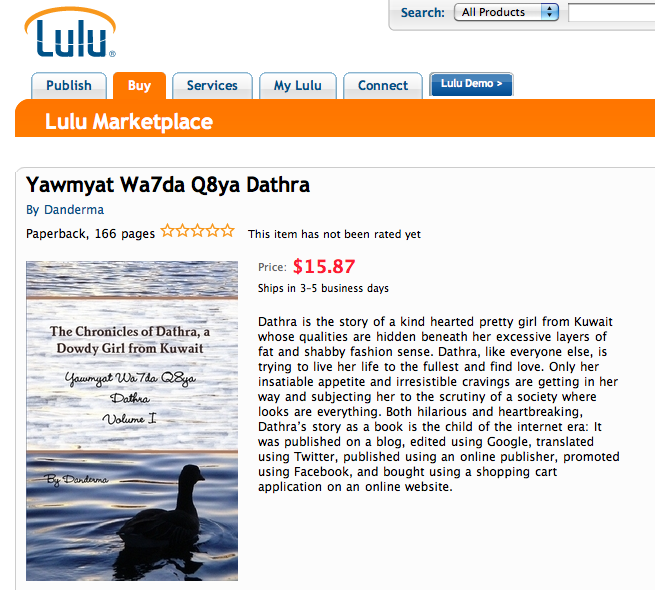
It’s easy to get addicted to Danderma / Dathra; she is unpretentious, sharply insightful, and hilarious. She pokes fun at herself – and at the society in which she (dys)functions. Side-splittingly funny stuff.
By the book or download Here.
Hissing on Easter and other Rambles
The 0815 service this morning was glorious. We got there early, because those who had gone to the early-early service and had stayed on for breakfast would be leaving, and this is Easter – we needed a parking place. The front of the church was laden with flowers, so many flowers it looked like a private garden, and the flowers scented the entire church, an odor of sanctity.
Getting there early was a really good thing – just after we entered, the brass trio started serenading us, exultant music, full of joy and triumph, perfect way to start an Easter morning service. It’s a special treat, having music and the full choir at the 0815 service, but a member of the choir told me earlier that this is the only Sunday of the year that they sing at all three services. If you like music, oh, what a treat!
The church filled up quickly. I couldn’t help it, I had to look around to see if there were any Easter bonnets. I remember being a kid – a girl kid, that is. We always had hats for Easter. Being kind of a snotty kid, I was often critical of the one I got and somewhere along the line that tradition was discontinued. I guess it must have been discontinued widely, as there were only six ladies wearing hats (we couldn’t help it, we counted), but very nice hats they were. The little girls were all dressed in lovely dresses, some even with chiffon and lots of ribbons.
As we reached the offering, people behind us were criticizing the parents whose children were making noise.
“They should know better! Why don’t they just take them out, so they won’t bother the rest of us?”
“It’s SO disrespectful!”

There is child care available, but I personally love having the children in the service. Maybe it’s a little disruptive, but you know – we’ll live. And I just thank God they are there! I want them to be welcome! I want the parents not to have to leave, but to know their children – and their antics – are welcome! I miss our noisy services in Doha and in Kuwait, with the babies, the children. Even though they left, there was always a little serendipitous bedlam in the service to keep us from taking ourselves too seriously.
As we left, we also sighed – we miss the gorgeous colorful displays of all the saris on the high holy days, the saffrons and fuschias and peacock blues and greens and golds.
Later this afternoon, when the Happy Baby wakes up from his nap, we’ll be having Easter Dinner. He got going too fast this morning and split his lip when he fell. I remember our son at that age, and the doctor who looked at me meaningfully and asked “does your son often have bruises?” I was so offended, but all I could do was laugh – when they start running, they fall down. Once, I was right there when he tripped – inches away from me – and fell against a sharp edged table. It all happened so fast there was nothing I could do (except take him to the emergency room for stitches).
Actually, we were at a school friend’s house in Jordan, his father owned the hospital, his driver drove us, he Dad-the-doctor put in the stitches and we were back at the party before ice-cream and cake were served.
We try to protect them. We do our best. We try to teach them how to behave at public gatherings, like parades, like church, like change-of-command ceremonies, things we are not born knowing. It takes practice. Like parenting. 🙂
Good Friday for the Non-Christian
When I saw this on AOL News it struck me that if I post Ramadan for Non-Muslims, then it also makes sense to publish Good Friday for Non-Christians.
Different Christian groups have varying traditions on Good Friday. In our church, Good Friday starts on the evening before, Maundy Thursday, with a stripping of the altar. In some churches, there is also a gathering where the priests of the parish wash the feet of members of the congregation, as Jesus washed the feet of his disciples, as a demonstration of the humble spirit required, that we are to serve one another.
Good Friday: Origins, Observances And Fasting Rules
by Neha Prakash
Good Friday is the Christian commemoration of Jesus’ Passion story; specifically his betrayal, trial and crucifixion that are described in the Christian gospels. In the sequence of Holy Week, it follows the rituals marking the Last Supper on Maundy Thursday and precedes the celebration of Jesus’ resurrection on Easter Sunday.
Since Jewish tradition dictates that Friday begins at sundown on Thursday, the events of Good Friday traditionally begin with the betrayal of Jesus by his apostle Judas in the garden of Gethsemane. He is subsequently brought before the Sanhedrin council, the Roman governor Pontius Pilate and King Herod of Galilee with the ultimate outcome being his condemnation to death by crucifixion.
The trial of Jesus and his crucifixion are described in varying detail by all four canonical Gospels, the Jewish historian Josephus and the Roman writer Tacitus. While the specific events and theological implications are widely disputed, the historicity of the occasion is widely accepted.
Good Friday church services generally revolve around the reading of the Gospel accounts of the Passion story. The Catholic liturgy for Good Friday also includes the distribution of the Eucharist that was consecrated during the Mass on Maundy Thursday and special veneration of the cross by inviting individuals to approach the altar and kiss the wood of the crucifix.
Many Christians also mark Good Friday by participating in or watching processions meant to replicate the journey that Jesus took through the streets of Jerusalem while carrying his cross to the site of his crucifixion at Calvary. Two of the largest and most famous of these occasions are Rome’s Way of the Cross that leads to the Colosseum and is presided over by the Pope and the Via Dolorosa in Jerusalem — a procession along the traditionally marked route of Jesus that is attended by thousands of pilgrims each year.

Good Friday is also a day of strict fasting for Catholics and some other Christians. As with all the Fridays of Lent, Catholics are instructed to abstain from eating meat. As with Ash Wednesday, the fasting rules for Good Friday dictate that adherents should eat only one full meal with two smaller meals being permitted as long as no other food is consumed in the interim. The use of other meat-based products such as lard, chicken broth or dairy is not traditionally forbidden, although many individuals elect to make their Good Friday meals entirely vegetarian or vegan.
In many countries with strong Christian traditions such as those in Latin America, Good Friday is observed as a national holiday. Good Friday is not a federal holiday in the United States, but several states observe it as an official state holiday by closing government offices, courts and banks. Many private businesses also choose to close on Good Friday in addition to financial markets.
Holy Week Evensong at Christ Church, Pensacola
My favorite service of all, Evensong. Everything is just moving along, peacefully, penitentially, as we enter Holy Week, when all of a sudden, the choir is singing Gounod, the Jerusalem anthem from Gallia. Oh, WOW! Gounod makes me grin, and he moves me. Gounod . . . Gounod ROCKS!

And here you can here the anthem:
I was introduced to Gounod in Doha. Our priest, Ian Young, led a group called the Doha Singers, and he chose challenging music. We learned Gounod’s Mass for St. Cecelia, and the music is the kind that gets into your blood. I couldn’t get enough of it. I never get sick of it. Gounod is music with a sense of drama and a sense of humor about itself. I think it is his sense of timing, how you hold a note just a little longer than you would expect, and then rollick on to the next. I had never heard this piece before, but Gounod is so individual, so unique – it had to be Gounod.
It was a perfect evening, a lovely service, and the sun shone in through the cross as it set:

At the end, we sang one of my very favorite hymns, The Day Thou Gavest Lord, is Ended:
I admit it, I am pretty tough, but these words make me weak and weepy:
The day Thou gavest, Lord, is ended,
The darkness falls at Thy behest;
To Thee our morning hymns ascended,
Thy praise shall sanctify our rest.
All in all, a lovely day. Our son joined us for the first episode of The Game of Thrones on HBO. He’s read all the books, I am on book 2, and AdventureMan is reading the first book, the one on which this series is based. Great way to begin our week. 🙂
Scamese
This was in my newest New Yorker magazine, originally given me by Little Diamond, now I can’t live without my subscription. 🙂 There is the kind of news you get on television, like what they have pictures of, maybe not the most important stuff but visual. Then there is National Public Radio news, and the New York Times, and The New Yorker. The New Yorker also has some of the greatest, funniest covers ever, and great cartoons. This one, as you might imagine, is near and dear to my heart:

Lunch in Paris (A Love Story With Recipes) by Elizabeth Bond
I just finished this book, and I need to review it so that I can pass it along to my daughter-in-law, who sees France, as I do, through eyes of love. Americans either love France or hate it, for some reason France evokes strong emotions one way or the other.

This author is a New Yorker, and her experiences are not my experiences, because her culture is not my culture. New York is a culture all its own. On the other hand, her experiences as an expat are universal, and her insecurity with the language, the culture and the customs are magnified by her commitment to marrying a French man and living in France for the rest of her life.
For the record, I really loved this book.
Can you read a recipe and have a pretty good idea what it is going to look like and how it will taste? In my family, we read cook books for fun. The recipes Elizabeth Bond has included are great recipes, a great start on French cooking the simple and fresh way. Even someone who has never cooked French food can make most of the dishes she creates in this book. In my very favorite chapter, A New Year’s Feast, there are several recipes for North African dishes I have eaten and loved – and oh, I am eager to try these! Chicken Tajine with Two Kinds of Lemon! Tajine with Meatballs and Spiced Apricots! Oh, YUMMMM!
In one part of the book, the author talks about some very basic differences between how Americans approach life and how the French view life:
I watched the couples walking around the lake. “Maybe it’s the New Yorker in me. I’m too used to rushing around. But everyone here is so relaxed, it’s like they’re moving in slow motion.”
“Why should they rush? They’re not going to get anywhere.”
Sometimes I really have no idea what he is taling about.
“You will never understand. You come from a place where everything is possible.” We lay side by side on the grass, our eyes half closed.
“It’s Henry Miller that said, ‘In America, every man is potentially a president. Here, every man is potentially a zero.’ ”
And then he told me a story.
“When I was sixteen it was time to decide what kind of studies I would pursue. I was the best in the class in Math and Physics, but also the best in Literature. I went to the school library and the woman behind the desk gave me a book. It was called All the Jobs in the World. I looked through it. I found two things I liked: scientific researcher and film director. I brought the book to the front and showed her my choices. ‘Ah non,’ she said, ‘You forgot to look at the key.’ And she pointed to the top of the page. Next to each job were the dollar signs – three dollar signs if the job paid a lot of money, one dollar sign if it paid very little. Next to the dollar sign was a door. If the door was wide open it was very easy to tet this job, if the door was open just a little bit, it was very hard. ‘Regard,‘ she said, ‘You have picked only jobs with no dollar signs and a closed door. Tu n’y arriveras jamais. You will never get there.”
‘You should become an engineer,’ she said. My parents never met anyone who did these other things. We don’t come from that world. They had no friends they could call to get me a job. They were afraid I would fail and they couldn’t help me. They were afraid I would have no place in the society. And I didn’t have the force to do it myself. I didn’t want to disappoint them. So I became an engineer.”
“It’s just like that here. If you want to do something different, if you head sticks up just a little, they cut it off. It’s been like that since the Revolution. You know the saying, Liberte,’ Egalite,’ Fraternite,’ equality is right in the middle. Everyone has got to be the same.
Of all the stories Gwendal has told me, before or since, this one shocked me the most. Never in my life, not once, had anyone ever told me there was something I couldn’t do, couldn’t be.
Have you ever known an expat wife (a woman who has married a man of another culture and lived in his country)? Expat wives are some of the bravest women I have ever met. No matter how long you have been married to a man of another culture, you can still be surprised.
The expat wives I have known have been smart, gifted people, woman who have been blessed to see the world through the eyes of more than one culture, and it changes everything. Their children are amazing – most will speak – and think – in more than one language. They have a sort of international fluidity, as well as intercultural fluency. It isn’t everyone’s choice, but those who chose it often live lives you and I can only begin to imagine. Elizabeth Bond has opened the door a little, and shared some of those experiences with us.
The book I bought has Reader’s Groups questions in the back, and they are good questions. Read the questions first; it gives you food for thought as you read through her experiences.
US Highway Deaths Lowest Since 1949
The major reason? 84% US drivers use seat belts. You can read the entire article at AOL News
WASHINGTON — Highway deaths have plummeted to their lowest levels in more than 60 years, helped by more people wearing seat belts, better safety equipment in cars and efforts to curb drunken driving.
The Transportation Department estimated Friday that 32,788 people were killed on U.S. roads in 2010, a decrease of about 3 percent from 2009. It’s the fewest number of deaths since 1949 — during the presidency of Harry Truman — when more than 30,000 people were killed.
The Pacific Northwest region, which includes Washington state, Oregon, Idaho, Montana and Alaska, saw fatalities fall 12 percent. Western states including Arizona, California and Hawaii also posted large declines.
Government officials said the number of deaths was still significant but credited efforts on multiple fronts to make roadways safer.
“Too many of our friends and neighbors are killed in preventable roadway tragedies every day,” said Transportation Secretary Ray LaHood. “We will continue doing everything possible to make cars safer, increase seat belt use, put a stop to drunk driving and distracted driving and encourage drivers to put safety first.”
Like Cats
I was talking with a friend who had started in a new church about a year ago, around the same time we started at our church. I was telling her about the Service to Others Committee, and how I like everyone working on it, we were all kind of nerds, my favorite kind of people.
She looked a little down, and told me it seemed to be taking some time for her to find her niche in the church, and so I had to share with her my cat theory.
When you bring a new cat into a house where you already have a cat, you have to keep them separated for a while. You put the new cat in a separate room, with separate feeding dishes and litter box. Even so, the original cat is going to be a little wary. He can smell the new cat, it is something new and something strange, and it makes him uneasy.
People, it seems to me, are a little the same way, especially people who are settled. When a new person comes in, it just won’t do to try to be accepted. You just have to come in quietly, don’t intrude, let people get used to you. Little by little, people reach out to you. It can be discouragingly slow. If you have patience, it pays off.
Sometimes, rarely, but sometimes, you meet someone with a widely accepting outlook, and this time, I was lucky, I met a friend at the church who is just so full of life she bubbles with it. She makes things happen. She doesn’t have time for gossip or negative thoughts, and if you are willing to help, that’s good enough for her. She is organized and she is busy, and I feel really lucky to be her friend.
Slowly, people are starting to realize we are not visitors at the church, but here to stay, and are reaching out to greet us. It’s a good feeling.
Tomorrow, we have our first of two sets of house guests arriving. When our first guest leaves, I have 18 hours to get the room and bathroom cleaned, clean sheets on the bed, etc. They are all really good friends, very old friends, and all coming to escape the chill of a seemingly endless winter and enjoy a little sunshine. If you don’t hear much from me, it’s because I’m out playing. 🙂
Alexander McCall Smith and The Saturday Big Tent Wedding Party

Just back from a wonderful two day trip to Botswana, visiting my dear and beloved friend Precious Ramotswe, who owns the #1 Ladies Detective Agency. For her, I make an exception to the paperback book rule (buy paperbacks because hard covers can hurt you if you fall asleep and they fall over) and get on the pre-publication order list so that Amazon will send me the book as soon as it comes out.
The Saturday Big Tent Wedding Party arrived Wednesday night. My husband was expecting a friend, and when the doorbell rang I thought “oh my, he is really early!” but it was the UPS guy, who had left a book-sized package on my doorstep. I had just finished an easy but fun book (The Map Thief by Heather Terrell) and was at odd ends as to what to read next, and this was an easy answer. As my husband drank Arabic coffee and sweet sweet Arabic tea, and ate delicate Middle Eastern treats downstairs, I got to start The Saturday Big Tent Wedding Party.
You know the books. They aren’t difficult to read, but while you are reading, you are transported to another world. Precious Ramotswe’s Botswana is not a world without problems, but the solutions to the problems are often found in softer gentler ways, ways that would seem counter-intuitive in our culture, but make total sense when you are raised in Botswana. There is a value placed on peaceable interaction, and maintaining relationships, on forgiveness, and going to extra mile. It’s a sweet world, and a great escape.
As usual, there are several intertwining plot lines with ingenious and unexpected solutions. I suspect that is what keeps me glued to this series – I cannot anticipate the solutions. That, and the gentleness of her outlook, the sweetness of life in Botswana, and the dignity and integrity of McCall’s primary characters.
I don’t know how McCall manages to keep the series fresh, but he avoids the formulaic and I find each book a treat. My favorite part of this book is how Mma Potokwane manages to wangle and invitation to Mma Makutsi’s wedding:
Mma Potokwane noticed the other woman’s uncertainty. “Yes,” she continued. “There’s that problem. And then there’s another problem. Problems come in threes, I find, Mma. So the next one – Problem number two, so to speak – is the cooking of food. You know what I find, Mma, it is this: the people doing the cooking never have enough pots. They say they do, but they do not. And right at the last moment they discover that there are not enough pots, or, more likely, the pots they have are too small. A pot may be big enough to cook your meat and pap at home, just for a family, but do not imagine that it will be big enough to cook for a couple of hundred people. You need big, catering-size pots for that.”
She was now warming to her theme. “And the third problem is the food itself. You may think that you have enough for the feast, and you may be right when it comes to the meat. People usually have enough meat – often rather too much, in fact. But they forget that after their guests have eaten a lot of meat, they need something sweet, and often they have made no arrangements for that. A wedding cake? Yes, but there will only be one small piece of that for each guest – usually not enough. So people find themselves wishing that they had had the foresight to get a supply of ordinary cake for the guests to eat with their tea. And where is this cake? Not there, Mma.”
Mma Ramotswe glanced at Mma Makutsi; this was not the way to speak to a nervous bride, she thought. “I’m sure that everything will work out well,” she said reassuringly. “And if there are any problems, they will surely just be small ones – nothing to worry about.”
Mma Potokwane looked doubtful. “I hope so,” she said. “But in my experience, it never works out like that. I think it’s better to be realistic about these things.”
Mma Makutsi picked up her pencil to add something to her list. “You said something about pots, Mma. Where would I be able to get these big, catering-size pots?”
Mma Potokwane examined her fingernails. “Well, we have them at the orphan farm. Each of the house mothers has a very large pot. I’m sure that we could do something . . . ”
Run to your bookstore and buy The Saturday Big Tent Wedding Party!
Recent Comments
ExpatAlien on What Country am I Living … intlxpatr on Yellowstone: Old Faithful to C… Michelle on Yellowstone: Old Faithful to C… Cathy on No Grown-Ups in Charge intlxpatr on Waiting for Snow Wikipedia Donate Button

Amazina


Early Voting in Florida


 Here There and Everywhere