Culture of Honor Shortens Lives
As I read this article, I thought about life growing up in a small town in Alaska, and how similar it was to life in Qatar and Kuwait, where you live all your life in one community and reputations, once ruined, are never lived down.
HealthDay News
For Men, ‘Culture of Honor’ Can Be Deadly
Mindset spurs risky behaviors and is most prevalent in U.S. South and West, study shows.
By Kathleen Doheny, HealthDay News
MONDAY, Aug. 15 (HealthDay News) — Psychologists call it the “culture of honor,” a mostly male mindset that places a high value on defending one’s reputation at any cost. But new research confirms that it’s linked with high rates of accidental deaths.
“People who embrace these values also report more risk-taking,” explained study author Dr. Ryan Brown, an associate professor of psychology at the University of Oklahoma, in Norman.
This dangerous male mindset is also more prevalent among those living in the South and West, in such states as South Carolina, Texas and Wyoming, he added.
In two studies published in the current issue of the journal Social Psychological and Personality Science, Brown looked at the consequences of such thinking.
First, he compared rates of accidental deaths (car accidents, drowning, over-exertion and so on) in all U.S. states. He found the so-called “honor states” had higher rates than non-honor states (such as New York, Ohio, Wisconsin).
More than 7,000 deaths a year can be blamed on risk-taking linked with the “culture of honor,” he said.
The behavior was most common in more rural areas of the honor states, he found. In the cities of honor states, he found a 14 percent higher accidental death rate than in the cities of non-honor states. He found a 19 percent higher rate in the smaller towns of honor states compared to non-honor states.
“In a smaller town, your reputation is much more important,” he said. It’s likely that everyone knows your business, and that could be good or bad for your reputation, he explained.
In a second study, Brown surveyed 103 college students from his university, including 79 women.
The participants completed tests measuring how much they subscribed to the culture of honor, finished a self-esteem test and answered questions about their tendencies toward risk-taking behavior. A sample statement to which they agreed or not was: “A real man doesn’t let other people push him around.”
The more the person subscribed to a culture of honor, the more likely they were to engage in risky behaviors, the findings showed.
The effect was there for women, too, Brown said.
He and others have previously noted that this culture of honor originated with the Ulster Scots (mistakenly sometimes called the Scotch-Irish) who came to the United States during the 18th century.
In their homeland, he said, they were herders and were always being invaded by someone. They learned to protect and defend themselves, not always in ideal ways. A typical statement, Brown noted: “You take one of our cows, we will take your whole herd.”
The culture of honor behavior persists, he said, despite the disappearance of the herds.
It has staying power, Brown added, and is fostered through norms and values about masculinity and femininity. It’s the stuff of country songs, he explained.
That makes sense to Richard Nisbett, the Theodore M. Newcomb Distinguished Professor of Psychology at the University of Michigan. He is the author of Culture of Honor: The Psychology of Violence in the South.
In the past, Nisbett explained, “if you kept animals for a living, you ran the risk of having your entire livelihood taken away [if someone opens the pasture gate, for instance].”
In modern times, “if you stand the risk of losing your livelihood easily and the state is not around to protect you, you are going to develop this kind of culture of honor,” Nisbett said.
There’s more to it than showing off for women, although that is part of it, he added. It is also, for a man, showing other guys your toughness.
While Brown’s research and that of others clearly shows that some states aren’t honor states, Nisbett said that the behavior is kept going partly by the false belief that everyone else subscribes to the same mindset.
“We tend to think of the culture of honor as historical,” said Joe Vandello, an associate professor of psychology at the University of South Florida. But, “elements of this culture of honor still exist today.”
Simply becoming aware of the phenomenon might help reduce the behavior, Brown noted. Even though it can become “part of your programming,” he said, “we have a will, we have a choice.”
Learn more in the Everyday Health Emotional Health Center.
Surprising Secrets to Happiness
Received this in an e-mail this morning from Bottom Line, a service we have subscribed to for many years because they report some of the newest findings in concise and readable articles:
Surprising Secrets from the World’s Happiest People
Dan Buettner
We’ve all heard that “wealth doesn’t buy happiness.” Neither, it turns out, does social status, youth or beauty.
Social scientists have collected tens of millions of data points that help identify what truly makes people happy. Genetics and life circumstances can influence happiness, but personal choices account for about 55% of it. That means we all have more control over our happiness than we may realize.
National Geographic author and explorer Dan Buettner spent five years talking to people in areas identified by researchers as the world leaders in happiness—Denmark’s Jutland Peninsula… Singapore…Nuevo León, Mexico … and the town of San Luis Obispo in California.
In his new book, Thrive, he identified the main characteristics of what he calls thrivers, people who consistently report the highest levels of well-being. Here, secrets from the world’s happiest people…
Own one TV, no more. Americans spend more than four hours a day, on average, in front of the television. This is time that they’re not spending with other people, including their families. (Family time in front of the television is not the same as real interaction.)
In the places where happiness is highest, people spend the least time watching television. It’s not that they never watch—they just watch less than most people.
I advise people to own no more than one television—and to keep it in an out-of-the-way place, such as the basement. You still can watch your favorite programs, but watching will become a deliberate activity, not something you just do automatically.
Create a “flow room.” In Danish society, most families have an area in the house where everyone naturally congregates. I call these rooms “flow rooms” because they’re places where time seems to flow away when people are engaged and enjoying one another’s company. Flow rooms have no screens (TVs or computers) and no clocks. They are quiet environments where it’s easy to engage in meaningful activities with family.
In our house, I chose a room with good lighting and the best views—it’s comfortable, and everyone in the family wants to be there. I keep it stocked with good books, musical instruments and the best family games.
There’s nothing formal about our gatherings. People wander in and out. Because it’s so pleasant, we spend a lot more time there than in front of the TV or separated in different parts of the house.
Experience the “sun bonus.” By most standard measures, people in Mexico should be less happy than those in other countries. About 60% of the population is poor. Education and health care are less than optimal. Yet on the happiness scale, Mexico ranks high.
This is partly due to the “sun bonus.” People in sunnier climates are consistently happier than those who live in northern countries.
Those of us who live in colder, less sunny climates still can take advantage of the sunny days we do have by getting out and enjoying the sun. The vitamin D that is produced in the body from sun exposure is sometimes called the “happiness vitamin” because it increases brain levels of serotonin, the same neurotransmitter that is increased by some anti-depressant medications.
Stop shopping. The satisfaction that we get from buying things—an expensive watch, a new suit, a fancy car—wears off within 14 months. Yet in the US, we’re pressured by the media and social expectations to always want more. In order to get it, we have to work longer hours and take fewer vacations, which generally reduces happiness.
In Denmark, regulations limit the number of hours that shops can be open. In Mexico, most of the inhabitants are not running a status race with their neighbors.
For more happiness, take the money that you could spend on nonessential items and spend it on something that lasts. For example, take a vacation with your family or sign up for a painting class. The experiences and good memories will continue to give satisfaction for the rest of your life.
Employ yourself. Self-employed workers and business owners report some of the highest levels of well-being. It may be because they are more likely to pursue work that they love or simply because they feel more in control.
The happiness zone of San Luis Obispo, California, has far more self-employed people per capita than the average community in the US. These self-employed workers are shop owners, graphic designers, artists, wine-makers and the like. The more autonomy and control you have over your job, the more likely you will be satisfied with your work.
Make new friends. People around the world report higher levels of satisfaction when they spend time with family and friends. Every additional friend that you make (assuming that these friends are upbeat) increases your chances of being happy by 9%.
People who get together with others for at least seven hours a day have the highest levels of happiness. That sounds like a lot, but the time quickly adds up.
For example, everyone eats lunch. Ask a coworker to join you, or sit with a group in a cafeteria. Talk with friends during coffee breaks. After work, encourage the family to eat and socialize together, rather than dispersing to separate rooms. Take classes or join a club.
The Danes don’t identify themselves as being particularly outgoing, yet 19 out of 20 Danish adults belong to clubs dedicated to arts, exercise and hobbies.
Get addicted to this. The happiest people almost always volunteer in some fashion—at their church, with environmental groups, for social-service organizations and the like. Volunteering means spending time with others, and it also takes your mind off your own problems and increases self-worth and pride in your community.
Studies have shown that altruism has an effect on the brain that is similar to that of sugar and cocaine. It creates feelings of well-being, along with an addictive feedback loop that encourages people to keep doing it.
Also, volunteers are healthier. They tend to weigh less than those who don’t volunteer, and they’re even less likely to suffer a heart attack.
Commit to volunteering for a set period of time—say, once a week for four weeks. People are more likely to keep doing it when they make this initial commitment—and then get “hooked” on the rewards.
Keep the faith. Religious people tend to be happier than those without faith. It’s not clear whether religion makes people happy or if happy people tend to be drawn to religious practices. Either way, those who are religious have less disease, live longer and are less likely to engage in dangerous behavior (such as smoking and heavy drinking).
In Mexico, for example, more than 80% of people who were asked, “How important is God in your life?” responded with a 10 on a scale of one to 10, compared with only 58% in the US. This helps explain why people in some parts of Mexico, despite the hardships of daily life, tend to thrive emotionally.
Even if you’re not religious, you can achieve similar benefits by cultivating a sense of spirituality—and a belief in giving back to your community and making the world a better place.
Bottom Line/Personal interviewed Dan Buettner, founder of Blue Zones, an organization that studies the regions of the world where people commonly live active lives past the age of 100. Based in Minneapolis, he is a writer for National Geographic and author of Thrive: Finding Happiness the Blue Zones Way (National Geographic). http://www.BlueZones.com
Jerry’s Drive-In, Pensacola
We pass it all the time. Jerry’s BBQ Drive-In. People kept telling us we had to go there, everyone goes there. When we were asking about the best hamburger in Pensacola, the word came back: Jerry’s.
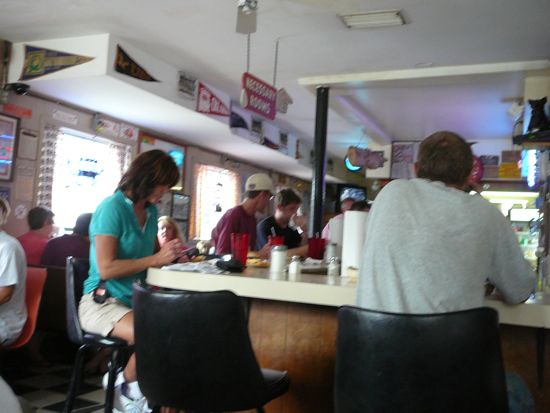

When people tell you about Jerry’s it’s like in Qatar when people tell you “it’s near where Parachute Roundabout used to be,” because it isn’t a drive-in anymore, and they also don’t seem to have a lot of BBQ. Jerry’s IS like a time capsule, you walk in, you wait about 15 minutes for a table at lunch, or you try to find a seat at the counter, and it’s like you’ve walked back into the 1950’s. But it isn’t a theme restaurant, it’s just that nothing has changed. When we looked at the menu, we got a big shock – we don’t even remember prices like these. It would be hard to spend $20 on a lunch for two, unless you toss back a beer or two, and we saw a few people doing that.
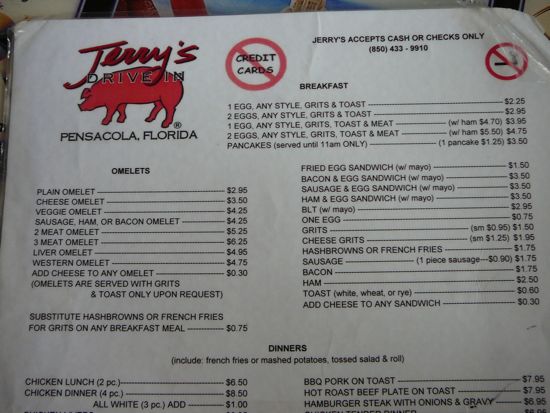


It seems like a place where people are known – like people eat there all the time. We heard a many greeted by name. AdventureMan said if he were a widower, he would probably eat there all the time. It looked like the kind of place where you could get a good meal and a kind and friendly greeting.
Service was prompt, efficient, courteous and friendly.
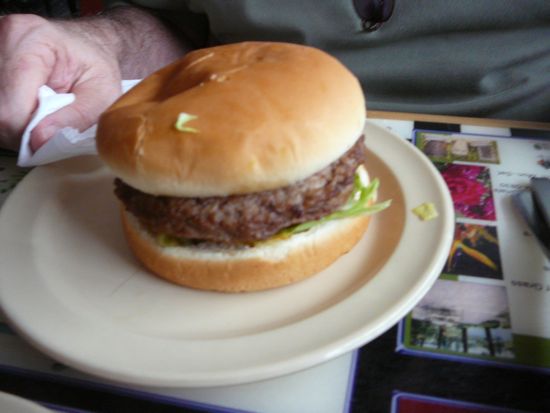
AdventureMan said it was one of the best hamburgers he has ever eaten. He compared it to Red Robin and said it isn’t so big, and it doesn’t look so fancy, but it is the perfect size, perfectly cooked and he thinks it is hand packed, it had a great texture. He ordered it with ‘the works’ and was surprised that ‘the works’ doesn’t include a slice of onion, but it did include lettuce, tomato and pickle.
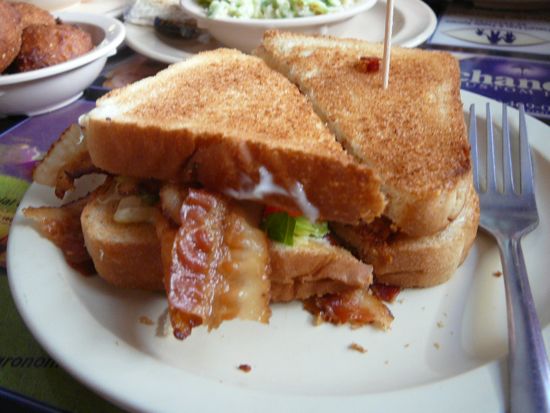
I had the BLT, which came on toast, with lettuce and tomato, nothing fancy, just a BLT, but a good BLT, generous on the bacon:
We ordered sides of hush puppies, baked beans and cole slaw, so we could see how they compare. Hush puppies were like AdventureMan used to eat when he was a kid, the kind people make at home, no surprises, no corn, no jalepenos, no sugar, just plain hush puppies, exactly in character with this slice-out-of-time. The cole slaw was wonderful. I am not a fan of mayonnaise-y cole slaw, and this one was a little vinegary, just what I love. The baked beans were divine. Not a lot of chunks of anything, just plain beans, baked to melting in a sweet tangy sauce. The best of the ’50’s.
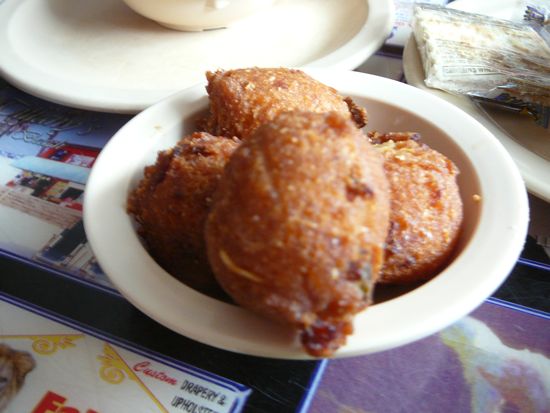
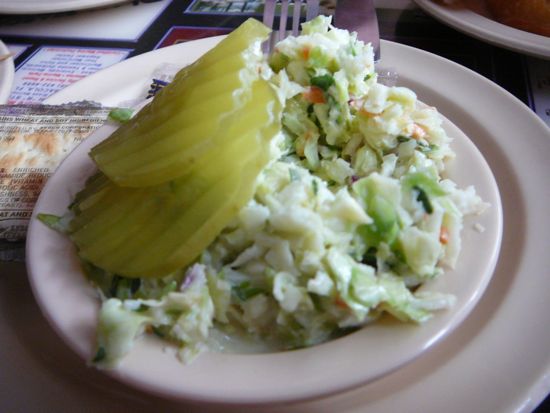
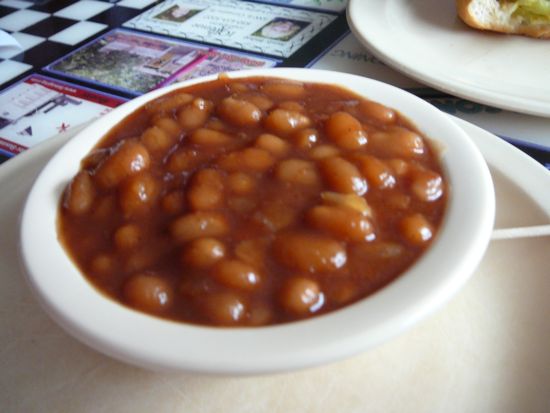
They are undergoing renovations to add more seating room and waiting room – business is good, and they need more space to handle their many loyal customers. At the corner of Perry and Cervantes, in East Pensacola Heights, right at the stoplight. AdventureMan says this is the kind of restaurant they feature in Southern Living magazine, or Garden and Guns, one of the hidden gems of Pensacola.
Sign of the Times in Pensacola

Pensacola, with its mild climate, attracts a lot of the nation’s homeless. In an area with high unemployment and where the housing crisis has wreaked havok with the economy, people still find it in their hearts to be generous and compassionate.
There are united efforts to clothe and feed the homeless, and efforts to help them get off the street – if they want to get off the streets, and a lot of them don’t.
I wonder what funds Krispy Kreme gives – bus tickets home? A donut and a cup of coffee? Help with a mortgage payment? I thought it might give a glimmer of hope to someone down and out.
A Prayer for Samuel Occum
I don’t always get a chance to read about a saint of the church on his/her saint’s day, but this morning, while reading The Lectionary readings, I took the time, and was glad I did. These readings tell me about ordinary people who made a difference, Samuel Occum by being Mohegan (Mohican?) and serving his community by raising funds for the establishment of Dartmouth College.
But what I loved was the prayer for his saint’s day, which starts “God, Great Spirit” and talks about his voice in the thundering wind.
PRAYER (contemporary language)
God, Great Spirit, whose breath gives life to the world and whose voice thunders in the wind: We thank you for your servant Samson Occom, strong preacher and teacher among the Mohegan people; and we pray that we, cherishing his example, may love learning and by love build up the communities into which you send us, and on all our paths walk in beauty with Jesus Christ; who with you and the Holy Spirit, is alive and reigns, one God, now and for ever. Amen.
SAMSON OCCUM
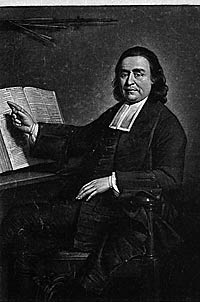
WITNESS TO THE FAITH IN NEW ENGLAND, 1792
The Reverend Samson Occom (1723 – 1792) (also spelled as Occum) was a Native American Presbyterian clergyman and a member of the Mohegan nation near New London, Connecticut. He has the distinction of being the first Native American person to ever publish documents and pamphlets in English.
Born to Joshua Tomacham and his wife Sarah, Occom is believed to be a direct descendant of the famous Mohegan chief, Uncas. In 1740, at the age of sixteen, Occom was exposed to the teachings of Christian evangelical preachers in the Great Awakening. He began to study theology at the “Lattin School” of Eleazar Wheelock in 1743 and stayed for four years until leaving to begin his own career.
Occom served as a missionary to Native American people in New England and Montauk, Long Island, where he married a local woman. It was also on Long Island where he was officially ordained a minister on August 30, 1759, by the presbytery of Suffolk.
Wheelock established an Indian charity school (which became Dartmouth College) with a benefaction from Joshua Moor in 1754, and he persuaded Occom to go to England in 1766 to raise money for the school, along with the Rev. Nathaniel Whitaker. Occom preached his way across the country from February 16, 1766, to July 22, 1767. He delivered in total between three and four hundred sermons, drawing large crowds wherever he went. By the end of his tour he had raised over twelve thousand pounds for Wheelock’s project. King George III himself donated 200 pounds, and William Legge, Earl of Dartmouth subscribed 50 guineas. The friendship between Occom and Wheelock dissolved when Occom learned that Wheelock had neglected to care for Occom’s wife and children while he was away. Occom also took issue with the fact that Wheelock put the funds toward establishing Dartmouth College for the education of Englishmen rather than of Native Americans.
Upon his return from England, Occom lived at Mohegan, then moved in 1786 with some New England and Long Island Indians to Oneida territory in what is known today as New York. He then helped to found Brothertown, and lived among the Brothertown Indians. Occom died on July 14, 1792, in New Stockbridge, New York.
Speak Kuwaiti
Thanks to commenter Zak who recommends a new book available in Kuwait. Wish it had been available when I was there. I had to learn by asking friends. I’m still tempted to answer the phone “Weynich?? Weynich?” (Where are you – to a female)
“SPEAK KUWAITI”
I liked the idea of this new book “Speak Kuwaiti”, unlike any other book, this book has been compiled and designed to focus on the spoken Kuwaiti dialect in the easiest and most interactive way possible. I have many expatriate friends who often ask me “How can I speak Kuwaiti ?” or “How to say I’m hungry, tired, happy in Kuwait?” Well this book is the answer
The price is 3.600 K.D and can be found at Virgin, That Al Salasil, and Jarir bookshop, Kuwait Bookshop.
Zak
The Passage by Justin Cronin
I subscribe to GoodReads.com, and I buy books through Amazon.com, so I am not sure which one of those recommended this book for me. I held it a couple months before I read it, just wasn’t sure it was something I cared about. Once I started, however, I was hooked.
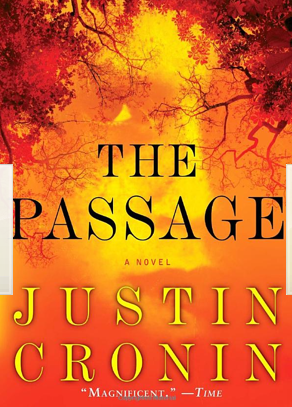
Don’t you just love summertime reading, the kind where you might even be able to grab a couple hours in a row? When you can focus like that, it’s like you are living two lives; you are in your normal existence, but a part of you is somewhere else, if the book is good enough.
Sometimes that somewhere else isn’t that great, and in The Passage, you are in a post-apocalyptic America where those military scientists have lost control of one of their experiments and life has changed forever as a result. Sorry to sound so cynical, but I started reading Sci-Fi when I was still in middle-school, so I am a little jaded about post-apocalyptic literature, but this one managed to suck me in. Also, even though you know it’s fiction, it is compelling enough to feel very real.
So before I go getting all critical about the little things, I need to tell you that when I had to put the book down, I could hardly wait to get back to it, and I probably need to look after my laundry and my floors and wash up some dishes now that I’ve finished; the book compelled my interest.
I think the author does a great job setting up the world. In order for young people to come into their own, to head out on their quest, you have to get parents out of the way, so all the young people out to solve the problems have parents who have died, or committed suicide (the living situation is a little bleak) and that kind of bugs me, even though I can see the literary usefulness of having this happen.
The survivors, 100 years after the societal meltdown, live a bleak and limited existence, mostly focused on not getting killed. (One of the very scary things is just how fast a society can melt down when faced with an overwhelming threat.)
This is a vampire-novel, but a vampire novel with a total twist, there is nothing attractive about these vampires, called virals. They are demented, and they want blood. They tear into flesh. You don’t want to be out in the open after dark, you don’t want to run into a viral. Justin Cronin makes it very very real. I’m glad my husband wasn’t traveling. I know vampires are not real, and I know there are no virals, and you know sometimes rational doesn’t matter when you hear sounds at night? These bad-guys are very very lethal and very very bad.
And here is what I like. Cronin takes you from utter fear to some compassion for the virals. I imagine this will play into the next book.
I also like his inclusion of children, and they way children perceive and the way children feel, and how those perceptions and feelings grow with the child, and, if you are very lucky or very persistent, how you can gain insights into those perceptions and understand them differently as you reach adulthood. It reminds me of another Sci-Fi author I used to read, Zenna Henderson, who wrote books about specially talented children.
Here is what I don’t like, what I find really frustrating: this is just the first volume. I am satisfied enough with this book, and I know I will have to read the next one, but I think I can see where he is going with it all. I find it frustrating; I am holding my breath for the next Game of Thrones/Fire and Ice volume to come out, and now this Passage follow up won’t be out until 2012, on AAARRGH.
It’s a dark book, but it kept me glued. The things that annoyed me didn’t annoy me enough to discourage me from reading. 🙂 It is a great summer read.
Red Robin – YUMMMMM
“I think I need a hamburger,” I said to AdventureMan as we were tucking in to bed. I can’t even remember the last time I had a hamburger, but I think it was in April, 2010, at the Red Robin in Pensacola.
Red Robin . . . YUMMM. One of the best ad campaigns in history, in my mind. Pure repetition, a little humor to re-inforce the memory, all positive. Anywhere you go in America, you can say “Red Robin” and someone will say “Yummm.”
I have a personal relationship with Red Robin. When I was a student at the University of Washington, long, long ago, the Red Robin was very near the university, near enough we could walk, even, and even though it was a bar, they weren’t very strict about carding people, and oh, they had the best burgers. It was pure comfort food. They also had a wonderful deck, so on the rare and beautiful spring days when final exams were coming and we just needed to blow off some steam, the Red Robin was one of the places we headed.
It wasn’t like the Red Robin chain. It was the original, and it was a little seedy. Here is what the original Red Robin looked like:

Yep. . . a little stoned.
Here is what he looks like now, he cleaned up good, LOL!

There were old wood floors, not the shiny kind of good wood floor, but the old fashioned cheap kind, sort of spongy when you walked on them, and usually covered with stuff that had been spilled. No, not exactly your family kind of place, it was a college student kind of place.
So for my once-in-more-than-a-year hamburger, we went to Red Robin.

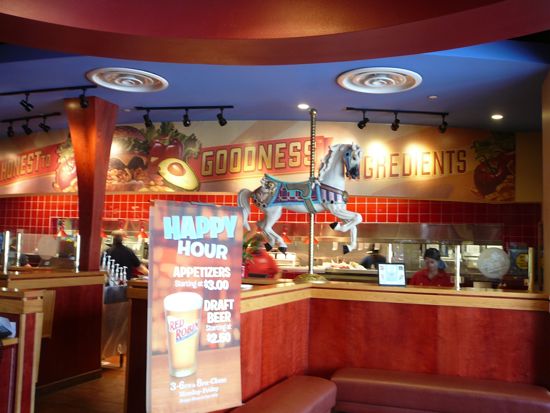
Compare that to the original:
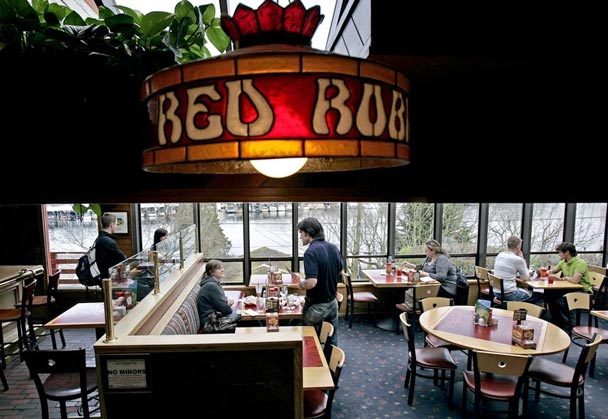
And here was my peppercorn burger:

It was YUMMMMM. Now, I won’t need another burger until September 2012 or so. 🙂
Sadly, as I was looking for some photos of the original Red Robin, I learned that they closed down the original on March 21, 2010. So sad, but I suspect it just didn’t suit the image of the new, family oriented Red Robins, more than 400 of them around the USA. But they still serve a good burger.
Fourth of July at Christ’s Church in Pensacola
We usually make it to the early service at Christ’s Church, Pensacola, but this Sunday we took it easy, and headed to the second service instead. AdventureMan loves the second service for the music; I love it because sometimes our son and his family are there and we get to sit together.
Father Neil gave a thought-provoking sermon, as usual, incorporating some of the things he learned serving as a chaplain to our American troops in the desert in Kuwait. During communion, the choir sang a song known by some as the Navy Hymn and by others as the Armed Forces Hymn. The last two lines of each chorus pray for our men and women “in peril” on land or sea or in the air. While I am a stoic, that song shakes me to my core, and brings tears to my eyes.
At the end of the service, just after the recessional, our superb music director, Kenneth Keredine, with two fellow musicians on drum and cymbals, played a rousing Sousa march, a joyful and happy way to celebrate the Fourth of July weekend.
Recent Comments
intlxpatr on Shampoo Ginger tigerbutterya0c5ff1d… on Shampoo Ginger intlxpatr on British Soldier Kidnapped, Esc… John on British Soldier Kidnapped, Esc… intlxpatr on British Soldier Kidnapped, Esc… Wikipedia Donate Button

Amazina


Early Voting in Florida


