St. Nicholas Eve
I’m putting out a little bit of Christmas, and came across these lovely, Palestinian embroidered towels. I’ve had them for around thirty years, and I still love them:

I’m also thinking – we in the west never hear about Palestinian Christians, of which there are / or used to be (?) many. I know there are groups in Jerusalem, working towards the use of Jerusalem as an inter-faith city, and I know they work closely with Palestinian Christians, but are the numbers of Palestinian Christians as large as they used to be?
Advent is a little like Ramadan, or it is supposed to be. The four weeks leading to Christmas are a time for thoughtful meditation, repentance of wrongful things we have done, and contemplating the birth of that special baby, the Gift of God, in Bethlehem. I love Advent; I love the whole peaceful focus and world-holding-its-breath-waiting-for-this-birth aspect.
A mosaic portrait of St. Nicholas:

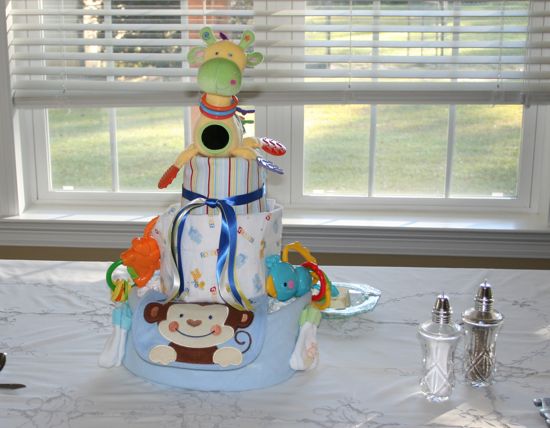
Baby Shower Diaper Cake
I wasn’t there. AdventureMan and I would have loved to be there, but it wasn’t possible. We spent Thanksgiving apart from our son and his wife. We also missed the BABY SHOWER! Her sweet aunts arranged a wonderful shower for them, and sent me a photo of the “diaper cake.” I don’t think this is a real cake . . . but I am not sure entirely what it is. I know only that it is adorable!
Failproof Easy Pecan Pie From Quail Country
A long long time ago, in a country far away, we lived in one village and our friend lived in another, but we often visited back and forth. One day she called and said they were coming into town with her parents, and I said “oh, we won’t be here those dates, but I will leave the key with my friends down the street and you can stay here.”
Months later, a mysterious package arrived in the mail, from my friend’s parents, with a lovely, gracious note of thanks for letting us stay in our house, and one of the world’s greatest cookbooks, Quail Country, by the Junior League of Albany, Georgia. (Quail Country, Smith House Publications, 516 Flint Avenue, Albany, GA 31701)
One of my all time best recipes, Soused Apple Cake is from there.
Today, I am making pecan pies for Thanksgiving and giving thanks for the never fail Pecan Pie recipe, which I have printed before, but will print again because it is such a life saver.
Pecan Pie
3 eggs
1/2 cup sugar
1 cup light corn syrup
1/2 teaspoon salt
1 teaspoon vanilla extract
1/4 cup butter, melted
1 cup coarsely chopped pecans
1 9-inch deep dish pastryt shell, unbaked
Beat eggs slightly; add sugar, corn syrup, salt and vanilla. Blend well, but do not overbeat; add butter. Stir in pecans. Pour into pastry shell. Bake in preheated 350 F (180 C) oven about 50 minutes, or until a knife inserted in the center comes out clean. Six servings.
I actually cheat on pie crust. I use a Graham Cracker Crust, made with what are called digestive biscuits here in Qatar and in Kuwait. So a small package of digestive biscuits, crushed, add a little cinnamon and about 1/3 cup melted butter. Mix, and press into pie pan. Nothing could be easier. 🙂
And as I am making the pies, I also give thanks that our son found a wonderful woman to marry, and that his wife’s aunt has sent me some of the world’s best Texas pecans, which I hand carried when I moved from Kuwait to Qatar because I was NEVER going to leave them behind!
“You’re Such a Good Driver”
Twice in the last two weeks, friends riding with me have said “You’re such a good driver.” You’d think I would be flattered, but instead, it makes me aware of how much I have adapted to driving conditions in Doha. The truth is, I am pretty good. The truth is, that’s not a good thing.
Doha is smaller than Kuwait. The trick in Doha is to know which roads are closed, (that is usually in the newspaper,) and to have two or three routes to get to the same place. The trick is to know where the lanes are going to go wonky with all the people needing to make a left turn, and at the same time, how to avoid the mandatory left turn lane that can catch you by surprise.
The trick is to yield to the bigger vehicle, especially if he is a cement truck, crane, or similar very heavy vehicle, unless you think you can quickly get ahead of them so you won’t have to go 15 km/hr for the next thirty miles. The trick is to avoid being behind a truck loaded with not-secured concrete blocks. The trick is to know that new cameras are going up all the time – have you noticed? Even the locals are slowing down, so I am guessing that the fines here are being imposed across the board.
Last week, I even saw a policeman pull a truck over for an illegal left turn – he turned from the lane next to the legal turn lane – he got pulled over. I don’t know if he got a citation, but he got a talking to. He seemed to be listening respectfully. I was shocked. There are times you will see three lanes turn left, only one of which is the legal left turn lane. It’s so common, you take it for granted. But things seem to be changing.
I have also caught myself doing some things I would never ever think of doing in the US. I needed to use a cash machine, and all the parking spaces were filled. I gave it 5 seconds thought, parked my car behind two cars right by the cash machine, and prayed no one would need to move while I was getting my money. Unfortunately – no one did. My bad behavior was positively reinforced.
The other night, picking up food on the way home, I begged some workers to let me park in a marked “no parking” spot so I could pick up my food.
“Bas hamsa deqiqa” I smiled as I ran to pick up my food, which, fortunately was ready and I paid, ran back out, tipped a little for the spot and drove off.
These are things I would never never never do in the United States. I do it here because it makes my life easier and because . . . everybody else does it.
I can still hear my Mother’s voice saying “and if everyone were jumping off a bridge, would you do that?” That’s what mother’s say. I probably said it myself. And here I am, knowing I shouldn’t do it, and doing it.
When I first got here, a woman was taking me shopping and as we got to the roundabouts, she said “You’ve just got to commit!” and she would whirl through the roundabout with seconds to spare. An Iranian friend got us from the airport to the Diplomatic Club once in 17 minutes in peak night-time traffic. It was easier for me to watch the clock than to watch her drive; she didn’t even look left when she entered the roundabouts. And she got us across town in 17 minutes. I still wonder at that accomplishment, and feel myself, at the same time, quaking in my boots at her confidence.
So I wonder if my admiring friends feel the same way, if I have become so used to local driving that I am adapting dare-devil tactics in my driving as well as in my parking?
I shudder at the re-education I will have to undergo when I return to the US for good.
FYI: How Long is a Generation?
So I get on a track and I can’t get off, like a little hamster running on the wheel. I got to thinking about generations, and how long ago is 10 generations and so I had to ask Google the question: How long is a generation? Don’t you love Google? They always have an answer.
Now I know something new. Now I will share it with you. This comes from Ancestry.com
Research Cornerstones: How Long Is a Generation? Science Provides an Answer
How Long Is a Generation?
By Donn Devine, CG, CGI
We often reckon the passage of time by generations, but just how long is a generation?
As a matter of common knowledge, we know that a generation averages about 25 years—from the birth of a parent to the birth of a child—although it varies case by case. We also generally accept that the length of a generation was closer to 20 years in earlier times when humans mated younger and life expectancies were shorter.
In genealogy, the length of a generation is used principally as a check on the credibility of evidence—too long a span between parent and child, especially in a maternal line, has been reason to go back and take a more careful look at whether the evidence found reflects reality or whether a generation has been omitted or data for two different individuals has been attributed to the same person. For that purpose, the 20- and 25-year averages have worked quite acceptably; birth dates too far out of line with the average are properly suspect.
But now, researchers are finding that facts differ from what we’ve always assumed—generations may actually be longer than estimates previously indicated.
Several recent studies show that male-line generations, from father to son, are longer on average than female-line generations, from mother to daughter. They show, too, that both are longer than the 25-year interval that conventional wisdom has assigned a generation. The male generation is at least a third longer; the female generation is about one-sixth longer.
As early as 1973, archaeologist Kenneth Weiss questioned the accepted 20- and 25-year generational intervals, finding from an analysis of prehistoric burial sites that 27 years was a more appropriate interval but recognizing that his conclusion could have been affected if community members who died away from the village were buried elsewhere.
Why Age Matters
In a more-recent study regarding generation length, sociologist Nancy Howell calculated average generational intervals among present-day members of the !Kung, contemporary hunter-gatherer people of Botswana and Namibia whose lifestyle is relatively similar to that of our pre-agricultural ancestors. The average age of mothers at the birth of their first child was 20 years and at the last birth 31, giving a mean of 25.5 years per female generation—considerably above the 20 years often attributed to primitive cultures. Fathers were six to 13 years older than mothers, giving a male generational interval of 31 to 38 years.
A separate study, conducted by population geneticists Marc Tremblay and Hélène Vézina, was based on 100 ascending Quebec genealogies. Researchers found a generational interval, based on the years between parents’ and children’s marriages, to average 31.7 years, and they determined that male generations averaged 35.0 years while female generations averaged 28.7 years.
Biological anthropologist Agnar Helgason and colleagues used the Icelandic deCODE genetics database to arrive at a female line interval of 28.12 years for the most recent generations and 28.72 years for the whole lineage length. Male line lineages showed a similar difference—31.13 years for the recent generations and 31.93 years overall. For a more mathematically appealing average, Helagason and fellow researchers recommended estimating female generational line intervals at 30 years and male generational intervals at 35 years, based on the Quebec and Iceland studies.
Calculating Ideas
What does this mean to the genealogist? When assigning dates to anthropologically common ancestors 50 or more generations in the past, using the “accepted” 20 or 25 years as a conversion factor can produce substantial underestimates of the time interval.
For my own purposes, however, given the imprecision of the various results and my own need for an estimate that lends itself to easy calculation, I decided that three generations per century (33 years each) for male lines and 3.5 generations per century (29 years each) for female lines, might work better when I needed to convert generations into years.
To check the accuracy of my values, I decided to compare the generational intervals from all-male or all-female ranges in my own family lines for the years 1700 to 2000. I was pleasantly surprised to see how closely the intervals agreed with the estimates I was using. For a total of 21 male-line generations among five lines, the average interval was close to 34 years per generation. For 19 female-line generations from four lines, the average was an exact 29 years per generation.
In genealogy, conclusions about relationships are subject to change whenever better evidence is discovered. Similarly, it’s the nature of the physical and biological sciences that current understandings are subject to change as more data becomes available and that data’s interpretation becomes more certain. So, for now, when genealogists want to convert generations to years and create probable date ranges, using an evidence-based generational interval—like Helagason’s 30 and 35 years or one that you’ve developed based on your own family history research—may be the best solution.
Donn Devine, CGSM, CGISM, a genealogical consultant from Wilmington, Delaware, is an attorney for the city and archivist of the Catholic Diocese of Wilmington. He is a former National Genealogical Society board member, currently chairs its Standards Committee, is a trustee of the Board for Certification of Genealogists, and is the administrator for Devine and Baldwin DNA surname projects.
Only Ten Generations
We were talking about marriage prospects, and I mentioned one young man.
She hesitated, then told me “we don’t marry with this family.”
“Why not?” I asked her. “He’s handsome, and kind, and I am told that they are the richest family in Qatar.”
“They are Iranian,” she said shortly.
“Iranian?” I asked. “They are Qatteri! They have been here more than ten generations!”
She grinned at me.
“It’s not enough,” she said. “They are still Iranian.”
Mom’s Fruit Cake in Qatar
Life has gotten busy, and somehow November is here and I haven’t made my fruitcakes. I need to fix that! For those of you who think fruitcakes are a joke – my Mom’s fruitcake has a secret ingredient – chocolate. Even people who don’t like fruitcake love this fruitcake.
I am in Qatar – I have brandy. I have rum. No, I don’t drink hard liquor, but oh, they do make my fruitcakes tastier. Today, I will soak the raisins in brandy overnight, so they will be ready to go tomorrow!
I am reprinting this recipe for those of you who would like to give fruitcake a try.
Mom’s Fruit Cake
This is the original recipe. I remember cutting the dates and prunes with scissors when I was little; now you can buy dates and prunes without pits and chop them in the food processor – a piece of cake!
1 cup boiling water
1 cup sugar
1/2 cup lard or butter
1 T. cinnamon
1 t. cloves
3 Tablespoons chocolate powder
1/4 cup jelly
1 cup seeded raisins
1 cup chopped walnuts
1/2 cup candied citron
1/2 cup cut prunes
1/2 cup cut dates
Put all in a pan on stove and bring to a boil. Boil for three minutes. Let cool. Add:
2 cups flour
1 teaspoon baking soda
Flavor with lemon
Bake at 350° in loaf pans for one hour. Makes 2 normal bread loaf sized cakes.
My variations: I put in about three times the fruit, the difference primarily in the candied citron – I prefer using whole candied cherries, because they are so pretty when the loafs are cut. This recipe doubles, or quadruples with no problems.
Pans: Mom used to line all the pans with brown paper and grease the paper. I grease the pans, then dust with more of the chocolate powder. Use a good quality chocolate, not cocoa. When the cakes come out of the oven, let them cool for ten minutes, loosen them with a knife, then they will shake out easily. Let continue to cool until they are totally cool, then wrap in plastic wrap, with several layers, then foil, then seal in a sealable plastic bag. Let them age a couple months in a corner of your refrigerator. I make mine around Halloween, and serve the first one at Thanksgiving.
I never make these the same any two years in a row.
You know how raisins get all dried out and taste yucky in fruitcakes? The night before you intend to make the fruitcakes, take all the raisins you intend to use (depending on how many fruitcakes you intend to make) and put them in a glass container. Pour brandy over them, to cover. Microwave just to the boiling point. Let stand in the microwave overnight.
The next day, you can drain that brandy and use it in a stew or something, and in the meanwhile, you now have plump, juicy raisins to use in your fruitcake, and just a hint of brandy flavor. Yummmm!
The Carrefour Majlis
Hubby and I were at a mall which is one of the Qatar see-and-be-seen places tonight, not to see nor to be seen, but looking for a special end table. As it turns out, we can probably get it, but not until January. No problem.
AdventureMan wanted to pick up some teas for his office and I needed skim milk so we headed for the Carrefour before leaving.
“Oh! How totally cool!” I said to AdventureMan, “Look! They have provided a tent majlis for guys waiting for their wives to grocery shop!” (A majlis, sometimes called diwaniyya, is a place where people gather – usually men, but not always, sometimes women also gather in a majlis but usually separately from men)
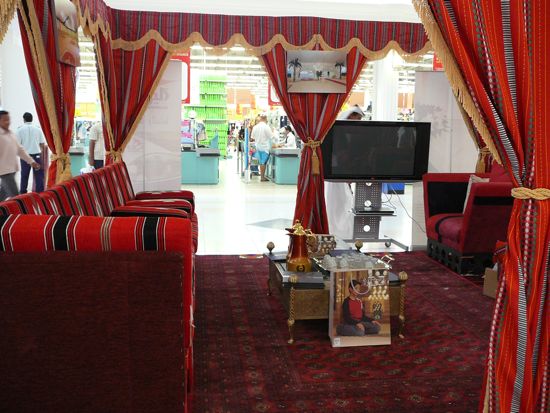
“I think that is one of the Islamic Center places,” AdventureMan said.
On our way out of Carrefour with our purchases, the majlis was packed, and everyone was drinking Arabic coffee in graceful little cups, even one western couple. It is a lovely, hospitable oasis, full of soft surfaces in a hard surface mall.
Truthful Visitor on Doha Press
Do you ever visit QatarLiving.com? It’s one of those places where you can end up passing a lot of time, and it is also a place where there is both a lot of information and a lot of misinformation. There are some very good posts, and then there are some poseurs.
A recent Forum discussed the statement by Qatar Attorney General Dr Ali bin Futais Al Marri that “no one is above the law.” As forums often do, the threads segued into a discussion of freedom of the press in Qatar.
I almost split my sides, I was laughing so hard. I asked Truthful Visitor if I could print his post on this blog, and he gave me permission. I hope you enjoy it as I did. 🙂
Don’t you folks know that all the newspapers in Qatar are screened by the Ministry of Interior every evening before publication for the following day? Anything that doesn’t fit the required image is cut out.
Hence you always get the presence of evil (there’s always an Asian gang being deported for doing something dreadful like burglary or selling liquor) page 1, bottom of the page, that covers the Evil In Our Midst; then the sycophantic article about HH who has just made some pithy pronouncement on The Necessity For Mutual Understanding And Education Across The World, page 2; some phony figures about how much more the Pearl property or other investments have increased pages 3 – 5; some baloney about how safe the country is for investment, page 6; then the gushing op-ed about how the best societies in the world are so great because they have been enforcing Islamic values, pages 6 – 8; Qatar Airways wins award for best in-flight hot towels, page 9, and a new order for 500 Airbus aircraft (thanks to the strategic profitability of the airline! ha!) . And not to forget, Gulf Escapes Economic Downturn for the fourth week in a row, page 10 ad infinitum.
The Filipina maids found dead and decayed in the desert? The photos of the police when they turn the water cannons on the labour camps outside the Industrial Area? Oh no. Those photos were seized under duress. These things are just not family -friendly, now are they?
If it doesn’t fit the great narrative of Qatar, it’s not really news!
Thank you, Truthful Visitor. (truthfulvisitor/-a-t-/me.com)
Debate on Media Freedom in Doha, Qatar
From today’s Gulf Times:
Debate on Qatari press law
The Doha Centre for Media Freedom (DCMF) will hold a roundtable discussion on the Qatari press law that dates back to 1979, on Wednesday, at The Ritz-Carlton Doha, an official said yesterday.
According to the official, under the discussion will be the need for a Qatari media, and the view concerning modification and changes to the accrual Press Law, in order for it to match the requirements of the current era.
Discussions will be moderated by DCMF deputy director general Maryam al-Khater, while senior media officials of the country, editor-in-chiefs, senior journalists, heads of media organisations and others are expected to be in attendance.
After an introductory presentation of the most-recent study prepared by DCMF on the Press Law, comprising recommendations, suggestions, and analyses, the floor will be opened to what is expected to be a “vigorous debate”, the official said.
“The DCMF calls on all media specialists to exercise their right of expression by participating in this gathering and sharing their thoughts about the possibility of amending the negative provisions of the law for journalists’ rights as well as adding provisions which respond to their ambitions,” the official added.
The event coincides with the National Day for Human Rights, which falls on November 11 every year.
There was an earlier report, on June 24th, that most of the original members of the DCMF had resigned:
Media Freedom Centre team leaves office
DOHA: Robert Ménard, director- general of the Doha Centre for Media Freedom and his team have left the Centre.
“We no longer have either the freedom or the resources to do our work,” said Menard, in a statement issued yesterday.
The heads of the assistance, research and communications departments have also left the Centre, said the statement.
The Center was set up on the initiative of H H Sheikha Mozah bint Nasser Al Missned and Reporters Without Borders in December 2007.
Ménard, who became director-general on April 1, 2008, was the founder of Reporters Without Borders, which he headed for 23 years.
I imagine this is going to be a very interesting “vigorous” debate, of interest to all those who write – or blog – on Qatar. One of the things I notice in both Kuwait and Qatar is that in the interest of self-preservation, the newspapers self-censor. For example, when a crime is committed, if it is an Asian, or even, rarely, a westerner, the name of the criminal can be printed. If it is a local citizen, they do not print the names, not ever, unless it is a rare case where the defendant is convicted and appeals – on rare occasions, the name will appear then. In order to spare the family the embarrassment, I have been told, but I would think that the fear of embarrassing the family would have a strong deterrent effect on young men, for example, who think it is OK to abduct, rape and humiliate young men and women, without fear of having their crime made public.
In Kuwait, they publish the crimes committed, at least. In Qatar, you would think from reading the papers, that these crimes don’t exist. They do. They aren’t reported.
I think it is very cool that in Qatar, many of these issues are opened for public debate, as in this media debate, and in the ongoing Doha Debate series.
Recent Comments
ExpatAlien on What Country am I Living … intlxpatr on Yellowstone: Old Faithful to C… Michelle on Yellowstone: Old Faithful to C… Cathy on No Grown-Ups in Charge intlxpatr on Waiting for Snow Wikipedia Donate Button

Amazina


Early Voting in Florida


 Here There and Everywhere