Light Haze Sunrise
At six in the morning, it is already almost 90°F / 32°C. WeatherUnderground says there is a “light haze.” I can’t imagine what they call a heavy haze. At least the light haze is white, not the orange of yesterday’s sandstorm, but there is still an awful lot of the “light haze.”

Hamd’allah, I have air conditioning. I feel human again. The Alaska girl in me has it turned up to 72°F / 22°C, and I am comfortable.
It took me a long time to capture a glimpse of the sun, early this morning, through the “light haze.” Even as I write, the sun is a great big hazy ball, high in the May sky, oh-so-early on a Friday morning.

I happened to be up early this morning, and was shocked to see busses arriving and laborers – Moslem laborers, like from Pakistan and Afghanistan, getting off buses, carrying shovels and picks and tools to go to work. I thought all Moslems in Kuwait got to take Friday off. Guess I was wrong – and I so often am.
Have a sweet, quiet day, Kuwait. We will be praying for you, in our little church, and for your leadership and your upcoming election, this Friday morning. We wish you only the very best.
Sanitary Germans
After all my years living in so many different places, I’m fairly blase about toilets. In Tunisia, there were no such thing as public toilets, and while exploring Tunisia, we always had to look for “the potty in the wadi”, i.e. a bridge with no-one in sight. I would run, pee as quickly as I could, and finish just before some curious child – or children – showed up. No matter how remote the place, I can’t remember a single stop that a child didn’t come running about sixty seconds after we stopped.
So I got a big smile at the public toilet in Germany – they started installing these about 20 years ago – that even cleans itself. I thought “I wonder how long these would last in Kuwait?” where they could put people our of jobs.

Yesterday, I used a public toilet in a very nice mall in Kuwait, but when I got there, a woman – I am guessing the “cleaner”, and I put it in quotes for a reason, was stretched out and sleeping. I looked in several stalls, no toilet paper, no problem, I carry my own. It didn’t seem all that clean, no paper for drying hands, either, and as I am leaving she holds out her hand and asks how I am, how is my health, etc. I usually tip – but I didn’t tip yesterday, why tip someone who is not doing the work she is paid to do? She didn’t even stand up, just held up her hand!
Neuleiningen Castle and the BurgSchanke
For many many years, we have been going back to the BurgSchanke in Neuleiningen. We would see the ruins of the old castle, high on a hill, as we would be driving by on Autobahn A6 between the Heidelberg area and France. When AdventureMan got his company command (it was a big deal) I saved up my money and treated him to dinner at the BurgSchanke.
This is where we sat:

The menu doesn’t change much. Most of these entrees were the same ones on the menu many many years ago:

Here is what AdventureMan likes to have – Franzosiche Entenbrust, or French Duck Breast (I think the French part is all the vegetables)

I don’t eat meat very often, but when I do – this is what I had – the Knoblouchsteak (garlic steak)

It used to be served on a wooden platter. I am guessing that health and sanitation standards now require porcelain or something less porous and prone to bacteria than wood.
And here is what we had for dessert. We totally hate the presentation, but it never fails to make us laugh, long and loud, and in spite of how it looks, the mousse is truly delicious.

We talked about all the years we had been coming to this restaurant, all the guests and friends we had brought with us, where we had been sitting with different people – including, more than once, my parents, coming back for their own sentimental journey. Ahhh . . . sweet memories. 🙂
One time, my youngest sister and her family came for a visit, and their son also tried the duck, and thoroughly enjoyed it. His father ordered the Eisbecher Burg Neuleiningen, and we didn’t tell him . . . we waited to see his face when they brought him a bowl the size of a punch bowl, filled with fifty scoops of ice-cream. 🙂 Oh, what fun!
We stayed in a truly darling hotel, and felt very lucky to get the last room. “Two hours ago, we had four vacancies,” the very nice manager said, “but now, we have just one!” In a heartbeat, we took it. The view from the Burggraf was amazing.

Breakfast in Schwetzingen
German breakfasts are anything but light. There wasn’t a piece of fruit to be found! We were lucky to be guests at the hotel, because most of the tables were reserved, and people were turned away, even at nine in the morning, the breakfasts at the hotel Cafe Journal are so good.
You could have smoked ham, cold cuts and cheese, too, but we chose not.
Breakfast bread basket:

Yummy condiments:

Fresh orange juice:

Herb and cheese omelettes:

We were astonished – in Germany and in France – that there is absolutely NO SMOKING in any of the restaurants. If you are sitting outside, you can smoke, but we could not believe how well enforced this law is. We had heard about it, but frankly – the French not smoke in restaurants? We would not have believed it possible! Germans are very law-obeying peoples, but the French??? Never, not once, did we see a person smoking in a restaurant. It was amazing.
Living our Religion
Today’s reflection from Forward Day by Day is a tough one. In the Gulf, there is a tradition of thfadl and thfadli (the second is what you say to a woman) which means, literally, “you are to be preferred.” You are supposed to outwait the other, to allow the other to take precedence.
I have one Kuwaiti friend – you know who you are – who simply cannot be out-thfadle-d. She out-thfadle-s me every time. 🙂
But when I read this passage, and think of how I live in Kuwait, I find myself thinking “Guilty! Guilty as charged!”
When I see a long line in front of me at the health department, and someone comes and ushers me to the front, yes, I have gratefully taken advantage, taken preference over those who continue to wait. I have scowled when people try to shove their basket in front of me in the supermarket. And in traffic – when I “thfadl”, it has nothing to do with politeness and preference, and everything to do with sarcasm and frustration.
Today’s reading reminds me I still have a long road in front of me when it comes to learning to love my neighbor, and put others first.
Romans 12:1-21. Outdo one another in showing honor.
The Episcopal Church (and some other denominations, too) is vexed these days by rancorous disputes about authority and sex. Name-calling, smirking, and thinly veiled anger sometimes characterize church gatherings. The prevailing sentiment seems to be that we ourselves are faithful and true, but those others are faithless and false. We demean and dismiss other Christians. It’s hard to find a Christian today who outdoes others in showing honor (except honor shown to those lined up on one’s own side). Is it any wonder that many people outside the church want nothing to do with us?
I long for the day when we will approach those who differ from us and say: “I agree with almost nothing you are advocating. I see God, the world, and our faith through different lenses than you do. But I know that God loves us both and has sent his Son to forgive and redeem us both. I know that Christ lives within us both. Therefore I honor you and join you in prayer and in worshiping our common Lord. I shall remain silent today so that you may speak and I may learn from you. I thank God for you because I see Jesus when I look at you.”
Revisiting Romance in Schwetzingen
When we met, AdventureMan and I, we didn’t date for very long. We knew, almost as soon as we met, that we were going to be married.
We met in Heidelberg, one of the most romantic cities in the entire world. My sister was getting married in the Heidelberg castle. It was a grand wedding, and AdventureMan and I were both supporting characters.

One of our first dates was going to the castle in nearby Schwetzingen. Schwetzingen has a beautiful castle, but it is not as famous for the castle as it is for its white asparagus, called spargel. It may sound funny to you, but this is a great delicacy, only served from mid-April to early June.
Schwetzingen really celebrates their white asparagus; this is a statue in the city square of an older woman teaching younger ones how to sort spargel:

Spargel is served a hundred different ways, in soups, in salads, and in big bunches, with vinaigrette sauce, hollandaise sauce, bernaise sauce, or sometimes with just butter. You can have it with schnitzle, with ham, or just with new spring potatoes. Who would believe asparagus could taste SO good?
So here is the story. We were so young, and had so little money. AdventureMan had taken me to the Schwetzingen Castle to walk, and as we walked and talked, I could tell he was really talking about getting married. He had planned on having enough money that we could sit afterwards, in a little cafe, and have a glass of wine, but we were both hungry. We dug into our wallets, and between the two of us, we came up with just enough for two glasses of wine, one bunch of spargel and one tiny little schnitzle. It was enough. We were in love.
That night, he asked me to marry him.
We go back to Schwetzingen and eat spargel every chance we get – and we have been blessed, through the years, to have lived nearby, or not so far away, and the thrill of our memories there never wears off.
OK Ok, enough of the mush gush stuff. On with the spargel!
This is my spargel with hollandaise. I just had it with potatoes, because I knew I also wanted dessert. 😉

AdventureMan had his with schnitzle. He had spargel with hollandaise and potatoes for lunch, too, and he didn’t plan to have any dessert.

While we were waiting for our spargel, we had a little sunshine, and watched the brides as they came out, every thirty minutes, from their weddings at the Schwetzingen castle:

Here comes the bride:

And here is my dessert, called Heiss Und Eis. As soon as I saw it on the menu, I had to make a decision – whether to start with the spargel or to start with the Heiss und Eis. The Eis part is the vanilla ice cream, and the Heiss part (hot) is a hot raspberry sauce poured over the cold vanilla ice cream. Oh YUMMMMMM.

We stayed at the ErbPrinzen, where we stayed before once when we were going to a ball in Heidelberg. It was wonderful. We were right across from the Schwetzingen castle, they have a fabulous restaurant and we ate all our meals right at the hotel, sometimes outside, sometimes in.

I had tried, unsuccessfully, to make reservations online. Good thing AdventureMan said “just run in and ask! What have we got to lose?” They had a room, it was a wonderful room, and parking was FREE! That’s our room, at the top right corner. We were on the no-smoking floor, which meant hauling our bags up two long floors. I guess the put the non-smokers on top because they don’t worry so much about us having a heart attack.
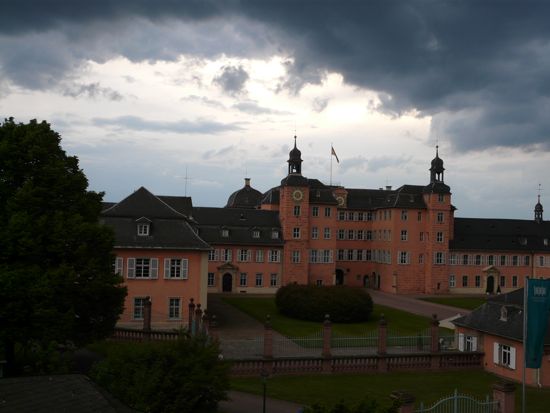
Here is one view from our corner room:

And here is another view, towards sunset, with some weather drama going on in the background:
John Berendt and City of Falling Angels
When AdventureMan brought home City of Falling Angels for me, I thought it was another mystery by the author of the famous Midnight in the Garden of Good and Evil. I had loved that book, full of unforgettable characters living in Savannah, Georgia, so I was a little puzzled with the immediacy and real-life feeling of this new mystery when I started it.
It’s set in Venice. The main “character” observes – much like Midnight in the Garden of Good and Evil – Venice, and its population. He arrives just after the horrendous fire that totally destroys La Fenice, the opera house, and we meet a wide variety of characters right off, experience the fire through their first hand experiences. We smell the smoke, we feel their horror as the fire grows, and spreads. We are depressed when the fireboats cannot quell the flames because the waters in the canal have been emptied, and are too low in the others.
I kept waiting for Commissario Guido Brunetti, Donna Leon’s Venetian detective, to show up.
I was about half way through the book when I realized – this wasn’t fiction. It was John Berendt living in Venice, meeting with and interviewing all these fabulously interesting people. Yeh, sometimes I am so SLOW!
But I was hooked. I kept reading. The mystery is how did the fire at La Fenice start, who started it and why. In the end – and believe me this is not a spoiler, because this book is really only peripherally about the fire at La Fenice – people are convicted, but you are never really sure these are the right people, or if, indeed, there was really a crime, or if the crime was negligence – but how can negligence be a crime if it is part of the culture?
One thing Berent says that Donna Leon also implies – don’t go to Venice during tourist season! Go when tourists are not there – after carnival, when it is cold, when it is raining. Stay in Venice, and walk, off the paths the tourists on their one-day-in-Venice travel. Visit the small markets, drop in for a coffee where the locals are drinking, but most of all – walk. And walk. and walk.
This is not an exciting book. It will not hold you on the edge of your seat like some horror thriller, turning pages because you are afraid to turn out the lights. The horrors in this book are the gossip, the strivings of various people to enter into Venetian society, the cut-throat competition for invitations, and who gets the prime seats at the opening night at La Fenice.
On the other hand, I loved his attention to detail, the ease with which Berendt got people to talk to him, the clarity with which he captures their personalities. I loved his description of the interiors, and how he uses the voices of others to paint in a detailed picture of Venice today. I loved being inside the Venetian community, and hearing their innermost thoughts. This was a book I looked forward to at the end of a long day, it took me to another – and fascinating – world. I just wish Commissario Brunetti had showed up. 🙂
Don’t Smear Amir
Ruling in anti-Amir smear May 27
KUWAIT CITY : The Criminal Court on Wednesday set May 27, 2009 to rule on State Security case number 114/2006 filed against a 20-year-old Kuwaiti man, identified as Mansour R., for insulting HH the Amir while talking on the phone.
During the session, the suspect’s lawyer, Attorney Ali Al-Rashidi, requested the court to acquit his client as he had no intention to insult the Amir. He argued there is no evidence to incriminate his client and requested the court to listen to the testimony of the defendant’s witnesses if the need arises.
Mansour, a student at the Public Authority for the Applied Education and Training (PAAET), has been charged with insulting the Amir.
During a previous session, Mansour denied the charge, saying he was talking to his friend, Mohamed, about somebody named ‘Sabah’, not the Amir.
By Moamen Al-Masri
Special to the <a href=”http://www.arabtimesonline.com/kuwaitnews/pagesdetails.asp?nid=31834&ccid=22″>Arab Times
Somali Pirate Code of Conduct
Ever since I was a kid, I found pirates interesting and exotic and adventurous. The truth is probably that those olden day pirates had bad teeth, scurvey – they had lived hard and fast and they probably aged quickly.
Of course, today we have Johnie Depp and the Pirates of the Caribbean series, which makes pirating look mostly like a lot of fun.
So a year or so ago, I wrote a post on the Somali pirates, and got an interesting response. It got me started looking more deeply into what is going on with the pirates there.
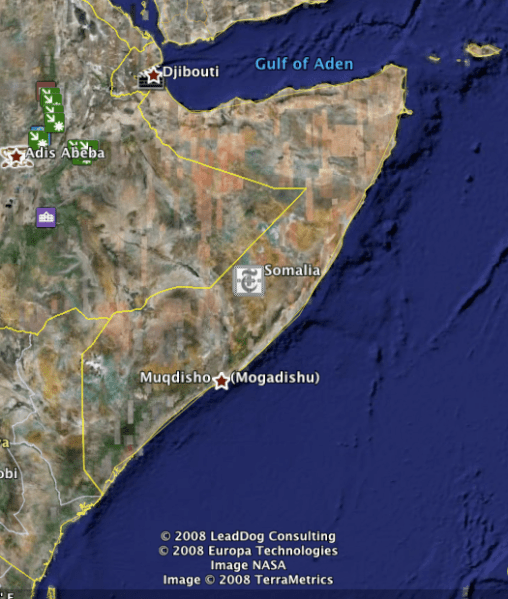
Yesterday, in the paper was an article about the Somali pirate code of conduct – with fines and punishments for infractions. I found a complete article in Newsweek, April 27.
What is bothering me now is that the one pirate captured by the US when it retook the captured US freighter (in the report filed by one BBC reporter) said he was just a frail teenager, a kid, and that the pirates had already agreed to surrender when they were blown out of the water. You could hear her attempting to control her rage.
I know it is a thorn in the side for all shippers and freighters and passenger ships who travel through waters anywhere near to Somalia. And yet . . . I kind of ask myself what the options are? Somalia is a for sure failed-nation. They haven’t been able to cobble together a government for over twenty years. Deadly, long lasting poisons have been dumped along their shoreline – and major industrial nations paid Somalis a pittance to dump their wastes there. Their coastline has been overfished. Families are starving, live is – or was – dismal.
I think it is pretty cool that they developed an enforceable – and enforced – code of conduct.
Here is the article from Newsweek:
It was a hit with the U.S. public, but president Obama’s decision to authorize the Pentagon to kill three Somali pirates who took an American sea captain hostage sent shudders through the world’s shipping and insurance industries. Because the pirates are motivated chiefly by money, maritime experts say, they have—at least until now—taken good care of the crews they hold captive. A document retrieved from a ship hijacked last year contained a “list of written rules” of conduct pirates had to follow, according to a maritime security expert who requested anonymity when discussing sensitive material. The document included a series of “punishments” to be imposed on any hijacker who struck a hostage.
Shipping companies and insurers are far more likely to fork over large ransoms if they have confidence that their personnel and cargo will be released unharmed, and while the scourge of piracy has been disruptive, so far there have been virtually no casualties among innocent people. According to estimates, there were 111 pirate attacks off the Somali coast in 2008; 42 were successful, resulting in the capture of 815 seamen. As of last week, according to one estimate, all but 37 had been released, and two had died—one reportedly of illness. Experts say the rate of attacks has increased sharply this year, and “the more [authorities] shoot, the more the pirates will shoot back,” says Tom Wilson, a Somalia analyst for the British consulting firm Control Risks.
Protecting the 23,000 merchant vessels sailing annually near the Horn of Africa would require a naval fleet of at least 60 ships, according to U.S. government and private experts; the existing international antipiracy task force has about 20. And attacking the Somali coastal villages where the pirates are based could potentially radicalize generations of Somalis. “That would be a 19th-century solution,” says Neil Roberts, a marine insurance expert with Lloyd’s Market Association in London. Industry experts say the only solution to piracy is the creation of a viable Somali government back on dry land.
According to industry officials, ransom demands have ranged as high as $25 million—but in most cases they are negotiated down to about $2 million to $3 million, and insurers then pay out claims to the shipping companies. As hijackings have increased in frequency, pirates have become fussier about how their money gets delivered. Initially, said a shipping-industry source who also asked for anonymity, ransoms were often handed off to shady Somali expats in places like Kenya. After Kenyan authorities cracked down, the pirates began insisting on airdrops via parachute into the ocean near Somali coastal villages, where they have cash-counting machines ready. Until the U.S. opened fire, one of the pirates’ biggest headaches had been dealing with the sheer volume of money they’ve collected. Last year, according to an insurance-industry official, one pirate’s boat capsized because he had overloaded it with cash.
I found this on National Post dated April 30, 2009; it is a copy of what I had read in the newspaper:
MOGADISHU — A mobile tribunal, a system of fines and a code of conduct: the success of Somali pirates’ seajacking business relies on a structure that makes them one of the country’s best-organised armed forces.
A far cry from the image conveyed in films and novels of pirates as unruly swashbucklers, Somalia’s modern-day buccaneers form a paramilitary brotherhood in which a strict and complex system of rules and punishments is enforced.
They are organized in a multitude of small cells dotting the Indian Ocean and Gulf of Aden coastline. The two main land bases are the towns of Eyl, in the breakaway state of Puntland, and Harardhere, further south in Somalia.
“There are hundreds of small cells, linked to each other,” Hasan Shukri, a pirate based in Haradhere, told AFP in a phone interview.
“We talk every morning, exchange information on what is happening at sea and if there has been a hijacking, we make onshore preparations to send out reinforcement and escort the captured ship closer to the coast,” he explained.
Somali piracy started off two decades ago with a more noble goal of deterring illegal fishing, protecting the people’s resources and the nation’s sovereignty at a time when the state was collapsing.
While today’s pirates have morphed into a sophisticated criminal ring with international ramifications, they have been careful to retain as much popular prestige as possible and refrain from the violent methods of the warlords who made Somalia a by-word for lawlessness in the 1990s.
“I have never seen gangs that have rules like these. They avoid many of the things that are all too common with other militias,” said Mohamed Sheikh Issa, an elder in the Eyl region.
“They don’t rape, and they don’t rob the hostages and they don’t kill them. They just wait for the ransom and always try to do it peacefully,” he said.
Somalia’s complex system of clan justice is often rendered obsolete by the armed chaos that has prevailed in the country for two decades, but the pirates have adapted it effectively.
Abdi Garad, an Eyl-based commander who was involved in recent attacks on U.S. ships, explained that the pirates have a mountain hide-out where leaders can confer and where internal differences can be solved.
“We have an impregnable stronghold and when there is a disagreement among us, all the pirate bosses gather there,” he told AFP.
The secretive pirate retreat is a place called Bedey, a few miles from Eyl.
“We have a kind of mobile court that is based in Bedey. Any pirate who commits a crime is charged and punished quickly because we have no jails to detain them,” Mr. Garad said.
Some groups representing different clans farther south in the villages of Hobyo and Haradhere would disagree with Mr. Garad’s claim that Somalia’s pirates all answer to a single authority.
But while differences remain among various groups, the pirates’ first set of rules is precisely aimed at neutralizing rivalries, Mohamed Hidig Dhegey, a pirate from Puntland, explained.
“If any one of us shoots and kills another, he will automatically be executed and his body thrown to the sharks,” he said from the town of Garowe.
“If a pirate injures another, he is immediately discharged and the network is instructed to isolate him. If one aims a gun at another, he loses 5% of his share of the ransom,” Mr. Dhegey said.
Perhaps the most striking disciplinary feature of Somali “piratehood” is the alleged code of conduct pertaining to the treatment of captured crews.
“Anybody who is caught engaging in robbery on the ship will be punished and banished for weeks. Anyone shooting a hostage will immediately be shot,” said Ahmed Ilkacase.
“I was once caught taking a wallet from a hostage. I had to give it back and then 25,000 dollars were removed from my share of the ransom,” he said.
Following the release of the French yacht Le Ponant in April 2008, investigators found a copy of a “good conduct guide” on the deck which forbade sexual assault on women hostages.
As Ilkacase found out for himself, pirates breaking internal rules are punished. Conversely, those displaying the most bravery are rewarded with a bigger share of the ransom, called “saami sare” in Somali.
“The first pirate to board a hijacked ship is entitled to a luxurious car, or a house or a wife. He can also decide to take his bonus share in cash,” he explained.
Foreign military commanders leading the growing fleet of anti-piracy naval missions plying the region in a bid to protect one of the world’s busiest trade routes acknowledge that pirates are very organised.
“They are very well organized, have good communication systems and rules of engagement,” said Vice Admiral Gerard Valin, commander of the French joint forces in the Indian Ocean.
So far, nothing suggests that pirates are motivated by anything other than money and it is unclear whether the only hostage to have died during a hijacking was killed by pirates or the French commandos who freed his ship.
Some acts of mistreatment have been reported during the more than 60 hijackings recorded since the start of 2008, but pirates have generally spared their hostages to focus on speedy ransom negotiations.
With the Robin Hood element of piracy already largely obsolete, observers say the “gentleman kidnapper” spirit could also fast taper off as pirates start to prioritize riskier, high-value targets and face increasingly robust action from navies with enhanced legal elbow room.
They have warned that the much-bandied heroics of a U.S. crew who wrested back control of their ship and had their captain rescued by navy snipers who picked off three pirates could go down as the day pirates decided to leave their manners at home.
I used to read science fiction novels about a diplomat named Retief, I think they were by Keith Laumer. He would find himself in an alien environment with a horrible unsolvable problem and he would find a great solution, where everyone walked away OK. I wish there were a Retief who could negotiate a win/win out of this situation.
Rola Dashti Tackles Sensitive Issues
“Why are you looking so sad?” AdventureMan asked me as we sat down to dinner.
(Sigh) “There are people in Kuwait who don’t believe change is possible, and there is a movement afoot to WITHHOLD their votes as a protest.”
“Why do you care? It’s not your country?”
We call it “falling on your sword,” when a person does something fatal to self, to career, to family or to country, choosing an issue and staking everything on it. Rarely does it pay. The world moves on, life goes on and you are left behind bleeding on your sword.
Withholding your vote gives more power to those who are good at stirring up the rabble with irrational and selfish issues. Those who get the votes are those who make grandiose – and general – promises, those who refuse to be held accountable.
If you are a person who cares deeply about Kuwait – Please, do not withhold your vote. Do the hard work of listening to the candidates, and exploring their reputations for truthfulness and accountability. Think beyond your own needs, think of the greater good of Kuwait.
This is from today’s Al Watan; a candidate tackling some very sensitive issues, bringing them out in the open.
Ghenwah Jabouri
Staff Writer Al Watan
KUWAIT: In pursuit of winning enough ballots to secure a seat in the National Assembly, Dr. Rola Dashti, who is believed to be a potential woman candidate, delivered an emotive speech Monday evening to announce her parliamentary agenda if elected.
Dashti touched on sensitive and delicate issues which aroused the emotions of the audience, resulting in heated engagements later on in the evening.
Dashti mainly focused on family related issues, germane to women issues.
In an attempt to recoup the cynicism manifested by citizens toward parliament, Dashti urged the audience to not ponder on who is wrong or right.
“We need to move on; seeking to blame parliament, government, MPs, etc., is not going to serve us justice. We need to focus on developing Kuwait, rather then pointing our fingers at the wrongdoers, ” Dashti said.
She stressed that whether it was the parliament, the government, or the citizenship who committed the mistakes is not important; “what is important is that we learn from such mistakes.
“Individuals who have the cultural habituate of blaming, attacking and are cynical, do not want to move toward the future; rather, they want to travel back in time. Allow me to give you an example: last year, thirty percent of citizens in my constituency did not cast their ballot. These people are like you and me: their heart is burning for Kuwait, and they observed nothing positive, and they are in immense suffering.
“They gave up on hope and decided to ultimately not vote. Had half of them voted (nine thousand), ten people who would have succeeded in the Third Constituency elections would have determined a better fate for those that abstained from voting.” She further lamented that society should consider first and foremost Kuwait, and that the children, the youth and coming generations “deserve this.”
Dashti, further illustrating her point, noted: “For example, if soـandـsoـperson does not vote, who is going to protect their rights and so forth?”
Dashti stressed that Kuwait is experiencing “tumultuous times” and that the country is on the verge of a major collapse.
“Kuwait cannot afford political arguments and political confrontations and commotions. It is in our hands to save Kuwait. If we take responsibility, vote and call on those who did not vote to cast their ballot, change might have a chance of survival.
“Hundreds of people did not cast their votes because they lost their confidence in parliament. However, many families are suffering, and so, it is pivotal to acquire each and every vote; we need to give back what Kuwait bestowed us with.
“We need to give a little back to those who lost their lives to protect Kuwait during the Iraqi invasion in 1990; many people lost their lives during the invasion who fought for our liberty. Women were raped and families were torn apart. We need to give back a little, we need to continue to believe, and fight for our children and future generations,” Dashti added.
“Does Kuwait not deserve for us to stand in the cue for fifteen minutes to cast our votes?”
Talking more about women”s issues, Dashti noted that there are many things that need to be considered where women’s issues are concerned.
“Women have many burdens that they shoulder; the divorced, the widowed, the one who is married to an expatriate, and housing for women, all are issues the Kuwaiti woman suffers from.”
She pointed out that not every family is living happily, “although this is something I would love to achieve.
“Today, the Kuwaiti family has to wait fifteen years for (government) housing. Where will the divorced woman go during this lengthy period?
“This woman could be my sister, my mother, or our daughter; where does she go?”
Dashti noted that the law stipulates that a woman who is over forty years of age and both of whose father and mother are deceased and is unassisted by a guardian “is entitled to receive a housing allowance.”
“However,” Dashti said challenging the law, “what about other women in a somewhat parallel situation where the father is deceased but is not receiving allowance from her guardian ـ what can she do? Shall the woman take her guardian to court to sue him?
“Why does the law in pursuit of helping women insist on punishing them, even insulting her?
“This law is one of many that are flawed and need to be amended,” Dashti stressed.
She further said that “neither Kuwait or the people of Kuwait can tolerate empty words and useless slogans. Today we need to put many things on the table and take action in tackling them.
“Let”s now have a look at the children of some Kuwaiti women who are married to expatriates: we need to look at their educational, health, and employment and social needs and treat them with justice, like other children are treated who have Kuwaiti fathers.
“This is their country, why are we abusing them? These are our cousins, our brothers and sisters, and have to be treated with equality when their mother is a citizen of the country.”
She further added that citizens have been “fooled” enough; “vote for someone who knows what they can do, someone who can save us from the financial burden.” Touching on an issue that has become central in campaigns, Dashti noted, “We should not allow people who do not understand finance to tamper with the budget.
“Nor should we allow individuals who are responsible in dealing with the financial budget to use the financial budget for personal gains.”
“Why should we follow those who damage our financial budget, and steal the money of the public? There is another option: choose someone who will protect the public financial budget and enhance the budget!”
Dashti further stated that there is an “internal bleeding” in the country and that she is not going to offer an “aspirin to silence your pain to only kill you” as a member of parliament.
“I will opt for a long term alternative and choose to cure you.”
During the question and answer session following her address, particularly passionate but enraged voices emerged, where some expressed their frustration with the old faces of parliament.
One woman said she was “fed up with the old faces and that it is about time new faces took over.”
She further said, “We have been deceived, fooled and cheated by the old MPs,” and stressed, “We are suffering and are in desperate need of MPs who will promote social and financial justice.
“Kuwait has hit a plateau and something”s got to give,” she noted.
Another woman made a remark about Dashti”s strong foreign accent.
She noted: “Society often criticizes you (Dashti) for speaking in a Lebanese accent.
“I don”t understand why you come under scrutiny for such a reason. After all, people have television at home and typically watch the satellite channels, all of which speak in foreign accents.”
The woman”s comment was understood to be a positive comment, where she welcomed Dashti”s candidacy and believes that the candidate will be a forceful vehicle towards righteous deeds toward society.
Another frustrated woman spoke about property and about people whose houses was taken from them by the banks. She said that she read an article in Al Watan newspaper that there are many withdrawn properties and houses for sale.
“The inheritors are crying blood and are traumatic, because their houses are being taken from them. Other citizens are staying in small apartments after they used to occupy villas,” she said.
Another woman who was virtually in tears pled to the people “to opt for change and choose new faces, even if the new members of parliament will do nothing.
“The former parliament has tormented and killed me; please, give your votes to new faces, in the name of God, please, vote for change.”
Recent Comments
intlxpatr on Shampoo Ginger tigerbutterya0c5ff1d… on Shampoo Ginger intlxpatr on British Soldier Kidnapped, Esc… John on British Soldier Kidnapped, Esc… intlxpatr on British Soldier Kidnapped, Esc… Wikipedia Donate Button

Amazina


Early Voting in Florida


