Vic’s Touchdown Cafe Near RaceTrack, LA
We’re headed home again, but the day has dawned shrouded in a thick Halloween-y fog drifting up off the bayous and covering the low lying roads. We get on a fast road, and decide to have breakfast, hoping the fog will break.
We exit almost as soon as we got on the road, headed South on a road heading toward the Gulf, looking for something that is not fast food. And there it is, on the left, we just passed it, so we circle back for breakfast at Vic’s, Breakfast Lunch Dinner.

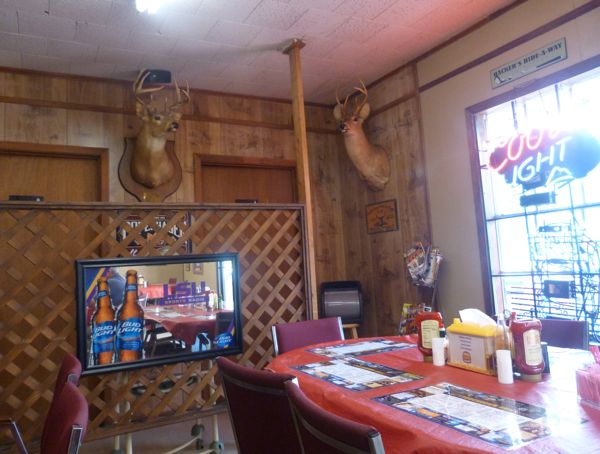
As it turns out, I believe the real name is Vic’s Touchdown Cafe. The interior is full of sports trophies, banners, team memorabilia, and stuffed deer heads. There are other customers, eating breakfast, chatting with a man whom I believe is probably Vic. We ordered breakfast off the plastic menu table mats, and settled back to listen and learn.
People in Louisiana are hospitable, and kind. They asked us questions, shared some local lore and when I asked Vic if he had any milk, he opened a little bottle of milk just for me and put it on the table so I could have milk in my coffee. I was impressed, but I get the impression he thought it was just good manners. My kind of place.

I didn’t take photos of the food; it might have spoiled the mood. It was traditional breakfast; eggs, bacon, biscuit and AdventureMan had hash browns. It was all good, even the coffee, and even better because it was not fast good. This was a great stop.
By the time we had finished, the fog had lifted and we had clear sailing all the way back to Pensacola 🙂
Big Mike’s BBQ in Houma, LA

Where do you eat in Houma, Louisiana? Just about everyone we asked started with Big Mike’s, so after our swamp tour, we gave it a try.
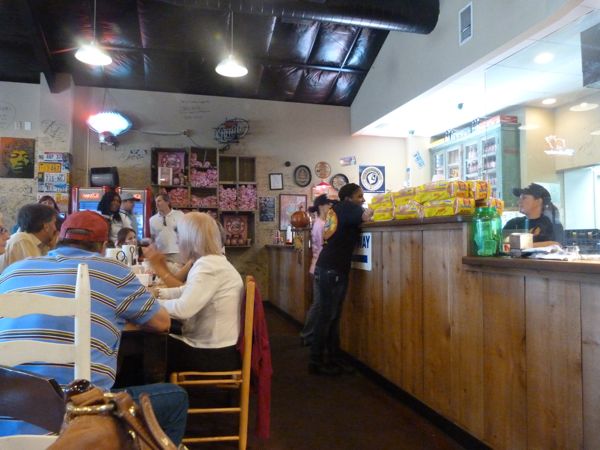
The place was packed. There are menus near the door; you look at the menus, you go to the counter, you place your order and they give you a number which you place on your table and someone brings your meals to you. The smell is divine.
This is cane sugar country, so of course, the sweet tea is cane-sugar sweet:

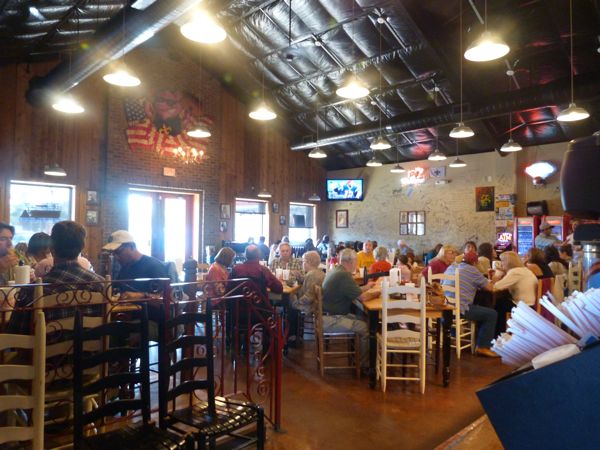
Several different seating areas in Mike’s:
The chicken with corn on the cob and jambalaya – delicious!

Pulled pork:

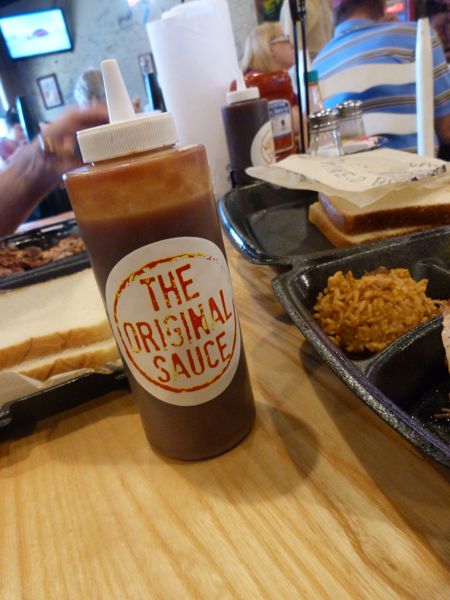
Big Mike’s has it’s own BBQ sauce, rubbing spices, t-shirts, etc>
Confuse, Confound, Devastate and Dissipate ISIS
When I was a kid, I did not like reading the Old Testament, all those old-timey people, and it all seemed very confusing to me. As I grew older, I find I like the Old Testament part of our readings very much, the people come alive in all their faults and bad decisions, and God’s mercy shines through as we continue to rebel against him and follow too much our own devices and desires of our hearts.
I love Genesis 11, where mankind, in all our pride, decides to build a tower, and it must have been pretty good because it got God’s attention and he didn’t like it. He didn’t like it so much that he created confusion among all the languages spoken, but I bet it was also confusion and dissension among the decision makers, too, to scatter the mighty population.
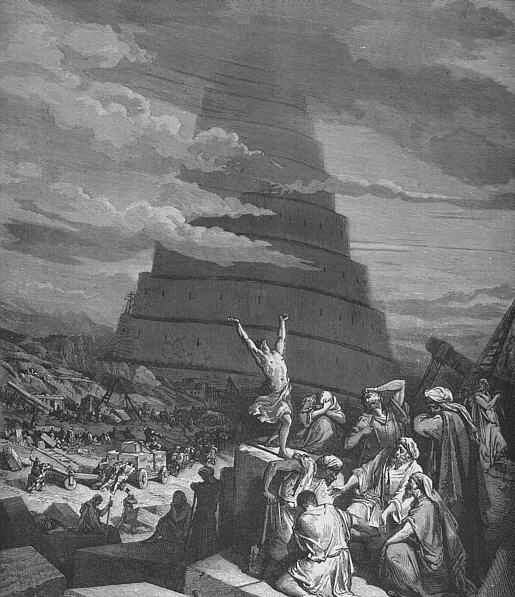
As the wandering descendants of Abraham began to settle, they often went up against armies and peoples much larger than they were, and God always told them not to worry, he would confuse the armies. He put fear in their hearts, in the confusion, mighty armies collapsed and scattered.
And why am I bringing this up, you might wonder?
This ISIS Army, it seems to me, is already cobbled together. I hear people people talking, people who know, they say ISIS is smart, fights smart. I believe they have some smart leaders, but I am willing to bet that they have some fatal flaws, also. They have overstretched. They are trying to enforce their will by violence and killing off the opposition, which might encourage the appearance of cooperation, but in reality breeds legions of those who will turn on them in a heartbeat.
Yes, we mistakenly dropped weapons which they were able to access. Mistakes happen in war zones all the time, with modern communication we just hear about it a lot sooner, not like 40 years from now when it is declassified and someone writes a book about it. Frankly, it’s not that big a deal.
What I believe is a big deal is their lack of cohesion. Lacking any strategic direct line to important decision makers, I am praying, and what I am praying is this, words from Psalms:
Confuse, O Lord, confound their speech
Disintegrate ISIS from the inside.
Create, Great and Merciful Father, miscommunications, misunderstandings, competing agendas and internal strife among the ISIS force.
All Mighty, All Powerful God, create a massive collapse, let their foot-soldiers drift away, drift home to their mothers and fathers and their families, and leave the Iraqi villages and the Syrian villages in peace.
Dry up the wealth of the Gulf, funneled through corrupt money changers in Kuwait, let it be mishandled, go missing, be stolen, be diverted and find its way to true charitable organizations providing a means of survival to those thousands of refugees who have been displaced.
Oh God! Collapse this abomination, the Islamic State of the Levant and Syria, collapse it utterly from within, strip it of all its power, devastate it like a virulent plague from within!
Oh God, bring good out of this downfall. Teach the remnants who return to their homes to live together in peace, to form peaceful and stable communities and then nations whose lives honor you!
All this is possible for the God who can do all things. Confound their speech, Lord, confuse them utterly, devastate and collapse them utterly from within. You are the one true God, there is no other God.
We are not without resources. We have the mighty fist of prayer.
Swamp Tour With Annie Miller’s Son
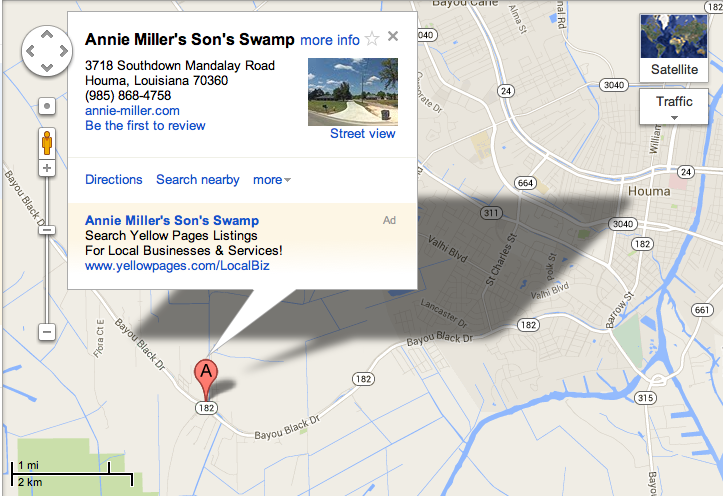
Annie Miller was a woman ahead of her time, out trapping, hunting and doing whatever she needed to do to keep her children fed and clothed and going to school. When oil went bottoms up, the town of Houma approached Annie Miller and asked her to start up some tours of the swamp, to attract business to the area. She did, and was so knowledgeable that people came from everywhere to take her tours.
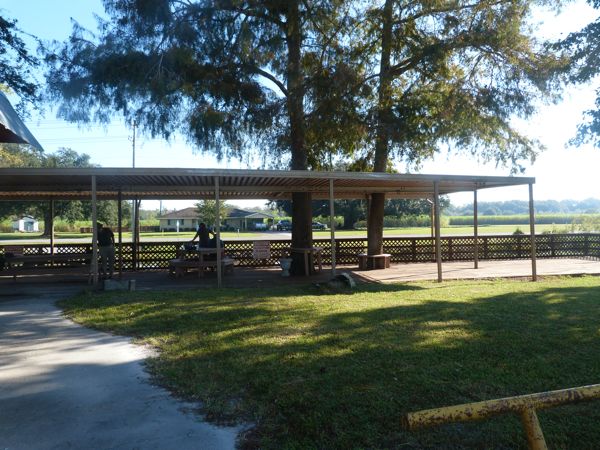
Now her son does the tours, and we liked his approach. We call it “Under promise and over deliver” which we think is a great slogan for contractors everywhere. At one time AdventureMan worked for a giant company whose contracts were called “The Gold Standard.” His company cost a little more, but they delivered on every promise and were good at figuring out problems that cropped up mid-contract and working with the government to support the mission.
As this tour departed from the gathering spot at Bayou Delights restaurant, the guide told us that with the colder weather, he couldn’t guarantee that we would see any alligators at all, but that there were other things he would show us. I love that approach. It prevents excessive expectations.
As it turned out, we saw all kinds of wonderful things, both inside and outside of the Mandalay Wildlife Refuge.
This is a revolving bridge over the Bayou Black. You can see the round base on which it can swing sideways to allow really tall boats up the Bayou. The guide saws he has never seen it work in his lifetime.

Almost immediately, we spy an alligator sunning on the side of the bayou.

Entering Mandalay Wildlife Refuge:

Shooting digital is a crap-shoot. You have that tiny delay, but a tiny delay makes shooting wildlife less predictable. I didn’t even know I had this shot until I uploaded my photos to my computer. It was absolutely glorious to see.

I have never seen anyone call an alligator before. “C’mon Ruby! C’mon b-a-a-a-a-a-a-a-by! C’mon Ruby!” And Ruby came!
So did Little Latin Loopy Lou! She jumps for the pieces of chicken that he puts on the end of the stick:


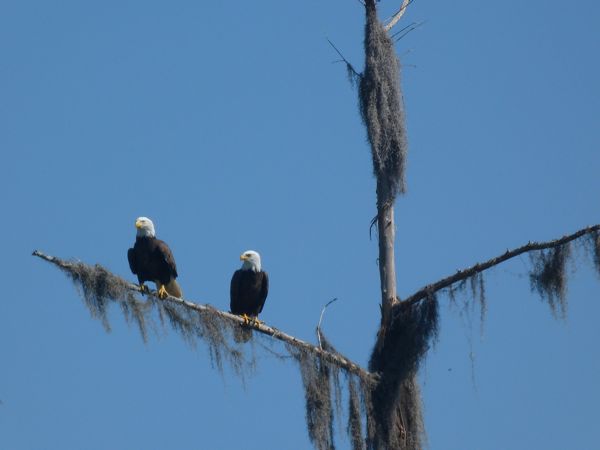
This is more exciting to me than alligators. These birds are gorgeous.

These two eagles would swoop at the same time for chicken skins; unfortunately, against the dark bayou, you couldn’t see them as they swooped, but I loved catching two of them together as they chowed down on their meal.
Back at the lovely Marriott Courtyard in Houma, I love having a balcony, especially in this weather. Gorgeous sunset, gorgeous weather.

Coffee Call in Baton Rouge
We are going to grab a bite of breakfast before we check out of our Baton Rouge hotel, when we catch sight of the line, the very very long line, and people are carrying plates of rolls and cups of coffee back to their room; there is no place to sit and eat because the conference room is all set up for the final meeting of the conference.
LOL, no, we are not going to stand in line for breakfast. I know just the place to go; I found it earlier on TripAdvisor, but with breakfast included in our room, I hadn’t a hope of getting there. But it is nearby, and just what we need! We check out, and head for Coffee Call.

The minute we walk in, we love this place. There are businessmen reading the paper, sipping their coffees, there are families with children who have put several tables together, there are all kinds of people just kicking back and enjoying this place.
We figure out that we have to go up to the front to order our coffee, tea and beignets 🙂 but because we are about to hit the road, we also order sausage biscuits for a little protein.

The beignets are loaded with powder sugar. As we get ready to go, I go into the ladies room to wash hands and find another grandmother, trying to get powdered sugar off her two grandchildren, LOL.

The Coffee Call gave our day a great start and sent us on our way with smiles on our faces 🙂
Jubans in Baton Rouge
So we’ve just had this strangeness with my new reinstated-credit card and my driver’s license, and AdventureMan is HUNGRY, and some very kind and helpful Baton Rouge friends have told us we have to try Juban’s for dinner, which sounds like exactly the place we would love our last night in Baton Rouge. Oddly, it is located in a non-descript strip mall, and the parking lot is so full we have to circle a couple times to find a spot.
When we find Juban’s, we are enchanged. It breathes elegance and atmosphere.
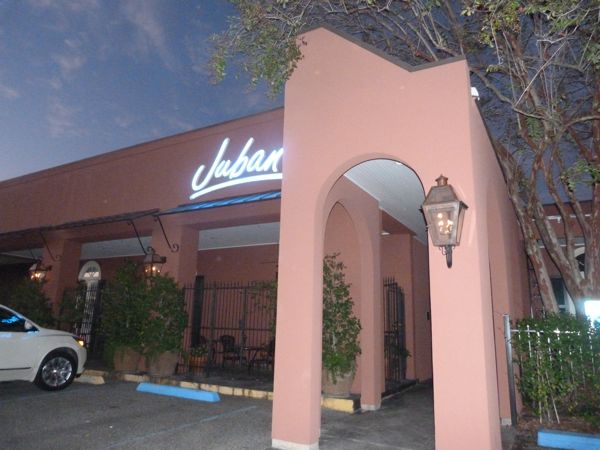
You evidently can dine outside, but no-one was dining outside.

There were a couple groups and a couple in front of us walking in; there were four large groups in various rooms (you can see this is where you schedule engagement parties, good-bye parties, getting-together with old friends parties, etc. This place is geared towards special times.) The groups were whisked away somewhere, and the couple in front of us was seated, and we were seated, almost immediately. We breathed a sigh of relief; we had no reservations, but we had a lovely table.
All around us were people gathered to have a good time. My favorite tables had children at them, and several generations, and the little girls all had dresses on and bows in their hairs, and the men were in coats and ties, and the groomed women wore nice dresses and pearls. At other tables, people were having business dinners, all dressed in coats and ties or nice business attire, the lighting was dim-but-good-enough-to-read-a-menu-by . . . . if we had a menu. We had no menus, and we didn’t seem to have a waiter.
We had plenty of time to observe.
After a good ten minutes, a waiter appeared and brought us two glasses of very very good wine . . . but no menus. He seemed annoyed when I asked for the menu; he was probably annoyed at the hostess, or something, I don’t know, but while he told us we had “the best waiter in the house” waiting on us, he never made us feel welcome in any way. He was entirely correct, in a very rushed, perfunctory kind of way.
We ordered. Food arrived fairly quickly. Our waiter never stopped by to ask how it was, or if we wanted more wine, or anything. It seemed to be an exceptionally busy evening; I didn’t see any of the waiters smiling or chatting cozily with any of the clients, so I wonder if it is part of the training that the waiters be rushed and perfunctory?

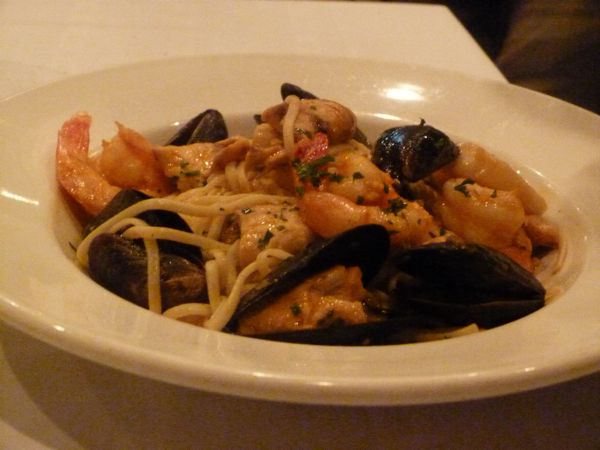
AdventureMan was the winner, with his Seafood Pasta. The sauce was intense, and truly wonderful, a sauce I would love to be able to make.
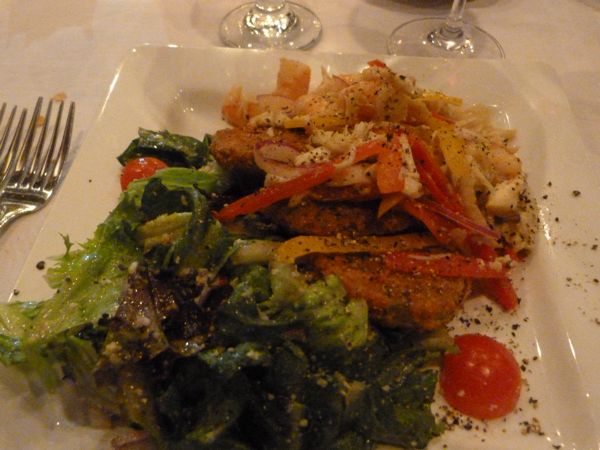
I had a perfectly nice salad and non-fried seafood, the Salad Napoleon. The salad part had taste; the seafood, not so much
:
I did order coffee, while AdventureMan finished up his exquisite Seafood Pasta. Normally, on a night like this, in a lovely restaurant, we might also have dessert, but we were so nonplussed at our non-welcome that we decided to pay the bill and leave.
I would go back, one time. I would give them the benefit of the doubt; it might have been just a very very unexpectedly busy evening and they found themselves short-staffed. I would give them another try, but I just have the feeling that maybe stuffy, rushed service is the norm rather than the exception. Pity, that, because the venue itself is wonderful.
And it was just another little strangeness . . . .
Kuwait in Fight Against Money Laundering and Drugs
This from yesterday’s Arab Times Kuwait:

‘Kuwait In Fight With Drugs, Money-Wash’UN Briefed On Efforts
NEW YORK, Oct 10, (KUNA): A Kuwaiti diplomat has briefed a United Nations commission about the State of Kuwait efforts to combat money laundering and other illegal financial activities as well as menace of narcotics. Ibrahim Faisal Al-Da’ee, the third secretary serving with the permanent Kuwaiti mission at the UN, in an address to the UN Social, Cultural and Humanitarian Affairs Committee (SOCHUM), underscored necessity of taking effective action against crime and boosting coordination at the international and regional levels in this respect. As to combating “corrupt financial activities and funding from illegitimate resources,” the third diplomat noted that the State of Kuwait issued lawinto- decree number 23 in 2012, setting up the public authority for combating corruption and issuing special rules for financial assets’ disclosure, as well as the Ministerial Resolution No. 37 (2013), containing executive regulations for combating money laundering and terrorism funding.
Established
On basis of the above mentioned, diplomat Al-Da’ee continued, the national commission for combating money laundering and terrorism was established. Moreover, the Central Bank of Kuwait issued a number of decisions aimed at clamping down on money laundering, in tandem with Kuwait’s endorsement of the UN convention for combating corruption. Regarding the drugs, Kuwait urges for taking necessary precautions to resolve this international problem by means such as encouraging planting of legitimate crops and improving living conditions in rural regions. Also in this respect, he pointed out, Kuwait had signed international conventions concerning such issues. According to Kuwait’s Ministry of Interior, number of drug-related crimes, during 2010-2013, dropped 6.4 percent, drug dealing cases 7.2 percent and narcotics-linked deaths 30 percent. He concluded his address to the international commission, stressing on respect for human and basic rights, through action against crimes, urging for collective global efforts against narcotics.

So . . . now we have legislation and a decree. Does Kuwait have the resources and/or the will to go after those who are funneling the funds to ISIS? Legislations and decrees are great, but even greater is following through; it gives a government credibility.
Domestic Violence: What is Wrong With this Picture?


At first, I thought oh, that is amazing, Florida has the lowest rate of all the states. Then, I looked a little closer . . . no data? No data on homicides related to male partners?
Here is what the report summarizes:
The States Where Women Are Most Likely to Be Killed By Men
Every year, the Violence Policy Center tracks which states have the highest rate of incidents in which one man kills one woman, a typical indicator of domestic homicide. The Huffington Post crunched the data to find the worst offenders over the past decade. Between 2003 and 2012, Nevada had the highest rate, at 2.447 women killed per 100,000. In 2012, however, the most recent year for which data is available, Nevada’s rate dropped to 1.83, and Alaska took the top spot with 2.57 women killed per 100,000.
It is horrifying in Florida; men killing their wives, their live-ins, their daughters, men and women striking or burning their children, or shooting them . . . but it is also horrifying that Florida can’t – or won’t – provide the statistics when every other state has.
It all goes back to the idea of women as property. Arrrgh, I am speechless with frustration.
Headless Horseman at Pensacola Ballet

Today is a day to make the heart joyful. Yesterday, we had thunder and lightning, so much that my water aerobics class was cancelled and I made that drive for nothing. Even when the sun came out, hours later, there was so much water soaked into the ground, the evaporation made it feel hotter than it really was.
The best part of the whole day was knowing we were headed to the opening of the Ballet Pensacola Season last night.
Who knew when we came to Pensacola that there would be so many fun things to do? And that we would have the time to try them all? Pensacola has an Opera, a Symphony, many many parades, some kind of fest, normally featuring seafood and/or art, and sometimes also the sugar white sands, wine and/or rock bands almost every month, AND the Ballet Pensacola.
Nothing about the Ballet Pensacola is ordinary. Ballet Pensacola has a husband wife team, artistic director Richard Steinart and his wife Christine Duhon, the ballet mistress, who also does the costumes. Her costumes are often spectacular. Lance Brannon does the sets which are are often minimalist and always wonderfully creative. You know public arts are almost totally public and community supported, you know they must have a tricky budget to work with but the sets and costumes are wondrous to behold.
We were debating whether The Headless Horseman would be a good ballet for our four year old grandson. AdventureMan thought it might be scary. There is a witch, a wonderfully convincing witch. There is a guy with no head. There is a skeleton horse. I countered that he sees worse on his cartoons with Spiderman and BatMan and whoever those heroes are that “Assemble!” The Headless Horseman is a lot of fun; it even looks like the dancers are having a lot of fun with it, and of course, there is this incredible skeleton. We leave our evenings at Pensacola Ballet delighted.
One of the things we love about the ballets this team creates is that it isn’t easy to get most men to love ballet, but many of the ballets they do have appeal to men – The Matrix, Dracula – they are not dainty ballets, but strong, dramatic ballets. In addition, they are, as I said, a lot of fun. When we offer up tickets we can’t use to our son and his wife, they jump at the chance. I want to make Nutcracker an annual event, but I recognize that if I want grandchildren who will love the dance, I will be likely to take them to some of this stronger stuff. We already have an extra ticket for Ali Baba, coming up in the Spring, so our grandson can come with us.
It was still warm when we left the theatre, but this morning it is like we are living in a different place.

The air conditioner is OFF! The windows are open! Fresh clean air is flowing through the house, the sun is shining without wilting anything, and, thanks to yesterday’s rain, the entire world looks fresh and clean and welcoming! The fun times begin in Pensacola, the cooler weather has arrived!
Good2Go for Consensual Sex
Go figure. In spite of admonitions to the contrary, young people have sex. Problems arise when someone isn’t old enough to consent, isn’t coherent enough to have sex or is forced to have sex or participate in a sex act they don’t consent to.
I love this idea. It takes a little of the “he says – she says” out of the classic dilemma of who did what to whom and who should be held accountable? Was it consensual? Was it rape? Were both parties in a sober enough state to make that decision?
This is from SLATE Online magazine
Consensual Sex: There’s an App for That

Courtesy of Good2Go
Last June, Reason’s Robby Soave called for an iPhone app that would clear up pesky he-said, she-said rape cases by recording “mutual consent” to engage in sexual activity before two people do the deed: “Maybe they would have to input a password and then touch phones, or something?” he proposed. Last week, his prayers were answered: The Good2Gosexual consent app isn’t as touch-and-go as the app of Soave’s dreams, but it does encourage sex partners to assess their mutual interest in sex and record their intoxication levels before getting busy.
Here’s how it works: After deciding that you would like to have sex with someone, launch the Good2Go app (free on iTunes and Google Play), hand the phone off to your potential partner, and allow him or her to navigate the process to determine if he or she is ready and willing. “Are We Good2Go?” the first screen asks, prompting the partner to answer “No, Thanks,” “Yes, but … we need to talk,” or “I’m Good2Go.” If the partner chooses door No. 1, a black screen pops up that reads “Remember! No means No! Only Yes means Yes, BUT can be changed to NO at anytime!” If he or she opts instead to have a conversation before deciding—imagine, verbally communicating with someone with whom you may imminently engage in sexual intercourse—the app pauses to allow both parties to discuss.
If the partner—let’s assume for the purposes of this blog post, partner is a she—indicates that she is “Good2Go,” she’s sent to a second screen that asks if she is “Sober,” “Mildly Intoxicated,” “Intoxicated but Good2Go,” or “Pretty Wasted.” If she chooses “Pretty Wasted,” the app informs her that she “cannot consent” and she’s instructed to return the phone back to its owner (and presumably, not have sex under any circumstances, young lady). All other choices lead to a third screen, which asks the partner if she is an existing Good2Go user or a new one. If she’s a new user, she’s prompted to enter her phone number and a password, confirm that she is 18 years old, and press submit. (Minors are out of luck—the app is only for consentingadults.) Then, she’ll fill out a fourth prompt, which asks her to input a six-digit code that’s just been texted to her own cellphone to verify her identity with that app. (Previous users can just type in their phone number—which serves as their Good2Go username—and password.) Once that level is complete, she returns the phone to its owner, who can view a message explaining the terms of the partner’s consent. (For example, the “Partner is intoxicated but is Good2Go.”) Then, the instigator presses a button marked “Ok,” which reminds him again that yes can be changed to “NO at anytime!”
Then you get to have sex.
Easy, right? When I tried this process out with a partner, it took us four minutes to navigate through all the screens, mostly because he kept asking, “Why are we using an app for this?” and “Why do I have to give them my phone number?” (More on that later.) I was confused, too: As the instigator, I wasn’t asked to confirm that I wanted to have sex or to state my own intoxication level for my partner’s consideration. (A promotional video modeling the process begins by announcing how “simple” it is, then snaps out instructions for three minutes, but questions remain.) Perhaps the process is deliberately time-consuming: The app provides the “opportunity for two people to pause and reflect on what they really want to do, rather than entering an encounter that might lead to something one or both will later regret,” the app’s FAQ reads. Or maybe I’m just old: At 29, I find it much easier to just talk about sex than to use an app for that.
Lee Ann Allman, a creator of the app, says she was inspired to make it after talking with her college-aged kids about sexual assault on campuses across the country. They “are very aware of what’s happening, and they’re worried about it, but they’re confused about what to do. They don’t know how they should be approaching somebody they’re interested in,” she told me. Meanwhile, “kids are so used to having technology that helps them with issues in their lives” that Allman believes the app will help facilitate necessary conversations, encourage them to consider their level of intoxication, and remind young people that consent to sex should be affirmatively given and can be revoked at any time.
“Good2Go” is obviously a euphemism for sexual activity, but it’s not clear what that means exactly—is it making out, oral sex, vaginal intercourse, or anal sex, and with protection or not? (I guess you could always pause, grab phones, and start the process over to consent to another specific sexual activity—but at some point, you’d actually have to verbally explain what you’re agreeing to be Good2Go4.) The message that people need to consent to sex, and that they can withdraw consent, and they probably shouldn’t be totally wasted while they do it is one that college campuses are already administering to their students upon orientation. It may not always be getting though, but it’s not clear how the app (which is now being promoted through campus ambassadors) advances the cause.
In fact, Good2Go could contribute a dangerous new element to those he-said she-said rape cases. What Good2Go doesn’t tell users is that it keeps a private record of every “I’m Good2Go” agreement logged in its system, tied to both users’ personal phone numbers and Good2Go accounts. (Records of interactions where users say “No” or just want to talk are not logged in this way.) Allman says that regular users aren’t permitted access to those records, but a government official with a subpoena could. “It wouldn’t be released except under legal circumstances,” Allman told me. “But it does create a data point that there was an occasion where one party asked the other for affirmative consent, that could be useful in the future … there are cases, of course, as we know, where the accused is an innocent party, so in that case, it could be beneficial to him.”
That record may help the falsely accused, but it’s unlikely to aid a real victim. Good2Go may remind its users that consent can be revoked at any time, but there are still judges and juries that will take evidence that a person said “yes” to sex at one point, and conclude that they were asking for whatever happened later that night (or the next). Compared to that scenario, talking about sex doesn’t seem so scary.
Recent Comments
intlxpatr on Shampoo Ginger tigerbutterya0c5ff1d… on Shampoo Ginger intlxpatr on British Soldier Kidnapped, Esc… John on British Soldier Kidnapped, Esc… intlxpatr on British Soldier Kidnapped, Esc… Wikipedia Donate Button

Amazina


Early Voting in Florida


