No Internet??? No Wi-Fi??? No Phone Service???
No, I have not abandoned you.
When my son asked about communicating with us from Alaska, I confidently assured him “oh, Alaska will be like Africa! Land lines are so expensive to install, there will be cell towers everywhere, and besides, my iPhone is covered everywhere! I can use the internet.”
Oh Pride, Intlxpatr, Pride. You speak whereof you do not know!
Our time in Juneau was a lot of fun. From the moment we arrived, it was just so smooth. The airport is small, like Africa. You can be in and out of the airport in minutes. We picked up our car; it was so easy, the reservation was waiting, and the car is out in the small lot. It is a car a lot like our own and we really like it. Not five minutes later, we are in our room at a nearby hotel, and it is a nice room, and of course it has Wi-Fi, that’s how I sent the earlier entries.
I called an old friend of my Mother’s, a friend I remember well from my childhood, she and my mother would laugh a lot together, and our families travelled together, out on a big old Coast Guard cutter fishing in Alaska, or out to islands where we would pick berries, or out, just out, because it was a beautiful weekend and when the weather is good, Alaskans go outside.
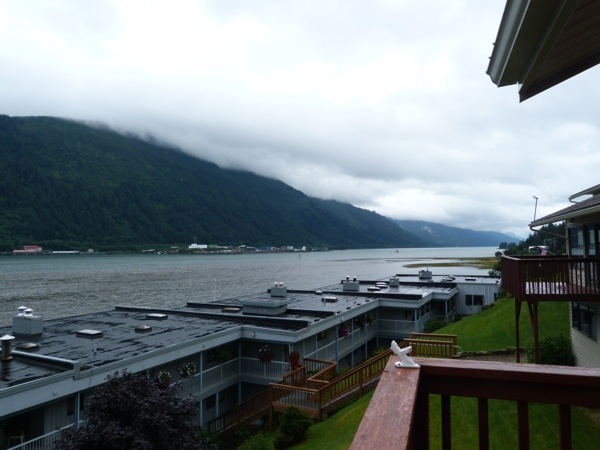
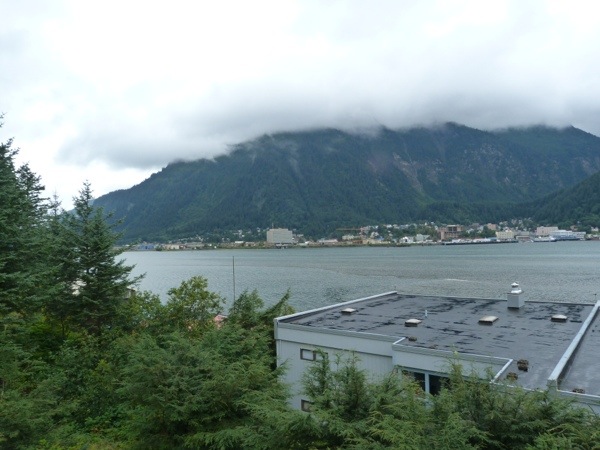
We planned to meet up for coffee, and when we did, she was just like the old days, only older. I laughed and told her I am now older than when I knew her before. She laughed at AdventureMan’s jokes, and she had a beautiful living place near where my family used to live, with a view to die for. It reminded me of Kuwait. I could lose hours looking out her window, if I lived there. Eagles flying by, cruise ships coming in and out, the weather changing on the mountain across the way – it was a magnificent location, and it was all made even better by good coffee, good conversation and a great deal of love based on old relationships.
But we needed to go! We had things we needed to see!
This is the view from our friend’s house in West Juneau:

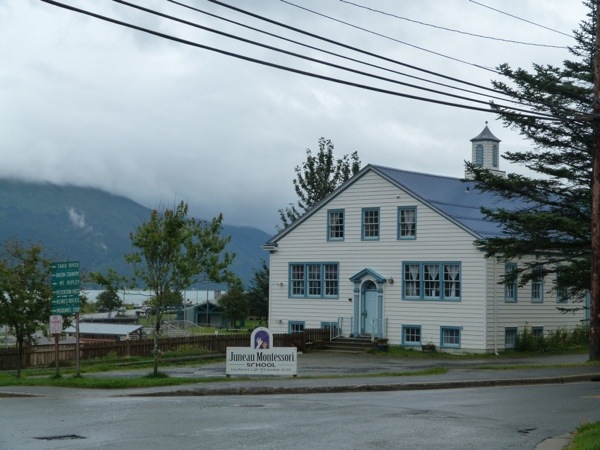
My old school:
Alaskan Indian art, painted over a garage door:

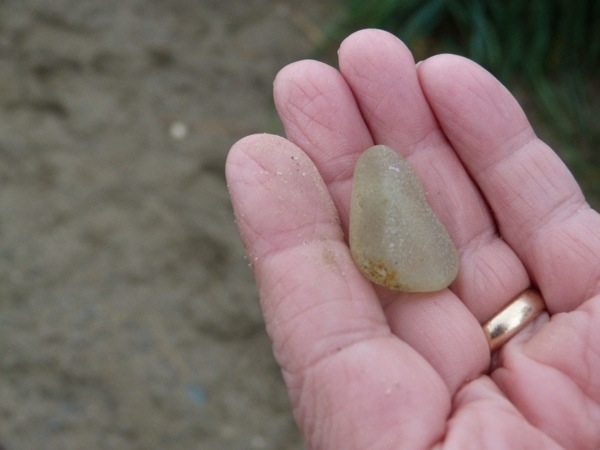
The beach we used to go to, called Sandy Beach. Occasionally a dead walrus would wash up there, causing no end of excitement to us young people.

AdventureMan found a piece of the sea glass I love:
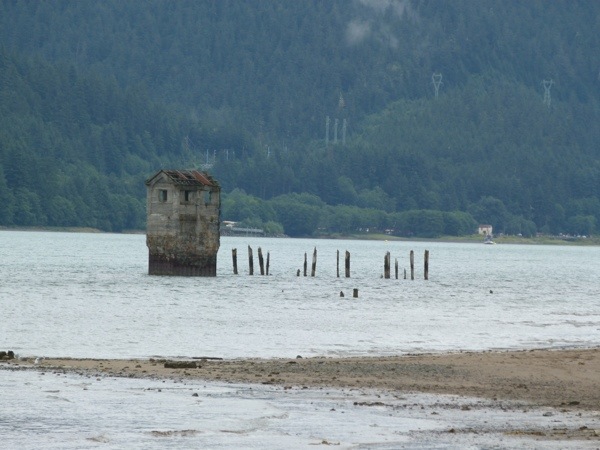

I thought this school above was a lot bigger than this . . . . I remember it being a lot bigger . . . LOL!
This is our old house, many many years ago. It used to have a much bigger front yard, before they widened the road. It also seemed farther from the little grocery store near the bridge that my Mom would send me to, but it’s gotten shorter!

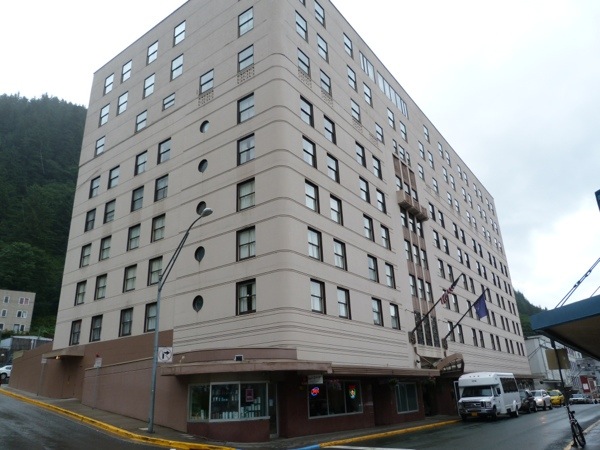
This is the Baranof Hotel, where my parents met. It used to be a very grand hotel, but it is now a Westmark hotel, and while it pretends to still be grand, it is shopworn and tired, and needs a major overhaul to be back in the game. We ate lunch there – to honor my parents meeting – and it was also a very mediocre meal. The very chipper waitress, Holly, tried to make it nice, but the Capitol restaurant needs better lighting and brighter colors. It was very, very dark.



Some public art. Later as we passed the same location we heard guys call out “The police are coming!” and saw them approach three men who looked like maybe they were drinking or drugging.

AdventureMan is so patient with me. When I spotted a quilt shop, he said he was going down the street and to call him when I was finished. 🙂

The best part of the day was picking up our friend for dinner, and hearing her stories. We loved hearing about Juneau in the old days, and hearing her laugh.
ARCO Gas Station: Something Doesn’t Feel Right

Just before leaving Seattle for the airport, I filled my gas tank. I went to an ARCO station, opened my tank lid and went to swipe my card when I saw a sign saying everyone must pay inside.
Annoying. It’s so convenient when you can just swipe your card at the point of service. I go inside and the Ethiopian woman at the counter asks me how many gallons I want.
I said “I need to fill the tank; I don’t know how many gallons. Swipe my card and then I will come in and sign the charge receipt when we know how much it is.”
She said that’s not how it works, they need to charge me and then they will give me back change. My bad. At that point I should have walked. I should have gone to the next gas station. I didn’t.
So I guessed 15 gallons, and she charged me $60. My car didn’t even take nine gallons. When I went inside, she gave me back $26.81 in cash, not refunded to my credit card. That is just such a strange way to do business.
It bothered me. What bothered me more was that when I got home and looked at my receipt, I had been charged $61.00. It’s only a dollar more, but the cost of my gas ($33.19) and my change back (26.81) add up to $60. Why was I charged $61?
Here is my dirty suspicion – she thought for $1. no one will bother complaining. If you read my previous entry, you can see why – my life is busy in its own way, but other people’s lives are busy in their ways. Who is going to made a big deal over $1.00 overcharge?
I don’t have time to deal with it right now and I will hold on to the receipts to see if I want to spend my precious time later trying to make it right. Or will I just figure my time is more precious than arguing over $1. in which case the scam works every time?
If this was a $1. charge for something, I don’t see it anywhere on the receipts. Do you? Why would they charge me for the inconvenience of buying gas in such a convoluted way?
I will NEVER go to that gas station again.
Second thought: Maybe I should just think of it as a charitable contribution?
Some Peeks in Edmonds, Washington
You would love Edmonds, Washington.
It is a picturesque village. Along Main Street, and Fifth Avenue there are corner gardens, maintained by the city. This year, they are planted primarily with white flowers, big, fluffy flowers which make all the other flowers POP! with color. Overhead, from the lamp posts, are huge hanging baskets, full of a variety of plants, mostly purples, blues and fuchsias. The overall effect is stunning.
On our way to her manicure-pedicure, I drove Mom around looking at the sights. Down at the Edmonds Beach, I was shocked to see an eagle, perched on a piling. The shot isn’t very good, I jumped out of the car in a hurry and snapped, not taking enough time, but I was so surprised – I had never seen an eagle there before.

After lunch, as we headed out, we saw people touching up one of the murals Edmonds has painted on the sides of buildings there:

Here is another one, nearby:

I love it that this sweet little town, with its ferry coming faithfully in and out, preserves its identity and character in the face of changing times.
Police Know Where We Are and Where We Go
This is not good news for people who don’t want other people knowing where they have been. I don’t see how it’s any different from cameras in big cities that are used by the police to see what cars went through at a time of a crime, for example. If you don’t have anything to hide, is this invasive? Where property crimes are increasing, where there is an increase in violent crime or assaults, these re tools to keep the majority of the population safer from the predators – in my opinion. Can you change my mind?

From AOL Auto News:
Police License Plate Scanners Record Driver’s Locations
Unregulated cameras store information indefinitely
Government surveillance isn’t just in our phone records and search engine history, but on our roads as well.
That’s what the Center For Investigative Reporting found when researching the small cameras popping up on police cars across the country known as license plate scanners. License plate scanners allow police officers to quickly scan thousands of license plates a day, looking for runaway criminals or stolen cars. In California there are very few limits on these readers and almost no transparency. These cameras record time and place of your vehicle, and even can store a picture record of your whereabouts.
Michael Katz-Lacabe, a security consultant, requested the records from the San Leandro, Calif., police department of every time his car was scanned. He was amazed at the frightening amount of information police had recorded. His two cars were scanned 112 times since 2009, and average of about twice a week. There was even a picture of him and his two daughters getting out of his Toyota Prius in their driveway.
The Center For Investigative Reporting points out that the use of license plate scanners has been growing quickly and quietly across the country. Read their fascinating story here to learn more.
“So There We Were, Two Naked Guys in the Shower and . . . . “
LOL, no, no, this is not going where you think it might go, but it got my attention, too!
AdventureMan was in the locker room with one of his exercise/aerobics buddies, cooling down from his water aerobics class when this story started, and was sharing the story with me later, at lunch, as we exchangin details of our mornings.
“. . . And he asked ‘do you know what today is?’ and I said ‘Yes! It’s the 63th anniversary of the beginning of the Korean War,” AdventureMan responded.
Guy talk. Guys discuss their combat experience in different wars. Combat is so intense, it imprints memories the way childbirth does in women, or a huge traumatic event, like the Iraqi invasion of Kuwait, or 9-11, or the Kennedy assassination, or the Tsunamis that hit Japan and washed entirely over the Maldives – experiences when the earth beneath your feet shifts, and things you once took for granted are shaken forever.
Who said guys don’t connect? AdventureMan has another old friend he needs to get in touch with today, to tell him he is thinking of him; Korean War veterans are largely forgotten in the tallying of combat in our country.
Pensacola is a wonderful place to be a military veteran. There is a Veteran’s hospital, and veteran-friendly policies at the clinics, commissaries and BX/PXx. Today we had lunch at Mellow Mushroom, where every Tuesday they give 20% off to all active duty and retired servicemen and women. Home Depot and Lowe’s give 10% off on every purchase, even plumbers, electricians, contractors, banks, theaters and many stores often give military discounts. And they thank us for our service. :0
To those of you who served in the Korean conflict: Thank you for your service.
Gulf Power and Customer Energy Use Monitoring
I love this! Yes, I am a nerd, yes, I get excited about geeky things, but after my first year in Pensacola, paying electrical bills in the $400’s because I like to be cool, I have learned a few tricks about spending less, like turning the a/c up when leaving the house, it really makes a difference.
And now, we monitor our energy use on a DAILY basis. I love it! When you log into your Gulf Power account, you can see your energy usage calculated against the daily temperatures, with a range of your estimated end-of-month bill. No more bad surprises!
I think I inherited a small bit of my father’s engineer mentality; I love being able to manage my energy use 🙂

Thank you, Gulf Power, for making it possible.
What Are Kuwait Traffic Laws?
You all know me – I am a law and order kind of gal. I like order, I like laws, especially those voted on by the people. I like laws which can be enforced, and are enforced, equally, for all people equally in the country. Oh? I did? I said EQUALLY twice?
We are all equal before the law.
Now here is the tricky part. Have you ever seen a listing of traffic laws in Kuwait? Can you find a listing of laws, violations, and their charges? When we apply for driver’s licenses in almost any country, we get a little booklet to memorize, with the laws written inside it. The laws are clear. Clear laws are enforceable.
I’ve looked at the MOI website. I see something that looks like it might be a traffic code in Arabic. I have looked everywhere; I cannot find one in English. I find no reference to any handbooks for people applying for their driver’s license.
How can you enforce a law if the law is not published? Is there a code somewhere listing violations and fines? I published one many years ago, something that all the expats were sending around as ‘the new Kuwait traffic rules’ but IF it was, there was never anything in the paper about it to confirm its validity.

If you are going to have a major campaign to enforce traffic codes, you might want to publish the laws . . . in all major languages use today in Kuwait.
From the Kuwait Times:
Ali vows to rid traffic ‘disease’
Interior Ministry Assistant Undersecretary Maj Gen Abdulfattah Al-Ali
KUWAIT: Interior Ministry Assistant Undersecretary Maj Gen Abdulfattah Al-Ali stressed that all traffic violation-related deportations are in accordance with the law. Speaking at a press conference at the Kuwait Journalists Association (KJA) headquarters, Ali said that deporting people for traffic violations was also adopted by the US and other countries worldwide. “The problem is that we were very tolerant with violators and this does not mean that law violation is a right for motorists,” he underlined, urging all human rights organizations who have criticized Kuwait’s traffic police to examine human rights in their respective countries before talking about Kuwait.
“We have filed over 70,000 traffic citations including 43,000 serious ones such as running red lights, driving under the influence of alcohol, driving on the wrong side and many others,” he elaborated, pointing out that those already deported did not want to respect the traffic laws they had repeatedly violated. Ali added that the results of studies of traffic problems revealed many and that once one problem was solved, another emerged immediately.
“We have various problems… including the fact that motorists speak many languages and dialects which requires a large number of specialists to develop their traffic awareness,” he explained, noting that the traffic remedy strategy started by diagnosing the “disease” by studying random “specimens” at different times of the day at places with heavy traffic flows such as Jleeb Al-Shuyoukh, Shuwaikh Industrial Area, Amman Street, Bnaid Al-Gar, Khaitan, Farwaniya and Fahaheel.
“The specimens showed some major problems such as domestic drivers using private vehicles as taxis, taxi and large vehicle drivers who do not hold general driver’s licenses and people driving without licenses at all,” he said, adding that this called for strict law enforcement.
“Traffic in Kuwait is like an old sick man who once treated for one aliment develops another,” he noted, adding that 18 traffic inspection teams dressed in civilian clothes had been formed and deployed in various places. “Fortunately, traffic police only file 100 daily citations in Jleeb compared to 1,000-1,500 in the past”, he concluded.
The Secret Lives of Baba Segi’s Wives by Lola Shoneyin

I don’t know what it is about summer reading, but now and then I go on a theme-fest; a couple years ago it was Nigerian literature, and, once hooked . . . when my friend who is now living in Lagos recommended The Secret Lives of Baba Segi’s Wives, I ordered it right away, thinking from the title it would be maybe light and sweet and humorous.
From the start, that assumption was blown. This is a direct and edgy Nigeria, darker, rougher and full of family secrets, domestic details and messy relationships.
It is a very Nigerian book – this is a good thing. There are cultural things that are not explained, but it all ends up making sense in the end. There are foods I have never heard of – ekuro with shrimp sauce, asun. There is a rudeness in the way they speak to one another, (“Is this a parking lot?” “Do I look like a parking attendant?”), a crudeness in the constant need to carry small bills for bribes, even on public streets. People speak their minds, with little or no mitigation, depending on the status of the person and their own personal goals and agendas.
At the weekly meeting of wives, the senior wife, Iya Segi, doles out rations of household supplies to the other wives, including chocolate powder and hair conditioner . . . and as the senior wives complain about the new wife thrown in their midst, she says:
“You will trip over in your hate if you are not careful, woman. Your mouth discharges words like diarrhea. Let Bolanle draw on every skill she learned in her university! Let her employ every sparkle of youth! Let her use her fist-full breasts. Listen to me, this is not a world she knows. When she doesn’t find what she came looking for, she will go back to wherever she came from.”
There is a whole other world in that one paragraph – a whole other way of seeing life and expressing thoughts. The culture may be alien, but I thoroughly enjoyed being a tiny mouse in the corner at that meeting – and others – and inside the minds of the wives, of Baba Segi, of the driver – so many good stories, so many points of view, and I learned things from behind those high compound walls and closed and locked doors that I might never otherwise have learned. Alien as it was, for me, this was a very good book, new ways of looking at things, and a great recommendation from my friend in Lagos.
One in Five Qataris Needs Mental Health Assistance
A Qatar Mental Health survey shows 1 in 5 Qataris suffering from a mental ailment, commonly depression or schizophrenia, with fewer than 1 in 4 of those afflicted receiving treatment, due to fears of social stigma . . . from the Gulf Times, Qatar.
By Noimot Olayiwola/Staff Reporter
A Mental Health Strategy, which is awaiting the endorsement of the Supreme Council of Health’s executive committee, is expected to be completed this year.
It is being envisaged that the Mental Health Strategy will lead to a reduction in the incidence and severity of mental illness in Qatar, besides increasing the proportion of people with emerging or established mental illness who are able to access the right care at the right time, with a focus on early intervention.
The strategy will also provide the opportunity to increase the ability of people with mental illness to participate in education, employment and training, enhance public education and awareness and thereby reduce the stigma associated with mental ailment, reduce the prevalence of risk factors that contribute to the onset of mental illness and prevent longer-term recovery, and establish Qatar as a centre of academic excellence in mental health research and education.
Speaking on the strategy at an event held recently, Hamad Medical Corporation’s (HMC) General Adult Psychiatry senior consultant and Weill Cornell Medical College in Qatar assistant professor Dr Suhaila Ghuloum said the mental health initiative contributes to the Human Development pillar of Qatar National Vision 2030, which recognises that a healthy mind is as important as a healthy body.
She said a study has shown that around 20% of the country’s population suffers from a form of mental disorder and less than 25% of the people with mental ailments actually receive the care that they need.
Stating that the actual prevalence rate of mental health ailments would soon be published, Dr Ghuloum added that around 20% and 18% of the population also suffered from depression and anxiety disorder, respectively.
The Psychiatry Department is the only facility providing primary, secondary and tertiary care for people with mental illness in Qatar. “We conducted the study on adult patients visiting the primary healthcare centres and found that one in five people here will experience a mental disorder with conditions such as schizophrenia and depression on top of the list,” she said.
According to her, schizophrenia, depression and substance abuse are three of the top five causes of disabilities in Qatar. “A condition like schizophrenia can prevent a child from attending school,” she said.
Dr Ghuloum said social stigma, which is a combination of ignorance and discrimination, is the biggest challenge facing people with mental illness in Qatar.
“Through interaction with some of our patients, we realised that many had delayed getting medical help due to fear of stigma and the negative attitudes of some of the patients themselves, their family members as well as physicians,” she noted.
The official called for comprehensive care for people with mental illness, saying the Psychiatry Department has already started a system that is all encompassing and comprehensive – through primary care – besides providing treatment for some patients on an in-patient basis, who are co-located in general hospitals, as well as community-based services being offered to those in need of long-term care.
“The transformation of Qatar’s mental health services focuses on early intervention and recovery, and will give people a range of options on how to access mental healthcare tailored to their needs. Whether it is in a primary care, community-based or a hospital setting, people with mental health issues will have access to the right care, at the right time and in the right place,” she asserted.
Recent Comments
ExpatAlien on What Country am I Living … intlxpatr on Yellowstone: Old Faithful to C… Michelle on Yellowstone: Old Faithful to C… Cathy on No Grown-Ups in Charge intlxpatr on Waiting for Snow Wikipedia Donate Button

Amazina


Early Voting in Florida


 Here There and Everywhere