Week of Celebrations For Qatar’s National Day
Wouldn’t you think these celebrations would want lots and lots of observers, helping celebrate? So . . . where and when is the camel dressage? (I really, REALLY want to see that!) Which day is the parade? When are the fireworks?
Announcements like this are tantalizing, and hard information often difficult to come by.
Gala planned for National Day
Web posted at: 12/7/2009 1:27:32
Source ::: The Peninsula
BY HUDA N V
DOHA: Qatar is set to celebrate National Day, which falls on December 18, on a grand scale this time. A series of exhilarating programmes have been lined up for the week-long celebrations starting six days ahead of the landmark date.
Beginning from December 12, various competitions, symposiums, parades and other events meant for family and children would mark the celebrations. The first day would witness two traditional Qatari sporting events — the Masseela Horse Race and Pure bred Arabian Camel Race.
Highlighting the country’s penchant for Arab horse racing and camel dressage, the National Day Masseela Horse Race will take place at the Darb-a-Saai Camp in Rawda Umm Rouman (Al Rayyan).
The horse race will be organised in the traditional Qatari way, whereby pairs of riders will challenge each other in a test of courage with the winning rider advancing to the next round.
The Masseela Horse Race, featuring both Arabian horses and Qatari riders dressed in the traditional attire of the ancestors is an apt way to introduce the young generation to the traditions of their ancestors.
Arabian camels from Qatar’s leading stables will compete in two contests — camel dressage and ‘Best Behaved Camel’. In the dressage, a camel has to complete a routine within a specific time and it is to be judged on the way it has been dressed up.
The ‘Best Behaved Camel’ competition will judge a camel on its ability to overcome obstacles and distractions such as water and food. Other events include a poetry competition for Qatari men and women focusing on their recitation skills. Various Qatari tribes will also showcase the traditional sword dance — Ardha — accompanied by music composition using traditional musical instruments. A symposium will also be held on the occasion.
Al Dawha satellite Channel, which was launched during the National Day in 2008, will be on air again this time with documentaries highlighting the progress, history and culture of the nation. On day, the Corniche will witness a huge military parade and a colourful rally. The 5km stretch of will be bejewelled in light. The grand finale of the week-long celebrations would be marked by a spectacular pyrotechnic.
Qatar University will also celebrate the occasion. Over 500 students have signed up for various activities to be held on December 16. A huge parade showcasing the history of Qatar, the visions of various rulers right from the first to Qatar Vision 2030, some of the greatest events in Qatar such as the Asian Games and the Qatar’s World Cup bid 2022 will also take place.
The Carrefour Majlis
Hubby and I were at a mall which is one of the Qatar see-and-be-seen places tonight, not to see nor to be seen, but looking for a special end table. As it turns out, we can probably get it, but not until January. No problem.
AdventureMan wanted to pick up some teas for his office and I needed skim milk so we headed for the Carrefour before leaving.
“Oh! How totally cool!” I said to AdventureMan, “Look! They have provided a tent majlis for guys waiting for their wives to grocery shop!” (A majlis, sometimes called diwaniyya, is a place where people gather – usually men, but not always, sometimes women also gather in a majlis but usually separately from men)
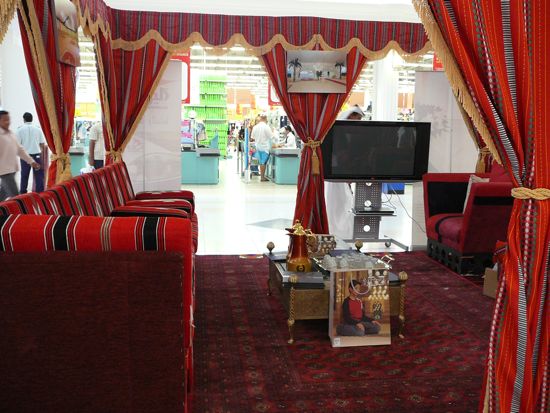
“I think that is one of the Islamic Center places,” AdventureMan said.
On our way out of Carrefour with our purchases, the majlis was packed, and everyone was drinking Arabic coffee in graceful little cups, even one western couple. It is a lovely, hospitable oasis, full of soft surfaces in a hard surface mall.
Debate on Media Freedom in Doha, Qatar
From today’s Gulf Times:
Debate on Qatari press law
The Doha Centre for Media Freedom (DCMF) will hold a roundtable discussion on the Qatari press law that dates back to 1979, on Wednesday, at The Ritz-Carlton Doha, an official said yesterday.
According to the official, under the discussion will be the need for a Qatari media, and the view concerning modification and changes to the accrual Press Law, in order for it to match the requirements of the current era.
Discussions will be moderated by DCMF deputy director general Maryam al-Khater, while senior media officials of the country, editor-in-chiefs, senior journalists, heads of media organisations and others are expected to be in attendance.
After an introductory presentation of the most-recent study prepared by DCMF on the Press Law, comprising recommendations, suggestions, and analyses, the floor will be opened to what is expected to be a “vigorous debate”, the official said.
“The DCMF calls on all media specialists to exercise their right of expression by participating in this gathering and sharing their thoughts about the possibility of amending the negative provisions of the law for journalists’ rights as well as adding provisions which respond to their ambitions,” the official added.
The event coincides with the National Day for Human Rights, which falls on November 11 every year.
There was an earlier report, on June 24th, that most of the original members of the DCMF had resigned:
Media Freedom Centre team leaves office
DOHA: Robert Ménard, director- general of the Doha Centre for Media Freedom and his team have left the Centre.
“We no longer have either the freedom or the resources to do our work,” said Menard, in a statement issued yesterday.
The heads of the assistance, research and communications departments have also left the Centre, said the statement.
The Center was set up on the initiative of H H Sheikha Mozah bint Nasser Al Missned and Reporters Without Borders in December 2007.
Ménard, who became director-general on April 1, 2008, was the founder of Reporters Without Borders, which he headed for 23 years.
I imagine this is going to be a very interesting “vigorous” debate, of interest to all those who write – or blog – on Qatar. One of the things I notice in both Kuwait and Qatar is that in the interest of self-preservation, the newspapers self-censor. For example, when a crime is committed, if it is an Asian, or even, rarely, a westerner, the name of the criminal can be printed. If it is a local citizen, they do not print the names, not ever, unless it is a rare case where the defendant is convicted and appeals – on rare occasions, the name will appear then. In order to spare the family the embarrassment, I have been told, but I would think that the fear of embarrassing the family would have a strong deterrent effect on young men, for example, who think it is OK to abduct, rape and humiliate young men and women, without fear of having their crime made public.
In Kuwait, they publish the crimes committed, at least. In Qatar, you would think from reading the papers, that these crimes don’t exist. They do. They aren’t reported.
I think it is very cool that in Qatar, many of these issues are opened for public debate, as in this media debate, and in the ongoing Doha Debate series.
Changes in Qatar Rent Laws
From today’s Gulf Times Qatar
New rent law seen a victory for tenants
By Sarmad Qazi
In a major victory for tenants, rent disputes can now be taken up with the Rental Dispute Resolving Committee (RDRC) regardless of whether the contract was registered or not, a senior official said yesterday.
This follows amendments in the rental law.
Law number 20 of 2009 sees changes to some provisions of the previous law number 4 of 2008 issued by HH the Emir Sheikh Hamad bin Khalifa al-Thani on October 25, the official said adding it further protected the rights of tenants in Qatar.
“There are two things in the new rule: you can come here, whether or not your contract is registered and speak to a judge, and secondly the landlord must now give at least six months notice of eviction,” the official said.
The law number 4 of 2008 was aimed at regulating the market by making registration of rental contracts mandatory and by establishing the RDRC with its own jurisdiction to take up grievances at a time of near-record inflation in the country.
“But we know the law missed out on rental contracts made prior to the 2008 law or based on goodwill and word only. In these cases we weren’t able to address any complaint,” the official at the RDRC’s headquarters in Muntazah (now Rawdat al-Khail) said.
“This amendment changes all that,” he added.
However, according to him, with the rents showing declining trends, the number of disputes is also falling; currently only 15 new cases are being filed at the RDRC every day.
The nature of cases varies from landlords wanting to hike the rent despite a two-year freeze since 2008, to non-payment claims and eviction notices.
A year ago the RDRC was registering 1,500 cases a month.
The official also dismissed questions about the effectiveness of RDRC saying so far this year its five committees have addressed and closed 1,205 cases. Only “600 or so are ongoing,” he said.
The committees have three members and one judge each.
“Yes it is true that 50% of RDRC decisions are later challenged in the appeal court (in Dafna), but 90% of the time the judge there upholds the rulings,” the official said.
Veteran lawyer Ala’a Hamad, a partner at the Arab Law Forum, yesterday said every new law requires takes time to prove its effectiveness.
“This was a new law and the more it’s practiced, it will prove its effectiveness.
“The tweaking is an ongoing process just as with foreign investment and other laws,” Hamad said.
Back in Traffic; How Do You Alphabetize / File?
So today I became, once again, a legal driver in Qatar, five months to the day from my arrival. Yep, for those of you who never have the joy of trying to maneuver through the complexity of getting a license in a foreign country – you have NO idea. NO idea. There are people who try and try to get a license and never do.
We are really lucky. We have some very good people who help us get things done. Somehow, it’s my turn to be lucky today.
When I showed up at the office, however, one of the HR girls told me “Oh! Flana is not here today! You will have to come back.”
You all know how nice I am. I smiled at her and said “my husband told me to be here today to get my driver’s license. Someone is going to help me.” Smile again, big smile.
Sure enough, someone is going to help me, and it is someone who I like, someone who has helped me before and who is always calm and patient and knows how to persist pleasantly until he gets what he wants from the bureaucrats. In fact, I admire him, because people end up liking to help him. He is low key. He takes me to the driver’s station, where, because of my advanced age (DO NOT ASK) I have to have an eye test. This leads me to wonder. Doesn’t everyone have to have an eye test?
Then I wait, in the special ladies’ majlis:
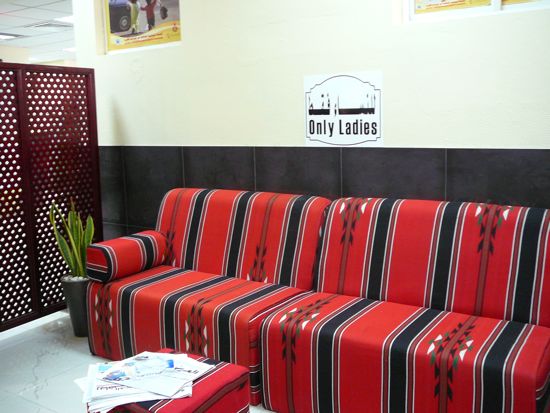
I had to wait quite a long time, but I was comfortable, and while I was waiting, I read all the driving safety signs they had up along the ceiling. They were all in English and Arabic, and they were great thoughts, but too many words. Like if you are reading that many words: If you are driving too fast you may not get home alive (that is not a real one, but that was the gist of most of them) so I was creating a new driving safety campaign called the equal campaign:
Speed + Texting = (shows a vehicle turned on its side and all smashed
Speed + Weaving = Two or three crunched vehicles
Texting + Driving = QR (enormous fine)
Something simple to read, graphically simple, something you can glance at and get the meaning.
When I got my driver’s license, I was really happy, except for one tiny little thing – it’s kind of my name but not exactly my name. It’s an easy mistake to make, names can be complicated, but . . . it isn’t my name on my license. It’s my face, it’s my information – it isn’t my name. For half a heartbeat, I consider saying something and then Wisdom kicks in and I zip my lip.
So then, driving home in traffic, I got to thinking about names and how we file things, alphabetically, and even Europeans sometimes file us wrong, which has led us to first class seats because airlines can’t find us, etc. It isn’t always such a bad thing.
Then I started wondering about how Arab speaking people file. Like do you have half the files in the “A” drawer, like Al So-and-So and Al Somebody Else, and how do the sun and moon words affect the filing, like Ar Rayyan, or Ath Thalaka, or As Shams, etc. Once you have filed someone, the goal is to be able to retrieve that information? How does alphabetization work in Arabic? How are things filed?
So being stuck in traffic might not be so bad if someone answers my question and I learn something. 🙂
Health Services Providers Closed in Doha
Also from today’s Gulf Times . . . . It would be nice if we knew what those institutions were, so we could avoid them in the future, and what the specific complaints were.
For example, it doesn’t bother me for men and women to be in the same waiting room, like when my husband was really sick and needed a procedure done, he really needed me by his side. It would have been agony to have to wait in separate rooms, and, in fact, I have never seen separate waiting rooms in the modern Doha facilities I have visited, except for the hospital where they process all the people trying to obtain residence visas.
But I really want to know who is carrying expired or adulterated medications in their pharmacies, and who is using unauthorized or unqualified medical personnel! Please! In the interest of public safety, name the names.
22 health institutions shut for flouting rules
The Medical Licensing department at the Supreme Council of Health closed down a total of 22 health institutions, which did not comply with the health standards and rules, between November 2008 and September 2009, the department’s report states.
According to the report, which was the first published by the department, the health institutions include private clinics, medical centres, herbs selling outlets, dental clinics and eye-glasses shops.
They were found violating the standards during surprise visits by medical licensing inspectors.
Among the violations listed against the institutions were employment of unlicensed general practitioners and persons banned from practising or blacklisted, shortage of medical staff, selling of drugs that contain internationally banned substances or drugs not registered with the government pharmacy department and improper collation of patients’ data.
While some centres were found operating without proper licences, some were said to be in possession of expired drugs.
The report added that a number of them failed to separate men and women in waiting rooms and that they lack proper hygiene.
NO PARKING!
On my way home, driving along the wall of our compound where they recently installed bright shiny new NO PARKING signs – not one or two, but like twenty; one every thirty feet – there are a whole brigade of big huge trucks, you know, the kind that accompany beginning construction? I am not even sure I can get through, there are so many, like six or seven or eight (it is a small street).
But one of the trucks is orange, and I am hoping hoping hoping, so I grab my camera out of my bag as I inch by, and yes! yes! he has parked right next to one of the signs. I take my shot and keep inching by, and just beyond the last truck on the left is a gaggle of truck drivers, I guess they are trying to figure out what to do about something.
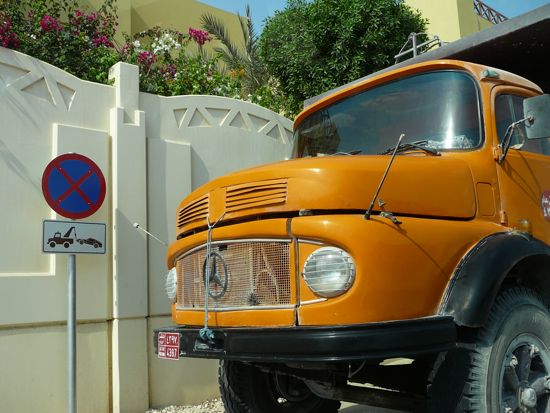
When I get to our gate, I tell them, “there are many trucks parked by the compound wall” (here I point in the direction) “can’t you see them on the security cameras??” and the gate guy says there is a man fixing the camera input right now, but did I get the truck number?
(Did I get the truck number I am thinking??? GO DO YOUR JOB! YOUR JOB IS SECURITY! GO TELL THEM NOT TO PARK THERE!)
I smiled and said “you need to tell them to move their trucks, and not to park right by the compound wall, it is a security risk.” I am a nice lady, yes I am, and so I say this nicely, with a smile, but there is a hint of steel in my voice.
He says “we have people working out there! They will tell them!”
The people out there working are the gardening crew.
I said “No. Your people are about 400 feet away from the trucks, and they are gardeners. They are not going to tell Pakistani truck drivers to move their big trucks.” (The smile is still there, but there is a hardness in my eyes.)
He doesn’t want to go. “Did you get his number?” he asks again. “I say no,” but then I pull out my camera and show him the photo. His eyes widen. The security man comes, and the gate guard shows him and his eyes widen. He assures me they will call the Bolice immediately.
Did they? I don’t know. Honestly, you do what you can. Sometimes it is like knocking your head against a wall, it just feels so good when you stop.
More Jewels from the Doha Museum of Islamic Art
More guests, and another trip to the Doha Museum of Islamic Art. I never tire of the place. Most of all, when I walk in, I just take a deep breath, breathe in the serenity.

It doesn’t hurt that there is also a wonderful, clean ladies room.
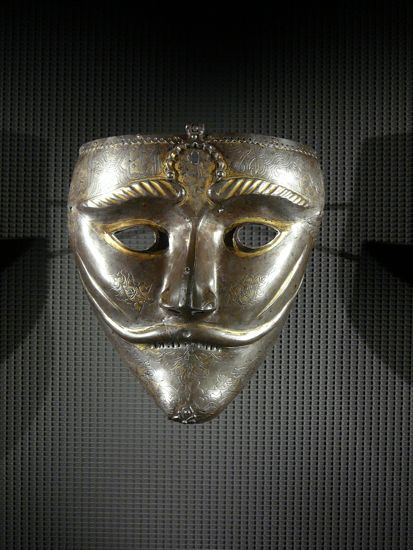
Every time we are there, we see something new and wonderful, something that was there, but we hadn’t noticed before. Here are some things I saw this time:


Mexican Rouladen, Recipe and Photos
I had my menu all set, and then, when I went to the butcher, he said “No madam, we never do this. You will not find this in all of Doha.
If I had the time, I would go to “all of Doha” and prove him wrong. And oh-by-the-way, what is wrong with saying “we can do this for you and have it ready for you tomorrow morning at 0900?” something like that?? No, just “you will never see this in Doha.”
So I can spend my time grinding my teeth in anger, or running all over Doha to see if I can find what I need (flank steak) or . . . I can see what is available and do what I can with what is available. Fortunately, I see a familiar cut of meat, and I can work with it.
When I get around a group of people, I can’t concentrate. I am so focused on the conversation and the people, that if I have houseguests, for example, which I did this weekend, I can’t talk and get dinner on the table at the same time (even with help!)
My solution is to do everything possible ahead of time, and make lists, including what dishes I plan to use for serving, what times this needs to happen, and then that, and sequences. That way, the fact that my thinking process goes on hold means I am not facing total disaster.
I needed to have a lot of variety, so that if someone didn’t like something, there would be something else they might like.
I took an old faithful recipe, Rouladen, and reworked it for a Mexican theme dinner. The secret to successful rouladen is long, slow pre-cooking. It can be entirely cooked the day before and then re-warmed to serve when you need it. It takes what might be a tough cut of beef and renders it fork-friendly. You don’t even need a knife; it cuts easily with a fork and melts in your mouth.

You pound the meat, especially on the edges, to flatten it and to tenderize it.

You have the filler ingredients ready to go:

Actually, I forgot to put the jalepenos inside, so I chopped up a few very finely and added them to the sauce – it turned out to be just the right thing. I like to start with just a teaspoon of Pesto, just to give it a little pop, and some already-cooked and crumbled bacon (this is turkey bacon, but any bacon will do.)
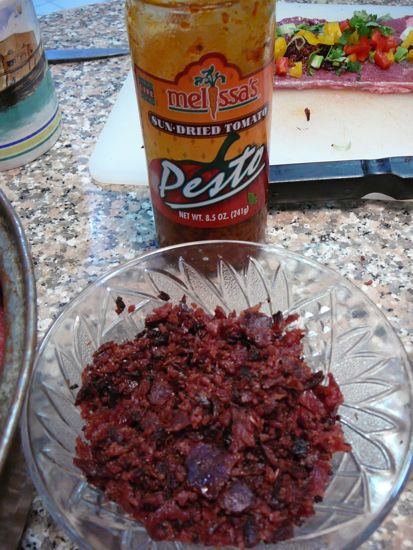
You sprinkle the other ingredients lightly over the length of the roll, leaving about an inch all around for rolling and folding:

When they are rolled, you put them closely together in a pot:

This is key – you make up an acidic sauce – tomatoes, for example, are acidic. I use tomato paste, and tomatoes, and then you can add broth, or wine, or lemon juice – something to make it more liquid. You also add spices, in this case, chili and cumin for the Mexican flavor, plus, as I mentioned above, some very finely chopped jalepenos.
Then, you pop it into a slow oven – 350°F/180°C – and slow cook it three or four hours. That’s why you want it very liquid-y, so that the sauce won’t disappear during the long cooking, it will concentrate. Yummm!
No, I don’t have any photos of the finished dish. I was pretty busy. 🙂 The roulades shrink, and brown over the top, but remain fork-tender for eating when you heat them up (30 minutes at 350°F/180°C, until hot!)

This is what one roulade on a plate looks like. They are much prettier when a bunch are all cooked up in the pan together, and I serve them right out of one of my Damascus copper cooking pots:

The Help by Kathryn Stockett

In my book club last year, one of the themes that continued to arise as we read books from many cultures was how we are perceived by the people we hire to help us in our homes. In The White Tiger, a Man Booker Award Winner, the main character lucks into a job working for a family as a driver. We see the people for whom he works from the inside, their sweet acts and all their flaws. We see how callous they can be, and, ultimately, how the driver takes his revenge and becomes his own boss. (Not one of my favorite books, but then again, I’m still thinking about it a year later, so there is something to be said for it.)
In Half of a Yellow Sun we saw an entirely different relationship (in a book I totally loved, BTW) between employer and employee, but it shared with White Tiger the aspect of employer as seen from the eyes of an employee inside the house who sees the family and all its interactions intimately.
The Help, a surprise best seller, does the same to 1960’s era Mississippi. A recent graduate from Ole Miss (University of Mississippi) starts interviewing the maids from local households, any maid that will talk to her. At first, no one will talk with her, but after traumatizing racial clashes, one by one, they share their stories. Just interviewing the maids, just the maids sharing their stories, is enough to bring on serious consequences.
First, the book is riveting. I have a million things I really REALLY need to be doing, and I can’t stop reading. There is something about peeking into your neighbors house, seeing how they behave when they think no one is looking, that appeals to the voyeur in each of us.
Second, these women are taking serious risks. I am on the edge of my chair with each reading, hoping nothing bad happens to them.
Third, there is something that makes you squirm, it is the old “wee giftie” that shows us the worst in ourselves as others might see us; our own hypocrisies, our condescensions, our patronizing acts, how cruel our charitable acts can appear through the eyes of others, and how callous we are in the end towards those who take care of us every day.
It has rocketed onto the best seller list, now the #6 best selling book on Amazon.
If your book club is looking for a book to read that will get you talking and keep you talking for a long time, this is one of the best.
If you have hired help in the house, I double-dog-dare-you to read this book. (OOps, sometimes the little Alaska girl in me pops back out!) Fair warning, though, once you start, you won’t want to put it down.
Recent Comments
ExpatAlien on What Country am I Living … intlxpatr on Yellowstone: Old Faithful to C… Michelle on Yellowstone: Old Faithful to C… Cathy on No Grown-Ups in Charge intlxpatr on Waiting for Snow Wikipedia Donate Button

Amazina


Early Voting in Florida


 Here There and Everywhere