Lord of Death by Eliot Pattison
I didn’t know that much about the Chinese obliteration of Tibetan culture in Tibet. I didn’t know about the systematic destruction of the monasteries, or at least not in detail. I didn’t know about the brutal re-education techniques for the Bhuddist monks. I didn’t know how strong and resistant the peoples of Tibet are to the Chinese incursion.
I’ve learned most of what I know reading Eliot Pattison’s series featuring Shan Tao Yun, a Chinese detective. Or he used to be. In the first book, The Skull Mantra, we meet Inspecter Shan Tao Yun in one of those re-education camps, where he has been tortured and mistreated almost to his physical limits, and the Bhuddist monks teach him new ways of thinking, and those ways help him to see things differently – and to survive.
The Tibetans hate the Chinese, but they make an exception for Inspector Shan Tao Yun, who earns the respect of both Tibetans and Chinese for his unwavering integrity, and his ability to solve the most intricate puzzles. As he does, we learn more about different aspects of life today in Tibet.
The Lord of Death introduces us to the evolving mountain climbing industry developing in Tibet, just across the border with Nepal. Western climbers will see themselves in a very new light reading this book, which involves the murder of the visiting Chinese Minister of Tourism, an American female climber, and former members of a clandestine CIA trained group of Tibetans during WWII.
In every volume, I learn something fascinating. In this book, I learned more about the early struggles of the Chinese Cultural revolution, the corruption of Chinese ideals, and more about Tibetan ways of thinking. I cannot wait for the next book to come out. You can visit his website here: Eliot Pattison.com
The Glass Rainbow by James Lee Burke
“Here’s the book,” Sparkle said, sliding into the restaurant seat as we all poured over the menu, wafts of garlic, white wine and butter drifting our way. “I’m getting kind of tired of Dave and Clete.”
“What, you mean not just bending the envelope but tearing right through it?” I asked “Or all the gratuitous violence?”
“Mostly the scorn for official procedures,” she started, two little lines between her eyes as she took in all the delicious possibilities, “How about some of that Montepulciano?”
She passed the book along to me. I was in the middle of another book, but oh, the temptation to drop it and get on with a new James Lee Burke.

The book opens with Dave Robicheaux, our recovering alcoholic detective, meeting up with a convict on a work crew whose sister has disappeared and who was found murdered. Bernadette Latiolais’s remains are thought to be the work of a serial killer working the area who targets prostitutes, but Bernadette was an honor student, graduating with a full scholarship promised to a Louisiana university. She was also an heiress, in a small way, to some property at the edge of a swamp. She doesn’t fit the profile, and her brother wants justice – not for himself, he’s doing his time, but for his sister, who never did anything to anyone, and who wanted to create a conservation area to preserve bears.
Right off the top, Robicheaux is outside of his parish, investigating a case nobody cares about in an area out of his jurisdiction.
OK, OK, my sister is right, this is pretty much another formulaic James Lee Burke. There are the corrupt rich families, the amoral women, the voiceless victims. Instead of the old Italian organized crime families, this time there are hired mercenaries, equally creative in killing, but way more efficient in cleaning up afterwards.
I’m just a sucker for James Lee Burke’s writing. Here’s one sample, from his interview with a very rich old man who goes a long way back with Robicheaux’s family:
“Don’t get old, Mr. Robicheaux. Age is an insatiable thief. It steals the pleasures of your youth, then locks you inside your own body with your desires still glowing. Worse, it makes you dependent upon people who are half a century younger than you. Dont’ let anyone tell you that it brings you peace, either, because that’s the biggest lie of all.”
Burke’s Dave Robicheaux and his private-investigator friend Clete are flawed men, prone to violence, but I cut them a lot of slack because in each novel they are bright shining avengers of all the wrongs done to the weak and helpless. They are Quixotic. They fight the rich and powerful for the rights of the common man. They know the risks they take, and they are too old to think they are going to survive every bad guy they go after. It’s a good thing the law of averages doesn’t hold true in novels; they should have been dead a long time ago.
What keeps me coming back are the lyrical descriptions of life along the Atchafalaya Bayou, community life in New Iberia, Louisiana, and Robicheaux’s family life, wife Molly, daughter Alifair (now grown to young womanhood) and Snuggs their cat and Tripod their raccoon, as well as the knowledge that at the end of the book, in spite of every evidence to the contrary, Dave and Clete will emerge alive, if damaged, and their indirect and violent path will have achieved some semblance of justice.

(I ordered the spaghetti with a white-wine mussel sauce, and Sparkle ordered the chicken marsala. Mom had seafood diablo.)
House Rules by Jodi Picoult
I got it all done – two days before Christmas. Wooo HOOOO, I get the reward, a new book! One I had been eager to read, House Rules by Jodi Picoult. (You can read reviews of other Picoult books by doing a blog search, enter Jodi Picoult in my blog’s search window.)

What I really like about Jodi Picoult is that she writes about really tough situations and exposes our ignorance and ambivalence to us. In this book, she writes about a single mother who is raising two sons, one of whom has Asperger’s Syndrome. He is extremely bright, but lives in a world where he is bombarded by too much sensation. He cannot block out sensory input that we learn to ignore, and some of it – noise, colors – in his case, the color orange – or any change in routine can cause him to spin out of control. Imagine a two year old having a tantrum in a grocery store . . . now imagine an eighteen year old young man having the same tantrum. It helps you see what the Mom is dealing with.
Dad left when the second son was born. “It’s too hard,” he said, and left her to cope with all of it.
She gets child support, while her husband is raising his new family a continent away. She free lances as an advice columnist, and edits from her home to supplement the bare bones family existence. She learns to cope with Jacob’s needs, and she advocates for him fiercely, to be mainstreamed in the school system AND to have some special supports to soothe him when he becomes over-stimulated.
Jacob isn’t a burden, although his need for routine – certain colors for different days of the week, including meals – can be burdensome. Jacob is also very very bright, and obsessed with crime scene forensics. He loves setting up “crime scenes” for his mom to solve and the one bright spot in his daily life is the Crime Busters show which comes on every day at 4:30.
And then, suddenly, a life which is already wobbling turns upside down. Jacob is implicated in the murder of his tutor, a young woman Jacob loved working with, who helped him develop an understanding of how people interact and behave. Those who know Jacob understand his quirks and eccentricities are due to his wiring, but Jacob looks very odd, very threatening and even violent to the outside observer – a nightmare client as a defendant.
It is a GREAT read. Picoult keeps her secrets up to the very end; the book is tightly wired and we are given clues all along the way. The edition I read had both a reader’s guide and an interview with the author at the end. It is NOT cheating to read those first! It gives you good guidance on what the author is trying to say, and what may be significant, while not appearing particularly so.
It gave me a great appreciation for parent’s of children outside the realm of ‘normal.’ It gave me an appreciation for the work and persistence and dedication it takes to try to get a more level playing field for their children.
It the book Jacob has some self-awareness, and compares Asperger’s Syndrome to seasonings, and he believes we all have a dose of Asperger’s Syndrome in our wiring, but that some children get a little extra.
What Women Did For Fun
Several weeks ago, AdventureMan presented me with two (large) piles of files, saying that they were mine and needed to be gone through. I spent the day today tossing out old term papers, old manuscripts, old resumes – lots and lots of things that were worth saving, and now, not so much.
One thing I came across was a file with copies of work my departed aunt Helen had done to gain entrance into the DAR, Daughters of the American Revolution (Revolutionary War for America’s Independence). It was like a game, only when she started playing, there was no e-mail, only snail mail. Long distance telephone calls were expensive, and she was a Navy wife, so it was all done by hand.
Genealogy work, too, was painstakingly done, and family histories, cemetery records, lists of people arriving and departing on ships and who married who – all lovingly compiled and typed on manual typewriters by people with a passion for making connections, solving the mysteries of who married whom and for how long:
(“no need to mention the divorce” one correspondent wrote, “it happened in my family, too, and it isn’t relevant so we just won’t mention it” she wrote about a marriage that ceased to exist over a hundred years before)
My aunt had a sure thing, and she had a unique entry, so she was tracking three entries at the same time, trying to prove a new connection, while knowing she had in her pocket an already proven entry.
I lost a couple hours of my life, reading through all the correspondence, trying to decipher her notes and the arcane charts of relationships stretching back to 1690, when one line of the family arrived on these shores. I grinned, thinking how we document our bloodlines, leaving out the pirates and the horse thieves, and (legend has it) the French aristocrat who left his first family in France and started our branch here, without having divorced his first family, LOL.
My aunt must have been a little younger than I am when she started on this search, and I know that she served proudly in the DAR for many years, along with several civic committees, library committees and planning commissions in Santa Barbara, California. I still miss her.
Stieg Larsson and The Girl With the Dragon Tattoo
I needed some escape time, so I started The Girl With the Dragon Tattoo, a mystery by Stieg Larsson, set in Sweden. I love these detective stories set in other countries; I can learn something as I pass the time reading an exciting mystery. And part of my heritage is Swedish, so I thought this should really be fun.

It wasn’t, at least not at the beginning. At the beginning, I didn’t like any of the characters, and they were always eating sandwiches that sounded awful, like liverwurst and egg. I felt like the characters didn’t have any moral center, like they drifted from day to day without neither conscience nor a plan. The main character, Mikael Blomkvist, is about to go to prison for libel; he printed a story about a major industrialist which turned out to be false, and he protected his source. We don’t really know the whole story, not until the end, which makes it hard to evoke a lot of sympathy for Blomkvist.
He is contacted by another industrialist, and asked to solve a mystery, if possible, about the disappearance, 40 years ago, of his niece, Harriet Vanger. Blomkvist would investigate under the cover of writing an autobiography of his employer and his family. There are members of the family who object. In many ways, it isn’t a very nice family.
Blomkvist gets an assistant, a deeply troubled and flawed young woman, Lisbeth Salander, with a gift for investigation. There is a lot of violence, sexual violence, and mutilation of animals. One of the points I credit Larsson with making is the amount of violence against women in Sweden, which goes on under a seemingly civilized veneer. The truth, as I see it, is that there is violence against women in every society; in some it is better documented than in others. In some, it is better punished that others. It exists in all societies, in all countries.
Another think I ended up liking about the book was that the main character, Blomkvist, who writes financial analysis, takes the press to task for printing what passes for financial news without critically reading and evaluating, which he feels is a responsibility of the press. At one point, as people quail with fear that the stock exchange will drop dramatically, he is interviewed and explains that the stock market is based on perceptions, while the Swedish economy is based on production and services; that while the markets may fail, the economy can still be going strong.
Slowly, the book tightens up. Actually, by the end, I was hooked. The only question in my mind is – did I like it enough to read another?
The book is available, new, from Amazon.com at $6.00 plus shipping.
James Lee Burke and Swan Peak
When I read the description of this book on Amazon.com, I thought “haven’t I read this before? Dave Robicheaux and his buddy Clete go to Montana for a vacation?” but the description sounded like it was probably a new book and the copyright date was recent. I’ve been burned before – especially with Donna Leon books, where I order a book and discover I have already read it – it was published in England under one title and then – years later – in America, under a different title. That is so frustrating!
It arrived just as all the household goods arrived, so I had something to look forward to reading after the long, grueling days of toting and unwrapping, and putting away.
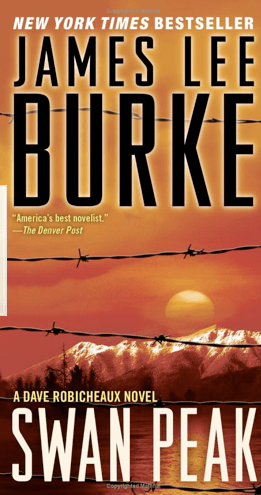
Some of the reviewers say it’s just another James Lee Burke, same story, different setting, and, to some extent, they are correct. I would counter with my opinion that no matter which James Lee Burke story you are reading, there are moments of pure poetry, and moments of keenly cynical insights that lift any book he writes out of the ordinary and puts it in the can’t-live-my-life-without-reading-this-book catagory.
Dave and Clete are vacationing in Montana (Dave’s wife is there, too, but barely appears in this book). As usual, they find themselves peripherally involved with a couple killings, and are interviewing a witness, Jamie Sue Wellstone, wife of a transplanted-from-Texas oil tycoon.
The garden was dissected by gravel pathways and surrounded by a gray stone will that was stippled with lichen in the shade. The flower beds were planted with pansies, English roses that were as big as grapefruit, forget-me-nots, violets, clematis vine and bottlebrush trees. I wondered if the eclectic nature of the ornamentals in the garden said something about the undefined and perhaps deceptive nature of the Wellstones and their ability to acquire an entire culture as easily as writing a check.
In the following section, he writes about the drifters, the people who end up in places like Montana, Alaska – wherever there is still a laxity in formal structures:
The waddies and drifters who worked for him were the kind of men who were out of sync with both history and themselves, pushed further and further by technology and convention into remote corners where the nineteenth century was still visible in the glimmer of the high-ceilinged saloon or an elevated sidewalk that had tethering rings inset in the concrete or an all-night cafe that served steaks and spuds to railroad workers in the lee of a mountain bigger than the sky.
Most of them were honest men. When they got into trouble, it was usually minor and alcohol or women or both. They didn’t file tax returns or waste money on dentists. Many of them didn’t have last names, or at least last names they always spelled the same way. Some had only initials, and even friends who had known them on the drift for years never knew what the initials stood for. If they weren’t paid to be wranglers and ranch workers, most of them would do the work for free. If the couldn’t do it for free, most of them would pay to do it. When one of them called himself a rodeo bum, he wasn’t being humble.
Their enemies were predictability, politic, geographical permanence, formal religion, and any conversation at all about the harmful effects of vice on one’s health. The average waddie woke in the morning with a cigarette cough from hell and considered the Big C an occupational hazard, on the same level as clap and cirrhosis and getting bull hooked or stirrup-drug or flung like a rag doll into the boards. It was just a part of the ride. Anybody who could stay on a sunfishing bolt of lightning eight seconds to the buzzer had already dispensed with questions about mortality.
There are many who object to the violence and brutality in every James Lee Burke novel. The problem is, he is writing about people who have to deal with violence and brutality and a way of life most of us never see. Burke writes about cops, about gangsters and organized crime, and about prisoners and prison life. It isn’t pretty. His main characters in this book, Dave and Clete, have seen too much. They are cynical as only deep-dyed idealists can be cynical. They are the guardians of our society; the enforcers of the codes. Without the police, and those who fight with them against crime, it is the rule of the jungle, where might makes right. The bullies rule, and as we have seen through history, unlimited power invites abuse.
What all predators hated most was to be made accountable. It wasn’t death that they feared. Death was what they sought, onstage, with the attention of the world focused upon them. But when you took away their weapons and their instruments of bondage and torture, when you pulled the gloves off their hands and the mask off their face, every one of them was a pathetic child. They were terrified of their mother and became sycophantic around uniformed men. The fact they were reviled by other felons and that cops would not touch them without wearing polyethylene gloves was not lost on them.
But how do you get your hands on a guy who has probably been killing people for years, in several states, leaving no viable clues, threading his way in and out of normal society? How do you find a sadist who probably looks and acts just like your next-door neighbor?
Much later in the book, he describes the kind of hero that crops up in each book the same way:
But if there is a greater lesson in what occurred inside that clearing, it’s probably the simple fact that the real gladiators of the world are so humble in their origins and unremarkable in appearance that when we stand next to them in a grocery-store line, we never guess how brightly their souls can burn in the dark.
There is only one Dave Robicheaux book I have kept – A Morning for Flamingos, the first one I ever read. I’m pretty sure it was in the late 1980’s, and I have been a James Lee Burke addict ever since. James Lee Burke hates organized crime, and he hates most of all those criminals who make themselves wealthy by bribery and corruption, who attend the society balls and events, whose photos appear in the paper looking like you and me – like respectable folk. People who get photographed making a donation to charity with wealth stolen from the common purse. His heros – and heroines – are modern day gladiators, they are the bureaucrat who refuses to hide the illegal wiretaps, the plodding cops and FBI officers who track down the slightest clue to bring down the Madhoff and the white-collar robbers, the prosecutors who risk their lives to put the bad guys away.
I guess for me, reading James Lee Burke is like reading a fairy-tale (If you have ever read the original fairy-tales, you will know what true gruesome violence and brutality is all about!) where those who flout the law, those who oppress the poor, those who use their ill-gotten wealth to isolate themselves high above the common man – get their justice. They think they are above the law. They are wrong.
Alexander McCall Smith: Tea Time for the Traditionally Built
This brand new book in the No. 1 Ladies’ Detective Agency series could not have come at a better time for me. Sorting through, giving away, selling my car – it all takes a toll. It’s a little like dying, this moving. I know I will be “resurrected” in another life, but in the meanwhile, I have so much grief, and I just stuff it away and keep going. These books are my carrots; they are my reward at the end of the day.

I have a stack of books and I am going through them like a locomotive – just chugging along.
Mma Precious Ramotswe and her totally different world in Botswana sweep me away totally. I love the sweetness of the way she thinks, her love for her country, and her tolerance. In Tea Time for the Traditionally Built, several things are going on at once, not the least of which is that she, also, must part with her dearly loved little white van, which has gone as far as it can go, and can go no further. The engine cannot be revived, not even one more time, by her dear husband, mechanic J.L.B. Matekoni.
Just in time, just when they need a new customer, comes Mr. Molofololo, the owner and manager of the Kalahari Swoopers, who hires Mma Ramotswe to find the traitor who is causing the Swoopers to lose their games.
Last, but not least, Mma Makutsi’s fiancee (she is the Assistant Detective now, remember?) Phuti Radiphuti, is being assaulted by Makutsi’s old rival from the secretarial school, Violet Sephotho, who is looking for a rich husband, and would love to steal Grace’s fiancee away, for all the worst reasons. How can plain Grace, with her big glasses and her unfortunate complexion, compete with the glamorous and seductive Violet? Can Phuti resist her wiles?
When I reached the last ten pages of the book, none of these crises had been resolved, and I thought “Oh no! How can the book end with all these loose ends out there?” but in a deft drawing together, McCall vanquishes the devils, finds simple solutions, and leaves us with Mma Ramotswe and Mma Makutsi having tea together at the President Hotel.
This book is a great way to end the day with a smile on your face. 🙂 I bought this book for $21 in a bookstore, but Amazon has it for $14.37 plus shipping. I don’t buy a lot of hardcover books, but this one was worth every penny.
Eliot Pattison: Prayer of the Dragon
As you can see, I am into some serious reading. Not heavy reading, but books like carrots – I am the donkey, plodding way, packing my boxes, sorting, weeding, throwing out – it is time consuming, and it is pitiless work. I need the promise of a great excape at the end of my day to keep me going.
Prayer of the Dragon was a GREAT carrot. I like all of Eliot Pattison’s Inspector Shan Tao Yun series, set in Tibet. In his very first book, we meet Shan as he is still in the Tibetan prison camp, imprisoned for exposing corrupt officials in China. He learns a huge appreciation, in prison, for a different way of thinking, and his treasured companions become the Bhuddist monks with whom he is imprisoned. If you want to read this series, you can read any book as a stand-alone, but it helps to read them in order, starting with The Skull Mantra. The Chinese eventually free Shan; they find him useful – as long as he is not exposing corruption in the Chinese bureaucracy. He is free on parole; he lives with the sword over his head. At any time, if he crosses an important person, he can be sent back to the merciless gulag.

In The Prayer of the Dragon Inspector Shan finds himself involved in a series of murders on the mountainside, in a small mining village. The village headman has a great scam going, skimming the miners take, charging passage on the mountain trails, and keeping his village hidden from the Chinese bureaucracy.
Here is what I learned that surprised me. There appears to be a connection between the American Navaho nation and the native Tibetans. They share some body-prototype similarities, and they share many symbols and earliest legends. An first-nation Navaho and his niece are exploring similarities, and commonalities, when two members of their party are murdered while sleeping. The Navaho is charged, by the headman, with the death, because he survived although he is covered in blood. It doesn’t make sense, but it doesn’t have to. The headman needs a scapegoat, and he chooses the Navaho.
It is a fascinating read. Here is an excerpt from a conversation Inspector Shan has with the local director of Public Security:
“I know your type so well, Shan, ” Bing said. “God, how well I know you. I was responsible for ten barracks of prisoners, like you – pathetic, morose creatures with no vision, only bitterness about the past. They would sit in reeducation classes and copy out slogans from the little red books like robots, praising the Chairman, reading aloud apologies printed in other books, using someone else’s words. Never a one among them with the balls to stand up and say Fuck the Chairman, screw the Party secretaries, and screw the limo drivers who brought them to town.”
“I tried at first,” Shan replied in a weary voice. “They sent me to a special hospital for the criminally insane.”
“Unfortunately,” Bing said soberly, “you are the sanest person I have ever met.”
AdventureMan knows I love these books. “Do you want to go to Tibet?” he asks me, and I say “No, if I went I would want to hang around with Inspector Shan and his gang of monks, not do tourist things allowed by the Chinese.” These are great reads, Pattison is doing a great job of bringing the plight of the Tibetans to the conscience of his readers, depicting, in graphic, horrorific detail how the Chinese are systematically crushing and obliterating every shred of Tibetan culture, while claiming they are not. I think one of the very worst things they have done is taking over the Tibetan monastery system and corrupting it into something it was never meant to be, a cruel, ugly deformity.
I can hardly wait for the next book to come out. I am on the waiting list for The Lord of Death, yet another book about Chinese bureaucratic corruption and the adventures Inspector Shan has in Tibet confronting and evading all its manifestations.
Dean Koontz: The Face
Dean Koontz writes a lot of books with children in them, usually children in very vulnerable positions, abandoned, neglected, or at the mercy of a cruel adult, or at best, a negligent adult. Adults do play positive roles in his books, but the positive adult is usually damaged in some way – maybe a history of alcoholism, a history of broken relationships – in short, a lot like most of us. Real people, who make mistakes along the way, and try to learn something from them.
I like Dean Koontz. It makes me sad to say that this is just another great escape. Young boy, lost in his famous father’s huge mansion, beautiful-model mother who spawned him and then walked away, like a cat leaves her kittens – it’s a sad, lonely life for a child.
There is the usual creepy, badly twisted bad guy.

There is a good guy in pain, mourning his dead wife, and a ghost who intervenes in human affairs. There are deus ex machina aplenty, and a couple page-turner moments where you don’t want to stop reading, not yet!
It was not a bad book, but if I weren’t so desperate for escape reading, I would not have wasted a minute on this book.
John Berendt and City of Falling Angels
When AdventureMan brought home City of Falling Angels for me, I thought it was another mystery by the author of the famous Midnight in the Garden of Good and Evil. I had loved that book, full of unforgettable characters living in Savannah, Georgia, so I was a little puzzled with the immediacy and real-life feeling of this new mystery when I started it.
It’s set in Venice. The main “character” observes – much like Midnight in the Garden of Good and Evil – Venice, and its population. He arrives just after the horrendous fire that totally destroys La Fenice, the opera house, and we meet a wide variety of characters right off, experience the fire through their first hand experiences. We smell the smoke, we feel their horror as the fire grows, and spreads. We are depressed when the fireboats cannot quell the flames because the waters in the canal have been emptied, and are too low in the others.
I kept waiting for Commissario Guido Brunetti, Donna Leon’s Venetian detective, to show up.
I was about half way through the book when I realized – this wasn’t fiction. It was John Berendt living in Venice, meeting with and interviewing all these fabulously interesting people. Yeh, sometimes I am so SLOW!
But I was hooked. I kept reading. The mystery is how did the fire at La Fenice start, who started it and why. In the end – and believe me this is not a spoiler, because this book is really only peripherally about the fire at La Fenice – people are convicted, but you are never really sure these are the right people, or if, indeed, there was really a crime, or if the crime was negligence – but how can negligence be a crime if it is part of the culture?
One thing Berent says that Donna Leon also implies – don’t go to Venice during tourist season! Go when tourists are not there – after carnival, when it is cold, when it is raining. Stay in Venice, and walk, off the paths the tourists on their one-day-in-Venice travel. Visit the small markets, drop in for a coffee where the locals are drinking, but most of all – walk. And walk. and walk.
This is not an exciting book. It will not hold you on the edge of your seat like some horror thriller, turning pages because you are afraid to turn out the lights. The horrors in this book are the gossip, the strivings of various people to enter into Venetian society, the cut-throat competition for invitations, and who gets the prime seats at the opening night at La Fenice.
On the other hand, I loved his attention to detail, the ease with which Berendt got people to talk to him, the clarity with which he captures their personalities. I loved his description of the interiors, and how he uses the voices of others to paint in a detailed picture of Venice today. I loved being inside the Venetian community, and hearing their innermost thoughts. This was a book I looked forward to at the end of a long day, it took me to another – and fascinating – world. I just wish Commissario Brunetti had showed up. 🙂
Recent Comments
intlxpatr on Yellowstone: Old Faithful to C… Michelle on Yellowstone: Old Faithful to C… Cathy on No Grown-Ups in Charge intlxpatr on Waiting for Snow intlxpatr on Waiting for Snow Wikipedia Donate Button

Amazina


Early Voting in Florida


 Here There and Everywhere