Daniel and the Vegetarian Diet
Most people I know these days are trying to eat less meat. In the readings for today, we start the story of Daniel, a story every Christian child learns in Sunday School, but when you read as an adult, you see different things. This morning, doing the readings from the Lectionary, I smiled to see that Daniel and his companions wanted only vegetables; they were working very hard not to violate their food laws.

I also wonder if not eating meat was helpful in the den of lions; maybe they smelled less interesting as vegetarians? Then again, lions eat impalas, wildebeest, all sorts of vegetarians, so that probably was not a factor . . . 🙂
Daniel 1:1-21
1In the third year of the reign of King Jehoiakim of Judah, King Nebuchadnezzar of Babylon came to Jerusalem and besieged it. 2The Lord let King Jehoiakim of Judah fall into his power, as well as some of the vessels of the house of God. These he brought to the land of Shinar,* and placed the vessels in the treasury of his gods.
3 Then the king commanded his palace master Ashpenaz to bring some of the Israelites of the royal family and of the nobility, 4young men without physical defect and handsome, versed in every branch of wisdom, endowed with knowledge and insight, and competent to serve in the king’s palace; they were to be taught the literature and language of the Chaldeans. 5The king assigned them a daily portion of the royal rations of food and wine. They were to be educated for three years, so that at the end of that time they could be stationed in the king’s court. 6Among them were Daniel, Hananiah, Mishael, and Azariah, from the tribe of Judah. 7The palace master gave them other names: Daniel he called Belteshazzar, Hananiah he called Shadrach, Mishael he called Meshach, and Azariah he called Abednego.
8 But Daniel resolved that he would not defile himself with the royal rations of food and wine; so he asked the palace master to allow him not to defile himself. 9Now God allowed Daniel to receive favour and compassion from the palace master. 10The palace master said to Daniel, ‘I am afraid of my lord the king; he has appointed your food and your drink. If he should see you in poorer condition than the other young men of your own age, you would endanger my head with the king.’
11Then Daniel asked the guard whom the palace master had appointed over Daniel, Hananiah, Mishael, and Azariah: 12‘Please test your servants for ten days. Let us be given vegetables to eat and water to drink. 13You can then compare our appearance with the appearance of the young men who eat the royal rations, and deal with your servants according to what you observe.’ 14So he agreed to this proposal and tested them for ten days. 15At the end of ten days it was observed that they appeared better and fatter than all the young men who had been eating the royal rations. 16So the guard continued to withdraw their royal rations and the wine they were to drink, and gave them vegetables. 17To these four young men God gave knowledge and skill in every aspect of literature and wisdom; Daniel also had insight into all visions and dreams.
18 At the end of the time that the king had set for them to be brought in, the palace master brought them into the presence of Nebuchadnezzar, 19and the king spoke with them. And among them all, no one was found to compare with Daniel, Hananiah, Mishael, and Azariah; therefore they were stationed in the king’s court. 20In every matter of wisdom and understanding concerning which the king inquired of them, he found them ten times better than all the magicians and enchanters in his whole kingdom. 21And Daniel continued there until the first year of King Cyrus.
Mediterranean Diet Cuts Heart Attacks, Strokes and Deaths by 30%
What I love about the report of this study is that all the related researchers have gone to a Mediterranean diet – see the end of this article 🙂 I found this article at the New York Times.

About 30 percent of heart attacks, strokes and deaths from heart disease can be prevented in people at high risk if they switch to a Mediterranean diet rich in olive oil, nuts, beans, fish, fruits and vegetables, and even drink wine with meals, a large and rigorous new study has found.
The findings, published on The New England Journal of Medicine’s Web site on Monday, were based on the first major clinical trial to measure the diet’s effect on heart risks. The magnitude of the diet’s benefits startled experts. The study ended early, after almost five years, because the results were so clear it was considered unethical to continue.
The diet helped those following it even though they did not lose weight and most of them were already taking statins, or blood pressure or diabetes drugs to lower their heart disease risk.
“Really impressive,” said Rachel Johnson, a professor of nutrition at the University of Vermont and a spokeswoman for the American Heart Association. “And the really important thing — the coolest thing — is that they used very meaningful endpoints. They did not look at risk factors like cholesterol or hypertension or weight. They looked at heart attacks and strokes and death. At the end of the day, that is what really matters.”
Until now, evidence that the Mediterranean diet reduced the risk of heart disease was weak, based mostly on studies showing that people from Mediterranean countries seemed to have lower rates of heart disease — a pattern that could have been attributed to factors other than diet.
And some experts had been skeptical that the effect of diet could be detected, if it existed at all, because so many people are already taking powerful drugs to reduce heart disease risk, while other experts hesitated to recommend the diet to people who already had weight problems, since oils and nuts have a lot of calories.
Heart disease experts said the study was a triumph because it showed that a diet was powerful in reducing heart disease risk, and it did so using the most rigorous methods. Scientists randomly assigned 7,447 people in Spain who were overweight, were smokers, or had diabetes or other risk factors for heart disease to follow the Mediterranean diet or a low-fat one.
Low-fat diets have not been shown in any rigorous way to be helpful, and they are also very hard for patients to maintain — a reality borne out in the new study, said Dr. Steven E. Nissen, chairman of the department of cardiovascular medicine at the Cleveland Clinic Foundation.
“Now along comes this group and does a gigantic study in Spain that says you can eat a nicely balanced diet with fruits and vegetables and olive oil and lower heart disease by 30 percent,” he said. “And you can actually enjoy life.”
The study, by Dr. Ramon Estruch, a professor of medicine at the University of Barcelona, and his colleagues, was long in the planning. The investigators traveled the world, seeking advice on how best to answer the question of whether a diet alone could make a big difference in heart disease risk. They visited the Harvard School of Public Health several times to consult Dr. Frank M. Sacks, a professor of cardiovascular disease prevention there.
In the end, they decided to randomly assign subjects at high risk of heart disease to three groups. One would be given a low-fat diet and counseled on how to follow it. The other two groups would be counseled to follow a Mediterranean diet. At first the Mediterranean dieters got more intense support. They met regularly with dietitians while members of the low-fat group just got an initial visit to train them in how to adhere to the diet, followed by a leaflet each year on the diet. Then the researchers decided to add more intensive counseling for them, too, but they still had difficulty staying with the diet.
One group assigned to a Mediterranean diet was given extra-virgin olive oil each week and was instructed to use at least 4 four tablespoons a day. The other group got a combination of walnuts, almonds and hazelnuts and was instructed to eat about an ounce of the mix each day. An ounce of walnuts, for example, is about a quarter cup — a generous handful. The mainstays of the diet consisted of at least three servings a day of fruits and at least two servings of vegetables. Participants were to eat fish at least three times a week and legumes, which include beans, peas and lentils, at least three times a week. They were to eat white meat instead of red, and, for those accustomed to drinking, to have at least seven glasses of wine a week with meals.
They were encouraged to avoid commercially made cookies, cakes and pastries and to limit their consumption of dairy products and processed meats.
To assess compliance with the Mediterranean diet, researchers measured levels of a marker in urine of olive oil consumption — hydroxytyrosol — and a blood marker of nut consumption — alpha-linolenic acid.
The participants stayed with the Mediterranean diet, the investigators reported. But those assigned to a low-fat diet did not lower their fat intake very much. So the study wound up comparing the usual modern diet, with its regular consumption of red meat, sodas and commercial baked goods, with a diet that shunned all that.
Dr. Estruch said he thought the effect of the Mediterranean diet was due to the entire package, not just the olive oil or nuts. He did not expect, though, to see such a big effect so soon. “This is actually really surprising to us,” he said.
The researchers were careful to say in their paper that while the diet clearly reduced heart disease for those at high risk for it, more research was needed to establish its benefits for people at low risk. But Dr. Estruch said he expected it would also help people at both high and low risk, and suggested that the best way to use it for protection would be to start in childhood.
Not everyone is convinced, though. Dr. Caldwell Blakeman Esselstyn Jr., the author of the best seller “Prevent and Reverse Heart Disease: The Revolutionary, Scientifically Proven, Nutrition-Based Cure,” who promotes a vegan diet and does not allow olive oil, dismissed the study.
His views and those of another promoter of a very-low-fat diet, Dr. Dean Ornish, president of the nonprofit Preventive Medicine Research Institute, have influenced many to try to become vegan. Former President Bill Clinton, interviewed on CNN, said Dr. Esselstyn’s and Dr. Ornish’s writings helped convince him that he could reverse his heart disease in that way.
Dr. Esselstyn said those in the Mediterranean diet study still had heart attacks and strokes. So, he said, all the study showed was that “the Mediterranean diet and the horrible control diet were able to create disease in people who otherwise did not have it.”
Others hailed the study.
“This group is to be congratulated for carrying out a study that is nearly impossible to do well,” said Dr. Robert H. Eckel, a professor of medicine at the University of Colorado and a past president of the American Heart Association.
As for the researchers, they have changed their own diets and are following a Mediterranean one, Dr. Estruch said.
“We have all learned,” he said.
La Sur Consommation
Thank you, Hayfa, for sending this truly horrifying video about our food, and where it comes from . . .
La surconsommation from Lasurconsommation on Vimeo.
Smell More, Eat Less
This is another great find from Bottom Line Secrets; we often read things from them that haven’t yet hit the headlines or the TV news:

You probably associate delicious food aromas with wanting to eat more of whatever you’re smelling, whether it’s the scent of fresh-baked cookies or bacon sizzling in the skillet.
But a new study suggests that powerful food smells actually may help you eat less… and lose weight in the process.
SMELL MORE, EAT LESS
René de Wijk, PhD, is a Dutch sensory scientist who studies how people react to the look, feel, taste and smell of food.
He wanted to explore whether the smell of food influences how big a bite we take, because previous studies have shown that when we take smaller bites, we feel full on fewer calories than when we take bigger bites.
Dr. de Wijk hooked 10 volunteers to machines that pumped a custard dessert directly into their mouths. (I know—I wish that I could have participated in this study, too.)
At the same time, the subjects were randomly exposed to either a slightly detectable aroma of natural cream…or a moderately detectable aroma of natural cream…or no aroma at all. During the experiment, the participants could press a button whenever they wanted to stop the flow of custard, which determined their “bite” size. The key result? People pressed the button more quickly—in essence, took smaller bites—when the aroma was stronger.
What surprised Dr. de Wijk was the fact that it didn’t take an overly strong scent to influence his subjects’ bite size. “Even the relatively weak aroma was associated with a smaller bite size. Most of the subjects were not even aware that an aroma had been presented—the decision to take a smaller bite was largely subconscious,” he said.
Dr. de Wijk theorized why the smell may have worked. “A cream aroma is associated with calories, and we regulate calories via bite size,” he said. Or, it could also be that we have an innate tendency to try to moderate intense sensations of any kind, so we take smaller bites as a protective measure. (Dr. de Wijk’s work has also shown that we take smaller bites from highly textured foods.)
CHOOSE FRAGRANT FOODS
“I would think that any foods that have intense flavors—and therefore intense scents—would result in smaller bite size and, therefore, you’d need less food to feel full,” he told me. So creamy aromas aren’t the only ones that might help you eat less. For example, aromas that are strongly spicy, meaty, buttery, fishy, vinegary, lemony, garlicky or oniony—anything other than bland—might also do the trick. And whatever the aroma, eating your food warm or hot might help you eat less than eating it cold, since warmth brings out aromas more strongly. Heat up those leftovers!
Source: René A. de Wijk, PhD, senior sensory scientist in the department of food and biobased research at Wageningen University and Research Centre, The Netherlands, and lead author of a study published in Flavour.
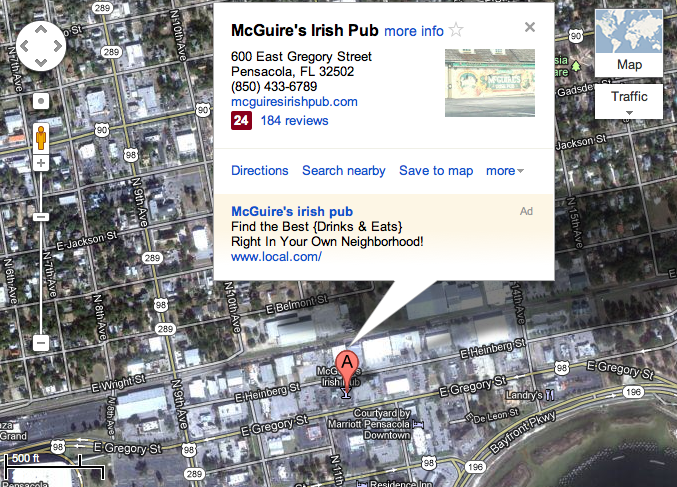
McGuire’s For Lunch
“I just have a yen for a steak,” I said to AdventureMan, and since it is my turn to choose, he grins and says “I could use a steak, too.” We don’t even feel guilty. The last steak we had was New Year’s Day this year, also at McGruires. Two steaks a year, not so bad.
It’s a gloomy day, and we are hoping it’s not so crowded we have to wait. We are seated immediately, but upon looking around, AdventureMan said “Does anyone in here know that the economy is suffering? Do they know we are in a downturn?”
McGuires is PACKED. It’s not just old retired folk and tourists, either, it’s young Pensacola families and their children, generations meeting up for a Saturday lunch. The bar is packed, the tables are full throughout and as we leave, there is a line waiting.
The steaks – we like the Molly filet – were fabulous. Erin A, our excellent waitress, warned us that some people find the pepper coating too peppery, and we assured her we like a pepper coating to be very peppery; when our steaks came, they were VERY peppery, and we were very happy. They also had fresh asparagus, perfectly cooked, still just a little crisp. We were really bad, we also had the bleu cheese dressing on our salads. It was a wonderful meal, altogether, and Erin A was attentive without being intrusive. Erin kept our glasses full, swept used dishes away as soon as they were finished, and kept her eye on our table in case we had any needs. Her service added to our enjoyment of the meal. Isn’t that the best?
There are other steak houses in town, where you can get a steak almost as good for a lot less. You can’t beat McGuires for the overall experience, though, and when you only have steak every few months, why not have the best?
We also love it that our out-of-town guests LOVE McGuires, for the overall experience as well as for the food. Live entertainment at night, lots of old Irish ballads. 🙂
As we left, we had to run between the raindrops to get to our car. Big heavy voluminous clouds over Pensacola, and a daily humidity factor of around 100%.
Good For You! Nuts!
From today’s Bottom Line Daily Health News:
If you’ve relegated nuts to the “occasional snack” category, it’s time to get more creative. Substitute nuts for some or all of the meat in a stir-fry entrée… sprinkle sliced or chopped nuts over vegetables, rice, soup or cereal… add ground nuts to a smoothie or yogurt… dress salads with nut oils… spread nut butter on celery sticks or apple slices. Why am I pushing nuts? Because from all corners of the nutrition world, I am hearing from wellness professionals who are amazed by nuts’ health benefits. Recent research shows that eating a moderate amount of nuts on a regular basis may help…
Control weight. According to Richard D. Mattes, PhD, MPH, RD, a professor of foods and nutrition at Purdue University who has done extensive research on the topic, nut consumption increases your resting energy expenditure, which means that you burn more calories just sitting still than you otherwise would. Also, about 5% to 15% of the calories in nuts are excreted without being absorbed. And nuts’ unique combination of protein, fiber, fatty acids and other characteristics quells hunger quickly and for prolonged periods.
Prevent heart disease. Most of the fats in nuts are heart-healthy monounsaturated fats and omega-3 fatty acids that help lower LDL (bad) cholesterol and triglycerides… increase HDL (good) cholesterol… and prevent abnormal heart rhythms. Nuts also contain vitamin E, which inhibits arterial plaque buildup… and L-arginine, an amino acid that makes arteries more flexible and less vulnerable to clots.
Fight inflammation. The soluble fiber in nuts appears to increase production of the anti-inflammatory protein interleukin-4. Antioxidant vitamin E also eases inflammation.
Reduce diabetes risk. A Harvard study found that women who ate five or more ounces of nuts weekly were almost 30% less likely to get type 2 diabetes than women who rarely or never ate nuts. Also: Spanish researchers found that nuts were even more effective than olive oil in combating metabolic syndrome, a condition that puts you at risk for diabetes and heart disease.
Combat cancer. Some nuts (including Brazil nuts and walnuts) are high in selenium, a mineral associated with a decreased risk for colorectal, skin and lung cancers. In animal studies, walnuts appeared to inhibit breast tumors — perhaps due to their disease-fighting omega-3s and antioxidants.
Support brain function. Evidence suggests that nuts’ omega-3s may ease depression and boost thinking and memory by improving neurotransmitter function. Nuts also provide folate — and low levels of this B-vitamin are linked to depression and poor cognition.
NUT TYPES TO TRY
Per ounce, nuts typically have 160 to 200 calories and 13 to 22 grams of fat. Eating 1.5 ounces of nuts per day (a small handful) is enough to provide health-promoting benefits. Nuts naturally contain only a trace of sodium, so they won’t wreak havoc with blood pressure, especially if you choose brands with no added salt.
“All types of nuts are good for you, so there’s no such thing as a ’best’ type of nut,” Dr. Mattes emphasized. Still, each type does contain a different mix of nutrients — so for the widest range of benefits, eat a variety. Below are some excellent options and the nutrients that each is especially rich in. Consider…
Almonds for bone-building calcium… and inflammation-fighting vitamin E.
Brazil nuts for cancer-fighting selenium.
Cashews for magnesium, which is linked to prevention of heart attacks and hypertension.
Hazelnuts for potassium, which helps normalize blood pressure.
Peanuts for folate, which lowers levels of the artery-damaging amino acid homocysteine.
Pecans for beta-sitosterol, a plant compound that combats cholesterol.
Pistachios for gamma-tocopherol, a form of vitamin E that may reduce lung cancer risk.
Walnuts for the heart- and brain-enhancing omega-3 alpha-linolenic acid.
Source(s):
Richard D. Mattes, PhD, MPH, RD, professor of foods and nutrition at Purdue University in West Lafayette, Indiana. He has published numerous studies on nuts and appetite.
. . . Hurray for the Pumpkin Pie . . .
“You’ve worked HARD!” our water aerobics instructor told us. “You get a free pass tomorrow; you can eat anything!”
I wish she hadn’t said that. We did work hard, but it wasn’t just one day of feasting, it was pretty much four days, and we enjoyed ourselves too much. No matter how hard we had worked Wednesday morning, it wasn’t enough to cover four days.
Arriving at Papa’s and Grammy’s we were welcomed with a bubbling gumbo, a combined effort of Papa and Grammy; Grammy did all the shopping and chopping, and PaPa worked the roux, which is the butter and flour combination that makes that smoky flavored base for the gumbo. They had just finished cleaning and deveining about 40 pounds of shrimp for Thanksgiving, and threw a few in the gumbo. Oh YUM. The next morning was full of preparations, and then, mid-morning, the feasting began, with all the guys shucking oysters and eating boiled shrimp. As you drive up, you can smell smoke from an outdoor fire, and chairs and tables are out everywhere, but the shucking goes on down near the creek:



The house is beautiful, spacious and welcoming for so many people. The happy baby, who is now a happy toddler, was in heaven – he was surrounded by boy toys – tractors and golf carts and a Model A and all sorts of age appropriate toys, as well as cousins, aunts, uncles and a lot of hilarious rough housing. Why is it kids just love the terror of being turned upside-down?
For me, this was the best Thanksgiving with the family; finally I am beginning to figure out who is who from year to year. I still have to ask questions, but they seem more comfortable with me, and I had some really good conversations, sort of beyond the polite-passing-the-time conversations. I’m not that great in big crowds, but now I am beginning to have some good one-on-ones, and for me, that’s a great Thanksgiving.
And on, man, the food. Tables and tables of food. I don’t know how they do it, but I saw the list of cakes, and there must have been twenty cakes on THE LIST. They each have responsibilities, and somehow, it all works.
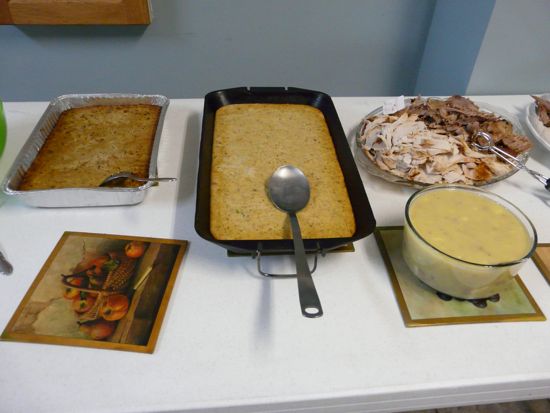
Three turkeys, all carved, and so much dressing (which I grew up calling stuffing, it all depends on where you grew up):

That green container is AdventureMan’s first foray into cranberry chutney. This one was a little tart, but tasty. As are darling daughter in law so diplomatically put it, “I would probably like it more if my taste buds were accustomed to having cranberries without sugar.”
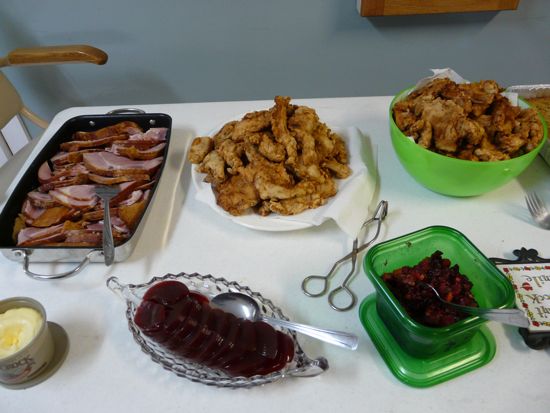


About half of the sides were sweet potato casseroles; you can’t believe how good these are. This year this front dish was one of the favorites, squash cassarole:

This photo doesn’t begin to do justice to the desserts – holy smokes:

So the biggest brother blessed the food and we ate around one, then we visited for a few hours, people going back and grazing a little. Then the next generation cleaned everything up and got all the food packaged up and put away. About an hour later, that broccoli salad started calling me, and I went out to try a little more and discovered it was all put away, but a partner in crime knew where it was, and we pulled it out and had some, which started a whole landslide of second-platers, just when everything had been all put away, LLOOLLL!
It was a great day, a day full of thanks for all the things in life that really matter.
Hilarious French Video / Ad
Thank you, Hayfa!
Glycemic Index
On the way to my follow up visit with my doctor, I figured it all out. Diets are hooey. I don’t really need to loose weight; I am happy the way I am. Actually, I am losing weight, but I am so contrary that as soon as I really try, I sabotage myself. Or worse, I lose a lot of weight, and then I put it back on, which is worse. So – no diets for me.
He has the results of all my blood work, and before I can go into my speech, he starts talking about how my trigliceride ratio is all wrong, and that my blood sugar readings would have been OK ten years ago, but now the scale has changed, and although I am a smart woman, my brain is spinning and I never get a chance to give my ‘I am not going on a diet speech’ because he is talking about the GLYCEMIC INDEX and how if we can reverse this all and I will never have to go on medication.
I register that part. I never want to have to go on any medication I have to take every day. That’s for OLD people, not me. Not me!
Diabetes is scary to me. I had a diabetic cat. We did everything, tried all different kinds of insulin, we never did get her blood sugar under control until we put her on special food, when it evened out. Then we moved to Doha, where the vet said he had never seen a diabetic cat before, and where the pharmacies promised me it was the ‘right’ insulin and it wasn’t . . . I really, really do not want to be diabetic.
So I started reading about the glycemic index, and glycemic diets, and oh, my head is spinning, none of the resources agree with one another about what is desirable and what is not! In one place, they will say you can eat pasta, and in another place, they will indicate that you can only eat whole grain pasta, and in one place peanut butter is good, and in another, it is like the worst.
They all agree that you need to be eating mostly fruits, vegetables and whole grains, but watermelon is forbidden, and candy has a lower glycemic number than a baguette. I am SO confused.
Wikipedia says The glycemic index, glycaemic index, or GI is a measure of the effects of carbohydrates on blood sugar levels. Carbohydrates that break down quickly during digestion and release glucose rapidly into the bloodstream have a high GI; carbohydrates that break down more slowly, releasing glucose more gradually into the bloodstream, have a low GI.
I totally get that. It’s the specifics I have problems with, as well as wondering if it works the same for each person (I imagine metabolism gets involved here, and exercise) and there is a part of me that wants to be like an ostrich and bury my head in the sand. It’s all overwhelming.
I slept well last night, but was wide awake at five, worrying about my glycemic index. I decided it might be a good time to walk; we are having really warm weather, so warm the windows are all frosted up from the A/C inside and the heat outside. I used to have water aerobics on Wednesday, but now that I am in the Isaiah study, I don’t get there on Wednesdays, and walking early would be a good substitute.
I headed our with my phone, keys and flashlight, all of which can be used as weapons if I feel endangered, but I discover there is a whole neighborhood full of people out there running and walking at that quiet, dark time of the day. As I reached the top of the hill, there is even a stiff breeze, which feels really good in the sticky humidity. If I can make this a habit, maybe the glycemic index will have less significance. I can hope.
New Territory: Pensacola Medicine
It’s payback time. Since AdventureMan and I retired, we have been trying to catch up with all the things we have left undone as we lived overseas. One of those things is catching up on medical work, you know, the preventive stuff.
One of the things I avoided in Qatar and Kuwait were any kind of procedures where something alien entered your body. There are good hospitals, and there are good doctors, but you have to know someone who can recommend them, and they they have to accept you as patients. My strategy was simply to stay well. I had a constant concern, about the cleanliness of the hospitals, about the conscientiousness of the people sterilizing medical equipment, about patient care, about credentials of those putting in IV’s – little things like that.
When I came to Pensacola, LOL, I had the same concerns. We have this illusion that everything is better in the USA, but we are only as good as our rules, and the enforcement of the rules, and when budgets are being cut, code enforcement can suffer. Who is checking on the cleanliness of the facility, etc. can be an issue here, too.
We ran into a couple of breaks. We have friends here, and we also have good advisory people. While our advisory people are not allowed to give specific recommendations, we had a long and lively chat with one and we asked, at the end, “if your Mom or Dad needed a good overall internist, who would you send them to?” and she paused and gave us a name.
The name was also on our short list of doctors we had looked up online. There are all kinds of places that comment on doctors, and this doctor has all A’s.
My visit with the doctor got me started on a lot of other appointments. The first visit, however, had a very funny moment. We were talking, generally, I thought, about weight, and he said “what do you think would be a good weight for you at this age” and I thought and said a number and HE WROTE IT DOWN. “Oh no!” I said. “Are you writing it down?”
“Yes.” he responded. “I agree, I think that is a good goal for you.”
GOAL??? I talk a lot about exercise and trying to lose weight, but now I am expected to meet a goal??? Oh, aaaarrrggghh. Me and my big mouth, why did I pick that number???
My Pensacola medical experience grew this week as I had a dreaded colonoscopy, something older people have to do as part of preventive maintenance. I totally hate colonoscopy preparation, and I also know that the same problems that happen in Qatar and Kuwait can happen here in Pensacola, so I was anxious the day of the procedure.
As I was pushed into the operating room by a young guy, I asked “who are you?” and he said he was the doctor. I interviewed him, asking about his certification, etc. and his record. He could see I was anxious.
Finally, I asked, in desperation, “are you Christian?” and he said “yes,” and then added “Would you like us to pray together before we start?” I was shocked. I paused, trying to deal with this new information – you are allowed to pray in the operating room?
“Yes,” I said, “please.”
They put hands on me and prayed for guidance during the procedure, and safety and a positive outcome. That is the last I remember, I felt so secure, and then I woke up and it was over. The outcome was positive.
There is no such thing as not allowing prayer in the schools or public places. People can pray wherever they want. The only thing forbidden is prayers where everyone is forced to pray together, the same words, words that may not express the same faith. We don’t all share the same beliefs, we don’t all pray in the same vocabularies. But we are free to pray, no one can stop the prayers of the heart.
Recent Comments
ExpatAlien on What Country am I Living … intlxpatr on Yellowstone: Old Faithful to C… Michelle on Yellowstone: Old Faithful to C… Cathy on No Grown-Ups in Charge intlxpatr on Waiting for Snow Wikipedia Donate Button

Amazina


Early Voting in Florida


 Here There and Everywhere