Real Age and Boost Your Immunities
A while back, there was a blogger, Fonzy, who was more here there and everywhere than . . . Here There and Everywhere. He found some of the most amazing resources, and Real Age was one of them.
I took the Real Age test, and got a shock; there were things I really needed to do to keep my health and fitness at peak. I hadn’t been doing them, thought I could slide. Real Age won’t let me.
Every week I get bulletins from them on new findings in health issues. They are always packed with valuable information. Here is one of the most recent ones:
Boost Your Natural Immunity
June 30, 2009 3:14 PM by Mehmet Oz, MD and Michael Roizen, MD
New flu strains. Antibiotic-resistant tuberculosis. Germs in and on the foods we buy in supermarkets and in restaurants. Flesh-eating bacteria. Feels like you’re in the midst of a scary twenty-first century germ invasion. And while you try your best to keep from meeting the nastiest bugs, there’s only so much you can do without living in a bubble. That means boosting your immune system matters more than ever.
And steps you take to boost your immunity may also protect you from the chronic diseases associated with aging. See, immune busters — everything from aging and stress to lack of sleep, too little exercise, and not-so-smart eating — can pull the plug on how well your white blood cells, natural killer cells, and chemical messengers can attack and destroy foreign invaders. Didn’t know you had an army of defenders, did you? Well, you do. And the very same actions that lessen their ability to fight off bugs also cause trouble by encouraging chronic inflammation — a hot-button health risk now linked with asthma, heart disease, diabetes, and even some types of cancer.
Keeping your own personal security force strong and disciplined is easy:
Feast on fin food. EPA (eicosapentaenoic acid), the essential omega-3 fatty acid found in fatty fish (and fish oil, of course), limits several cellular processes (involving dendritic cells and interleukin 12; aren’t you glad you asked?) associated with inflammation, so they can’t do their dirty work. Serve yourself salmon or trout at least twice a week, or get 2,000 milligrams of EPA plus DHA, another omega-3, from supplements daily. Don’t like the fishy taste or the size of the pill? Just get the DHA from pills made from algae — that’s where the fish get it.
See red or go nuts. Red wine, red grapes, and peanuts are great sources of resveratrol, a compound that protects against immune system aging and inflammation.
Learn the art of ahhhh. Your nervous system and your immune system are linked more closely than fraud and Bernard Madoff. Extreme stress reduces your natural killer cell count — one reason widows and widowers are more likely to get sick after the death of a spouse. Even periods of short stress (say, road rage) can boost levels of proinflammatory chemicals called cytokines. Set aside 10 minutes a day for relaxation, whether it’s meditation, intimacy, a walk, or the pure bliss of playing with your kids or grandkids. And learn some coping skills that help you talk your stress level down while you’re still in traffic or whatever situation gets on your nerves.
Tuck yourself in. Sleep deprivation torpedoes immunity and increases levels of proteins associated with inflammation. Stop shortchanging yourself and jump into the sack a half hour earlier tonight . . . and every night this week. Add another half hour next week, and keep going until you’re getting 7 1/2 to 8 hours of shuteye per night. Every night!
Take a walk today. Regular physical activity can help keep immunity where it should be. You don’t have to be a gym rat: When a group of overweight couch potatoes started exercising five times a week, they gained a definite cold-fighting edge over nonexercisers.
Pop some vitamin D. This vitamin can’t do its immunity-boosting job if you don’t get enough of it . . . which includes at least 30% to 40% of us. Since it’s difficult to get what you need from food alone, get 1,000 international units a day from a supplement if you’re younger than 60, 1,200 if you’re 60 or older.
Munch apples, broccoli, and red onions. All are bursting with quercetin, a flavonoid that shores up immunity, even when you’re fatigued. The fiber and antioxidants in these natural goodies also help reduce or mute inflammation instigators.
Think zinc. Go to the end of the alphabet for a mineral that supports immunity (it may also thwart cancer cells). You can get the zinc you need — 12 milligrams a day — from crab, oysters, pork, poultry, beans, cashews, and yogurt. Or find a good multivitamin with less than 15 milligrams. Too much of the stuff could stop other important minerals from doing their jobs.
Don’t forget classic “C.” This vitamin helps you produce more bullets to kill invading germs. Bell peppers are chock-full of vitamin C; other good C options include strawberries, cantaloupe, and broccoli. Or take 400 milligrams of vitamin C as a supplement three times a day.
Turmeric Kills Cancer Cells (Pass the Biriyani, Please!)
Curry spice ‘kills cancer cells’
From BBC Health News
An extract found in the bright yellow curry spice turmeric can kill off cancer cells, scientists have shown.
The chemical – curcumin – has long been thought to have healing powers and is already being tested as a treatment for arthritis and even dementia.
Now tests by a team at the Cork Cancer Research Centre show it can destroy gullet cancer cells in the lab.
Cancer experts said the findings in the British Journal of Cancer could help doctors find new treatments.
Dr Sharon McKenna and her team found that curcumin started to kill cancer cells within 24 hours.
‘Natural’ remedy
The cells also began to digest themselves, after the curcumin triggered lethal cell death signals.
Dr McKenna said: “Scientists have known for a long time that natural compounds have the potential to treat faulty cells that have become cancerous and we suspected that curcumin might have therapeutic value.”
Dr Lesley Walker, director of cancer information at Cancer Research UK, said: “This is interesting research which opens up the possibility that natural chemicals found in turmeric could be developed into new treatments for oesophageal cancer.
“Rates of oesophageal cancer have gone up by more than a half since the 70s and this is thought to be linked to rising rates of obesity, alcohol intake and reflux disease so finding ways to prevent this disease is important too.”
Each year around 7,800 people are diagnosed with oesophageal cancer in the UK. It is the sixth most common cause of cancer death and accounts for around five percent of all UK cancer deaths.”>
Short Fat Women of the Future
I found this on AOL’s Lemondrop.com link this morning, LLOOLLLL!
Well, here’s a self-confidence booster — you’re not short and fat, you’re just highly evolved.
According to a study by Yale researchers, humans are still evolving, and women are evolving to become shorter and fatter. It is estimated that in 10 generations, women will be two centimeters shorter, weigh one kilogram (around 2.5 lbs.) more, and look back and wonder what kind of freakish monster Angelina Jolie was. (“What are these jeans called ‘long’ from the Gap?)
But we won’t just be jolly little trolls, we’ll also be healthier, with the study expecting women to have lower cholesterol and better heart health, start menopause later, and have more children earlier in life. The study observed over 2,000 medical histories from Framingham Heart Studies in Massachusetts. Shorter, heavier women have more children, who also grow up to be shorter and heavier.
Let’s also not forget that in addition to shrinking downward while expanding outward, we’ll all also have super-hot faces. Short, fat, healthy and hot. Totally awesome.
You can read the original article on TheMedGuru.com
Mediterranean Diet Can Help Fight the Blues
From BBC Health News comes a study that says not only is the Mediterranean diet good for your heart healt – it is also good for your mental health. If you are fighting the seasonal blues, fight back with olives, olive oil and a diet high in veggies and legumes.
The Mediterranean diet, already thought to protect against heart disease and cancer, may also help to prevent depression, Spanish researchers say.
They found depression was more than 30% less likely to develop in people who followed a diet high in vegetables, fruit and cereals, and low in red meat.
They studied 10,094 healthy adults over four years, the Journal of the American Medical Association reports.
However, the team stressed additional, larger-scale studies were required.
Researchers at the Universities of Las Palmas and Navarra recruited university graduates to take part.
Dietary patterns
They completed questionnaires and the researchers calculated their adherence to the Mediterranean dietary pattern (MDP) for an average of four-and-a-half years.
MEDITERRANEAN DIET FEATURES
• A high intake of monounsaturated fatty acids like olive oil
• A moderate intake of alcohol and dairy products
• A low intake of meat
• A high intake of legumes, fruit and nuts, cereals, vegetables and fish
Participants who had a strong adherence to the MDP tended to be male, ex-smokers, married and older individuals.
They were more active physically and showed a higher total energy intake.
The researchers identified 480 new cases of depression during the follow-up period – 156 in men and 324 in women.
They found that those with the highest adherence to the MDP were more than 30% less likely to develop depression.
They took into account marital status, the number of children and factors associated with a healthy lifestyle and found the relationship did not change.
Even taking account of personality traits, such as competitiveness and anxiety, had no effect on the results.
‘More research needed’
Professor Miguel Martinez-Gonzalez, of the University of Navarra, said the results would have to be confirmed in longer trials with more participants but they had found a strong inverse association between the Mediterranean diet and depression.
“Thirty per cent is a large reduction in the risk and this could be very important considering the large burden of disease represented by depression.
“We know how important the Mediterranean diet is in reducing cardiovascular risk factors and the same inflammatory proteins are also raised in patients with depression.”
He said it was likely that the overall dietary pattern was more important than the effect of single components and “may exert a fair degree of protection against depression”.
Dr Cecilia D’Felice, a clinical psychologist, said there was mounting evidence for the importance of diet in treating depression.
She said: “What we do know is that a diet high in olive oil will enhance the amount of serotonin or brain transmitter available to you.
“Most anti-depression drugs work to keep more serotonin available in the brain.”
Casper’s A Taste of the South
We had decided on one restaurant, an Italian restaurant we both like, and were on our way, when Mom thought of another restaurant we might like to try, but it was on the way, so we could look at it and decide whether we wanted to eat there or go on to the Italian one.
This is very normal for our family. Our son used to call it “bait and switch” because we would say “Hey! Do you want to go to Tortilla Gonzales?” and he would say “Yeah!” and we would all jump in the car and then on the causeway, AdventureMan would say “You know I really have a taste for Chinese . . . would anyone prefer Chinese?” and I would jump in and say “We’re really close to that sushi place we all love!” and then our son would have to rein us in “NO! You said we were going to Tortilla Gonzales!”
Once he went away to college, we switched all the time. Later, we learned that now he and his wife do the old switch-a-roo, too – family culture is a hard thing to shake.
So we are en route and Mom suddenly shouts “RIBS!” and I say “What??” and she said “We just passed a rib place!” We were at a stop light. “Mom,” I asked, “Do you want to go to that rib place?”
Silence.
Silence.
I pull into the U-turn lane and complain “You’ve got to start dealing with me directly; if you want to go to the rib place, you have to say so!” The complete irony being that I was already making the U-turn, which is what she wanted me to do. . . . Family culture being a hard thing to shake . . .
But as we pulled into the already crowded parking lot, the smell was absolutely divine. There was already a line. Good thing, too, it gave us time to read the menu and decide what we wanted.

We both ordered ribs. We are both forbidden to eat ribs. I eat ribs maybe one time each year, like once, at a buffet, I ate one small rib. It is so rare that I allow myself to eat a rib that I can remember even that one tiny rib. But this time, I ordered ribs, because my Mom did. She ordered Sweet Potato Fries and Cole Slaw and I ordered Hush Puppies and Cole Slaw.
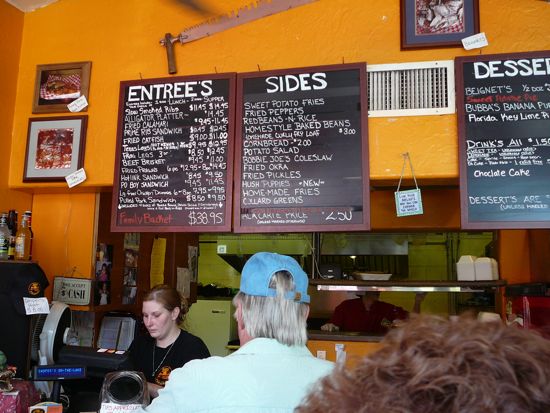
You are going to be so so proud of me. I took pictures before we ate the food this time, well, except for one tiny bite I took out of the hushpuppies, but that was to show you what they look like on the inside. (My Mom has NEVER had a hushpuppy in her life before having one of mine.)
We sat down in the large outside sitting place – I can’t help but wonder what they do in the winter time, because it can get really really cold and damp in Seattle, but I am guessing that they do a huge take-out business.

They have a map that they want people to put push-pins in to say where they are from:
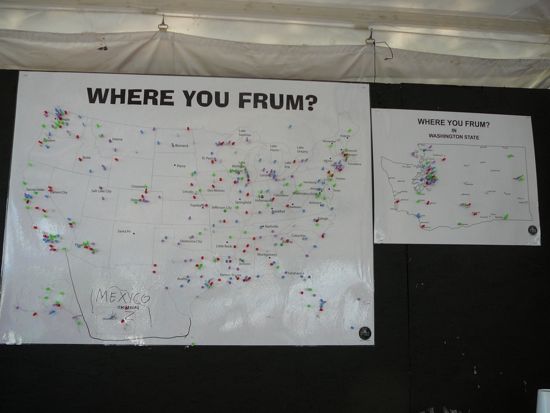
I made a little addition:

And, as I promised, here is the food. Actually, they gave Mom this HUGE portion, about double my portion, but since I got four ribs and only ate two, Mom took home a huge box of leftover ribs to package up and freeze and have a little at a time.

Did you know sweet potatoes are really really healthy for you?

(I think sweet potatoes are healthier for you when they have a lower surface/interior ratio and have absorbed less fat, but these are totally, incredibly delicious. That’s sugar on the sweet potato fries, not salt.) Mom took leftover sweet potato fries home, too.

I can’t even pretend that there is anything healthy about deep fried cornbread. I ate them all, except the one Mom ate. They . . . they were really really good. Yes, I am so ashamed, but I would do it again.
And no, I didn’t take a photo of the sweet potato pie, generously seasoned with fresh nutmeg, it was divine, or the key lime pie we couldn’t eat and Mom took that home, too.
Oh, this food was good. As we left, the line stretched way out to door and into the parking lot.
Casper’s Taste of the South
15030 Bothell Way
Lake Forest Park, WA
(206)268-0202
Their slogan is:
Put a Little South in Your Mouth. LLLOOOLLLL!
Prickly Pear Becomes Cash Crop

The first time I ever saw these prickly pears was in Tunisia, where they were a by-product of huge prickly pear fences that kept roaming sheep, goats, even cattle out of the living areas. The prickly pear fences were everywhere. Some people made jam out of the fruit, but now, the fruit is bringing in big bucks to Moroccans.
To read the entire story, please click BBC News Africa
By Sylvia Smith
BBC News, Sbouya, Morocco
It is just after dawn in the hills above the Moroccan hamlet of Sbouya and a group of women are walking through the thousands of cactus plants dotted about on the hillside, picking ripe fruits whenever they spot the tell-tale red hue.
But these woman are not simply scraping a living out of the soil.
The cactus, previously eaten as a fruit or used for animal feed, is creating a minor economic miracle in the region thanks to new health and cosmetic products being extracted from the ubiquitous plant.
This prickly pocket of the semi-arid south of the country around the town of Sidi Ifni is known as Morocco’s cactus capital.
It is blessed with the right climate for the 45,000 hectares (111,000 acres) of land that is being used to produce prodigious numbers of succulent Barbary figs.
Every local family has its own plot and, with backing from the Ministry of Agriculture, the scheme to transform small scale production into a significant industry industry is under way.
Some 12m dirhams ($1.5m) have been pledged to build a state-of-the-art factory that will help local farmers process the ripe fruits.
The move is expected to help workers keep pace with the requirements of the French cosmetics industry which is using the cactus in increasing numbers of products.
Lucrative
Izana Marzouqi, a 55-year-old member of the Aknari cooperative, says people from the region grew up with the cactus and did not realise its true benefit.
“Demand for cactus products has grown and that it is because the plant is said to help with high blood pressure and cancer. The co-operative I belong to earns a lot of money selling oil from the seeds to make anti-ageing face cream.”
I know I have seen these growing in Kuwait – are they growing in Qatar, too?
Drink White Tea, Lose Weight
New article from Real Age suggests we drink white tea to blast the fat cells and keep the weight off:
Drink This to Fight Fat
Have a little fat you’d like to lose? Maybe now is a good time to turn on the kettle and pour yourself a cup of this: white tea.
Made from the buds and early leaves of the same plants used to make green and black teas, white tea may have special fat-thwarting powers, a new study suggests.
Fat-Blasting Brew
Fat cells increase or decrease in size, according to your weight. And in a lab study, human fat cells treated with white tea extract accumulated significantly less fat. In fact, the white tea extract reduced the incorporation of fat by as much as 70 percent! The tea also seemed to stimulate the breakdown of fat from mature cells.
Real Age: Restaurant Catastrophes
LLOOLL – I thought we were good, sharing a dessert between two people. Real Age suggests sharing a dessert with 4 – 5 people! Just a few bites are all you need! LLOOLLL!
The truth, as I see it, is that Real Age gives lots of really good advice on health maintenance and prevention. Do I always follow their advice? . . . hmmmmm. . . . Take their Real Age test, sign up and they send you newsletters with lots of great ideas. Even if, like me, you adopt some but not all, it is probably a good thing.
Avoid Restaurant Catastrophes
To us, a restaurant catastrophe isn’t just when a waiter spills something on you or when you accidentally miscalculate the tip. When it comes to your health, a catastrophe is what can happen in the first and last 10 minutes of a meal. But it doesn’t have to. Here’s how to dine out, enjoy your meal, and be trim and healthy, too:
Before You Go
Don’t arrive starving! Eat a little healthy fat — like about six walnut halves — before a meal. The healthy fat in walnuts triggers a chain reaction that slows the rate at which your stomach empties, so you’ll feel fuller faster. But the chain reaction takes 30 minutes, so plan for it.
The First 10 Minutes
• Raise a glass. Of water. To your lips. This can fill you up, so you don’t overeat.
• Ask for cut-up veggies instead of bread. Most quality restaurants (including inexpensive ones) provide this option.
• Dip in olive oil. If the restaurant brings you whole-grain bread, dip it in olive oil. People who opt for this over butter eat less bread.
• Request the bottles. Order oil and vinegar on the side. Relying on the kitchen to dress your salad — even with oil and vinegar — can deliver as many as 450 extra calories!
The Last 10 Minutes
• Share. Get one dessert for every four or five people, and have just a few bites. If there are just two of you, take half of the dessert home, and freeze it for a special occasion.
• Savor your wine. Ending a meal with a glass of wine lets you avoid the cloying aftertaste of sweets . . . and helps you avoid calorie-bombs, too.
• Go European. Do what many Europeans do: Make salad the last thing you eat.
The Camera-Phone Diet
Sometimes AdventureMan will say “Take a photo! You can talk about this place in the blog!” I give him the look that says “get your own blog, AdventureMan.” Like if there is no one else in the restaurant, I might try, IF there is no one watching us. If there are other people I might do it IF I can do it subtly . . . I don’t like to attract attention, and especially if it is a place I like going back to regularly, I don’t want them figuring out who I am.
But now . . . I have a whole other excuse! I think this diet from Real Age is a total hoot! Keeping a food diary is known to help lose weight, but snapping a photo BEFORE you eat helps you think about how much you are eating, keeps you conscious of it . . . who knew? I wonder who thinks these things up?
You can read all about this diet HERE
Try the Camera-Phone Diet
Could your camera phone help you lose weight? One study seems to suggest so.
When people in a small study snapped a picture of everything they ate for 1 week, something interesting happened. They took better stock of their meals — and ate less or ate more healthfully because of it.
Snap Your Way to Slimmer Hips
Just think of it as a digital version of a food diary — but better — because it forces you to think about what you’re eating before you put it in your mouth, instead of after. With written food diaries, it’s too late — people log their choices after the fact. Watch this 60-second video on how to dish up just-right portions.
Worth 1000 Words (and Calories)
In the study, the simple act of taking a picture caused people to pay closer attention to how much they were eating, how diverse their food choices were, or how healthful the food was. And that extra thought and attention actually helped them eat better.
Here are some more slim-down tricks to try:
Pace yourself. Find out how eating slowly can help you eat less.
Be regular. Here’s why you don’t want to skip meals.
Learn to decode labels. Yep, reading is good for weight loss.
Chart your weight loss with this nifty weight loss tracker that lets you see your daily progress.
RealAge Benefit: Maintaining your weight and body mass index at a desirable level can make your RealAge as much as 6 years younger.
Gardening Leads to a Longer Life
Back when The Fonz was still blogging, he ran this free test from REAL AGE which I took, full of pride because I lead such a healthy life. Man, did I get a bad surprise, the first of many. First the REAL LIFE people told me my body was one year OLDER than my real age because I don’t like to exercise, and then at my annual physical, my doctor looked me in the eye and said I had to make some changes.
I have. I’ve made some changes. One of the changes is I don’t take tests like that any more!
But REAL AGE doesn’t give up on me. They send me helpful newsletters every week, and I have to admit, they really are interesting, and they really do help me stay on track, like eating oatmeal and drinking green tea.
Today they talk about a hobby that lengthens your life – gardening:

The Hobby That Leads to a Longer Life
A hobby is more than a way to pass the time. It may be a way to get more of it.
Know which hobby has probably added years to the longest-lived people in the world? It’s gardening. Okinawans — whose men typically live to age 78, women to age 86 — have a long tradition of working with soil.
Flex Your Green Thumb
The benefits of gardening reach body and soul, according to Dan Buettner and his book The Blue Zones: Lessons for Living Longer from the People Who’ve Lived the Longest. “It’s a source of daily physical activity that exercises the body with a wide range of motion and helps reduce stress,” he writes. So, as the ground thaws and the seed catalogues start arriving, make a pact to plan — and plant — a plot this year.
Grow for Years
It’s not a coincidence: There are lots of other wonderful side benefits to gardening besides the body and mind boost. Here are the other garden goodies Buettner notes in his book:
A veggie-packed life. Okinawan centenarians eat a plant-based diet, often incorporating vegetables that they grow.
A bit of sun. Vitamin D, produced by the body when it’s exposed to sunlight, promotes stronger bones and better health. Vitamin D also helps your body fight cancer.
A dash of spice. Mugwort, ginger, and turmeric are staples of an Okinawan garden, and all have proven medicinal qualities.
Older Okinawans are active gardeners and walkers. Walk your way to a healthier, fitter life.
Recent Comments
ExpatAlien on What Country am I Living … intlxpatr on Yellowstone: Old Faithful to C… Michelle on Yellowstone: Old Faithful to C… Cathy on No Grown-Ups in Charge intlxpatr on Waiting for Snow Wikipedia Donate Button

Amazina


Early Voting in Florida


 Here There and Everywhere