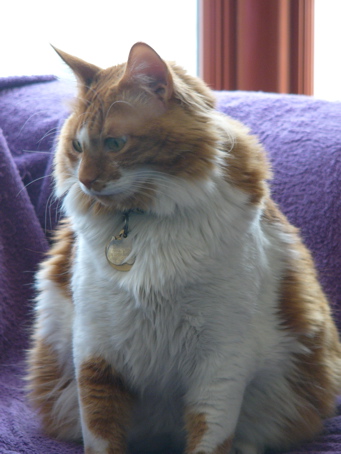
“I’ve Never Seen a Diabetic Cat Before”
I arrived in Qatar with my diabetic cat, and quickly had to find a vet who could help me keep her blood sugar stable. I had been working for a year with a German vet who had all the latest equipment, but we were never able to fully stabilize my little kitty.
I was told there was a vet in Qatar, and fortunately, his office wasn’t too far away. We made an appointment and went for a visit.
“I’ve never seen a diabetic cat before,” he said. “I’ve seen one diabetic dog, and I will go on the internet and find out what to do.”
Diabetes in animals is relatively new, and most of the vets think it is a combination of more people having housepets, the pets living long enough to develop these illnesses, and the poor quality of the processed kibble we buy them. My little cat had been put on special foods, those expensive cat foods which have a guaranteed formula.
He was a very friendly and open vet – always had lots of customers. When my cat would have a diabetic crisis, he would take a blood sample and run it to the lab across the street himself, even with a waiting room full of people and their pets. He loved his job and he was very open.
On yet another visit when my cat was in crisis (it’s not easy to give enough insulin and not too much insulin, and that can vary even day by day) he took her into his surgery, and the floor was littered with dead cats in nylon net bags. Dead cats everywhere! All over the floor! I was horrified!
“It’s spaying day,” he explained briefly. The cats were not dead, just anaesthetized, and kept in nylon string bags to keep them contained if they started to come out of anaesthesia. Believe me, there are sights you don’t want to see. That is one of them.
Eventually, my little sweetie gave up the fight. She died in the car on our way, one more time, to the vet. Diabetes is a terrible disease, and when the body fails, it just fails utterly. It can only manage so much destruction.
The vet suggested another cat – he always had cats that needed homes – but we weren’t ready yet. We needed some time to grieve our little sweetie. Adventure Man said “NO MORE CATS” because his heart breaks every time we lose one.
And this was the same vet who, when we were ready, gave us the Qatteri Cat. He said he thought the Qatteri Cat looked like me!
If you have a cat who develops diabetes, it is not a death notice. First, go online and gather all the information you can. Thousands of people have diabetic cats who are living fine, normal lives, they have formed an online community, and they can give you support and information. There is special animal insulin made for cats, and special small syringes. Some diabetes can be controlled with diet alone, other cases require one, two or three shots a day. The cats mostly don’t mind. (Mine did.)
My sister has a diabetic cat, too, and she tells me that he KNOWS when he needs another shot and comes to her at his injection time. He doesn’t resist, he seems to know the insulin helps him. You will think at first that you can’t give injections, but you can. It’s amazing what you can do when you have to.
Eat Your Onions!
(And carry breath mints!)
From today’s BBC Health News comes proof that those helpings of vegetables and fruits cut the risk of early heart disease.
Onions ‘cut heart disease risk’
Eating a meal rich in compounds called flavonoids reduces some early signs of heart disease, research shows.
An Institute of Food Research team focused on one of the compounds, quercetin, which is found in tea, onions, apples and red wine.
The Atherosclerosis study examined the effect of the compounds produced after quercetin is broken down by the body.
They were shown to help prevent the chronic inflammation which can lead to thickening of the arteries.
You can read the rest of the article HERE.
Be Thin, Cut Cancer Risk
Be thin to cut cancer, study says
This is from today’s BBC Health News
Even those who are not overweight should slim down if they want to cut their risk of cancer, a major international study has claimed.
The World Cancer Research Fund carried out the largest ever inquiry into lifestyle and cancer, and issued several stark recommendations.
They include not gaining weight as an adult, avoiding sugary drinks and alcohol, and not eating bacon or ham.
Everyone must also aim to be as thin as possible without becoming underweight.
People with a Body Mass Index (BMI), a calculation which takes into account height and weight, of between 18.5 and 25, are deemed to be within a “healthy” weight range.
But the study says their risk increases as they head towards the 25 mark, and that everyone should try to be as close to the lower end as possible.
Recommendations include:
Limit red meat
Limit alcohol
Avoid bacon, ham, and other processed meats
No sugary drinks
No weight gain after 21
Exercise every day
Breastfeed children
Do not take dietary supplements to cut cancer
Comment: This is not a new study, but a compilation based on the committee looking at hundreds of studies done on correlations of weight, diet and cancer risk. The troublesome issue to me is that these are things we have been told, things that we KNOW, and things we aren’t doing anything about.
Hey! The weather is great! Let’s go for a walk!
(You can read the rest of the BBC article here.
Halloween Warning
When you eat too much candy, bad things happen.
This is so gross, and too funny.
Not for people with a weak stomach.

Olive Oil Scandal Comment
This is a response to my recent post on The Olive Oil Scandal. I am so delighted when I get a thoughtful and enlightening response like this that I want to give it a separate entry so that it won’t be overlooked by all you bloggers with little time and short attention spans. 😉
It certainly is disgusting. One might note that, though, that none of the above named diluters of olive oil come from Spain, by far the largest producer and exporter of the product.
Currently, in fact, the Andalucian regional government (Andalucía, in which I am an olive grower, produces over 30% of the world’s olive oil) is currently funding a project intended to identify through mass spectometry analysis the molecular ‘signature’ of all the different regional denominations of extra virgin olive oil, enabling bottlers to include this information on barcode-like labels on every bottle marketed and against which the contents could be tested. The systematic adoption of this system, when it is completed, would go along way to protect consumers from the present situation, brought on partly through the fraudulent business practices of various Italian and American producers and sellers.
Also, considering that IOOC olive oil standards have no legal force in the United States, effectively permitting virgin or lampante oil to be sold as EVOO (but not diluted with other oils), the seemingly imminent adoption of international nomenclature by the USDA would be a very positive move. It can’t come soon enough.
Charles Butler’s website, The Olive Oil Gazette, is an absolutely fascinating resource, with all kinds of listings for Olive Oil sites and all kinds of olive oil information, including an article on October 21 about the proposal for the DNA “fingerprinting” of olive oil. Here is what it says about author Charles Butler McKay:
The Olive Oil Gazette is published in Cazorla, Jaén, Spain by Charles Butler Mackay, whose Spanish birth certificate states, correctly, that he was born in Toronto, Canada. Aside from editing this news source, he owns and oversees an olive plantation that has been in his family for a century and a half.
Thank you for your input!
Meanwhile, I don’t want to be sceptical. For a very good price, I found the below olive oil at the Sultan Center, and the lable says all the right things:
Cholesterol Free
Less than 1% acidity
Cold Pressed
It even has an expiration date
And it says it is a product of Syria. Because I am sceptical, I bought it because I thought it had a pretty label:

The Olive Oil Scandal

A good friend gave me a subscription several years ago to The New Yorker, and at the time I didn’t know how lucky I was. First, I loved the cartoons. A couple magazines later, I got pulled in by some of their excellent travel and political writing. Later, the fiction issues pulled me in and introduced me to authors I had never read before. In no time at all, I was totally addicted.
Now, when The New Yorker arrives, Adventure Man and I fight to see who gets to read it first! Often he wins; he skims it. He knows I will take too long getting through it.
It was the New Yorker magazine who informed me about the great olive oil scandal.
I love olive oil. I only use other oils in baked goods, where the olive oil might give an odd taste, we use olive oil almost exclusively. Or so I thought.
In the August 13 Issue of the New Yorker, Tom Meuller starts like this:
On August 10, 1991, a rusty tanker called the Mazal I docked at the industrial port of Ordu, in Turkey, and pumped twenty-two hundred tons of hazelnut oil into its hold. The ship then embarked on a meandering voyage through the Mediterranean and the North Sea. By September 21st, when the Mazal II reached Barletta, a port in Puglia, in southern Italy, its cargo had become, on the ship’s official documents, Greek olive oil. It slipped through customs, possibly with the connivance of an official, was piped into tanker trucks, and was delivered to the refinery of Riolio, an Italian olive-oil produce based in Barletta. There it was sold—in some instances blended with real olive oil—to Riolio customers
Between August and November of 1991, the Mazal II and another tanker, the Katerina T., delivered nearly ten thousand tons of Turkish hazelnut oil and Argentinean sunflower-seed oil to Riolio, all identified as Greek olive oil.
Riolio’s owner, Domenico Ribatti, grew rich from the bogus oil, assembling substantial real-estate holdings, including a former department store in Bari. He bribed two officials, one with cash, the other with cartons of olive oil, and made trips to Rome, where he stayed at the Grand Hotel, and met with other unscrupulous olive-oil producers from Italy and abroad. As one of Italy’s leading importers of olive oil, Ribatti’s company was a member of ASSITOL, the country’s powerful olive-oil trade association, and Ribatti had enough clout in Rome to ask a favor—preferential treatment of an associate’s nephew, who was seeking admission to a military officers’ school—of a high-ranking official at the Finance Ministry, a fellow-pugliese.
However, by early 1992 Ribatti and his associates were under investigation by the Guardia di Finanza, the Finance Ministry’s military-police force. One officer, wearing a miniature video camera on his tie, posed as a waiter at a lunch hosted by Ribatti at the Grand Hotel. Others, eavesdropping on telephone calls among Riolio executives, heard the rustle of bribe money being counted out. During the next two years, the Guardia di Finanza team, working closely with agents of the European Union’s anti-fraud office, pieced together the details of Ribatti’s crime, identifying Swiss bank accounts and Caribbean shell companies that Ribatti had used to buy the ersatz olive oil.
The investigators discovered that seed and hazelnut oil had reached Riolio’s refinery by tanker truck and by train, as well as by ship, and they found stocks of hazelnut oil waiting in Rotterdam for delivery to Riolio and other olive-oil companies.
The investigators also discovered where Ribatti’s adulterated oil had gone: to some of the largest producers of Italian olive oil, among them Nestlé, Unilever, Bertolli, and Oleifici Fasanesi, who sold it to consumers as olive oil, and collected about twelve million dollars in E.U. subsidies intended to support the olive-oil industry. (These companies claimed that they had been swindled by Ribatti, and prosecutors were unable to prove complicity on their part.)
You can read this entire fascinating article here: Tom Meuller: Slippery BusinessGive yourself plenty of time. It is an article well worth reading.
There is another good reference here: The Great Olive Oil Scandal from PalestinianOliveOil.org
Investigators have gathered evidence indicating that the biggest olive oil brands in Italy — Bertolli, Sasso, and Cirio — have for years been systematically diluting their extra-virgin olive oil with cheap, highly-refined hazelnut oil imported from Turkey. [1]
A 1996 study by the FDA found that 96 percent of the olive oils they tested, while being labeled 100 percent olive oil, had been diluted with other oils. A study in Italy found that only 40 percent of the olive oil brands labeled “extra-virgin” actually met those standards. Italy produces 400,000 tons of olive oil for domestic consumption, but 750,000 tons are sold. The difference is made up with highly refined nut and seed oils. [2]
EVEN THE BIGGEST OF THEM WILL MISLEAD THE PUBLIC…
“In 1998, the New York law firm Rabin and Peckel, LLP, took on the olive oil labeling misnomer and filed a class action suit in the New York Supreme Court against Unilever, the English-Dutch manufacturer of Bertolli olive oil. The firm argued that Bertolli’s labels, which read “Imported from Italy,” did not meet full disclosure laws because, even though the oil had passed through Italian ports, most of it had originated in Tunisia, Turkey, Spain or Greece. “Bertolli olive oil is imported from Italy, but contains no measurable quantity of Italian oil,” according to court documents.”
Curezone lists manufacturers of adulterated olive oil and marketers of the same oil. It is disgusting. We pay high prices for junk-olive oil. From Curezone.com/forums
The Guilty
Below is a list of known adulterated brands and dishonest distributors with links to information about their cases.
Adulterated brands of extra virgin olive oil
with country of origin
Andy’s Pure Olive Oil (Italy)
Bertolli (Italy)
Castel Tiziano (Italy)
Cirio (Italy)
Cornelia (Italy)
Italico (Italy)
Ligaro (Italy)
Olivio (Greece)
Petrou Bros. Olive Oil (California)
Primi (Italy)
Regale (Italy)
Ricetta Antica (Italy)
Rubino (Italy)
San Paolo (Italy)
Sasso (Italy)
Terra Mia (Italy)
Distributors caught selling adulterated olive oil
Altapac Trading
AMT Fine Foods
Bella International Food Brokers
Cher-Mor Foods International
D&G Foods
Deluca Brothers International
Gestion Trorico Inc.
Itaical Trading
Kalamata Foods
Les Ailments MIA Food Distributing
Lonath International
Mario Sardo Sales, Inc.
Petrou Foods, Inc.
Rubino USA Inc.
Siena Foods Ltd.
Vernon Foods
So who do we trust? How do we know that we are getting a quality, unadulterated product? This is fraud in an international scale!
Craving Chocolate? Indulge!
You can read the entire article at BBC Health News, by clicking on this blue type.
Trying to cut out all thoughts of your favourite, fattening food may actually make you eat more, claims research. Women who tried to stop thinking about chocolate ate 50% more than those who were encouraged to talk about their cravings.

(Photo courtest Virtual Chocolate.com)
This “rebound” effect could also apply to smokers, say the Hertfordshire University authors in Appetite journal.
Experts at Weight Watchers said a “varied diet” was the best way to lose weight.
Dr James Erskine, who led the project, recruited 134 students who were asked to either suppress all thoughts about chocolate, or talk about how much they liked it.
They were then asked to choose from two brands of chocolate, believing that it was this choice that was being recorded by the researchers.
However, the quantity they ate was recorded instead.
Women who had tried to suppress their cravings ate on average eight chocolates, while those who had talked freely about it ate five.
Men did not show the same effect, with the group told to talk about the snack eating more.
The article continues HERE.
Need for Vigorous Exercise
From BBC Health News.
“Misleading” government guidelines have led to many Britons wrongly believing that moderate exercise is as beneficial as a vigorous workout, a study alleges.
In a survey of nearly 1,200 people, around half of men and three quarters of women thought moderate exercise conferred the greatest health benefits.
Guidelines urge 30 minutes of moderate exercise each day five days per week.
But the authors of the study, published in Preventive Medicine, said vigorous exercise was best for averting disease.
The NHS guidelines say “taking a brisk walk, spending some time doing the gardening or doing a few laps of the local swimming pool on the way home from work” can all improve health.
But the researchers from Exeter and Brunel Universities said these activities were unlikely to do much for them.
“It’s extremely worrying that British adults now believe that a brief stroll and a bit of gardening is enough to make them fit and healthy,” said Dr Gary O’Donovan, lead author.
“Brisk walking offers some health benefits, but jogging, running and other vigorous activities offer maximal protection from disease.”
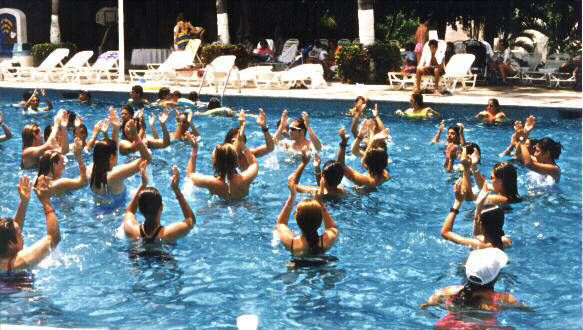
The article goes on to say that part of the problem is a series of studies with conflicting results. While any exercise is better than no exercise, vigorous exercise provides the maximum health benefits. You can read the rest of the article HERE.
Rubberlegs
My friend is finally back, and oh! We are so happy to see each other again. So today we got together with all kinds of new exercise equipment and ideas. After looking at photos, we spent an hour doing aqua-aerobics. Actually, that was enough for me. It was a great day to be outside, the pool was just cool enough – not like a hot tub and not so chilled your toes turn blue, but just right – and it was very very private. We could look as foolish as we wanted and no one cared.

(Cartoon courtesy Everydaypeoplecartoons.com.)
Then we hit Buns of Steel, and from time to time, I totally wiped out. How can they keep smiling and breathing and talking while they are doing all these totally exhausting exercises?
And then, she showed me moves on the exercise ball that i can’t even comtemplate right now. First I have to learn how to keep my balance.
But leaving, what a disaster. I almost fell down the stairs! I don’t have Buns of Steel, I have Legs of Rubber! Looks like I need to build up my strength a little. 😦
Recent Comments
ExpatAlien on What Country am I Living … intlxpatr on Yellowstone: Old Faithful to C… Michelle on Yellowstone: Old Faithful to C… Cathy on No Grown-Ups in Charge intlxpatr on Waiting for Snow Wikipedia Donate Button

Amazina


Early Voting in Florida


 Here There and Everywhere