Doha – Pensacola – Doha
I was always a KLM frequent flyer, when my destination was Seattle, the Amsterdam – Seattle direct flight was the least hassle from Kuwait. From Doha, however, there is an annoying stop in Dammam. a ghostly airport in Saudi Arabia, where all the men who have been working on the oil rigs and in isolated locations get on. Some families also board, but most of the passengers are men who like to drink and talk talk talk in loud voices when the rest of us just want to sleep en route to Amsterdam.
Now that we are flying to Pensacola, we could still go KLM, but one time when KLM cancelled my flight and didn’t tell me, they put me on an Emirates flight out of Kuwait around six at night that got me to Dubai in about an hour, and then put me on a Delta flight that landed early the next morning, not in Amsterdam, but in Atlanta. In another couple hours I was in Pensacola.
Hmmm. Let’s see – 23 hours of flying plus seemingly endless layovers in airport lounges and an additional annoyance factor of the landing in Dammam, OR a short flight + a very long walk in the new Dubai airport to the next terminal + checking in again because the airlines are not partners (bags are checked all the way through, though, so it is only a ticketing issue) and then a very very long flight that gets you there the next morning . . . I’ll opt for the long flight. Now that Delta and KLM are partners, all my miles still count.
Downside. It is a very long flight. There are also a lot of women and children on board, and the first time, I sat next to a little boy who threw up. I felt really sorry for the little boy and his Mom, and I was nice about it, but the smell of throw up makes me feel very much like throwing up. Memorable flight.
This time, because we needed to accomplish a lot in a hurry and needed to be at our best from the moment we arrived, we went business class. Wooo HOOO. I love the Business Class on this flight. All the things that matter to me – Privacy . . . Comfortable Sleeping . . . Quiet cabin . . . relatively clean restrooms . . .
This is what the sleeping pod looks like:


En route back to Doha from Pensacola, when I got to the departure terminal, there was an extra delight – a live pianist in the food mall. I don’t know if this is a paid pianist or a volunteer but she was GOOD! She was also enthusiastic and lively, and played a bunch of old Beatle’s songs. It brightened up what might have been a dull time.

After all that Grandmama-ing and house buying, I was exhausted, and I really slept a lot all the way home. I am paying for it now. I have never had jet lag so extreme or so long. Almost a week later, I am still unable to sleep through the night, falling asleep at weird times, like 8 p.m. and waking up around 2 in the morning. Aarrgh.
Other than that, my life is very dull right now. Packing boxes. Toting things I won’t need – 220v appliances, for example – to people that might need them. Packing more boxes, clearing out cupboards, trying to figure out what I need to keep and what I can freely freely give. Didn’t I just do this? Like yesterday? Leaving Kuwait for Doha?
Some nights I cook, some nights we go out to old favorite restaurants we want to hit one more time – The Majlis. The Little Sailor. The Beirut. Beijing. Royal Tandoor. Places we know we will miss when we are living in Pensacola. Trying to figure out what to take with me in suitcases, what to ship in our limited air cargo, and what I can live without for three months (!)
Of course, the carrot on the end of this long stick is living near our son and his bride and our little grandson. 🙂 Makes it all worthwhile.
Some ‘adventures’ are more irksome than others. This moving stuff is getting old. For those of you who are asking in the background, yes, the Qatteri cat goes with us. He is a member of our family!
Daiso No longer Allowed to Sell Toys in US due to Violations
From U.S. Consumer Product Safety Commission on AOL News: Wallet Pop
Daiso To Pay $2 Million Civil Penalty for Violations of Federal Safety Laws and Must Stop Importing Children’s Products and Toys Into U.S.
(Tue, 02 Mar 2010 22:40:00 GMT)
The U.S. Consumer Product Safety Commission (CPSC) announced today that Daiso Holding USA Inc., Daiso Seattle LLC, of Seattle, Wash. and Daiso California LLC, of Hayward, Calif. have agreed to pay a $2.05 million civil penalty and stop importing children’s products and toys into the United States. Due to alleged violations of federal safety laws, the company must now demonstrate to the Commission that it has sufficient knowledge of and is in compliance with CPSC safety standards and testing requirements.
I didn’t even know we had Daiso’s in the US, stores where you can find amazing things at very cheap prices. I know them from Qatar, where there is a Daiso at Hyatt Plaza, and I also think there is one in Kuwait.
Traditional Qatari Architecture Saves on A/C
If, like me, you have any interest in traditional Gulf architecture, and in understanding what works in Gulf countries – and what doesn’t – I urge you to visit a wonderful resource, John Lockerbie’s blog on a variety of things including Islamic design. Clicking on the blue type will take you to a menu with so many items you can get lost for hours. I discovered it one day when I needed information to help me identify the traditional boats, which I love. John’s blog has been a constant resource for me when I have questions about the things I see. . .
Traditional Qatari buildings save on air-conditioning
Web posted at: 3/2/2010 6:26:27
Source ::: The Peninsula
Doha: Buildings and places need to be designed and developed in a sustainable way to allow communities to be less reliant on air conditioning and cars. Sustainable design can lead to cost and energy efficiencies, enhanced lifestyles and a reduced impact on climate change.
This is the view of Tim Makower, partner at Doha-based architects Allies and Morrison, who will be presenting his thoughts and ideas at the Sustainability and the Built Environment Seminar tomorrow, which has been organised by the UK Trade & Invest section of the British Embassy in Doha.
“Air conditioning is not the only way to cool a building, especially in the more temperate months of the year. The Gulf faces extremely hot weather for three, arguably five, months of the year and during this time air conditioning is essential, but for the rest of the year, the weather is very pleasant and architects, engineers and developers should explore alternative ways to cool buildings during these months,” said Makower.
Allies and Morrison opened an office in Doha in summer 2009 and over the last three years has helped to develop the ‘Architectural Guidelines’ for the Dohaland’s 35 hectare development Musheireb, (formerly Heart of Doha).
It is also designing the Diwan Annexe and the National Archive buildings within the first development phase of Musheireb. Both buildings will be two of the first LEED Platinum buildings in Qatar.
Makower said far more air conditioning is used than necessary. He believes that by reducing the reliance on air conditioning there would be some clear benefits, including cost savings and being more eco-friendly due to lower energy consumption.
“We need to design places and buildings that allow people to respond to the climate and live in more harmony with the seasons. For instance, people should be provided with the choice to switch off their air conditioning and open a window during the winter months; for many people that is the most comfortable way to live,” Makower said.
“What could be better than being given greater choice, greater comfort and cost savings all in one go? We are designing homes and work places now which can be dramatically opened up on to external courtyards and balconies in good weather.”
Makower said this flexibility should also extend to the use of the car. He passionately believes that places should be designed to be pedestrian-friendly and that streets should be naturally cooled so that people can choose to walk to schools, shops, the mosque or to work during the cooler months, instead of having to use their cars and face traffic congestion.
“I don’t question the right to use air conditioning or a car, but I believe that we should design places and buildings that give people the choice to switch off their air-conditioning and leave their car in the garage,” he said. During his presentation, Makower will explain how using inventive solutions, which are often founded in traditional Qatari methods and building techniques, can naturally cool buildings.
For instance, buildings can be cooled by incorporating wind-catchers or using thick walls. They can also be positioned to capture the prevailing winds and sea breezes and be related to the sun’s path to create optimum shade.
This can be supported by architectural features such as projecting cornices, canopies, colonnades and screens, all of them traditional Qatari motifs. Re-introducing the traditional form of the narrow lane, or Sikkat, is another way to create shaded spaces with modern buildings.
“Over and above energy related issues, sustainability is about minimising waste and creating lasting places. Buildings and neighbourhoods should be built to last, while still allowing for the natural process of gradual change and regeneration rather than wholesale demolition. It is Dohaland’s intention to retain and maintain the Musheireb in the long term, and to ensure that it is built to last.”
The Sustainability and the Built Environment Seminar will be held at 8.30am on March 3 at the Diplomatic Club in Doha.
Qatar Initiates Solar Energy Plan
Woooo HOOOO, Qatar, for not depending on a non-renewable energy source, but continuing to develop strategies for survival into the future. And Qatar definitely has an abundance of solar power. But then again – so does Kuwait.
Qatar to tap solar power in a big way
Web posted at: 3/2/2010 6:29:33
Source ::: THE PENINSULA/ BY SATISH KANADY
DOHA: Qatar is all set to tap its abundance of solar power. Two leading international agencies yesterday announced their decision to partner with two Qatari entities to produce the green energy in the country.
SolarWorld AG, one of the world’s largest solar companies, will partner with Qatar Solar Technology (QST), in which Qatar Foundation (QF) has a major stake. Separately, the Institute of Technical Thermodynamics, German Aerospace Centre (DLR), will partner with the country’s ambitious Qatar National Food Security Programme (QNFSP).
Qatar Solar Technology marks the entry of QF into the solar energy sector. QF will have a 70 percent stake in QST, with SolarWorld holding 29 percent and Qatar Development Bank the remaining one percent.
The initial investment in QST is valued at over $500m, QF said.
Through the joint venture, solar grade polysilicon, the essential ingredient of solar panels, would be produced in the first phase.
QST will develop a new plant in Ras Laffan Industrial City, in the northeast of Qatar, which will be one of the first operational polysilicon plants in the region. The plant will produce well over 3,500 tonnes per annum of the material and will be designed with future expansion in mind, which will enable it to significantly increase production capacity.
You can read the rest of the article, including contributions by Texas A&M, by clicking HERE
Oh! Didn’t It Rain!
I love it that this YouTube version of Mahalia Jackson’s rendition of “Oh Didn’t It Rain!” starts out with photos in Wadi Rum in Jordan, a couple peeks at Petra, and as the camera backs off, the effects of wind and rain on the topography of the Wadi Rum area. We camped there for three nights, lo, these many years ago, going on camelback into the deeper parts of the canyon. It was unforgettable.
My trip back into Doha last night was unforgettable.
In what is usually the most mundane of flights, we found ourselves bumping up and down with lightning striking all around us, from about the halfway point all the way into Doha. I’ve never had a lot of faith in the aerodynamics that keeps airplanes up in the air, and seeing flashes of lightning all around me was a genuinely religious experience, LOL.

(From article on lightning strikes plane in Japan: According to a Scientific American article about lightning strikes and aircraft, its is “estimated that on average, each airplane in the U.S. commercial fleet is struck lightly by lightning more than once each year”. However, the article notes that the last crash directly attributed to a lightning strike occurred back in 1967 when the fuel tank exploded.)
At the airport, all the baggage handlers actually had on rain-gear, and on the way home, there were deep pools where drains have clogged. And, as AdventureMan said, when you live at sea level, just where is the water going to drain?
I am so thankful to be home. Home for the next scant three weeks, anyway, as I pack up all those boxes once again for what we think will be (one of) our last moves. Sorting, giving away, “can I live without this if I leave it behind?” “Will I regret it forever if I leave this behind?” “Is there someone who could give this a good home?”
I have two great avenues of disposal; my own church, where incoming church personnel can make use of household goods and not have to buy everything new, and my housekeeper’s church, where they cherish anything they get.
Grabbing a Half Day
While most of my time has been spent joyfully grandmama-ing, I was feeling increasing anxiety about one thing. I am flying back to Doha to pack, and then I am flying back to Pensacola to close on the house, and wait for AdventureMan to join me, and then all our furniture and household goods that have been in storage a lifetime – twelve years – will arrive.
Oh oh. Where do we sleep until our bed arrives? We COULD invade our dear son and his sweet wife once again, but don’t you think enough is enough? Would you want your parents and in-laws living with you, week after week, with all our well-intentioned advice, and stories about our son when he was young?
No? LLOOLLL, me neither!
So yesterday, I took an afternoon to myself.
First, I had learned that the Pensacola Quilter’s Guild was having their bienniel (once every TWO years) show this weekend, Friday and Saturday. There is little that can take this adoring grandmama away from her most adorable brand-new grandson, but I will admit it – a quilt show – that is beyond temptation. I had to go, even just for an hour. I went, joined the guild, hurried through the exhibit, which was GLORIOUS! and then I went furniture shopping.
Furniture shopping is not what it used to be. I have some lovely furniture in storage, but not a huge amount of it. Some of it we sent off with Law and Order Man when he went off to law school and needed some basics. Some of it is just outdated – like televisions from the 90’s! I figured I would just look for the basics – bed, mattress and table and chair. We will have a place to sit when we are not sleeping, and we can buy the TV’s together, later, with our son’s help. We need the help of the high-tech-savvy to get us up to speed on what we will be needing, phones, TV’s, cable connections, phone plans, internet connections, oh, it is as bad as buying a new car!
When we were still in the military, we found a dining room table and chairs, gorgeous, at an auction, for $169. We found marble topped antique oak nightstands, gorgeous, at the flea market in Metz, and paid $60 for the pair. We found a gorgeous buffet/credenza in a used furniture shop in Leavenworth, KS for $50 + $10 for delivery, all these are furniture pieces we still treasure. I am telling you this so you will understand what sticker shock I get when I go to look at new furniture.
I am quick and clear about what I want and need, but the prices require me to summon all the courage I can summon when I go to write the checks. I am good at saving. Letting that money go is so HARD. It took me the entire afternoon to find pieces I knew would work for us.
Here is where you will sleep, the guest room bed, when you come to stay with us:

It was on sale. I love it because, with the inlay, it sort of reminds me of the Middle East, of Damascus:
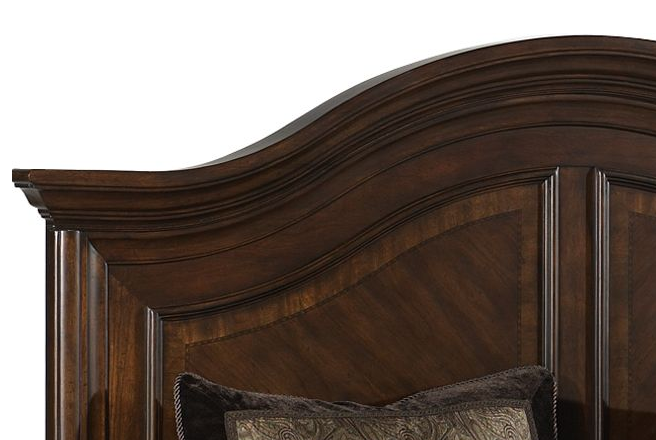
I also bought mattresses. It was difficult, too, because I don’t like these pillow tops. We like a good, firm bed, and I like to sleep cool, I can’t get to sleep if I am too warm, and these pillow tops are too warm. It took me a long time to find a good, firm mattress set for the bed.
Then I went looking for a table and chairs for the family room/ casual dining area. I knew what I wanted. My long-time Chinese friend told me the best table for families is the round table, no one sits at the head, everyone is equal. My sister Big Diamond (Little Diamond’s and Sporty Diamond’s Mom) has a HUGE, gorgeous round table, and I have seen how people love to gather there. So I knew I wanted a round table that would be inviting and comfortable, but not so grand as my sister’s. I have been looking online, checking out a lot of models. When I found one here in Pensacola, at a reasonable price, I was hooked. It is light teak – light in color, heavy in weight. OOps. Then she reminded me I would need chairs. Aaarrgh.
There weren’t any other customers in the shop at the time, so we took our time. As I learned from you, my Middle Eastern friends, we dickered a little, comfortably and amiably – and she gave me a discount, and free delivery.


The chairs are amazing. You would not believe wood could feel so comfortable. The table and chairs together remind me so much of all our times camping and in lodges in Africa, in Zanzibar, in Zambia, in Botswana, where the furniture is both comfortable and well made. But I almost choked, writing the check. Some things are just worth buying new; sturdy, comfortable furniture is one of them.
Here is the guest bathroom:
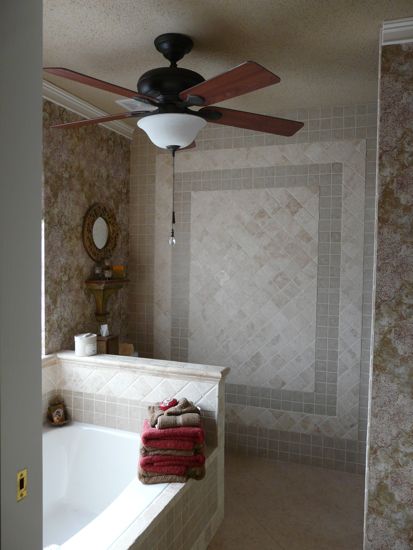
It has a spa tub and a walk in shower. 🙂
Last but not least, I found some farewell gifts for friends I have had in Doha for a long long time, and a bolt of muslin for a friend who knows I am coming back with suitcases almost empty. 🙂 It was a long day, and a fruitful day, and I am resting easier knowing all these little details are coming together.
Today, however, my son and his wife are taking me to the kinds of places I LOVE buying furniture! The Waterfront Mission Store and Loaves and Fishes! Wooo HOOOOO!
Thing Younger, Act Younger, BE Younger
A couple of my friends and I were trying to figure out why we were friends. What goes into making friendships? One thing that surprised us was that we tended to choose people with some risk-taking behaviors – people who look ‘normal’ and conservative on the outside, but are thinking outside-the-box on the inside. They are thinking all the time, observing and analyzing and making choices that set them aside from others. For one thing, here we are, all living in Qatar – and that is a choice. Our lifestyles are a choice.
Most of my friends are a lot of fun – you would like them. And it might take you a while to figure out we are all total nerds, very uncool people. One of the very coolest sent me this. On the inside, this woman is into EVERYTHING! On the outside, she obeys the conventions. On the inside, she is thinking all the time. 🙂
This study, from BBC News Magazine is amazing. But don’t believe me! Listen to the broadcast! See the movie! Imagine yourself 20 years younger (please! not those of you in your 20’s!) and start acting YOUNGER!
In 1979 psychologist Ellen Langer carried out an experiment to find if changing thought patterns could slow ageing. But the full story of the extraordinary experiment has been hidden until now.
How much control do you have over how you will age?
Many people would laugh at the idea that people could influence the state of their health in old age by positive thinking. A way of mitigating ageing is a holy grail for the pharmaceutical and cosmetics industry, but an experiment by Harvard psychologist Ellen Langer three decades ago could hold significant clues.
Prof Langer has spent her entire career investigating the power our mind has over our health. Conventional medicine is frequently accused of treating them as separate entities.
“Everybody knows in some way that our minds affect our physical being, but I don’t think people are aware of just how profound the effect actually is,” she says.
In 1979, Prof Langer conducted a ground-breaking experiment – the results of which are only now being fully revealed.
Prof Langer recruited a group of elderly men all in their late 70s or 80s for what she described as a “week of reminiscence”. They were not told they were taking part in a study into ageing, an experiment that would transport them 20 years back in time.
The psychologist wanted to know if she could put the mind back 20 years would the body show any changes.
The men were split into two groups. They would both be spending a week at a retreat outside of Boston.
Ellen Langer in 1979 and today
But while the first group, the control, really would be reminiscing about life in the 50s, the other half would be in a timewarp. Surrounded by props from the 50s the experimental group would be asked to act as if it was actually 1959.
They watched films, listened to music from the time and had discussions about Castro marching on Havana and the latest Nasa satellite launch – all in the present tense.
Dr Langer believed she could reconnect their minds with their younger and more vigorous selves by placing them in an environment connected with their own past lives.
And she was determined to remove any prompt for them to behave as anything but healthy individuals. The retreat was not equipped with rails or any gadgets that would help older people. Right from the off she was determined to ensure they looked after themselves.
One man discarded his walking stick
When they got off the bus at the retreat, Prof Langer did not help the men carry their suitcases in. “I told them they could move them an inch at a time, they could unpack them right at the bus and take up a shirt at a time.”
The men were entirely immersed in an era when they were 20 years younger.
Understandably, Prof Langer herself had doubts. “You have to understand, when these people came to see if they could be in the study and they were walking down the hall to get to my office, they looked like they were on their last legs, so much so that I said to my students ‘why are we doing this? It’s too risky’.”
But soon the men were making their own meals. They were making their own choices. They weren’t being treated as incompetent or sick.
Pretty soon she could see a difference. Over the days, Prof Langer began to notice that they were walking faster and their confidence had improved. By the final morning one man had even decided he could do without his walking stick.
As they waited for the bus to return them to Boston, Prof Langer asked one of the men if he would like to play a game of catch, within a few minutes it had turned into an impromptu game of “touch” American football.
The experiment took the men back to 1959
Obviously this kind of anecdotal evidence does not count for much in a study.
But Prof Langer took physiological measurements both before and after the week and found the men improved across the board. Their gait, dexterity, arthritis, speed of movement, cognitive abilities and their memory was all measurably improved.
Their blood pressure dropped and, even more surprisingly, their eyesight and hearing got better. Both groups showed improvements, but the experimental group improved the most.
Think younger, feel younger?
Prof Langer believes that by encouraging the men’s minds to think younger their bodies followed and actually became “younger”.
She first published the scientific data in 1981 but she left out many of the more colourful stories. As a young academic, she feared this might taint the experiment and affect the acceptance of the results.
Now after over 30 years of research into the connection between the mind and the body and with the confidence and conviction of a Harvard professor, she feels she has a fuller story to tell.
“My own view of ageing is that one can, not the rare person but the average person, live a very full life, without infirmity, without loss of memory that is debilitating, without many of the things we fear.”
Richard Wiseman, professor of public understanding of psychology at the University of Hertfordshire, thinks the results of Prof Langer’s experiments are fascinating but the big question is what’s causing them. “I think there could be multiple things going on here and the question is which explanations really hold water.
Why some people age faster than others is mysterious
“Part of it could be self perception, for example if you get people to smile they feel happier. The same could be going on here, by getting people to act younger they feel younger.”
Prof Weisman believes another factor could be motivational, the men are simply trying harder by the end of the week, or it could be similar to hypnotism, where people do better on memory tests because they are told they have a better memory.
Whatever the cause he believes there is a place for the type of positive thinking shown in the study.
“If you take something like heart disease positive thinking can have a role, because while it won’t heal your heart on its own, positive thinking will feed into positive actions like healthy eating or exercise which will help.”
In any event there is likely to be more interest in the 1979 experiment. The retelling of the study has been snapped up by Jennifer Aniston’s new production company, with Aniston tipped to play Prof Langer.
(FIND OUT MORE
Horizon: Don’t Grow Old is available via iPlayer and will be repeated at 0250GMT on BBC One on Tuesday 9 February)
To Kuwait: Happy Liberation and Independence Days Celebrations
Wishing all my Kuwait friends all the blessings of liberty, and independence.
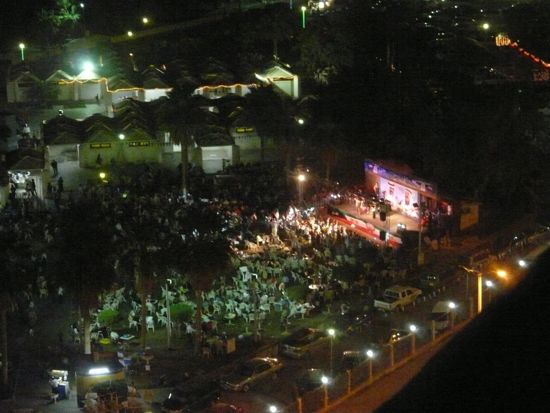

I always remember February in Kuwait as being one of the nicest months of the year – so how is it this year? My friends in Doha tell me they are having a heat wave!
The Five Legged Dog
“It’s like trying to buy a five-legged-dog,” my friend started out. When a friend starts a conversation with an opener like that, she has my full attention. “You look and you look, but you know at some point your going to have to give up one of the legs to find a dog to buy.”
We had been talking about house hunting. You know what you want. This house has most of it, but that house has all of it, at a price you can’t afford. Another house has everything, at a price you can afford, but you can see endless maintenance costs associated with ownership of that property. In short . . . there is no five legged dog. Somewhere along the way, you give up wanting it all and settle for good enough.
I think about that friend and her saying often. It’s become a family catch-phrase, they have heard me tell it so often. We’re all in search of that five legged dog.
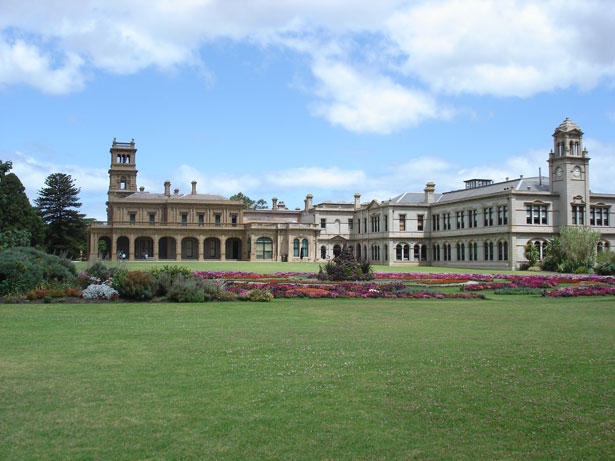
(photo from public domain pictures)
Recent Comments
ExpatAlien on What Country am I Living … intlxpatr on Yellowstone: Old Faithful to C… Michelle on Yellowstone: Old Faithful to C… Cathy on No Grown-Ups in Charge intlxpatr on Waiting for Snow Wikipedia Donate Button

Amazina


Early Voting in Florida


 Here There and Everywhere