Qatar ‘ONE OF US’ Campaign – Nice Touch
Expat women who don’t wear enough clothing has long been a bone of contention for traditional and conservative Qatari women, who find themselves a minority in their own country. I remember well the anguish in the voice of one of my friends talking about how the salesgirl her mother was speaking with was showing “everything” AND she didn’t even speak Arabic, only English. Her mother was wondering whose country Qatar was?
Qatar doesn’t want to go to the extreme lengths of Saudi Arabia, they just want the non-Moslem, non-local women to cover up a little. Oh! Not just the women, the men, too! It’s a cute campaign – If you’re here, you’re one of us. I like it. It has a welcoming sound, but at the same time it politely reminds the expat that we are a guest in their country. This is the expectation, stated politely. Here is one of the visuals
(I found this article on Doha News)
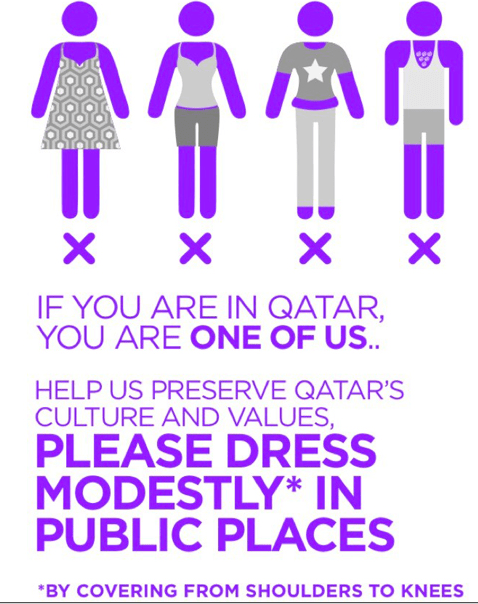
A grassroots modesty campaign started by a group of Qatari women this summer has received the backing of the Qatar Tourism Authority, with the goal of helping visitors and expat residents “avoid embarrassment” and “feel welcome” here, the group has announced.
The “One of Us” drive, which was launched in June, highlights the part of the Qatari penal code that prohibits wearing “indecent” clothing in public, but adds to it by clarifying what exactly is deemed inappropriate – namely, bare shoulders and legs.
QTA will ensure that the dress code campaign guidelines will be displayed on posters in shopping malls and public spaces. They will also be posted on the QTA website and in future guides and brochures that the group publishes.
In June, campaign organizer Najla Al-Mahmoud told Doha News:
I don’t blame foreigners as they come from a different culture and they don’t know that it’s not acceptable… that’s why a group of ladies from different group of age gathered and decided to do something for Qatar…
We don’t want to interfere with anyone’s religion and force them to wear hijab … we only want modest clothing. It’s a matter of etiquette and class. We want to be able to go to public places without a lot of flesh around us.
Despite organizers’ efforts not to raise hackles, the campaign sparked a fierce debate on social media and Doha News about local/expat relations and the definition of decency.
Commenter J wrote:
This is a tricky issue for ex-pat women here as being “modest” is relative. And there are lots of mixed messages. You may see a young Muslim woman wearing a Shayla, a long, loose skirt, and the tightest long-sleeve shirt you’ve ever seen, leaving little to the imagination. And men wear tight t-shirts, tight skinny jeans, and shirts with the first three buttons open showing their chest. I think this campaign should not be aimed at everyone, not just at ex-pat women.
Others said they supported the campaign and expressed appreciation for having concrete guidelines to follow.
Meanwhile, Qatar University rolled out its own dress code in September, to mixed reaction from the student body, who are now prohibited from wearing tight, revealing clothing (including tight abayas) and casual wear like sweatpants and Bermuda shorts.
The Monarch Caterpiller Ornament
Only a friend can know you so well as to send you a gift like this. When I arrived home from Seattle, this was waiting, and we had to unwrap it right away. When I saw it, I laughed, and ran to show AdventureMan, and we nearly danced for joy, it is so perfect for our tree.
AdventureMan loves butterflies, is creating gardens to attract butterflies, and my sweet Doha friend was looking for a Monarch butterfly ornament, but instead, she found the caterpillar.

How perfect for Advent! We love the season of expectation, waiting for the birth of this dear little babe who will make all the difference. The caterpillar is the form of the Monarch before it goes into the caccoon and transforms into the Monarch. Perfect for the season of waiting expectantly 🙂
Fairbanks, Alaska or Brazil

I would have loved to be able to actually watch and see when the actual 2 millionth visitor visited, but as it does, life got in the way. There were things that needed doing, people that needed time and attention, and I by the time I got back to check, I had already gone over.
Using StatCounter, I was able to go back 78 people and figure out that it was either the visitor from Brasil or a visitor from Fairbanks, Alaska.
A couple times, I have thought I would quit blogging, like when I hit 5 years, then six, or maybe when I hit 2 million hits . . . Now, I don’t know. There are times when it is hard to get inspired, hard to think of anything I might have to say that you might find interesting, too.
I have a little trick. When I am stumped, I think of our aqua aerobics group in Doha, Qatar. We weren’t very serious, but we were very committed. We had to show up because the others counted on us. Our motto was “any exercise is better than no exercise” and on very cold days in January, exercise counted as sitting in the hot tub and kicking. We talked to pass the time, and not to think about exercising. We talked about books we had read, dishes we had cooked, movies we have seen, and events in the news. So when I can’t think of anything much to say, I think about my friends, the Aqua Babes (LOL!) and I can usually come up with something.
A long time ago, in Kuwait, there was a blogger called (something) Red, I followed, and she thought about quitting and asked us to give her reasons why or why not. I remember writing that we blog because it’s what we do, we write because it is something in us that needs to be written. Until I wrote that to her, I didn’t even know that I thought that. I guess that is why I keep on, because there is something in me that needs to do what I am doing, and when I don’t need to do it, I will stop.
Libyans Say “Sorry” In Counter-Protests
I was living in Qatar, and the Libyan ambassador’s wife had invited me, along with several other women, to morning coffee. It’s what people did. I was sitting between one of my Libyan friends and my good Iranian friend, and I started laughing. I said “Oh, what is this good little American girl doing sitting between a Libyan and an Iranian?” and then we all laughed. We weren’t Libyan, or American, or Iranian, we were just women who liked each other; we got along.
We were all religious women. Not the same religion, but all believers in the Abrahamic tradition. I felt more comfortable with them than I felt around non-religious women. We had a lot of fun together, and we liked each other.

It breaks my heart when bad things happen, and I know how good these people are, and that the people on the attack have their own agenda which has nothing to do with Islam, or Christianity, and everything to do with power. If they prevail, I fear for my good friends.
This article from USA Today made me cry this morning. Ambassador Stevens was loved, and these brave people are risking their futures to tell us so.
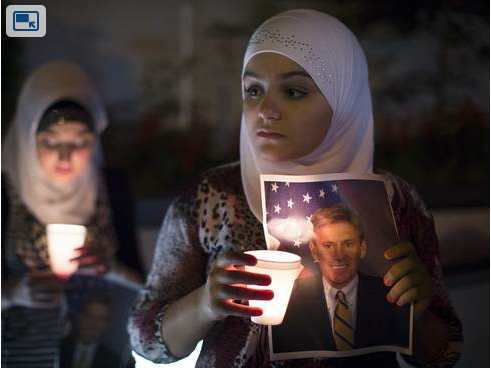
Libyans express sorrow over killing of Americans
by Donna Leinwand Leger, USA TODAY
Hours after learning of Ambassador Chris Stevens’ death, the Libyan Youth Movement transformed its Facebook page into a tribute to the slain diplomat. It changed its cover photo from “Free Libya” graffiti sprayed on a Tripoli wall to a somber photo of Stevens with the tag “RIP Christopher Stevens1960-2012.”
“As North America wakes up, dread washes over me. What a rough night. I’m sorry for the horrible day the world is about to face,” the administrator of the Shabab Libya page wrote. “We are sorry.”
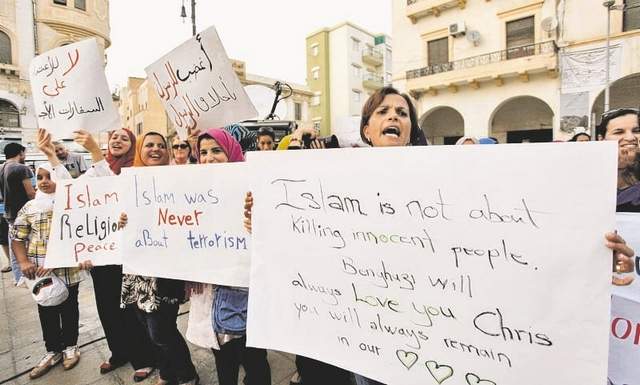
As anti-American protests swept across North Africa and the Persian Gulf, a counter-protest of apology emerged. Photos of Libyans carrying hand-lettered signs condemning the violence and expressing contrition for their countrymen appeared on Facebook. “Sorry” became the trending mantra of Libyans on Twitter.
At one counter-protest, an unidentified man carried a crude sign phonetically written in English with blue marker on lined notebook paper, “Sorry People of America this not the Pehavior of our ISLAM and Profit.”
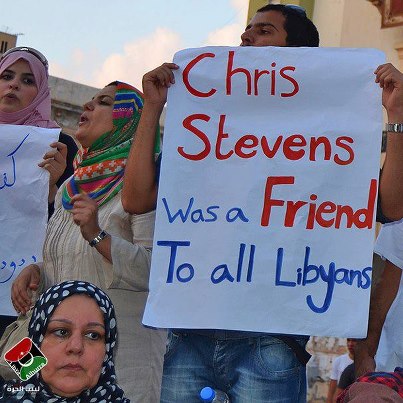
Another sign in red, white and blue read: “Chris Stevens wasa friend to all Libyans.”
On Facebook, one group formed The Sorry Project, designed to collect thousands of personal, written apologies from Libyans. Its profile photo is a man holding a sign, “USA. We are sorry. We are sad.”
“We Are Sorry,” the group wrote on the page created Sept.11. “We would like show that as Libyans we do not support on the actions committed by these criminals. USA, we are sorry and we will say it one thousand times over. Our apologies will never be enough, but the Libyan people will always be grateful for you since you were the first to stand by us in our fight for freedom and hopefully you will continue supporting us.”
One commenter, Hajer Sharief, vowed to avenge Stevens’ death by rebuilding a “new civilized democratic Libya.”
“We promise, we will not tire, we will not falter, and we will not fail,” Sharief wrote. “This is the way real Libyans will pay you back Mr. Ambassador Chris Stevens.”
At the ceremony Friday outside Washington to repatriate the remains of the four American victims, President Obama acknowledged Libya’s internal conflict.
“I know that this awful loss, the terrible images of recent days, the pictures we’re seeing again today, have caused some to question this work. And there is no doubt these are difficult days. In moments such as this — so much anger and violence — even the most hopeful among us must wonder,” Obama said. “But amid all of the images of this week, I also think of the Libyans who took to the streets with homemade signs expressing their gratitude to an American who believed in what we could achieve together. I think of the man in Benghazi with his sign in English, a message he wanted all of us to hear that said, ‘Chris Stevens was a friend to all Libyans.’ “
Shar’a Kaharabaa Today
One of our favorite places in Doha was Shar’a Kaharabaa, Electricity Street. Bombay Silk was there. the old Beirut restaurant was there and several very good and reasonable tailors worked there. All good quilters knew the Mumtaz Tailor, who had every notion in the world, and good prices, and knew where everything could be found in the chaos of his shop. You could always find parking.
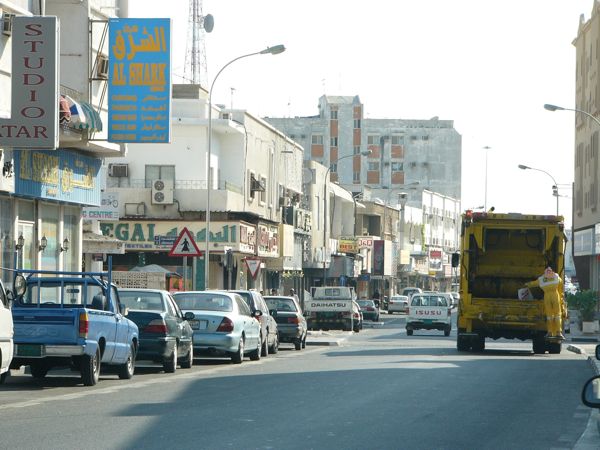

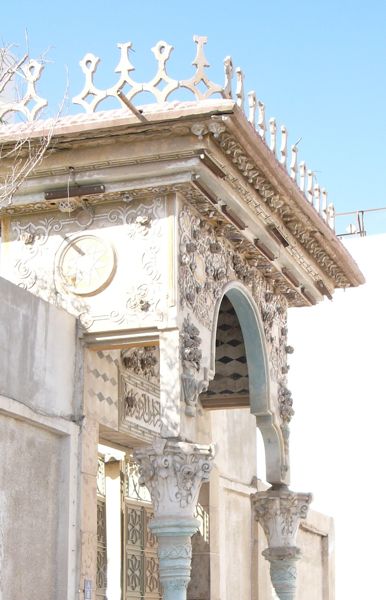
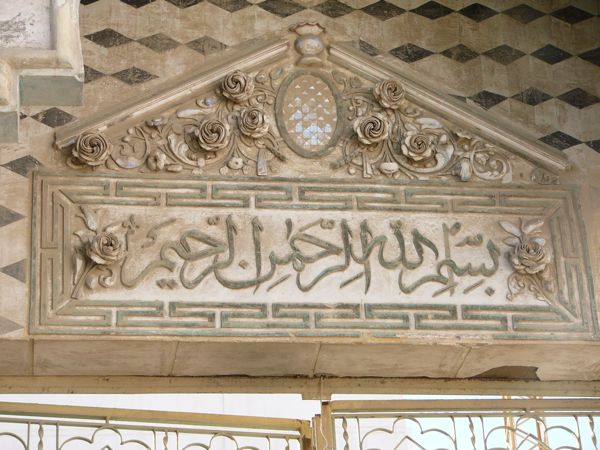
I dared to take a look at Sharia Kharabaa this morning, and I shouldn’t have. It’s that bare spot middle left. Al Rayyan, at the top of the photo, leads to the Souk al Waqif. One day, the old picturesque Sharia Kharabaa is supposed to be a grand walk way to the Souq.

The Cheesecake Factory in Alpharetta, GA
“You’ve never been to a Cheesecake Factory?” my Kuwait friend would ask me (more than once) in astonishment. She loved the Cheesecake factory. She could describe the dishes on the menu at length, fondly, nostalgically, and all the desserts, how delicious each was, how big they all are, how she would love one right now! In all these years, I just haven’t been in the same area as a Cheesecake Factory restaurant, which I understand is a chain.
We were visiting Alpharetta, GA, visiting old friends from our time living in Qatar, and they invited us to dinner at the Cheesecake Factory. Wooo HOOO! Now’s my time to find out what it’s all about, but before I go, I go online and check the menu, and wooo HOOO again, now they have a Skinnylicious menu. I had dreaded that everything on the menu was huge portions and like three days worth of caloric count and a week’s worth of glycemic index count, but no, now they have a Skinnylicious menu!
We had a wonderful time. First, you know, anyplace is special when you are with people and the conversation flows fast and furious. These were people you could talk about the important things with, like how we live our lives, what we want, what place compassion plays in our lives – you know, the important stuff. It’s all good when you are together with people that share your vision.
Now – the restaurant. It is clearly THE place to dine in Alpharetta, GA. They don’t take reservations, and we waited about 45 minutes to get in. When we left, around 9:30 pm, there was still a waiting line, maybe 30 minutes instead of 45, but the place was teeming with customers.
When we got seated, AdventureMan was up at one end with his friend, talking business, and I was at the other, and I think we had more fun 🙂 My end of the table was Skinnylicious!
Even though my Chinese Chicken Salad was Skinnylicious, I couldn’t eat it all, there was so much, so I took it home and had the rest the next day.

Skinnylicious Grilled Salmon:

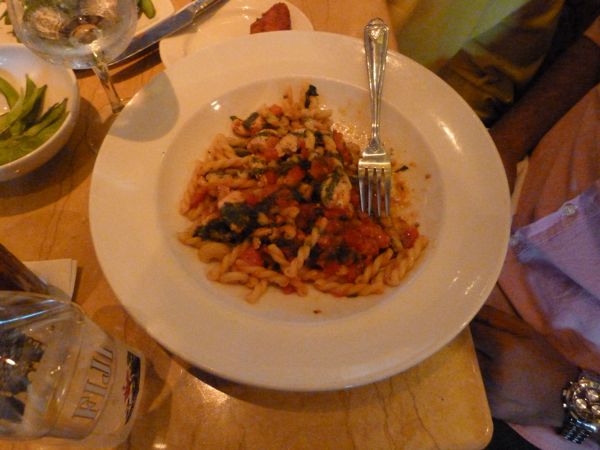
Skinnylicious Pasta:
Club Sandwich:

Sirloin Steak

The Skinnylicious End of the table all carried food home, LOL!
We had carrot cake for dessert, two pieces and 6 forks, but we still couldn’t eat it all, and I am sorry, it was so good and I didn’t even take a photo. They have a lot of really really good desserts. They also do take-out cheesecakes.
Good friends, good conversations, good food! It was a very fun evening with people we like.
Glimpse of Doha from I <3 Qatar
Thank you, I Love Qatar, for sending this new Glimpse of Doha so we can keep up with some of the changes. 🙂
Driving in Qatar
Almost every day, the two articles garnering the greatest number of hits have to do with new traffic rules in Kuwait and in Qatar. I think I wrote the posts in 2009. Here is what the US Department of State has to say to US Nationals about driving in Qatar:
TRAFFIC SAFETY AND ROAD CONDITIONS: While in Qatar, you may encounter road conditions that differ significantly from those in the United States. The information below concerning Qatar is provided for general reference only and is subject to change at any time. Current traffic regulations may be obtained through the Ministry of Interior’s Traffic Police.
Short-term visitors should obtain a valid International Driving Permit prior to arrival and should not drive in Qatar on a U.S. driver’s license. New and prospective residents should obtain a permanent Qatari Driving License immediately after arrival. To obtain a Qatari driver’s license, U.S. citizens need to pass a driving exam, including a road test. Short-term visitors and business travelers can also obtain a Temporary Qatari Driving License by presenting their U.S. driver’s license at any branch of Qatar’s Traffic Police.
Traffic accidents are among Qatar’s leading causes of death. Safety regulations in Qatar are improving, thanks to a more stringent traffic law adopted in October 2007 and a country-wide traffic safety campaign. However, informal rules of the road and the combination of local and third-country-national driving customs often prove frustrating for first-time drivers in Qatar. The combination of Qatar’s extensive use of roundabouts, many road construction projects and the high speeds at which drivers may travel can prove challenging. The rate of automobile accidents due to driver error and excessive speed is declining but remains higher than in the United States. In rural areas, poor lighting, wandering camels and un-shouldered roads present other hazards.
Despite the aggressive driving on Qatar’s roads, drivers should avoid altercations or arguments over traffic incidents, particularly with Qatari citizens who, if insulted, have filed complaints with local police that resulted in the arrest and overnight detention of U.S. citizens. Drivers can be held liable for injuries to other persons involved in a vehicular accident, and local police have detained U.S. citizens overnight until the extent of the person’s injuries were known. Due to its conservative Islamic norms, Qatar maintains a zero-tolerance policy against drinking and driving. Qatar’s Traffic Police have arrested Americans for driving after consuming amounts of alcohol at even smaller levels normally accepted in the U.S.
Any motor vehicle over five years old cannot be imported into the country. For specific information concerning Qatari driver’s permits, vehicle inspection, road tax and mandatory insurance, please contact either the Embassy of the State of Qatar in Washington, DC or the Consulate General of the State of Qatar in Houston, Texas.
There are things that the Department of State is too diplomatic to tell you, and that people living there will not write for fear of having a travel ban put against them, a case filed against them for ‘insulting’ a national or the government.
The beautiful roads in Qatar were wonderful when they had a tenth of the cars on the road they have now. There are two categories of “most dangerous.” One category is the expat $200 car held together with gum and rubber bands that breaks down in the worst possible place, or has a blow-out, or hits someone because the driver not only doesn’t have a license, he also doesn’t know how to drive.
Although there are rules about what trucks are allowed to haul and how it is to be tied down, the laws are ignored and unenforced. It is still important never to travel behind or beside a truck carrying cement blocks. They look like they are not secured. They are not secured. Watch out, too, for any truck delivering bottled water (that makes a huge mess all over the roundabout) or sheep or cows, which regularly overturn.
The worst hazard of all is Qatari male drivers between 11 and 35 years old. They own the roads. They will drive on the sidewalks, down the wrong way of a six lane highway to get to the roundabout, through red lights. They will push you into an unsafe roundabout with the Hummer daddy bought for their 12th birthday. If you insult a Qatari young male driver in any way, they may block you, stop you and threaten you, and no one, least of all the police, will come to your aid. They know no speed limits, blow through stop lights, harass female expat drivers, and they pay no fines for traffic violations. For a short time, the law was applied somewhat equally to all, but there were so many outraged Qataris paying the humungous fines that no one enforced the law against the Qataris anymore, and you rarely see the police stopping anyone except the poorest of the poor.
If you want to drive in Qatar, you will want a sturdy car to get over the unpaved areas and the roads torn up for infrastructure improvements, as well as for protection against the aggressive Qatari male drivers and the accidents that may not be your fault but cannot be avoided. You will want to drive only during the lowest traffic times of the day, if possible. Even during the summer, when much of the population goes elsewhere, anywhere, to avoid the heat, night traffic on the major ring roads, the major arterial roads and on the Corniche is gridlock.
The Department of State will also not tell you that if you are ever in trouble on the road, you are certain to have many kind older Qatari men stop and render assistance. They will insist on giving you water, and fixing whatever they can fix, or at the very least waiting with you until help comes. If they think you are lost as you journey around Qatar, they will make sure you get where you are going. There is a long tradition of taking good care of the guest, and of civility among the Qataris, but mostly it seems to kick in when they mature – like around 35 or so.
This may not be the truth for everyone; we all have our own stories, horror stories and stories of kindness. It’s a little bit of the wild west, driving in Qatar.
Houston CC: Qatar Unable to Credit Coursework?
TThe western universities in Qatar have fought long and hard to have accountability and enforced standards . . . and there are always challenges. Here is a hilarious article about one such newer university facing significant challenges (thanks, John! )
Faulty planning may be to blame for HCC Qatar campus’s problems
By Jeannie Kever, Houston Chronicle
Updated 09:01 p.m., Saturday, February 4, 2012

As top officials at Houston Community College were collecting awards and publishing papers about their international ventures last year, their effort in Qatar was struggling with disagreements over accreditation, high faculty turnover and growing worries that the dean hired by the Qataris to lead the effort was working against them.
The problems, detailed in emails and internal documents obtained through a public records request, raise questions about whether HCC was prepared for the ambitious foreign undertaking.
The dean chosen by the Qatari government was replaced in November by a veteran HCC employee, Butch Herrod, as part of an administrative overhaul. Enrollment has reached 750 students, less than two years after HCC signed an agreement with the Qatari government to create that nation’s first community college.
But students have not received HCC credits for their classes there – a cornerstone of the promises made when the partnership was announced – and for now it appears unlikely their coursework will transfer to the six U.S. universities with operations in Qatar. After months of student protests, a deal signed last month will allow graduates of the new community college to enroll in Qatar University.
Things were so bad last spring an HCC administrator in Qatar wrote HCC Chancellor Mary Spangler that Community College of Qatar, or CCQ, had become known as “the Crazy College of Qatar.”
From the beginning, Spangler said the Qatar contract was a way to earn money as state funding dropped and property tax revenues remained flat. HCC records indicate the college has collected $640,034 from the deal; it projects a profit of $4.6 million by 2015, slightly more than expected.
Deputy Chancellor Art Tyler said in a recent interview that things now are running smoothly, and that misunderstandings are unavoidable in any international operation.
“The world is not exactly flat,” he said. “It may have gotten smaller over the years, thanks to technology, but when you’re dealing with people, with communities, you can’t know everything.”
Women taught separately
Among the things HCC didn’t know until just before classes began in September 2010: The Qatari government decided male and female students would be educated separately, contrary to the five-year, $45 million contract, which called for coeducational classes.
Former employees say that was just one of the surprises when they arrived in Qatar, ranging from delays in getting textbooks to worries over their exit visas.
“Things did not go smoothly at all,” said Randi Perlman, hired to teach English to Arabic-speaking students. “There were a lot of issues that came up … that I think didn’t need to happen.”
Overseas campuses
With more than 70,000 students, HCC is one of the nation’s largest community college systems, offering lower division academic classes and workforce training.
Over the past decade, it has become increasingly involved in international ventures, as well, with projects in Vietnam, Saudi Arabia, Brazil and Qatar.
Tyler said Qatar, located on the Persian Gulf, is a natural match for a Houston institution: energy industry ties, Qatar Airlines’ nonstop flights and the presence of the Qatar Consulate here. Six U.S. universities have campuses there, including Texas A&M.
The Methodist Hospital System has an office in the United Arab Emirates and is helping to build an ambulatory care center in the capital city of Doha.
Visa requirement
The first wave of HCC faculty and staff discovered after being hired – in some cases, after arriving in Doha – that their visas required them to get permission before leaving the country.
“That seemed to me to be a human-rights violation,” said Jan McNeil, a veteran English teacher who had previously worked in Singapore.
HCC offered interviews with three employees who worked in Qatar last year, all of whom said the visas posed no problem.
David Ross, chairman of the English as a second language and English departments in Qatar, said the system worked but acknowledged the six-day window to use the visas made timing tricky and the lack of multiple exit visas – standard for U.S. employees of American universities and companies there – provoked anxiety.
Internal emails also detail delays in preparing apartments for the expatriate employees, paying tuition at schools for their children and complaints about spotty Internet service.
“That whole piece of helping faculty and staff feel at home … was a challenge,” Tyler said.
‘A matter of learning’
Perlman, who now teaches at Texas A&M in College Station, attributed many of the challenges to poor planning, including hiring administrators – many of whom transferred from Houston – without experience working in a foreign country.
“You need people on the ground there, to help you get things done,” said Perlman. “They didn’t have that.”
Mark Weichold, dean and CEO of Texas A&M’s Qatar campus and a member of an interim board appointed last fall to govern CCQ, said missteps are to be expected.
“Watching HCC help get the community college established, some of the bumps are similar to what I’ve seen the other branch campuses (in Qatar) experience,” he said. “It’s a matter of learning how to do things in a different part of the world.”
Little control at top
But former employees and internal documents suggest HCC’s biggest problem came from a contract that authorized the Qatari government to hire the school’s chief academic official, giving HCC little control over decisions at the top.
Judith Hansen was hired by Qatar’s Supreme Education Council and served as dean until late last year.
Tyler declined to discuss the circumstances that led to Hansen’s departure in November.
Hansen, who had been forced out of the president’s job at Southwestern Oregon Community College in 2008 following three no-confidence votes by faculty and staff groups, did not respond to requests for comment.
But she was at the center of disputes over accreditation and whether CCQ could change HCC’s curriculum or claim it as its own.
She insisted on independence in an email to Tyler last winter: “The request for no assistance with (Southern Association of Colleges and Schools) accreditation means there is no need for HCC to be concerned about CCQ organizational chart,” she wrote.
‘Crazy College of Qatar’
Not so fast, Spangler said after Tyler passed on the message.
“We will not accept this response,” the HCC chancellor wrote to Tyler. “She is not calling the shots.”
Cheryl Sterling, an HCC administrator now in Qatar, wrote Tyler and Spangler last spring after Tyler acknowledged no HCC credit would be awarded for the spring 2011 semester.
“If students do not receive HCC credits this Spring, we will have a major crisis (all out war),” she wrote. “The Dean has held several forums assuring them of credits. … we are known as CCQ, the Crazy College of Qatar.”
At about the same time, faculty members issued a “no confidence” vote against Hansen.
John Moretta, a faculty member now in Qatar, was in contact with Spangler before the vote.
“She avoids me because she knows … that I know what she is doing is in direct contravention of so many HCC policies,” he wrote of Hansen. “Should we proceed with the faculty-senate vote of no confidence? … Please advise.”
Spangler replied the same day.
“The short answer is yes, and we didn’t have this conversation,” she told him.
Slow Moving Severe Weather
The last of my Doha friends left yesterday, not without moments of hilarity. We had a great time together, and all my concerns about visiting Pensacola in the coldest month of the year were for naught. The weather, every single day, was in the 70’s, and one of the days it almost hit 80. One friend was flying straight into severe weather, and I wonder how it affected her day – if she even got home.
We had one lovely evening when our son and his wife and little happy toddler came over, laughing and talking, and our sweet daughter in law introduced all my friends to a Pensacola specialty, Sin in a Tin. Our last stop on their last day was the market where they could stock up on it to take back with them!
I am keeping my own eye on this ‘slow moving weather front’ because it is headed our way. If you’ve seen the devastation in Dallas, you’ll know – hurricane level destruction, 90 mph winds – high winds and lots of rain, and flooding.
When I checked Weather Underground this morning, this is what it looks like heading towards Pensacola:

Scary looking, hmmm?
Recent Comments
ExpatAlien on What Country am I Living … intlxpatr on Yellowstone: Old Faithful to C… Michelle on Yellowstone: Old Faithful to C… Cathy on No Grown-Ups in Charge intlxpatr on Waiting for Snow Wikipedia Donate Button

Amazina


Early Voting in Florida


 Here There and Everywhere