Petroglyphs in the Petrified Forest
So here we segue back to the Petrified Forest, and it may not seem logical in a linear, chronological sense, like time-as-pearls-strung-together-on-a-string sort of thing, but in terms of like things, the next chronological entry is going to be on 700 years of culture, the Ancestral Puebloans who used to be called the Anasazi, but before I go there, I want to show you some petroglyphs.
(I’m putting in a lot of links in case you are as big a petroglyph nerd as I am, and want to read more)
I always imagine the problems with being early man. Imagine they are smart, and spend a lot of their days figuring things out, most important being 1. What are we going to eat? 2. How are we going to keep dry/warm? 3. How do we protect ourselves from our enemies? They have the same problems we have, only on a much more basic level, and with fewer resources.
Have you ever thought about how easy it is to get information now? (The hard part being sifting through so you get the most reliable, most relevant information). Imagine a world where you have to figure it out for yourself, every day.
Early civilizations fascinate me. I am always interested in little tiny things that can be very important, like how did they fasten skins together to keep themselves warm? How do you poke a hole in a sharp bone so you can use it as a needle? How do you make a button, or make strips that can be used to tie clothing together?
How do you fasten a spear head onto a spear, or an arrowhead onto an arrow?
Early man was a problem solver, and I am fascinated by petroglyphs, which are either early attempts at documentation, or early attempts at communication, or maybe both? The first petroglyphs and cave paintings I ever visited were the Font de Gaume Caves near Les Eyzies-de-Tayac-Sireuil, and they took my breath away. I didn’t even hesitate because it was a cave, I wanted to see them so badly.
I want you to look at this photo of a fairly early dwelling in Les Eyzies de Tayac-Sireuil and hold it in your mind before we move on:

Later, living in Saudi Arabia, one of the most fun day trips ever was to a rock formation called Graffiti Rock, which had no protection, so very old petroglyphs mingled with modern carvings, but some of the older carvings were so interesting, so intriguing.
Coming across petroglyphs in the Petrified Forest was a delight.
Here is part of what the national parks website has to say about petroglyphs found in the Petrified Forest:
In 1977 a spiral petroglyph at Chaco Canyon National Monument was discovered which displayed a precise interaction with sunlight at the time of summer solstice by means of a narrow shaft of sunlight that moved down a shadowed rock face to bisect the center of a large spiral petroglyph. Subsequent observations found that on winter solstice and equinoxes there were intriguing interactions of sunlit shafts with the large spiral and a smaller spiral nearby. No other example of a sunlight interaction with prehistoric or historic petroglyphs was known at this time. However, there was a tradition of Pueblo sun watching in historic times, particularly of the varying sunrise and sunset positions throughout the year, to set the dates for ceremonies.
As a result of the Chaco Canyon find, Bob Preston initiated a research project to determine whether other petroglyph sites in the Southwest functioned as solar “observatories.” Over the last 16 years he has identified about 120 examples of similar solstice events at more than 50 petroglyph sites in Arizona, New Mexico and southern Utah. Evidence indicates that the phenomenon may have been spread over as much as a 1000-km region. These findings show clearly that certain petroglyphs were used by early pueblo cultures to function as calendrical markers for the winter and summer solstices. Petrified Forest National Park contains the greatest known concentration of solar calendars, with 16 of the sites being in or immediately adjacent to the park, and has been key to understanding their nature.
Shadows and sunlit images are found to move across petroglyphs due to other rocks being in the path of the sun’s rays. As the sun’s path across the sky changes throughout the year, the positions of the shadows and sunlit images change on the petroglyph panels. In many cases the petroglyphs have been placed on the rock faces in just the right position so that specific interactions occur on the solstices. The most common types of petroglyphs on which solsitial interactions have been identified are spirals and circles. The key to determining that these were intended and not by chance is that interactions are seen from site to site, and occur on the solstices more frequently than on other days of the year. These consistent interactions may involve a point of sunlight or shadow piercing the center or tracing the edge of a spiral or circular petroglyph; or shadow lines may suddenly appear or disappear at the center or edges of the petroglyph; or they may move up to the center or edge and then retreat. It is not uncommon for a single petroglyph to display multiple interactions of this type, either on the same solstice or on each of the solstices. In fact, at one site, there are five circular and spiral petroglyphs that show 15 interactions on the both solstices.
An intriguing question is whether types of petroglyph images were involved with specific dates. In several cases similar sunlight and shadow interactions occur on spiral and circular petroglyphs on the equinox, and distinctive interactions occur with other petroglyphs on the solstices and other dates. Clearly much of the puzzle remains to be unraveled.
There was a WEALTH of petroglyphs. I’m just going to show you a few of those we found:
This one makes me laugh; it looks so much like our modern day stork-who-brings-babies (LOL, where did that legend/story start anyway??)





LOL, these feet are larger than life, or else they were made by giants!



Early people in widely separated parts of the world carved and painted on rock, probably for a number of reasons, maybe keeping track of solar activity and seasons, maybe magical/religious thinking for a good hunt or nostalgia for a good hunt, maybe just someone who, like today’s blogger, just has to document in some way . . . 😉
Bullying and Community
I found this on AOL/Huffpost Parenting: it contains a line – I italicized it – that I need to think about. In America, we tend to think of the individual over the community. For the most part, we don’t encourage our children to continue with an activity they don’t like ‘for the good of the group,’ we tend to take them out of the activity. I’ve lived in cultures where obligations to the group are much stronger, and I’ve always felt confined and constricted by the burden of those expectations, but it does make for a more peaceful situation when we consider the needs of others and the needs of the group.
Preventing Bullying Begins With Us
Richard Weissbourd and Stephanie M. Jones
On Feb. 29, Lady Gaga will launch a foundation dedicated to creating caring communities and stopping bullying. Hosted by the Harvard Graduate School of Education and Harvard’s Berkman Center, Lady Gaga will be joined by Oprah and other celebrities. A powerful new film, “Bully,” will be widely released at the end of March, and many Americans in recent years have been galvanized by a blizzard of tragic bullying stories.
Yet too often in the past a problem plaguing children like bullying has received huge waves of public attention that simply never translates into any positive changes in kids’ lives. What will it take to capitalize on this attention? How can we curb this problem once and for all?
We can start by recognizing where the main solution lies. There is a tendency to simply blame bullying on “bad” kids or peer groups or destructive media. But bullying often has deep roots in parents’ attitudes and behavior, and stopping bullying begins with us.
How can parents prevent bullying? Parents in recent years have been flooded with articles and books that guide them in shielding, or “bully-proofing,” their own child. But just protecting our own kids won’t stop bullying, and this guidance reinforces the damaging tendency of many parents to just focus on their own children. The best way to prevent bullying — and many other forms of cruelty and harassment — is to encourage and enable children to care for and take responsibility for each other. Research indicates that bullying is greatly reduced in particular when children who witness bullying stand up for the victim. Bullying brings home to parents our fundamental moral responsibilities. How can we help our children widen their circle of concern and stand up for other children? How can we help our children build more just and caring communities?
Bullying, unlike more typically developmental teasing and hurtful remarks, is commonly defined as prolonged or frequent cruelty to others, often characterized by imbalances of power. This kind of cruelty can produce intense and often lasting feelings of shame in children, a sense that they are defective in some core way. About 30 percent of children are bullied each year on school property alone. Adults’ understandable reflex is to curb this kind of bullying by punishing perpetrators. Yet this strategy alone usually fails to stop bullying, and sometimes it backfires.
On the other hand, bystanders — especially a friend of the bully — tend to be far more effective. A bystander is present in 85 percent of bullying situations, and bystanders who intervene appear to prevail over half the time. Yet in the vast majority of cases bystanders elect not to intervene.
What can we do as parents to help our children stand up for others? Research suggests that parents bolster their children’s ability to act independently and to withstand disapproval when they respect their children’s capacity as independent thinkers from early ages and give them input into family decisions. All the things parents do to build in their children a sturdy sense of self make it easier for children to hold their ground against a powerful peer. As parents we strengthen the self, for example, when we praise appropriately, know and appreciate who our children are and maintain their trust and respect. Nurturing empathy in children from early ages certainly matters as well. That means in part helping children appreciate people who may not be on their radar, whether a bus driver, a custodian or a new child in class. It means helping children consider the perspectives of those they’re in conflict with as well as people who are different from them in customs or background or other characteristics.
While it’s vital that we convey high moral expectations and underscore the importance of sticking up for others, we also must listen carefully to our children and understand the complexity of their social worlds and ethical decisions. We as parents will be more real and valuable to children if we pay careful attention to their perceptions and experiences of bullying and discuss when and how to stand up for someone else. We need to talk to them about the complexities of balancing our needs with others and what consequences are worth and not worth bearing. We need to help them figure out how to challenge someone else constructively.
But perhaps most important, stemming bullying will require us to seriously examine our parenting priorities. As a good deal of research now indicates, we live in an era when many parents are intensely focused on their children’s self-esteem, happiness and achievements, not on how well they care for others. And in all sorts of subtle ways we can prioritize happiness over taking responsibility for others. Too many of us, for example, don’t push our children to fulfill obligations that might distress them. We let our children write off friends they find annoying, or fail to reach out to a friendless child on the playground, or quit a team or chorus without asking them to consider what it means for the group. How many of us simply tell our children that their classrooms, schools and neighborhoods are communities to which they have obligations?
Just as worrisome, many of us as parents are failing to model for our children a sense of responsibility for others. Over and over we have heard from teachers that many parents are occupied with their own child and care little about other children in the classroom. “It’s a dog fight,” one recently retired teacher says, driven out of the profession in part by his fatiguing battles with parents. “Parents are out of control. They’re always seeking an advantage for their own kid… they lobby for a gifted class or they want their kid to get extra attention… and they don’t care how they might be hurting other kids.” Some parents say they want kids with behavior problems immediately removed from the classroom because they believe their own child’s learning is compromised. But that message certainly doesn’t convey responsibility for others and the community. At least for some period of time, we as parents ought to encourage teachers to work with that child and ask our own child how she/he might support the struggling child.
It is, of course, a great deal easier and tidier for us as parents to simply wrap our attention around our own child or to periodically remind our child to respect others. But such bland reminders will never get us where we need to go. Our children’s moral development is deeply interwoven with our own. If we want our children to be fair, courageous and humane, we have to take a close, hard look at whether those values are priorities in our parenting, and whether we are living those values day to day.
Colorado Student Quits Choir Over Song about Allah
Those who do not know that there is only one God often think Allah is not the same God we worship. Those who do not know the history of Islam do not understand that all our traditions stem from Abraham, and that Islam springs from Hajar, mother of Ishmael. They do not know that the prayers start with “There is no God but Allah” and I am willing to bet that linguistically, Jahweh and Allah are related, too.
The good news is, too, that this is not an official school activity, and the student has the freedom to sing – or not to sing. My bet is that the student is missing out on an interesting opportunity to sing some very different music.
A Colorado high school student says he quit the school choir after an Islamic song containing the lyric “there is no truth except Allah” made it into the repertoire.
James Harper, a senior at Grand Junction High School in Grand Junction, put his objection to singing “Zikr,” a song written by Indian composer A.R. Rahman, in an email to Mesa County School District 51 officials. When the school stood by choir director Marcia Wieland’s selection, Harper said, he quit.
“I don’t want to come across as a bigot or a racist, but I really don’t feel it is appropriate for students in a public high school to be singing an Islamic worship song,” Harper told KREX-TV. “This is worshipping another God, and even worshipping another prophet … I think there would be a lot of outrage if we made a Muslim choir say Jesus Christ is the only truth.”
But district spokesman Jeff Kirtland defended the decision to include the song.
“Choral music is often devoted to religious themes. … This is not a case where the school is endorsing or promoting any particular religion or other non-educational agenda. The song was chosen because its rhythms and other qualities would provide an opportunity to exhibit the musical talent and skills of the group in competition, not because of its religious message or lyrics,” Kirtland told FoxNews.com in an email while noting that the choir “is a voluntary, after-school activity.”
“Students are not required to participate, and receive no academic credit for doing so,” he said.
At an upcoming concert, the choir is scheduled to sing an Irish folk song and an Christian song titled “Prayer of the Children,” in addition to the song by Rahman.
“The teacher consulted with students and asked each of them to review an online performance of the selection with their parents before making the decision to perform the piece,” Kirtland said, and members who object to the religious content of musical selections aren’t required to sing them.
Rahman, who has sold hundreds of millions of records and is well-known in his homeland, has said the song is not intended for a worship ceremony. He told FoxNews.com in a written statement that the song, composed for the move “Bose, the Forgotten Hero,” is about “self-healing and spirituality.”
“It is unfortunate that the student in Colorado misinterpreted the intention of the song,” Rahman said. “I have long celebrated the commonalities of humanity and try to share and receive things in this way. While I respect his decision for opting out, this incident is an example of why we need further cultural education through music.”
The song is written in Urdu, but one verse translates to “There is no truth except Allah” and “Allah is the only eternal and immortal.” Although the choir sang the original version, Wieland distributed translated lyrics.
Grand Junction High School Principal Jon Bilbo referred questions to Kirtland.
FoxNews.com’s Joshua Rhett Miller contributed to this story.
Houston CC: Qatar Unable to Credit Coursework?
TThe western universities in Qatar have fought long and hard to have accountability and enforced standards . . . and there are always challenges. Here is a hilarious article about one such newer university facing significant challenges (thanks, John! )
Faulty planning may be to blame for HCC Qatar campus’s problems
By Jeannie Kever, Houston Chronicle
Updated 09:01 p.m., Saturday, February 4, 2012

As top officials at Houston Community College were collecting awards and publishing papers about their international ventures last year, their effort in Qatar was struggling with disagreements over accreditation, high faculty turnover and growing worries that the dean hired by the Qataris to lead the effort was working against them.
The problems, detailed in emails and internal documents obtained through a public records request, raise questions about whether HCC was prepared for the ambitious foreign undertaking.
The dean chosen by the Qatari government was replaced in November by a veteran HCC employee, Butch Herrod, as part of an administrative overhaul. Enrollment has reached 750 students, less than two years after HCC signed an agreement with the Qatari government to create that nation’s first community college.
But students have not received HCC credits for their classes there – a cornerstone of the promises made when the partnership was announced – and for now it appears unlikely their coursework will transfer to the six U.S. universities with operations in Qatar. After months of student protests, a deal signed last month will allow graduates of the new community college to enroll in Qatar University.
Things were so bad last spring an HCC administrator in Qatar wrote HCC Chancellor Mary Spangler that Community College of Qatar, or CCQ, had become known as “the Crazy College of Qatar.”
From the beginning, Spangler said the Qatar contract was a way to earn money as state funding dropped and property tax revenues remained flat. HCC records indicate the college has collected $640,034 from the deal; it projects a profit of $4.6 million by 2015, slightly more than expected.
Deputy Chancellor Art Tyler said in a recent interview that things now are running smoothly, and that misunderstandings are unavoidable in any international operation.
“The world is not exactly flat,” he said. “It may have gotten smaller over the years, thanks to technology, but when you’re dealing with people, with communities, you can’t know everything.”
Women taught separately
Among the things HCC didn’t know until just before classes began in September 2010: The Qatari government decided male and female students would be educated separately, contrary to the five-year, $45 million contract, which called for coeducational classes.
Former employees say that was just one of the surprises when they arrived in Qatar, ranging from delays in getting textbooks to worries over their exit visas.
“Things did not go smoothly at all,” said Randi Perlman, hired to teach English to Arabic-speaking students. “There were a lot of issues that came up … that I think didn’t need to happen.”
Overseas campuses
With more than 70,000 students, HCC is one of the nation’s largest community college systems, offering lower division academic classes and workforce training.
Over the past decade, it has become increasingly involved in international ventures, as well, with projects in Vietnam, Saudi Arabia, Brazil and Qatar.
Tyler said Qatar, located on the Persian Gulf, is a natural match for a Houston institution: energy industry ties, Qatar Airlines’ nonstop flights and the presence of the Qatar Consulate here. Six U.S. universities have campuses there, including Texas A&M.
The Methodist Hospital System has an office in the United Arab Emirates and is helping to build an ambulatory care center in the capital city of Doha.
Visa requirement
The first wave of HCC faculty and staff discovered after being hired – in some cases, after arriving in Doha – that their visas required them to get permission before leaving the country.
“That seemed to me to be a human-rights violation,” said Jan McNeil, a veteran English teacher who had previously worked in Singapore.
HCC offered interviews with three employees who worked in Qatar last year, all of whom said the visas posed no problem.
David Ross, chairman of the English as a second language and English departments in Qatar, said the system worked but acknowledged the six-day window to use the visas made timing tricky and the lack of multiple exit visas – standard for U.S. employees of American universities and companies there – provoked anxiety.
Internal emails also detail delays in preparing apartments for the expatriate employees, paying tuition at schools for their children and complaints about spotty Internet service.
“That whole piece of helping faculty and staff feel at home … was a challenge,” Tyler said.
‘A matter of learning’
Perlman, who now teaches at Texas A&M in College Station, attributed many of the challenges to poor planning, including hiring administrators – many of whom transferred from Houston – without experience working in a foreign country.
“You need people on the ground there, to help you get things done,” said Perlman. “They didn’t have that.”
Mark Weichold, dean and CEO of Texas A&M’s Qatar campus and a member of an interim board appointed last fall to govern CCQ, said missteps are to be expected.
“Watching HCC help get the community college established, some of the bumps are similar to what I’ve seen the other branch campuses (in Qatar) experience,” he said. “It’s a matter of learning how to do things in a different part of the world.”
Little control at top
But former employees and internal documents suggest HCC’s biggest problem came from a contract that authorized the Qatari government to hire the school’s chief academic official, giving HCC little control over decisions at the top.
Judith Hansen was hired by Qatar’s Supreme Education Council and served as dean until late last year.
Tyler declined to discuss the circumstances that led to Hansen’s departure in November.
Hansen, who had been forced out of the president’s job at Southwestern Oregon Community College in 2008 following three no-confidence votes by faculty and staff groups, did not respond to requests for comment.
But she was at the center of disputes over accreditation and whether CCQ could change HCC’s curriculum or claim it as its own.
She insisted on independence in an email to Tyler last winter: “The request for no assistance with (Southern Association of Colleges and Schools) accreditation means there is no need for HCC to be concerned about CCQ organizational chart,” she wrote.
‘Crazy College of Qatar’
Not so fast, Spangler said after Tyler passed on the message.
“We will not accept this response,” the HCC chancellor wrote to Tyler. “She is not calling the shots.”
Cheryl Sterling, an HCC administrator now in Qatar, wrote Tyler and Spangler last spring after Tyler acknowledged no HCC credit would be awarded for the spring 2011 semester.
“If students do not receive HCC credits this Spring, we will have a major crisis (all out war),” she wrote. “The Dean has held several forums assuring them of credits. … we are known as CCQ, the Crazy College of Qatar.”
At about the same time, faculty members issued a “no confidence” vote against Hansen.
John Moretta, a faculty member now in Qatar, was in contact with Spangler before the vote.
“She avoids me because she knows … that I know what she is doing is in direct contravention of so many HCC policies,” he wrote of Hansen. “Should we proceed with the faculty-senate vote of no confidence? … Please advise.”
Spangler replied the same day.
“The short answer is yes, and we didn’t have this conversation,” she told him.
Teach Your Teen to Negotiate
I found this article on the National Public Radio Health Page; with the title Why a Teen Who Talks Back may have a Bright Future. It has to do with teaching your teen to talk problems through confidently; researchers found teens who could express themselves confidently had a greater likelihood of turning down offers of illegal drugs or behaviors.

It is interesting to me, too, that the Dutch who had the courage to shelter the Jews during the Holocaust were those who had learned to think independently as teenagers.
If you’re the parent of a teenager, you likely find yourself routinely embroiled in disputes with your child. Those disputes are the symbol of teen developmental separation from parents.
It’s a vital part of growing up, but it can be extraordinarily wearing on parents. Now researchers suggest that those spats can be tamed and, in the process, provide a lifelong benefit to children.
Researchers from the University of Virginia recently published their findings in the journal Child Development. Psychologist Joseph P. Allen headed the study.
Allen says almost all parents and teenagers argue. But it’s the quality of the arguments that makes all the difference.
“We tell parents to think of those arguments not as nuisance but as a critical training ground,” he says. Such arguments, he says, are actually mini life lessons in how to disagree — a necessary skill later on in life with partners, friends and colleagues on the job.
Teens should be rewarded when arguing calmly and persuasively and not when they indulge in yelling, whining, threats or insults, he says.
In Allen’s study, 157 13-year-olds were videotaped describing their biggest disagreement with their parents. The most common arguments were over grades, chores, money and friends. The tape was then played for both parent and teen.
“Parents reacted in a whole variety of ways. Some of them laughed uncomfortably; some rolled their eyes; and a number of them dove right in and said, ‘OK, let’s talk about this,'” he says.
It was the parents who said wanted to talk who were on the right track, says Allen. “We found that what a teen learned in handling these kinds of disagreements with their parents was exactly what they took into their peer world,” with all its pressures to conform to risky behavior like drugs and alcohol.
Allen interviewed the teens again at ages 15 and 16. “The teens who learned to be calm and confident and persuasive with their parents acted the same way when they were with their peers,” he says. They were able to confidently disagree, saying ‘no’ when offered alcohol or drugs. In fact, they were 40 percent more likely to say ‘no’ than kids who didn’t argue with their parents.
For other kids, it was an entirely different story. “They would back down right away,” says Allen, saying they felt it pointless to argue with their parents. This kind of passivity was taken directly into peer groups, where these teens were more likely to acquiesce when offered drugs or alcohol. “These were the teens we worried about,” he says.
Bottom line: Effective arguing acted as something of an inoculation against negative peer pressure. Kids who felt confident to express themselves to their parents also felt confident being honest with their friends.
So, ironically the best thing parents can do is help their teenager argue more effectively. For this, Allen offers one word: listen.
In the study, when parents listened to their kids, their kids listened back. They didn’t necessarily always agree, he says. But if one or the other made a good point, they would acknowledge that point. “They weren’t just trying to fight each other at every step and wear each other down. They were really trying to persuade the other person.”
Acceptable argument might go something like this: ‘How about if my curfew’s a half hour later but I agree that I’ll text you or I’ll agree that I’ll stay in certain places and you’ll know where I’ll be; or how about I prove to you I can handle it for three weeks before we make a final decision about it.”
Again, parents won’t necessarily agree. But “they’ll get across the message that they take their kids point of view seriously and honestly consider what they have to say,” Allen says.
Child psychologist Richard Weissbourd says the findings bolster earlier research that finds that “parents who really respect their kids’ thinking and their kids’ input are much more likely to have kids who end up being independent thinkers and who are able to resist peer groups.”
Weissbourd points to one dramatic study that analyzed parental relationships of Dutch citizens who ended up protecting Jews during World War II. They were parents who encouraged independent thinking, even if it differed from their own.
So the next time your teenager huffs and puffs and starts to argue, you might just step back for a minute, take a breath yourself, and try to listen. It may be one of the best lessons you teach your child.
It’s All ‘Insh’allah’
(Forgive me if I ramble a little bit; New Year’s Eve day is always something of a day of reflection for me. It’s not something I plan, it’s something I just find myself compelled to do; I do it whether I want to or not.)
I joke with my friends that the Lord kept sending me back to the Middle East until I learned that it was less my mission to share, than to learn. Once I shut up and watched and listened, I began learning, and what I learned contradicted many of my ignorant prejudices. In learning about my friends in the countries of the Middle East, I learned a lot about our Christian culture, and about myself.
When Westerners first get to the Middle East, the phrase ‘Insh’allah’ (God willing, or ‘if God wills it’) makes them want to tear their hair out. When your heat breaks down in the midst of a cold winter (and yes, there are very cold patches in many Middle Eastern countries) and the heat people tell you ‘Insh’allah’ they will be there ‘in the afternoon’ but won’t give you an exact time, it makes us want to slam the phone down. When you make plans to meet up with a friend for coffee, set a time, and then she says she will see us ‘insh’allah’, we don’t know whether she is going to show up or not.
It was only after many many years in the Middle East that we relaxed and accepted ‘insh’allah.’ Now, living back in the USA, we laugh, because life here is insh’allah, too, it’s just that people don’t know it. We’ve had several things done with our house, and whether or not the workers show up – it’s all insh’allah. When making plans with our family, a lot depends on when the baby is awake or sleeping, insh’allah. How much money our investments are worth? It’s all insh’allah. The same factor is there, it’s just cultural as to whether you acknowledge it or not.
Today’s New Testament reading from The Lectionary is all about insh’allah:
James 4:13-17, 5:7-11
13 Come now, you who say, ‘Today or tomorrow we will go to such and such a town and spend a year there, doing business and making money.’ 14Yet you do not even know what tomorrow will bring. What is your life? For you are a mist that appears for a little while and then vanishes. 15Instead you ought to say, ‘If the Lord wishes, we will live and do this or that.’ 16As it is, you boast in your arrogance; all such boasting is evil. 17Anyone, then, who knows the right thing to do and fails to do it, commits sin.
7 Be patient, therefore, beloved,* until the coming of the Lord. The farmer waits for the precious crop from the earth, being patient with it until it receives the early and the late rains. 8You also must be patient. Strengthen your hearts, for the coming of the Lord is near.* 9Beloved,* do not grumble against one another, so that you may not be judged. See, the Judge is standing at the doors! 10As an example of suffering and patience, beloved,* take the prophets who spoke in the name of the Lord. 11Indeed we call blessed those who showed endurance. You have heard of the endurance of Job, and you have seen the purpose of the Lord, how the Lord is compassionate and merciful.
And I think my New Year’s resolution is clear: Not to grumble against one another. 🙂
Good For You! Nuts!
From today’s Bottom Line Daily Health News:
If you’ve relegated nuts to the “occasional snack” category, it’s time to get more creative. Substitute nuts for some or all of the meat in a stir-fry entrée… sprinkle sliced or chopped nuts over vegetables, rice, soup or cereal… add ground nuts to a smoothie or yogurt… dress salads with nut oils… spread nut butter on celery sticks or apple slices. Why am I pushing nuts? Because from all corners of the nutrition world, I am hearing from wellness professionals who are amazed by nuts’ health benefits. Recent research shows that eating a moderate amount of nuts on a regular basis may help…
Control weight. According to Richard D. Mattes, PhD, MPH, RD, a professor of foods and nutrition at Purdue University who has done extensive research on the topic, nut consumption increases your resting energy expenditure, which means that you burn more calories just sitting still than you otherwise would. Also, about 5% to 15% of the calories in nuts are excreted without being absorbed. And nuts’ unique combination of protein, fiber, fatty acids and other characteristics quells hunger quickly and for prolonged periods.
Prevent heart disease. Most of the fats in nuts are heart-healthy monounsaturated fats and omega-3 fatty acids that help lower LDL (bad) cholesterol and triglycerides… increase HDL (good) cholesterol… and prevent abnormal heart rhythms. Nuts also contain vitamin E, which inhibits arterial plaque buildup… and L-arginine, an amino acid that makes arteries more flexible and less vulnerable to clots.
Fight inflammation. The soluble fiber in nuts appears to increase production of the anti-inflammatory protein interleukin-4. Antioxidant vitamin E also eases inflammation.
Reduce diabetes risk. A Harvard study found that women who ate five or more ounces of nuts weekly were almost 30% less likely to get type 2 diabetes than women who rarely or never ate nuts. Also: Spanish researchers found that nuts were even more effective than olive oil in combating metabolic syndrome, a condition that puts you at risk for diabetes and heart disease.
Combat cancer. Some nuts (including Brazil nuts and walnuts) are high in selenium, a mineral associated with a decreased risk for colorectal, skin and lung cancers. In animal studies, walnuts appeared to inhibit breast tumors — perhaps due to their disease-fighting omega-3s and antioxidants.
Support brain function. Evidence suggests that nuts’ omega-3s may ease depression and boost thinking and memory by improving neurotransmitter function. Nuts also provide folate — and low levels of this B-vitamin are linked to depression and poor cognition.
NUT TYPES TO TRY
Per ounce, nuts typically have 160 to 200 calories and 13 to 22 grams of fat. Eating 1.5 ounces of nuts per day (a small handful) is enough to provide health-promoting benefits. Nuts naturally contain only a trace of sodium, so they won’t wreak havoc with blood pressure, especially if you choose brands with no added salt.
“All types of nuts are good for you, so there’s no such thing as a ’best’ type of nut,” Dr. Mattes emphasized. Still, each type does contain a different mix of nutrients — so for the widest range of benefits, eat a variety. Below are some excellent options and the nutrients that each is especially rich in. Consider…
Almonds for bone-building calcium… and inflammation-fighting vitamin E.
Brazil nuts for cancer-fighting selenium.
Cashews for magnesium, which is linked to prevention of heart attacks and hypertension.
Hazelnuts for potassium, which helps normalize blood pressure.
Peanuts for folate, which lowers levels of the artery-damaging amino acid homocysteine.
Pecans for beta-sitosterol, a plant compound that combats cholesterol.
Pistachios for gamma-tocopherol, a form of vitamin E that may reduce lung cancer risk.
Walnuts for the heart- and brain-enhancing omega-3 alpha-linolenic acid.
Source(s):
Richard D. Mattes, PhD, MPH, RD, professor of foods and nutrition at Purdue University in West Lafayette, Indiana. He has published numerous studies on nuts and appetite.
Saudi Arabia: Women Driving Will Have Sex, Report Says
I am sorry, but if this were a joke, it would be hilarious. It IS hilarious, or it would be, if it didn’t impact so darkly on the lives of so many women.
So my friends in Saudi Arabia, here is the solution. Let the women drive. Tell the men not to have sex with these driving women, not until they are married. Tell the men that no matter how much the women beg, to keep themselves pure, and not to let these women tempt them away from their purity. Teach the men that it is a CHOICE, and that they can behave themselves honorably, and withhold themselves from these driving women who want to have sex with them.
That’ll teach those women 🙂
From the Huffington Post
Saudi Arabia: Women Driving Will Have Sex, Report Says
RIYADH, Saudi Arabia — A report given to a high-level advisory group in Saudi Arabia claims that allowing women in the kingdom to drive could encourage premarital sex, a rights activist said Saturday.
The ultraconservative stance suggests increasing pressure on King Abdullah to retain the kingdom’s male-only driving rules despite international criticism.
Rights activist Waleed Abu Alkhair said the document by a well-known academic was sent to the all-male Shura Council, which advises the monarchy. The report by Kamal Subhi claims that allowing women to drive will threaten the country’s traditions of virgin brides, he said. The suggestion is that driving will allow greater mixing of genders and could promote sex.
Saudi women have staged several protests defying the driving ban. The king has already promised some reforms, including allowing women to vote in municipal elections in 2015.
There was no official criticism or commentary on the scholar’s views, and it was unclear whether they were solicited by the Shura Council or submitted independently. But social media sites were flooded with speculation that Saudi’s traditional-minded clerics and others will fight hard against social changes suggested by the 87-year-old Abdullah.
Saudi’s ruling family, which oversees Islam’s holiest sites, draws its legitimacy from the backing of the kingdom’s religious establishment, which follows a strict brand of Islam known as Wahhabism. While Abdullah has pushed for some changes on women’s rights, he is cautious not to push too hard against the clerics.
In October, Saudi Arabia named a new heir to the throne, Prince Nayef, who is a former interior minister and considered to hold traditionalist views, although he had led crackdowns against suspected Islamic extremists. His selection appeared to embolden the ultraconservative clerics to challenge any sweeping social reforms.
Prince Nayef was picked following the death of Crown Prince Sultan.
Male on Male Sexual Abuse on Law and Order
AdventureMan teases me about my loyalty to the Law and Order Series . . . “Ripped from the headlines!” he will taunt me, when I flip the channel. We often watch separate TV’s when he wants to watch one of his droning military history channels and I want to watch Law and Order re-runs. But tonight’s L&O will tackle a topic no-one talks about – male on male rape and abuse.
I was so naive. I thought it only happened in prisons. While I was living in Qatar, I started hearing horrific stories about young men abducted and taken to the desert, often gang raped. Most of them lived, but had to deal with the aftermath of the violence and humiliation. In Kuwait, it was reported almost weekly in the papers, it was so common. I had a friend whose son was abducted, and walked with her through the horrors of the aftermath. Her greatest fear was that her son would commit suicide. He overcame his abduction, and is happy now, but the path was long, and full of perils along the way.
Male on male rape, like male on female rape, or any kind of rape, is not about sex. It’s about power. It’s about humiliation. It’s bullying taken to the extreme. It’s just wrong.
From AOL TV:
The second episode of ‘Law & Order: SVU’ Season 13 is one for the TV history books. Not only does it feature guest stars Dan Lauria, Mechad Brooks, Carmelo Anthony and Chris Bosh, but it’ll also tackle the taboo issue of male-on-male sexual violence.
In ‘Personal Fouls,’ a basketball coach known as a trusted mentor and figure in the community comes under suspicion of molesting a number of his players.
“This script was very exciting and I think the cast felt honored and excited to be able to talk about this issue because obviously sexual violence is something people are scared to talk about,” series star Mariska Hargitay said at a recent press event on the ‘SVU’ set.
Hargitay’s The Joyful Heart Foundation, Wolf Films, NBC, 1in6 and A Call to Men are partnering in an effort to raise awareness about male-on-male sexual abuse.
“It takes so much courage to come forward and male-on-male sexual violence is even more swept under the carpet,” she said. “The statistics are frightening.”
According to statistics from 1in6, an organization that seeks to help male sexual abuse survivors, 19 million men in the United States are victims of sexual abuse.
“It’s exciting to do a show about it because obviously when things are on TV somehow they’re made OK to talk about and that’s been exciting.”
The partnerships between the organizations hope to spread awareness about the subject. Hargitay said one of the objectives is to “let male survivors know they’re not alone and there are so many people that want to help them.”
“It’s not a shameful secret that you should keep to yourself, that the blame belongs with the perpetrator, not the survivor,” she said.
New Generation of Readers
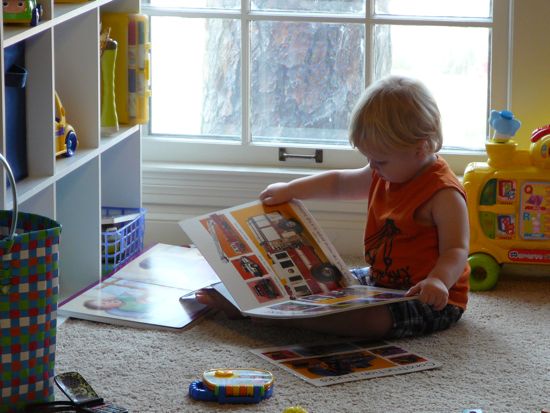
Nothing could make me happier. The Happy Baby loves books! When he was born, one of my sisters sent a box, full of almost every classic book children love to read. Since then, AdventureMan and I have been supplementing with all our own favorites. Happy Baby loves to sit in a lap and read a book, and he is also happy reading on his own.
He LOVES trucks and buses and cars, LOL, he is all boy:
This weekend the Happy Baby discovered heaven-on-earth – the Pensacola National Aviation Museum. He loves the cockpits, with all those buttons and levers and wheels. He only screamed when it was time to move on to the next exhibit.
I was babysitting the other day and they left us with the iPad, which he also loves. I thought I knew how things worked, but I was wrong. I didn’t know anything about Angry Birds or Zombies in the Garden, and he showed me. 18 months old. I just had to laugh. Already, I am learning from him!
Recent Comments
ExpatAlien on What Country am I Living … intlxpatr on Yellowstone: Old Faithful to C… Michelle on Yellowstone: Old Faithful to C… Cathy on No Grown-Ups in Charge intlxpatr on Waiting for Snow Wikipedia Donate Button

Amazina


Early Voting in Florida


 Here There and Everywhere