AdventureMan Finds the Sunset
It was getting close to five p.m. and AdventureMan had just awakened from a much shorter nap than usual. There is no pressure to adjust to the local time, so he is taking it slow. I love to watch him take a nap.
“So what do you want to do?” he asks me, and suppresses a groan when I remind him he said we would find some places where I can watch the sun set.
We decided to head over to Perdido Bay, me navigating, but sometimes I miss the right turn and we have an “adventure.” It’s all OK, it’s not like we have to be anywhere by any time, so there’s no such thing as a wrong turn, just another opportunity to make some additional connections in the brain cells as we try to figure out Pensacola. Or that’s the way I am telling it, and it is my blog. Anyone can make a mistake, right?
Pensacola has very funny roads. Almost all the roads curve. Like the road we live on is the same road my son lives on, but where he lives, the road is north south, but where we live, it is almost east-west. A road called 9th, you would think would be a straight road, but it is more like a parabola! Fairchild road will turn south and become Navy Boulevard, but the real Fairchild road actually continues, considerably diminished. You just have to get used to it; it doesn’t have to make sense.
And there are Kuwaiti drivers everywhere!
(So, OK, now it comes. I apologize for all the bad things I ever said about Kuwait drivers. American drivers are also going through the orangey-red lights, even going through the red lights, and American drivers are also making left turns from the far right turn lanes. Yep. I’ve seen it. Guess I’ve been gone a long time. I wonder if even Seattle has become the Wild West on the roads? The difference between the really bad American drivers and the Kuwait drivers is that the Americans are mostly driving a lot slower when they do these things. So Kuwait, I apologize.)
We discover there is no state park along the band of land from where we thought we were going to watch the sunset, and there sure are a lot of slabs where houses used to be – which usually means they were blown away or seriously destroyed in one hurricane or another.
AdventureMan found a fabulous place, though, Tarkiln Bayou Preserve State Park. They have two walking trails, and since it was getting close to sunset (and I have a thing about being in swampy areas after dark) we chose to do the short hike, like one mile, out to the Bayou, but next time we will do the 7.2 mile hike out to the Bay.

We didn’t know we were going to do the hike when we left the car, so I didn’t have my camera. At first, we were walking not too far from the busy highway and thought it wasn’t such a great hike, but then AdventureMan spied the endangered white pitcher plant, a carnivorous plant that traps insects. Pretty fantastic!
This was one fantastic adventure. I am going to show you some pictures I got from the Florida State Parks website, focusing on Tarkiln Bayou.

This is a view of where the trail ended – it was unbelievably beautiful. The sun was setting and we were on a bayou with not another human being in sight, not a house, not a trail – it was pure nature surrounding this gorgeous tiny little bayou. But . . . the sun was setting, and I don’t like to be out in a park after dark. No, I am not chicken, I am a realist, foolish people who are where they should not be can find themselves in big trouble when the sun goes down. Also, I hate mosquitos and mosquito bites, and they usually come out around sundown, so we did our return hike at a healthy pace.

As we headed home, AdventureMan said “I think I remember a good place where you can see the sunset.”
And within five minutes, we were there.
You know how I love those sunrises in Kuwait. Sunsets are what I love even more. Here are some photos of last night’s sunset, thanks to AdventureMan 🙂
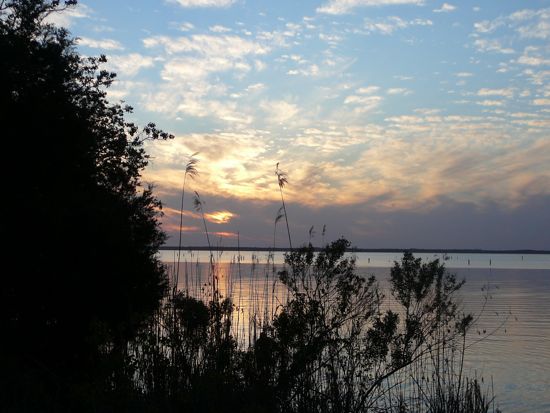


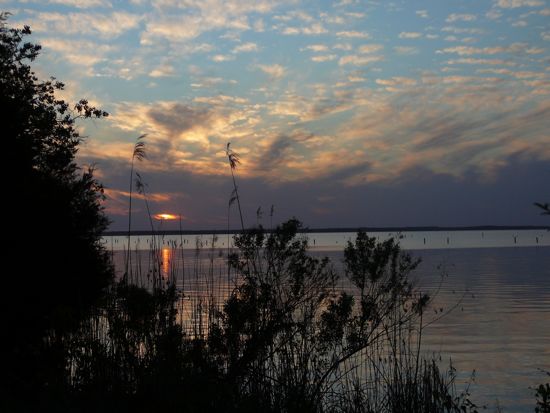
And so I ask you – is this not a magnificent way to end a day?
Taste of India in Pensacola
I had just finished doing the laundry at our son’s house when AdventureMan came back from the YMCA, where he had been trying out a series of their exercise machines trying to exorcise a demon caught in his back muscles.
“I have two suggestions for lunch,” he began, “you choose.”
OK. I can live with that. “What are my choices?” I ask.
“Taste of India or The Cajun Cafe with the lunch special for $4.99?” he responded.
“I’d like to try the Taste of India. It’s gotten some great reviews. It’s hard for me to believe an Indian food restaurant is doing well in Pensacola; let’s go see.”

I will tell you honestly, I did not have high hopes. We have been so spoiled, living in the Gulf countries, where real Indian food has been available, and inexpensive. Even better, we have had Indian food in homes, where it doesn’t get any better or any more authentic. I’ve been shown how to make some dishes (wooo HOOO!). So I was prepared to be a harsh critic, and – even worse, in our book – it is a lunch buffet.
Buffets just don’t put out the quality of food we seek. They seem to focus on quantity, at the expense of good ingredients, superbly prepared.
Not this time.
The food was awesome.
They didn’t have a lot of dishes, maybe nine or ten, plus condiments and dessert. The dishes they had were excellent, and the kinds of dishes we use to determine whether we like a place or not. Vegetable pekoras. Chicken Korma. Biriyani. Dal Makhani. Chicken Tandoori. Delicious.
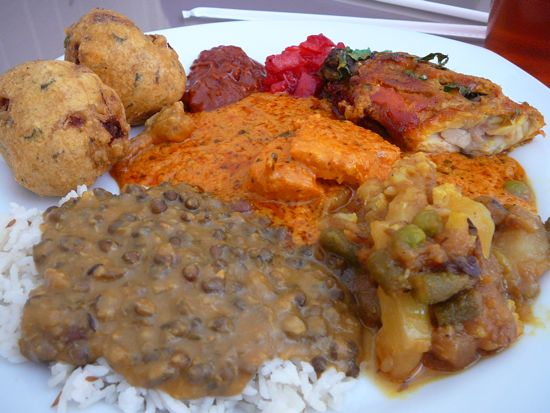
And there was HEAT! They had a very hot red sauce you could use; there was also a little heat in the korma. I was impressed. I can’t wait to go back and order off their menu, which you can also do.
I was also delighted to see that they had a steady stream of committed customers; you could tell most of them come there often and love the food.

No, no, I did not eat two plates of food. One was mine and the other was AdventureMan’s. And the plates look so huge because I had the camera right down next to the plate, so you could get the textures. It was SO good!
Yes, we are eating out a lot. It’s because we are living in a hotel until we can get into our house. Soon, we are assured, very soon. By the date they promised!
The ’50’s Automatic Car Wash
Not too far from where we will live is this old fashioned car-wash, with all these car washing machines.

It costs $5.00. That is it. No additional taxes, it is all included. You can get the fancier treatments, but I just needed to get the pollen and sap off my new car. Within seconds, I was in, and finished.
It could make you a little claustrophobic (well, it makes me just a little claustrophobic) because you have NO control! You have to keep your hand off the steering wheel and your foot off the brake! You just sit there while water shoots from different directions, and then you are covered with soap suds and you cannot see a thing except the lights from the car in front of you, oh no!
And then huge gusts of wind and it is over except for the optional – and free – vacuums you can use to clean out the car interior.
My car looked like new! I think me and the 50’s car wash are going to be good friends.
It does remind me of the automatic car wash we used to visit in Saudi Arabia. In a country where labor is cheap and the harshness of the weather and climate makes specialized machinery hard to maintain, things happen. We don’t know if the machines broke and couldn’t be fixed or whether they were sabotaged, but while it was billed as an “automatic” car wash, it was this thing where the car got on tracks but while water squirted and suds squirted, there were people, not brushes, with rags and towels, washing, drying, spraying, scrubbing and finally buffing. The end result was the same, but people, not machines, did the work.
Pensacola/Escambia County Honors WWII Vets
To understand how significant this is, you need to know that Pensacola is not a wealthy area, suffering more than 10% unemployment. Pensacola and Escambia County were hit hard by Hurricanes Ivan and Dennis, and are still recovering, but when asked to support this effort, exceeded – and nearly doubled – the charitable contribution:
The sixth trip of Emerald Coast Honor Flight is scheduled to depart from the Pensacola Gulf Coast Regional Airport this morning, taking a group of Northwest Florida’s WWII veterans to see the WWII Memorial.
This is from the Pensacola News Journal for today:
The Escambia County School District is the major sponsor for the April 14 flight, which will take 98 World War II veterans to Washington, D.C.
More than $114,000 was raised through individual donations. Teachers made personal donations to sponsor a veteran, often doing so in honor of their own loved ones who served during WWII. Students saved pennies and participated in school activities such as the “Hats Off To Veterans” day hosted at N. B. Cook.
All of the funds given were donations made by employees, students, schools, parents and community members.
In October, the district set a goal to sponsor 50 veterans, but within six weeks, the goal had been exceeded. On March 16, Superintendent Malcolm Thomas presented a ceremonial check to Emerald Coast Honor Flight, representing the largest donation ever made to the organization.
“I’m so incredibly proud of Escambia County’s staff, teachers and students,” Thomas said in a news release. “They really stepped up to the challenge to honor our local veterans by sending them on Honor Flight.”
The veterans, whose ages range from 82 to 95, will have guardians to escort them throughout the entire day. A cherished war time memory , “mail call,” will be re-created on the flight to Washington, with letters of appreciation from students and employees being distributed to each of the veterans.
Bryce Cox, a fourth-grade student from N. B. Cook Elementary, wrote one of the letters.
“I wrote ‘Thank you for serving our country and protecting it and I hope you have fun on the Honor Flight,” Bryce said.
A big homecoming celebration is planned upon the veterans’ return to Pensacola. Escambia County School District high school bands, cheerleaders and NJROTCs will be participating.
The public is invited to welcome home the veterans as at 7 p.m. at the Pensacola Gulf Coast Regional Airport.
Wooo HOOOO on you, Pensacola and Escambia County!
Qatteri Cat in the Pensacola Sunshine
Haven’t done a shot of the Qatteri Cat for a while, and I am always getting requests. He is sleeping with his Dad (AdventureMan) right now, keeping him company while he takes his JetLag Nap.
Here’s a shot from earlier in the day. We get the early morning sunshine, and the QC takes his morning sunbath, watching the world go by:

He is losing a little weight, slowly, the way the vet recommended. When you know how many people in the world are going hungry, it is obscene what a Diet Cat food costs. 😦 The QC now weighs under 20 lbs; this is a good thing.
This is a tiny little Qatteri street cat, found wandering, cold and hungry, with an eye infection, on the Corniche in Qatar about 7 years ago. We have promised him no more long airplane trips; it was just too traumatic for him. But – that was yesterday. As long as the sun is shining and the Qatteri Cat is warm, hey, life is good. 🙂
Crabs on Pensacola Beach
We love seafood, and after hiking around on Ft. Pickens, we were ready for a late lunch. We did something we rarely do, we deliberately chose a very touristy restaurant surrounded by people on Spring break, lots of college kids, lots of high school kids, lots of parents with very young kids, maybe the elementary schools are also having Spring Break, but also – it’s Saturday.
And it is gorgeous on Pensacola Beach, temperatures in the low 80’s (F), a nice breeze, some fluffy clouds now and then, and the Crabs looks like just the right place. It is huge. It says it can take ‘large parties’ and it looks like it has seen a large party or two.
They have a huge sign. It says “We’ve got CRABS!”

It is right on the beach. It has several levels, and I am guessing, based solely on my observations of the demographics, that young things in swimming suits, couples, and people with small children get seated on the beach level and people wearing clothes (us) are seated one floor up. That’s fine with us, by the way, we got this gorgeous table with a view that goes on forever, overlooking the entire beach scene.
We also decided we’ve lived in the Middle East too long. We keep thinking those women need to put on some more clothes! And they ask us if we are missionaries! Think maybe my skirts are a little too long?

There was a huge crowd. Service was very friendly, but SLOW. When our food came . . . we were so hungry. I forgot to take photos. We were half way through when I remembered . . . 😦
This is what half of Crabs Shrimp and Fish dish looked like:

This is what AdventureMan’s Southern Mixed Seafood looked like:

We have so much left over that we are having it for dinner tonight!
Golden Age at Fort Pickens
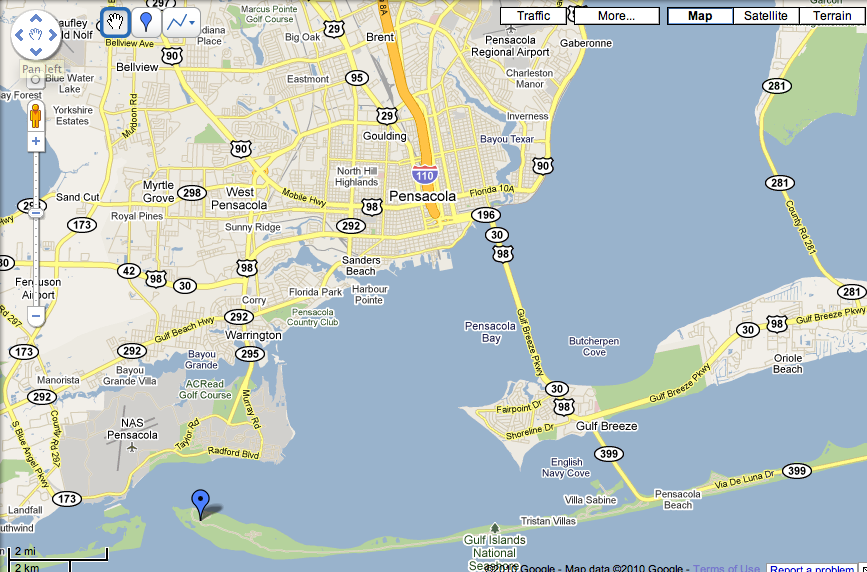
“We need a break” said AdventureMan, and we decided to go exploring, preferably out in some beachy area. We decided to visit Ft. Pickens, waaaaaaaaay out on the end of a very long barrier island protecting Pensacola.
You can see the blue balloon shows where the Fort Pickens defenses were built:
It’s a national park. It costs $6 to drive a car in.
“Are there any annual passes?” AdventureMan asked, because for us, those are a good deal, and once you buy them you can go anywhere!
The answer was yes, but it was expensive, probably still worth it, but the twinkly eyed woman then asked him “Are you a golden ager?”
“What?” AdventueMan asked in confusion.
“Are you 62? If you are 62, you can buy a Golden Age pass that lets you in all the National Parks for $10.”
“No,” AdventureMan stuttered, “no, not yet . . . ”
“But I am!” I hollered, handing him the money to buy a Golden Age pass before she could change her mind. She carded me, yes, she did, but as I am four months older than AdventureMan, I qualified, and now we can go anywhere (as long as he is with me, we get in on my pass.)
Fort Pickens is beautiful. The sand is white and powdery, and the sea is a lot like the Arabian Gulf, all shades of green and turquoise and blues, shading into purples.
Looks like snow, doesn’t it?

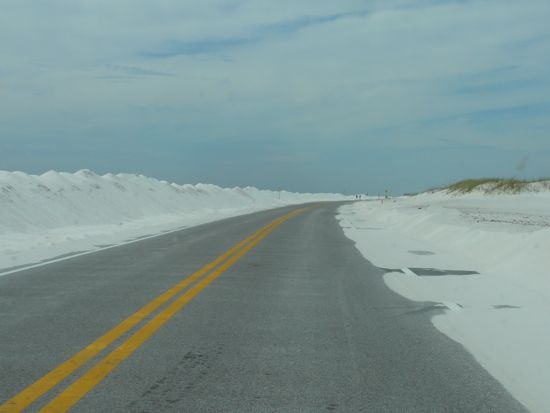
AdventureMan loves old forts; here are where gun batteries were once placed to guard the shores:

We spotted Osprey flying on the air currents around the forts, and huge osprey nests:


We hiked along a beautiful bike/walking trail where I saw tiny purple flowers like we used to find in Saudi Arabia:

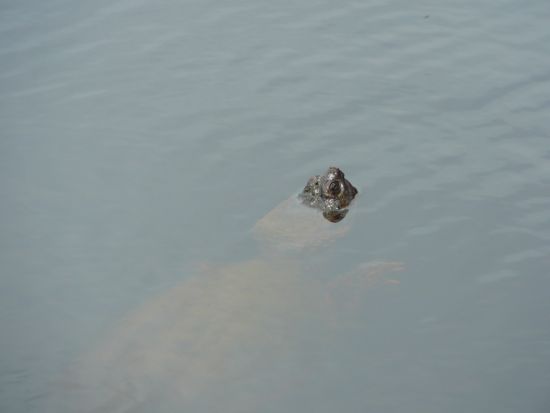
Sharp eyed AdventureMan pointed out a snapping turtle – can you see him?

Can you see him now?


We needed a day to remind us it’s not all about work. Getting settled as we get retired – isn’t that supposed to be fun?
The Quest for a Florida Driver’s License
I thought it would be a piece of cake.
One of the hardest driver’s licenses to get is a German one, unless you are a driver’s license holder from select states who have an agreement with Germany. I was not a resident of any of those states, but my husband’s company was located in one of them, so as I went through one year, I exchanged my current state license for that state’s license by showing my license and letting them punch a hole in it, getting a new photo and a new license from the needed state – it took like ten minutes.
So AdventureMan and I show up at the Florida Driver’s license place with our old licenses. The man hands us a check list of items we need, and it is like a scavenger hunt! You must have one from column one, one from column two, one from column three and two from column four.
Aha! The Queen of Paperwork, one of my aliases, assures AdventureMan we can cobble together what we need. I have utility bills! I have a 1099! We have passports! We have a deed to our new house, with our names on it!
We walk back in and meet a very nice Florida driver’s license guy and discover our paperwork is not quite so adequate as we thought. My 1099 does not have my FULL social security number on it. I haven’t seen my social security card for – decades. No one has EVER asked to see it before. I know my number, and it isn’t enough that it is on the several other cards I pull out to verify who I am.
We have 9/11 to thank for this, and the Orwellian Patriot Act, life has gotten a lot more complicated.
AdventureMan does not have exactly the right papers either, but very close, so the attendant allows me to write out a statement verifying that I am responsible for him and verify he is living at my address with me (the utility is in my name.)
On our way down to the Social Security Administration, which, by the way was amazingly efficient for a bureaucracy, AdventureMan started laughing and said it’s not unlike when we first got married and he, being four months younger than I am, was not old enough to rent a car, so I rented the car in my name. I laughed and told him he was lucky that when I vouched he lived with me, I did not check the block where I said I was his guardian!
Less than an hour later, I have a letter verifying I have a social security number, and will have a new card, and we are back at the Driver’s License office for the third time; the third time’s the charm, and now I am a legal Florida driver, a registered voter, and an organ donor.
I still have my lifetime-good German driver’s license, which has been handy many a time, and my Kuwait driver’s license, valid for eight more years, and a valid Qatar driver’s license, although maybe now that we are no longer legal residents, we no longer have valid licenses, either, LOL!
Olive Oil: Reading the Labels
Ever since I read the New Yorker article on The Olive Oil Scandle I have been goosey about olive oils, reading the labels. My friends (Palestinian) tell me I should always buy Palestinian olive oil, and from the oils they have shared with me, holy smokes! I think they are right.
Try finding Palestinian olive oil in Pensacola. Honestly, sometimes I am afraid they are going to arrest me in the stores as I stand for a half hour, turning all the bottles and trying to read the labels, some of which are in very very tiny print. One thing the Gulf States (Arabian Gulf, my friends) have going for them is some excellent labeling on the foods they import.
When I came across this label, I could hardly believe it. I am sure they probably don’t like me photographing in the stores, but as long as no one says anything to me, I do it. Often I am saying something nice, anyway.
So here is the front of the bottle; it looks promising:
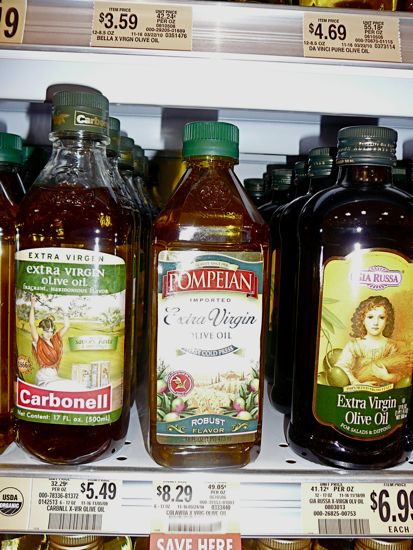
Here is the reverse side, showing the origin of the oil, or at least where parts of it might come from . . .

Horrors! What a mess! Every bottle could be different, it’s like cat food and dog food, it’s what the oil bottler could find that was the cheapest at the moment, and maybe it is from Spain, or maybe from Tunisia or who knows where? I will NEVER buy an oil that looks like that!
Meanwhile, the search for Palestinian olive oil goes on . . .
Pensacola Navy Exchange and Customer Service
One of the things that totally blows us away in the United States is customer service. Every now and then you run into bad customer service and it is so noticeable because most of the customer service is so GOOD. It is so good so often that you take it for granted, if you haven’t lived in countries where sometimes they treat you like you are lucky they notice your existence and maybe you aren’t good enough for their product, LOL!
I have a sweet, very elegant Indian friend in Kuwait. One time she told me she wanted to buy a beautiful pen for her husband, but when she went to the store, the man behind the counter didn’t want to show her the pen she wanted – because she is Indian. She said “here he is, working behind the counter, and he treats me like he doesn’t think I can afford to buy the pen I want to look at!” How insulting is that??
Oops. I digress. Sorry.
We decided to check out the Navy Exchange in Pensacola. Pensacola is a big military retirement area. It is a beautiful place, beautiful white powdery sands, green to turquoise to blue to purple waters, green palms and trees and right now azaleas blooming everywhere – many military people think it is heaven on earth, and come back to retire here. It’s a fun place, the Blue Angels practicing on Tuesday and Wednesday mornings; you can hear them thundering through the skies and over the Gulf, practicing their moves.
We get to the exchange (the souks, for my Gulf readers 😉 ) I am disappointed – it’s small. There is another building, but it is also small, and I am looking for big appliances, like a clothes washer and dryer. As we are leaving, a store guy asks us if we found everything OK, and we said ‘no, not really’ and he listened to us and then laughed and told us we were at the wrong place, and he took his time to tell us how to get to the right place, and to make sure we understood.
When we got to the right exchange (and it is HUGE!) there were lots of parking places – I love this place. We parked next to a reserved space. There are lots of reserved spaces – remember, this is a military base. The commander of this, the commander of that, a space for flag officers (generals) and then . . .this space. It gave me a big grin. And there are TWO of them, right in front of the Naval Exchange:

In my seven years in the Gulf, in Qatar and in Kuwait, I saw some amazing changes, including going from total disregard of handicapped spaces to increasing respect for the handicapped spaces. Wouldn’t it be cool to have a couple Expectant Mother spaces reserved in front of the Co-ops, and maybe in front of Toys R Us, and the hospitals?
Once inside, I was looking at washer and dryers, and a lady asked if she could help me. I said no, but then I couldn’t find the ones I was looking for, the ones recommended by Consumer Reports and I saw the lady behind a counter so I asked her. She said if we didn’t see them, we could order them, looked them up and told me the price, which was only minimally lower than I had seen them off base, except that on base we don’t have to pay the sales tax, which would make a difference.
But then, she started telling me more. Right now, we could take off 15% for this sale, and get a $50 mail-in rebate (better!) but if I could wait to order until April 12, the price would be 20% off for three days (woo hoo, even better!) AND if I used my Navy Star card for the first time, I could take an additional 10% off anything I purchased on the first day (WOOO HOOOOO, better and better!)
We are about to set up an entire household in a country where we haven’t lived for 12 years. We need EVERYTHING. We’ve been saving, so this isn’t going to put us in debt, but it’s like God just handed us this huge gift when he sent this woman our way to explain how it all works. So I applied for the credit card and was instantly approved, and I asked if I should put AdventureMan on the card and she laughed and said “no!” because what if we wanted something else BIG down the road, then he could apply for his own card and we would get the 10% all over again.
Now, my friends, THAT is customer service. What a woman!
Washer
Dryer
Vacuum Cleaner
2 Plasma TVs
wireless BlueRay/DVD player channels Netflix
All-in-one fax/scanner/printer
etc.
We are going to save a bundle.
First, AdventureMan is coming with me to our Water Aerobics class at the YMCA. He has toured the Y, met the instructor, and no longer thinks this is going to be ‘girly’. From there, we will head for the NEX (Naval Exchange) to make our purchases and place our orders.
Next week, the major start-up grocery shop. Imagine, starting your kitchen once again from scratch. No, I have pots and pans and tools, but the basics, from salt and pepper, through olive oil, flour, sugar, etc . . .everything. oh, AARRGH.
Recent Comments
intlxpatr on Shampoo Ginger tigerbutterya0c5ff1d… on Shampoo Ginger intlxpatr on British Soldier Kidnapped, Esc… John on British Soldier Kidnapped, Esc… intlxpatr on British Soldier Kidnapped, Esc… Wikipedia Donate Button

Amazina


Early Voting in Florida


