December Great Kuwait Holiday Challenge
Yes, I know, we are not even totally finished with the Great Kuwait Sand and Surf Challenge, but the holidays are coming – this year for many of us at the same time, with the big Eid and Christmas both falling in December.
If you are celebrating, be sure to have your cameras with you. This next challenge is more inclusive – The Great Kuwait Holiday Challenge is coming up next!
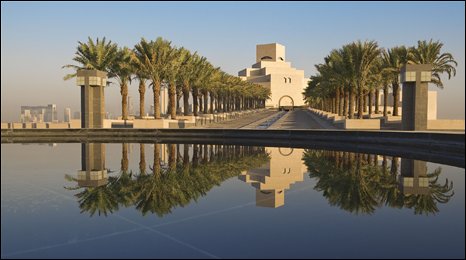
Doha Museum of Islamic Arts Opens
My friends in Doha tell me that the long-awaited Museum of Islamic Arts, designed by I.M. Pei (who showed up for the opening, along with Robert de Niro) opened this weekend. I can hardly wait to see it for myself.
By Lawrence Pollard
BBC News, Doha
A few years ago, prices in London auction houses went through the roof – not for the classic modern or contemporary art, but for works from the Islamic world.
Fabulous jewels, manuscripts and ceramics were fetching 10 times their estimate and more, and it soon emerged this was thanks to the al-Thani family, rulers of Qatar, the tiny gas-rich Gulf state.
They had tempted the veteran architect I M Pei – the man behind the glass pyramid at the Louvre – to design one last statement building, a spectacular museum on a purpose-built island in Doha, which would house only the best Islamic art.
Then they went shopping for their collection.
And this weekend the museum opens, a dramatic pile of white limestone shapes inspired by Islamic architecture and full of 800 of the finest examples of Islamic art.
Not long ago, the idea of culture being a reason to visit the Gulf would have made other Arabs laugh. No longer.
The Syrian cultural historian Rana Kabbani sees a political element to the museum, putting Doha on the cultural map.
“I think all the rulers in the Gulf see what they really lack is culture on a grand scale, as a kind of imperial identity. It’s a political-cultural lack. They have the means, and they’re going for it.”
The hope is that – like hosting a Grand Prix or buying a football club – a fabulous collection of art will bring prestige, attract tourists and create a brand.
That’s why along the coast, two museums are planned for Abu Dhabi – branches of the Louvre and Guggenheim.
New conversation
But what exactly is the Islamic art in the collection? What can ceramics from southern Spain have in common with metalwork from the Silk Route city of Samarkand?
One thing which links them is the misconceptions about Islamic art held by both east and west.
Designer and writer Navid Akhtar explains: “The conversation tends to go: ‘How come you don’t paint people? Because its forbidden.’
“There’s little understanding of the scriptures or commentaries, or the concept of art, so we’re left with a limited conversation.
“There’s a lot of figurative Islamic art. And the geometric patterns aren’t just pattern.”
The Koran has no comment on the visual arts.
The prophet was firmly against idols, but then so were Jews, orthodox Christians and puritan Anglicans at various times.
Many religions mistrust images but their cultures still end up using them – Islam however has had less use for them.
“The Koran is not a narrative like the old or new testament, it doesn’t tell a story, a narration you can illustrate,” says professor Doris Abouseif, author of Beauty in Arabic Culture.
“The Koran is precepts, it guides but doesn’t narrate.”
Any museum will show Persian and Indian miniatures, or Arab pottery with figures of animals or people.
They won’t be from a mosque, but the figure isn’t banned from wider Islamic culture.
‘Whole language’
One element Islamic objects have in common is intricate geometric patterns.
Some scholars think this is a craft habit, pure and simple, but to many younger Muslim artists the geometry holds something else.
“Pattern is a whole language of colour, form and shape,” says Reem al-Faisal, a Saudi artist-photographer.
“Each colour symbolises a state of the soul or being. It’s poetry translated into material elements.”
Mr Akhtar agrees: “Many of these things, as well as being objects of beauty, have functional usage, but then hidden beyond that is the sense of transcendence that they create.”
The chief curator of the new museum, Oliver Watson, is British, as are many of the staff.
The museum houses 800 artistic and historical works from three continents
The study of Islamic art is a western creation, which Ms al-Faisal says is not a problem so long as more Muslims now take up the study.
“I don’t care if it’s Muslims or Westerners – the problem is that there’s not enough research and that’s a mistake of the Muslims.
“They should have studied their own civilisation far more, they’ve been in hibernation for 500 years. There has to be a reawakening – they have to start studying their own history.”
Qatar’s museum will be just a glittering collection of greatest hits unless it manages to become, as promised, a centre of education and research into the history of this beautiful art.
How To Turn Kuwaiti Youth Into Law Breakers:
Lord, have mercy! Who doesn’t know that the quickest way to get young people to want to read a book or watch a movie is to BAN it?? It’s just human nature! So you take smart, tech-savvy young people and FORBID them to watch YouTube, or hey! even better – block it – and watch how fast they find a way around every attempt to block it.
There are a lot of sayings that come to mind – like “That train done left the station” or “Like getting ketchup back in the bottle” – you might as well ban water from running downhill.
Lawyer to file case against ministry over failure to ban YouTube
Al Watan staff
and agencies
KUWAIT: A leading Kuwaiti lawyer Mubarak AlـTasha has said that he intends to file a case against the Ministry of Information for not blocking the Web site YouTube or at least blocking infamous clips that are considered as insulting to Islam and the Prophet Mohammed (PBUH).
The lawyer said that since the ministry failed to carry out its promises, a law suit will be filed against it in order to ensure that this is legally binding, and added that the Kuwaiti Constitution protects freedom of expression, press and publication however such freedoms should not in any way insult Islam.
He added that the State needs to uphold the Constitution and respect it since law 70/2002 issued by the Information Ministry states that internet providers should not promote or encourage pornographic, indecent and antiـIslamic material.
A few months ago local newspapers reported that the ministry ordered local Internet service providers to block the Web site over clips that could offend Muslims.
“Since the Web site displays the Quran in the form of songs sung with the oud … and displays disrespectful pictures of the Prophet Mohammed … please proceed with immediate effect in blocking the Web site http://www.youtube.com,” read a copy of a memo obtained by Reuters.
However, following the circulation of this memo, the ministry went back on its decision and the site was subsequently not banned.
Last updated on Monday 24/11/2008
The Great Kuwait Sand and Surf Contest: Your Turn to Vote!
The deadline is here! The Great Kuwait Sand and Surf Contest is closed, and here are the entrants:
Check out their Sand and Surf photos, and then – you choose which photographer wins this round of the Great Kuwait Challenges.
Somalia: Pirates – and Dumping
This is a report from BBC News. I published a piece previously on Somalia on March 11, and blogger Shafi said the following:
“When wealthier nations align their fleet of vessels at Somali coast to fish illegally (estimated at around $6 million as the article says) and dump toxic waste in some parts of the water, aren’t they doing a greater evil and a major harm to the shell-shattared country and her people than the pirates for whom piracy is itself a survival method?”
The statement caught me totally by surprise. I went looking to see if it was true, and it was.
Shafi has a fascinating blog, and if you have some time, go take a look. Meanwhile, I am happy to see glimpses of a fuller picture coming forth in the news:

Ex-Somali Army Colonel Mohamed Nureh Abdulle lives in Harardhere – the town closest to where the hijacked Saudi oil tanker, Sirius Star is moored. He tells the BBC, via phone from his home, that the town’s residents are more concerned about the apparent dumping of toxic waste than piracy.
The Harardhere-born military man advises the town’s elders on security matters and is in his fifties.
Somalia has been wracked by conflict since 1991 – when its last national government was forced from power.
The super-tanker is close to our coast. It is a very, very long ship. Some time ago we had our own problems of piracy in our town but that has not happened lately.
The people who have been hijacking these ships in our seas are not from our region. We do not know any of the guys on the super-tanker and they haven’t made any contact with us.
You know, our problem is not piracy. It is illegal dumping.
These problems have been going for sometime and the world knows about it. The Americans have been here in the region for a long time now – they know about the pollution.
Instead, no, the world is only talking about the pirates and the money involved.
Mysterious illnesses
Meanwhile, there has been something else going on and it has been going on for years. There are many dumpings made in our sea, so much rubbish.
It is dumped in our seas and it washes up on our coastline and spreads into our area.
A few nights ago, some tanks came out from the high sea and they cracked it seems and now they are leaking into the water and into the air.
The first people fell ill yesterday afternoon. People are reporting mysterious illnesses; they are talking about it as though it were chicken pox – but it is not exactly like that either. Their skin is bad. They are sneezing, coughing and vomiting.
This is the first time it has been like this; that people have such very, very bad sickness.
The people who have these symptoms are the ones who wake early, before it is light, and herd their livestock to the shore to graze. The animals are sick from drinking the water and the people who washed in the water are now suffering.
TimesOnline ran an article on Somalia after the tsunami, and the contaminants that had been washed ashore:
“The current situation along the Somali coastline poses a very serious environmental hazard not only in Somalia but also in the eastern Africa sub-region,” the report says. Toxic waste was first dumped in Somalia in the late 1980s, but accelerated sharply during the civil war which followed the 1991 overthrow of the late dictator Mohamed Siad Barre.
Local warlords, many of them former ministers in Siad Barre’s last government, received large payments from Swiss and Italian firms for access to their respective fiefdoms.
Most of the waste was simply dumped on remote beaches in containers and leaking disposable barrels.
Somali sources close to the trade say that the dumped materials included radioactive uranium, lead, cadmium, mercury and industrial, hospital, chemical and various other toxic wastes. In 1992, Unep said that European firms were involved in the trade, but because of the high level of insecurity in the country there were never any accurate assessments of the extent of the problem.
In 1997 and 1998, the Italian newspaper Famiglia Cristiana, which jointly investigated the allegations with the Italian branch of Greenpeace, published a series of articles detailing the extent of illegal dumping by a Swiss firm, Achair Partners, and an Italian waste broker, Progresso.
The news is so much more complicated than it appears. How do we stop all these wrongful, hurtful things? Do not we have a responsibility toward the poorest nations? If we – meaning the richest nations – don’t stop this dumping now, is there not every chance in the world that it will come back to haunt us?
No Home Activities for Welfare Societies
A sudden and unbelievable decision bans welfare activities in private homes. This could have far reaching effects – are not most welfare activities taking place in Kuwait privately organized and funded? I have been to so many private fund raisers for charities I support – bazaars, game nights, line dancing classes – almost all in private homes. I suspect this is legislation that means well, but discourages people from reaching out to meet needs not met by the city or state.
Welfare societies banned from organizing activities in private homes
Al Watan staff
KUWAIT: Welfare and charitable societies are facing a new challenge after the Municipality has decided to suspend any such activities from taking place in private homes.
The Municipality has sent 62 official letters to the Ministry of Water and Electricity demanding that power be cut off to certain buildings in Jabriya and Salmiya after these private residencies were found to have been involved in activities of welfare societies. Undersecretary at the Ministry of Water and Electricity Yusuf AlـHajiri confirmed in a statement to Al Watan that the ministry will disconnect the electricity from properties involved in violations of housing regulations.
Representatives from a number of welfare societies and charitable organizations expressed their bewilderment at this decision and said that all their activities are licensed and were often inaugurated under government sponsorship. They added that many people will suffer from what they described as a “hasty decision.”
The decision to ban activities in private homes came directly from the Municipality General Manager Ahmad AlـSubaih who on Tuesday gave formal instructions to suspend all such activities on grounds that they violate private home regulations.
Local Municipal Councils are now able to issue violations and communicate directly with the Ministry of Water and Electricity to disconnect the power of any property which is found to be violating the terms and condition of housing tenancy.
Welfare societies and charitable organizations have already sent an official letter to the Cabinet requesting that they be allowed to expand their charitable activities and receive donations in cash to facilitate their work.
Last updated on Friday 21/11/2008
GKS&S Challenge: You Can Do Better!
See, it’s my challenge, I make up the rules, and wow. I am so glad I did. The first challenge came because I truly could not find a decent sunset photo, and you showed me they exist, and you showed me they could be totally WOW.
The second challenge, Sand and Surf, is because I love Sand and Surf, and I am so glad I cannot compete (it’s my contest, remember? Like it would be dirty pool for me to compete, and how would you know if I won fair and square, or if I used wasta with myself?
So just to encourage you, I am going to show some of my favorite sand and surf photos, but now that I have seen yours, I know that these are not particularly good, I just like them. YOU can do better. It’s OK with me. 🙂
Here is sand and surf and everything I love on Mnemba Island, a CCAfrica camp, off the coast of Zanzibar:

Here is a scene I found here in Kuwait:

Here is another shot from Kuwait . . . well there is surf . . .

Here is a shot from another favorite place I visit, Oman, near Sur:

Here is a shot taken in Seattle:

And here is a shot from the Oregon beaches with a little bit of everything – sand, surf, sunset and even a dancing dog:

Have a great weekend, Kuwait.
You still have time to get your photos in. The contest will close this coming Saturday, and the poll will go up, insh’allah, the same day. (Are you thinking of ideas for the next one? I am! 🙂 )
Sharing Faith
Several years ago, a woman put a book in my hands and said “I got this for you because I think you will love it.” It was kind of a shock; I didn’t know this woman all that well, but she knew me better. I loved the book, and I ordered a workbook to go with it, and I loved doing it. It was a forty day study called The Purpose Driven Life.
If you think I am trying to convert you, I’m not. Just as this woman wasn’t trying to convert me. The Purpose Driven Life is all about trying to make your walk in faith more meaningful. It starts with the premise that each one of us is uniquely created, and has a unique function to fill. The book has changed how I live my life. Intrigued? Go read the book!
I also subscribe to their daily e-mail, and today it was all about gaining wisdom from reading THE BOOK, learning from our own experiences and those of others:
Write down the major life lessons you’ve learned so you can share them with others. We should be grateful Solomon did this, because it gave us the books of Proverbs and Ecclesiastes, which are filled with practical lessons on living. Imagine how much needless frustration could be avoided if we learned from each other’s life lessons.
Mature people develop the habit of extracting lessons from everyday experiences. I urge you to make a list of your life lessons. You haven’t really thought about them thoroughly unless you’ve written them down. Below are a few questions to jog your memory and get your started:
So what?
What has God taught me from failure?
What has God taught me from a lack of money?
What has God taught me from pain or sorrow or depression?
What has God taught me through waiting?
What has God taught me through illness?
What has God taught me from disappointment?
What have I learned from my family, my church, my relationships, my small group, and my critics?
It felt like a jolt of electricity going through me when I read those questions. Sometimes, I think I am not very bright; sometimes I don’t even learn from my own experiences and mistakes! As I read these questions, I started thinking how the financial crisis has energized us and changed our plans. We thought we would have a hunk of money to work with when we retire, and suddenly that hunk has shrunk! Meanwhile, we are instigating all kinds of new strategies to make our money go farther. You would think it would be depressing, but the truth is . . . we are having fun! I’d forgotten the thrill of the hunt; getting items for good prices, finding substitutes . . . and the questions above reminded me that at one time we knew a lot about stretching money.
AdventureMan is a great cook, and truly, if we ate fewer meals out, we probably wouldn’t have to worry about our waistlines. I used to bake all our bread, when we lived in Tunis, and only had access to wonderful baguettes. I even baked English muffins, my favorite.
Every one of the questions he asked today reminded me of a lesson I had learned . . . and then kind of let go. I didn’t exactly forget, but now all these life-lessons are fresh again!
You don’t have to be Christian, or Moslem, or a even a believer to think about these questions. Take a look at the questions and see what YOU have learned from life’s circumstances.
Where do YOU find wisdom?
Erratic Vacation
Please forgive me, dear blog-friends, but we are traveling and I am not always able to connect. I know, I know, you are wondering, as I did “is that even possible? Are there places where you cannot connect in the whole world anymore?” and the answer is yes. There are times and places and circumstances where you cannot connect – or where you are just too absorbed in life itself. We are moving from spot to spot and I won’t know about connections until I get to each location.
I know many of you will also be travelling soon, or enjoying the new “Staycation,” where you stay at home for your holiday. The weather in Kuwait could not be more perfect for exactly that kind of vacation! Lucky, lucky you! Visiting friends and family, celebrating Eid with all those delicious foods! Maybe a little shopping, with gold down to around $743/oz.
We will also be celebrating with family and friends along the way, and I will keep you informed as best I can. Meanwhile, I will check in on you, too, when I can, to find out how you are doing.
Man Jumps to Save His Honor
From today’s Arab Times. Rape is despicable, whether committed on man, woman, or child, daughter, sister, son, brother, neighbor, domestic or wife. Despicable. It’s a crime of power, of humiliation, of ownership and it is robbery as well as assault.
Man dies saving ‘honour’
KUWAIT CITY : The Court of Appeals Monday set Nov 19, 2008 to issue a verdict in a case of four Kuwaitis and two Bedoun, who have been convicted of causing the death of a Kuwaiti man after they kidnapped him and tried to rape him.
Case papers indicate on April 20, 2007, five of the six men agreed to kidnap and rape the victim. One of the accused talked to the victim from the Internet chat room and pretended to belong to the third gender.
The man invited the victim to his place to have sex. He went, along with another accused and took the victim in the car of the latter to a flat which was rented by yet another accused for the purpose of prostitution.
When they arrived at the place, one of the accused locked the door of the apartment and others who had been hiding in the apartment showed up. When they tried to rape the victim, he jumped out from the ninth floor window and fell to his death.
On June 18, 2008, the Criminal Court sentenced the first, second, third and fifth suspects to 15 years in jail. The court sentenced the fourth suspect to seven years in jail. The court sentenced the sixth suspect to three years in jail and ordered the deportation of the fifth and sixth suspects after serving the sentence.
The session was presided over by Judge Faisal Khuraibet.
By Moamen Al-Masri
Special to the Arab Times
Recent Comments
intlxpatr on Shampoo Ginger tigerbutterya0c5ff1d… on Shampoo Ginger intlxpatr on British Soldier Kidnapped, Esc… John on British Soldier Kidnapped, Esc… intlxpatr on British Soldier Kidnapped, Esc… Wikipedia Donate Button

Amazina


Early Voting in Florida


