Tena Tena, RPS, Zambia 2008
We travel to Africa almost every year, but the Robin Pope Safari camps are the only ones we have ever visited more than once. After our first visit, I think in 2003, we went back for a Hiking with Robin Pope safari in 2005 and enjoyed every minute of it. When we first dreamed of taking our son and his wife to Africa with us, we thought we would do the Hemingway Safari with CCAfrica (it’s twelve parts but this link takes you to the first entry) but that takes 14 days, and LawAndOrder Man doesn’t get that much time off.
No problem, we know that the Robin Pope Safari Camps do it right. We know they will be totally WOWED. We set up some dates, and then when the Cupertino wedding comes up, we revise the dates, which means that we do the same trip we did the other two times, only backwards. This is fun! When you are booking a Robin Pope Safari, you need to book early, they fill up fast.
We love Tena Tena, the first camp we stayed at. Each couple has a very large tent, with furniture and books and oriental carpets. The bedcovers are kilim, the whole flavor is very fusion, like Zanzibar – African, Indian and Middle Eastern. There are only five tents, maximum of ten guests. We feel so at home.
During the day, each tent is totally open in the front to a large patio from which you can watch passing game. Our very first day in Tena Tena, just after lunch the elephants came through, and we watched, enchanted, from the porch. First AdventureMan went to our son’s tent to watch as they passed, and then all three came to our tent. My heart was so full of joy that I didn’t know whether to watch the elephants or to thank God for the sheer happiness I felt, all of us together and the miracle of elephants walking right past our door as we watched in wonder. I found a way to do both.
So here are some more photos of our time at Tena Tena:
The airplane we flew in on, and Mfuwe International Airport. Once a week or so, a flight comes in from Malawi, and so it is genuinely an International airport:

The South Luangua needs these small planes to get the visitors to their camps, so Robin and Jo Pope invested in their own airline, ProFlight.


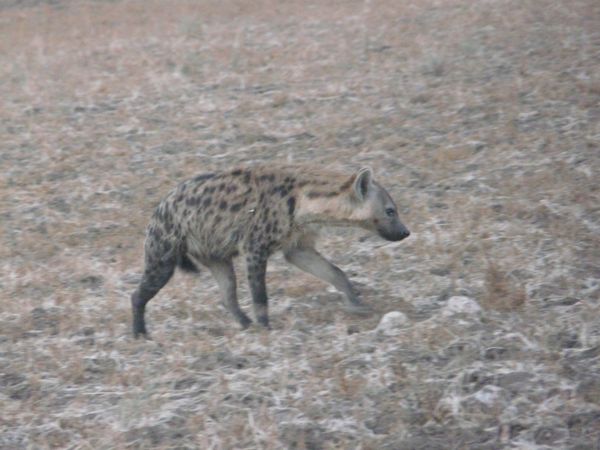
The guides at the Robin Pope Camps are so patient. I am absolutely ga-ga about the sky, seeing blue sky and clouds and a sunset. I get gorgeous sunrises in Kuwait, but I never see the sun set. The guide is patient when I ask him to stop to take a photo. While we are stopped – a hyena comes slinking along, totally ignoring us, crossing behind our vehicle.

The next morning, it is up at 0530, out of the camp by six (not a vacation for people who want to sleep in!) LawAndOrder Man and EnviroGirl have been awake since three a.m. – jet lagging – and are bright and shiny!
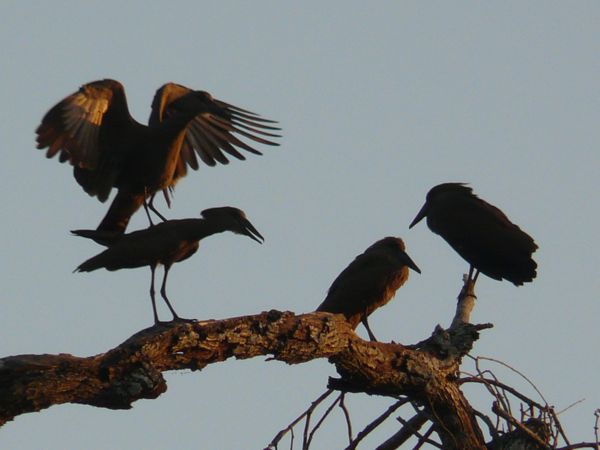
As we are watching the baboons wake up and take care of daily business, we see the most amazing fight – a set of four birds fighting over a tree top territory. One hops up on his partner’s back to scold and intimidate the other two into leaving:

Back in Tena Tena, a delicious lunch – every meal is delicious – and just as we are finishing, there are elephants crossing the river to our side. What is cuter than a baby elephant?

The elephants crossed the river, then came foraging down past our tents:

I know you are all dying to see LawAndOrder Man and Enviro Girl – that’s them, watching the elephants on our tent front porch.
Our guide, Bertram, was amazing. He would ask us “what do you want to see?” and we would tell him, and he knew just where to find them. The first night drive, I said “We love seeing everything, but it would be a real thrill to see a leopard.”
We drove around, looking at all kinds of things, and then he said “over on your left is a hammerkopf – and a leopard.” And there she was, relaxed, soaking up a little sun before she hunted up something for the night’s dinner. She posed, she stretched, she changed positions and gave us plenty of time before she sauntered off. Wooo HOOOOOO! We had been to Africa three times before we ever saw a leopard, and here was one on their very first night of their very first safari. God is Good!

One of the best parts about Tena Tena is hearing hippos. There are hippos everywhere:

Thank you for being so patient with all my vacation stories and photos. I know, I know, I am turning into that boring old aunt who always shows up with photos! 😉
Disturbing Change
Late yesterday, I was online on AOL checking my e-mails. I often do, Law and Order Man comes online around that time in Pensacola and we can grab a quick chat.
Only Instant Messaging didn’t show up on my screen. I took care of business, and went on to other things. We don’t chat every day, just when we can.
Today, I noticed again – I don’t have AIM. I have a couple other ways to check in online, so I tried them. No AIM. Finally, I tried iChat, which also logs into AIM. It showed me logged in, it also showed no contacts.
My other AOL entry route didn’t show the Buddy Screen, even when I asked it to repeatedly.
I am hoping this is a little AOL glitch, temporary.
You don’t think Instant Messaging is being blocked in Kuwait, do you?
Grin for the Day
Thanks to some great long-time friends for this visual:
The American way of life!

Michelangelo’s famous statue, David, returns to Italy this week after a successful 12 week, 20 city tour in the United States of America.
The David statue after a visit to the USA
Sacred Spaces in Kuwait
As I was on my way home from picking up milk and vegetables, I passed another local mosque undergoing renovation. Or at least, that is my best guess; it has been gutted and partially destroyed. I am guessing it is about to be reconstructed, but I don’t know for sure. I am only guessing because I have seen it happen to other mosques since we arrived.
And it got me thinking, and I am going to ask a question, but I will tell you before I ask it, that if you asked me the same question about Christian spaces, I would have to ask an expert; it is not a question I can answer about my own culture.
Do Moslems have sacred spaces? How are they made sacred? Is there a ceremony? If you are going to destroy parts of a building on a sacred space, does it have to be de-consecrated (made no-longer-sacred) while it is undergoing renovation? If a mosque is destroyed/no longer used is there a ceremony that makes it no longer a holy spot?
I know that in my religion, churches are consecrated, made officially holy, and that there is a ceremony. I know that in some places, churches that are no longer needed are deconsecrated, not made UNholy, but made not a sacred place of worship any more, and they become restaurants, housing, etc.
In my specific branch of Christianity, which is Episcopalian, there is a service for blessing a new house, which I love, and it is called a House Blessing. The priest comes, usually at dusk, you can have friends there, you carry candles and he blesses every room in the house. When we buy and move into a new house, we always have it blessed. The priest tells me that it is really a mis-nomer, it is not the house being blessed, but those who live within in. To me, that is a distinction that hardly matters, all I know is that I feel more secure in a house that has been blessed.
And no, there is no un-blessing ceremony when we leave a house. The blessing does not create a holy space, a place of worship, a sacred place, but only blesses a humble dwelling.
No, I don’t understand exactly how this all works.
I remember travelling in Syria with an archaeology group one time, and we went to see the site of St. Simeon the Stylite. In my cynical heart, I was not wild about the visit – a saint who sat atop a huge rock for several years to show his devotion to God? When I got there, however, my heart changed – it felt like a holy place. It felt like Saint Simeon had done a holy act, demonstrating his faith so . . . faithfully. If you know Syria, you know how bitterly cold it can be in winter, and how bone-breakingly hot it can be in summer. The pure grit and devotion it took to stay atop the pillar of stone was an amazingly faithful act. It felt like a sacred place, a holy place, to me.
So my question is not just for the Moslem readers, but also for Christian readers – what makes a space holy? Does it need a ceremony to be holy? Does it need a ceremony if it will no longer be used for sacred purposes?
Jackknife
The Kuwait Times crime editor has come across a new term, and now he is using it every chance he gets. It is driving me crazy.
See if you can pick it out:
Policeman Injured
A policeman was injured after his patrol vehicle jackknifed when he lost control of the steering with the car coming to a rest upside down in the road. The officer managed to use the car’s radio to call for assistance and emergency services were quickly rushed to the scene, rushing the injured policeman to hospital.
Unless the police officer was driving a sectioned vehical; a car towing a trailer, a truck carrying a connected load – something that can be BENT, FOLDED, like a jackknife –

– then it is NOT a jackknifed vehicle. Most police vehicles are sedans. A sedan cannot jackknife.
This is the explanation from Wikipedia:
Jackknifing means the accidental folding of an articulated vehicle (i.e. one towing a trailer) such that it resembles the acute angle of a folding pocket knife. If a vehicle towing a trailer skids, the trailer can push it from behind until it spins round and faces backwards. This may be caused by equipment failure, improper braking, or adverse road conditions such as an icy road surface.
Jackknifing is not very common and usually only happens to an empty vehicle. Most truck drivers are skillful enough to correct a skid before it becomes a jackknife. It would be an exaggeration to claim that jackknifing accounts for a large number of tractor-semitrailer accidents since in many cases it is the collision that would have caused the vehicle to jackknife and not vice versa. Radio stations often report jackknifed trucks because people phone to tell them, but more often than not, the truck has not technically jackknifed; it may be stuck in the snow or damaged in a crash.
The Qatteri Cat’s Five Under Five
As told to me by the Qatteri Cat:
1. The sound of Dad’s key in the door when he comes home.
2. Tuna water
3. Sleeping on my back in the last remaining spot of sunshine
4. Cat mint! Cat grass! Catnip!
5. Snuggling up to Mom on a cold winter day.

Five Under Five Tag – You’re It!
It’s a slow summer day, not a lot going on, so let’s play.
I was making the Pasta Melanzane and added some sun-dried tomatoes when the smell suddenly reached my nose and I was caught by the sweet intensity of the smell. I thought to myself “so much flavor! and at so little cost!” and it started a whole train of thought.
What gives your life pleasure and doesn’t cost much? Here are the rules – the cost of your pleasure must be under 5KD (under $20 for my USA players). See if you can think of five. If you find more than five, you can list those too, if you want – the rules here are pretty vague. so – give me five!
Here are mine:
1. The sound of my husband whistling – it means he is feeling peaceful, even happy.
2. Moments with my family when I suddenly realize how special they are, and truly treasure our time together.
3. The intense flavor of sun-dried tomatoes.
4. The sound of waves crashing onto the shore.
5. The smell of the sea, cloves, lavender, baked apples, roasting meat, a fresh pine Christmas tree,
the first rain in a dry, dusty country.
Bonus: The smell of Comfort fabric softener on laundered underwear. 🙂
The sound of my friend’s voice when I don’t expect a call from her.

Crown Relocation Marketing
I found this on my doorstep, as a neighbor is moving out:

And this is on the flip side:

I totally love it. Brilliant marketing.
First, it purports to be an apology for any inconvenience. How thoughtful, right? What great customer service, innoculating against negative perceptions by apologizing humbly in advance.
And, what a brilliant way to get attention and drum up customers. Wouldn’t you want a company who is so polite? So caring? After all, they start by apologizing for any inconvenience, before you turn the page over to read about the services they offer.
Last – no misspellings, uses good English, uses economical language and lots of white space. Well done, no annoyances, and leaves a positive impression.
I love it. Well done, Crown Relocation Services.
AIDS and Africa
Listening to BBC yesterday, I learned that in Ghana, men forbid their wives to get HIV testing. If the wife tests positive, it makes public his own shame, carrying HIV, and they don’t want people to know they are infected. They will even resist being treated rather than confess to having HIV.
Recently a Ghanian man divorced his wife for testing positive, even denied he was infected. She states he is the only man she has ever been with. He said she is bringing shame on him, going public.
What tragedy. What folly. Life enhancing, life prolonging drug treatments are available. First, you have to acknowledge you are infected. And, of course, if the women do not get tested, the dreaded disease passes along to the babies.
The newspaper recently published an article that 129 Kuwaitis are HIV positive. I imagine the problems here are similar, that people would prefer it all be kept very private. Is that possible? Is confidentiality respected? Do couples have blood tests before getting married?
Khadra and The Swallows of Kabul
While waiting for our luggage to be offloaded, we were passing time, visiting with our greeter / expediter, asking about his family, his life in Zambia.
“How does this work, travelling with your son and your daughter-in-law?” he asked us. “Do you like her?”
Nothing on earth could disguise the delight on our faces as we both said “Yes!” We truly adore her.
When our son was only seven years old, a Christian speaker passing through said that if you have children, it is likely that their mates have also been born, so to start praying now for the unknown mate your child would choose, and we did.
When our son called us from university, and told us there was someone he wanted us to meet at graduation, and graduation was still months away, we knew, we just knew, that this might be THE ONE.
We were so delighted when we met her, we liked her immediately. What parent isn’t happy to see his/her son/daughter happy, and choosing well?
“But!” our meeter/greeter added, “how do you like her family?”
And we laughed again! We love her family! Her father is smart and very funny, and her mother is kind and practical, and we all share the same values on family and friends and living our lives. She comes from a large rowdy family that gathers when they can, and so do we.
And YOU are thinking “what does all this have to do with The Swallows of Kabul?” but I am getting there.
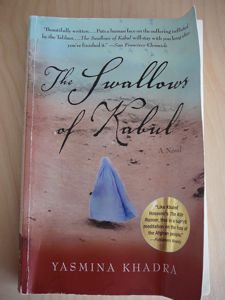
On the trip, we all had books for our quiet time, and I could see EnviroGirl deeply engrossed in this book. When I asked her, she said she had gotten it from her father’s wife, a woman with whom I often talk books, and that she (EnviroGirl) was trying to finish it so that she could leave it with me.
And thank goodness that she did! I couldn’t put it down!
First, you think it is written by Yasmina Khadra, but that is a pseudonym. The real author, Mohammed Moulessehoul, was Algerian army officer, and he used the pseudonym to avoid having to submit the manuscript for approval by military authorities. That got my attention right away.
The book is about Taleban era Afghanistan, and starts out with utter hopelessness, describing the deterioration in life brought about by the arbitrary imposition of religious rule, as interpreted by men who have memorized the Qur’an, but have a poor understanding of what they have memorized. Women lead a dismal, limited life, at the mercy of men who treat them as detestable if they are seen in public, even totally cloaked.
His language is beautiful, poetic and compelling, even describing despair and desolation.
We meet two couples, Atiq, a jailer, and his wife, Musarrat, who risked her own life to save his life back when he was seriously wounded and left for dead, and Mohsen, former member of a moderately successful merchant family, married to the love of his life, Zunaira, who is beautiful, educated and from a wealthy background. These men love their wives, and have a strong, genuine connection to them. Their ability to maintain that connection, and to stay connected to their own values, withers in the dry, dusty context of fundamentalist rule.
Their lives and relationships have been changing gradually, increasingly limited and undignified under the stress of Taleban rule, and the novel follows a rapid spiral of deterioration and folly. The steady decline of their lives speeds when Mohsen makes a terrible impulsive decision, has to live with the consequences, and confesses to his wife.
Atiq, too, faces dismal consequences. Even though we know he is limited, he becomes a sympathetic character. His hardness of heart covers a genuine grief that his wife is dying, and he can do nothing to stop it, nor to alleviate her pain.
We all face hard times. In our family, when someone lashes out unjustly, we often ask “is it something I have done, or am I just the nearest dog to kick?” It always gets a laugh, and it puts things back in perspective, puts us on the same side. Sometimes we can’t always vent our frustrations against those people or events creating the frustration, so we take it out on those we love – and who love us. It’s not right, it’s not fair or just, but it is very human, and once you get that out on the table, it is easier to discuss the real issue.
When Zunaira ends up in jail, Atiq’s world is shattered as if by an earthquake – the earth moves under his feet, all his understanding of life is shaken.
“As he cleans up, he cautiously lifts his eyes to the roof beam looming over the cell like a bird of evil augury, and his gaze lingers on the anemic little lightbulb, growing steadily dimmer in its ceiling socket. Screwing his courage to the sticking point, he walks back to the lone occupied cell, and there, in the very middle of the cage, the magical vision: the prisoner has removed her burqa! She’s sitting cross-legged on the floor. Her elbows are on her knees, her hands are joined under her chin. She’s praying. Atiq is thunderstruck. Never before has he seen such splendor. With her godess’s profile, her long hair spread across her back, and her enormous eyes, like horizons, the condemned woman is beautiful beyond imagination. She’s like a dawn, gathering brightness in the heart of this poisonour, squalid, fatal dungeon.
Except for his wife’s, Atiq hasn’t seen a woman’s face for many years. He’s even learned to live without such sights. For him, women are only ghosts, voiceless, charmless ghosts that pass practically unnoticed along the streets; flocks of infirm swallows – blue, yellow, often faded, several seasons behind – that make a mournful sound when they come into the proximity of men.
And all at once, a veil falls and a miracle appears. Atiq can’t get over it. A complete, solid woman? A genuine tangible woman’s face, also complete, right here in front of him? He’s been cut off from such a forbidden sight for so long that he believed it had been banished even from people’s imaginations. . . ”
Atiq has a friend, Mirza, who thrives under Taleban rule, as a soldier, and also running illegal businesses highly profitable under the current regime. He encourages Atiq to abandon his cancer-striken wife, to get rid of her and to find a fresh, young wife. He offers Atiq shady business opportunities, and tells him a wise man bends with the wind. Ignorance and chaos benefit Mirza, and he has no wish to see the good old days return.
In spite of the bleakness, the desolation, the crushing arbitrariness and inhumanity, there is hope, love, and compassion in a thin, steady stream throughout the book.
Once I started reading, I had to finish. It was a great book for the long trip back to Kuwait, one I am eager to pass along to the next avid reader.
Recent Comments
intlxpatr on Shampoo Ginger tigerbutterya0c5ff1d… on Shampoo Ginger intlxpatr on British Soldier Kidnapped, Esc… John on British Soldier Kidnapped, Esc… intlxpatr on British Soldier Kidnapped, Esc… Wikipedia Donate Button

Amazina


Early Voting in Florida


