Widad Kawar’s Passion
Many years ago, in another life, I was honored to visit the collection of Widad Kawar in Amman, Jordan. I was so young, and so completely in awe of Widad, who had made it a life mission to collect traditional clothing of the area, Palestinian, which was her own heritage, and nomadic.
It was like being a little girl and getting to play dress up as we oooohed and aahhhed over these gorgeous old dresses and head dresses. I had no idea she had become an institution, until I began to research a style of hijab I had seen there which I found very elegant.
LIttle Diamond, these are for you. They are from several sources, including The Arab Heritage site on Widad Kawar which I urge you to peruse when you have a spare hour or half a day or . . . a lifetime. She has created a monumental body of work with her passion for preserving these fabulous textiles.
From Widad Kawar’s collection: North Jordan

Shows a little of the glitz – this one is from Salt, photo from Widad Kawar’s collection: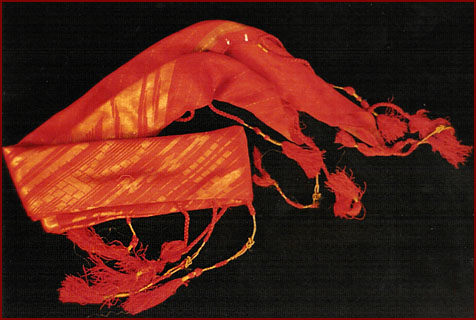
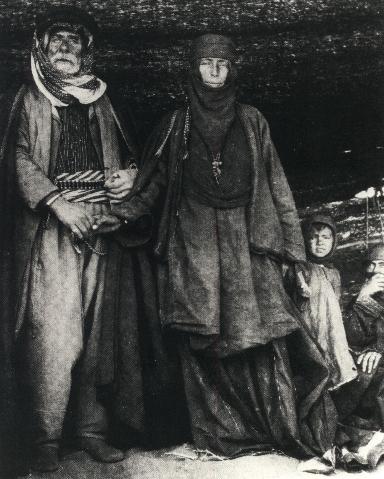
I love this photo. The woman has a plain version of the headdress, and is wearing a double dress . . . and her husband is holding her hand!
Blog Complaints
My family and friends outside Kuwait tell me I don’t publish enough Kuwait photos. These two are for you, and I will try to work on this. 😉 These are from a recent trip to the Al Kout mall in Fehaheel, just south of Kuwait.
Ladies leaving the Al Kout Mall

I think this mosque is one of the most beautiful I have seen:

Is this not one of the most beautiful Starbucks you have seen? It sits on overlooking a small marina. Greetings to all my Seattle friends.

Palestinian Embroidery
There is a richness in the textile heritage of this region, the clothing, the embellishments, the techniques . . . influences from Africa, from India, from Europe all meeting and blending in the most spectacular ways. This is textile heaven!
Today I was trying to find an example of a traditional Jordanian head-dress so I could show Little Diamond but instead I found this blog Arabesque Rhapsody and her beautiful article on everyday Palestinian embroidery. When you look at these women, wearing dresses that took hours, days and months to create, it is a feast for the eyes.
Heat Lagging

The heat has hit me like a building crashing down around me. It changes everything I do. Somehow I don’t remember last year being so hot, but I know it was, and I think I just didn’t go out very often. Now that I am driving all over town, man, the heat KILLS me.
I just checked Weather Underground for Kuwait and the temperatures (Fahrenheit for my US readers) is going to be between 107 and 114 for the next five days. Kuwait DOES cool down at night more than Doha, but if you are outside after nine in the morning, you feel like a steak thrown into a hot frying pan to sear. It is sizzling hot!
I find myself trying to get everything done I need to get done early in the day. Sometimes when I get home, get the groceries put away – I need a NAP! I feel like I’ve run a marathon! It’s embarrassing to be so effected by the heat, but I am.
If I have had things going on and don’t get a nap, then by nine my head is nodding. I can be in the middle of a great book, a thrilling movie or a nail biting tv program . . . it doesn’t matter. Sleep calls me like a siren; I can’t resist, I crash. Around three in the morning, having had six hours of great sleep – Hey! here I am! wide awake!
Even my husband, born in the heat of the south, who gets cold easily, even my husband who never complains about the heat – told me this morning he hated the thought of having to walk today from here to there because of the heat. I can hear him wheezing a little at night. We no longer have the dust storm of earlier this week, but the residual dust has made breathing a little harder. I hear a lot of my friends wheezing mildly, too.
It’s just like jet lagging. I’ve got to get it under control, and I’m at a loss. I think most of my friends cope with the heat – by leaving! Others stay inside most of the summer – even the thought of meeting up with a friend for coffee during the day just seems like too much trouble, when I think of the hot hot hot walk from car to air conditioned mall or restaurant!
How do you cope with the heat?
Does your life change?
Do your hours change?
Black Magic Chocolate Cake
No, no, no sorcery involved in making this chocolate cake, althought you might think so when you taste it – it’s so good! The magic in this cake is using a lot of cocoa powder (not cocoa mix, which has milk and sugar added – cocoa powder, which is all chocolate) and some very strong coffee to boost the intensity of the flavor. Everything you need is available here in Kuwait.
This is the very best chocolate cake I have ever tasted. The batter seems thin when you make it up but it cooks to a very moist chocolate cake with a fine crumb. And best of all – it’s EASY!
1 3/4 cup all purpose flour
2 cups sugar
3/4 cup Hershey’s cocoa
2 teaspoons baking soda
1 teaspoon baking powder
1 teaspoon salt
2 eggs
1 cup strong black coffee (secret ingredient!)
2 cups buttermilk or sour milk (In a pinch, 1 Tablespoon lemon juice plus milk to equal 1 cup, let stand 10 minutes)
1/2 cup vegetable oil
1 teaspoon vanilla extract
Combine dry ingredients in large mixer bowl. Add remaining ingredients – beat at medium speed 2 minutes. Batter will be thin. Pour into greased 9 x 13 pan and bake at 350 degrees (180 degrees Celcius) for 35 – 40 minutes. Cool completely and frost.
Black Magic Chocolate Icing
(makes about two cups)
1 stick butter, softened
2 2/3 cups powdered sugar
3/4 cup Hershey’s cocoa
1 teaspoon vanilla
1/4 t. salt
milk
Cream all together until smooth.To thin, use just a little milk at a time until you have the right consistency.
HINT: After you grease the baking pan, use cocoa instead of flour to sprinkle in pan, and shake really good until it adheres to the butter or Crisco you greased the pan with. This helps the whole cake release without those pesky stuck spots.
Storm Rolling In
This is what a storm looks like rolling into Kuwait. The normal day is on the right, the storm rolling in is on the left. Nothing has been enhanced; this is the way it really looks:

You really can’t imagine what an orange sky looks like:

Cat Meat Rumors Refuted (Ho ho ho ho ho)
Front page of todays Kuwait Times is this article:
KUWAIT: A ministry of Commerce official denied rumors that a local restaurant has been closed for selling cat meat. According to Ali Baghli, assistant undersecretary for commercial supervision affairs at the Ministry of Commerce, no violation has been registered against the Arabic restaurant in the Jahra governate as of yet. . . .
My comment – So here is what we know for sure:
A ministry official says the restaurant has not been closed for selling cat meat.
He says no violations has been registered AS YET.
He does not say the restaurant was not selling cat meat; he is saying the restaurant was not closed for selling cat meat.
What was interesting, is that both the Kuwait Times and Arab Times, when they reported this cat meat restaurant closing, said that because of connections in the government, this restaurant was unlikely to stay closed.
It is not unlike Make This Case Go Away where two youths are caught with a maid they have abducted and raped, they fight the arresting officer and bite him on the hand, they confess to what they have done . . . and no violation is registered, because the police officer is pressured by his superiors to drop the case.
It’s not like your next schwarma is guaranteed not to contain fresh cat meat. It’s only guaranteed not prosecuted.
If I sound angry, I am. Police and law enforcement officials are supposed to protect the public – that’s you and me. When the system is broken so badly that laws are not enforced against the transgressors, and worse, when courageous policement are punished for doing their job, it is a very very sorry state of affairs.
And I am convinced that God has a very special place in hell for those who abuse the trust the public places in them.
I sure wouldn’t eat any schwarma in Jahra.
Doha Additions
The rate of building in Doha is astounding. You have to wonder, sometimes, how the building inspectors can keep up with it all. I am guessing in Doha they lose one or two workers a week to unsafe construction practices, and I wonder at the quality of the construction . . . .
I particularly love this building, facing the Gulf. I call it the Doha twist. I think it has a spectacular look:
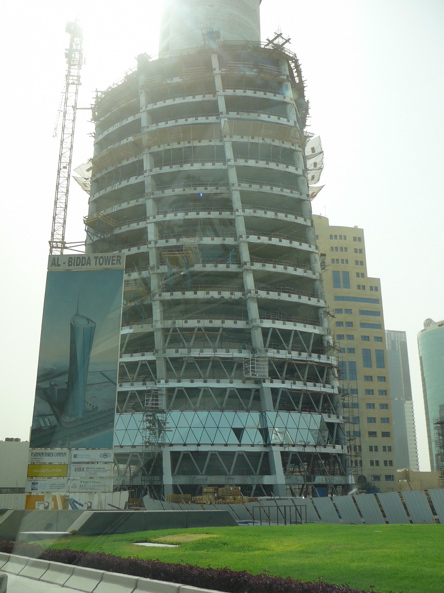
They have been working on the foundation for this building for years now, with nothing to show for it. The design of the building totally cracks me up.

From time to time, in both Doha and Kuwait, I have seen honest-to-God wild Parrakeets, Flamingos and Cranes. But when we say that the crane is the Qatar national bird, this is what we mean:

Quintessentially Doha
While all the news is about the burgeoning crop of skyscrapers in Doha, these two landmarks are located close to one another, in the old downtown Doha area, when the Sheraton Hotel was way out there – kinda like the Ritz Carleton is now, with the growth of West Bay creeping the city out closer and closer.
The first is quintessential Doha – the crossed swords on Grand Hamad, which turns into Airport Road:
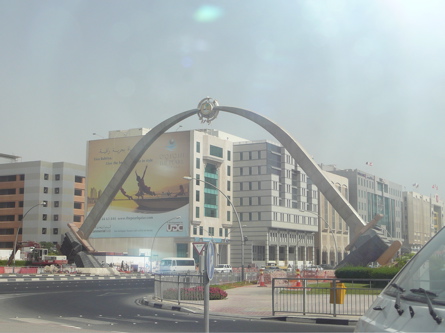
The second photo is of the QCPI building – Qatar Center for the Presentation of Islam – which we all watched with total amazement as it was being built – what imagination! It gives Doha a unique skyline. Even with the imaginative skyscrapers, a skyscraper skyline is just a skyscraper skyline – it all blends. But this building – WHOA! It is so bold, so retro and so forward at the same time – I love it.
This is a view looking across the newly renovated Iranian souks – the old Souk area in Doha:

Who’s Checking Kuwait’s Toothpaste?
US checks toothpaste for toxins
Toothpaste is the latest Chinese export to raise safety concerns
Health officials in the United States say they are checking all shipments of toothpaste imported from China for contamination with toxic chemicals.
Panama and the Dominican Republic have reported finding diethylene glycol, a chemical used in engine coolants, in toothpaste from China.
The toothpaste scare is the latest involving products from China.
Earlier this year, contaminated pet food ingredients killed a number of cats and dogs in North America.
The toxic chemical, melamine, was found in wheat gluten exports from China for use in pet food, prompting a recall of at least 100 pet food brands.
The tainted wheat gluten was even thought to have made its way into livestock feed.
Low-cost substitute
Cough syrup containing containing diethylene glycol originating from China killed more than 50 people in Panama last year.
The New York Times said a Chinese chemical maker had sold the industrial-grade chemical as glycerine, which is often used as a moistener in products from toothpaste to soap and cosmetics.
CHINESE FOOD SCARES
May 2007 China probes reports that contaminated toothpaste was sent to Central America
March 2007 Melamine is found in wheat gluten exports from China for use in pet food, prompting a recall of at least 100 pet food brands
Nov 2006 A dye farmers fed to ducks to make their eggs look fresher is found to contain cancer-causing properties and 5,000 ducks are culled
August 2006 About 40 people in Beijing contract meningitis after eating partially cooked snails at a chain of restaurants
Diethylene glycol is sometimes used as a low-cost substitute for glycerine and Chinese toothpaste makers have said small amounts of the chemical are harmless in toothpaste.
“We are going to be sampling and testing all shipments of toothpaste that come from China,” said Doug Arbesfeld, a spokesman for the US Food and Drug Administration.
The FDA says China is the second-largest exporter of toothpaste to the US after Canada.
Food safety investigators in Panama said two brands of toothpaste were imported illegally from China through a free-trade zone.
Chinese officials say they are investigating the claims.
The Dominican Republic and Panama have pulled thousands of tubes of Chinese toothpaste brands Excel and Mr Cool from store shelves.
Beijing recently pledged to clean up its tainted food and drug industry after the series of safety scares. The subject was raised by the US in bilateral trade talks this week.
The former head of China’s State Food and Drug Administration is facing trial, accused of taking large bribes to approve untested medicines.
From today’s BBC News.
Recent Comments
intlxpatr on Shampoo Ginger tigerbutterya0c5ff1d… on Shampoo Ginger intlxpatr on British Soldier Kidnapped, Esc… John on British Soldier Kidnapped, Esc… intlxpatr on British Soldier Kidnapped, Esc… Wikipedia Donate Button

Amazina


Early Voting in Florida


