Peeking Inside
You are a blessing in my life.
You think you are just blogging, but for me, you allow me to get a little bit beneath the surface of what your lives are like here in Kuwait.
I have to assume that most of you, like me, protect a lot of realities in your life, and that I am just getting the surface, just getting what you feel comfortable sharing with me.
And yet . . .no matter how superficial the “peek,” it is better than nothing.
Over time, we build a body of work. No matter how discreet we are ( Little Diamond I almost wrote “discrete,” and thinking of your pet peeve, checked it, thank God!) we reveal how we think, and what is important to us.
I love having some Kuwaiti friends. You teach me things I could never learn in a million years, just looking from the outside.
True story: I am having breakfast with my Kuwait friend at the Al-Kout Mall and she shivers. This friend is very special to me; it’s as if a flame burns inside her, keeping her pure and true from the inside out.
“I feel so out of place here!” she says.
I am truly bewildered.
“You are Kuwaiti! This is a Kuwaiti Mall!” I cry. “What is it that makes you so uncomfortable?”
“It’s like another world,” she says. “I’m not dressed conservatively enough.”
She is dressed in jeans – not tight. A t-shirt – not tight. And has a long sleeved shirt to go over it tied around her shoulders. She is entirely modest.
“I don’t see it,” I say. “Please, let me see through your eyes. What are you seeing, how is it different, why are you uncomfortable?”
“You’ve been to Marina Mall,” she responded. “You can see the difference?”
Of course. But Marina Mall . . . it is kind of a la la land to me, sort of bizarre. It almost looks Western, but there are things that are just not quite right . . .
“Yes,” she said. “You’ve got it.”
I still don’t know what I’ve got. So she starts explaining . . .”Look, you can see how the thobes are cut differently down here, tighter around the chest.”
(Uh . . . no, I can’t see!)
“. . . and the cuffs, the way they button. And the shoes are different, less . . . . ”
all of a sudden, I am thinking of my friend who taught Arabic, and the hours she labored, trying to get me to hear the difference between the light “t” and the hard “t”, I am trying and trying, but I don’t get it and then one day – I do!
I thank God for you, my friends, letting me see through your eyes, helping me understand, giving me new ways of seeing the world.
You All Look the Same to Us
“Which one is Noriko?” my instructor asked me.
“She’s Japanese, ” I responded, “She sits between Katrina and Joyce.”
She looked up at me and grinned.
“We can’t tell you apart, you know,” she laughed. “You all look the same to us. It takes us weeks, even months, to be able to tell you apart.”
Maybe I should have been offended, but I wasn’t. My class was made up of Europeans, Americans, Asians – people from all over the world who wanted to learn Arabic. It was funny to me that she couldn’t tell us apart, but I often have the same problem – I’m bad with faces. When you’re the teacher, looking out at a sea of faces – it takes a while.
But it has become a family tag-line, a joke – “You all look the same to us”.
Qatteri Cat vs. Easter Egg Tree
The Qatteri Cat’s favorite toy is a Sakura Express Bag:

But sometimes, when he needs exercise, we tease him. We put his white bear “baby” at the top of his scratching post:

And the Qatteri Cat HATES that! He can’t bear it! He says “That’s just not right!” and within 30 seconds, he attacks the bear and brings – or knocks – him back down (that white blur at the bottom of the photo is the bear):
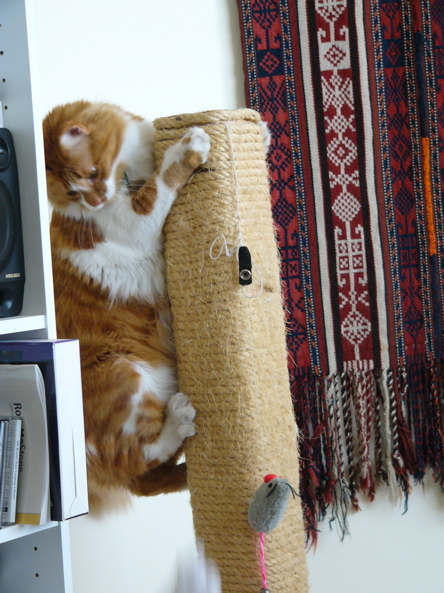
Now, he thinks our Easter Egg Tree is his new toy. (Remember the debacle with the Christmas tree?) I am working with him on this, not to bat at the eggs. So far, not so good:

*Easter Egg trees have nothing to do with religion. Easter Eggs go a long way back and are related to Spring, to fertility, and probably to early pagan rituals. Same with bunny rabbits. In Germany, people used to put literally thousands of hand decorated eggs out on their trees as Easter approached, and we would walk around admiring everyone’s trees. It is more a cultural thing, not a religious thing.
Even After All this Time – Latifi
A good book can make your blood race faster. A good book may even require underlines, turned page corners to mark the places you liked the best. A good book may compell you to tell others about it. Above all, a good book is a book you think about long after you have turned the last page.
Some of my best “good books” come to me through Little Diamond, my neice who lives in Beirut. We share a family culture, but even better, we share a wacky sense of humor. There are times we can’t even let our eyes meet in family gatherings, because we are thinking the same thing and can’t afford to laugh out loud.
She recommended this book to me more than three years ago, and I bought it immediately. And then it sat in my “read me soon” pile(s), languishing, unread, until early this year.
Oh, what a treat this book is! Once I picked it up, I could hardly put it down!
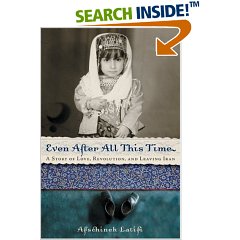
The book is autobiographical, and begins in pre-revolutionary Iran, where Afchineh Latifi’s father is a soldier. You see the early years of her life with her sweet, struggling parents, and you feel like you lived in their home with them, the images are so vivid.
As a military officer, though, her father is suspect once the revolutionaries come into power, and her family’s fortunes fail. Her father is arrested. As Latifi’s mother bravely goes from jail to jail, trying to find her husband, her daughters are often with her. Once she finds him, she brings him comfort items – shaving kit, washcloth, etc. so he can maintain a small amount of dignity while he is being beaten and imprisoned. Latifi’s mother was young when this book opens, maybe in her thirties, with two daughters and two sons, and I am totally blown away by the courage it took to persist as her husband was transferred from prison to prison, increasingly brutalized, and then, immediately after the last visit – shot. So immediately that the family heard the shots.
And then the real nightmare begine. The young mother and her family have no income, and her (now dead) husband’s mother claims her house, even though they bought her a house of her own while her husband was alive. Latifi’s Mom never gives up. She gets her daughters visitor’s visas to Austria and puts them in a convent school, and then gets them to America – again on visitor’s visas – where they are forced to camp – for years – with a relative. Literally, years. Their brave mother eventually manages to get herself and her sons out of Iran, and join them in the US.
Their mother is a pistol. She is brave in the face of obstacles that would deter most of us. She never gives up. I am in total awe of her commitment to the survival – and thriving – of her family.
I love this book for two reasons – the first being the strength and courage of this family, and the second being that they immigrated to America. You will hear a lot of Americans who say terrible things about immigrants, and how they take up scarce resources better meant for “real” Americans. Who are they kidding? We are ALL immigrants, in America, except for the Native Americans! This family, their will to succeed, is the story of us all, and what makes the country great. It is still a country where you can work hard, and succeed, and thrive. It’s an every day story in our country, but a story I never get tired of hearing.
Here are some excerpts from the book:
She looked at me as if I were an alien, which in fact I was. “Yes,” she said, “You get a library card and you can borrow as many books as you want.”
“And it doesn’t cost a thing?” I asked.
“Not a penny,” the woman said. “Unless you bring the books back late. Then we charge you a late fee.”
This was news to me. There were libraries in Tehran to be sure, but we had never frequented them. Mom would come home every two or three weeks with armsful of new books, and we would devour them hungrily. We were much too spoiled to share books with anyone.
The librarian processed my card on the spot. I couldn’t believe it. It felt like the biggest gift of my life. . . . . By the end of the summer I discovered a whole new world. Books. Words. Stories. I got in touch with my inner geek. Reading was not only exciting, it offered escape. When I was reading, my other life didn’t exist. There were days when I didn’t even think of Mom.
Her Mother was still in Iran at this time, and she and her sister are living with relatives who have loud arguments wondering how much longer they will be burdened with these girls. Finally, the two sisters find jobs, as well as going to school, and save every penny, and get an apartment where they live while putting themselves through university. And, one day, their mother and brothers arrive. Life changes. They all live together again.
“It’s almost Norouz,” she said. “Or have you forgotten?”
I had indeed forgotten. She was referring to the Persian New Year, which on the Gregorian calendar falls in late March. About two weeks before the start of Norouz, many Persians take part in something called ‘khane tekani,’ which literally means ‘shaking your house.’ You will see people painting their homes, washing their carpets, sweeping out their attics, cleaning their yards. One could say that it is a form of spring cleaning, but that is only a very small part of it. In Persian ‘no’ means new, and ‘rouz’ means day. The last Wednesday of the year is known as ‘chahar shanbeh suri.’ At dusk, with the cleaning over, people light small bonfires and sing traditional songs, and those who can manage it are urged to jump over flames. Fire, too, is seen as a cleansing, purifying agent: it burns away all the negative things in one’s life – the bad habits, the misfortune, the sorrows. It’s all about cleanliness: clean house, clean soul, new beginnings.
On the “new day” itself, people focus on family and friends, and for the next two weeks there will be much visiting back and forth. In each house, one finds a ‘sofreh eid,’ . . . Laid out on this garment, one will find the ‘Haft Seen’ (Seven S’s) comprised of seven items that begin with the letter S. These are ‘sabzeh’ or sprouts (representing rebirth); samanu, a pudding (for sweetness in life); ‘senjed,’ the sweet, dry fruit of the lotus tree (representing love); ‘serkeh’ or vinegar (for patience); ‘seer’ or garlic (for its medicinal qualities); ‘somaq’ or sumak berries (for the color of sunrise); and ‘seeb’ or red apples (symbols of health and beauty. In addition there are candles laid out on the ‘sofreh eid” one for each member of the household. The lit candles represent the goodness and warmth that enter life with the coming of spring.
(For the first time, this year we are invited to a new year’s celebration, and I thank God that I read this book just at the right time, so I will know even just a little of what this is all about. I am excited to see the ‘haft seen.’ )
Something else happened that November that I will never forget: Our family celebrated Thanksgiving for the first time. We loved the whole idea behind the celebration. It wasn’t about religion, and it wasn’t about gifts; it was about people sitting down to enjoy a meal together and acknowledging everything that they had to be thankful for. And we had a lot to be thankful for.
By the end of the book, all four children have graduated from university with professional degrees. This isn’t a spoiler. The book is about the sacrifice, the hard work and the commitment it took to get them there. Even After All This Time is an inspirational book, a book you won’t soon forget, and a book you will want to share with your friends.
Amazon offers it used from $4.67 and in hardcover around $25.
And Happy New Year to my Persian friends.
Bacteria Helpful, Not Harmful
You might think I am obsessed with bacteria, but I am not. I think we are overly fearful, and overly protective of ourselves. Washing hands frequently is proven to help prevent frequent colds, but disinfecting our work place, etc. on a daily basis is probably not so productive. This article says, essentially, that we can disinfect all we want; we carry the stuff with us.
Bacteria on our skin natural, so stop obsessing with the hygiene
March 17, 2007
FEAR of common bacteria stoked by incessant advertising of antimicrobial soaps and cleaners may be misplaced. Researchers say that while they have discovered nearly 200 different species of bacteria living on human skin, many of these have evolved along with us for so long that they should be considered part of us – and many are helpful rather than harmful.
Some of 182 species identified on the skin appeared to be permanently in residence, while others were temporary visitors, according to the researchers from New York University School of Medicine.
In research published recently in the Proceedings of the National Academy of Sciences, Dr Martin Blaser and his colleagues took swabs from the forearms of six healthy people to study the bacterial populations in human skin – our largest organ.
“We identify about 182 species,” Blaser said in an interview. “And based on those numbers, we estimate there are probably at least 250 species in the skin.
“In comparison, a good zoo might have 100 species or 200 species. So we already know that there are as many different species in our skin, just on the forearm, as there are in a good zoo.”
Bacteria are single-celled micro-organisms believed to have been the first living things on Earth.
While some cause disease, bacteria also reside normally in our bodies, for example in the digestive tract, performing useful chores.
“Without good bacteria, the body could not survive,” added Dr Zhan Gao, a scientist in Blaser’s lab involved in the study.
The researchers noted that microbes in the body actually outnumber human cells 10-to-1.
“Our microbes are actually, in essence, a part of our body,” Blaser said. “We think that many of the normal organisms are protecting the skin. So that’s why I don’t think it’s a great idea to keep washing all the time because we’re basically washing off one of our defence layers,” Blaser added.
It has long been known that bacteria reside in the skin, but Blaser and his colleagues used a sophisticated molecular technique based on DNA to conduct a rigorous census.
The inhabitants proved to be more diverse than had been thought, with about 8 per cent of the species previously unknown, the researchers found.
Some bacteria seemed to be permanent residents of the skin, with four genera – Staphylococcus, Streptococcus, Propionibacteria and Corynebacteria – accounting for a bit more than half the population. Others were more transient.
In each person, the population of bacteria changed over time although a core set existed for each.
The volunteers included three men and three women, and the findings suggested the two sexes may differ in the bacteria they tote along.
The researchers previously had studied bacteria in the stomach and esophagus. With this research, they found that the insides of the body and the skin had major differences in bacterial populations.
“Microbes have been living in animals probably for a billion years. And the microbes that we have in our body are not accidental. They have evolved with us,” Blaser said.
Reuters
This article is from The Australian: Health and I found it on Google News.
Internet Phone Blockage
So far, my internet phone is still working. But I can no longer pick up messages; I had a work-around and the work-around is now blocked, too. I still have the connection, but I can’t connect with my internet phone service provider. Hmmmmm.
In Qatar, the problem was solved in less than a week, when ambassadors went to the Emir and protested that the ban on internet phones hurt the entire population. Does the government here understand that Kuwaitis have kids at school in the UK, the US, and are relying on these phone services, too?
My sense is that with the government currently in chaos, no one has the time to focus on this “small” problem. Nor the problem of increasing population and buildings vs. limited infrastructure – roads. water. electricity.
My Kuwaiti friends say that even 20 short years ago, Kuwait was paradise. I believe it, there is so much beauty here, so much natural richness. They say Kuwait was more free twenty years ago.
I know my focus on the internet phone service is selfish; there are bigger problems to be solved. Right now – it’s the one that affects ME!
St. Patrick’s Day, March 17
Even non-Irish around the world celebrate St. Patrick’s Day. St. Patrick was the saint who converted the majority of Irish to Christianity, and legend has it, made all the snakes leave Ireland.
People have parties, make Irish stew and soda bread, and drink beer colored green with food coloring.
And – they tell Irish jokes.
Here is one of my favorites:
Even God Enjoys A Good Laugh
There were 3 good arguments that Jesus could have been Black:
1. He called everyone “brother”
2. He liked Gospel
3. He couldn’t get a fair trial.
But then there were 3 equally good arguments that Jesus was Jewish:
1. He went into His Fathers business.
2. He lived at home until he was 33.
3. He was sure his Mother was a virgin and his mother was sure he was God.
But then there were 3 equally good arguments that Jesus could have been Italian:
1. He talked with his hands.
2. He had wine with every meal.
3. He used olive oil.
But then there were 3 equally good arguments that Jesus could have been a Californian:
1. He never cut his hair.
2. He walked around barefoot all the time.
3. He started a new religion.
But then there were 3 equally good arguments that Jesus could have been Irish:
1. He never got married.
2. He was always telling stories.
3. He loved green pastures.
But the most compelling evidence of all – 3 proofs that Jesus could have been a woman:
1. He fed a crowd at a moment’s notice when there was no food.
2. He kept trying to get a message across to a bunch of men who just didn’t get it..
3. And even when he was dead, He had to get up because there was more work to do.
You can find an entire website devoted to Irish Jokes by clicking here.
Record foreclosures hit mortgage lenders
This story is from USA Today and is related to an earlier blog entry on spiraling mortgage foreclosures. The reason it caught my eye is that no-where in the article does it mention that the top two states where foreclosures occurred are Mississippi and Louisiana, the two states most recently hit – and hit hard – by hurricanes. And the reason people are failing to continue mortgage payments are that in some cases, the houses no longer exist and either they had no insurance, or the insurance company found a way NOT to pay up.
This is a big story – the record foreclosures – and evidence how in every society, when borrowing money becomes too easy, people get hurt.
It is an equally big story when the insurance companies don’t pay up. I have been told by the company insuring my Florida house that they will probably not continue insuring me. It is hard to find a company who will insure your house against hurricane damage in Florida.
By Noelle Knox, USA TODAY
The reason many mortgage lenders are in trouble became alarmingly clear Tuesday. The Mortgage Bankers Association said more than 2.1 million Americans with a home loan missed at least one payment at the end of last year — and the rate of new foreclosures hit a record.
The problem is most severe for borrowers with scuffed credit and adjustable-rate mortgages. More than 14% of them were behind on their payments. And the worst is yet to come, the MBA said. At least $300 billion in subprime ARMs will reset this year to higher interest rates. Those borrowers face higher payments and a harder time refinancing.
Blindsided by the number of loans that have already gone bad, more than two dozen lenders have gone out of business or been purchased. New Century Financial, the nation’s second-largest subprime lender, has quit making loans and is edging toward bankruptcy protection.
“There’s been a stunning erosion of mortgage quality,” said Mark Zandi, chief economist at Moody’s Economy.com. “It’s primarily in the subprime market, but the entire market is weakening … and that adds to problems in the housing market, and by extension the broader economy.” Retailers are already feeling the effect, he said, because homeowners tend to spend less when they fear their homes are worth less.
To stem their losses, lenders are ending 100% financing plans, requiring better credit scores and demanding more proof of a borrower’s income. The stricter rules are squeezing first-time buyers, as well as homeowners who want to refinance.
To read the rest of the story, and to see a state-by-state list of mortgage foreclosures, Click USA Today, here.
This Little Eggy
I was with my sweet friend and many of her 12 children, and I was goofing off with the younger ones, running, chasing. With tiny Abdulaziz, I started playing with his toes.
“This little . . . ” I started, and then caught myself in horror. The next word is “piggy” and my friends are devout Muslims.
She just laughed.
She said “Oh we do this too! We say ‘this little eggy went to market and this little eggy stayed home'”.
Oh! Thank goodness! Every child around the world loves that game; I’m so glad I can continue to play it here!
Who Knew? Skimmed Milk Gets Top Post
When I blog, I know what I think is important. I don’t just blog what I think is important, I also blog what I think is funny, what catches my eye, what I want people who don’t live in Kuwait to know about how life here is different from their life, and then.. . things in the news that might be obscure, but interesting.
Every day, the Who Knew? Skimmed Milk Affects Fertility post gets hits. Although I only posted it two weeks ago, it is the leader for the last thirty days, way ahead of the next most popular post.
I never know. Mostly I blog because I have things ( originally wrote “thinks” which must be truly Freudian) I want to say, but in any kind of communication, you need feedback. Feedback, for me, is a combination of what you comment, and what you read – my statistics. It just cracks me up, what you, the reader, find most interesting in my posts as opposed to what I am thinking when I post. Go figure!
Recent Comments
intlxpatr on Shampoo Ginger tigerbutterya0c5ff1d… on Shampoo Ginger intlxpatr on British Soldier Kidnapped, Esc… John on British Soldier Kidnapped, Esc… intlxpatr on British Soldier Kidnapped, Esc… Wikipedia Donate Button

Amazina


Early Voting in Florida


