Journalists are tough, and snarky. All the photos and stories coming out of Sochi about the orangey brown water coming out of the taps, doors kicked down so new TVs can be installed (better late than never) etc. These are things we take for granted when we go to other countries, especially when they are undergoing rapid construction. There are times when deadlines are not met and things do not go smoothly. (I will never forget the look on the face of our building care-taker, who had sworn to me, over and over, he had no key to my apartment, but who walked in one day when my car was at the dealership for repairs, and he thought I was gone, too.) Things happen.
But one journalist on NPR (National Public Radio) cracked me up totally talking about the opening ceremony, and how beautiful it was until the climax, and the five snowflakes morphed into five Olympic rings – or at least that was the plan. “Four rings – and one lonely little snowflake! This is the memory of the Sochi games!” he chortled, and I found myself laughing, too, at that one lonely little snowflake.
I would hate to be the person responsible for that snowflake, or any of the hotel problems. It may be modern day Russia, but heads can still roll 😦
As it turns out, the Russians never saw that. They saw a doctored tape from the rehearsal, when all went as scored:
SOCHI, Russia (AP) — Smoke and mirrors? Russian state television aired footage Friday of five floating snowflakes turning into the Olympic rings and bursting into pyrotechnics at the Sochi Games opening ceremony. Problem is, that didn’t happen.
The opening ceremony at the Winter Games hit a bump when only four of the five rings materialized in a wintry opening scene. The five were supposed to join together and erupt in fireworks. But one snowflake never expanded, and the pyrotechnics never went off.
But everything worked fine for viewers of the Rossiya 1, the Russian host broadcaster.
As the fifth ring got stuck, Rossiya cut away to rehearsal footage. All five rings came together, and the fireworks exploded on cue.
“It didn’t show on television, thank God,” Jean Claude-Killy, the French ski great who heads the IOC coordination commission for the Sochi Games, told The Associated Press.
Producers confirmed the switch, saying it was important to preserve the imagery of the Olympic symbols.
The unveiling of the rings is always one of the most iconic moments of an opening ceremony, and President Vladimir Putin has been determined to use the ceremony as an introduction of the new Russia to the world.
Konstantin Ernst, executive creative director of the opening ceremony, told reporters at a news conference that he called down to master control to tell them to go the practice footage when he realized what happened.
“This is an open secret,” he said, referring to the use of the pre-recorded footage. The show’s artistic director George Tsypin said the malfunction was caused by a bad command from a stage manager.
Ernst defended his decision, saying that the most important part was preserving the images and the Olympic tradition: “This is certainly bad, but it does not humiliate us.”
NBC was to air the ceremony in the U.S. on tape delay later Friday.
Glitches are not uncommon at Olympic opening ceremonies.
There was a minor controversy over trickery involving the fireworks at the opening ceremony of the 2008 Beijing Olympics, after it was revealed that some of the display featured prerecorded footage.
Fireworks bursting into the shape of gigantic footprints were shown trudging above the Beijing skyline to the National Stadium near the start of the ceremony. Officials confirmed that some of the footage shown to TV viewers around the world and on giant screens inside the stadium featured a computer-generated, three-dimensional image.
In addition, a tiny, pigtailed 9-year-old girl in a red dress who sang “Ode to the Motherland” was lip-synching. The real voice belonged to a 7-year-old girl who was replaced because she was deemed not cute enough by a member of China’s Politburo.
At the 2006 Winter Games in Turin, Luciano Pavarotti’s performance was prerecorded. The maestro who conducted the aria, Leone Magiera, said the bitter cold made a live performance impossible.
___
Associated Press writers Stephen Wilson and Oskar Garcia contributed to this report.
Thank you, John Mueller, for forwarding me this story. We lived in luxury, next to a vacant lot where a few laborers lived with next to nothing. They were the lucky ones, but lived in fear of being caught without passports (their sponsors held their passports) and without any papers. The Indian and Nepalese were treated like animals, not like human beings. They are a means to and end, and treated as a resource, without humanity:
Boarding the bus back to their accommodation camp November 19, 2013
STANDING UP FOR THE LITTLE GUY
Azfar Khan: Laboring for Labor
February 07, 2014By Laura Secorun Palet
Share on facebookShare on Facebook Share on twitterShare on Twitter Share on emailEmail
Why you should care
Because migrant workers finally have an advocate worthy of their wants and needs in a place that believes they deserve none of the above.
Defending the little guy is a stance old as time, but you wouldn’t think the glitzy world of professional soccer would need that kind of advocate. But for the people who work so that others can play in new stadiums and watch from secure bleachers, it’s an entirely different story. And it’s the story being told by migrant workers in Qatar who are helping the city prepare for the world’s largest sports competition in 2022.
Cue Azfar Khan, a Pakistani native living in an increasingly unstable Lebanon because he sees an even greater threat facing the regions’ migrant workers.
“Sorry about the bad connection. There has been an explosion in the neighborhood,” Khan says in a surprisingly relaxed tone over the phone.
When you do something like this, it’s not only about the job — it has to be personal.
The senior migration specialist for the International Labour Organization (ILO) in Beirut, Khan monitors and advises Arab states on how to protect workers’ rights. He is talkative and cheerful, even in the face of bombs and sectarian violence.
Azfar Khan
“The security situation is pretty dire,” he says plainly.
If Khan doesn’t sound overly concerned about explosions, it’s because he’s focused on helping the countless immigrant workers who don’t make the headlines. As their champion, he is counseling the Qatar government on how to host the World Cup without violating any more international labor laws.
Working conditions in the region are “pathetic,” Khan says. He believes the kafala system — a traditional sponsorship scheme that binds each migrant worker to a single employer — is incompatible with modern-day labor because it puts workers in a very vulnerable situation.
Last year alone, 185 Nepalese workers — the single largest group of laborers in Qatar and also the lowest paid — died during the construction of the World Cup infrastructure. More than half, some as young as 16, died of heart attacks or workplace accidents, often after enduring 12-hour days and sharing unsanitary lodgings.
Surprisingly enough, Qatar has ratified most conventions on labor rights, which means all exploitative practices are technically illegal. But rules mean nothing if they’re not enforced.
”People with a little bit of assistance can do a better job about improving their lives than paternalistic policymakers.”
“The problem is an extreme lack of political will,” says Khan. “For example, Qatar has signed the convention on the elimination of forced labor but still allows the practice of withdrawing workers’ passports, which easily leads to forced labor.”
Source: Narendra Shrestha/EPA/Corbis
Nepalese domestic migrant worker Om Kumar Chaudhary, aged 23, fixes a goods lift at a 60 feet high construction building in Kathmandu, Nepal, December 16, 2013.
The Qatari government thinks Khan’s concerns are exaggerated, insisting, according to the Emir, that the country is “on the right track” and “truly committed to treating all workers fairly.”
Yet Qatar refuses to sign one convention — the very one Khan considers most crucial: the freedom of assembly and association. “Without any organization to adequately represent their interests, no matter how much we discuss, we are going to have problems,” he says.
And if you thought it was just a regional issue, think again. This unwillingness to take action is not unique to the Gulf states. According to Khan, “Labor law doesn’t get much attention anywhere, whether it is in developing countries or in developed ones.”
Pushing countries to implement these laws without the momentum of political will is like pushing water uphill, but Khan perseveres in his quest with modesty and conviction.
“I know that what I can do will not be earth shattering, but at least it is a cog in the wheel,” he explains.
Khan is himself a former immigrant who moved to Canada with his mother and sister from his native Pakistan at age 14. Raised in a household partial to Sufi philosophy, he was instilled with a sense of social justice from an early age.
“We were told that we had a commitment to people, and I guess championing the underdog was implicitly part of this teaching,” he says.
Source: Amnesty International/Corbis
Migrant worker sitting on a bunk bed in his accommodation in Qatar.
While in Canada, Khan’s dreams of cricketing stardom turned to aspirations of fighting for social justice. He studied economics at McGill University, specializing in development economics before moving to the U.K. and completing his Ph.D. on the impact of international migration on rural Pakistan. In the 1970s and ’80s, Khan noticed how many Pakistanis moved to the Gulf countries to earn money to send home and became concerned about the trend’s long-term effects.
In 1995, Khan started working for the ILO, where he promotes legal and social protection for migrant workers — a dream endeavor, but far from easy. A crucial part of his task is raising awareness among international organizations as well as the governments he already counsels. He thinks institutions should do more to empower those they seek to protect and stop viewing the poor as just another statistic.
What we really need are good institutions that will protect the workers like the unions used to.
Which explains why working face to face with people is Khan’s favorite part of the job. While running experimental community workshops in the region of Kochi, India, he realized “that people with a little bit of assistance can do a better job about improving their lives than paternalistic policymakers sitting in high offices can.” Grassroots work has become just as important to him as presenting reports in well-appointed meeting rooms.
Source: Fadi Al-Assaad/Reuters/Corbis
View of Doha city, under construction
The key to moving things in the right direction, he asserts, is public support — and Khan isn’t shy about using the media to get politicians’ attention. In Ukraine in 2003, for example, he surveyed how the restructuring of enterprises promoted by liberal policies was affecting workers’ security. The morning after he shared his results with the press, the issue was discussed in parliament, and his recommendations were adopted by the government.
Information is useful, Khan notes, but taking action is a whole other matter. “So what we really need are good institutions that will protect the workers like the unions used to,” he adds.
Unfortunately Khan’s work is as slow going as it is important, but he’s more than willing to put in the effort. Any moves toward social justice are worthwhile, he says, “regardless of the size.”
Khan’s genuine love of people seems to be the secret behind his boundless enthusiasm. After 20 years of working for the ILO, he will soon be forced to retire, but he plans to keep fighting for the proverbial little guy.
“When you do something like this, it’s not only about the job — it has to be personal. Do you believe in it or don’t you believe in it?” he asks rhetorically.
Spend a minute with Khan, and you too will believe.
A computer generated image shows the stadium to be built in Al-Wakrah.
This is big news for people in my area, because they often flash lights to warn of speed traps ahead.
Warning Drivers Of Speed Traps With Flashing Headlights Is Free Speech
A federal judge in St. Louis has set the benchmark
A federal judge in St. Louis ruled Monday that a driver flashing their lights to warn other drivers of an impending speed trap is protected free speech.
On November 22, 2012 Michael Elli received a ticket for flashing his lights to warn fellow drivers of a speed trap, according to Fox 2. The American Civil Liberties Union helped Elli fight the $1,000 ticket all the way to federal court.
Judge Henry Autrey of St. Louis ruled a driver has the right to flash their lights under the First Amendment. Autrey issued an injunction to stop Ellisville Police from enforcing the policy.
“If you’re at the gas station on the corner and someone says ‘Hey be careful over there, there’s a speed trap,’ that’s protected speech. You can’t be ticketed for that. This is no different,” Tony Rothert, an attorney for the American Civil Liberties Union, told Fox 2.
A lawyer for the police in Ellisville said the department isn’t affected by the ruling, as this kind of ticket has only been issued five or so times in the last decade. Across the country, however, the ruling will be considered the benchmark for such cases.
“Are you catching colds?” our friend asked as the funeral ended.
“No, no, I said, funerals just find us very vulnerable, and we have to deal with losses, past, present . . . and future. We have an ongoing fight over who is going to bury whom.”
We did not know the man well who had died, but we knew him as a stalwart. He was a greeter and usher at our service, and he was only rarely ever not there. He served the church. He was always there. I had asked his wife to help me with tickets, and she had laughed and said “of course, I’ll be there because my husband will be there, and if you need me just holler.”
They weren’t there. It made me uneasy, it nagged at me. I didn’t need her, but I missed her, and as I said – they are ALWAYS there. Sometimes it’s what is missing that catches your attention. It caught mine.
When I learned her husband had died, suddenly and unexpectedly, just as the Antique Fair was starting, it came almost as a physical blow. It’s not that I knew him that well. It’s that his presence at the church was something we took for granted, he was stalwart. You could count on him. We attended out of respect, respect for him, support for his wife.
And I know that the two of them spend (spent) as much time together as AdventureMan and I do. I don’t like to think that it could happen to me, that I could be suddenly left. AdventureMan was a military man, he would often leave, all these years, and he might tell me where he was going but I never knew for sure where he was going. We had a code to use if he was lying, but although he never used the code, I know there are times he lied, all for that bitch, national security. Yes, yes, I know, strong language from Intlxpatr, but strong times call for strong language. We both knew that there were times when there was a risk he wouldn’t come back.
We didn’t have to deal with death a lot in our life abroad. Of course, in the military, everyone is young. In all the countries where we worked in the Gulf, there were upper age limits – people retired and people left; you can’t live out your years in Qatar or Kuwait, there are laws against it. You can’t even be buried there without special permission. We learned to deal with the losses of people coming into our lives and leaving, but we didn’t have to deal with the great finality of death. We’re learning.
AdventureMan insists he is going to go first. I am tough in a lot of ways, but I don’t know that I am tough enough to go through his funeral. The very thought of it makes me sick to my stomach.
He tells me not to worry. He wants a Viking funeral; he wants to be sent out in a kerosene soaked ship and for archers to set it on fire as it sails off, disintegrating in flames. Isn’t going to happen, AdventureMan, but if it did, I might give some thought to pitching myself on the ship as it departs . . . otherwise, I’m afraid I might live the rest of my life as the one of the walking wounded.
Vanity, vanity. When I was in university, along with our studies, we all picked out our china patterns and silver flatware. We were preparing for the rest of our lives, which meant getting married. My parents gave me six place settings when I graduated university and through the years, AdventureMan and I added settings. We used the sterling all the time, military people entertained more formally. We haunted French and German antique markets and flea markets, seeking obscure pieces we didn’t have, it was fun.
These days, not so much. I haven’t bought any silver for years. We do very little formal entertaining. My sister and her daughters have taken to using their good silver for every day. I haven’t reached that point – yet – but I am thinking about it.
In spite of the fact that we are not often using our silver flatware, at the recent Christ Church Antique Fair, a woman celebrated having found gumbo spoons.
Gumbo spoons? I have a lot of pieces, mostly French and German. I have asparagus servers, yes, really! I have pieces for all kinds of exotic foods, but no. No, I did not have gumbo spoons. I had never even heard of gumbo spoons.
Gumbo spoons are a little larger than soup spoons, wider, rounder, a little deeper.
As it turns out, they don’t even make gumbo spoons in my sterling, but they had some beautiful ones that will go with my everyday flatware; these had shells on the base of the handles. They are beautiful, and I can hardly wait to eat gumbo in such grand style. These will be well loved – and well used!
Oh Hayfa, this is one of the best flash-mobs ever! I wanted to be there!
I always thought Kuwait was ripe for a flash mob at the junction where the Fintas Expressway joined 6th Ring road. Never had the courage; even though you’d have to wait 6 – 9 light changes to get through. Figured the morality police would have me up on charges, LOL.
“I was scratching their heads and ears and noticed that they were nice and warm! I wondered how they were managing to keep so warm in the awful cold, but I was glad they found a nice warm place,” my friend said, when I asked her how her outdoor cats had fared in the bone-chilling cold we experienced in Pensacola last week.
“Then I got my Gulf Power bill, and Intlxpatr, it was over a thousand dollars!” she exclaimed, her eyes huge.
Her normal bill is probably around what I pay. Not nearly a thousand dollars, not even on the hottest month of summer when I have to keep the air on full blast 24/7 on just to survive.
“So I called the heating people,’ she continued, and they had to crawl under the house, imagine, in this weather. . . ”
I imagined.
“. . . And they discovered the cats had clawed a hole in one of my air ducts and had luxuriated, down there under the house, while my heater tried to heat up half of Pensacola!”
We laughed, but a thousand dollars . . . that knocks a hole in anyone’s budget. It was one of those laughing-because-if-you-don’t-laugh-you-will-cry kinds of laughs.
I am an energy nerd. It comes from growing up in Alaska, I am convinced, where I had neighbors who fished in the summers and had to get by all year on that income, plus what they might come by with odd jobs the rest of the year. My friends had a huge garden in their back yard, and a root cellar where things were stored. In the root cellar, they had a chalkboard, where every potato, every carrot, everything they had stored was listed, and numbers subtracted as they were used. They had to keep track, to be sure they would make it through the winter.
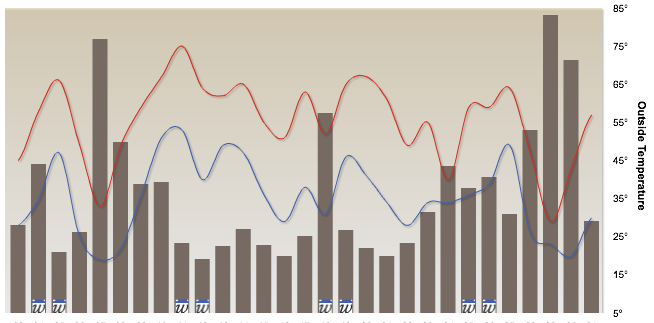
In Pensacola, Gulf Power has a really cool feature on their website. You set up an online account, and you can check on your daily energy usage. LOL, this is mine for January. It has huge ups and downs – mostly we don’t need to have the heat on, but when the temperatures go down and stay down – it shows. There are also a couple days when we used our oven, and that shows up, too, but not badly.
I remember living in Germany, where I didn’t have a dryer (or any space for one) and my landlady brought me my energy bill. We lived in a very small farming village, where they were also all very frugal, but she couldn’t believe my bill was so small. I just smiled; I could hear her dryer going every day, and dryers are also a huge source of energy usage. Anything that heats up – or cools down – is an energy eater.
On the website, you can also compare this year against previous years – and my bill this year is nearly a third higher than last year, but last year we did not have a three-day arctic freeze!
From Agence France, a report that 191 Nepali laborers died in Qatar in ONE year:
Nearly 200 Nepali migrant workers died in Qatar last year, many of them from heart failure, officials said Monday, figures that highlight the grim plight of labourers in the Gulf nation.
Tens of thousands of impoverished Nepalis head every year to Qatar, where a construction boom is gathering pace as it prepares to host the 2022 football World Cup.
The Nepal embassy in Doha said it registered 191 deaths last year compared with 169 the year before, with a foreign ministry official describing many of the deaths as “unnatural”.
“In the year 2013, a total of 191 Nepali migrant workers died in Qatar,” Harikanta Paudel, a senior embassy official, told AFP by telephone.
“The highest number of deaths occurred in July when 32 workers died,” Paudel said.
Qatar is under mounting pressure over poor conditions for migrant labourers, particularly during the blisteringly hot summer, in the gas-rich nation’s booming construction industry.
A Kathmandu-based foreign ministry official told AFP that a third of the deaths recorded were due to “unnatural” heart failure.
“Young and healthy men in their twenties and thirties have died… it is unnatural,” said official Subhanga Parajuli.
“Cardiac arrest is followed by traffic accidents as another main cause of death. The third cause of death is injuries during work,” Parajuli said.
An Amnesty International report released last November said migrant workers in Qatar endured a series of abuses including “non-payment of wages, harsh and dangerous working conditions, and shocking standards of accommodation”.
The rights group said its researchers overheard one construction firm manager use the term “animals” to describe migrant workers, while a labourer told the watchdog that “Nepalis are treated like cattle”.
Qatari authorities last October said allegations of abuse of labourers working on World Cup facilities were exaggerated but insisted they took such claims seriously.
More than one million Nepali migrant workers toil in the Gulf region and Southeast Asia. Qatar alone hosts around 400,000 Nepalis as part of its two-million strong migrant workforce.
What do you want to bet that those fees are whoppers? 🙂
From: MS REBECCA L.MORGAN service@un.com
From: Ms.Rebecca L.Morgan
Att:Dear Friend .
This is to inform you that I came to Nigeria yesterday from USA,after series of complains from the FBI and other Security agencies from Asia, Europe,Oceania, Antarctica,South America and the United States of America respectively,against the Federal Government of Nigeria and the British Government for the rate of scam activities going on in these two nations.
I have met with President GoodLuck of Nigeria who claimed that he has been trying his best to make sure you receive your fund into your account through their reserve account in USA.
Right now,as directed by our secretary general Mr. Ban Ki-Moon,We are working in collaborations with the Nigerian Economic and Financial Crime Commission (EFCC) and have decided to waive away all your clearance fees/Charges and authorize the Government of Nigeria to effect the payment of your compensation of an amount of $10.5M approved by both the British/United States government and the UN into your account without any delay.The only fee you are required to pay in other to confirm your fund in your account is COURT NOTARIZATION FEE to the UN.
Sincerely,you are a lucky person because I have just discovered that some top Nigerian’s/African’s and British Government Officials are interested in your fund and they are working in collaboration with One Mr.Ben S.Bernanke,FAKE FBI and others from USA to frustrate you and thereafter divert your fund into their personal account.
I have a very limited time to stay in Nigeria here so I would like you to urgently respond to this message with your full name, full address,direct phone number so that I can advise you on how best to confirm your fund in your account within the next 72 hours.
Sincerely yours,
Ms.Rebecca L.Morgan
United Nations Under-Secretary
General for Internal Oversight.






 Here There and Everywhere