Ramadan for Non Muslims; An Annual Tradition
I wrote this post when I was living in Kuwait, for my readers in the US in particular, who knew little about Ramadan. I wrote it because I had discovered that much of what I knew about Ramadan was wrong. Living in lands where Ramadan was celebrated helped me see the month – and many of our own traditions – in a new light.
It has become a tradition to post it – or a similar post – annually for those who are interested in what Ramadan is all about.

I am repeating this post from September 13, 2007 because it found so much interest among my non-Muslim friends. We are all so ignorant of one another’s customs, why we do what we do and why we believe what we believe. There is a blessing that comes with learning more about one another – that blessing, for me, is that when I learn about other, my own life is illuminated.

(I didn’t take this photo; it is from TourEgypt.net. If you want to see an astonishing variety of Ramadan lanterns/ fanous, Google “Image Ramadan lanterns” and you will find pages of them! I didn’t want to lift someone else’s photo from Flicker or Picasa (although people do that to me all the time!) but the variety is amazing.)
Ramadan will start soon; it means that the very thinnest of crescent moons was sighted by official astronomers, and the lunar month of Ramadan might begin. You might think it odd that people wait, with eager anticipation, for a month of daytime fasting, but the Muslims do – they wait for it eagerly.
A friend explained to me that it is a time of purification, when your prayers and supplications are doubly powerful, and when God takes extra consideration of the good that you do and the intentions of your heart. It is also a time when the devil cannot be present, so if you are tempted, it is coming from your own heart, and you battle against the temptations of your own heart. Forgiveness flows in this month, and blessings, too.
We have similar beliefs – think about it. Our holy people fast when asking a particular boon of God. We try to keep ourselves particularly holy at certain times of the year.
In Muslim countries, the state supports Ramadan, so things are a little different. Schools start later. Offices are open fewer hours. The two most dangerous times of the day are the times when schools dismiss and parents are picking up kids, and just before sunset, as everyone rushes to be home for the breaking of the fast, which occurs as the sun goes down. In olden days, there was a cannon that everyone in the town could hear, that signalled the end of the fast. There may still be a cannon today – in Doha there was, and we could hear it, but if there is a cannon in Kuwait, we are too far away, and can’t hear it.
When the fast is broken, traditionally after the evening prayer, you take two or three dates, and water or special milk drink, a meal which helps restore normal blood sugar levels and takes the edge off the fast. Shortly, you will eat a larger meal, full of special dishes eaten only during Ramadan. Families visit one another, and you will see maids carrying covered dishes to sisters houses and friends houses – everyone makes a lot of food, and shares it with one another. When we lived in Tunisia, we would get a food delivery maybe once a week – it is a holy thing to share, especially with the poor and we always wondered if we were being shared with as neighbors, or shared with as poor people! I always tried to watch what they particularly liked when they would visit me, so I could sent plates to their houses during Ramadan.
Just before the sun comes up, there is another meal, Suhoor, and for that meal, people usually eat something that will stick to your ribs, and drink extra water, because you will not eat again until the sun goes down. People who can, usually go back to bed after the Suhoor meal and morning prayers. People who can, sleep a lot during the day, during Ramadan. Especially as Ramadan moves into the hotter months, the fasting, especially from water, becomes a heavier responsibility.
And because it is a Muslim state, and to avoid burdening our brothers and sisters who are fasting, even non-Muslims refrain from eating, drinking, touching someone of the opposite sex in public, even your own husband (not having sex in the daytime is also a part of fasting), smoking is forbidden, and if you are in a car accident and you might be at fault, the person might say “I am fasting, I am fasting” which means they cannot argue with you because they are trying to maintain a purity of soul. Even chewing gum is an offense. And these offenses are punishable by a heavy fine – nearly $400 – or a stay in the local jail.
Because I am not Muslim, there may be other things of which I am not aware, and my local readers are welcome to help fill in here. As for me, I find it not such a burden; I like that there is a whole month with a focus on God. You get used to NOT drinking or eating in public during the day, it’s not that difficult. The traffic just before (sunset) Ftoor can be deadly, but during Ftoor, traffic lightens dramatically (as all the Muslims are breaking their fast) and you can get places very quickly! Stores have special foods, restaurants have special offerings, and the feeling in the air is a lot like Christmas. People are joyful!
There were many comments on the original post, and, as usual in the history of Here There and Everywhere, the commenters taught us all more about Ramadan than the original post. If you want to read the original post and comments, you can click HERE.
Iran Raids Coffee Shops as Un-Islamic

(Starbucks in Dubai Mail)
I always thought coffee shops started in that part of the world – oh wait, right, those were just for men.
LOL, found this on AOL, from Huffpost, from a Reuters report:
DUBAI, July 15 (Reuters) – Iranian police shut down dozens of restaurants and coffee shops over the weekend, Iranian media reported, in a renewed crackdown on what the state sees as immoral and un-Islamic behaviour.
Regular officers and members of the “morality police” raided 87 cafes and restaurants in a single district of the capital Tehran on Saturday and arrested women for flouting the Islamic dress code, according to the Iranian Students’ News Agency (ISNA).
“These places were shut for not following Islamic values, providing hookah to women, and lacking proper licenses,” said Tehran police official Alireza Mehrabi, according to ISNA. Women are not allowed to smoke hookah, water pipes, in public.
Mehrabi said the raid came as part of a plan to provide “neighbourhood-oriented” security, and would continue in other parts of Tehran.
Coffee shop culture has flourished in Iran in recent years, offering wireless Internet, snacks, hot drinks, and a place to hang out for Iranian youth in a country where there are no bars or Western chain restaurants or cafes.
But that trend has been criticised by conservative Iranians who consider it a cultural imposition from the West and incompatible with Islamic values. The government periodically cracks down on behaviour it considers un-Islamic, including mingling between the sexes outside of marriage.
In 2007, Tehran police closed down 24 Internet cafes and other coffee shops in as many hours, detaining 23 people. (Reporting By Yeganeh Torbati; Editing by Robin Pomeroy)
Reading Eight Months on Ghazzah Street by Hilary Mantel
When I told my niece I had become thoroughly engrossed in Hilary Mantel’s Wolf Hall and Bring Up The Bodies, she asked me if I had read her book Eight Months on Ghazzah Street. I hadn’t.

Meanwhile, I had started re-reading George R.R. Martin’s A Storm of Swords, so I’ll be ready when HBO does Season Three, and while there is no redeeming value, I sure enjoy the escape, and like my sister Sparkle, sometimes I forget it isn’t the real world, it’s not history, it’s FICTION. I enjoy every minute.
But now I am reading Eight Months on Ghazzah Street, and from the opening pages – where the main character is living in Zambia – I have been totally engrossed.
Frances and her husband Andy move to Saudi Arabia. It’s 1985, Andy is going to build a Saudi ministry headquarters, but it might well been the late nineties, when we lived there. Her flight into Saudi Arabia whipped me back to those days, and to all the loud-mouthed drinkers who kept the rest of us awake.
Frances goes in with preconceptions, but also with a spirit of adventure, and is quickly stifled by the claustrophobic apartment, the limited social opportunities and the lack of free movement as a woman. The heat is oppressive, the clothing rules arbitrary and annoying, and Frances finds all the cockroaches good company during her long lonely days while her husband works.
Her situation was not mine. I lived on a compound, with bus routes that took women shopping every day, twice many days. We had a pool, and a small store, and a video rental kiosk. I had more options, and I probably had more fun. AdventureMan was good about taking me down to the souks at night; it was exotic and interesting. It was also, as Frances describes it, stultifying. It was oppressive. Sometimes the phone worked just fine. Sometimes your dial-up access to the internet functioned. Even on a compound, where some women did drive, walking on your own invited ogling and comments from non-Western men. Living in a country where your sponsor holds on to your passport, and where you need to ask permission to leave the country, and where laws are enforced sometimes, and sometimes not, and where women cannot drive but 12 year old boys have their own cars – it’s La La Land, it’s crazy-making.
Even though I had options and friends, Hilary Mantel captures the time alone. You spend a lot of time alone. In my case, I got used to it . . . we also had a lot of time on our own in Qatar and in Kuwait, where you are more free, where women can drive, but where you can only go to the malls and souks so many times; even when the heat isn’t enough to knock you over, there really just isn’t that much to do. You learn to amuse yourself, you develop a talent for creating, you learn to like your own company.
Then you get back to the USA and the availability of so many options makes you feel semi-autistic, bombarded by so much stimulation you quail and retreat.
I haven’t even gotten to the meat of the plot; I’m about a third of the way in, and I’m feeling hot and sticky and restless and she has totally taken me back to expat life in Saudi Arabia.
Does the Surf Burger on Pensacola Beach Rock?
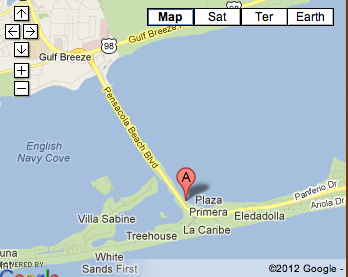
AdventureMan and I disagree about the Surf Burger on Pensacola Beach.
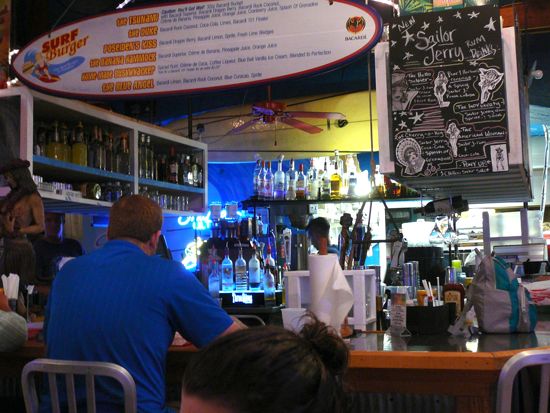
I don’t eat a lot of hamburgers. In fact, I eat about one a year, and it has become a sort of tradition that I go to the Red Robin around the Fourth of July for my annual hamburger quota. Like, if you’re going to do it, do it right. (“YUMMMMMMMMMMMMMMM.”) 🙂
But it was close to the 4th of July when our son called and said they were headed to the beach and did we want to meet them at the Surf Burger for dinner. We said sure, there is always something on the menu we can eat at most places, and we’ve never been to the Surf Burger. How can you live in Pensacola and never eat at the Surf Burger?
We got there first. There’s a part of me that felt comfortable there right away. It’s a lot like the old Red Robin used to be, the one we used to go to when I was in university, kind of a dive. There is a bar, and semi-sloshed looking people dressed in not-very-much trying to pick each other up, and a very basic menu, mostly hamburgers. And beer. And those mixed drinks with cute names you find at most beaches with 7 or more potentially lethal kinds of alcohol – in each drink.
It is both family friendly and pet friendly. If you are not wearing beach gear, you are overdressed. Service can be slow when they have a lot of customers, and often, they have a lot of customers. It’s very very hard on a Sunday night to find a parking place.
I knew just what I wanted – a Firecracker Burger. When it came, on two slices of toasted bread, I was disappointed, until I bit in. Once I tried it, I was happy. The burger tasted like 100% real meat, none of these chain burgers that you’re not sure how much is meat and how much is ‘special ingredients’ you really don’t want to know. It was SPICY; it was a Firecracker. I enjoyed every bite, and that is a good thing when you only eat one burger a year.

AdventureMan was not so happy. He ordered a SurfBurger. He hated the French Fries. He found his burger not that great. He thought it was greasy.
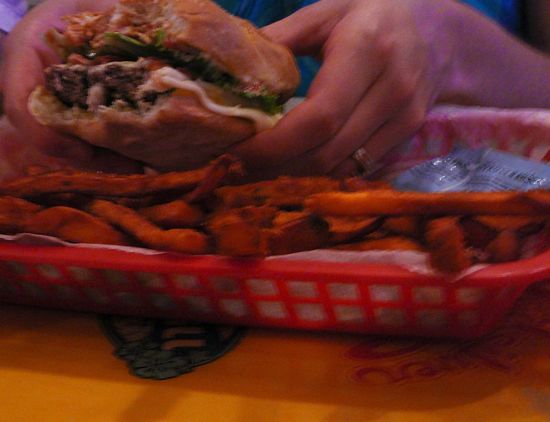
Our Vegan ordered a VeggieBurger, and she was happy, too. She said it tasted like meat, and had a great texture, but it wasn’t meat.

Surf Burger is probably not your destination kind of restaurant. It’s a burger joint. You go there for a hamburger because you are at the beach and you are hungry. You go there maybe to drink and hook up with a new friend. You go there because it is easy and comfortable and you don’t want to get cleaned up or dressed up. All those are good reasons to go to the Surf Burger.
Surf Burger
500 Quietwater Beach Blvd
Pensacola Beach, FL
850-932-1417
TO GO ORDERS WELCOMED
Mon – Thur: 11am – 10pm
Fri: 11am – 11pm
Sat: 8am – 11pm
Sun: 8am – 10pm
Hot Rain For Pensacola Blue Angels

It’s the biggest week for Pensacola and Pensacola Beach, it’s Blue Angels week, and people come from all over the USA to watch our home team do arial acrobatics. It’s always a thrill, driving to an appointment, when suddenly the Blue Angels appear in the sky, flying in close formation. Their practices are a weekly delight to Pensacolians.
It’s a funny week, though, a week when we have had rain almost every day. It makes summer in Pensacola different from summer in Kuwait and Qatar. In Pensacola, rain is a good thing, sometimes we don’t get enough. This year, we have been deluged; one area of our city flooded while we were in Zambia, and even our house suffered from the hurricane-force wind-driven rain.
It’s not a cold rain, it’s a hot rain, the rain falls and the temperatures are in the 90’s, falling to the high 80’s. We are planning to go out to the beach to watch the big practice on Friday (we do not plan to go for the full show on Saturday! Maybe someday when we can book a hotel room for that time) hoping the beach breezes keep the mosquitos at bay. Thundershowers are forecast for the entire week, through Saturday, but, when they come, they don’t last too long, an hour at most, and then the air is clear and clean. Not crisp, but clear and clean and HUMID!

The mosquitos are thriving. It was forecasted when we had such a mild winter that the insect population would rocket, and already, barely midsummer, or at least mid-heat of summer, and dengue fever has hit in New York, Miami, and other mosquito-borne illnesses are showing up throughout Florida. Dengue fever, the article referenced above states, used to be seen only in people returning from overseas country where it was present, but now, mosquitos in the USA are carrying it. Good time to wear repellant. 🙂
Barnes and Nobles: Paradise
We’d had guests, people we really like and admire, and now I was about to take them shopping. This kind of shopping is special. It is people-on-limited-budget shopping by people-who-may-never-visit-the-United-States-again and who have a lot of people hoping they will bring something back for them. We know this feeling – we’ve been those people on a limited budget who want to delight our family and friends with some exotic treasure.
I had a plan. Truthfully, I should know by now how it is going to work out, but I always plan bigger, just in case. This time, we started at TJ Maxx and The Dollar Store.
We park in a highly visible place. I know it sounds rude, but I escort them in, explain a few little things, then I go back to the car. I have a book with me, and Sudoku; they get to shop at their own pace without feeling like they are inconveniencing me. They have my phone number, and they know where the car is parked. Some groups come back and forth, many times, they bring packages, drop them, and head back again. This time, I didn’t see them, so after two hours, I went in and found them and told them this was their “one hour warning.” I had promised to have them back at their hotel by seven.
Almost on the minute one hour later, they came out, entered the car, and were so excited. One said she had finished all her shopping; she had something just right for everyone. The other said “Look! My friend wanted Bicycle cards! They had Bicycle cards!” They had found special gifts for all their friends and family, but the price was high. They had wanted to go to the Barnes and Noble store, but we had run out of time.
Deep sighs.
“It’s totally worth it,” the older one said, “I really really needed to have the peace of knowing my shopping was done. But . . . I’ve never seen the Barnes and Noble, only heard about it. Maybe I’ll have another chance at our next city . . . ”

I couldn’t bear it.
“The Barnes and Noble is only a short distance away,” I gave in, “I will take responsibility for getting you back late IF you promise me to only go in and look, just take a quick look, and come back out to the car.”
“Yes! Yes!” they both promised enthusiastically.
They were gone for twenty minutes. When they came back out, their faces were stunned. They got in the car, so silent I was afraid there was a problem.
The youngest leaned over, buried her head in her hands. She looked like she was going to be sick.
“What’s the matter?” I asked, alarmed.
“I almost feel sick,” she said. “So many books! We walked everywhere, but I stayed most of the time in the Business Management section; they had EVERYTHING. They had Who Moved My Cheese. Oh! They had so many good books, not the blah-blah-blah you get in textbooks, but the way they teach in parables, it’s so easy to understand their point. I can’t carry all the books I wanted to buy. I’m feeling shocked. All those books, right there where anyone can buy them! I want them all and I can’t have them.”
“You could order them, have them sent,” the older girl offered, and then remembered that no, she couldn’t have things sent in her country. She would never get them.
All the way to the hotel we had a great conversation about the flow of ideas, about censorship and the internet and cable television and Twitter, and how ideas flow more freely everywhere in the world, in spite of those who would try to restrict what their citizens might access. We also talked about freedom to travel – or the lack of freedom. We talked about families, caring for the elderly, and family responsibilities. We talked about what we’ve learned from one another, the truths travel teaches you about your prejudices and opinions, about others, and about yourself.
As I dropped them off, we all hugged, sadly realizing that we may never see one another again. Nonetheless, no regrets. Just the time I had with these two impressive young women was a great gift, and seeing the Barnes and Noble through their eyes – I will never again take a book shop for granted.
Emirates Women Seek Law Forcing Tourists to Dress Modestly
Qatari women have the same concerns in Qatar; this article from http://www.huffingtonpost.com/2012/07/06/emiratis-dress-code_n_1653446.html?utm_hp_ref=world:

ABU DHABI, United Arab Emirates — With the number of foreigners dwarfing that of locals in her hometown of Abu Dhabi, Asma al-Muhairi has become increasingly anxious at the prospect of her younger nieces abandoning their full-length black robes in favor of Western attire that seems to be everywhere she goes.
But it wasn’t until the 23-year-old marketing worker came face to face with two scantily-clad female foreigners at one of the many luxury shopping malls in the United Arab Emirates that she decided to take action.
“While going to a mall, I saw two ladies wearing … I can’t say even shorts. It was underwear,” said al-Muhairi, whose black abaya – a long garment worn by conservative Gulf women – is offset by a gold Versace watch and egg-shell blue handbag.
“Really, they were not shorts,” she said. “I was standing and thinking: `Why is this continuing? Why is it in the mall? I see families. I see kids around.'”
Failing to persuade the mall to intervene, al-Muhairi and another Emirati woman, Hanan al-Rayes, took to Twitter to air their concerns in May.
They were inundated with responses that prompted them to launch a Twitter campaign dubbed (at)UAEDressCode that aims to explore ways to combat the growing number of shoppers in low-cut dresses and hot pants.
As the campaign picked up steam, it also has served to symbolize the growing concerns among Emiratis, a tiny minority in their own country.
Emirati citizens account for a little more than 10 percent of the 8 million people living in the Gulf nation. Most of the population is made up of Asian, African and Middle Eastern guest workers, as well as Western expatriates living here temporarily.
The overall population more than doubled over the past decade as the country embarked on a building boom that transformed Dubai, up the coast from Abu Dhabi, into the Arabian Gulf’s financial hub and a popular tourist draw.
“I think in an increasingly tumultuous region and in an era of powerful and often intrusive globalizing forces, citizens of the UAE are increasingly concerned that their traditions and core values are being eroded,” said Christopher Davidson, an expert on Gulf affairs at Britain’s Durham University.
“In some senses, it is a grassroots reaction to authorities and leaders that have for many years done little to check this erosion,” he added. “We’ve seen reactions to alcohol, so now we are seeing a reaction to immodest dress.”
Jalal Bin Thaneya, an Emirati activist who has embraced the dress code campaign, said it is a way for Emiratis to show they are concerned about the loss of traditions.
“If we were the majority and had the same make up, things would be different,” Bin Thaneya said. “You wouldn’t need anything. You would see Emiratis everywhere and you would be afraid of offending them … Now, we’re a minority so you feel the need to reach out to an authority.”
As the number of foreigners has increased, so have the stories of them violating the UAE’s strict indecency code, which limits drinking to bars and nightclubs and bans public displays of affection. A drunken couple was caught having sex on the beach and another allegedly having sex in a taxi. A Pakistani was deported for flipping the middle finger at a motorist, and the courts are filled with cases of foreigners having sex out of wedlock.
Most Emiratis rarely come face-to-face with misbehaving foreigners.
The malls, however, are a different story.
They are one of the few places where everyone comes together to escape the brutal summer heat. The cultural clash is hard to ignore, as families of traditionally dressed Emiratis shop and relax in cafes alongside foreign women wearing tank tops, shorts and even transparent gowns over bikinis.
Most malls have policies in place that require “conservative” dress and encourage shoppers to avoid showing shoulders and knees, but few publicize them or enforce them. Police in Dubai, where the mall that al-Muhairi visited was located, didn’t respond to a request for comment. They told the Gulf News newspaper there is nothing they can do since there are no specific laws against immodest dress.
“People were seeing it for a long time but they didn’t say anything,” Bin Thaneya said. “You can’t go to the police for such stuff. There is no one to go to. You can’t go to the mall management. The mall security guard gets paid less than someone at McDonald’s. He isn’t going to do anything.”
Al-Muhairi’s campaign is just one of several over the years led by Emirati women who have tried in vain to enforce the dress code – handing out brochures, confronting foreigners. But hers has benefited from the growing popularity of social media as well as the Arab Spring popular uprisings, which has given Emiratis a sense they can speak out on some social issues.
The UAEDressCode feed has more than 3,300 followers with a lively discussion that includes plenty of support for a code but also concerns that it would unfairly target foreigners or create divisions between locals and foreigners. Unlike similar campaigns in Kuwait or Saudi Arabia, the impetus for a code has not come from Islamic hard-liners, but from moderate locals like al-Muhairi who love their Starbucks and Western movies but just want foreigners to respect local customs.
“We are not asking others to cover up like us. We are giving them freedom based on their beliefs and religion,” al-Muhairi said. “We are not judging and saying this shows she has other interests. We never want to judge. Do whatever you want and wear what you want but with limits. Just respect the public here.”
The campaign has caught the attention of the Federal National Council, which pledged last month to push for stronger measures to enforce the dress codes. That came after the country’s culture minister, Abdulrahman al-Owais, supported efforts to emphasize the conservative traditions of the UAE.
Members of a half-elected, half-appointed council have suggested a law could include warnings and fines but not jail time for offenders. But the FNC has no law-making powers, so any decision now rests with the UAE government.
“If there is a law, the behavior will be different,” said Hamad al-Rahoomi, an FNC member who compared a UAE dress code to laws in France that bans the niqab, in which a veil has only a slit exposing a woman’s eyes, or the new dress code at Royal Ascot in Britain that aims to limit provocative outfits.
“We don’t want to catch people. We just want people to think of the other parties,” al-Rahoomi said. “What I want is to go with my family in my country and not see something that is harming me.”
The Abu Dhabi police issued this week a booklet on dos and don’ts for tourists that will be available at the Abu Dhabi International Airport and hotels, according to The National newspaper. It advises tourists that public displays of affection including kissing are considered indecent and that they should wear “modest” clothing.
Tourists – some in skimpy summer dresses, others in shorts and T-shirts – defended their right to wear what they want, either because it is fashionable or keeps them cool in the summer heat. None of the 10 people interviewed in Dubai and Abu Dhabi knew about a mall dress code, nor were they advised their outfits violated it. Several said a dress code law would go too far.
“I think it’s ridiculous because most of the people in Dubai are tourists,” said Sarah, a 21-year-old tourist from Kenya wearing a short dress exposing her shoulders and legs. “I want to go somewhere where I would be comfortable in my own skin as a travel destination. I feel comfortable like this and this is how I will dress.”
Not the Day We Expected – Even Better
LOL, as our Friday dawned with thunder and lightning, our day totally changed. We had thought we would rush to our water aerobics class, rush home, hand up our clothes, head out to meet friends for Italian food near Destin, and then come home.
With the thunder and lightning, however, we knew there couldn’t be a class, and so we had an unexpected holiday from exercise, sort of puttered around the house taking care of things that needed taking care of, and headed off to meet up with our friends. We had a great time, great conversations, and they mentioned – as have other friends – how much they enjoyed The Best Exotic Marigold Hotel, and that we really needed to see it. After long, fond farewells, we headed home, via the beach, which we always love. So far, it was a much cooler day, only reaching the 80’s as we drove along, due to the cloud cover.
AdventureMan suggested we look at the GulfBreeze4, a really fun little theatre we love to go to where they show a lot of foreign movies or quirky movies that didn’t make it to the big screen, and there it was, the Best Exotic Marigold Hotel, and we were just in time for the afternoon showing.

It is a delightful movie. It has a lot of fun moments, some sad moments, many very human moments. You know me, I especially love the cross-cultural moments, and the thought that people can grow and adapt – no matter what age. We really enjoyed the movie.
And, when we left, we just had to have Indian food. We stopped at Taste of India on the way home and had Talli. It was one of those nights when almost every table was taken, but they had room for us.
“How spicy?” our favorite waitress asked.
“Spicy,” we stated emphatically.
“Oh!” she exclaimed, “Indian spicy!” and we said “Yes!”
When it came, it tasted like being back in Kuwait, eating food my friends had prepared. Not dumbed down food. Good, strong spicy food. We couldn’t even eat it all; but we know how good it will taste tomorrow. We brought a lot of it home 🙂
So it wasn’t the day we expected, but we feel blessed by the day we had. Good friends, good conversation, lots of laughing, good movie and a good time at Taste of India. A great day altogether.
She Cried

“I wanted to thank you,” I said to my son’s sixth grade teacher “I can’t imagine how hard it was to get 30 sixth graders to go through the paper-writing process, but I know my son learned from it and he will use the skills you taught him for many years to come. One day he will thank you in his heart, but I wanted to thank you now.”
It was one of those small expat military communities, where your child’s teacher also goes to the same church you go to and shops in the same commissary. We were at a church benefit, chatting before dinner.
She started crying.
She told me that every year, she teaches the sixth graders to write papers, and they hate it. She started with library research, making bibliography cards on little index cards, formal writing, footnotes and a formal bibliography at the end with a formal title page at the beginning.
I was the first one who had ever thanked her. She believed in what she was doing, but it was so hard, and she never got any positive feedback.
Imagine. Do you remember what sixth graders are like? This lady had courage, and persistence. She gave these students (in spite of themselves) a skill which would take them through the rest of high school and into college. They learned to do it right, so they never had to embarrass themselves by turning in an inferior, poorly-done paper. It was a great gift she gave these students – and no one thanked her.
Well, it would be a rare, very rare sixth grader who has the maturity to understand that while it was a difficult and demanding section in their school year, it was a tool in their tool box of life, a gift that just kept on giving.
Thank you. Thank you, all the teachers out there who knock themselves out to give our children (and grandchildren) the tools they need to be good students and good citizens.
Kuwait Mode On a Hot Day in Pensacola

“On any given day in Kuwait, this would not have even registered on our ‘so-what’ scale” AdventureMan responded when I commented on the particularly bad driving we had experienced on our way back from the commissary. People were weaving, people were taking right-of-way-not-their-own and people were taking stupid chances.
What is it about heat that makes people crazy?
I wonder if any one has done a study to find out which crimes go up in very hot temperatures, if any?
I’m in my Kuwait mode these days; if there is anything I need to do outside the house, I do it early in the morning (occasionally, early morning is even pleasant) or after the sun has gone down. The rest of the day, I stay out of the sun and in the air conditioning as best I can. I always have projects, quilts to sew 🙂 and books to read, not to mention a floor to scrub and a dishwasher to unload, plenty to keep me busy inside.
My heart goes out to those in the eastern USA, hit by storms, hit by electrical outages and hit by the extreme heat. At least in Pensacola we have a sea breeze which keeps things bearable most of the time.
Recent Comments
ExpatAlien on What Country am I Living … intlxpatr on Yellowstone: Old Faithful to C… Michelle on Yellowstone: Old Faithful to C… Cathy on No Grown-Ups in Charge intlxpatr on Waiting for Snow Wikipedia Donate Button

Amazina


Early Voting in Florida


 Here There and Everywhere