Upcoming Execution in Iran?
Thank you, John Mueller 🙂
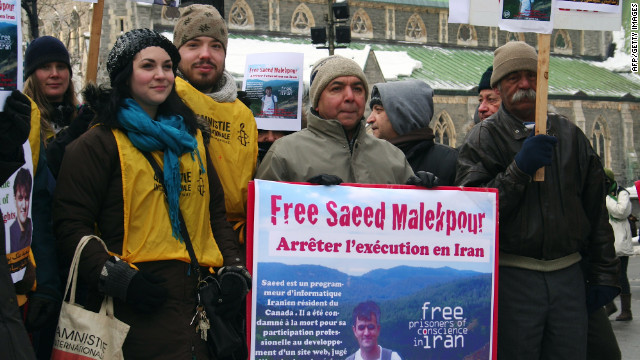
Supporters demonstrate in January for the release of Saeed Malekpour in Montreal, Quebec.
(CNN) — A computer programmer from Canada faces imminent execution in Iran for the actions of another person, which he had no control over, a human rights group says.
Saeed Malekpour wrote a program to upload photos to the Internet, an accomplishment that could cost him his life, Amnesty International reported Friday. Authorities in the Islamic Republic claimed his program was used by someone else to upload pornography and charged him with “insulting and desecrating Islam.”
Malekpour, who is a Toronto resident, was arrested in October 2008 while visiting relatives in Iran. He was convicted in a short trial and was sentenced to death in October 2011, according to Amnesty International.
Iran’s Supreme Court confirmed the sentence on January 17. Malekpour’s lawyers have been unable to ascertain the whereabouts of his court files since Tuesday and fear this could be an indicator that an executioner could carry out the sentence soon, Amnesty said. A court official suggested to the lawyers that the file had been sent to the Office for the Implementation of Sentences, according to Amnesty.
Malekpour sent a letter from prison detailing beatings and other mistreatment at the hands of Iranian prison officials to obtain a confession, said Hadi Ghaemi, executive director of the International Campaign for Human Rights in Iran.
“A large portion of my confession was extracted under pressure, physical and psychological torture, threats to myself and my family, and false promises of immediate release upon giving a false confession to whatever the interrogators dictated,” the letter says.
Malekpour’s supporters have created Facebook pages and websites in his support dating to at least 2009.
Amnesty International has requested on its website that concerned individuals write Iranian authorities inside and outside the country to demand that Malekpour not be executed.
Malek Jandali Freedom Qashoush Symphony مالك جندلي حرية سيمفونية القاشوش
We have spent many happy hours and days in Syria. We grieve for our Syrian friends, for those living in Homs and Hama, and all those seeking freedom from tyranny.
Wooo HOOOOO! Official Zain Kuwait Flashmob – فلاش موب زين الكويت
I LOVE this! Thank you, Hayfa! I love it that it is real Kuwaiti’s; I can’t tell the song, but I think it is one of the National Day songs (National Day and Liberation Day are coming up, February 25 / 26) and oh, what a wonderful, fun way to celebrate.
I especially love the security guard 🙂
Everyone is having such a great time!
Scam Letter
You know how I hate lying and deception, sneaking and peeping, all manner of pretending rather than keeping it real. I have a real thing about scams, and I want to pour the light of day on each and every one of them, so that the vulnerable will be forewarned.
This is a letter I got this week. Many times, I won’t even open junk mail, just throw it away, but this one looked like it MIGHT be official, even though my gut told me it wasn’t:

Looks a little like a W-2 form, doesn’t it, or something governmental?
Inside:
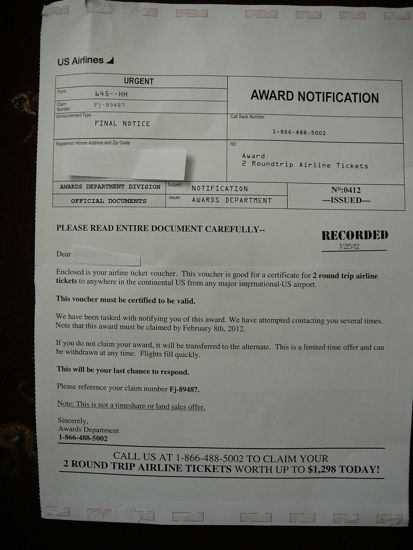
Still looks official, doesn’t it, but it isn’t a government form, it’s a form telling me (using my name) that this is my FINAL notification that I have to claim the two round-trip tickets on any American airline that I have won.
In a separate attachment is this “flight coupon”:

I passed it along to AdventureMan, in case he wanted to call the number and mess with them a little, but neither of us really wanted to waste the time – or to give them any idea what our phone number is: we hate scam phone calls, too. Yes, it is a scam, even if it may not be an illegal scam, it is a deception and not what it appears to be. SCAM!
Houston CC: Qatar Unable to Credit Coursework?
TThe western universities in Qatar have fought long and hard to have accountability and enforced standards . . . and there are always challenges. Here is a hilarious article about one such newer university facing significant challenges (thanks, John! )
Faulty planning may be to blame for HCC Qatar campus’s problems
By Jeannie Kever, Houston Chronicle
Updated 09:01 p.m., Saturday, February 4, 2012

As top officials at Houston Community College were collecting awards and publishing papers about their international ventures last year, their effort in Qatar was struggling with disagreements over accreditation, high faculty turnover and growing worries that the dean hired by the Qataris to lead the effort was working against them.
The problems, detailed in emails and internal documents obtained through a public records request, raise questions about whether HCC was prepared for the ambitious foreign undertaking.
The dean chosen by the Qatari government was replaced in November by a veteran HCC employee, Butch Herrod, as part of an administrative overhaul. Enrollment has reached 750 students, less than two years after HCC signed an agreement with the Qatari government to create that nation’s first community college.
But students have not received HCC credits for their classes there – a cornerstone of the promises made when the partnership was announced – and for now it appears unlikely their coursework will transfer to the six U.S. universities with operations in Qatar. After months of student protests, a deal signed last month will allow graduates of the new community college to enroll in Qatar University.
Things were so bad last spring an HCC administrator in Qatar wrote HCC Chancellor Mary Spangler that Community College of Qatar, or CCQ, had become known as “the Crazy College of Qatar.”
From the beginning, Spangler said the Qatar contract was a way to earn money as state funding dropped and property tax revenues remained flat. HCC records indicate the college has collected $640,034 from the deal; it projects a profit of $4.6 million by 2015, slightly more than expected.
Deputy Chancellor Art Tyler said in a recent interview that things now are running smoothly, and that misunderstandings are unavoidable in any international operation.
“The world is not exactly flat,” he said. “It may have gotten smaller over the years, thanks to technology, but when you’re dealing with people, with communities, you can’t know everything.”
Women taught separately
Among the things HCC didn’t know until just before classes began in September 2010: The Qatari government decided male and female students would be educated separately, contrary to the five-year, $45 million contract, which called for coeducational classes.
Former employees say that was just one of the surprises when they arrived in Qatar, ranging from delays in getting textbooks to worries over their exit visas.
“Things did not go smoothly at all,” said Randi Perlman, hired to teach English to Arabic-speaking students. “There were a lot of issues that came up … that I think didn’t need to happen.”
Overseas campuses
With more than 70,000 students, HCC is one of the nation’s largest community college systems, offering lower division academic classes and workforce training.
Over the past decade, it has become increasingly involved in international ventures, as well, with projects in Vietnam, Saudi Arabia, Brazil and Qatar.
Tyler said Qatar, located on the Persian Gulf, is a natural match for a Houston institution: energy industry ties, Qatar Airlines’ nonstop flights and the presence of the Qatar Consulate here. Six U.S. universities have campuses there, including Texas A&M.
The Methodist Hospital System has an office in the United Arab Emirates and is helping to build an ambulatory care center in the capital city of Doha.
Visa requirement
The first wave of HCC faculty and staff discovered after being hired – in some cases, after arriving in Doha – that their visas required them to get permission before leaving the country.
“That seemed to me to be a human-rights violation,” said Jan McNeil, a veteran English teacher who had previously worked in Singapore.
HCC offered interviews with three employees who worked in Qatar last year, all of whom said the visas posed no problem.
David Ross, chairman of the English as a second language and English departments in Qatar, said the system worked but acknowledged the six-day window to use the visas made timing tricky and the lack of multiple exit visas – standard for U.S. employees of American universities and companies there – provoked anxiety.
Internal emails also detail delays in preparing apartments for the expatriate employees, paying tuition at schools for their children and complaints about spotty Internet service.
“That whole piece of helping faculty and staff feel at home … was a challenge,” Tyler said.
‘A matter of learning’
Perlman, who now teaches at Texas A&M in College Station, attributed many of the challenges to poor planning, including hiring administrators – many of whom transferred from Houston – without experience working in a foreign country.
“You need people on the ground there, to help you get things done,” said Perlman. “They didn’t have that.”
Mark Weichold, dean and CEO of Texas A&M’s Qatar campus and a member of an interim board appointed last fall to govern CCQ, said missteps are to be expected.
“Watching HCC help get the community college established, some of the bumps are similar to what I’ve seen the other branch campuses (in Qatar) experience,” he said. “It’s a matter of learning how to do things in a different part of the world.”
Little control at top
But former employees and internal documents suggest HCC’s biggest problem came from a contract that authorized the Qatari government to hire the school’s chief academic official, giving HCC little control over decisions at the top.
Judith Hansen was hired by Qatar’s Supreme Education Council and served as dean until late last year.
Tyler declined to discuss the circumstances that led to Hansen’s departure in November.
Hansen, who had been forced out of the president’s job at Southwestern Oregon Community College in 2008 following three no-confidence votes by faculty and staff groups, did not respond to requests for comment.
But she was at the center of disputes over accreditation and whether CCQ could change HCC’s curriculum or claim it as its own.
She insisted on independence in an email to Tyler last winter: “The request for no assistance with (Southern Association of Colleges and Schools) accreditation means there is no need for HCC to be concerned about CCQ organizational chart,” she wrote.
‘Crazy College of Qatar’
Not so fast, Spangler said after Tyler passed on the message.
“We will not accept this response,” the HCC chancellor wrote to Tyler. “She is not calling the shots.”
Cheryl Sterling, an HCC administrator now in Qatar, wrote Tyler and Spangler last spring after Tyler acknowledged no HCC credit would be awarded for the spring 2011 semester.
“If students do not receive HCC credits this Spring, we will have a major crisis (all out war),” she wrote. “The Dean has held several forums assuring them of credits. … we are known as CCQ, the Crazy College of Qatar.”
At about the same time, faculty members issued a “no confidence” vote against Hansen.
John Moretta, a faculty member now in Qatar, was in contact with Spangler before the vote.
“She avoids me because she knows … that I know what she is doing is in direct contravention of so many HCC policies,” he wrote of Hansen. “Should we proceed with the faculty-senate vote of no confidence? … Please advise.”
Spangler replied the same day.
“The short answer is yes, and we didn’t have this conversation,” she told him.
Abraham Buys a Cave and a Field
When I was an undergrad in college, I was majoring in political science, and there weren’t a lot of women in the field. You’d think that would be heaven for a young woman, but many of these political scientists had political aspirations, or an ax to grind, and were constantly standing up and making speeches. It was annoying; I needed some balance, so I took on another major, in English Literature, to give my academic life some balance.
It’s not like that was without its own problems; English Lit was full of these really OLD women, like in their thirties, who had come back to school to earn or finish up a degree, and they took it seriously. Aarrgh! Didn’t they know that this was university? This was supposed to be fun? Having those women in class competing for grades forced the rest of us to work harder . . . not such a bad thing.
One of the things you learn in studying Lit is that there are things that are important, or the author wouldn’t include them. As I read today’s Old Testament reading from The Lectionary, I found myself reading as literature, asking “where is the significance?” “why was this story included?” The Hittites are so very gracious to grieving Abraham; they sound like loving friends. Abraham insists on paying for the land, the cave where Sarah would be buried. Why was it so important to pay for the land? Was it so that there would be no question later as to whether the land was his?

Genesis 23:1-20
23 Sarah lived for one hundred and twenty-seven years; this was the length of Sarah’s life. 2And Sarah died at Kiriath-arba (that is, Hebron) in the land of Canaan; and Abraham went in to mourn for Sarah and to weep for her. 3Abraham rose up from beside his dead, and said to the Hittites, 4‘I am a stranger and an alien residing among you; give me property among you for a burying-place, so that I may bury my dead out of my sight.’ 5The Hittites answered Abraham, 6‘Hear us, my lord; you are a mighty prince among us. Bury your dead in the choicest of our burial places; none of us will withhold from you any burial ground for burying your dead.’ 7Abraham rose and bowed to the Hittites, the people of the land. 8He said to them, ‘If you are willing that I should bury my dead out of my sight, hear me, and entreat for me Ephron son of Zohar,9so that he may give me the cave of Machpelah, which he owns; it is at the end of his field. For the full price let him give it to me in your presence as a possession for a burying-place.’ 10Now Ephron was sitting among the Hittites; and Ephron the Hittite answered Abraham in the hearing of the Hittites, of all who went in at the gate of his city, 11‘No, my lord, hear me; I give you the field, and I give you the cave that is in it; in the presence of my people I give it to you; bury your dead.’ 12Then Abraham bowed down before the people of the land. 13He said to Ephron in the hearing of the people of the land, ‘If you only will listen to me! I will give the price of the field; accept it from me, so that I may bury my dead there.’ 14Ephron answered Abraham, 15‘My lord, listen to me; a piece of land worth four hundred shekels of silver—what is that between you and me? Bury your dead.’ 16Abraham agreed with Ephron; and Abraham weighed out for Ephron the silver that he had named in the hearing of the Hittites, four hundred shekels of silver, according to the weights current among the merchants.
17 So the field of Ephron in Machpelah, which was to the east of Mamre, the field with the cave that was in it and all the trees that were in the field, throughout its whole area, passed 18to Abraham as a possession in the presence of the Hittites, in the presence of all who went in at the gate of his city. 19After this, Abraham buried Sarah his wife in the cave of the field of Machpelah facing Mamre (that is, Hebron) in the land of Canaan. 20The field and the cave that is in it passed from the Hittites into Abraham’s possession as a burying-place.
Egyptian Synchronized Swimmers, Montreal 2009
What I totally love about this YouTube clip (Thank you, Hayfa!) is that the swimmers are so original and have a great sense of humor about what they are doing. They also manage to infuse their performance with their own culture and make it all uniquely their own.
Canadian Family Found Guilt of Honor Killing
From today’s AOL / Huffington Post: World:
KINGSTON, Ontario — A jury on Sunday found an Afghan father, his wife and their son guilty of killing three teenage sisters and a co-wife in what the judge described as “cold-blooded, shameful murders” resulting from a “twisted concept of honor.”
The jury took 15 hours to find Mohammad Shafia, 58; his wife Tooba Yahya, 42; and their son Hamed, 21, each guilty of four counts of first-degree murder in a case that shocked and riveted Canadians from coast to coast. First-degree murder carries an automatic life sentence with no chance of parole for 25 years.
After the verdict was read, the three defendants again declared their innocence in the killings of sisters Zainab, 19, Sahar 17, and Geeti, 13, as well as Rona Amir Mohammad, 52, Shafia’s childless first wife in a polygamous marriage.
Their bodies were found June 30, 2009, in a car submerged in a canal in Kingston, Ontario, where the family had stopped for the night on their way home to Montreal from Niagara Falls, Ontario.
Prosecutors said the defendants allegedly killed the three teenage sisters because they dishonored the family by defying its disciplinarian rules on dress, dating, socializing and going online. Shafia’s first wife was living with him and his second wife. The polygamous relationship, if revealed, could have resulted in their deportation.
The prosecution alleged it was a case of premeditated murder, staged to look like an accident after it was carried out. Prosecutors said the defendants drowned their victims elsewhere on the site, placed their bodies in the car and pushed it into the canal.
Defense lawyers said the deaths were accidental. They said the Nissan car accidentally plunged into the canal after the eldest daughter, Zainab, took it for a joy ride with her sisters and her father’s first wife. Hamed said he watched the accident, although he didn’t call police from the scene.
After the jury returned the verdicts, Mohammad Shafia, speaking through a translator, said, “We are not criminal, we are not murderer, we didn’t commit the murder and this is unjust.”
His weeping wife, Tooba, also declared the verdict unjust, saying, “I am not a murderer, and I am a mother, a mother.”
Their son, Hamed, speaking in English said, “I did not drown my sisters anywhere.”
But Judge Robert Maranger was unmoved, saying the evidence clearly supported their conviction for “the planned and deliberate murder of four members of your family.”
“It is difficult to conceive of a more despicable, more heinous crime … the apparent reason behind these cold-blooded, shameful murders was that the four completely innocent victims offended your completely twisted concept of honor … that has absolutely no place in any civilized society.”
Hamed’s lawyer, Patrick McCann, said he was disappointed with the verdict, but said his client will appeal and he believes the other two defendants will as well.
But prosecutor Gerard Laarhuis welcomed the verdict.
“This jury found that four strong, vivacious and freedom-loving women were murdered by their own family in the most troubling of circumstances,” Laarhuis said outside court.
“This verdict sends a very clear message about our Canadian values and the core principles in a free and democratic society that all Canadians enjoy and even visitors to Canada enjoy,” he said to cheers of approval from onlookers.
The family had left Afghanistan in 1992 and lived in Pakistan, Australia and Dubai before settling in Canada in 2007. Shafia, a wealthy businessman, married Yahya because his first wife could not have children.
The prosecution painted a picture of a household controlled by a domineering Shafia, with Hamed keeping his sisters in line and doling out discipline when his father was away on frequent business trips to Dubai.
The months leading up to the deaths were not happy ones in the Shafia household, according to evidence presented at trial. Zainab, the oldest daughter, was forbidden to attend school for a year because she had a young Pakistani-Canadian boyfriend, and she fled to a shelter, terrified of her father, the court was told.
The prosecution said her parents found condoms in Sahar’s room as well as photos of her wearing short skirts and hugging her Christian boyfriend, a relationship she had kept secret. Geeti was becoming almost impossible to control: skipping school, failing classes, being sent home for wearing revealing clothes and stealing, while declaring to authority figures that she wanted to be placed in foster care, according to the prosecution.
Shafia’s first wife wrote in a diary that her husband beat her and “made life a torture,” while his second wife called her a servant.
The prosecution presented wire taps and cell phone records from the Shafia family in court to support their honor killing theory. The wiretaps, which capture Shafia spewing vitriol about his dead daughters, calling them treacherous and whores and invoking the devil to defecate on their graves, were a focal point of the trial.
“There can be no betrayal, no treachery, no violation more than this,” Shafia said on one recording. “Even if they hoist me up onto the gallows … nothing is more dear to me than my honor.”
Defense lawyers argued that at no point in the intercepts do the accused say they drowned the victims.
Shafia’s lawyer, Peter Kemp, said after the verdicts that he believes the comments his client made on the wiretaps may have weighed more heavily on the jury’s minds than the physical evidence in the case.
“He wasn’t convicted for what he did,” Kemp said. “He was convicted for what he said.”
Winter Beach in Pensacola
We had great weather during the Doha reunion, great in that it was warm every day, and it only rained a little now and then. We had lots of sunshine, and they even got to experience a little bit of Pensacola sultriness.
The big thrill, for me, was the winter beach. I love good wave action, and a little drama in the sky. The Pensacola beach, with its gorgeous white sands, gave it to us in full:

Recent Comments
intlxpatr on Yellowstone: Old Faithful to C… Michelle on Yellowstone: Old Faithful to C… Cathy on No Grown-Ups in Charge intlxpatr on Waiting for Snow intlxpatr on Waiting for Snow Wikipedia Donate Button

Amazina


Early Voting in Florida


 Here There and Everywhere