A Different Perspective
“It’s going to be a great weekend! We’re expecting sun and temperatures of 85°F!” my Mom enthused, from Seattle.
“We’re expecting a great weekend, too,” I enthused right back, “the temperature will be down to about 85°F and it’s going to RAIN!”
We laughed. It’s all a matter of perspective.
“We’re staying in this weekend,” said one of my co-mother-in-laws. “When it gets like this, we just hunker down.”
“We went out to the beach!” I crowed! I wanted to see the waves, and when the temperatures go down and it rains, I feel re-energied!”
We laughed. She’s married to a man from the Pacific Northwest, so this perspective is not new to her.

What was not funny was when I had just started a load of laundry, and the electricity went out. Electricity goes out all the time, or from time to time, with frequent thunder and lightning storms, but this time it went out and stayed out. Without the ceiling fans going, it wasn’t hot, but it got stuffy. We have a covered and protected area outside, so we went outside and sat and watched the gusting winds and the flying rain beating down our tomato plants. Mostly, the rain has been drizzling down, but for an hour or so, it really battered and flew about. It’s just a normal small storm, though, nothing like it could be, nothing like Hurricane Irene, which devastated the East Coast last weekend.
And it was a good thing. We have hurricane preparations, but . . . sometimes we rob the Hurricane supplies, or borrow them, and forget to put them back. While it was still daylight, I wanted to check on candles, matches, etc. and I discovered the matches had been MISPLACED. I finally found them. I gathered candles, and checked the weather station on my radio that you wind up during electrical outages (it worked fine) and started a list of additional things I want to gather to have on hand in case the electricity goes out for any length of time. It’s good to be prepared. 🙂
Electricity is back on now, adventure over.
Sobering Reading on Wealth
It’s a long weekend, Labor Day weekend, and Pensacola awakes to rain-sodden streets and forecasts of a rain soggy three day weekend (bad for hotels and restaurants at the beach who hope for a sell-out Labor Day) and high surf from off-shore storms.
The reading for today from James is equally gloomy. I always think of “Insh’allah” when I read it, because it probably has an equivalent somewhere in the Quran, and my Muslim friends say “Insh’allah” (As God wills, or If God wills it) when they state a planned event.
While we are not rich, we have a large homeless population in Pensacola, sleeping out under the skies in hidden camps, scrounging for food, often with a dog, seeking handouts, seeking scraps. They are a constant reminder, to me, of how comfortable we are, and how comfort wars with the religious spirit. When we are too comfortable, we often fail to keep our focus on God, and are distracted by our toys and interests.
(I told you this would be gloomy.)
On the other hand, I wonder how spiritual I would be if I were hungry, worried about getting enough to eat, worried about my safety sleeping out in one of the camps. I wonder if their community looks after one another, or if it is a brutal and chaotic life. I wonder how you can keep your mind on things of the spirit when the search for basic necessities takes up a large part of your life.
James 4:13-5:6
13 Come now, you who say, ‘Today or tomorrow we will go to such and such a town and spend a year there, doing business and making money.’ 14Yet you do not even know what tomorrow will bring. What is your life? For you are a mist that appears for a little while and then vanishes. 15Instead you ought to say, ‘If the Lord wishes, we will live and do this or that.’ 16As it is, you boast in your arrogance; all such boasting is evil. 17Anyone, then, who knows the right thing to do and fails to do it, commits sin.
5Come now, you rich people, weep and wail for the miseries that are coming to you. 2Your riches have rotted, and your clothes are moth-eaten. 3Your gold and silver have rusted, and their rust will be evidence against you, and it will eat your flesh like fire. You have laid up treasure* for the last days. 4Listen! The wages of the labourers who mowed your fields, which you kept back by fraud, cry out, and the cries of the harvesters have reached the ears of the Lord of hosts.
5You have lived on the earth in luxury and in pleasure; you have fattened your hearts on a day of slaughter. 6You have condemned and murdered the righteous one, who does not resist you.
What Tiny Qatar Stands To Gain In Libya
Another fascinating discussion on National Public Radio, which covers subjects not covered by major national news sources.
Of course, anything having to do with Qatar is of interest to us, as we lived there for four years during a time of breathtaking and exhilarating change. It is astounding, and wonderful, to us, that Qatar defies the lethargy and inertia of the Gulf Countries, and has transformed itself into a major influence, in spite of its smaller size, and even smaller population of native Qataris. They have taken the huge influx of cash that came with the discovery of natural gas, and leveraged it into massive modernization, transformation, and influence on the international scene. It’s an amazing accomplishment.

ROBERT SIEGEL, host: The Libyan rebels received decisive air support from NATO. But there was another, less publicized, smaller-scale but equally remarkable foreign involvement in support of the uprising, the involvement of Qatar, Q-A-T-A-R.
Qatar is a peninsula, a little smaller than Connecticut. It juts north into the Persian Gulf. On the south, it borders Saudi Arabia. It is rich in oil and natural gas. Its population is only about 900,000. And while it is an Arab country, a monarchy ruled by the al-Thani family, the majority of its residents are non-Arabs, non-citizens from India and Pakistan. Qatar is also home to the TV channel Al Jazeera. It will host soccer’s World Cup and it was an important player in Libya.
Ibrahim Sharqieh is deputy director of the Brookings Doha Center. Doha is the capital of Qatar. And, Ibrahim, first, what did the Qataris do in support of the Libyan rebels?
Dr. IBRAHIM SHARQIEH: That Qataris’ support to the Libyan rebels has been politically, diplomatically and militarily. We had about five Qatari fighter jets. In Qatar, we had about the training of Libyan rebels. And Qatar also played an important role in developing an Arab League support through the military intervention in Libya, which this Arab League support actually has provided the umbrella for the NATO intervention and for the military intervention and provided the legitimacy that, for example, was missing in Iraq.
SIEGEL: Why? What are the motives behind Qatar’s involvement in Libya and some of its broader ambitions in the region?
SHARQIEH: Oh, there are many theories. The one that makes the most sense in my view is that Qatar is supporting the revolution for humanitarian reasons. And in addition to this, Qatar is working and supporting the revolution is they’re strictly with its vision for its role in the region and in the world.
SIEGEL: One thing we should note, though, in this year of the Arab Spring, one thing Qatar isn’t is it isn’t a democracy. It isn’t an elected parliamentary republic.
SHARQIEH: Well, there is very high level satisfaction of the people here in the country, of the political system and of its leadership. So there haven’t been – we haven’t seen any cause for change or any protests or any different types of complaints. So the system seems to work and we seem to have a stable country. That distance itself very far away from the protests that are happening in the region.
SIEGEL: How would you describe U.S.-Qatar relations?
SHARQIEH: We know it’s a strong relationship. Qatar hosts a military base, the largest in the region here, in Al Udeid. And this has been a sophisticated policy where Qatar managed to have a good relationship between the United States and other rivals in the region, like Iran. In order to protect yourself as a small, wealthy country, some sort of striking a balance is needed and Qatar has been more influential in this crisis and other regions in Benghazi.
Going back to Libya, when you go outside the offices of the National Transition Council, you see the American flag. You see the French flag. You see the British flag, and you see also the Qatari flag.
SIEGEL: Yes. Here’s a country that aspires to a very high profile in regional affairs, but it consists of fewer than a million people. And of them only about 350,000 I read are citizens. That doesn’t sound like a country that can really be a world player, you know? It just sounds too tiny.
SHARQIEH: Well, it is too tiny but, hey, we are living in an international system that you have the means to play it right and become an important player. Qatar has invested in the right political market by mediation. Qatar was successful in the mediating an agreement between the Yemeni government and the Houthi rebels. Prevented a civil war almost in Lebanon, brokered peace agreements between the Palestinians, Fatah and Hamas, and also intervened in the fall in Sudan.
So, Qatar has proved to me an important, major emerging power in the region and to play it right and position itself very well in the international scene.
SIEGEL: Well, Ibrahim Sharqieh, thank you very much for talking with us about Qatar.
SHARQIEH: My pleasure. Thank you for having me, Robert.
SIEGEL: Ibrahim Sharqieh is deputy director of the Brookings Doha Center. Doha is the capital city of Qatar.

“Is Your House Always This Clean?”
We had guests this week, visitors from overseas, and it was so much fun. One woman was full of questions. This was her first time out of her own country, and you know how it is when you are in a foreign culture, people think differently. Some of her questions bordered on impolite, according to our culture, but we could tell she was asking because she really was interested, and we didn’t let her questions bother us.
“No!” I laughed, “We cleaned because we had guests coming! My husband vacuumed and I washed all the floors!”
My daughter-in-law jumped in.
“Yes!” she laughed. “Yes, their house is always this clean!”
We all laughed.
“It’s just my husband and me,” I added, “it’s not that hard to keep it picked up and neat. We make extra effort when guests are coming.”
“Why do you do this?” she asked. “Why do you invite strangers into your home and give us dinner?”
“People have been so kind to us, in so many countries, in so many ways,” I began, “No matter how hard we try, we will never be able to repay all the kindness we have received. But we do our best.”
We were in my kitchen, which is not large, and I am trying to get dinner on the table. It is a simple, family dinner, a little chaotic, but with lots of dishes so the guests can find something they might like to eat.
“Do you clean yourself? You have no cook?” she asked.
“We clean. Both of us. We could hire help, but it is very expensive here,” I said, pulling the chicken out of the oven. “And we do our own cooking. My husband makes bread! He is very good at it.”
During the evening she continued asking questions, and now, several days later, we find ourselves thinking about the questions, and thinking . . . THIS is why we do it! We love these guests who come in with a different way of looking at things and their questions, which stimulate us to think in new ways, too, as we try to explain why we do things the way we do them.
I remember in Doha, the Philipina maids would ask me “how old are you?” because they couldn’t guess by looking at me. We never ask a woman how old they are once they are past maybe eighteen or twenty years old. We never ask how much money a husband – or wife – makes. It is culturally taboo, it just isn’t done. We never ask what kind of birth control someone is using. I am aware of these things because I have been asked, and it made me think about it.
But now I wonder what questions I have asked in foreign lands which shocked people, or made them uncomfortable?
HIV Epidemic Emerging in Middle East and North Africa
Recently published on National Public Radio is a study showing that governments are quietly gathering statistics on the rising tide of HIV infections in the Middle East and North Africa, but they don’t want those statistics published:
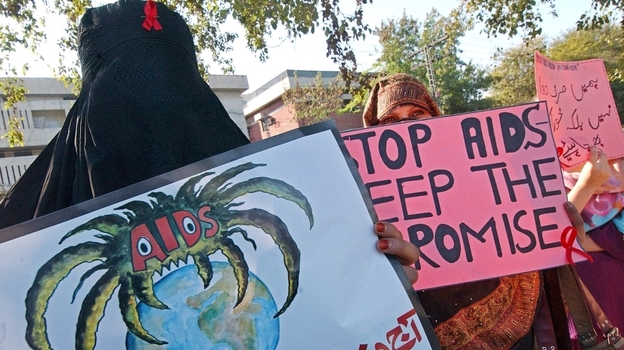
HIV epidemics are emerging among men who have sex with men in the Middle East and North Africa, researchers say. It’s a region where HIV/AIDS isn’t well understood, or studied.
More than 5 percent of men who have sex with men are infected by HIV in countries including Egypt, Iran, Lebanon, Morocco, Sudan and Tunisia, according to a recent study in PLoS Medicine. In one group of men in Pakistan, the rate of infection was about 28 percent. (For reference, in 2008, rates of HIV infection among men who have sex with men in the U.S. ranged from 16 percent among white men up to 28 percent of black men, according to the CDC.)
Risky behavior, low condom use, injectable drug use and male sex workers are some of the factors that could cause HIV rates to rise in the region, the researchers say. On average, the men who have sex with men group had between four and 14 sexual partners within the past six months, with consistent condom use falling below 25 percent.
Lack of HIV surveillance and low access to treatment and prevention are a concern for researchers, who believe the window of opportunity to prevent the epidemic from spreading across the region is growing smaller.
Shots had a chance to speak with one of the study’s authors, Dr. Laith Abu-Raddad, assistant professor of public health at the Weill Cornell Medical College in Qatar, to discuss the challenges of researching such a taboo topic.
What made you decide to pursue this study?
There are some political and community leaders who believe that our region is not affected by the epidemic. While others, such as HIV activists, believe that men having sex with men behavior is hidden, so HIV data must be hidden. They have called it the “HIV epidemic behind the veil.” It occurred to me that these are very contrasting views, and the truth must be out there somewhere.
I started this work eight years ago, to get every piece of evidence that we have on HIV. Turns out that there are more data than we think. The regions are not hiding the data, it’s just a sensitive issue. These issues aren’t discussed like in the western media. But it doesn’t mean that the government isn’t dealing with it. Governments do have programs such as active non-government organizations, NGOs, working with groups that are infected.
What surprised you about the findings?
Certain countries did surprise us with the work they’ve done. In Iran, they target the population of drug users. When Iran discovered HIV among drug users, they created programs that offered drug users access to treatment, and gave them free clean needles and syringes.
Many governments don’t want to provide HIV treatment or counseling directly. They support NGOs financially and logistically to help treat communities affected. It’s a way for them to protect people without raising sensitive issues of sexual and drug use behaviors that are often controversial.
What challenges did you face while gathering evidence?
There were some governments that gave us their data on the condition that we didn’t publish it. They want to deal with this issue, but they see no reason to raise it to the public. There were governments who did not want to release data. I can’t tell you which countries, since we have long-standing relationships with them. But we managed to convince some of them that the data would be used purely for scientific research and not used against them by the media.
What do you hope to accomplish from this study?
To raise awareness among policy makers. Hopefully, governments will make changes to policy. Surprisingly, the No. 1 barrier is poor research capacity in this region. If we don’t have the scientific data, we can’t have effective policy. We need to have an effective surveillance program, so we can help prevent further HIV transmission.
This part of the world is seen as not addressing the epidemic. Countries like Iran, Morocco and Egypt are developing programs and working with NGOs. But other countries haven’t yet improved their services to the public. But we hope they will.
Major Pettigrew’s Last Stand
 Major Pettigrew’s Last Stand by Helen Simonson
My rating: 5 of 5 stars
I loved this book. It follows all the themes I love – how convention blinds us, how our cultural assumptions make us unconsciously snobbish and leads us to hideous behavior, it is very cultural and also very cross-cultural. Major Pettrigrew is widowed, and his grief has made him old. At the beginning of the book, his life seems very dull and grey. It lightens as his friendship sparks with Mrs. Ali, a widow who runs a small convenience market in his small English village. They both love reading (of course I love that part!) and they talk books, and sparks of warmth kindle.
This book is also very uncomfortable for me, as Roger has a grown son who bullies his father. The book isn’t just cross-cultural, it’s cross-generational, and I see glimpses of myself in the boorish behavior of his son toward his father.
There are some amusing scenes, some wickedly insightful village-interaction scenes, some painfully introspective moments, and some truly grand moments when everything becomes clear and a person acts. For me, there was an added bonus in that as I read Mrs. Ali’s words, I could hear them so clearly, and she spoke in the voice of a dear friend. I could picture her, because I could see the sweet smiling face of a dear friend. It was like having a great visit.
<a href=
Phoenix: One Thing Leads to Another
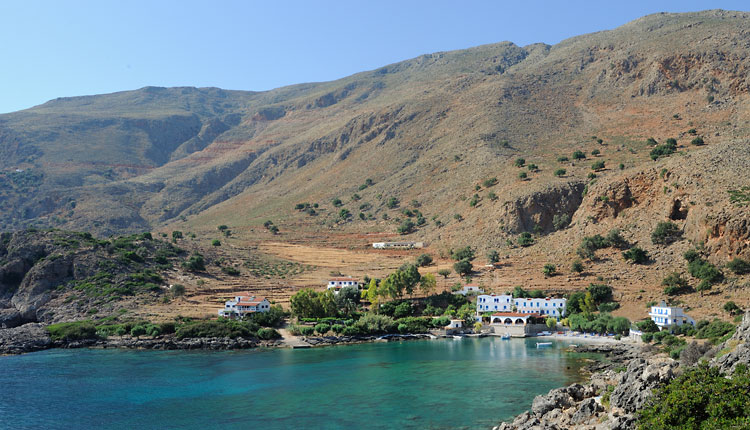
In our lectionary readings for today, St. Paul talks about a bay in Crete, facing northwest and southwest, at the west end of Crete, called Phoenix Bay. I’m a bit of a geography nerd, but with the miracle of Google Maps, and the Internet, I found the bay, and even better, I found a hotel I would love to stay in.
It’s not a fancy hotel, and it’s not expensive. It appears simple and clean. But look at the location! Alone! You can’t even get to it by driving, you either drive to a village and take a ferry boat to the hotel, or you hike overland about half and hour to get there. It is ISOLATED! (I love isolated hotels!)
The hotel is calls itself the Old Phoenix Look at its setting:
What is so special about us?
The Old Phoenix can only be reached on foot or by boat. There is no sound of traffic and everything moves at a slow and laid-back pace.
The guests come here looking for peace so they are unlikely to be noisy themselves.
All our rooms have large balconies overlooking the Libyan sea.
Our food is simple, traditional Cretan fare, cooked daily from fresh local ingredients by the family.
Despite the quietness there is a whole range of things to do including lazing on the beach, snorkeling in some of the clearest waters in the Mediterranean, easy walks to serious hiking, canoeing and excursions by boat to the neighbouring villages.
Watching the two sea turtles (Caretta caretta) that have chosen to live in our bay since 2010 is also a nice addition to the quiet entertainment that I can be had during the day.
We have stayed in the general area before, and loved it. We were in our early 50’s, and we heard of a hike that was beautiful and challenging and unforgettable, and we knew we had to do it or we never would – 20 km, starting out hiking downhill, which sounds easy but after a couple kilometers you discover muscles and weaknesses you never knew you had. The only way we completed the hike was that there was no alternative. You had to keep going because there was only one way in and one way out.
At the end, we were almost dead from exhaustion, and the next day we could barely move. It’s one of the BEST things we have ever done. 🙂 The Old Phoenix is not far from this 20 kilometer gorge.
I would really love to find this hotel and stay there four or five days, it looks special. You don’t find a lot of hotels like this one, remote, family owned, small, quiet – and every room with a gorgeous view of the sea.
“We Have Lost Our Moral Compass”
There is something I need to confess, as I print my friend Amer’s most recent editorial from the Arab Times in Kuwait.
Amer is writing about the great loss of civility in Kuwait, a country where trade routes crossed, merchants ruled and differences were tolerated. While I lived in Kuwait, I was horrified at the flaunting of traffic rules and the reckless endangerment of the population because some people believed the laws did not apply to them.
Amer, with a few differences specific to Islam, your editorial, sadly, could be equally well applied many places in the United States today, where some people believe they should not have to patiently stand in line, or obey the traffic rules, or protect the quality of the food supplies or water sources that provide for the communities.
When we fail to restrain ourselves and our selfish greediness, we harm others – but we also harm ourselves. We damage the fabric of society that protects us from the chaos of anarchy. Well said, Amer.
We Have Lost Our Moral Compass
EVERY Ramadan we are inundated by articles and features highlighting the proper means of fasting, alms-giving, praying and other essential pillars of Islam. I am not going to do that.
Most citizens are decent, God-fearing individuals trying to improve their lot and the lives of their loved ones. I believe the Kuwaiti character in essence is one of integrity and generosity — we are a charitable people, evident by the Ramadan dinners we sponsor and the alms we pay (Zakat) — indeed we are almost always the first to rush in aid of others, local or internationally. We should be proud of this trait.
We are, however, far from perfect. Praying, fasting and spending alms on the needful are not enough to qualify us or other societies as superior Muslims.
Our Prophet (Peace Be Upon Him) stated, ‘The best amongst you are those who have the best manners and character.’
Recently, we have all been witness to a drastic deterioration in the way people treat one another and conduct their lives — a certain segment lack the proper traits, either due to absence of decent rearing, non-implementation of laws (which they view as ‘toothless’) or the gradual radicalism in society which encourages gender segregation, intolerance of foreigners and non-Islamic ideals and views.
Our society seems to have lost its moral compass; gaze around you, materialism and power is valued over integrity and honesty; harshness in tone is embraced, over humility and etiquette. An individual’s caliber is immaterial; what matters is how one can ‘benefit’ another, the extent of personal influence and how many laws one can break with impunity.
On the behavioral level, this is evident all around us, nothing is respected; people don’t wait their turn, they drive erratically, they walk into elevators without waiting for others to exit, they are rude to foreign workers, they disturb women in malls and public places, they cause a ruckus in movie theatres, road and traffic signs are ignored, municipality laws are ignored, smoking signs are ignored. The list goes on…
This personal methodology is poisoning society — we are all victims of and responsible for this collective, ethical Achilles’ heel.
Follow the law, pay your bills on time, stand in a queue, follow road signs and you’re regarded as a dimwit.
These days you get a taste of good manners when you travel to countries like the United States and the European Union where parents educate their children ‘not to point at others’, ‘scream’ and wait patiently for their turn in a queue, saying ‘please’ and ‘thank you.’
Even progressive GCC states such as the UAE — eager to attract foreigners and investment — do not tolerate any law breaking: speeding tickets affect the validity of your car license and insurance premiums; if unruly youths disturb or sexually harass women in public, security arrests them, shaves their heads, splashes their mugs in the papers, for example. People think twice before embarking on any moves which might offend the personal space or respect of others.
It’s the atmosphere of tolerance, openness and the implementation of laws that truly make an Islamic society, not the number of mosques built or how many foreigners converted to Islam. Where is Islam if society deems Expired Food Merchants and MPs and their ‘state benefactors’ — who dabble in tens of millions of corrupt money — for example, as ‘untouchables’?
People’s behavior forces one to ditch the law because the law is not really on one’s side, it’s not really being enforced — it’s an illusion. Additionally, we need to start embarking on ‘naming and shaming’ lawbreakers and criminals instead of shielding their identities from the public, who have a right to know.
The state apparatus — traditionally infatuated with forming committees, hosting seminars and running bloated campaigns — needs to execute them properly, namely by implementing a two-track initiative: On the one hand formulating an awareness campaign on ‘Islamic Moderation And Tolerance’ by highlighting the work of groundbreaking pioneers and world-renowned Moderate Islamic voices such as our very own Dr Naif Al-Mutawa (creator of the comic book series ‘The 99’) and Dr Reza Aslan, author of ‘No God But God,’ among other accomplished intellectual luminaries — so that younger generations may be able to benefit from their stimulating, refreshing views. Simultaneously, on the other track enforcing Civic and Constitutional Laws preaching freedom of speech, equality and appropriate justice — so individuals may learn to respect state laws and tolerate differing views – they need to realize grave repercussions are incoming, leading to imprisonment or worse, if they indulge in any lawbreaking or negative antisocial behavior. Ultimately, the State needs to step up to the plate and protect society, lest individuals take the law into their own hands and mob rule surfaces.
Islam without proper laws, justice for all and proper education is abridged, toothless — as a society we need to instill the values amongst ourselves and future generations, not just censure ‘external influences,’ the media or the West for our ills (many which are self created). Moreover, we need as a community to re-examine the way we conduct ourselves and treat others — to realize that no good can come from a society that obliquely persuades fraud, dishonesty and ill-treatment of others.
By: Amer Al-Hilal
The Value of the Trivial
“Be sure to use your full name, First, maiden and married, on your quilt labels,” our presenter instructed us.
Oh-oh. I’ve been lucky just to get labels on my quilts, and I haven’t used my maiden name at all.
“Years from now, if someone is trying to track you as a quilter, it will help to have your maiden name to distinguish you from other quilters who may have similar names,” she continued.
OK. So now I will include my maiden name. (For my Moslem friends, it is our custom to take our husband’s names when we marry. Some women don’t, but even now, the majority do. I know, I know, it seems backward to you, it is irrational, it is just the way it is. We also don’t have marriage contracts.)
At lunch with a long-time friend this week, she mentioned she still has her mother’s diaries. I suggested she offer them to a major university near where my friend grew up, to their historical collection, and my friend said “oh, it’s just daily weather, who’s sick, stuff like that.”
Stuff like that is just exactly what historians treasure. When I was at university, I worked for a time in the copying department of the library, and I specialized in the historical collections, many of which were from people who came west. The papers were fascinating – letters home, lists of supplies they asked to have sent West, to-do lists, old photos. The scraps of paper you and I throw away – there in the Northwest collection.
They become valuable, at least for historical research, for writing period fiction, for medical research – because we do throw them away, and so few survive.
Keeping up with this blog has become more problematic. I just don’t have the time in my life I used to have. My life is interesting to me, but now that I am no longer living in exotic locations, I don’t believe I am so interesting to others. My internal debate is whether or not to continue. I would let it go in a heartbeat and not miss the time, but . . . I think I would miss your feedback.
I’m not writing this for you. I’m sort of writing more for my own record-keeping, it’s why I include news articles and scraps of daily life (not my own) and all the oddities and irrationalities that catch my eye. I love having a place to store it all (this blog) and I love your comments, which can sometimes completely turn me around in point of view; you give me perspectives I hadn’t considered.
The point of all this is the ephemeral nature of our daily lives, and the records of our lives. There are things worth keeping.
I wish someone in Kuwait were doing oral histories on the older people who were living there ‘before oil’.
“Feels Like . . . “
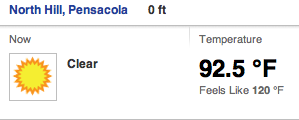
AdventureMan is at a meeting, and I had been thinking lunch at the beach later today when he gets home. At “feels like 120°F,” I think maybe not the beach today.
Oddly, while the temperatures are high, it hasn’t felt like the worst days of summer. I have tomatoes growing again, so some of our nights must be going below 70°F, and with the recent rains, the roses are blooming again and the lantana in the former pool area (not our doing, the original owner) is going bananas. The bees are busy, and I am hoping they will fertilize the eggplant, so the plant I have been nursing all summer will not have been for nothing. It FEELS like Fall is coming, in spite of the temperatures.
On my Weather Underground home page, I have temperatures for Doha and Kuwait also listed. Doha, nine hours ahead, has almost the same exact temperature at 6 pm that Pensacola has at 9 am. God’s mercy is showing in Doha, cooling the evening for the Ramadan celebrations. 🙂
Recent Comments
ExpatAlien on What Country am I Living … intlxpatr on Yellowstone: Old Faithful to C… Michelle on Yellowstone: Old Faithful to C… Cathy on No Grown-Ups in Charge intlxpatr on Waiting for Snow Wikipedia Donate Button

Amazina


Early Voting in Florida


 Here There and Everywhere