Baked Stuffed Pumpkin
My visiting niece, Little Diamond, is vegetarian. AdventureMan and I are not vegetarian, we laughingly say we are meatatarian or meatavore, but the truth is, we don’t eat a lot of meat, either. Last I tried a new recipe, not entirely original, but a lot of fun, and it turned out really really good. It is also surprisingly easy. 🙂

(This is not my photo, but it looks a lot like my pumpkin. It is from visual recipes, another great recipe site)
I got the idea from a quilting friend in Kuwait who baked a pumpkin full of a meat stuffing. It sounded yummy. I filled it with a channa dal / burgul mixture (recipe follows) and I added:
1 chopped apple
seeds from 1/2 pomegranate
1/2 cup slightly chopped walnuts
Here is the original recipe for the stuffing:
• 3/4 cup chana dal
• One large onion, chopped
• 2 cloves garlic (or more, to taste), minced or pressed
• 2 tablespoons olive oil
• 1 cup bulgur wheat
• 2 cups hot water
• 1 teaspoon salt (or less, to taste)
• 1/4 cup finely chopped parsley or cilantro
• freshly ground black pepper
Preparation:
Soak chana dal for 10-12 hours. Drain and rinse.
Sauté onion and garlic in olive oil until soft (5-8 minutes). Add drained chana dal and bulgur wheat. Sauté for about 3 more minutes, until bulgur wheat is browned (it will begin to smell heavenly). Add all remaining ingredients except pepper, bring to a boil, and lower heat.
Simmer, covered, for about 35 minutes. At this point, check to see if the chana dal is tender enough for you. If not add a quarter cup more water and simmer another few minutes or until you are satisfied. Turn off heat and let sit, covered, for at least 10 minutes. Fluff with a fork and mix in pepper.
Makes about 6 cups.
The only hard part is remembering to soak the chana dal. 😉
Pumpkin
Cut a lid off the top of the pumpkin. I usually put a notch, so I know how the lid fits back on.
You have to clean out the pumpkin, throwing out the innards (you can toast the seeds if you want). I also cut some of the pumpkin flesh into small pieces and added it to the stuffing, but that is optional.
Stuff the pumpkin tightly with the stuffing mixture, then line a baking bowl or pan with the remaining stuffing, set the pumpkin in the center, pour 1/2 cup of water – or wine, now that we are in Qatar – or broth – over the stuffing, and cover loosely with foil.
Bake at 350°F / 175°C for one hour, or more, until the pumpkin flesh is soft all the way through. Cut the pumpkin into slices to serve, and heap extra stuffing on top.
Delicious!
Additional hint – I use a Misto, a bottle you can fill with the best olive oil, pump, and spray. I spray the bowl before I put the stuffing in, to make cleaning easier, and I also spray the pumpkin to give it that glisten. It is very sparing with the olive oil, but you still get the taste.
Little Diamond asked if it were a potiron or a citrouille, two words the French use for pumpkins, but none of us could say definitely. I thought it was a potiron, because it is more squat and I thought citrouille were taller and oranger, but Little Diamond actually looked it up online after dinner.
AdventureMan reminded me of the time in Tunisia when Halloween was coming and I went to the market and bought a whole pumpkin to carve. I don’t think it was really a pumpkin at all, it was a huge pumpkin-like squash, and it was sold in slices, by the kilo. I bought the smallest one I could find, but it still caused quite a commotion, buying the whole squash, not just a slice.
And I was thinking, too, of my French friend who shared her recipe with me for the very best pumpkin pie I have eaten in my life, ever.
A Small Adventure in Qatar
Here is one reason I love AdventureMan. He loves to go exploring, and Friday mornings after church are our favorite time. I am showing him some new routes, because the street patterns have changed, and where the pigeon mosque used to be, and he notices that the GATE IS OPEN!

So here is what I love. The gate is open. There is no sign saying No Entry. To AdventureMan – and to me – that means that it is not forbidden, which means that it is allowed, right?
There is no guard on duty – it’s Friday. Maybe they are praying.

And the pigeon mosque is still there! I was so afraid they were tearing it down. I don’t know what the real name of this mosque is. There used to be parking behind it where all the Pakistani drivers parked their decorated delivery trucks, and those of us visiting the souks in that area parked there, too. Now, there is almost NO parking available unless you get there at like 6 in the morning. (Actually, if you get there around 0830 on Saturday morning, you can find a parking place.) We call it the pigeon mosque because all the pigeons gather on the roof there. The mosque has been totally gutted and is being renovated.
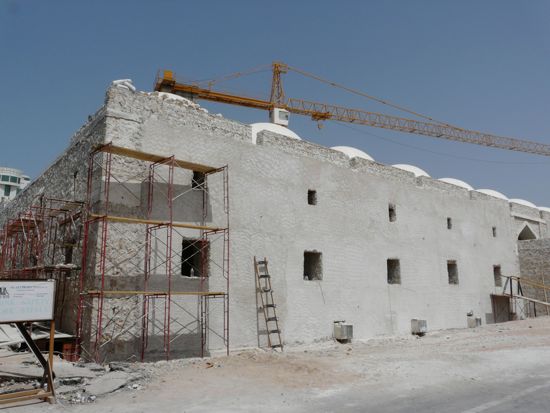
The rest of what used to be a place filled with cheap junky stores is gone. Demolished and carted away. It’s just a big empty space. No clue yet as to what is going in.
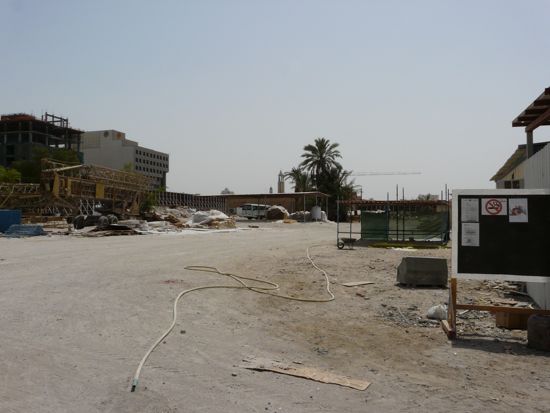
We will have to wait for another day when the gate is open – inviting us to come in. 🙂
Who Is My Neighbor?
You would think when someone so special is talking, people would listen. You would think that when he is trying to tell us what God expects from us to enter into his kingdom in the after life, people would be listening, and indeed, they listened, many listened. There were others who did not. There were also those closest to him who misunderstood! That always baffles me, that those closest could misunderstand.
Today’s lesson is one of my very favorites in the world. You can substitute any two races who hate one another and the story is equally clear. The man who was asking the question was setting Jesus up, or trying to, and Jesus used the occasion to teach a stunning truth – that love is stronger than hate.
Luke 10:25-37
25 Just then a lawyer stood up to test Jesus.* ‘Teacher,’ he said, ‘what must I do to inherit eternal life?’
26He said to him, ‘What is written in the law? What do you read there?’
27He answered, ‘You shall love the Lord your God with all your heart, and with all your soul, and with all your strength, and with all your mind; and your neighbour as yourself.’
28And he said to him, ‘You have given the right answer; do this, and you will live.’
29 But wanting to justify himself, he asked Jesus, ‘And who is my neighbour?’
30Jesus replied, ‘A man was going down from Jerusalem to Jericho, and fell into the hands of robbers, who stripped him, beat him, and went away, leaving him half dead. 31 Now by chance a priest was going down that road; and when he saw him, he passed by on the other side. 32 So likewise a Levite, when he came to the place and saw him, passed by on the other side. 33 But a Samaritan while travelling came near him; and when he saw him, he was moved with pity. 34 He went to him and bandaged his wounds, having poured oil and wine on them. Then he put him on his own animal, brought him to an inn, and took care of him. 35 The next day he took out two denarii,* gave them to the innkeeper, and said, “Take care of him; and when I come back, I will repay you whatever more you spend.” 36 Which of these three, do you think, was a neighbour to the man who fell into the hands of the robbers?’
37He said, ‘The one who showed him mercy.’ Jesus said to him, ‘Go and do likewise.’
I have seen this in my own life. I have seen hopeless situations, with no solution in sight, totally change because one person chooses to love, instead of to hate. Choosing to love, in the face of hatred, takes a lot more character, a lot more strength. It has the potential for changing everything.
Free Speech in Fiji
It was prime drive time in Kuwait, and I almost laughed so hard that I might have been a danger on the road. A brief news article on BBC News featured the national leader in Fiji saying “free speech is nothing but trouble.” The news reporter was saying that the only real news in Fiji right now is from the bloggers. Here is a fragment of an article on BBC April 15th:
Free speech ‘trouble’
In an interview with Radio New Zealand, Mr Bainimarama said he was determined to carry out what he described as reforms.
He defended the introduction of emergency regulations that include an edict that the local Fijian media publishes only positive news, saying Fiji does not need free and open public discussion about current issues.
“That was how we ended up with what we came up with in the last couple of days,” he told Radio New Zealand.
“The circumstances have changed. We [the government] now decide what needs to be done for our country, for the reforms that need to be put in place for us to have a better Fiji,” he said.
Fiji’s Court of Appeal ruled last Thursday that the Bainimarama regime, in power since staging a 2006 coup, was illegal under the country’s 1997 constitution.
In response, the country’s ailing President Josefa Iloilo sacked the judges, dissolved the constitution and reappointed Mr Bainimarama, who then said there would be no democratic elections until 2014.
Walnuts Help Protect Against Breast Cancer
Walnuts may prevent breast cancer
You can read the entire report on BBC Health News
Walnuts have been linked to heart disease prevention
Eating walnuts may help to reduce the risk of developing breast cancer, research suggests.
The nuts contain ingredients such as omega-3 fatty acids, antioxidants and phytosterols that may all reduce the risk of the disease.
Mice fed the human equivalent of two ounces (56.7g) of walnuts per day developed fewer and smaller tumours.
The US study was presented to the American Association for Cancer Research annual meeting.
Researcher Dr Elaine Hardman, of Marshall University School of Medicine, said although the study was carried out in mice, the beneficial effect of walnuts was likely to apply to humans too.
She said: “We know that a healthy diet overall prevents all manner of chronic diseases.”
“It is clear that walnuts contribute to a healthy diet that can reduce breast cancer.”
Previous research has suggested eating walnuts at the end of a meal may help cut the damage that fatty food can do to the arteries.
It is thought that the nuts are rich in compounds that reduce hardening of the arteries, and keep them flexible.
In the latest study mice were either fed a standard diet, or the walnut-based diet.
The animals fed walnuts developed fewer tumours, and those that did arise took longer to develop and were smaller.
Molecular analysis showed that omega-3 fatty acids played a key role – but other parts of the walnut contributed as well.
I remember reading another study where walnuts made veins more flexible and were helpful against heart disease. It isn’t any hardship, in this part of the world, eating fresh walnuts – they taste so GOOD!
Gardening Leads to a Longer Life
Back when The Fonz was still blogging, he ran this free test from REAL AGE which I took, full of pride because I lead such a healthy life. Man, did I get a bad surprise, the first of many. First the REAL LIFE people told me my body was one year OLDER than my real age because I don’t like to exercise, and then at my annual physical, my doctor looked me in the eye and said I had to make some changes.
I have. I’ve made some changes. One of the changes is I don’t take tests like that any more!
But REAL AGE doesn’t give up on me. They send me helpful newsletters every week, and I have to admit, they really are interesting, and they really do help me stay on track, like eating oatmeal and drinking green tea.
Today they talk about a hobby that lengthens your life – gardening:

The Hobby That Leads to a Longer Life
A hobby is more than a way to pass the time. It may be a way to get more of it.
Know which hobby has probably added years to the longest-lived people in the world? It’s gardening. Okinawans — whose men typically live to age 78, women to age 86 — have a long tradition of working with soil.
Flex Your Green Thumb
The benefits of gardening reach body and soul, according to Dan Buettner and his book The Blue Zones: Lessons for Living Longer from the People Who’ve Lived the Longest. “It’s a source of daily physical activity that exercises the body with a wide range of motion and helps reduce stress,” he writes. So, as the ground thaws and the seed catalogues start arriving, make a pact to plan — and plant — a plot this year.
Grow for Years
It’s not a coincidence: There are lots of other wonderful side benefits to gardening besides the body and mind boost. Here are the other garden goodies Buettner notes in his book:
A veggie-packed life. Okinawan centenarians eat a plant-based diet, often incorporating vegetables that they grow.
A bit of sun. Vitamin D, produced by the body when it’s exposed to sunlight, promotes stronger bones and better health. Vitamin D also helps your body fight cancer.
A dash of spice. Mugwort, ginger, and turmeric are staples of an Okinawan garden, and all have proven medicinal qualities.
Older Okinawans are active gardeners and walkers. Walk your way to a healthier, fitter life.
Bad News: Brain Decline Begins at 27
Bad news today as BBC reports our brains begin their functional decline as early as age 27:
‘Brain decline’ begins at age 27
Professor Timothy Salthouse of the University of Virginia found reasoning, spatial visualisation and speed of thought all decline in our late 20s.
Therapies designed to stall or reverse the ageing process may need to start much earlier, he said.
His seven-year study of 2,000 healthy people aged 18-60 is published in the journal Neurobiology of Aging.
To test mental agility, the study participants had to solve puzzles, recall words and story details and spot patterns in letters and symbols.
The natural decline of some of our mental abilities as we age starts much earlier than some of us might expect
The same tests are already used by doctors to spot signs of dementia.
In nine out of 12 tests the average age at which the top performance was achieved was 22.
The first age at which there was any marked decline was at 27 in tests of brain speed, reasoning and visual puzzle-solving ability.
Things like memory stayed intact until the age of 37, on average, while abilities based on accumulated knowledge, such as performance on tests of vocabulary or general information, increased until the age of 60.
You can read the rest of the article at BBC Health News
GoogleEarth Map of Speed Cameras in Kuwait
From this morning’s mail, a most valuable tool for money-saving:

AdventureMan tells me in Doha, Qatar, there are now speed cameras everywhere, and the fines are HUGE. Like $2000 for speeding, and they have the picture to prove it. He also tells me the law is applied against everyone, from the highest to the lowest, so that there is a lot less speeding and weaving than we see in Kuwait. I wonder how it is going to work here?
I read in yesterday’s paper, in Jahra, a driver deliberately hit one of the cameras with his car! I wonder if the camera was able to capture the incident before its demise? (It said the culprit was arrested, I think.)
We were out in the Wild West last night (Fehaheel) and a police car was trying to get to a huge traffic snarl. He blurped and burbled, he shouted in his loudspeaker, and nobody let him in. There was no respect for the traffic police, no fear. People just looked after their own interests. Fortunately, it was all at a very low speed, as traffic was jammed tight. There WAS room to let the police car in, but nobody did. I wonder how it would have worked if he had a camera? Or started giving tickets?
Doesn’t Kuwait need a call-in, or e-mail in place where you can take photos of traffic things happening and report violators, like those guys who think they own the emergency lanes when traffic is backed up, or who think the handicapped spots are for them (one told me “but when there is no one parking there, anyone can use it!”) to use – it would be so nice to be able to take a photo and send it in to the authorities and to believe that something would be done about it.
Together We Can
This one gave me shivers – the good kind. Together we can – take the pledge:
Recent Comments
intlxpatr on Yellowstone: Old Faithful to C… Michelle on Yellowstone: Old Faithful to C… Cathy on No Grown-Ups in Charge intlxpatr on Waiting for Snow intlxpatr on Waiting for Snow Wikipedia Donate Button

Amazina


Early Voting in Florida


 Here There and Everywhere
