Raising Blog Interest
I like WordPress – even if things go wrong from time to time, it is because they are trying something new. They work out the bugs, they move forward.
In an announcement today, called Possibly an Announcement they talk about putting some references at the bottom of each post which, if you liked this post, will take you to other blogs with posts on similar subjects.
I don’t know how this will work, but I like it that they are coming up with new ways to increase blog traffic, and to allow readers to follow a theme. You can read the entire announcement by clicking on the blue type, above.
Blog posts can be a total tease. You get to the end and you’re ready for more, but all that’s there is maybe some post navigation, and if you’re lucky a few comments. If your appetite was whetted by the awesome post you just read there’s no place for you to go, except maybe to a search engine to look for terms around what you just read.
Post or permalink pages probably account for about half of the pageviews on your blog.
One of my favorite things about Youtube is that you can start with a single video and then see something else interesting in the related videos and you lose yourself and next thing you know it’s four in the morning and you’re watching disco pilates videos. My fancy term for this is lateral navigation. (Which the rest of the world seems to think has something to do with flying.)
Well now you can have that same experience across WordPress.com.
In a feature we’re calling possibly related posts we’ll now try to show posts related to yours a little section at the end. If we find any posts on your blog that are related, we’ll put those at the very top and in bold. Next we’ll show other posts from around WordPress.com, and finally we’ll check if there’s anything in the mainstream media.
The result is a handful of links that should provide you and your visitors something interesting to check out. On blogs that cover the same topics frequently related posts could cause a 5-10% increase in traffic overnight. You could also start to see traffic from lots of other blogs. It’s a bit of an experiment, and we’ll be tweaking it a lot based on your feedback and the data that we collect once everything is live.
Shop and Eat Locally
I’m fascinated with the concept of trying to eat “local” and there is an article in Wired: How to Shop and Eat Locally that tells us more about it. Below is an excerpt:
Innumerable books and other media extol the virtues of eating food that’s grown and processed near you: it benefits the planet, it benefits the farmers, it tastes better, it’s better for you. ReadMichael Pollan or Barbara Kingsolver for examples.
But piecing together a local menu isn’t as easy as going to the Local aisle of your supermarket. Here are some tips for bringing your meals closer to home.
Start small. Shopping locally goes against the grain (pun intended) of our globalized economy, so it’s not the easiest thing to do. Even if you live in a region that’s rich in vegetables and meats, chances are you won’t have easy access to staples like sugar, salt, oil, and flour. Just focus on what you can get, and keep an eye out for sources and/or substitutes for what you can’t.
Personalize. If you want to try the classic 100-mile diet, you can find your personal 100-mile radius at 100milediet.org.
Get a supplier. You can find farms, greenmarkets, and locally oriented stores in your area using web tools offered atEatwellguide.org and Localharvest.org. If you live in a city, investigate CSA — Community-Supported Agriculture. Citydwellers pay a fee to subscribe to a farm, and get a share of its output delivered in weekly boxes of joy. Just Food offers a listing for New Yorkers.
Go For the Bloat
It is breathtaking in its audacity. In a report from CondeNastPortfolio.com we learn of a reverse approach by Carl Jrs. / Hardee’s – going full out towards mega-caloric burgers.
This post is dedicated to Mark, at 2:48 the b-side who is on a quest in Kuwait for the ultimate burger. I am afraid he is going to – literally – eat his heart out.

It was a patriotic statement that went a bit too far afield: an attempt to create the “ultimate picnic burger.” Called the Fourth of July Burger, it was tested last summer at seven locations by the West Coast fast-food chain Carl’s Jr. and consisted of a huge beef patty topped with pickles, ketchup, mustard, potato chips, and a hot dog. Stacked high and loaded with fat and calories, it was the food equivalent of the national anthem played through a sousaphone, a perfect distillation of a peculiarly American form of balls-out, postmodern gluttony that, at least outwardly, we’re all supposed to be ashamed of right now.
Yet for all its pomp and glory, it didn’t quite work. When John Koncki, director of product development for Carl’s Jr., talks about it now, he comes across a little wistful. It tasted really good, he says, but the name and the concept proved too much for the testers. “Sometimes,” the earnest Koncki says, “some of the sandwiches are so unique that consumers can’t wrap their heads around them.”
The uniqueness isn’t the only thing that’s hard to get your head around. During the past few years, CKE Restaurants, the parent company of Carl’s Jr. and Hardee’s, has employed an audacious go-for-bloat approach that defies just about everything you’ve come to assume about the business of modern fast food. (See nutrition data for CKE franchises and other fast-food chains.) In an age when other chains have been forced to at least pretend that they care about the health of their customers and have started offering packets of apples and things sprinkled with walnuts and yogurt, Hardee’s and Carl’s Jr. are purposely running in the opposite direction, unapologetically creating an arsenal of higher-priced, high-fat, high-calorie monstrosities—pioneering avant-garde concepts such as “meat as a condiment” and “fast-food porn”—and putting the message out to increasingly receptive consumers with ads that are often as controversial as the burgers themselves.
You can read the rest of this article, and similar articles, by clicking HERE.
Muslim Bioethics
I love Wired because it gives me science news in a language I can understand:
A Beginner’s Guide to Muslim Bioethics
By Brandon Keim March 04, 2008 | 1:26:15 PMCategories: Bioethics, Biotechnology, Religion
When Sunni and Shiite scholars disagreed over the ethics of cloning animals, I wondered whether there were other bioethical conflicts in the Muslim world.
Are Muslims split over stem cell research and genetically engineered crops? Generally speaking, do they approach biotechnologies in the same way — or variety of ways — as Western cultures?
I posed the question to a handful of Muslim bioethicists. The first to respond was Brown University anthropologist Sherine Hamdy. Wrote Hamdy,
I think it would be easy and reductionist to make this into yet another ‘Shiite vs. Sunni’ issue, but there has always been a wide space of interpretation and widely debate even within the Sunni Muslim world about various biotechnologies including cloning. Most religious sources say that if a given technology, e.g. cloning is for beneficial purposes and the good outweighs the negative (if there is potential for human cures, etc.) then it is permissible, others have cautioned about the potential danger of creating a ‘super race’ of people, animals….so most of the disagreement is actually about the understanding of the technology itself and what impact it might have.
Would it be a bit too easy and reductionist, I asked, to then say that Muslims are less inclined to take an absolutist position and instead base their judgments by weighing the risks and benefits of each case?
You can read the entire article, and related articles, HERE
Start With Breakfast, Stay Lean
Today in BBC Health News
Breakfast ‘keeps teenagers lean’
In a five year study of more than 2,000 youngsters, those who skipped breakfast were found to weigh about 5lbs (2.3kg) more than those who ate first thing.
This was despite the fact that the breakfast-eaters consumed more calories in the course of the day.
But the study in Pediatrics found they were likely to be much more active.
The University of Minnesota research adds weight to a growing body of evidence that those who eat breakfast – whether young or old – are leaner than those who do not.
“It may seem counter-intuitive,” said Mark Pereira, who led the research. “But while they ate more calories, they did more to burn those off, and that may be because those who ate breakfast did not feel so lethargic.
“While it’s best to go for a healthy option – a wholegrain cereal for instance – the evidence does seem to suggest that eating anything is better than eating nothing at all.”
Read the entire article HERE

(AdventureMan’s favorite breakfast: biscuits n’ gravy)
Segregation – Integration – Choice
A fascinating new and very long article from The New York Times Magazine section discusses a school where boys and girls have a choice of integrated or segregated classrooms – in the same school.
I would have hated going to an all-girl school, and at the same time, I think it is far for people to have a choice in how they want to learn. What was right for me is not right for everyone else, and maybe not for YOU – or your children.
Here is a quote from deep in the article, about how things are succeeding at one same-sex school. I wonder how this technique would fly in Kuwait 😉
If a child arrives at 7:31 a.m., his parents will receive a call at 5:45 the next morning to make sure that boy will be at school on time.
By ELIZABETH WEIL
Published: March 2, 2008
On an unseasonably cold day last November in Foley, Ala., Colby Royster and Michael Peterson, two students in William Bender’s fourth-grade public-school class, informed me that the class corn snake could eat a rat faster than the class boa constrictor. Bender teaches 26 fourth graders, all boys. Down the hall and around the corner, Michelle Gay teaches 26 fourth-grade girls. The boys like being on their own, they say, because girls don’t appreciate their jokes and think boys are too messy, and are also scared of snakes. The walls of the boys’ classroom are painted blue, the light bulbs emit a cool white light and the thermostat is set to 69 degrees. In the girls’ room, by contrast, the walls are yellow, the light bulbs emit a warm yellow light and the temperature is kept six degrees warmer, as per the instructions of Leonard Sax, a family physician turned author and advocate who this May will quit his medical practice to devote himself full time to promoting single-sex public education.
Foley Intermediate School began offering separate classes for boys and girls a few years ago, after the school’s principal, Lee Mansell, read a book by Michael Gurian called “Boys and Girls Learn Differently!” After that, she read a magazine article by Sax and thought that his insights would help improve the test scores of Foley’s lowest-achieving cohort, minority boys. Sax went on to publish those ideas in “Why Gender Matters: What Parents and Teachers Need to Know About the Emerging Science of Sex Differences.” Both books feature conversion stories of children, particularly boys, failing and on Ritalin in coeducational settings and then pulling themselves together in single-sex schools. Sax’s book and lectures also include neurological diagrams and scores of citations of obscure scientific studies, like one by a Swedish researcher who found, in a study of 96 adults, that males and females have different emotional and cognitive responses to different kinds of light. Sax refers to a few other studies that he says show that girls and boys draw differently, including one from a group of Japanese researchers who found girls’ drawings typically depict still lifes of people, pets or flowers, using 10 or more crayons, favoring warm colors like red, green, beige and brown; boys, on the other hand, draw action, using 6 or fewer colors, mostly cool hues like gray, blue, silver and black. This apparent difference, which Sax argues is hard-wired, causes teachers to praise girls’ artwork and make boys feel that they’re drawing incorrectly. Under Sax’s leadership, teachers learn to say things like, “Damien, take your green crayon and draw some sparks and take your black crayon and draw some black lines coming out from the back of the vehicle, to make it look like it’s going faster.” “Now Damien feels encouraged,” Sax explained to me when I first met him last spring in San Francisco. “To say: ‘Why don’t you use more colors? Why don’t you put someone in the vehicle?’ is as discouraging as if you say to Emily, ‘Well, this is nice, but why don’t you have one of them kick the other one — give us some action.’ ”
During the fall of 2003, Principal Mansell asked her entire faculty to read “Boys and Girls Learn Differently!” and, in the spring of 2004, to attend a one-day seminar led by Sax at the school, explaining boys’ and girls’ innate differences and how to teach to them. She also invited all Foley Intermediate School parents to a meeting extolling the virtues of single-sex public education. Enough parents were impressed that when Foley Intermediate, a school of 322 fourth and fifth graders, reopened after summer recess, the school had four single-sex classrooms: a girls’ and a boys’ class in both the fourth and fifth grades. Four classrooms in each grade remained coed.
Separating schoolboys from schoolgirls has long been a staple of private and parochial education. But the idea is now gaining traction in American public schools, in response to both the desire of parents to have more choice in their children’s public education and the separate education crises girls and boys have been widely reported to experience. The girls’ crisis was cited in the 1990s, when the American Association of University Women published “Shortchanging Girls, Shortchanging America,” which described how girls’ self-esteem plummets during puberty and how girls are subtly discouraged from careers in math and science. More recently, in what Sara Mead, an education expert at the New America Foundation, calls a “man bites dog” sensation, public and parental concerns have shifted to boys. Boys are currently behind their sisters in high-school and college graduation rates. School, the boy-crisis argument goes, is shaped by females to match the abilities of girls (or, as Sax puts it, is taught “by soft-spoken women who bore” boys). In 2006, Doug Anglin, a 17-year-old in Milton, Mass., filed a civil rights complaint with the United States Department of Education, claiming that his high school — where there are twice as many girls on the honor roll as there are boys — discriminated against males. His case did not prevail in the courts, but his sentiment found support in the Legislature and the press. That same year, as part of No Child Left Behind, the federal law that authorizes programs aimed at improving accountability and test scores in public schools, the Department of Education passed new regulations making it easier for districts to create single-sex classrooms and schools.
Foley Intermediate School began offering separate classes for boys and girls a few years ago, after the school’s principal, Lee Mansell, read a book by Michael Gurian called “Boys and Girls Learn Differently!” After that, she read a magazine article by Sax and thought that his insights would help improve the test scores of Foley’s lowest-achieving cohort, minority boys. Sax went on to publish those ideas in “Why Gender Matters: What Parents and Teachers Need to Know About the Emerging Science of Sex Differences.” Both books feature conversion stories of children, particularly boys, failing and on Ritalin in coeducational settings and then pulling themselves together in single-sex schools. Sax’s book and lectures also include neurological diagrams and scores of citations of obscure scientific studies, like one by a Swedish researcher who found, in a study of 96 adults, that males and females have different emotional and cognitive responses to different kinds of light. Sax refers to a few other studies that he says show that girls and boys draw differently, including one from a group of Japanese researchers who found girls’ drawings typically depict still lifes of people, pets or flowers, using 10 or more crayons, favoring warm colors like red, green, beige and brown; boys, on the other hand, draw action, using 6 or fewer colors, mostly cool hues like gray, blue, silver and black. This apparent difference, which Sax argues is hard-wired, causes teachers to praise girls’ artwork and make boys feel that they’re drawing incorrectly. Under Sax’s leadership, teachers learn to say things like, “Damien, take your green crayon and draw some sparks and take your black crayon and draw some black lines coming out from the back of the vehicle, to make it look like it’s going faster.” “Now Damien feels encouraged,” Sax explained to me when I first met him last spring in San Francisco. “To say: ‘Why don’t you use more colors? Why don’t you put someone in the vehicle?’ is as discouraging as if you say to Emily, ‘Well, this is nice, but why don’t you have one of them kick the other one — give us some action.’ ”
During the fall of 2003, Principal Mansell asked her entire faculty to read “Boys and Girls Learn Differently!” and, in the spring of 2004, to attend a one-day seminar led by Sax at the school, explaining boys’ and girls’ innate differences and how to teach to them. She also invited all Foley Intermediate School parents to a meeting extolling the virtues of single-sex public education. Enough parents were impressed that when Foley Intermediate, a school of 322 fourth and fifth graders, reopened after summer recess, the school had four single-sex classrooms: a girls’ and a boys’ class in both the fourth and fifth grades. Four classrooms in each grade remained coed.
Separating schoolboys from schoolgirls has long been a staple of private and parochial education. But the idea is now gaining traction in American public schools, in response to both the desire of parents to have more choice in their children’s public education and the separate education crises girls and boys have been widely reported to experience. The girls’ crisis was cited in the 1990s, when the American Association of University Women published “Shortchanging Girls, Shortchanging America,” which described how girls’ self-esteem plummets during puberty and how girls are subtly discouraged from careers in math and science. More recently, in what Sara Mead, an education expert at the New America Foundation, calls a “man bites dog” sensation, public and parental concerns have shifted to boys. Boys are currently behind their sisters in high-school and college graduation rates. School, the boy-crisis argument goes, is shaped by females to match the abilities of girls (or, as Sax puts it, is taught “by soft-spoken women who bore” boys). In 2006, Doug Anglin, a 17-year-old in Milton, Mass., filed a civil rights complaint with the United States Department of Education, claiming that his high school — where there are twice as many girls on the honor roll as there are boys — discriminated against males. His case did not prevail in the courts, but his sentiment found support in the Legislature and the press. That same year, as part of No Child Left Behind, the federal law that authorizes programs aimed at improving accountability and test scores in public schools, the Department of Education passed new regulations making it easier for districts to create single-sex classrooms and schools.
How Good People Turn Evil
This is a subject that fascinates me – how even “good” people can do very very bad things . . . The article and interview is from Wired.com science/discoveries and you can read the entire article and view a videotape by clicking on the blue type.
TED 2008: How Good People Turn Evil, From Stanford to Abu Ghraib
By Kim Zetter 02.28.08 | 12:00 AM
MONTEREY, California — Psychologist Philip Zimbardo has seen good people turn evil, and he thinks he knows why. Zimbardo will speak Thursday afternoon at the TED conference, where he plans to illustrate his points by showing a three-minute video, obtained by Wired.com, that features many previously unseen photographs from the Abu Ghraib prison in Iraq (disturbing content).
In March 2006, Salon.com published 279 photos and 19 videos from Abu Ghraib, one of the most extensive documentations to date of abuse in the notorious prison. Zimbardo claims, however, that many images in his video — which he obtained while serving as an expert witness for an Abu Ghraib defendant — have never before been published.
The Abu Ghraib prison made international headlines in 2004 when photographs of military personnel abusing Iraqi prisoners were published around the world. Seven soldiers were convicted in courts martial and two, including Specialist Lynndie England, were sentenced to prison.
Zimbardo conducted a now-famous experiment at Stanford University in 1971, involving students who posed as prisoners and guards. Five days into the experiment, Zimbardo halted the study when the student guards began abusing the prisoners, forcing them to strip naked and simulate sex acts.
His book, The Lucifer Effect: Understanding How Good People Turn Evil, explores how a “perfect storm” of conditions can make ordinary people commit horrendous acts.
He spoke with Wired.com about what Abu Ghraib and his prison study can teach us about evil and why heroes are, by nature, social deviants.
Wired: Your work suggests that we all have the capacity for evil, and that it’s simply environmental influences that tip the balance from good to bad. Doesn’t that absolve people from taking responsibility for their choices?
Philip Zimbardo: No. People are always personally accountable for their behavior. If they kill, they are accountable. However, what I’m saying is that if the killing can be shown to be a product of the influence of a powerful situation within a powerful system, then it’s as if they are experiencing diminished capacity and have lost their free will or their full reasoning capacity.
Situations can be sufficiently powerful to undercut empathy, altruism, morality and to get ordinary people, even good people, to be seduced into doing really bad things — but only in that situation.
Understanding the reason for someone’s behavior is not the same as excusing it. Understanding why somebody did something — where that why has to do with situational influences — leads to a totally different way of dealing with evil. It leads to developing prevention strategies to change those evil-generating situations, rather than the current strategy, which is to change the person.
You can read the rest of the article and view the video HERE.
Taking the Cat for a Drag
When we were first married, we got our first cat. Being book people, we read a book about training cats that told us how easy it was to train a cat to go for a walk on a leash.
We tried it. We tried it several times. We tried it with several different cats. We never found a cat who could be trained to go for a walk on a leash. The Qatteri Cat scratched me bloody when I just tried to put on the harness. I never even got the leash attached. I still have the harness. I still have the leash – never been used.
We called it “Taking the Cat for a Drag.” It looks a lot like this:

Enter the ICHC online Poker Cats Contest!
First Sunrise in March
Sunrise is starting to look a lot like summer – not so many clouds to make it more dramatic. We still have some clarity, the sky is still more blue and less hazy, but every sign is there that the cold winter is over and summer is well on its way. It is 48°F / 9°C, and there isn’t a cloud in the sky, only that wicked, poisonous haze hanging over the horizon.

Mabooch Kuwaiti
I am on an endless quest to find things actually made in Kuwait. I have actually found a few things – The Sadu House on Arab Gulf Drive, up near the Souk Sharq has a fine selection of hand woven trimmed gift items, from time to time I can find something originally Kuwaiti in the antique souks or at the Friday market, I have found locally grown vegetables in the Sultan Center and yesterday I found Mabooch Kuwaiti in the local co-op.
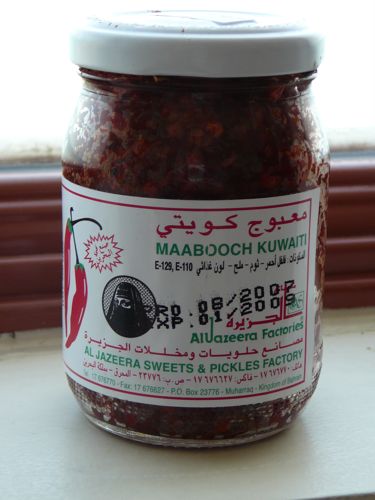
It looks a lot like the hot peppery sauce used in some Chinese cuisines, so I thought I would give it a try. As I looked a little closer at the jar, I saw this:

Do YOU see it?
It is less hot and more vinegary than the Chinese peppery sauce. Can you tell me how it is used?
Recent Comments
ExpatAlien on What Country am I Living … intlxpatr on Yellowstone: Old Faithful to C… Michelle on Yellowstone: Old Faithful to C… Cathy on No Grown-Ups in Charge intlxpatr on Waiting for Snow Wikipedia Donate Button

Amazina


Early Voting in Florida


 Here There and Everywhere