10 Science Proven Ways to be Happier
Happy – or happier – Saturday. Doesn’t everyone want to be happy? Happier? As it turns out, the science of being happy is studied, and there are ways proven to improve your feelings of happiness. I found this on a website called Motto, through AOL News:
10 Science-Proven Ways to Be Happier
Science continues to find ever more specific and idiosyncratic ways we can bring just a bit more of happiness into our lives
We never get tired of thinking about happiness, do we? Life is so much nicer when you’re able to couple it with joy and gratitude.
We’ve published posts before about simple ways to be happy and retraining your brain for more gratitude, and Buffer’s CEO Joel has even shared his own daily to-do list for happiness. (There’s also our popular list of things to stop doing to be happier.)
Meanwhile, science continues to study happiness, finding ever more specific and idiosyncratic ways we can bring just a bit more of this elusive quality into our lives.
I love keeping an eye on these studies, and thought I would share the latest batch with you here to see if any of them might resonate with you and make you just a bit happier.
Here are 10 truly unique ways to be happier that you can start today!
1. Do cultural activities
Need a boost of joy? Trying seeing a play or heading to a museum.
A study that collected data on the activities, mood and health of 50,000 adults in Norway found that people who participated in more cultural activities reported higher happiness levels and lower anxiety and depression.
“Participation in receptive and creative cultural activities was significantly associated with good health, good satisfaction with life, low anxiety and depression scores in both genders,” the researchers write.
Curiously, men saw stronger benefits from receptive, or passive, cultural activities (like visiting museums, art exhibitions, concerts or theaters) while women more enjoyed active participation events (like club meetings, singing, outdoor activities and dance).
2. Keep a diary: Rereading it brings joy
To learn to find more gratitude and joy in every day—not just special occasions, the boring days, too—try keeping a diary and re-reading it from time to time.
Researchers who did a variety of experiments involving keeping a journal discovered that “ordinary events came to be perceived as more extraordinary over time” as participants rediscovered them through their older writings.
In other words, simply writing down our ordinary, regular-day experiences is a way of banking up some happiness down the line, when the activities we describe could bring us unexpected joy.
3. Make small talk with a stranger
Chatting up your barista or cashier? Good for your health!
Behavioral scientists gave a group of Chicago train commuters a $5 Starbucks gift card in exchange for striking up a conversation with a stranger during their ride. (While another group kept to themselves.)
Those who started conversations reported a more positive experience than those who had stayed quiet—even though they had predicted they would feel happier being solitary.
Another study saw similar results from giving Starbucks visitors a $5 gift card in exchange for having a “genuine interaction with the cashier.”
It seems that connecting with another person—no matter how briefly—increases our happiness.
4. But have meaningful conversations, too
While positive small talk is great, more substantial conversations could up our happiness quotient even higher.
A study that tracked the conversations of 80 people for 4 days found that, in keeping with the small-talk study, higher well-being is associated with spending less time alone and more time talking to others.
But researchers also discovered that even higher well-being was associated with having less small talk and more substantive conversations.
“Together, the findings demonstrate that the happy life is social rather than solitary and conversationally deep rather than superficial,” the researchers write.
So dive deep in your conversations with friends and loved ones—it’s great for you.
5. Live in the suburbs and get involved
This one seems to apply to the U.S. A. only, but I still found it quite interesting.
I would have guessed that city dwellers might be the most satisfied with where they live, but in a poll of 1,600 U.S. adults, the highest rate of happiness was found in the suburbs.
84 percent of suburbanites rated the communities where they live as overall excellent or good, compared to 75 percent of urban dwellers and 78 percent of rural residents.
Another study on city happiness found that residents are happier if they feel connected to their cities and neighborhoods and feel positively about the state of city services.
So wherever you live, make sure to get involved in your community for maximum happiness.
6. Listen to sad songs: They provide emotional release
How could sad songs make us happy? And why do we seek them out?
That’s the question researchers wanted to answer with a survey of 722 people from around the world.
They discovered that there are 4 main reasons we take comfort in melancholy songs:
- They allow us to drift off into imagination
- They might provide us catharsis (emotion regulation)
- They allow us to relate to a common emotion (empathy), and
- They’re divorced from our actual problems (no “real-life” implications)
Researchers determined that “listening to sad music can lead to beneficial emotional effects such as regulation of negative emotion and mood as well as consolation.”
7. Spend money on experiences, not items
Here’s one that’s easy to understand but might be tougher to fix.
We know that spending money on life experiences will make us happier than spending money on material things (and it does!) but we can’t seem to stop ourselves from choosing the wrong option.
That’s what a study in The Journal of Positive Psychology found as they surveyed people before and after they made purchases.
The series of studies concluded that we’re more likely to spend on items than experiences because we can quantify them more easily and we want to see the best value for our dollars.
However, they found that the study subjects reported that after they spent, experiences brought them greater well-being and they considered them to be a better use of money.
So if we can keep that in mind, it’s possible to have our cake and eat it, too—definitely something to be happy about!
8. Set tiny, attainable goals: Make someone smile
It might be cliché, but making someone happy will make you happy, too.
And science says the more specific you can be with your goal, the better.
University of Houston professor Melanie Rudd found that a group of people who were told to make someone smile felt both happier and more confident that they’d actually achieved their goal than a similar group who’d been told simply to make someone else happy.
Even more interesting: In a separate experiment, people wrongly predicted that going for the bigger goal would make them happier.
“If you can meet or exceed your expectations of achieving a goal, you will be happier than if you fall short of your expectations,” Rudd explained.
9. Look at beautiful things: Design makes us happy
Could looking at a beautiful object make you feel happier?
The smartphone company HTC conducted a study that says yes.
In a series of laboratory and online experiments, volunteers looked at and interacted with objects that fell into 3 categories: beautiful, functional, or both beautiful and functional.
Their reactions uncovered some interesting findings, like:
- Well-designed objects that are both beautiful and functional trigger positive emotions like calmness and contentment, reducing negative feelings like anger and annoyance by almost a third.
- Purely beautiful objects (not functional) reduce negative emotions by 29%, increasing a sense of calmness and ease.
Objects that were both beautiful and functional created an especially high level of emotional arousal:
In general, people feel happier looking at and using beautiful objects that work well.
10. Eat more fruits and veggies
We know being healthier makes us happy, but can carrots give you purpose?
I have to admit I didn’t expect such a direct link between happiness and eating a lot of fruits and vegetables as researchers in New Zealand report.
Their 13-day study of 405 people who kept food diaries showed that people who ate more fruits and vegetables reported higher than average levels of curiosity, creativity, and positive emotions, as well as engagement, meaning, and purpose.
Even more interestingly, participants often scored higher on all of those scales on days when they ate more fruits and vegetables.
“These findings suggest that fruit and vegetable intake is related to other aspects of human flourishing, beyond just feeling happy,” writes the research team.
Arrival in Sevilla, Spain
Except for that moment on our way to the airport, everything was smooth as glass. That moment? As we are in the taxi on the way to the airport, I am thinking how wonderfully lightly I am traveling and suddenly, by the grace of God, remember my carry-on bag, carefully packed, sitting in my room. We quickly turn the taxi around, go back and pick up my bag, and from there on, all goes smoothly.
Connecting in Charles de Gualle airport used to be a lot of fun. So many shops, so much time. Not now. There may be shops, but customs and security are a nightmare, and the new airport configuration boggles the mind. There was one bored, tired, annoyed looking Frenchman for lines of travelers as we arrived, and while we were close to the front of the line, it took forever.
Our trip back was worse; we had a tight connection. Entry was worse, lines and lines of desperate travelers, too few processors. Then we had to try to find E: M 32. It was a maze. I am normally pretty good with navigation, but CDG isn’t any fun, there is no logic, there is no assistance, no explanatory signage. We got to E, then had to find M, then had to get on a shuttle bus to somewhere else; it is purely horrible.
And I suppose it is the price you pay to fly Air France, which we love. Flying Air France is like a step back in time, where flight attendants were plentiful and gracious. We had slide-down-flat seats, great for sleeping, and good meals. We had hot washcloths and good coffee. It was worth every penny.
Our arrival in Malaga was our real introduction to group travel. Meeting us were Maria and Antonio, two consummate professionals who were greeting all the people coming in for this cruise/trip. First, we learned that there were several groups on board, in fact, just about everyone arriving was a member of some group or another. We were with Smithsonian, but others were with alumni groups, or affiliated in other ways. Once everyone on their list was checked off, we strolled to the bus, which required that the heavily laden would need the elevators. They led the group to one elevator, but AdventureMan and I spotted another elevator on the other side, and took that one.
The drive to Seville was 2 and a half hours. Many slept. It was a sunny day with some clouds, so mostly I watched the olive tree groves and the bull signs drift by, happy to be traveling in Spain.

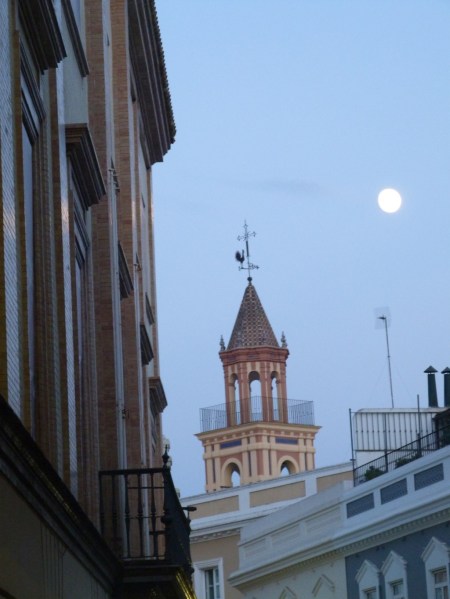
We were so impressed with the process at the hotel when we arrived; there were envelopes with the names of arriving passengers and their keys. It was all done for us, no registering, just straight to our rooms. We were happy to see we had a room in the rear of the hotel. Good firm beds and very quiet. Our our bathroom window, we had a view of a nearby church steeple, and the full moon 🙂
The bar at the Fernando III was a lively place, and a gathering place for locals and hotel patrons:

The breakfast hall had a large buffet but only two one-cup-at-a-time coffeemakers, which was a real bottleneck. If I were not traveling with a group and were staying in this hotel, I would not be happy, as most of the tables had signs on them designating different groups. There were not many for independent travelers, but then again, most of us in the group had early start dates as our tour groups gathered, and the independent travelers could eat at a more leisurely time:

The very best part of this hotel, as you can see in the screen shot above, is that it had a great location. We could walk anywhere, and we did. We walked and walked.
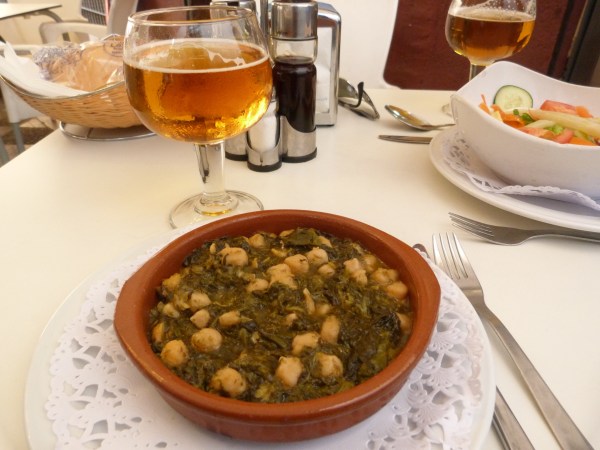
Our first night we were not very hungry, but we knew we would be (in the middle of the night) and that we needed to eat something to get our tummies on local schedule. We found a nearby restaurant, El Cordobes, and while the service was surly and a couple of the dishes mediocre, our main courses were delicious. I had wanted to try the spinach and garbonzos; they were all right. But when the shrimp, sizzling in garlic sauce arrived, oh WOW. AdventureMan had the paella, which was also very very good. We were sitting at a table on a sidewalk in Seville, watching a rugby game for which other tables were cheering and hollaring, drinking good beer, listening to the church bells and life is sweet.
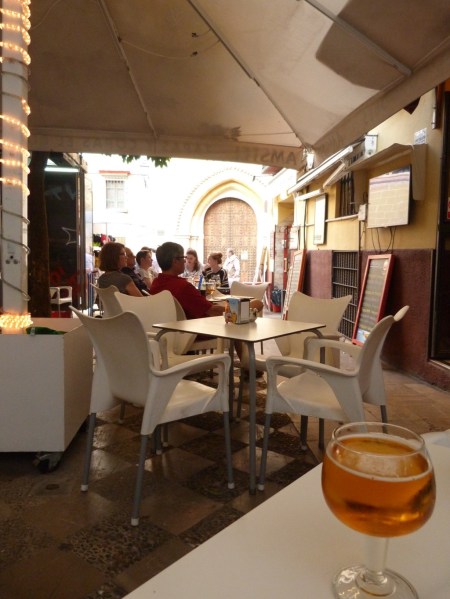

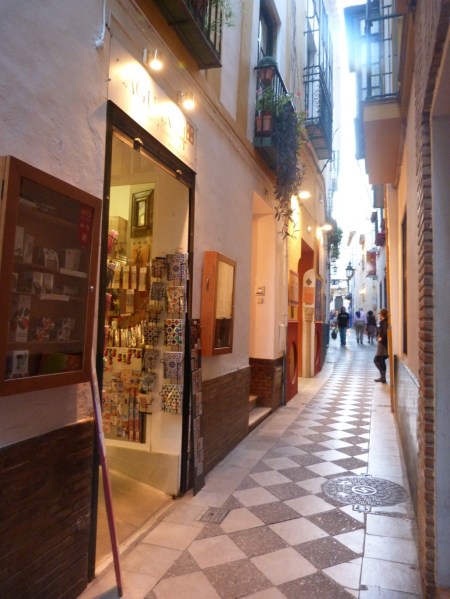
On the way back to the hotel we take a walk in the Santa Cruz barrio and get totally lost, wandering on the narrow little streets, full of flowers, shops, tiny grocery stores, restaurants, bars and tapas bars, stores with flamenco dresses, stores with spices, stores for the locals and stores for the tourists. By the time we were back at the hotel, we were ready for bed, and I had my first no-effort day with more than 10,000 steps. I didn’t even have to try, woooo hoo!
The Trip Process
We are usually two trips out. By that, I mean that while we are getting close to one trip, we are usually planning the next trip. It just works out that way, and it gives us something to look forward to even when one trip is over . . . there is always the next trip.
While we were still planning our three week trip to the American Southwest and California Coast last March – April, AdventureMan shouted from his office to mine “Why do I keep getting these brochures from Viking Cruises?” I was shaking with laughter. “Because I signed you up!” I replied.
We are getting older. We tire more easily. It’s just the way life goes, and we need to focus on how we can continue doing what we love. We need to explore other strategies, other ways of doing things. So we decided to look at cruises to Istanbul and beyond, and after two hours of looking around, ended up choosing a Smithsonian trip to Spain and Morocco. For us, it is totally normal. We toss ideas back and forth, and all of a sudden, something will click.
AdventureMan was on the phone, booking the sea and land cruise within two hours of the start of the conversation. We knew we wanted a balcony and we also knew that flying business class would help us adjust to the jet lag involved, so we could hit the ground running.
And yes, we already have our next trip booked 🙂
Jurassic World Explosive Experience
We’ve been waiting for a free afternoon to see Jurassic World, and yesterday was it. We wanted to see it in 3D, although in retrospect, I am not so sure it makes that big a difference. It was LOUD. We are not hard of hearing, and at the beginning I had to cover my ears, it was so loud.

And, for all the movies I have seen, this one had some twists I didn’t see coming. It was full of exciting moments, and, within its own context, believable. You have to believe that humans let greed overcome their good judgement. You have to believe genetic manipulation is possible. You have to believe that the minute someone says “this is totally safe” you’d better be looking for a life jacket and a way out. All this, I believe.
AdventureMan had some struggles with unexplained things, but I think they were good at covering their bases, if you paid attention when the scientists were talking. I had a really hard time believing velociraptors could be tamed in any way. Trained – maybe if they are bored enough, and the training follows their normal instinctive practices. Tamed? Ummm, I don’t think so.
I loved the homage paid to Jurassic Park. I always love it when the bad guys get their just desserts. I always wonder, if we get curious and clone/create a prehistoric animal, will we be able to foresee all the possible outcomes?
Houseguests and Rabies and Wedding Anniversaries
We’ve had a lot of wedding anniversaries, AdventureMan and I. Some anniversaries we have sacrificed to national security, as AdventureMan would be called to go to the field, or head out on some exercise. There are a few which have been truly memorable. If you’ve been reading this blog for very long, you will know that the ones we remember are probably not those that include roses, or wine and a fine meal and a beautiful gift, although we have had those.
One, we remember because we ate at a very fine restaurant, very snooty, and the waiter made a big deal out of presenting us with chilled forks for our salad course. We could barely keep a straight face, it is so far from anything we would consider a priority.
Another, and we howl with laughter – now – was the wedding anniversary when we had just arrived in Germany from Saudi Arabia, and found a lovely apartment on the top floor of an old mansion in a village I loved. When we got back to the car, AdventureMan said “Did you notice it is not furnished?” and I said we can find what we need at the re-utilization office, which is alway selling off used furniture.
Indeed, two days later there was a huge sale at the re-utilization center and we bought a dining room set, living room chairs, three big cupboards for holding clothes and some lamps, etc – all for $53. We’ve always had great luck that way. I had a lot of fun re-upholstering the chairs, and the landlord threw in a bed for us.
But as we sat in the car, on our anniversary, I said “Now, you probably need to take me to the hospital so we can get my bite looked at.” A few hours before leaving Saudi Arabia, the cat I had been feeding bit me, hard, on the arm. It ws one of those bites where the incisors went deep. I’d have liked to ignore the bite, but rabies is an ugly way to die, and I sure didn’t want to stay in Saudi Arabia to be treated.
So we headed to the hospital, and the next few hours were excruciating. Then we went to a favorite old Mexican restaurant we had known from years before, and that was our anniversary, truly memorable. We still laugh; we remember finding that lovely old apartment, and then having to go to the emergency room.
As an aside, the landlord didn’t tell us he was trying to sell the mansion, and nine months later, we were looking again for an apartment. We became very good friends with the new owners, and are friends with them to this very day.
This wedding anniversary was a non-event, we had houseguests, and their customs and daily lives are so very different that celebrating a wedding anniversary would have been far outside their comfort zone. We had a friend from Saudi Arabia and his 10 year old son.

We received an e-mail from them saying (I will paraphrase a little here) ‘we have reservations to come to Pensacola for 26 days and we want to stay with you.’ There was more, but that was the essence. AdventureMan looked at me and said “I think we need to do this” and I was glad, because I had been thinking the same thing.
I think I have told you about our friends who welcome the stranger, so I think God had been preparing us for this visit, and for us to do it.
How did it go? It was challenging. There were times we just wanted it to be over, and there were times our friends must have found us to be very disappointing. There were continual clashes in expectations, and there was a very large well of good will out of which we continually drew. There were uncomfortable moments regarding meals, and meal times, and getting up times, and where we would go. There were also some fabulous meals and some truly wonderful conversations.
I know they were sorry to go. I know they want to come back again for another visit. We have no regrets; we are glad we did this, and we are also glad to have our very normal American lives back. We like this man very much, and we know this visit was a challenge for him, too.
But as we are hollering back and forth, we are laughing, this is one of those anniversaries we will never forget, the year we had our Saudi house guests.
We are aging, AdventureMan and I. We are no longer truly nomadic, living out of our suitcases. We have everything we own in this one house, except our other house. We no longer have other furniture in storage, and we have trimmed down a lot on the load of things we have collected. Maybe the one thing we truly fear is becoming too settled, and this visit was a wonderful way to shake things up a little bit, to force us out of our comfortable routines, and to force us to see our lives through the eyes of others.
It has given us a lot to think about.
Happy Anniversary, AdventureMan 🙂
A Harsh Ruler
Today’s Gospel reading from The Lectionary brings up so many questions! Jesus gives a parable, a story to help explain what he is saying, but what, exactly, is the parable saying?
Luke 19:11-27
11 As they were listening to this, he went on to tell a parable, because he was near Jerusalem, and because they supposed that the kingdom of God was to appear immediately. 12 So he said, ‘A nobleman went to a distant country to get royal power for himself and then return. 13 He summoned ten of his slaves, and gave them ten pounds,* and said to them, “Do business with these until I come back.” 14 But the citizens of his country hated him and sent a delegation after him, saying, “We do not want this man to rule over us.” 15 When he returned, having received royal power, he ordered these slaves, to whom he had given the money, to be summoned so that he might find out what they had gained by trading. 16 The first came forward and said, “Lord, your pound has made ten more pounds.” 17 He said to him, “Well done, good slave! Because you have been trustworthy in a very small thing, take charge of ten cities.” 18 Then the second came, saying, “Lord, your pound has made five pounds.” 19 He said to him, “And you, rule over five cities.” 20 Then the other came, saying, “Lord, here is your pound. I wrapped it up in a piece of cloth, 21 for I was afraid of you, because you are a harsh man; you take what you did not deposit, and reap what you did not sow.” 22 He said to him, “I will judge you by your own words, you wicked slave! You knew, did you, that I was a harsh man, taking what I did not deposit and reaping what I did not sow? 23 Why then did you not put my money into the bank? Then when I returned, I could have collected it with interest.” 24 He said to the bystanders, “Take the pound from him and give it to the one who has ten pounds.” 25 (And they said to him, “Lord, he has ten pounds!”) 26 “I tell you, to all those who have, more will be given; but from those who have nothing, even what they have will be taken away. 27 But as for these enemies of mine who did not want me to be king over them—bring them here and slaughter them in my presence.” ’
We know, by his own words, this was a harsh man and we know many of his citizens – not slaves – did not want him to rule over them. Why did Jesus use this man to illustrate his point? What about the other seven slaves who were given the money; how did they invest or protect the money? When I look at this parable, I am not so sure I would want to be one who was given more to administer over; the master is harsh. Perhaps those who protected the talent and kept their heads down fared better in the long run under this harsh man’s rule? What if one had taken the money and used it to make the lives of the people better – provided medical care or built a safe-haven for abused women? I shudder to think what the harsh ruler might have done with a slave who used the funds for the good of the people.
The Rains in Africa
There are times – it doesn’t matter where I am, but it’s usually a grocery store. Kuwait. Qatar. Pensacola – they all have this elevator music, music you barely notice, until you find yourself unconsciously belting out “I miss the rains in Africa . . . .”
I love that song. We’ve visited many African countries, and occasionally just before or after the rainy season. When the drops of rain hit the dry earth, there is a scent like no other, an earthy, clean perfume smell.
MIT scientists have worked out the source of that intoxicating scent – tiny bubbles.
Earthy, Post-Rain Smell Explained by MIT Scientists
By Jim Algar, Tech Times | January 18, 11:22 PM

Researcher create slow-motion video of “champagne bubble” effect to show the origin of the familiar after-rain smell. Raindrops can release aerosols from the ground into the air as they hit, researchers find.
(Photo : MIT)
Researchers say they’ve used high-speed photography to show the origin of the familiar earthy, sweet smell that lingers in the air following a rainstorm.
Scientists call that aroma petrichor, and have long ascribed it to chemicals and oils in soil released as aerosols when raindrops hit the ground.
Now researchers at MIT say they’ve created super-slow-motion footage to demonstrate how that “rain smell” moves from the ground into the air.
“It’s a very common phenomenon, and it was intriguing to us that no one had observed this mechanism before,” says professor of mechanical engineering Cullen R. Buie.
“Rain happens every day — it’s raining now, somewhere in the world,” he says.
When a raindrop impacts a porous surface, the researchers found, it traps tiny bubbles of air that then shoot upwards like the bubbles in a glass of champagne, ultimately bursting out of the raindrop in a fizz of aerosols.
Those aerosols contain aromatic elements that can be released by light rainfall and spread by winds, they say.
More aerosols are produced by light or moderate rainfall than during heavy rainfall, which is why the familiar petrichor odor is more commonly apparent after a light shower, they add.
“Heavy rain [has a high] impact speed, which means there’s not enough time to make bubbles inside the droplet,” says postdoctoral researcher Youngsoo Joung.
The scientists filmed raindrops falling on a variety of surfaces, including 16 kinds of soil and 12 engineered materials.
Identifying a mechanism for raindrop-induced generation of aerosols may help to explain how some kinds of soil-based diseases are spread, Joung says.
“Until now, people didn’t know that aerosols could be generated from raindrops on soil,” he says. “This finding should be a good reference for future work, illuminating microbes and chemicals existing inside soil and other natural materials, and how they can be delivered in the environment, and possibly to humans.”
The MIT scientists are conducting further experiments with surfaces containing soil bacteria and pathogens, including E. coli, to see if rainfall and its aerosol-generating mechanism can spread them.
“Aerosols in the air certainly could be resulting from this phenomenon,” Buie says. “Maybe it’s not rain, but just a sprinkler system that could lead to dispersal of contaminants in the soil, for perhaps a wider area than you’d normally expect.”
The results of the MIT study have been published in the journal Nature Communications.
Total WOW at Pot Roast And Pinot
So Pot Roast and Pinot has been open for months now, and although we have heard good things, we couldn’t bring ourselves to go. We hear the food is wonderful. People rave about it. But . . . pot roast? Pot roast is that tasteless Sunday dish anyone can make, stringy meat, watery gravy . . . hmmmmm, no, that doesn’t sound good to me, nor to AdventureMan.
But one day I said “we really have to go, so we can have an informed opinion” and we both kept coming up with alternatives, we were so unenthusiastic. Then, AdventureMan googled the Menu at Pot Roast and Pinot and his opinion shifted. “We should go,” he said, “We should give them a try. Their menu is interesting.”
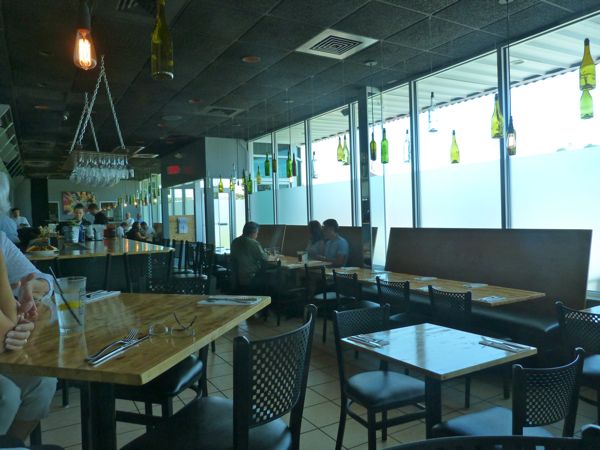
As we entered, we mentally groaned. It’s all hard surfaces and hard chairs and a hard looking bench along one set of windows. The chairs are not actually hard to sit in, and that is good, because service is relaxed, i.e. slow. They aren’t slow in a bad way, they let you take your time ordering, they don’t rush you. We spend longer at Pot Roast and Pinot than we spend in other restaurants (and we have eaten there twice now). It’s an urban feel, with an open kitchen.
It also gets crowded fast. We’ve been once for lunch, once for dinner, and this is a popular place. Both times, we ended up sitting at ‘high tops’ in chairs I have to climb up on and have difficulty dismounting gracefully.
Those are the negatives.
The meals, the preparation and the presentation overcome the negatives. The food at Pot Roast and Pinot is ripe with robust flavors.
This is what it looks like mid-day inside. I love the frosted windows that let in the light but hide the traffic outside on Cervantes.
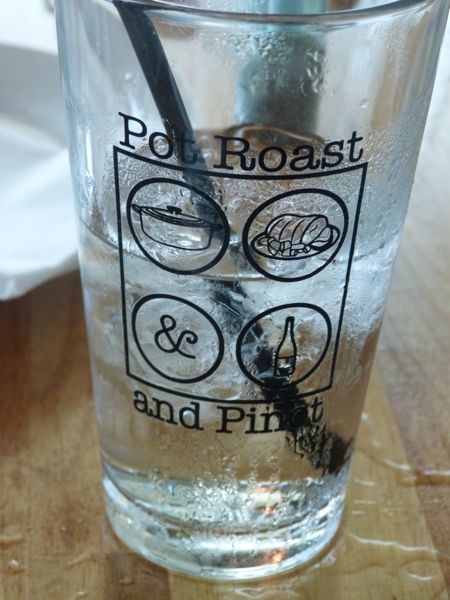
This is the sign on the outside, as well as the logo on their glass. I think they need to be more specific for most people – many won’t guess that it is supposed to be a Pot Roast and Pinot.
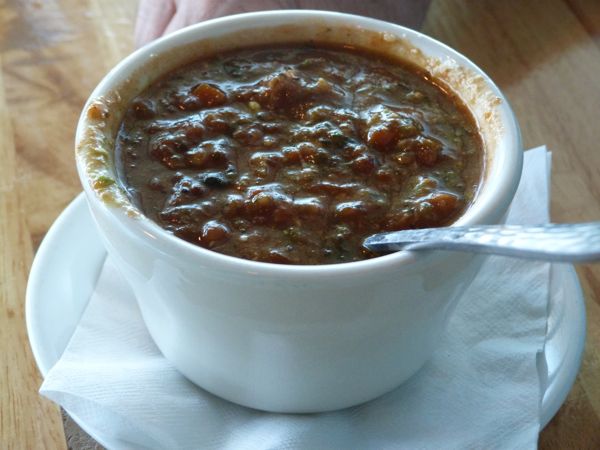
Here is their signature soup, and our first hint of the delights to come – Tomato Florentine Soup. It hits your mouth with a burst of flavor, the ripest intense tomatoes, basil, spinach, it’s all there with some mild but enhancing herbs. A Total WOW.
My starter was a beet salad, and another ‘oh, WOW.’ Thick, meaty slices of red beets AND a golden beet, woven together, a smokey tomato, very tasty, and a smokey vinaigrette dressing, with a sprinkle of a mild goat cheese. This salad was a rich tapestry of perfectly blended ingredients.

My main course was a bowl of Gumbo, and this was one of the best Gumbos I have ever eaten. It was a very manly treatment of Gumbo, thicker than most, a rich thick brown roux binding it all together with great big shrimp and spicy bites of andouille and every bite as flavorful as the last. This was so filling, I couldn’t even eat half of it, and I had the rest at night for dinner. It was just as delicious for dinner as it was for lunch. It had a beautiful garnish of deep fried okra on top, wasted on me, as I am not a big fan of okra, but I appreciate the effort and the artistry 🙂

AdventureMan was in heaven. He ordered the grilled vegetables. He got a plate glistening with a great variety of vegetables, each more luscious than the previous. He said he would order this dish again in a heartbeat, it was so good.

We had them pack up our leftovers so we could split a dessert. I love love love the drip-free container for my Gumbo. The lid fits tightly and doesn’t spill a drop, wooo hooooo!

The Creme Brulee’ changes from day to day, and this day was chock full of huge blueberries. It was perfectly crisped, not burned, with a smooth interior. Magnificent!
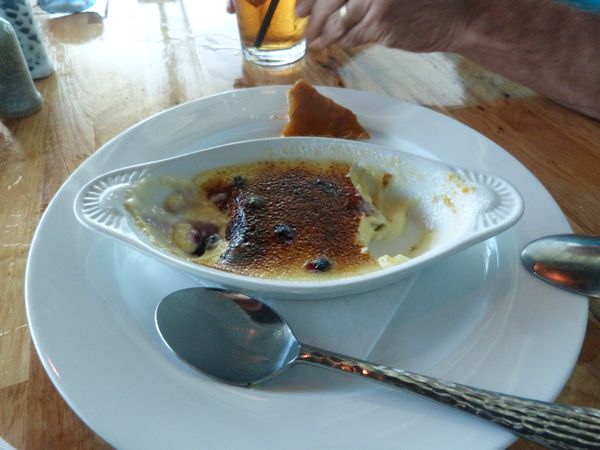
When we went back, it was night (not good for photos) and crowded (not good for photos) and we were with friends (not a good time to take food photos) but the food was equally good. One friend actually ordered the pot roast, of which he ate EVERY bite and declared it very tasty, and another ordered the Surf and Turf special, which was also perfectly prepared.
One friend is totally Gluten Free, and appreciated the goodly number of gluten free options on the menu. She has to be very careful what she eats; when she had questions, the waitstaff were very helpful at getting confirmations for her.
We all enjoyed the Chocolate Mousse for dessert, and I think as much as I like their Creme Brulee’, I am totally hooked on their Chocolate Mousse!
Pedestrian name; world class flavor. Forget the name, go for the flavors. There is no place like this in Pensacola.
Crime to be “Happy” in Teheran?
From today’s Kuwait Times:
TEHRAN: The arrest of six Iranian youths for dancing to US singer Pharrell Williams’ hit “Happy” in a video that went viral highlights the rift between conservatives and youths fascinated by the West. Recorded on a smartphone and uploaded multiple times on YouTube, the clip shows three girls dancing and singing along to the song in a room, on rooftops and in secluded alleys with three young men. For the youths, the homemade video now watched one million times was merely an “excuse to be happy”, but for the Iranian authorities it was “vulgar” breach of the Islamic republic’s values. Originally posted online in April, the clip gradually spread online before it led to the arrest of the dancers and their director on Tuesday for having “hurt” the country’s strict moral codes, according to Tehran police chief Hossein Sajedinia.
The youths appeared on state television repenting for appearing in the clip, after the girls failed to properly observe hijab, a series of rules that oblige women in Iran to cover their hair and much of their body when outside.
Their arrest sparked international fury and criticism in the media and online, with many Iranians expressing shock and some observers questioning whether it was a “crime to be happy in Iran”. Supporting the young Iranians, Williams himself chimed in and hit out at their treatment, saying on Twitter and Facebook: “It’s beyond sad these kids were arrested for trying to spread happiness.” Reports emerged Wednesday night that the dancers were released on bail, with one of the arrested girls, Tehranbased fashion photographer Reihane Taravati, saying on Instagram: “Hi I’m back.” The arrests came after President Hassan Rouhani-a selfdeclared moderate who claims to be for more social freedomsreiterated in a weekend speech his calls for a relaxation of Internet censorship. Rouhani’s statements have irked the conservatives, who have long imposed limitations on the Internet, blocking millions of websites particularly social media platforms, including Facebook and Twitter, as well as YouTube. — AFP
Alzheimers and Cancer: Does One Decrease the Liklihood of the Other?
A study published today on AOL Health News has an intriguing find – that there is a negative correlation between Alzheimers and cancers. You can read the entire study by clicking on the type above. Below is a quote from the study:Ei
“Benito-Leon said that scientists need to better understand the link between Alzheimer’s disease, which causes abnormal cell death, and cancer, which causes abnormal cell growth.”
It refers also to a study published last year on
Skin Cancer May Be Linked to Lower Alzheimer’s Risk, Study Says
A new study finds a link between non-melanoma skin cancer and a decreased risk for Alzheimer’s disease.
From an earlier study on AOL EveryDay Health:
WEDNESDAY, May 15, 2013 — A new study found an association between a history of non-melanoma skin cancer and a reduced risk for Alzheimer’s disease. The observational study, published in the journal Neurology, analyzed a cohort of 1,102 participants of the Einstein Aging Study at Albert Einstein College of Medicine’s Institute of Aging in the Bronx, N.Y.
The researchers report that study participants with a history of non-melanoma skin cancer were close to 80 percent less likely to develop Alzheimer’s disease than people who did not have skin cancer.Among the 141 participants who had non-melanoma skin cancer, only two developed Alzheimer’s disease. But the researchers say they’re still unsure why this link may exist.
“Our goal is really to identify risk factors and genetic factors for Alzheimer’s,” said Richard Lipton, MD, of Albert Einstein College of Medicine, a fellow of the American Academy of Neurology, and lead author of the study. “One explanation is that there is a biological link, and another explanation is there’s a link between risk factors. Really what we need to do is sort out the reasons for these associations.”
Researchers followed participants for an average of 3.7 years. The average age of study participants was 79. At the start of the study, none of the subjects were reported to have dementia, though 109 people had a history of skin cancer. During the study, 32 additional people developed skin cancer, while 126 of the subjects developed dementia. Out of the subjects with dementia, 100 of them had Alzheimer’s-related dementia.
“In neurodegenerative disease, specific cell populations have a tendency to die,” said Dr. Lipton. “In cancer, cells tend to divide out of control. Good health requires a balance between cell death and cell division. Skin cancer may reflect a predisposition to cell division, which protects against Alzheimer’s disease.”
But Lipton also said that subjects in the study with a history of skin cancer may also have lived a more active life, engaging in outdoor activities such as running, playing tennis, or swimming. “We know that physical activity and cognitive activity can prevent against Alzheimer’s,” he said. Therefore, more physical activity would also likely mean more time spent under the sun and in the great outdoors.
Some experts, such as Ahmedin Jemal, PhD, vice president of Surveillance & Health Research at the American Cancer Society, speculates that these findings simply reflect how healthy lifestyle choices can reduce Alzheimer’s risk. “Those people who develop skin cancer are more likely to be physically active and if those people are physically active, they are more likely to eat healthy food, such as fruit and vegetables,” he said.
Dr. Jemal also said there’s research suggesting that high levels of vitamin D can also protect a person from developing Alzheimer’s disease. “For our body to synthesis vitamin D we need sunlight,” he said. One study published earlier this year in the Journal of Alzheimer’s Disease, suggests that high levels of vitamin D may jump-start certain genes in the immune system that are able to help dissolve amyloid plaques in the brain. These plaques are found to cause Alzheimer’s disease.
But Lipton recognizes there are limits to his study. While the researchers did adjust their findings for age, gender, education, and race, they did not base any analysis on diet or vitamin D levels. He added that his team is seeking funding to analyze blood samples of study participants, which may be able to detect certain nutrition-based biomarkers, which may help to better understand the study findings.
Heather Snyder, PhD, director medical and scientific operations at the Alzheimer’s Association finds the study’s findings compelling, but she’s also skeptical, since the number of skin cancer incidences in the study pool is relatively small. However, she said the study points to the value of further research.
“[The study] really underscores the need to understand the biology of these disease mechanisms,” said Dr. Snyder. “If we highlight what mechanisms might be connected in disease processes, if we can understand these disease processes, then we can develop therapies.”
Recent Comments
ExpatAlien on What Country am I Living … intlxpatr on Yellowstone: Old Faithful to C… Michelle on Yellowstone: Old Faithful to C… Cathy on No Grown-Ups in Charge intlxpatr on Waiting for Snow Wikipedia Donate Button

Amazina


Early Voting in Florida


 Here There and Everywhere