AdventureMan’s New Talents
This has been a great month for AdventureMan.
He knew what he wanted. He thought about it, planned it, sought out resources. He now has three photo shelves in his office, where he can display a changing round of photographs. He bought the lumber, tacked on the trim and mounted them on the wall, all by himself.

All these years he has worked so hard – he has never had the time for a fun project like this, and he just sits there and grins that something he was able to do himself can give him so much satisfaction and happiness. Retired, maybe, but still learning new skills, scaling new mountains.
Last night, he baked his first pork tenderloin, and then roasted up some asparagus with an olive vinaigrette sauce. Oh, yummmmm. Still growing, still developing new skills, it is so much fun.
Today, he is going out to explore what kind of kayak he wants to buy. 🙂
In Search of the Seminole Pumpkin and the Black Krim
The big box stores are full of plants, some of which will grow in Florida, and some of which are nothing but heartache. They SAY these plants are all zone specific to our area – it’s a big fat lie. Many of the plants they sell will last a short while, but were never meant to grow here.
I planted a lot of seeds last year, and got tomato plants of many varieties, but only one actually produced fruit, a golden drop tomato. I bought plants, and one plant, bought from a local gardener at an annual gardener’s fest, produced copiously – the Black Krim. We tried growing crook neck squash and zuccini, but one day our plants looked healthy and fabulous, and the next, they would be withered and broken, eaten from the inside by some boring insect. Literally boring, not figuratively speaking.
At a meeting this week (which I am so glad I attended) the director of the local Manna Food Pantry program was telling us about the Manna community gardens, and he mentioned a squash that will grow, the Seminole squash or pumpkin.

I’ve spent two days touring nurseries and open markets to see if I can fine one. One nursery had heard of it but said you usually see it later in the season, you plant it like in July so that you will have first fruits in September.
The rules for gardening are so different in Florida. I am learning, but it is all counter intuitive, except that in Kuwait gardening was similar – people yearned for October, when you could set out plantings and hope they would not be destroyed by the heat.
Bougainvillea is an exception. You would think it would grow beautifully in this heat and humidity, but I am told that the cool winters kill it off. It doesn’t really get that cold for that long, but it seems it is cold enough and long enough to kill bougainvillea, which breaks my heart. I love the flamboyant lushness of bougainvillea.
Meanwhile, we will be planting other zone-hardy plants, and we will see what works. If you see a Seminole Pumpkin / Squash plant for sale, let me know, will you?
Tonight the full moon will be closer to the earth than at any other time for many years to come. AdventureMan and I are heading out with a little picnic to watch the moon rise from a tiny park we know. 🙂
Beirut Knows How to Have Fun
I’m sure most of you have seen this, but it just rocks my heart! Beirut Airport duty free! Rafic Hariri International Airport! They are having so much fun! I would love to see this on the catwalk in the Kuwait airport or Qatar airport, LOL, I am guessing in the Gulf it would have to be just men, but some of these Lebanese girls are amazing dancers!
All this dancing is so good for your health! Look, there isn’t a fat person on the floor! They have all danced themselves skinny!
Exercise Reverses Aging
When I lived in Qatar, we had a group that did water-aerobics, and we, sort of ironically, called ourselves the Aqua Babes. (If you knew us, you would snicker along with us. ) The best part was that we had a lot of fun, secondly, we got some exercise. Our motto was “Any exercise is better than nothing,” and we would repeat it to ourselves on mornings when the pool was too cold and we were kicking lacksadaisically in the hot tub, LOL. It tickles my heart to see the researcher use the same words. 🙂
I found this report on AOL NEWS

Photo Courtesy of Adeel Safdar
Ph.D. student Adeel Safdar is pictured with one of the mice that took part in the exercise and aging study at McMaster University in Hamilton, Ontario.
Research Shows Exercise Reverses Aging in Mice
Rebecca Delaney
Dr. Mark Tarnopolsky is not a couch potato. The professor of pediatrics at McMaster University in Hamilton, Ontario, recently placed first in his age group in a series of trail races in the United States and Canada. He’s also competed internationally in winter triathlons, ski orienteering and adventure racing. However, if he feels burnt out and needs a little motivation to hit the gym, he needs only to look to his lab.
Tarnopolsky recently published a groundbreaking study with Ph.D. student Adeel Safdar that found exercise reversed the signs of aging in mice.
Tarnopolsky specializes in studying and treating mitochondria dysfunction. Mitochondria are similar to little furnaces in each cell that convert food and oxygen into energy for the cell to do its job. As people age, the mitochondria break down, causing the cells to break down as well — thus contributing to the well-known signs of aging, brain atrophy, wrinkles, hair loss and heart problems.
“We knew that exercise was beneficial and that runners had a lower risk of death,” Tarnopolsky told AOL News. “But we wanted to look at the systemic effects and find a therapy [exercise] that’s available to most people if they got off the couch and did it.”
The mice that Tarnopolsky used in his study had been genetically modified with dysfunctional mitochondria, meaning they were engineered to age prematurely. Half of these genetically modified mice ran for 45 minutes on mini treadmills, like those at a gym — except smaller — three times a week. The other half remained sedentary in their cages.
The results were staggering.
“After a few months of exercise, there were absolutely unprecedented changes,” Safdar said. “And we saw improvements not only in their running capacity but also their other organ systems.”
He added, “It went way above and beyond the muscles and heart, but also the brain, gonads, kidneys and other organs. It was absolutely exciting.”
The exercised mice were also more robust and had shinier, fuller fur.
“Every organ was better off in the mice that exercised,” Tarnopolsky said. “And not just a little bit better — it was a 100 percent improvement.”
Safdar said that before he joined Tarnopolsky’s lab he wasn’t that interested in exercising, but now he makes a point to stay active by running and doing karate.
“People who exercise are generally physically active longer and are happier,” he said. “Their whole system remains young, so to speak.”
And for those who haven’t exercised regularly, it’s not too late to start, the scientists said. People don’t have to run on a treadmill for 45 minutes three times a day, like the mice.
“Anything is better than nothing,” Tarnopolsky said. Those who are older than 65 can still see the benefits if they just start walking for five minutes and slowly ramp up.
Tarnopolsky also conducted a previous study on weight training in seniors, which proved to significantly slow the body’s aging process.
“It all about keeping yourself moving every day,” Safdar added.
Lord of Death by Eliot Pattison
I didn’t know that much about the Chinese obliteration of Tibetan culture in Tibet. I didn’t know about the systematic destruction of the monasteries, or at least not in detail. I didn’t know about the brutal re-education techniques for the Bhuddist monks. I didn’t know how strong and resistant the peoples of Tibet are to the Chinese incursion.
I’ve learned most of what I know reading Eliot Pattison’s series featuring Shan Tao Yun, a Chinese detective. Or he used to be. In the first book, The Skull Mantra, we meet Inspecter Shan Tao Yun in one of those re-education camps, where he has been tortured and mistreated almost to his physical limits, and the Bhuddist monks teach him new ways of thinking, and those ways help him to see things differently – and to survive.
The Tibetans hate the Chinese, but they make an exception for Inspector Shan Tao Yun, who earns the respect of both Tibetans and Chinese for his unwavering integrity, and his ability to solve the most intricate puzzles. As he does, we learn more about different aspects of life today in Tibet.
The Lord of Death introduces us to the evolving mountain climbing industry developing in Tibet, just across the border with Nepal. Western climbers will see themselves in a very new light reading this book, which involves the murder of the visiting Chinese Minister of Tourism, an American female climber, and former members of a clandestine CIA trained group of Tibetans during WWII.
In every volume, I learn something fascinating. In this book, I learned more about the early struggles of the Chinese Cultural revolution, the corruption of Chinese ideals, and more about Tibetan ways of thinking. I cannot wait for the next book to come out. You can visit his website here: Eliot Pattison.com
Her Fearful Symmetry by Audrey Niffenegger
This was another find passed along by either Big Diamond or Little Diamond, via my Mom, and oh, what a find. Audrey Niffenegger wrote The Time Traveler’s Wife, a highly unusual book which hit the best seller list like a hurricane. This book, Her Fearful Symmetry, solidifies the perception that this author has real talent, thinks way outside the box, and creates characters and situations that, while unlikely, are likable and who become real enough for us to identify with them.
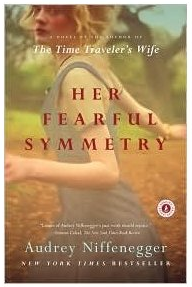
The title is based on a poem by William Blake, a poem I have always liked:
The Tiger
TIGER, tiger, burning bright
In the forests of the night,
What immortal hand or eye
Could frame thy fearful symmetry?
In what distant deeps or skies 5
Burnt the fire of thine eyes?
On what wings dare he aspire?
What the hand dare seize the fire?
And what shoulder and what art
Could twist the sinews of thy heart? 10
And when thy heart began to beat,
What dread hand and what dread feet?
What the hammer? what the chain?
In what furnace was thy brain?
What the anvil? What dread grasp 15
Dare its deadly terrors clasp?
When the stars threw down their spears,
And water’d heaven with their tears,
Did He smile His work to see?
Did He who made the lamb make thee? 20
Tiger, tiger, burning bright
In the forests of the night,
What immortal hand or eye
Dare frame thy fearful symmetry?
While this tale is a great yarn, it helps to know this poem, there are a lot of literary references in the novel and the title is just one of them.
As the story begins, there is a death, a will, and a set of mirror-image twins who inherit a flat in London overlooking a famous cemetery. The flat is in a building and has an upstairs neighbor, a man succumbing to obsessive-compulsive disease, and a downstairs neighbor, an aging bachelor, all a little eccentric in the nicest, English sort of way. The twins, Valentina and Julia, are twenty years old, and waif-like, still dressing alike, doing almost everything together.
There is also a ghost. No, wait! Two ghosts, and a kitten ghost. No, wait! I forgot! Lots of ghosts!
What I love about Audrey Niffenegger is that she takes what we perceive as reality and gives it a twist, and once you buy the twist, you are off on a wild ride. This book is a wild ride, with unforgettable characters and some unexpected kinks and thrills, as well as more than a couple shudders and chills.
Onion Soup of the Pfalz region of Germany
I am printing this just as I found it. The thrill to me is that I can read it and follow it! It is from a blog called ‘Grandmother’s Best Recipes in the Pfalz’ and today I am making Pfalzerzuppe! (It is a onion soup made with creme and a little caraway seed; I often used to eat it at Neuleiningen Castle, in the Bergschanke restaurant.Zwiebelsuppe
“Zwiwwelsupp”
Zwiebelsuppe ist nicht gleich Zwiebelsuppe. Oder auf pfälzisch: Zwiwwelsupp is net wie Zwiwwelsupp. Die nach diesem Rezept ist jedenfalls sehr delikat und würzig.
Zutaten:
- 10 mittlere Zwiebeln (onions, middle sized)
- 500 ml Sahne (cream)
- 1 l Hühnerbrühe (chicken stock)
- Pfeffer, Salz, Kümmel (pepper, salt, caraway seed)
- Butter
- 2-3 EL Mehl (flour)
- 1/5 l Weißwein (aber bitte Pfälzer Wein!) (white wine, Pfalzer white wine, PLEASE!)
Zubereitung:
Geschälte Zwiebeln kleinschneiden und in Butter nur ganz leicht anbräunen. Mit dem Weißwein ablöschen und zur Hälfte einkochen lassen. Das Mehl darüber streuen. Die Brühe und die Sahne hinzugeben und ca. 20 Minuten köcheln lassen, dann abschmecken.
Tipp:
Am Ende des Kochens noch drei Eigelbe mit etwas Sahne verrühren und unter die Suppe ziehen, dann aber nicht mehr aufkochen, sondern gleich servieren.
Father and Son Send Camera into Space
Once again, my Kuwaiti friend has sent me amazing footage of a father-son Science project, where they found a way to send a camera and iPhone into the atmosphere, broadcasting what it saw back to earth. The video story is here:
Only As Old as You Think You Are :-)
I found this great story in BBC Health News. The part that cracks me up is that they made these people carry their own bags, and they left all the uneven floors and throw carpets in place and forced them to pay attention to where they walked. . . and the result – they all did BETTER than they had been doing before!
Can You Trick Your Body into Feeling Younger?
Our volunteers were actors Liz Smith (88), Sylvia Syms (76) and Lionel Blair (78), cricket umpire Dickie Bird (77), newsreader Kenneth Kendall (86) and former Daily Mirror editor Derek Jameson (80).
They agreed to live in our time capsule house for a week, during which they dressed in 1970s clothes, slept in replicas of their very own 70s bedrooms, watched television from that era, and talked about 1975 in the present tense.
It proved to be a fascinating but draining experience – for both experimenters and experimentees.
From the beginning we made it clear to our volunteers that they would be expected to look after themselves. Research in nursing homes shows clearly that giving residents control over their own lives and their own choices has a hugely beneficial impact on health and happiness.
In one study, residents who were allowed to choose a plant to care for, and when and where to receive visitors, were found 18 months later to be significantly more cheerful, active and alert. They were also far more likely to be still alive.
Another thing about our 1970s house was that it was full of physical challenges. There were shag pile carpets to trip over, door ridges to step over and lots of slippery linoleum. Research on mice has shown that those who live in a challenging environment live nearly 30% longer than those who in a secure but boring environment.
In this spirit, on their arrival, our volunteers were asked to carry their bags up a flight of stairs to their bedrooms. It was the first time they’d been forced into such physical activity in many years, and they were not happy.
But they rose to the challenge. When they started at the bottom of the stairs, a couple were adamant it would be impossible to make it to the top. Watching from a laboratory close by, it was hard to resist going to their aid.
Slowly, step by step, they succeeded. We had made them question whether, perhaps, they were more physically capable than they had given themselves credit for.
It was a tough initiation, but a core element of Ellen’s original experiment was the idea that our prior beliefs play a huge part in how we perceive the world, and how we perceive ourselves. By immersing our volunteers in a 1970s world, we were hoping to make them think of themselves as younger, fitter and healthier.
For many of them, the 70s had been a golden decade, a highlight of their careers.
We took Dickie Bird back to Lords to relive the atmosphere. As he walked through the tunnel, onto the grounds, he blossomed before our eyes. Dickie had had a stroke, suffered 18 months of illness, lost confidence and come to think of himself as old. By the end of the week, his confidence was back and he showed remarkable improvement across a range of tests, including memory and stamina.
Over the week we gave all the celebrities tasks to do, but we also left them to fend for themselves. For up to 12 hours a day, we observed them through our surveillance cameras and, just as Ellen had discovered all those years before, we saw great changes.
Half way through the week, Liz Smith took 148 steps with the aid of just one stick. For someone who had not walked without both sticks since her stroke – and who often relied on a wheelchair – it was a real breakthrough. She was no longer willing to be limited by the physical constraints she had imposed on herself.
At the end of the week we put our guinea pigs through the same rigorous battery of physical and psychological tests we had at the beginning. Memory, mood, flexibility, stamina and even eye sight had improved in almost all of them.
The results were not uniform, but in some cases they shed up to 20 years in their apparent biological age.
It made a compelling case for Ellen Langer’s argument that opening our minds to what’s possible can lead to better health, whatever our age.
Squirrel Proof Bird Feeder
Before we left on our 5,000+ mile trip to Seattle and back, we bought a bird feeder. I found it at Home Depot, and didn’t pay much, but it said it was squirrel-proof. It wasn’t. It deterred the squirrels for maybe two days as they figured out how to climb the thin pole and lean over to nibble at the bird-goodies.
When we got back, the feeder was ripped apart; the squirrels had torn out all the bird perches, so we got a new one, a more expensive one, ‘totally squirrel proof.’
Yeh. Right.

The good news is that we also bought a hummingbird feeder. A hummingbird had been by, and we could tell he was looking for a feeder, and figured there had probably been one before, when the previous owners were in the house. As I was waiting to catch a shot of the squirrel, he came back and found the feeder, where he is a regular visitor. He also visits our garden, full of hummingbird-friendly flowers. 🙂

Recent Comments
ExpatAlien on What Country am I Living … intlxpatr on Yellowstone: Old Faithful to C… Michelle on Yellowstone: Old Faithful to C… Cathy on No Grown-Ups in Charge intlxpatr on Waiting for Snow Wikipedia Donate Button

Amazina


Early Voting in Florida


 Here There and Everywhere