Welcome Easter in Pensacola!
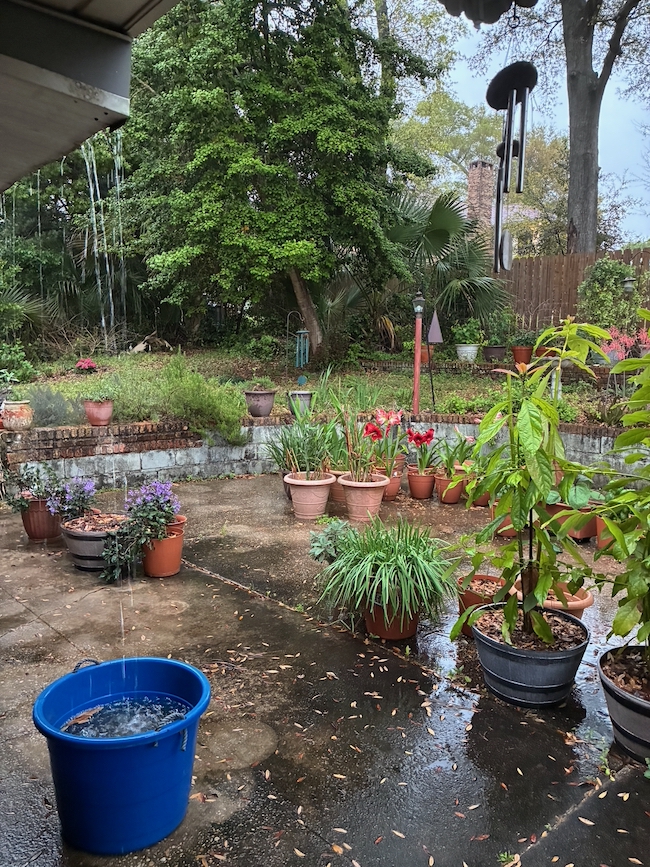
If you live in Pensacola, you feel truly blessed when it rains as early gardens are planted, and dry weather means a drought in Florida. We have had beautiful sunny weather, good for planting seeds and sprouting them, and we need the rain to ensure their survival and vigorous growth. Thanks be to God for a glorious rain.
We had a strong crowd for the early service this morning; the flowers were stunning. I totally missed that the alter flowers were a metaphor for sunrise until our priest pointed it out.
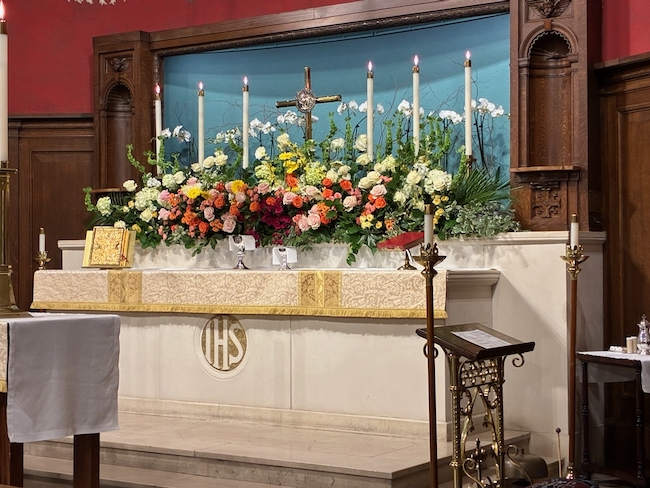
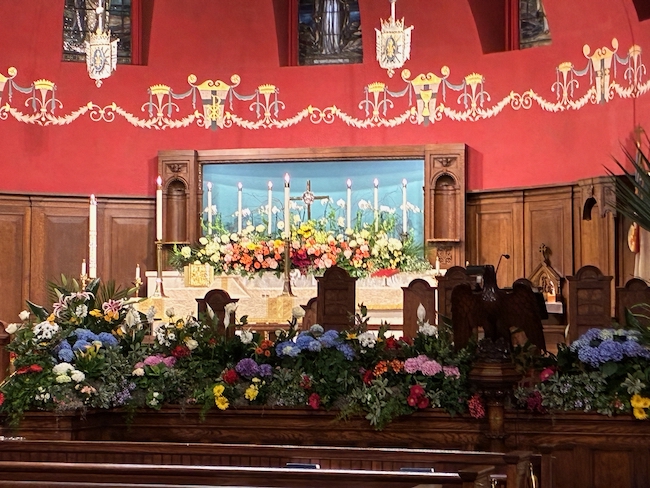
This was the quiet service, the sanity service. Our family will be serving at the next service, the children’s service, after which there will be an Easter Egg hunt. There will be a brass band and celebratory trumpets at the two later services, making a joyful noise indeed! We will all meet up for brunch later. A festive and joyful day, The Lord is Risen Indeed, Alleluia!
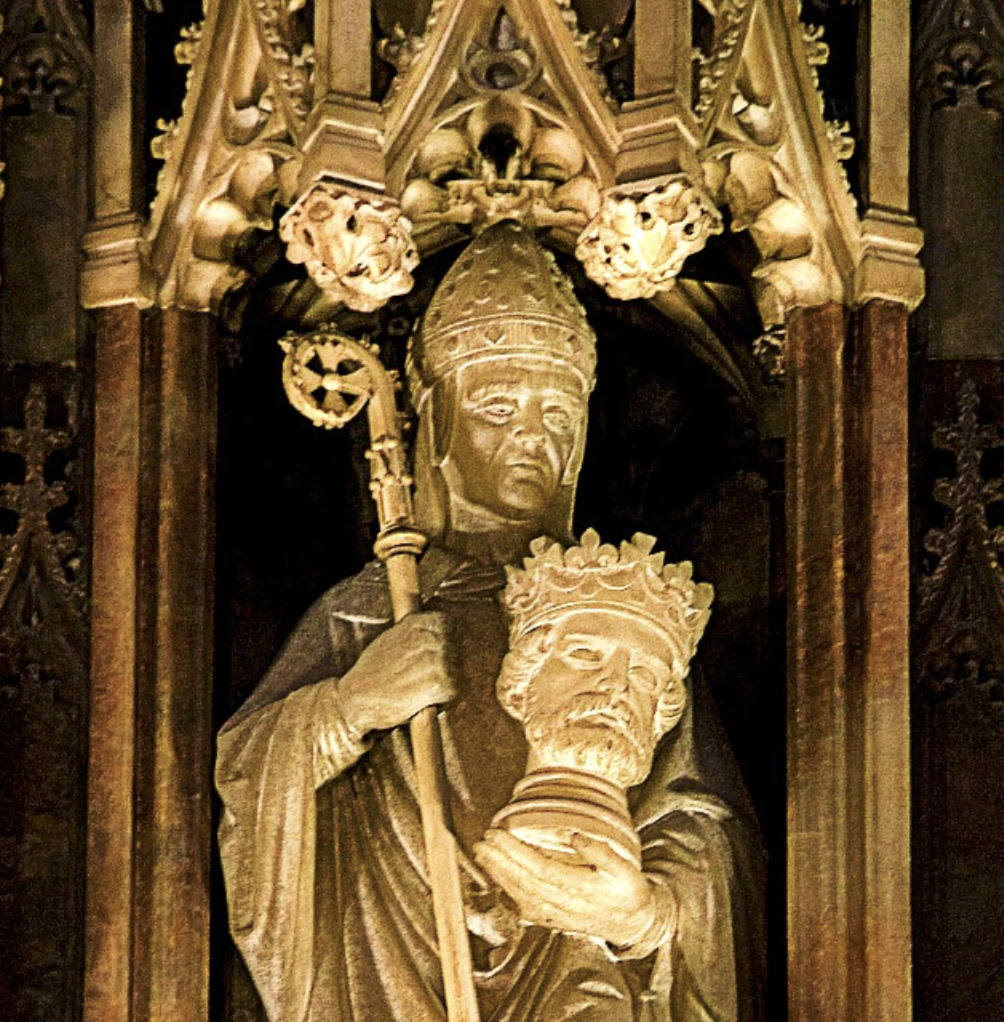
Oscar Romero, Patron Saint of The Americas and El Salvador
My friends, when you hear that the immigrants seeking a new life in our country are rapists, thieves, the mentally ill and very bad people, please think of Oscar Romero, and all those who have fought the evil forces of thuggery and dictatorship to find a life of freedom for themselves, and for their families, especially, hope for their children.
I urge you to read a much criticized book, American Dirt, by Jeanine Cummins. Here is what Wikipedia says. My experience was that the struggles exposed in American Dirt are very typical of people seeking to escape the violence of their societies.
American Dirt is a 2020 novel by American author Jeanine Cummins, published by Flatiron Books. The book is about a Mexican bookseller who is forced to flee as an undocumented immigrant to the United States, along with her son, after her journalist husband exposes a local drug kingpin.
ÓSCAR ROMERO
ARCHBISHOP OF SAN SALVADOR, AND THE MARTYRS OF EL SALVADOR
(24 March 1980)
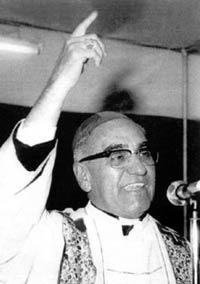
Óscar Arnulfo Romero y Galdámez (August 15, 1917 – March 24, 1980), commonly known as Monseñor Romero, was a priest of the Roman Catholic Church in El Salvador. He later became prelate archbishop of San Salvador.
As an archbishop, he witnessed numerous violations of human rights and began a ministry speaking out on behalf of the poor and victims of the country’s civil war. His brand of political activism was denounced by the hierarchy of the Roman Catholic Church and the government of El Salvador. In 1980, he was assassinated by gunshot while consecrating the Eucharist during mass. His death finally provoked international outcry for human rights reform in El Salvador.
In 1997, a cause for beatification and canonization into sainthood was opened for Romero and Pope John Paul II bestowed upon him the title of Servant of God. Pope Francis canonized Romero as a saint on 14 October 2018. He is considered the unofficial patron saint of the Americas and El Salvador and is often referred to as “San Romero” in El Salvador. Outside of Catholicism Romero is honored by other religious denominations of Christendom, like the Church of England through its Common Worship. He is one of the ten 20th-century martyrs from across the world who are depicted in statues above the Great West Door of Westminster Abbey, London.
from Wikipedia
Also commemorated on this day are three Maryknoll nuns and a woman lay missionary killed by a Salvadoran army death squad on 2 Dec, 1980, and additionally six Jesuits, their housekeeper and her daughter, who were also murdered by the Salvadoran army on 16 Nov. 1989.
Prayer for the Feast Day of Saint Cuthbert
From today’s Lectionary readings:
Merciful God, who called Cuthbert from following the flock to be a shepherd of your people: Mercifully grant that we also may go without fear to dangerous and remote places, to seek the indifferent and the lost; through Jesus Christ our Lord, who lives and reigns with you and the Holy Spirit, one God, for ever and ever. Amen.
“I Have No Need of You”
From this morning’s Lectionary Readings:
1 Corinthians 12:12-26
12 For just as the body is one and has many members, and all the members of the body, though many, are one body, so it is with Christ.13For in the one Spirit we were all baptized into one body—Jews or Greeks, slaves or free—and we were all made to drink of one Spirit.
14 Indeed, the body does not consist of one member but of many. 15If the foot were to say, ‘Because I am not a hand, I do not belong to the body’, that would not make it any less a part of the body. 16And if the ear were to say, ‘Because I am not an eye, I do not belong to the body’, that would not make it any less a part of the body. 17If the whole body were an eye, where would the hearing be? If the whole body were hearing, where would the sense of smell be?
18But as it is, God arranged the members in the body, each one of them, as he chose. 19If all were a single member, where would the body be? 20As it is, there are many members, yet one body. 2
1The eye cannot say to the hand, ‘I have no need of you’, nor again the head to the feet, ‘I have no need of you.’ 22On the contrary, the members of the body that seem to be weaker are indispensable, 23and those members of the body that we think less honourable we clothe with greater honour, and our less respectable members are treated with greater respect; 24whereas our more respectable members do not need this. But God has so arranged the body, giving the greater honour to the inferior member, 25that there may be no dissension within the body, but the members may have the same care for one another. 26If one member suffers, all suffer together with it; if one member is honoured, all rejoice together with it.
Small Groups and the Seven Deadly Sins

One of the great calming forces in my life is meeting with my small groups. One is a monthly book club; we are not all of the same mind; we bring different perceptions, and it is good for us. New doors open, we see things differently. Yesterday, I was confronted by a woman who reminded me that when she was reviewing a book she loved, and wondered why it was not popular, there was a silence. And then I said “Well, it was poorly written.” I expected a rebuke, but she said that having given it some thought, now she agrees. Whew!
(I hate confrontation. And I also have a big problem with lying. I believe lying hurts the person receiving the lie, and it hurts the liar. I think lies are seeds that grow wildly, creating a thicket of evil. Unintended consequences.)
My other small group doesn’t meet all the time, just for studies two or three times a year. Small group are where real connections are made, so the church makes an effort to help us connect with one another. This small group has met at the same time with the same leader for several years. It has several people who have been with this group for a long time. New people come once or twice and are never seen again, and some come and settle in for the long haul. We are diverse, from all segments of the church, and we have a wonderful gift in common. As we study and apply scripture, we laugh at ourselves. On rare occasions, we cry with one another. It is a band of buddies, and our buddies keep us safe in life.
Last night we were working on Envy. It was fascinating, and I learned something new. There is a technical difference between jealousy and envy. Jealousy is having something/someone and being afraid of losing what you have. Envy is wanting something – or something better than – someone else has, or something you lack. That’s food for thought for the rest of the week.
As a group, we thought the illustration for Envy was fabulous. One member asked to look at all the eyes, all green, and notice how cold envy is. Another said that Envy is the only deadly sin that gives no pleasure. We only have six weeks; it makes me laugh to know that the deadly sin of Lust is optional.
During an epoch when I find events stirring in me emotional turbulence, I leave these groups feeling at peace, and I sleep well at night. The world goes on. We find our people. They help us shoulder our burdens and march alongside us. Thanks be to God.
Anna Julia Haywood Cooper
Today the church honors Anna Julia Haywood Cooper, an extraordinary woman who prevailed against prejudice.

ANNA JULIA HAYWOOD COOPER
EDUCATOR
(1964)
Anna Julia Haywood Cooper (August 10, c1859- February 27, 1964). Educator, advocate and scholar. Born in Raleigh, North Carolina to an enslaved woman and a white man, presumably her mother’s master, Anna Julia was an academically gifted child and received a scholarship to attend St. Augustine Normal School and Collegiate Institute, a school founded by the Episcopal Church to educate African-American teachers and clergy. There she began her membership in the Episcopal Church. After forcing her way into a Greek class designed for male theology students, Anna Julia later married the instructor, George A.C. Cooper, the second African-American ordained to the Episcopal priesthood in North Carolina.
After her husband’s death in 1879, Cooper received degrees in mathematics from Oberlin College, and was made principal of the only African American high school in Washington D.C.. She was denied reappointment in 1906 because she refused to lower her educational standards.
Throughout her career, Cooper emphasized the importance of education to the future of African Americans, and was critical of the lack of support they received from the church. An advocate for African-American women, Cooper assisted in organizing the Colored Women’s League and the first Colored Settlement House in Washington, D.C. She wrote and spoke widely on issues of race and gender, and took an active role in national and international organizations founded to advance African Americans.
At the age of fifty-five she adopted the five children of her nephew. In 1925, Cooper became the fourth African-American woman to complete a Ph.D degree, granted from the Sorbonne when she was sixty-five years old. From 1930-1942, Cooper served as president of Frelinghuysen University.
from the Episcopal Women’s History Project
Bored of Peace

The man who mercilessly called Joe Biden “Sleepy Joe” dozes through his own “Peace” meeting. Pony up a billion dollars and anyone can join. Maybe his son-in-law gets in for free.
What will greed and corruption contribute to the Palestinian situation in Israel? When Trump talks of villas and high rises facing a Mediterranean basin, is he talking about housing for Palestinians? Is he talking about establishing a beautiful Palestinian state on the Gaza strip?
Or is he seeking to monetize and take advantage of a political void to eliminate the Palestinian inhabitants and create a sleazy nouveau riche community a la Mar-a-Lago?
A Tale of Grace
For perspective, this is the legendary acquisition by Father Abraham of the first Jewish purchase of land. It is a tale of grace, hospitality, and sharing between two cultures:
Genesis 23:1-20
23
Sarah lived for one hundred and twenty-seven years; this was the length of Sarah’s life. 2And Sarah died at Kiriath-arba (that is, Hebron) in the land of Canaan; and Abraham went in to mourn for Sarah and to weep for her.
3Abraham rose up from beside his dead, and said to the Hittites, 4‘I am a stranger and an alien residing among you; give me property among you for a burying-place, so that I may bury my dead out of my sight.’
5The Hittites answered Abraham, 6‘Hear us, my lord; you are a mighty prince among us. Bury your dead in the choicest of our burial places; none of us will withhold from you any burial ground for burying your dead.’
7Abraham rose and bowed to the Hittites, the people of the land. 8He said to them, ‘If you are willing that I should bury my dead out of my sight, hear me, and entreat for me Ephron son of Zohar, 9so that he may give me the cave of Machpelah, which he owns; it is at the end of his field. For the full price let him give it to me in your presence as a possession for a burying-place.’ 10Now Ephron was sitting among the Hittites; and Ephron the Hittite answered Abraham in the hearing of the Hittites, of all who went in at the gate of his city,
11‘No, my lord, hear me; I give you the field, and I give you the cave that is in it; in the presence of my people I give it to you; bury your dead.’ 12Then Abraham bowed down before the people of the land. 13He said to Ephron in the hearing of the people of the land, ‘If you only will listen to me! I will give the price of the field; accept it from me, so that I may bury my dead there.’ 14Ephron answered Abraham,
15‘My lord, listen to me; a piece of land worth four hundred shekels of silver—what is that between you and me? Bury your dead.’ 16Abraham agreed with Ephron; and Abraham weighed out for Ephron the silver that he had named in the hearing of the Hittites, four hundred shekels of silver, according to the weights current among the merchants.
17 So the field of Ephron in Machpelah, which was to the east of Mamre, the field with the cave that was in it and all the trees that were in the field, throughout its whole area, passed 18to Abraham as a possession in the presence of the Hittites, in the presence of all who went in at the gate of his city. 19After this, Abraham buried Sarah his wife in the cave of the field of Machpelah facing Mamre (that is, Hebron) in the land of Canaan. 20The field and the cave that is in it passed from the Hittites into Abraham’s possession as a burying-place.
A Rare Co-Incidence of Holy Days
To all my friends entering this holy period of fasting and repentance and meditation, I wish you a Holy Lent and a Holy Ramadan. May God Almighty/Allah listen to your prayers and grant you peace and serenity.

“Your Mission is to Shine”
Today, our priest took on the brave task of dealing – not with politics or political events, (God forbid!) but addressing how we, as members of the body of Christ, are to respond to these events. We are to be light. We are to do what the bible tells us to do. We are to treat our fellow human beings – even those who are not like us, who do not share our opinions, with the dignity and love with which every human being were created.
Holy Smokes! That’s a tall order. We are to love one another. We are to welcome the stranger. We are to share. We are not to gossip or say mean things about our friends – or anyone!
In the resources posted online for his sermon, he quotes C. Andrew Doyle, 9th Bishop of Texas, from his blog. Because it is publicly posted, I am sharing because when he posts, he expects people to read.
Tuesday, January 27, 2026
An Embodied Christian Call to De‑escalation, Dignity, and Truthfulness in Immigration Enforcement
O God,… we thank Thee for Thy Church, founded upon Thy Word, that challenges us to do more than sing and pray, but go out and work as though the very answer to our prayers depended on us and not upon Thee… Help us to realize that man was created to shine like the stars and live on through all eternity. Keep us, we pray, in perfect peace, help us to walk together, pray together, sing together, and live together until that day when all God’s children, Black, White, Red, and Yellow, will rejoice in one common band of humanity in the kingdom of our Lord and of our God, we pray. Amen.
— Martin Luther King Jr.
A pastoral and theological statement for this moment — with particular concern for Minnesota.
Introduction
Episcopal Bishop of Minnesota Craig LoyaI write this statement not as a political pundit but as a pastor and teacher of the Christian faith, as a bishop in the line of the Apostles, now having served in that particular office for 18 years. I have read and followed events regarding immigration throughout my time as bishop and have made no secret of my belief that the church is called to serve all people. Over the last month, I have been watching events across the country, with particular interest in Minnesota.
The Church exists to care for souls, which means I will care for souls on both sides of any partisan debate. I will speak both to Republicans and Democrats, to Independents and the politically exhausted, to immigrants and citizens, to agents and to those who fear the agents, to people who protest and to people who feel threatened by protest. I will not tell anyone how to vote. But neither will I stand silently when fear overwhelms our public life. How could I? Our hearts grieve at what we are bearing witness to in the world around us, especially as it has to do with immigration.
Across the country, immigration enforcement has become a flashpoint of fear and rage. In Minnesota, that tension has sharpened into tragedy and public crisis.
In recent weeks, Minnesota has seen increased federal immigration enforcement, described by the DHS as the largest operation ever, alongside mass arrests, major protests, and increasingly fraught encounters between federal agents and Minnesotans. This includes multiple shootings involving federal immigration agents in Minneapolis this January alone, including both the killing of Renée Good and this weekend’s shooting that killed Alex Pretti. Nationwide demonstrations have followed over the past week, bringing unrest beyond Minnesota state lines.
Many Minnesotans who support aggressive enforcement are motivated by real concerns: the rule of law, public safety, fairness to those who immigrate legally, and the fear that communities can’t absorb disorder. Those concerns deserve a hearing. But no concern, however sincere, justifies dehumanization, disproportionate force, or policies that treat human beings as leverage.
In parallel with this violence, we have watched the conflict escalate rhetorically and tactically: on threats to invoke the Insurrection Act, talk of “occupation,” and weaponized public speech hardened into competing moral absolutes.
This is precisely the kind of moment that Christians should practice what I have elsewhere called an embodied apologetic: arguing not merely with words but demonstrating publicly, concretely, and nonviolently what we believe about the human person, the nature of authority, and the lordship of Jesus Christ.
By demonstrating, I mean far more than marching or civil disobedience. I mean demonstrating the love of Christ to all people. Remembering that in the migrant in our midst, we see the neighbor as defined by Jesus and the stranger God tells us to care for.
Groundwork: immigration enforcement and the theological depth of creation
To sit quietly while immigrants are demonized, blamed for crime, or dehumanized is to sit quietly while Christian doctrine is being threatened.
The Christian claim is that the Word became flesh, that humanity is encountered, named, and raised to new life in the material particularity of Jesus Christ. The Christian faith does not treat bodies, human lives, or human faces as incidental. When Christians claim that the incarnation altered the universe, we mean that the material world has theological depth.
Every human being bears the image of God, including the migrant at the border and the undocumented worker. That includes the asylum seeker fleeing gunfire and the citizen bystander who gets caught in the middle. It includes the protester holding a sign in the street and the federal agent wearing the uniform.
Human dignity is not conferred by paperwork, politics, or popularity. Human dignity is linked to God by the very generosity of the Godhead to bring us into being.
And when we understand human sinfulness not simply as “bad behavior” but as the fracture between what God has made and our too-often selfish desire to remake creation in our own image…well, then we have a theological framework for our contemporary moment.
The doctrine of sin explains our predicament. But the Christian gospel that Jesus Christ entered into our fractured humanity to redeem and reconcile us to God is our explanation of how things change.
As Christians understand human brokenness and healing, we are neither naïve about fear and disorder nor resigned to it. We recognize sin; we name it; we flee from it. But we do not stand and watch it with holy indifference.
We do not sanctify fear, baptize cruelty, or call dehumanization “prudence.” To insist otherwise isn’t pragmatism; it’s theological divorce: declaring some aspects of creation safe for politics and using Christian language to justify policies or tactics that degrade human dignity or scapegoat racial and ethnic minorities. The Church cannot allow this faith, the faith of every Christian generation, to be twisted in the service of anti-immigrant cruelty.
Which means we cannot accept a public order so structured that it trains us, through constant repetition and a steady diet of dehumanizing rhetoric, to see some people as contaminants, vermin, or existential threats by virtue of their very existence. That’s not realism. It’s idolatry.
And when that mythology attaches itself to nation-states, bullets inevitably follow. The Church has seen where such theological claims lead when fused with nationalism, racial mythology, and demands for unquestioned allegiance.
Christ alone is Lord. No other power takes precedence over the Church in Christ. And when any political ideology inclines that way, Christians must stand against it. If race-craft and nationalist mythology run rampant unchecked in our politics, they will destroy our democracy. Worse still, they are in the end a theological threat to the church.
If federal agents lose sight of their own humanity or basic constitutional rights amid tense confrontations, everyone loses. We are not only witnessing a newfound morality that allows harm, but we are also allowing a state to do moral injury to those who serve in law enforcement.
De‑escalation is Christian obedience
Because Christ is Lord, we cannot tolerate panic as policy. Christian leaders should call for immediate de‑escalation tactics in Minnesota and nationwide, especially from federal leaders, federal agencies, and ICE. Here’s why and how:
Because life is not a bargaining chip. When policies or tactical shifts treat human bodies as leverage, political leverage, intimidation leverage, violent “force multiplier” leverage, the state courts us into an anti‑human logic that Christians cannot affirm. It’s that simple.
Because fear is contagious. When immigration enforcement looks like a militarized invasion, everyone gets trained to be afraid: parents who teach their kids to hide, workers who avoid hospitals and schools, congregations that fear gathering for worship, citizens who fear recording with their phones, and agents who become afraid, too (more reactive, more quick to see every person of color as a threat).
That fear feeds on itself. Dehumanization multiplies. When any human group is treated as subhuman, everyone’s capacity for recognizing humanity begins to slip away, including the humanity of agents ordered to do their jobs.
Because the Church has something unique to say about what it means to be human.
Unlike many voices in our public life, the Church does not merely talk about human dignity; our allegiance to Christ compels us to embody it. Our witness must not be a slogan; it must be a public pattern of life: prayerful, truthful, courageous, nonviolent, hospitable, committed to the dignity of our neighbors and the strangers who live among us.
For these reasons and more, what we’re seeing must be named:
Agents are operating with increasing combat‑style visibility: helmets and vests, crowd‑control weaponry designed for more confrontational policing, tactical vehicles, and face masks.
Such a posture is often experienced as intimidation rather than order, and it can train communities toward avoidance and suspicion.
Whether you believe immigration law is too harsh or not harsh enough, Christians cannot remain silent about how our public life is changing. Domination is not justice.
When repeated lethal encounters happen across a concentrated operation, even if investigations ultimately exonerate agents in each incident, the moral burden shifts.
The question is no longer simply, “Was this legal?” but “What kind of society are we becoming, if incidents like this become normalized?”
Immediate steps we are asking for, nationwide
Stop. Take a breath. Listen. De‑escalate.
How can federal agencies and federal leaders de‑escalate tactics and posture immediately?
Pause operations that have produced multiple lethal encounters over a short period of time and inflicted widespread trauma across immigrant communities. Commit to visible accountability: name badges, clear chains of command, and timely release of video and incident documentation consistent with due process. Prioritize de‑escalation techniques in training materials and practices — especially community‑engaged operations where children and bystanders are likely to be present. End tactics that reasonably read as intimidation. Even if lawful, if their predictable effect is widespread fear and trauma in communities, stop them and adopt alternatives.
The DHS itself has framed this Minnesota operation as “the largest enforcement operation we’ve ever conducted in Minnesota.” That is cause for additional, not lesser, scrutiny.
What can state and local leaders do to protect both public safety and civil liberties?
Fully protect lawful protest while continuing to hold protesters civilly and criminally accountable should violence occur. Commit to clear nonviolent crowd‑management techniques that don’t replicate wartime intimidation. Do everything in your power to lower the temperature, rather than rhetorically inflaming the situation. Provide additional support and resources for communities experiencing disproportionate fear, including immigrant communities, communities of color, and neighborhoods receiving saturation enforcement.
What can protesters and activists do to practice disciplined nonviolence?
Commitment Card for Peaceful Protests
You are angry. You are grieving. Many of you are operating in understandable fear for your lives. But Christians do not get to numb ourselves to moral agency in the adrenaline of a crowd. Violence is not leadership. If you condemn dehumanization, you cannot then dehumanize the person in the uniform. If you are going to protest for dignity, you must demonstrate dignity.
What can the Church do?
Hold public prayers for peace and truthfulness.
Explicitly call on Christians to lower the temperature where they are: online, in-person, wherever misinformation, dehumanization, and fury are allowed to settle and fester.
Teach our people that anger is human, but vengeance is demonic. Demand better of our leaders. Insist on civil institutions that honor human dignity.
Open churches for pastoral care where needed.
For immigrants afraid to leave their homes. For families disrupted by ICE raids and detentions. For anxious citizens who feel too afraid to leave their homes. And yes, for agents’ families who love their children too much to let them keep policing. In the Diocese of Texas, we do not have the luxury of believing only one side of this conflict sits in our pews.
Consider organizing accompaniment/aid in lawful and disciplined ways: Food. Shelter support. Transportation to court hearings. Connections to legal resources. Trauma care. Emergency family preparedness plans. We are currently doing this in the Diocese of Texas, as are many dioceses around the country. You can contribute to our legal fund here. You can contribute and learn more about our convening a multi-faith initiative here feeding people. We will have a new immigration portal up in the near future. I hope this will inspire you to gather local leaders to demonstrate God’s love in Christ in various ways to our immigrant neighbors near our churches.
Train de‑escalation teams for vigils/demonstrations: Teams whose explicit task is to lower the temperature, protect the vulnerable, and prevent further harm. Consider training specific leaders for this ministry if it does not already exist in your community.
Preach and teach the holistic truth of Christian anthropology starting now. That Scripture does not sort people into worthy and unworthy buckets as our habit of Christian life. That there is no politics or policy so vital that we should make an idol of it. That we will not hand the American Church over as a get-out-of-accountability-free card to any national leader or political party that demands our silence or allegiance in return for temporary power.
Christianity is a serious faith precisely because it comes with a seriousness of expectation: that we will love our neighbors as ourselves. That we will speak truth to power. That we will love our enemies. And while Christians are not the silent majority, perhaps the silent Church will speak now.
The Associated Press has reported clergy in Minnesota risking arrest as part of their public witness.
People of faith are beginning to recognize what’s at stake in this moment.
We preach forgiveness, and we preach against sin.
We preach that Christ alone is Lord.
If we say the Word became flesh, we cannot allow policies and tactical shifts that treat human flesh as disposable. If we say Christ alone is Lord, we will not give the silence of the Church to any leader, any political party, or any government agency that demands our blessing as the price of patriotic cooperation.
Social de‑escalation is not merely political point‑scoring. It’s a confession that God’s government doesn’t require us to terrorize our neighbors into obedience, that Christ doesn’t radiate power through humiliation, and that the Spirit produces something other than fear within those who follow him.
Friends, we have been here before in our nation’s history. During my tenure, it was not that long ago that we faced the George Floyd period, among others. Yet, many who will read this can remember the fight for desegregation. We must rise to our better angels again in this moment, wherever we find ourselves. So I say:
To the anxious in our congregations: you are not forgotten.
To immigrant communities in our states: you are not alone.
To officers and agents who feel beyond the reach of critique or moral accountability: you are wrong about that. And, you are also not beyond God’s grace.
To the Church: we must not become the chaplain of fear.
Friends: de‑escalate.
Let’s insist publicly, prayerfully, and steadfastly for social de‑escalation in Minnesota and nationwide. Let’s demand accountable governance and policies that recognize our common dignity. Let’s refuse every ideology that functions by dehumanization. And let’s practice an embodied Christianity that shows our neighbors what it looks like when citizens are governed, not by panic, but by the peace of Christ.
Because otherwise it is not merely a political failure – it is a spiritual failure: a society willing to forget what a human being is. May God give us the courage to tell the truth. The discipline to refuse violence. And the grace to become, together, the kind of people who can carry that peace into a frightened world.
Posted by C. Andrew Doyle at 9:06 AM
Labels: ICE, immigrant, immigration, immigration reform, minneapolis, minnesota
Recent Comments
ExpatAlien on What Country am I Living … intlxpatr on Yellowstone: Old Faithful to C… Michelle on Yellowstone: Old Faithful to C… Cathy on No Grown-Ups in Charge intlxpatr on Waiting for Snow Wikipedia Donate Button

Amazina


Early Voting in Florida


 Here There and Everywhere
