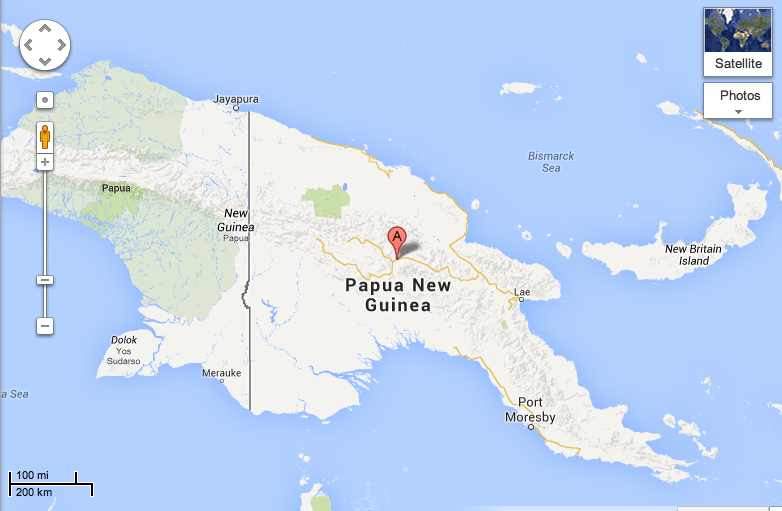
Where is Aipo Rongo, Papua New Guinea?
I had to go to Wikipedia for this one; the Anglican communion is praying today for the diocese of Aipo Rongo, in Papua New Guinea. When I went to Google Maps, it didn’t have any references to it, but Wikipedia was able to help me. Papua New Guinea is divided into four dioceses, and Aipo Rongo is centered in Mount Hagen.
Where is Enugu, Nigeria?
Today the church prays for Enugu, in Nigeria:
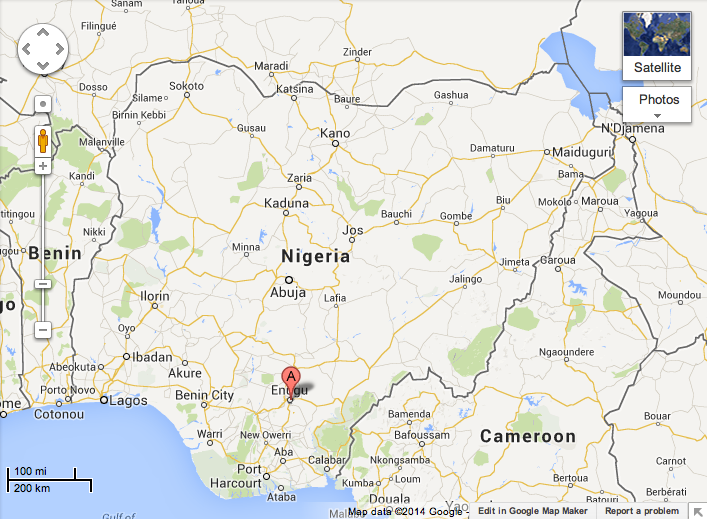
As you pray for the well-being of Enugu, would you also pray for all those places where religion is a cause for strife? Syria, northern Nigeria, the newest country in the world, South Sudan? To me, it is just heartbreaking that those who should be living in peace, working together, are in armed bloody conflict against one another.
Pockets of Silence
On Christmas Eve Day, when I attended church, I prayed for ‘pockets of silence.’ I am an introvert. I love my family and our gatherings, and I also find all that interaction exhausting. When you pray for a need, you often get the answer to your prayer; I shared this with AdventureMan and now I am kidded about needing my pockets of silence. It’s OK, I’ll take the kidding, as long as I get my pockets 🙂
I’ve always loved this scripture; I think of the huge desert storms, full of power and fierce winds, I think of the roar of an earthquake, and how it jars you to the bones, and I smile as I think of the Lord’s voice in the ‘pocket of silence.’
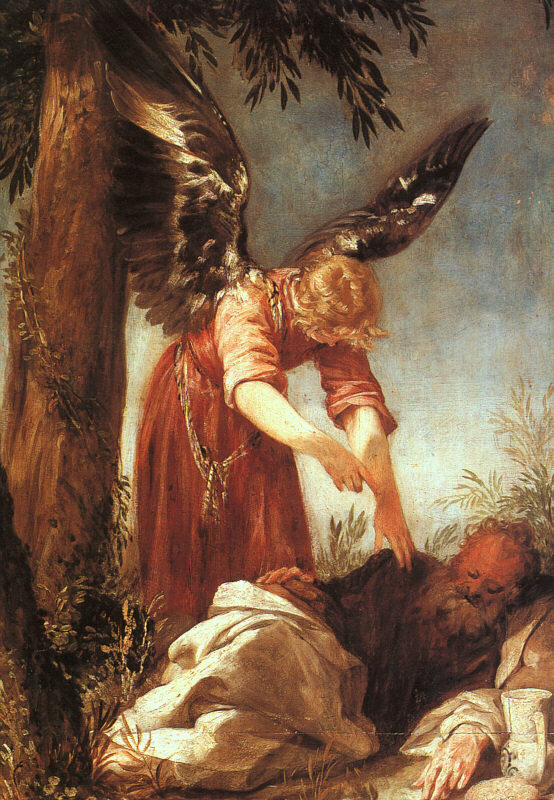
1 Kings 19:9-18
9At that place he came to a cave, and spent the night there.
Then the word of the Lord came to him, saying, ‘What are you doing here, Elijah?’ 10He answered, ‘I have been very zealous for the Lord, the God of hosts; for the Israelites have forsaken your covenant, thrown down your altars, and killed your prophets with the sword. I alone am left, and they are seeking my life, to take it away.’
11 He said, ‘Go out and stand on the mountain before the Lord, for the Lord is about to pass by.’ Now there was a great wind, so strong that it was splitting mountains and breaking rocks in pieces before the Lord, but the Lord was not in the wind; and after the wind an earthquake, but the Lord was not in the earthquake; 12and after the earthquake a fire, but the Lord was not in the fire; and after the fire a sound of sheer silence.
13When Elijah heard it, he wrapped his face in his mantle and went out and stood at the entrance of the cave. Then there came a voice to him that said, ‘What are you doing here, Elijah?’ 14He answered, ‘I have been very zealous for the Lord, the God of hosts; for the Israelites have forsaken your covenant, thrown down your altars, and killed your prophets with the sword. I alone am left, and they are seeking my life, to take it away.’
15Then the Lord said to him, ‘Go, return on your way to the wilderness of Damascus; when you arrive, you shall anoint Hazael as king over Aram. 16Also you shall anoint Jehu son of Nimshi as king over Israel; and you shall anoint Elisha son of Shaphat of Abel-meholah as prophet in your place. 17Whoever escapes from the sword of Hazael, Jehu shall kill; and whoever escapes from the sword of Jehu, Elisha shall kill. 18Yet I will leave seven thousand in Israel, all the knees that have not bowed to Baal, and every mouth that has not kissed him.’
A TCK Wedding (Third Culture Kids)
Several years ago, back in my earlier blogging years, a Kuwaiti friend, Amer al Hilaliya wrote a wonderful post: I Am a Third Culture Kid, Are You? He never anticipated the result – comment after comment, some short, some a little bitter, some longer and insightful. The Third Culture Kids know who they are, and are eager to share their insights and experiences – but mostly with other Third Culture Kids, who understand.
Others . . . don’t get it.
This weekend, we went to a wonderful Third Culture Kids wedding. It wasn’t billed that way, but it was so thoroughly that way that I couldn’t stop seeing it. It doesn’t hurt that we are reading the seminal work on Third Culture Kids by David C. Pollock and Ruth E Van Renken called, yep, you guessed it, Third Culture Kids.

It’s almost like reading a whole new book. It has all the Third Culture Kids stories, but has expanded to include third culture kids cousins, like the adult third culture kids, ATCKs (those who have lived a goodly share of their lives in a non-native culture), cross culture adoptees, cross cultural marriages, etc. One of the points they make is that being third culture kids cuts across a lot of boundaries and makes for odd – odd by normal standards – friendships. Once again, across the boundaries – countries, old, young – friendships are determined by a commonality in experiences outside the native culture. It is a fascinating read.
People don’t think of how LONG Florida is, tip to tip, but from Pensacola to Fort Myers is a fuuur piece, as they say, even if it is on an inside curve. Thank God it wasn’t Key West! We thought it would be an eight hour drive, and it turned into thirteen, with heavy traffic from Lake City to Ft Myer.
The wedding was sweet, simple and heart felt. Both sets of parents had done significant missionary work in foreign countries, and the kids were definitely third culture kids. The groom would speak Turkish in his sotto voce asides to his best man, who grew up with him on the streets of Ankara. The bride’s brother read all the greetings and best wishes to the bride from her friends in Hungary – and he read them all in Hungarian.


Just as the ceremony started, along came a pirate ship! Some things, you just can’t plan, they just happen.
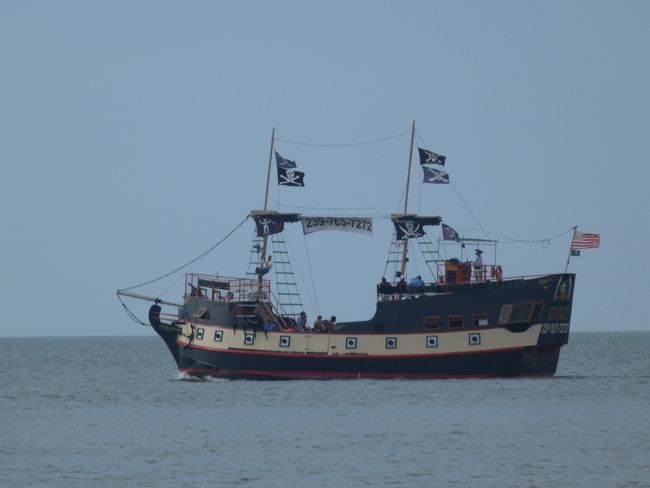
They all told family stories, and one of them stuck in our hearts because it reflects our own experiences growing up in the Moslem world. The groom, as a young man, came home flustered because a woman on the metro, as he was coming home, noticed he was not wearing an undershirt under his T-shirt, and assumed he was a homeless child. She started talking with all the other passengers, and they marched him off the train to the souks, where they insisted on buying him an undershirt (who knew that you were not properly dressed in Turkey unless you were wearing a sleeveless undershirt?) and also a sweater, to keep him warm on the streets. All this, in spite of the fact that this homeless boy spoke excellent Turkish and kept telling them he had a home! No! No undershirt, he has to be homeless.
Few people in America know the kindnesses we experience living in the Moslem world. It may not always make sense to us – in Tunis, we always wondered if we were getting the annual Eid platter of lamb and couscous showed up because we were thought to be poor or because we were strangers? There has always been a sweetness and generosity to our Moslem neighbors that humbled us. Because of the layering upon layering of these kindnesses, we see Islam, and the Middle East, differently from most of our American friends who have never lived among Moslems. Maybe if we all knew one another a little better, we would have less cause to fear one another, and maybe without all that fear, we could manage a little less hatred.
What is a wedding without babies and children to remind us of the Circle of Life (which AdventureMan calls The Circle of Death). This little one speaks English and Turkish already, and loved the sugar white sands of Ft. Myers Beach and the little seashells, just her size.

As more and more people cross borders, for work, for play, for marriage, for education, as we live in ‘alien’ cultures and learn other ways of thinking, maybe we are growing into an entire world with a larger viewpoint?
A King is Given

It is the sweetest, quietest morning in the year; the Qatari Cat awoke me early – well actualy, he awoke me often as the temperatures have dropped dramatically and he wanted my body heat. He is a BIG cat, and takes up a lot of room wherever he stretches out, so I end up sleeping cramped much of the night, LOL. He is such a sweet cat, who can complain?
Yesterday, our church started a new service, a noon service, to help drain off some of the 4:00 and crush of good Episcopalians wanting to start Christmas with a moment of holiness and order before the chaos. Noon was a perfect time for me, and it was a perfect service, full of great readings and music, a goodly crowd, many people I know, and cold enough to wear one of my vintage German coats, coats I considered ‘investments’ when I thought we would be living in Seatte after retirement. If I get to wear them one day each year, they still look new at the end of this century.
A little later in the day, the festivities began, friends arriving from out of town, a family gathering and Christmas Eve dinner where my beloved daughter in law made some of the best crab cakes with Remoulade sauce I have ever eaten, the children were adorable, and the conversation full of laughter and memories. This morning has dawned clear and cold, the Qatari Cat is fed, AdventureMan still snoozing, and I have a few minutes to share a Psalm from today’s lectionary with you. Life is sweet.
Happy, happy Christmas to all!
Psalm 2
1 Why do the nations conspire,
and the peoples plot in vain?
2 The kings of the earth set themselves,
and the rulers take counsel together,
against the Lord and his anointed, saying,
3 ‘Let us burst their bonds asunder,
and cast their cords from us.’
4 He who sits in the heavens laughs;
the Lord has them in derision.
5 Then he will speak to them in his wrath,
and terrify them in his fury, saying,
6 ‘I have set my king on Zion, my holy hill.’
7 I will tell of the decree of the Lord:
He said to me, ‘You are my son;
today I have begotten you.
8 Ask of me, and I will make the nations your heritage,
and the ends of the earth your possession.
9 You shall break them with a rod of iron,
and dash them in pieces like a potter’s vessel.’
10 Now therefore, O kings, be wise;
be warned, O rulers of the earth.
11 Serve the Lord with fear,
with trembling 12kiss his feet,*
or he will be angry, and you will perish in the way;
for his wrath is quickly kindled.
Happy are all who take refuge in him.
Doubt and Faith
I have fellow students who consider doubt “double-mindedness” and yet today, we have the Feast Day of Saint Thomas, the Apostle who doubted that Jesus had risen until he could touch his wound. His reaction – “My Lord and My God!” is the reaction of a searcher.
Doubt doesn’t imply lack of belief; doubt is hope that looks for evidence. A doubter is a person who is seeking; my greater concern is those who treat their beliefs with complacency – lacking self-examination – or the worst, indifference.
Jesus chose those who will follow him specifically. He chose St. Thomas for a reason, knowing how deeply skepticism runs in our hearts, and knowing there is no belief so deep as that of one who has sought and found.
SATURDAY, December 21 Saint Thomas the Apostle Ember Day
John 20:28. Thomas answered him, “My Lord and my God!”
Today the church remembers Saint Thomas, often called Doubting Thomas. It seems to me he has gotten a bad reputation for doing something that I actually admire. Thomas had questions—and he dared to ask them. If I were creating his nickname, I’d call him “Good Question Thomas.” Doubt is the companion of faith, and it’s time for doubt to come out from under the carpet.
You see, I think every thoughtful Christian has moments of wondering about faith or God’s place in our lives. Alas, we too often keep quiet about our uncertainties, suffering with them alone. But there is great value to sharing our questions and our struggles. When that happens, a community can share them together and inspire one another. Every time I have shared a doubt or question with another, it has been a blessing.
When we raise our questions with sincerity, we are opening ourselves for God to enter our minds. Like Thomas, we might move past doubt to a place of confident faith. “My Lord and my God!”
Today the church prays for the diocese of Yirol, in the South Sudan:

Where is the Diocese of Yei, Central Equatoria, Sudán do Sur – South Sudan?
We don’t always see the timeliness of our prayers, but as we pray for Yei, in the South Sudan, we pray with increased vigor, as the country faces unrest and internal turbulence.

We pray for our friend David, and all the people of South Sudan who have suffered so much for so long. The Lord has blessed them with oil, let them use their resources wisely, for the greater good, and may they enjoy the wealth of their nation in peace with one another.
David, and Where is Yambio, South Sudan?
A year ago, we had an extraordinary experience. We often entertain delegates visiting from other countries, and this time we had three African journalists, and, strictly by chance, they all turned out to be Christian. Most of our gatherings are strictly ecumenical, but these were joyful, praying Christians, and the evening took a turn we never anticipated.
“So how did you find Jesus?” one woman asked David, from the newest country in the world, South Sudan. Inside, I was shocked, and when I am shocked, my tendency is to laugh, I don’t know why, it is just the way I am wired. Every culture is so different. In the South, people might ask that of one another, particularly if you worship in a fundamental sect, but our sect is more formal, and to inquire into another’s spiritual life can be perceived as intrusive.
David, however, was not taken aback. “It’s a long story,” he said, and we all settled into comfortable chairs to listen better. It was Christmas, the decorations were up, the lights all twinkling and we had eaten. A good time for a story.
It was a long story. It started with a little boy in a happy family, who one day was told to run! Run! Run into the forest and hide! The riders were coming! His family grabbed a very few things and ran.
His family ran for years. His family ran into forests, across borders, into dry arid spaces. Sometimes some of the children would get separated from their parents for a while, but they would keep asking, and eventually meet up again, only to face separation again. Their whole lives were running, from the Janjaween, from border police, from robbers.
At one point, he and a brother stayed in a church, and a priest taught them about Jesus. Simple stories, simple songs, and he drew letters and numbers in the dirt – that was his early schooling. It was a haven of peace for him.
Many years later, the family was reunited in their village in the new country of South Sudan. Miraculously, every member of his family survived, indeed, most of his village survived. They had maintained lines of communication through all those years of running and separation, and were so thankful. Most of all, now, they were thankful – they had a church in their village. David had learned to love learning, and had completed his education and had found a wonderful job.
“I don’t know the book like you do,” he told us, “I only know it like a little child sitting at the feet of that priest, but I am learning.”
I can’t help but think that David knows more than he thinks. David holds his belief in Jesus like a child, simple and direct. His testimony is powerful and unforgettable. I am in awe, even a year later, of his story and testimony.
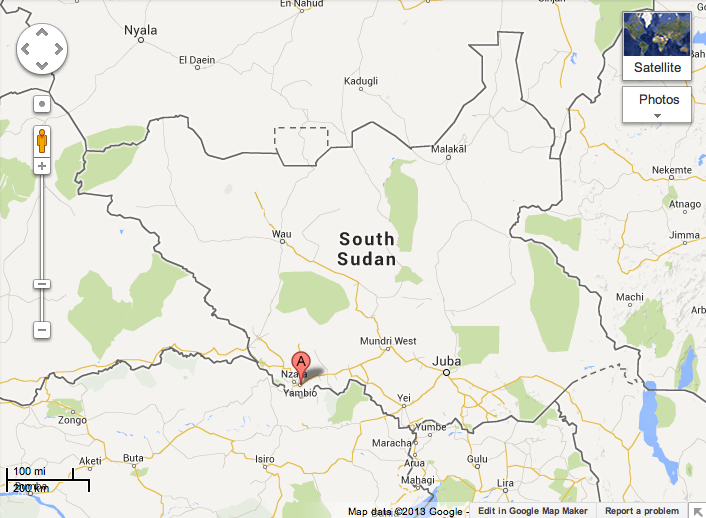
Today the church prays for the diocese of Yambio, in the South Sudan:
Recent Comments
intlxpatr on Shampoo Ginger tigerbutterya0c5ff1d… on Shampoo Ginger intlxpatr on British Soldier Kidnapped, Esc… John on British Soldier Kidnapped, Esc… intlxpatr on British Soldier Kidnapped, Esc… Wikipedia Donate Button

Amazina


Early Voting in Florida


