Wake of the Vikings: Reykjavik and Thingvellir in Iceland
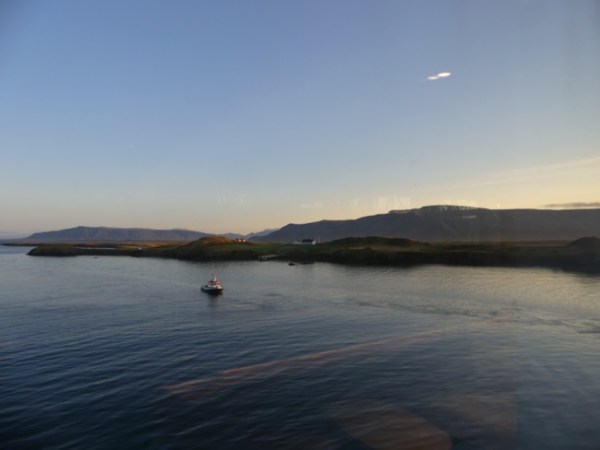
We can’t believe our good luck, after the clouds and rain in Oslo, Bergen and being shut out of Lerwick, here we are in Iceland, and the weather is PERFECT. Perfect, that is, if you are an Alaska girl who loves to chill 😉 as AdventureMan debates whether or not he needs to wear his long underwear to keep warm.
The cruise director, Aaron Syfert, has told all of us, his cruise-children, to dress “like onions,” in layers, so that we can dress down if possible, and be warm enough when it is really cold. As we enter the bus, we have three or four layers; within minutes, there is a loud outcry from those aboard “Please turn down the heat!” In our full-up onion garb, it is really hot. The driver laughs and said he had wanted us to be warm enough, and turns down the heat until everyone is happy.
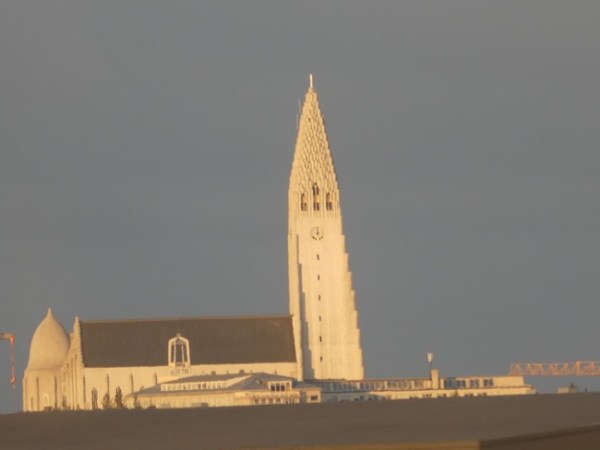
We drive through part of Reykjavik en route to our first stop, and the place I have wanted to see the most, Thingviller.
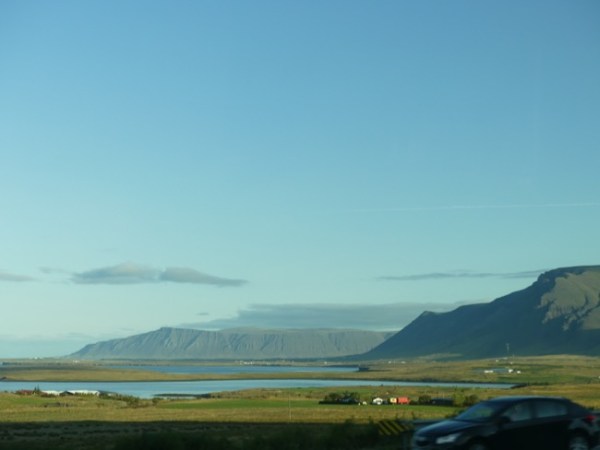
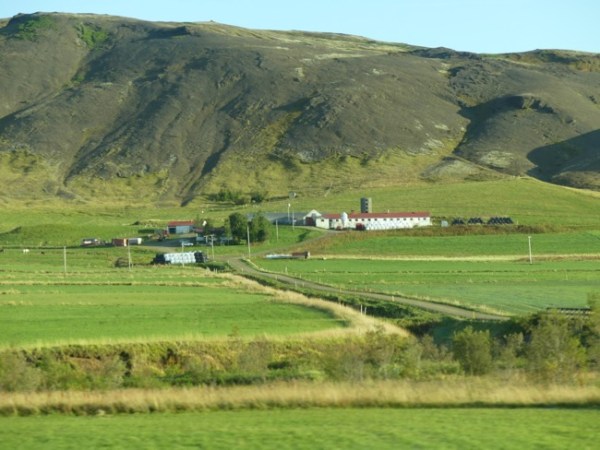

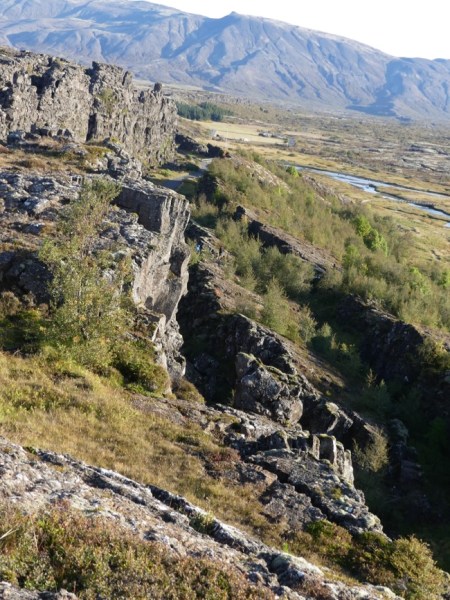
I have a thing about sacred spots, that it seems to me that there are some places in the world where the interface between this world and . . . the next? . . . the former? . . . .the alternate? . . . the interface is thin and perhaps not open, but permeable. Thingviller is a very very old place, a place where all those spread out in rural Iceland would gather to made decisions for the community. It was one of the most ancient forms of democracy, or democracy of a sort, of course it was mostly chieftains making the decisions, advised by their counsel, and while those decision makers were probably mostly men, they made decisions by consensus, and vote, for the greater good of the community.


Some of the decisions they reached would chill you. You will see a waterfall, below, by which there is a pond where violates of the law were drowned. Our guide tells us that most of them were women who had children out of wedlock. “What happened to the men?” one guest asked. “They were beheaded, if they could be found, if they could be identified,” she replied. She added that most of the time, the women went to their death without identifying the man who had impregnated her.
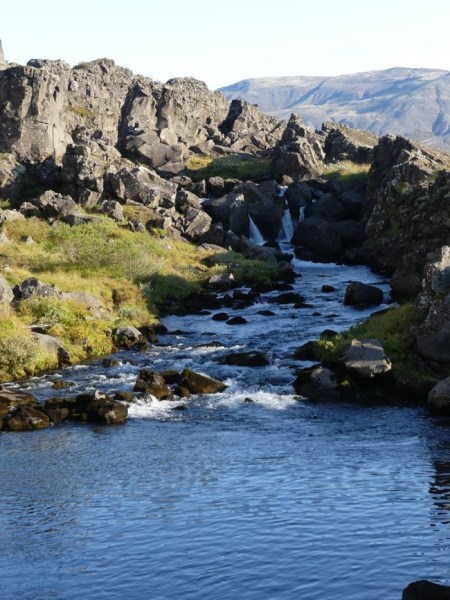
Geologically, Thingviller is fascinating. Thingviller is a huge rift between two tectonic plates, the North American Plate and the Euro/Asian Plate. I had known of “The Thing” the Viking Thing, about the decision making places, but it wasn’t until Digg, or one of the other news sourcing articles I get told me in some spectacular photos from around the world, that I knew about the rift. There were photos underwater, photos of daring young divers with one hand and foot on the North American Plate and the other on the EuroAsian Plate, truly spectacular. I wanted to visit the decision making place, and I wanted to visit the rift.
Last – and not least – Thingviller is one of the locations where Game of Thrones is shot, many of the scenes north of The Wall and of The Wall are shot here. It gives us a thrill, first Spain and the Alcazar and Alhambra, then Dubrovnik, and now Iceland, we are on a roll.
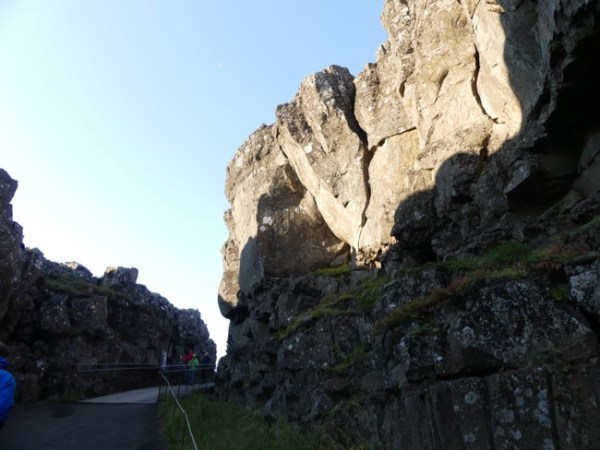


We had a great day, a truly great day, and the weather held. For me, Thingviller was worth the trip to Iceland.
Wake of the Vikings: Vikings in the Faroe Islands
We can’t say enough good things about the Viking business model, and we are critical travelers. We headed out on a tour this morning, we who are not good at touring in groups, and had to give our admiration to the facility with which Viking gets large numbers of people on the ground and going out and learning something. When you book a cruise, there are always “included” tours, included means you don’t pay extra. The included tours are usually overviews, often panoramic, i.e. you get in a bus and drive and stop now and then for a photo. Everyone who wants a tour gets a tour.
Having lived overseas most of our married life, we know that it is so much easier to stay comfortable than to go out and see something and learn something. About 10% of people will make it happen for themselves, another 80% will go if it is made easy enough, and 10% will never go. In the Embassies, that 10% will hang out at the American Club or the Marine Bar, and if military, shop almost exclusively at the PX (BX, Navy Exchange) and commissary.
Viking makes it easy. The night before we reach a port, there is a Port Talk, where the local currency is explained, a few good phrases (usually like “good morning” and “thank you”) taught, and photos and videos (all very full of sunshine) are shown to give you an idea what to expect. The daily newsletter always tells you how to say “Please take me back to my ship” in the appropriate language. Buses show up on time. There are enough guides for all the passengers. The guides have the patience of Job.
Our guide for Vistas, Vikings, and Village Woodturner was very very good. I don’t really know that I learned a lot about Vikings. Really, Vikings raided a little, intermarried a little, and are just a part of the history of the Faroes, the way Angles and Picts and the Norse are a part of the English. We had a very good guide, a funny man who often broke into song, and who has probably attended to more tourists than is good for him.
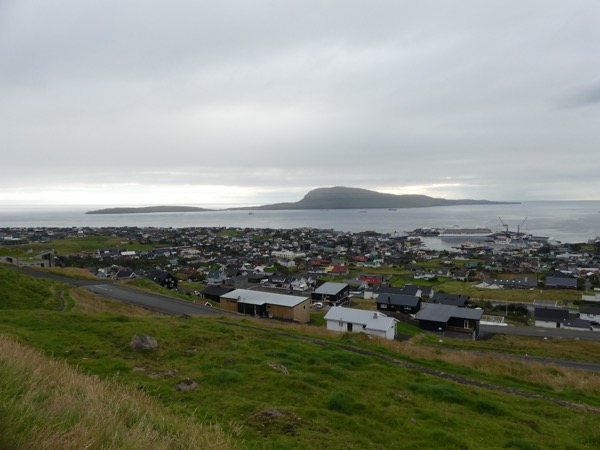
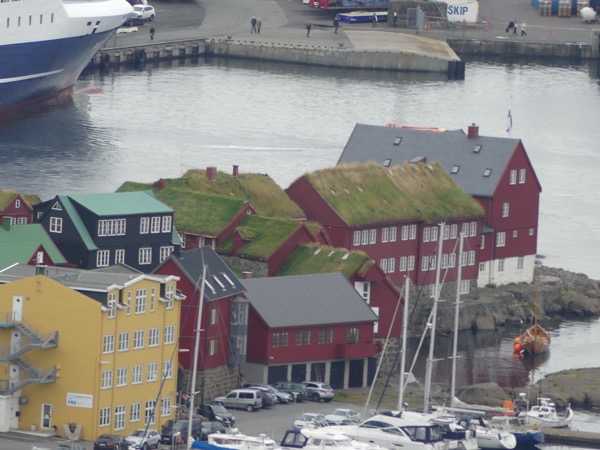


There were sheep everywhere, including sleeping alongside the road. Drivers are all very careful, because if you hurt a sheep, you pay the owner like $500. for his loss. The sheep were every color from white to brown, and black, and spotted white and brown and black. If I lived in the Faeroe Islands I would learn to sheer and card sheep wool, and spend evenings spinning the raw wool into threads for weaving into cloth and yarns. I’ve always wanted to learn to spin. LOL, too late to be a spinster 😉


What do I think is a good guide? This man told us a lot about life on the Faroes, about choices people make. Do they want to be a part of Denmark or not? It would require an election, and people can figure about half want one thing and half want another, and no matter who won, it would be narrow and cause turmoil, so why spend all that money on an election, just leave things as they are.
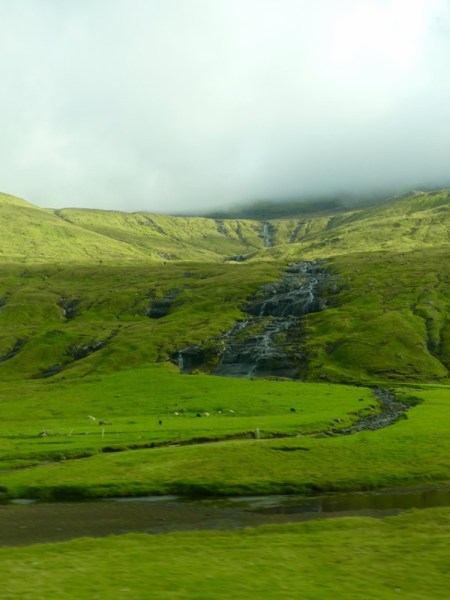
We head to the village of Kvivik to see the Viking longboat remains, or where they once were, and then to Leynar to visit the Village Woodman.

Below are stone built salmon jumps, old technology, but with devices which keep count of each salmon who climbed the steps, new technology. Can you see how green and lovely everything is, evan as fall approaches?

Drama Drama Drama! Who could be bored when the weather changes every minute with such verve and gusto?

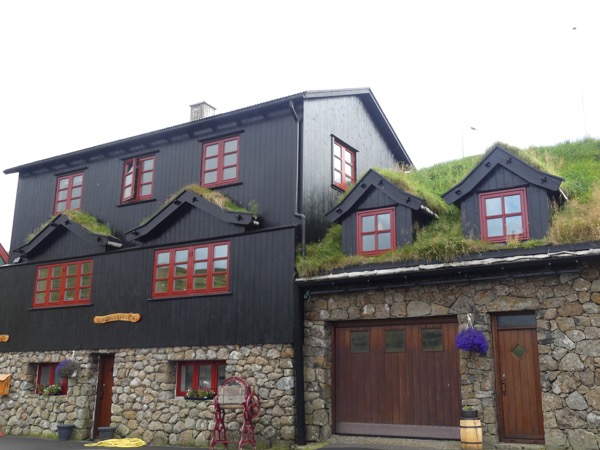
We are always interested in how people choose to live. Our guide explains that houses often contain three generations, the grandmother, the mother, and the daughter. Isn’t that an interesting way to describe it? We tend to think in male-ownership terms, but these houses are communal based on matrilineal lines.
I wonder where daughters-in-law fit in?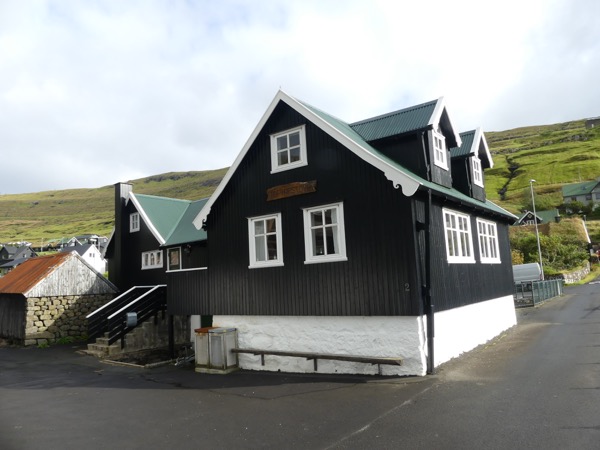


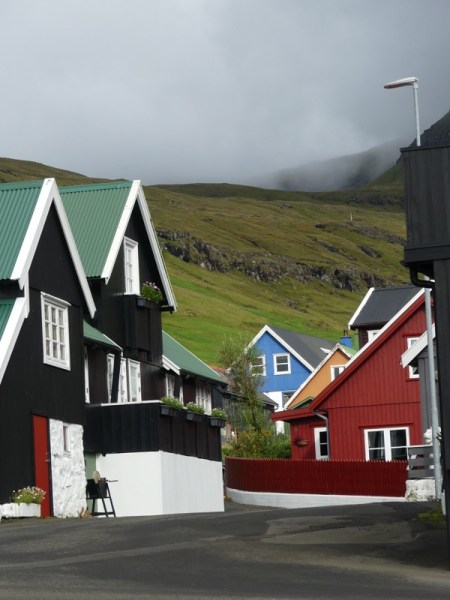
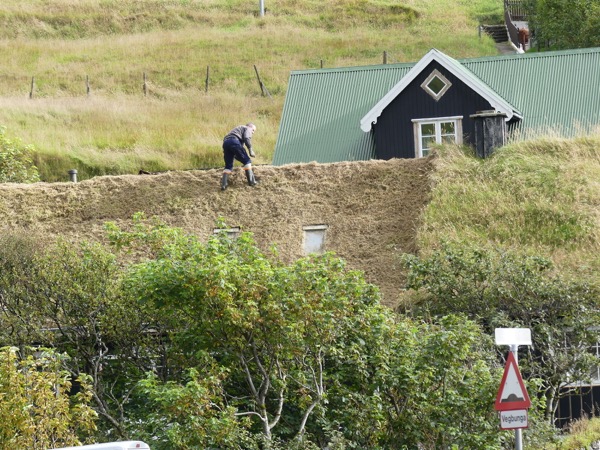
Look closely here, a man is up on his turf roof, trimming things down for the winter.
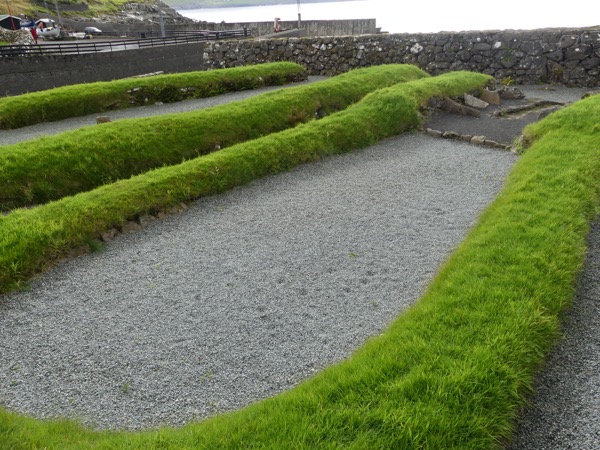
Viking longboat site
They teach their children three important rules. 1. Be kind. 2. Be kind. 3. When one and two fail, be kind.
He told us how houses are built, and how people help one another get their houses built. They are taught “better that many are not poor than that a few are rich.” We did not see a single dump any where in our journey took us; everything was clean and well-kept. People are fined heavily for dropping trash. There are only two policemen in the Faroes, and there is no prison, there is so little crime. “Where would you run? Where would you hide?” he asks. “Everyone would know you, so you don’t do it.”
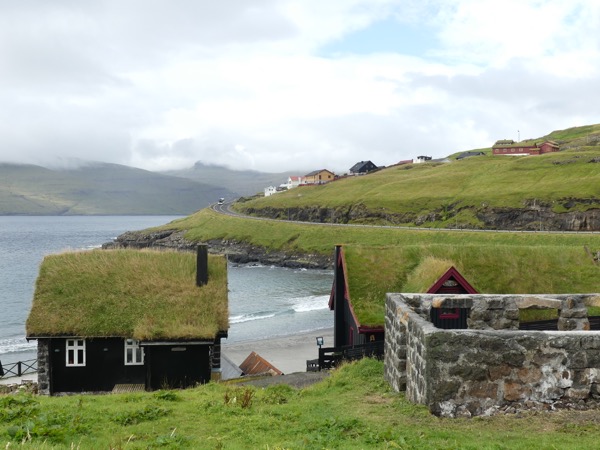
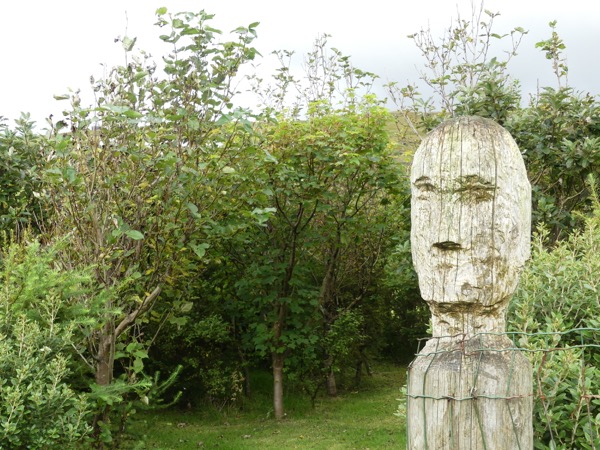
He told us that many of the families of the Faroes were started by Norsemen who found local girls and were afraid to go home and face their wives, who were waiting for them with big sticks. He made us laugh, and laughter always helps us understand.
He took us into a beautiful little church, beautiful finished wood on the inside (see below) and he sang to us a familiar hymn, in Faraoese, Nearer My God to Thee. It was so sweet, and so beautiful, my eyes teared. He told us he waited 30 years to get married, and was the first one to wed once the Danish stopped insisting on state churches. (The church is now Lutheran.)

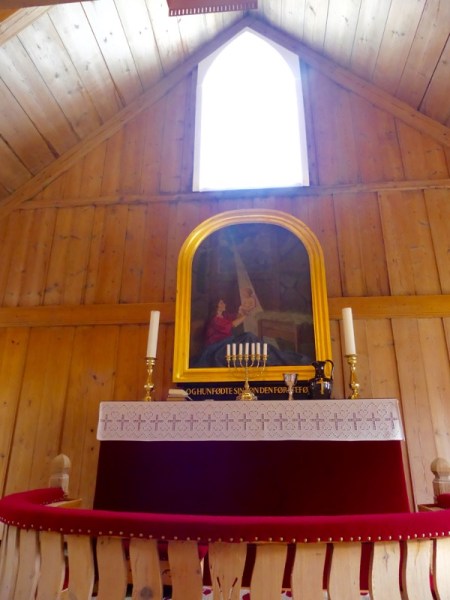
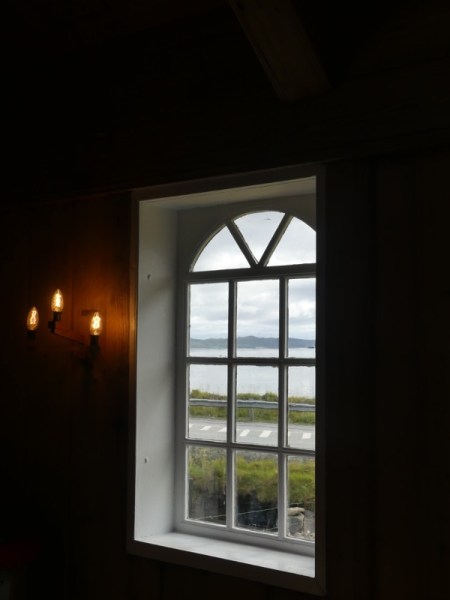
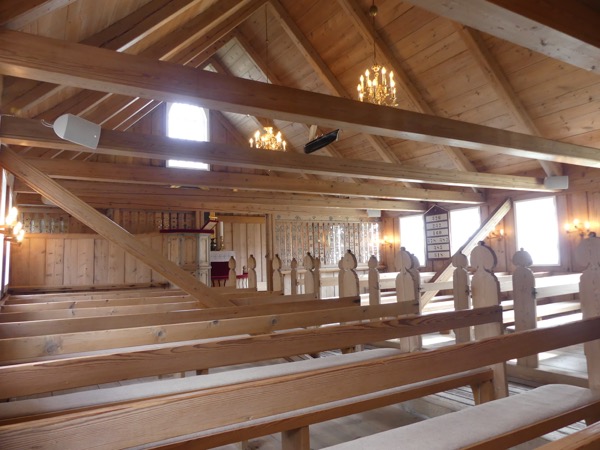

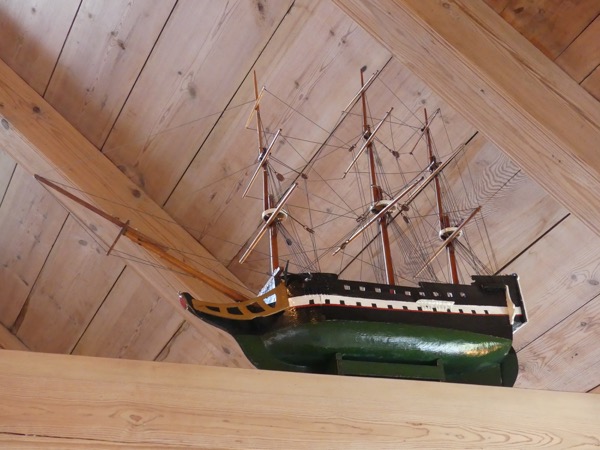
The Faero Islands reminds me of where I grew up, in Alaska, where neighbors held that same kind of concern for one another and for the communal life. We lived on an island full of Scandinavian immigrant families, along with the native Haida, Aleut, Tlingket, and occasional Inuit. It never mattered that we differed, when someone needed help, we helped. A neighbor didn’t go hungry, their children didn’t go unclothed. I remember the delight when our neighbor passed along her daughter’s lightly used clothing they had outgrown, and we could wear it. I remember one skirt in particular, a grey and yellow plaid Pendleton skirt which I wore for years, and maybe fifteen years later my old neighbor saw me wear it and said “I used to have a skirt just like that!” and I laughed and said “This is your skirt!” When you have a Pendleton skirt, you can wear it for the rest of your life; they wear so well. We were frugal people, and we never wanted for anything. We shared what we had.
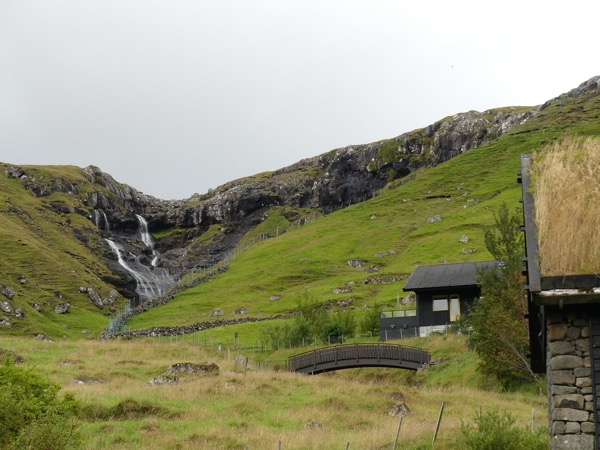
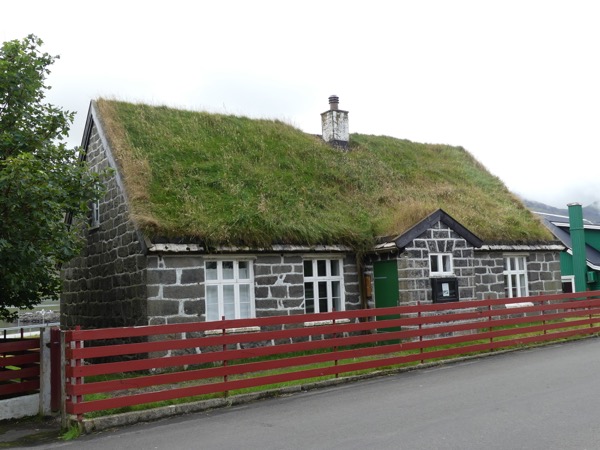
I got the impression that actually the guide doesn’t much like Americans. It didn’t matter, he was kind, he was professional, and I believe he gave a great value for the money. He shared the truth of his culture as he lives it and was fair to us. That’s good enough.
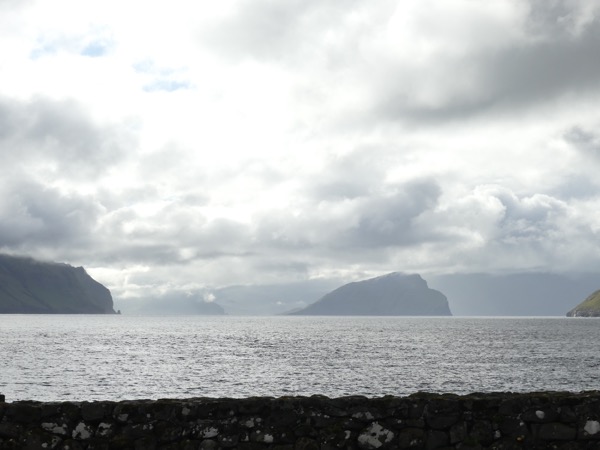
I can’t give you a lot of information about the photos, only that I took what I thought would give you an idea of what life on the Faroe Islands might look like. For me, this was a great day, very little rain, even some sunshine, and I learned about a culture I really like. I like that they teach their children: Be Kind. Be Kind. Be Kind.
Wake of the Vikings: The Fantoft Stave Church
People are irrational, or anyway I know I am irrational. I think I am logical and make decisions using my mind, but I know that I often make decisions based on an emotional tug, and I rationalize my decision to make it seem logical. Such is the Fantoft Stave Church just outside of Bergen.
I really wanted to see this church. I found a way to take a bus there, but it was a long way out and it was a Sunday and I wasn’t sure about buses running on Sunday. I signed us up for a tour.
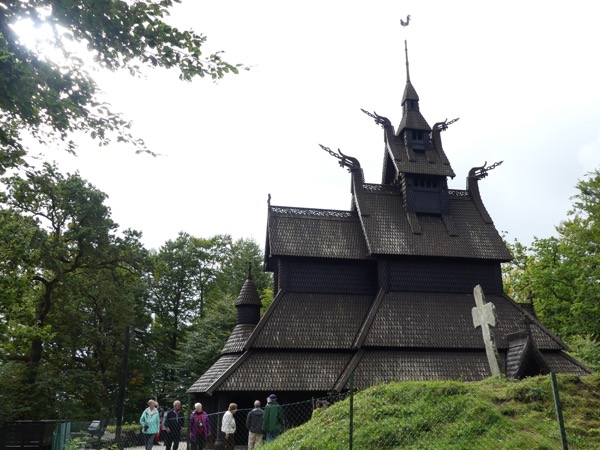
I really like churches.
I really like being alone in a church, or being with other church-y people, people who respect churches as a place where people do their best to communicate with a God they can’t figure out.
This was not that kind of visit.
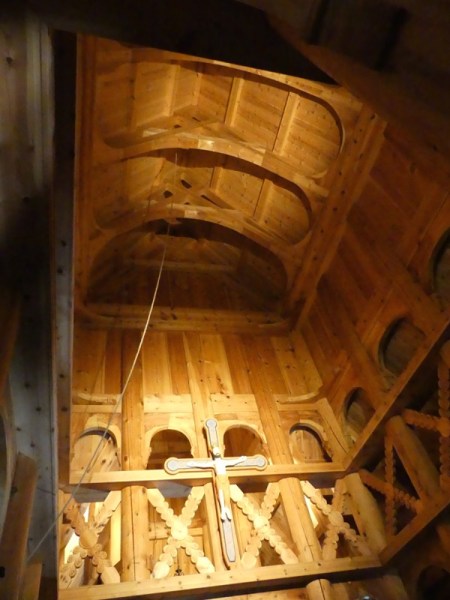
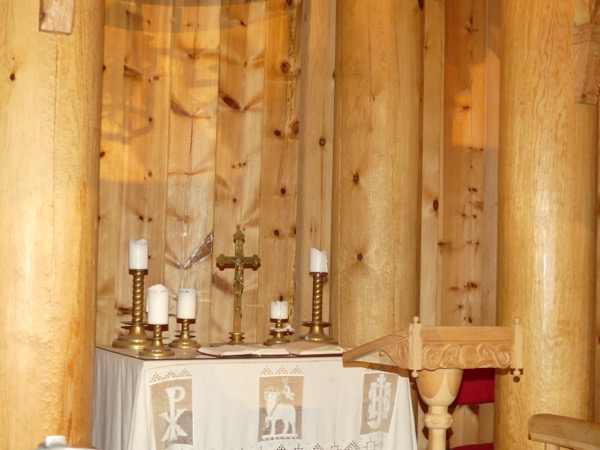
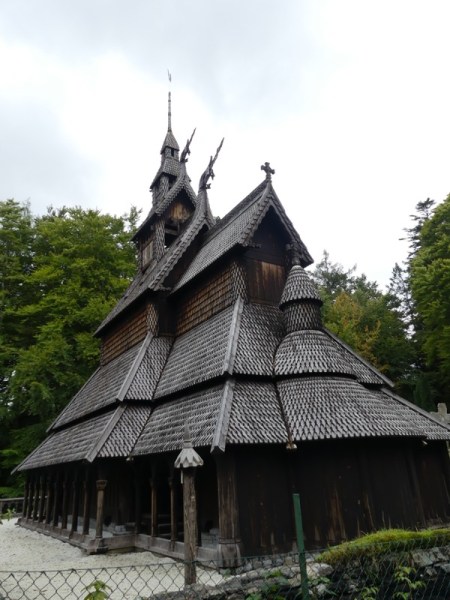
One group out, another group in. I never had a moment alone in this lovely church, built entirely of pegged wood. Imagine, putting an entire church together without a nail. Pretty amazing. The church is beautiful and unique. I just wish I had had time there to get to know it better.


The roof is stunning. They used the same technology they used to build Viking boats.
The tour was also listed as “moderate” walking, but several people were on the tour who had wheelchairs or walkers. The second part of the tour, visiting Grieg’s house, museum, studio, grave site, etc required hiking up and down rock paths and leaf strewn paths in wet, rainy conditions. There were places I just didn’t go; I didn’t want to take a chance on a slip-and-fall that could hold me up the rest of the trip. I did fine, but I felt really sorry for those who had signed on thinking it was ‘moderate’ walking and it was really some fairly dangerous turn for those with mobility impairments.
Back on the ship, we went straight to the safety muster, where we gather to be shown how to put on a life-jacket and to go to our life boat, when and if needed.
Best part of the day was Sunday church services held in the Torshavn Bar. It’s a light interdenominational service with inspirational readings, but it soothes my grumpy soul and sets me right for the week to come.
St. Herman of Alaska
Today, the Lectionary tells me, is the Saint’s Day for Herman of Alaska, and here is the prayer they give:
Holy God, we bless your Name for Herman, joyful North Star of Christ’s Church, who brought the Good News of Christ’s love to your people in Alaska; and we pray that, following his example and admonition, we may love you, God, above all; through Jesus Christ, who with you and the Holy Spirit lives and reigns, throughout all ages. Amen.
I love that these ikons show Saint Herman in a cold and snowy land, not too far from where I grew up. No, I am not Orthodox, nor Catholic, and I can appreciate the spirit and sacrifice it took to leave his homeland to come serve, and eventually die, far away from home.

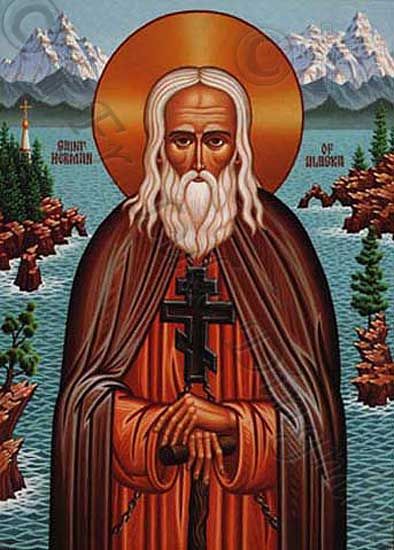
Herman of Alaska (born 1756 or 1760 in Serpukhov, Russia – died December 13 or November 15, 1837 on Spruce Island, Alaska) was one of the first Eastern Orthodox missionaries to the New World, and is considered by Orthodox Christians to be the patron saint of the Americas.
Herman was born in the town of Serpukhov near Moscow around 1756. Herman is his name in monasticism; his birth name is unknown. At 16, he entered the Russian Orthodox monastic life at the Trinity-St. Sergius Hermitage near St. Petersburg. Eventually he was tonsured a monk, though he was never ordained to the priesthood. A request was made for a mission into the Alaskan territory. Herman was selected to go, along with seven other monks.
Herman and the other monks arrived on Kodiak Island on September 24, 1794. The monks converted the native Aleuts, and as time progressed they found themselves protecting the natives from exploitation and abuse. Because of this moral stance the monks themselves were abused, arrested and physically threatened. In time, enduring hardship, inclement weather, illness and more, Herman stood as the only remainder from the original band of missionaries, the others either being martyred for their faith, dying of natural causes or returning to Russia.
Herman eventually built a hermitage on Spruce Island, about a mile and a quarter from Kodiak Island. A small chapel was built as well, along with a school and guest house. The local people would visit him often. He devoted his life to prayer and to performing those services he could do as a simple monk who had not been ordained to the priesthood.
He died on November 15, 1837, but was not buried on Spruce Island until December 13 because a priest could not come to serve the funeral, and was forgotten until the first investigation of his life in 1867 by Bishop Peter of Alaska. He was named a saint by the Orthodox Church in America on 9 August 1970.
Santa Fe, Here We Come
We spent one night in Santa Fe two years ago, and knew we had to come back. We put a three day stay at the end of our parks visit to give ourselves some play time, we really love Santa Fe.

This was not a bad day, but I will not tell you it was another best day of the trip. Some days, you just have to drive to get where you are going. This was mostly that kind of day.
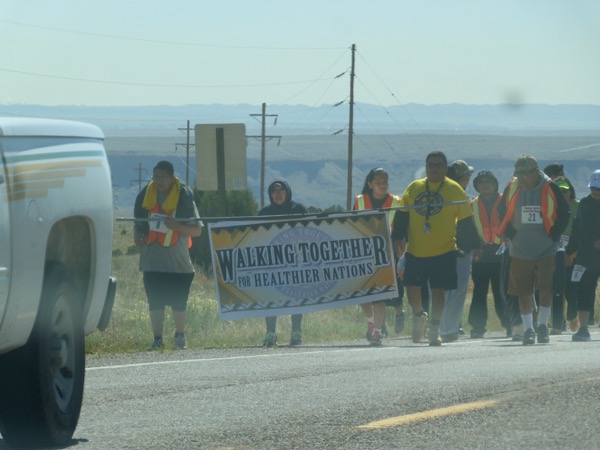
We came south back to Kayenta, turned left, and stayed on the same highway until Farmington, where we had lunch at the crossroad where we turned south. On the way, we saw flashing lights ahead, and were afraid it was an accident but it was a marching group. We didn’t know why they were marching. Then about ten miles later, we saw a similar group marching towards us. We gave them a big thumbs up; YAY! Marching for a healthier lifestyle! They all looked about our age 🙂

We were about to turn south when we saw this sign: Serious Texas Bar-B-Q. Who could resist that sign? Not us!
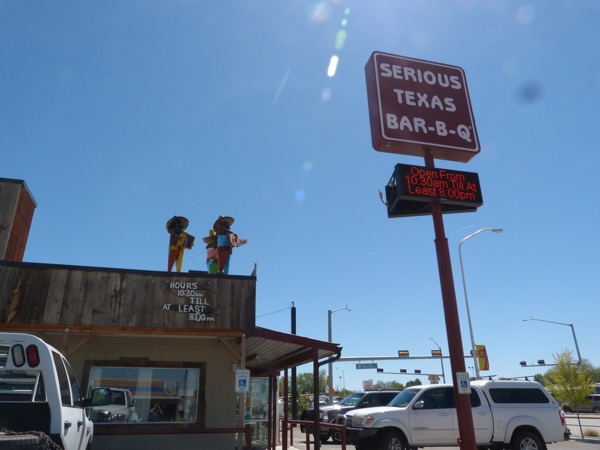

We each ordered a sandwich. When they came, we discovered that SERIOUS meant huge. We couldn’t begin to eat the whole sandwiches, we had to leave about half behind. The restaurant was full of big burly cowboy types who seemed to have no trouble packing away that kind of serious sandwich.
All the following photos seem to be about food, but we did other things, too!
Checking in at the Hotel Santa Fe and Hacienda, AdventureMan reminded me we had one of the best meals of our lives at their Amaya restaurant. We reserved for that night, and AdventureMan had their duck, and I had the salmon.
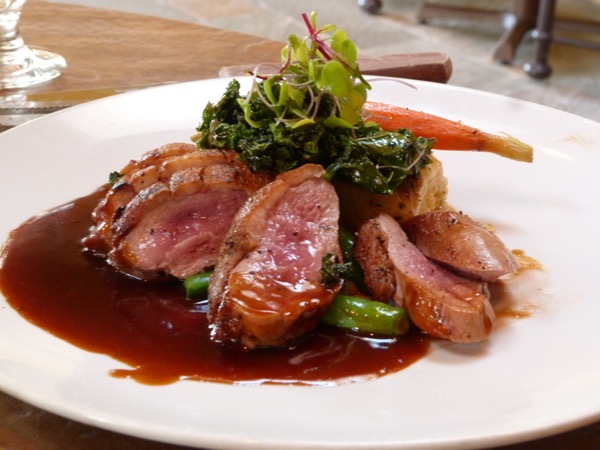
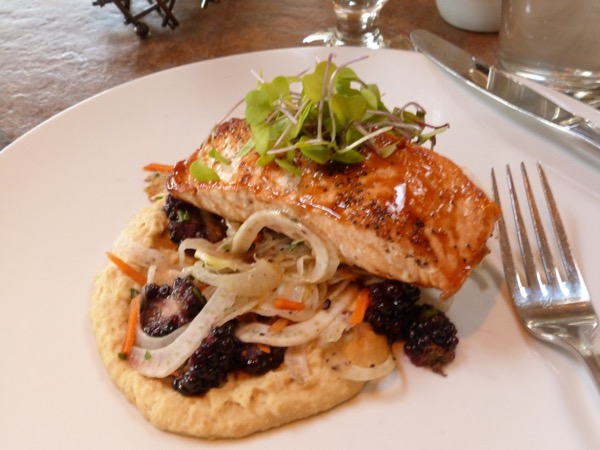
As we were eating, we overheard another table talking about the Farmer’s Market the next day. We love Farmer’s Markets! We asked the waitress if she knew where it might be, and she didn’t know, but very soon, another waiter came over and told us how to get there – it was right across the street. After dinner, we took a walk, found where the market would be, and came back to the hotel, had coffee and dessert while we listened to the hotel musician, who plays Spanish guitar and Indian flute, then headed upstairs for some much needed sleep.
Although we were near the elevators, the rooms are so quiet, we never heard another guest. I love that the hotel has coffee service for guests on each floor; early the next morning while AdventueMan slept, I could creep out and fill my cup without him even missing me.
He was awake soon, and we headed for the Farmer’s Market, only to learn that there was also a Crafts and Artists Market in a separate row. Oh, what heaven! I found some wonderful gifts and AdventureMan and I found wonderful quiche and croissants at the Farmer’s Market, which also has baked goods and crafted goods, plants, all kinds of things. We loved the Santa Fe market.


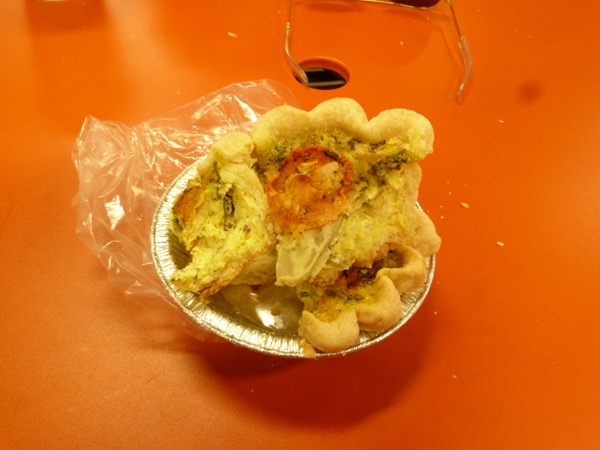
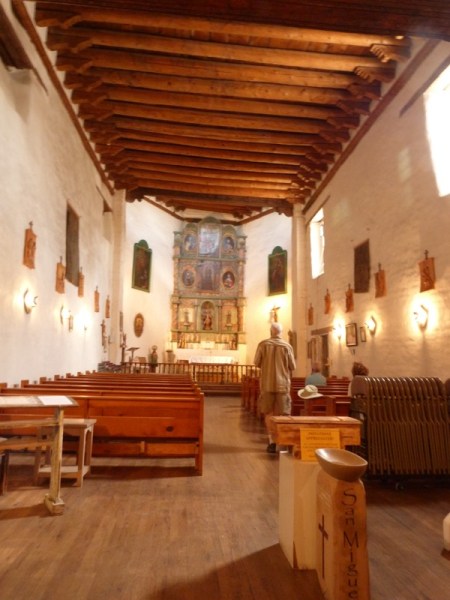
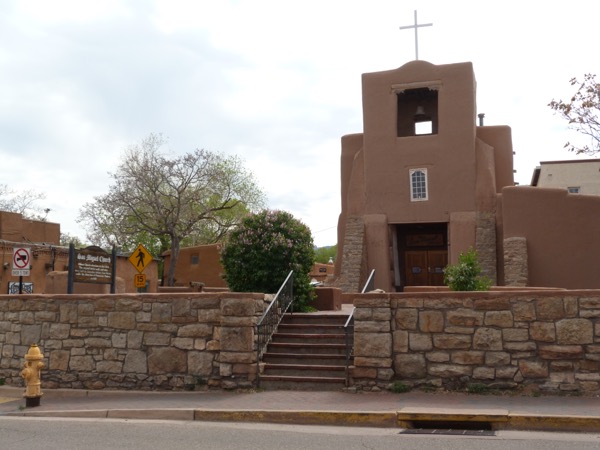
I asked one of the vendors I was buying from where he and his wife eat when they come to Santa Fe, and without hesitation he said “The Pantry” so we put it on our list of places to take a look at. Meanwhile, we headed out Canyon Road, which we loved, with all the art shops and cute restaurants, then went to explore San Miguel’s, billing itself as the oldest church in the United States, with an altar that dates from the days of the Spanish exploration.



AdventureMan had heard of Jambo, an African fusion restaurant he thought we should try. It was wonderful. We ordered too much. We ordered a hummus appetizer, salads and a peanut chicken stew to share. The hummus was huge, and beautiful, with hummus, and also lots of veggies and olives, and pita bread, and then the salads came, huge and delicious . . . when the stew came with the rice, it was also delicious, but we were so full! We ate a few bites, then packed it up to take it back to the hotel for dinner. We love that our room has a fridge and a microwave, and we have plates and utensils and napkins, so we will feast again tonight in the glory of our own little suite.
xxx

(Forgot to take a photo of the peanut chicken stew, which when we first had it many many years ago was called Ground Nut Stew. This was a little different, but equally delicious.)
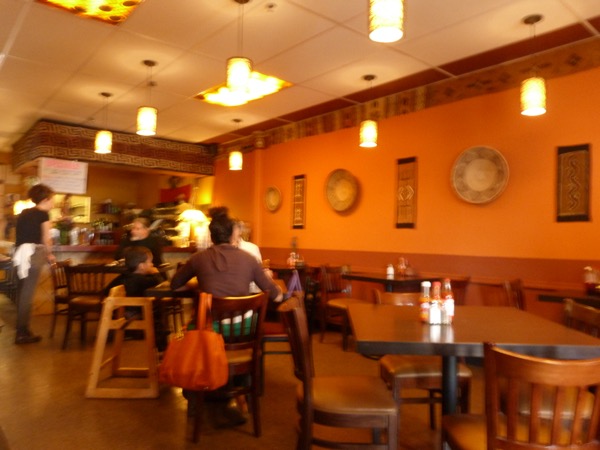
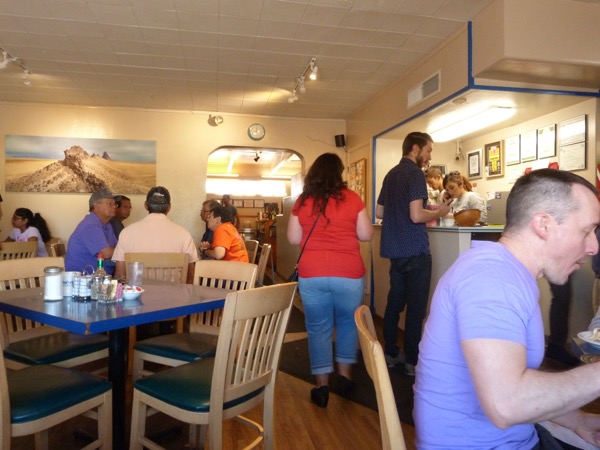
We were lazy on Sunday and didn’t get up until seven thirty or so, to get to the Pantry while there still might be tables left on a lazy Sunday morning. Oops, my bad, Santa Fe must get up early, all the tables are taken and there is a line to get in. The waitress says it will only be ten minutes or so, we decide to wait. In almost no time, we are in, and have a great table.
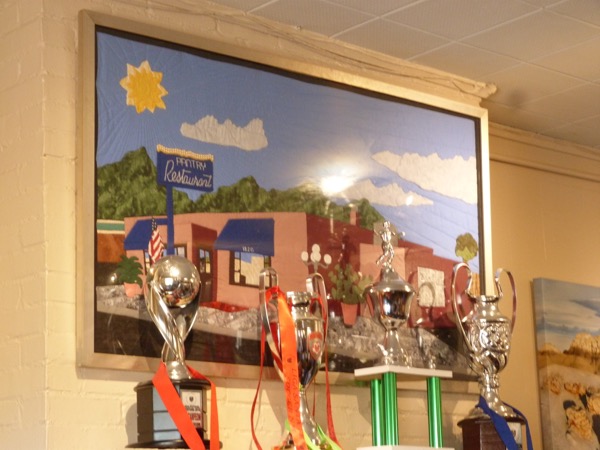
This looks like a picture, but it is actually a quilt someone did of the Pantry.
AdventureMan ordered biscuits and gravy – and beans!


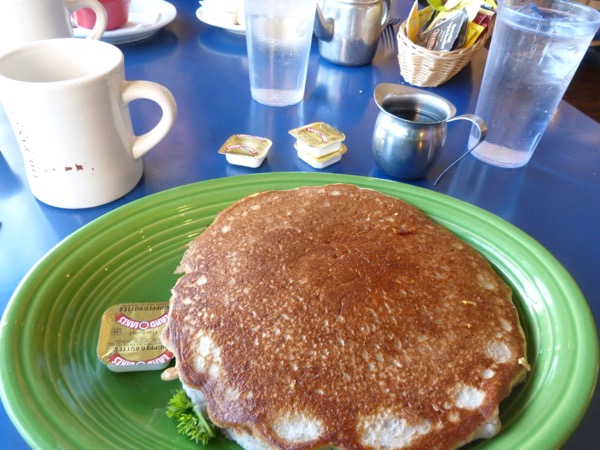
I ordered blue-corn pancakes. Sigh. They were good, but they tasted like . . . pancakes!
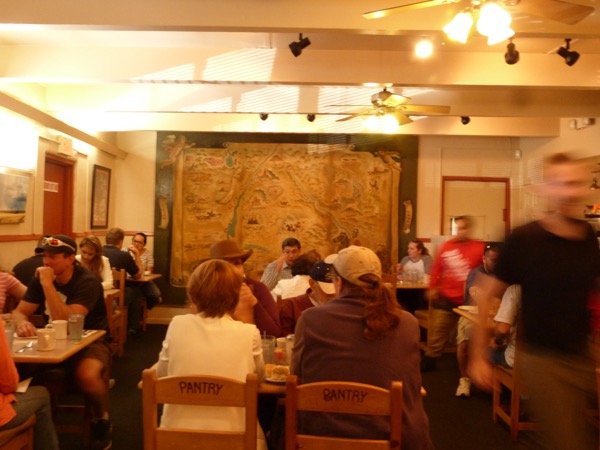
At a nearby table was a friendly man who told us we might want to try Maria’s for dinner, that it was another good place where people from Santa Fe eat. He also told us he was a musician and an Elvis impersonator. Almost everyone we met in Santa Fe was very welcoming and glad to give out information. It was a lot of fun, being in that kind of atmosphere.
We visited the Georgia O’Keefe museum, walk around a little, but AdventureMan’s banged up leg make it hard for him to walk easily. That’s OK, we are in Santa Fe to kick back and rest up, so we spend the afternoon reading and snoozing. Later in the day, we hit Maria’s. Most of the people coming in were heading to the bar, evidently Maria’s has like 99 different kinds of Margaritas. We just wanted dinner – and our server was efficient, and sort of brusque. The restaurant wasn’t that busy, but getting busier. Maybe he had though he would get a break between lunch and dinner, and was just tired. He did the job. He did not make us feel welcome.
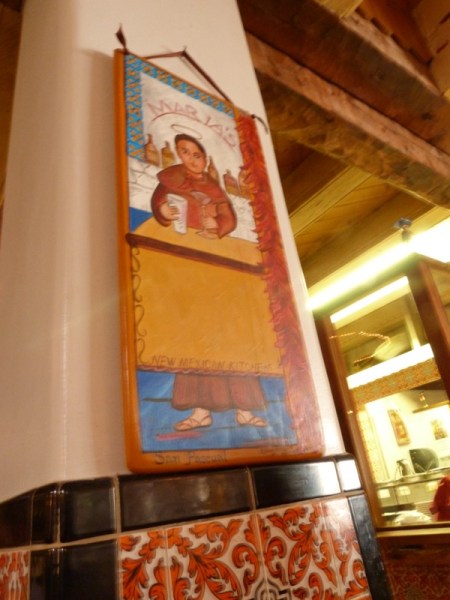
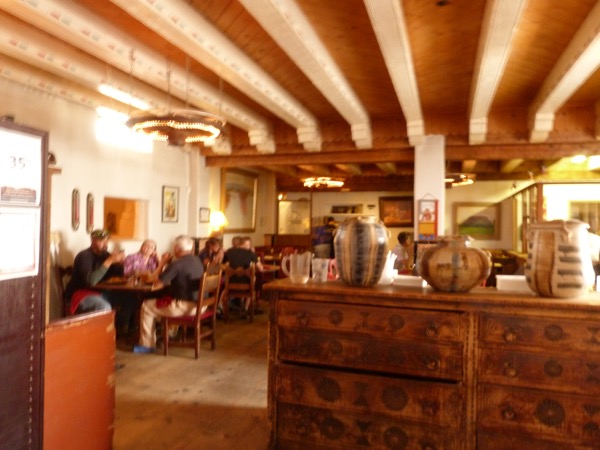
As much as we like Santa Fe, we are ready to start heading home. First step: get to Denver, where we will be staying with my sister and her husband, mother and father to Little Diamond, grandparents to the little little diamonds. From Maria’s, we head back to the hotel and organize our suitcases, take out the big ones and just keep the small overnighters. Sorting through now helps us plan for our time in Denver and for the trip back to Pensacola.
Moab to Tropic, Bryce Canyon And a Wonder-Filled Detour through Capitol Reefs
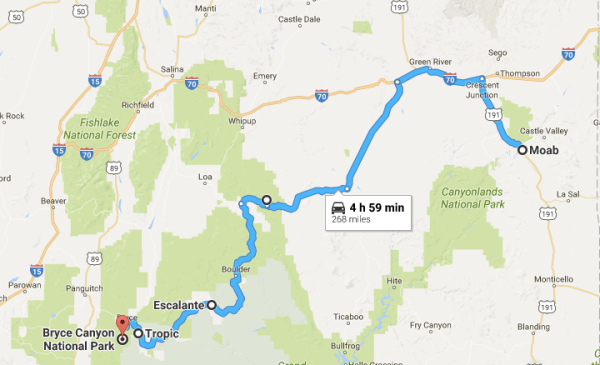
We are still on Pensacola time, so early rising is a piece-of-cake. Quick breakfast, quick departure. We had looked at the options the night before, we could go directly to Zion via fast roads, or take a southern route which would take considerably longer. AdventureMan had looked at the map and suggested a third route, which took longer, but not so long as the southern route, and took us through a place I have never even heard of, Capitol Reefs.
We’ve lived in so many wonderful places, and, because AdventureMan’s job was always so demanding, I took care of trip-planning, finding places to stay, creating routes to travel and choosing sights to see. This way is so much better, AdventureMan has the leisure to look at the maps, and he has good instincts. This day was another best day of the trip. 🙂
(Yes, I know, technically, they can’t all be best days. Toward the end we had some more boring days, but each day brought wonders and joys, and this is one of those best days, honest.)
One thing we never want is to find ourselves miles from a gas station in a remote location. As we are filling our tank, leaving Moab, I see one of our contemporaries loading up for his own adventure. This is what I love about Moab, you are free to pursue your own adventure.

If you are thinking about taking this trip, or a trip like it, you need to know that our phones had no service much of the time. Fortunately, we had maps and are good at reading them, mostly. It is really important to have some kind of back up when you are in remote locations. If you rely on your phone, and there is no service, you will have a harder time.
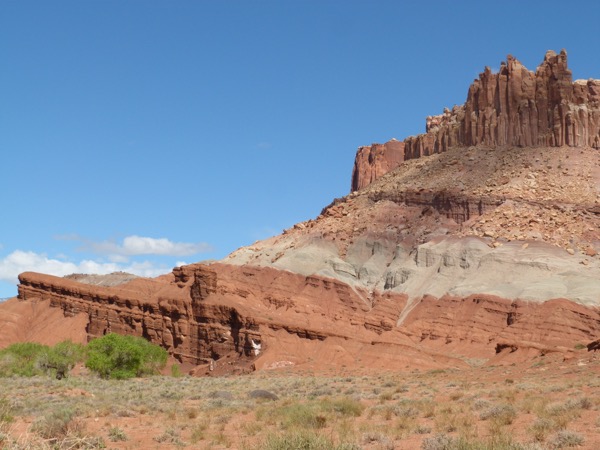
The scenery, even along the major highways, can be distractingly spectacular. This is, I believe, along I-70, which we take for a short time to get to the scenic road we want to be on to get to Capitol Reefs.

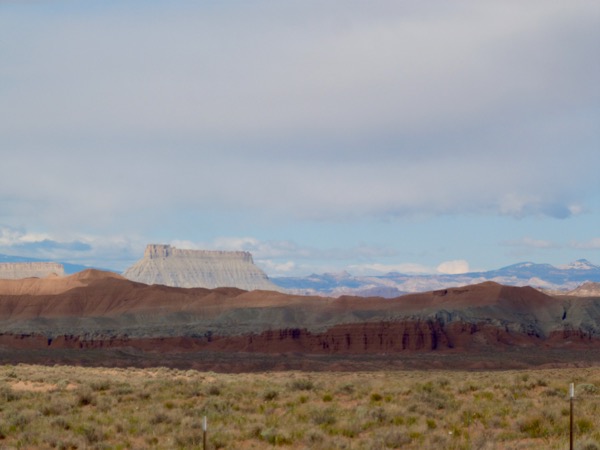


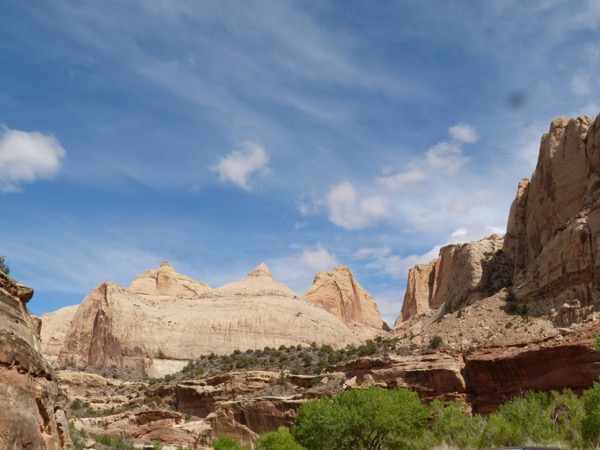
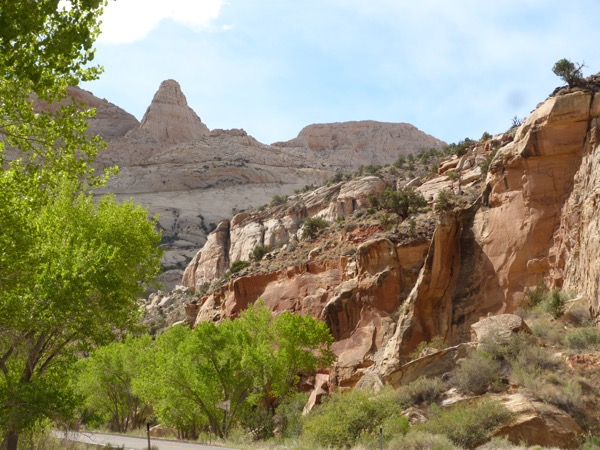
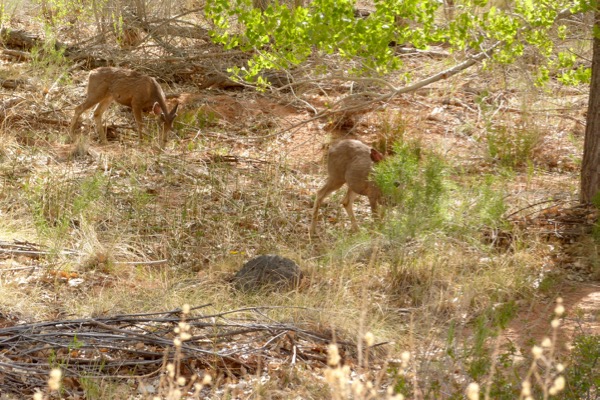
What we didn’t realize was that the greenery near the cliffs in Capitol Reefs indicated a river. I discovered it as I was making a pit-stop. I was headed to a private spot when all of a sudden, I realized I was not alone. By a stroke of luck, I had my camera in my hand. I whispered to the Mule Deer that I meant them no harm, and they calmly grazed as I took a couple photos.
Can you see why I am considering this another of the best days? I love happy surprises, and this day is full of happy surprises, even a few flakes of short-lived snow.

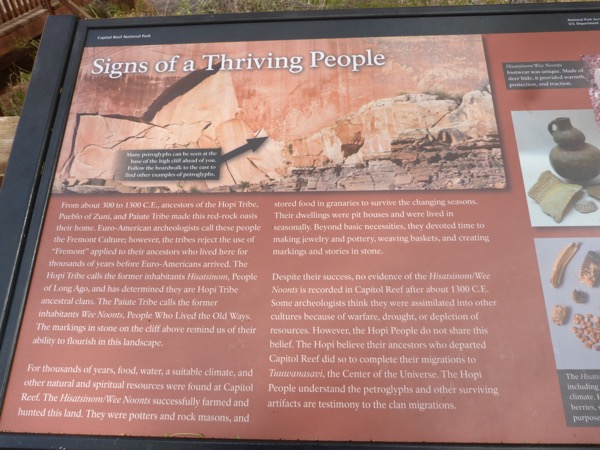
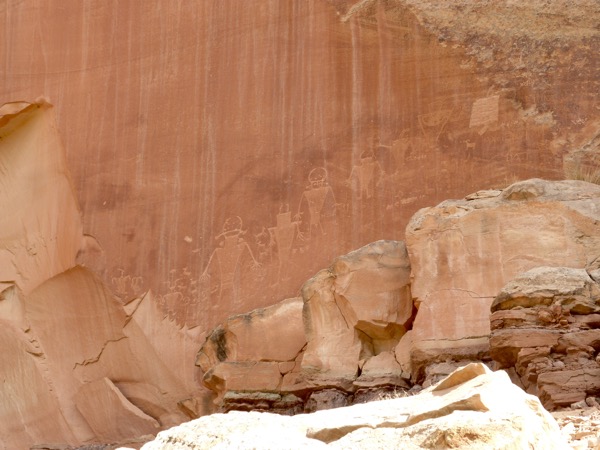
Good thing we stopped where we did. Just another quarter of a mile down the road is a major stop, with a beautiful walkway, so people can view Petroglyphs!

So, can you see the petroglyphs? I bet your eyes are getting better at it. You learn to look a little higher than you would think.
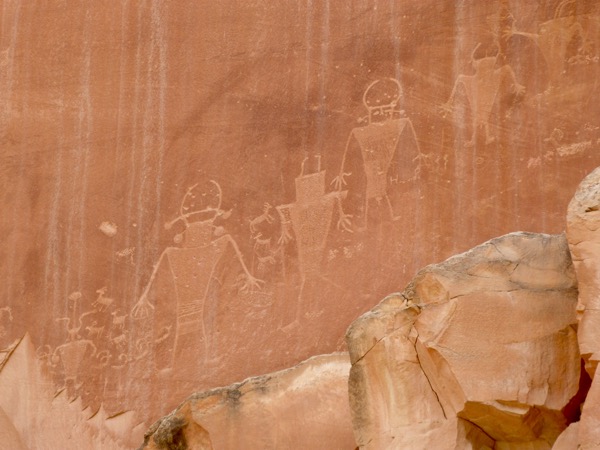
There are so many places where petroglyphs have been lost to natural breaking off and erosion.
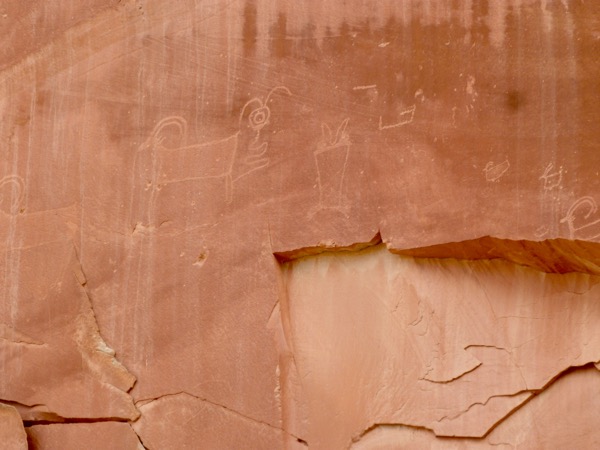


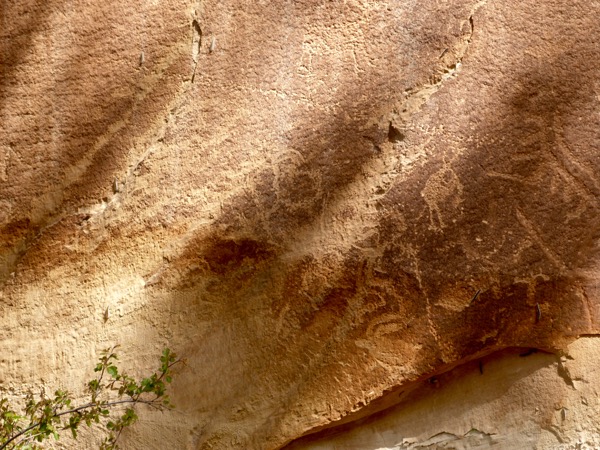
This is a piece that has broken off, but remnants of the original petroglyphs remain.

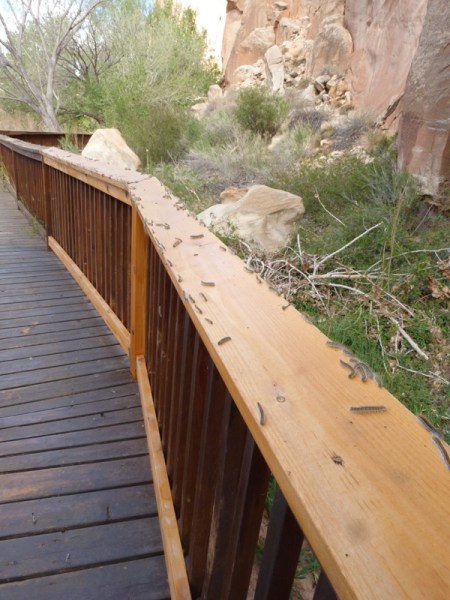
This is the beautiful walkway they built.

This is the sign. It is a little obscured, but we are always thankful for good signage.

I want you to know how very brave I was. I was about to lean on the railing to steady a shot when AdventureMan said “You’ll want to look before you do that,” and when I did, I saw a thousand creeping caterpillars. They were falling out of the trees, and covered the walkway. I made AdventureMan check my hair, and my hoodie, then I covered my hair completely; I looked like a total dork. Back in the car, I made him check me again, to make sure I wasn’t carrying an unwelcome guest with me. But no matter how much I was creeped out, it didn’t stop me from taking these photos 🙂

“This is the day that the Lord has made! Let us rejoice and be thankful in it!”
Shortly after finding a gas station, and looking for a restaurant that was open and might serve more than hamburgers and beer, we found the Capitol Reefs Cafe and Restaurant, which suited us perfectly. It had a unique gift store – I found the only petroglyph soap, black with etched petroglyphs – of the entire trip, perfect for a three year old, or even in the tip of AdventureMan’s Christmas stocking. Alas, there was only one, and I gave it to the three year old.


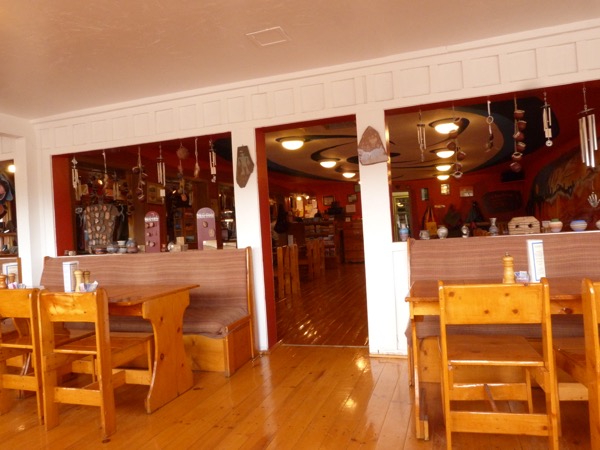

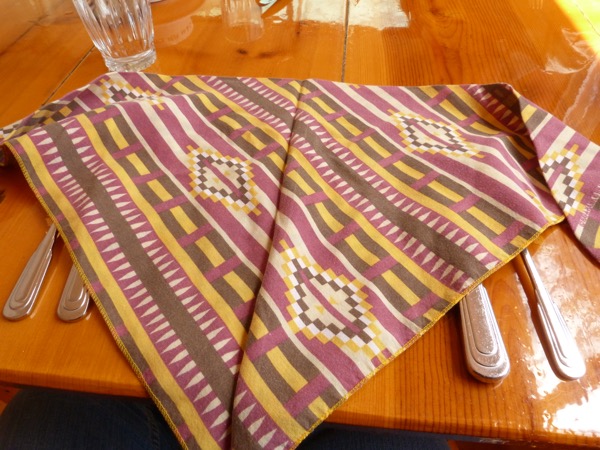
Look at that! Cloth napkins, and in a beautiful local textile.
AdventureMan had a fabulous corn chowder, and these Shrimp Tostadas.

I had a smoked trout salad, the only one I have ever had in my life. It was unique, and wonderful.

At Larb Hollow overlook, you could see for miles, maybe hundreds of miles. We could see Lake Powell. In the highlands, it was still very cold, and we had occasional flakes of snow.

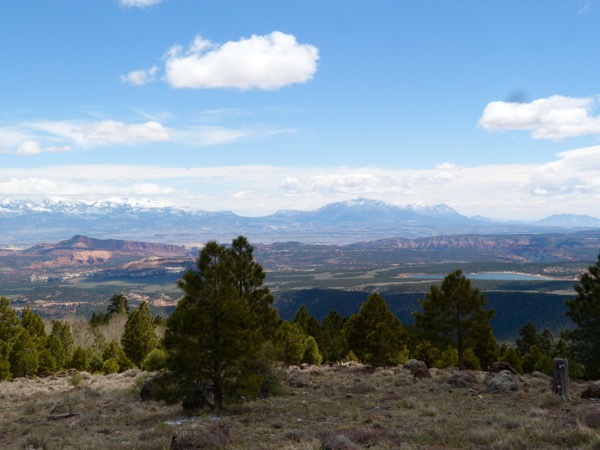
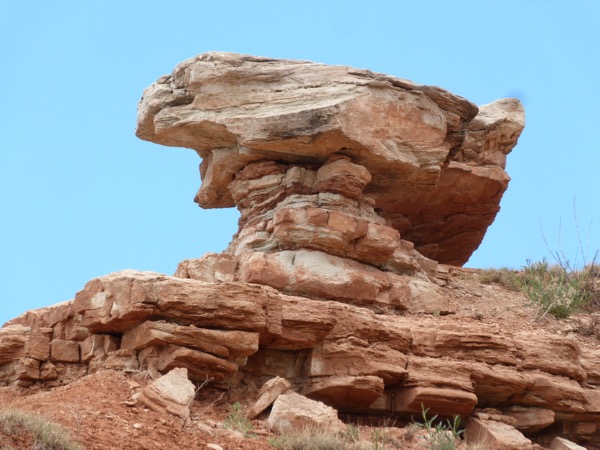

This stop was hilarious. We thought it was some kind of big deal but it was a very little deal. It reminded us very much of Germany, with a rural forest feel, a walk around a large lake, people with those walking picks that give me the shivers – “No! Don’t point that pick at me!”
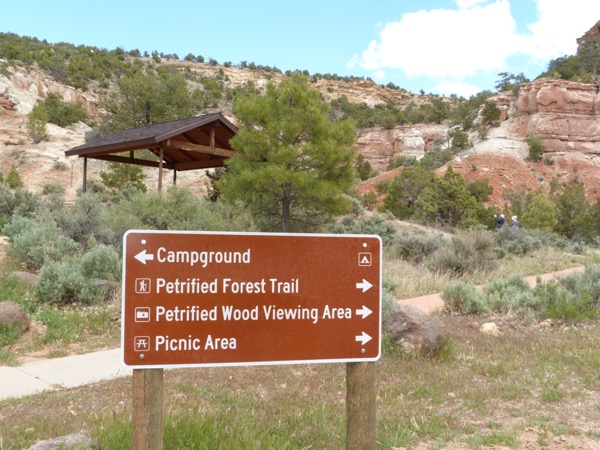
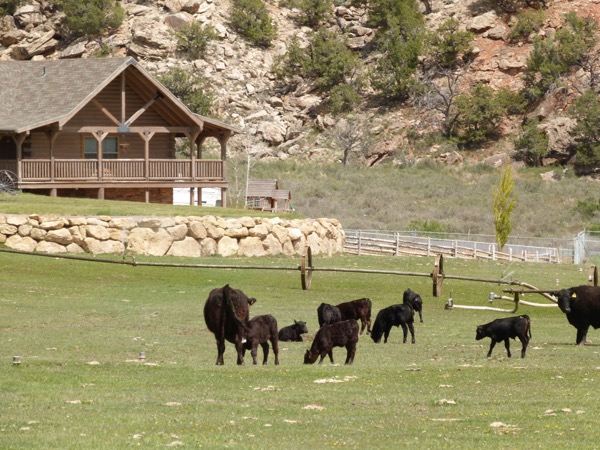
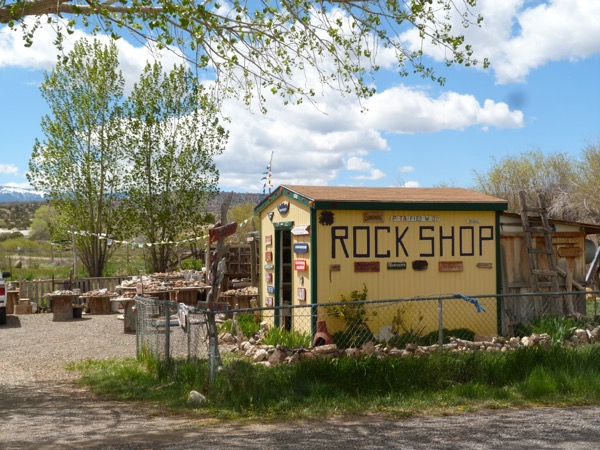
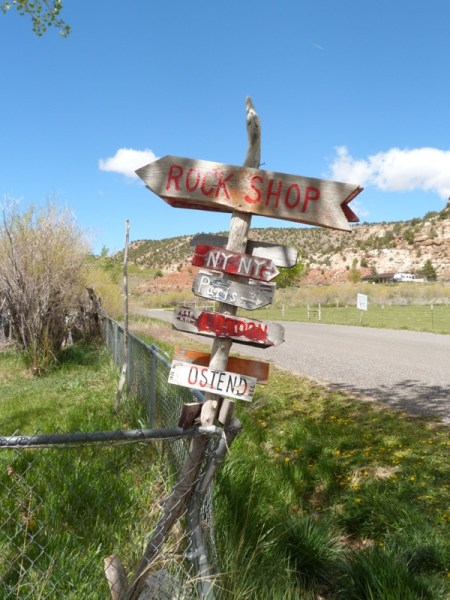
We stopped at a rock shop, where I bought a T-shirt I loved. He said it was last year’s color, and gave me a great discount, but it was a much more subtle color, a desert deep rose color, and it has a 70’s peace sign in gold, so elaborate that you don’t necessarily even see what it is. I love it. Then I went to take a photo of these cows, which AdventureMan thought was hilarious. “You’d be surprised how many people stop to take photos of those cows,” the owner of The Rock Shop told him.
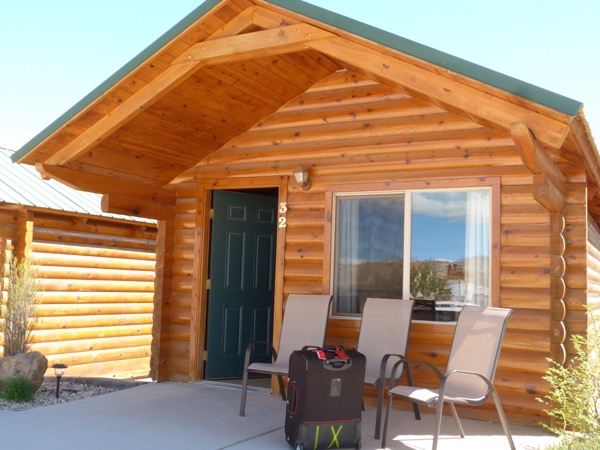
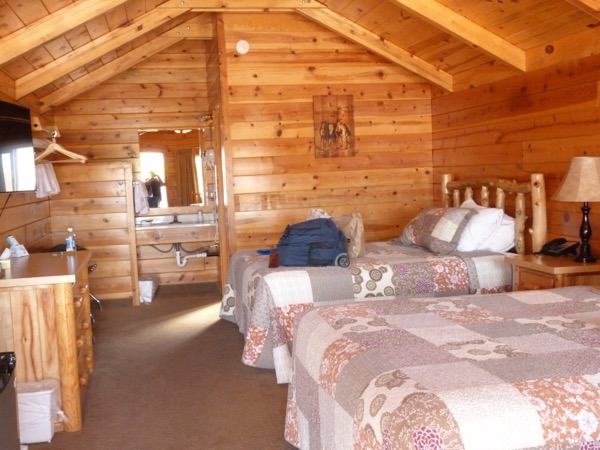
Arriving in Tropic, we are assigned to this cabin. Of all the places we stayed on the trip, we loved this cabin the best. It was a lot of fun, spacious, clean, very private, great beds, and the least expensive place we stayed. This was the Bryce Canyon Inn, in Tropic, which also has a coffee shop and a pizza restaurant in the same complex.


We took a short rest, then headed out to do a reconnaissance of Bryce Canyon, finding one of the major sights on our way. I think it was called Mossy Grotto, or something like that. Honestly, they give names to all these hikes, and while the hikes are great, I can’t remember the exact names. These are all late in the day, some times the sunlight is perfect and some times it has already disappeared due to landscape features. We needed a good hike after spending so much of the day with our only exercise getting in and out of the car.
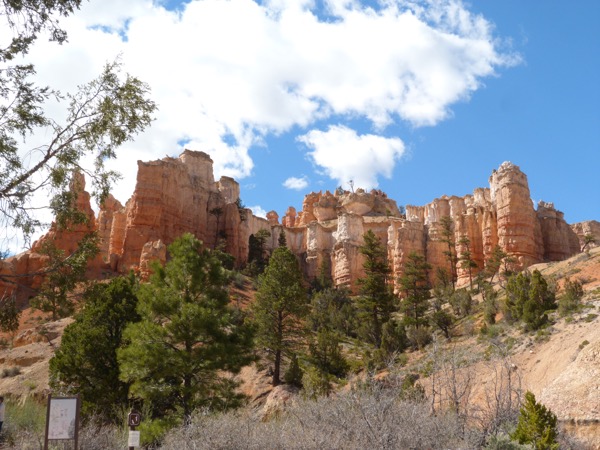
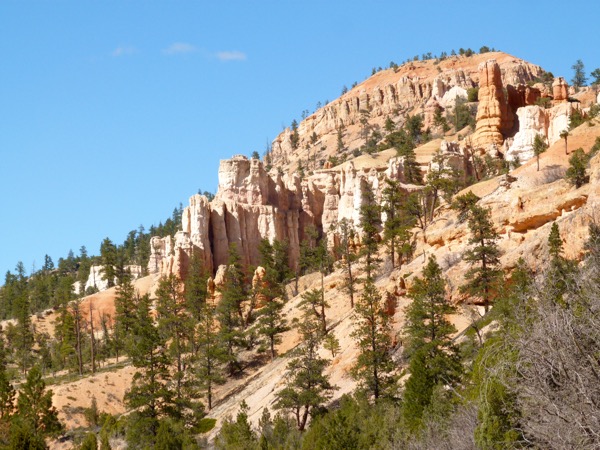


This is one of the features, and I couldn’t really figure out why. I think in winter it has huge icicles hanging from it. It is moist and water weeps from it. I think it is the mossy grotto.
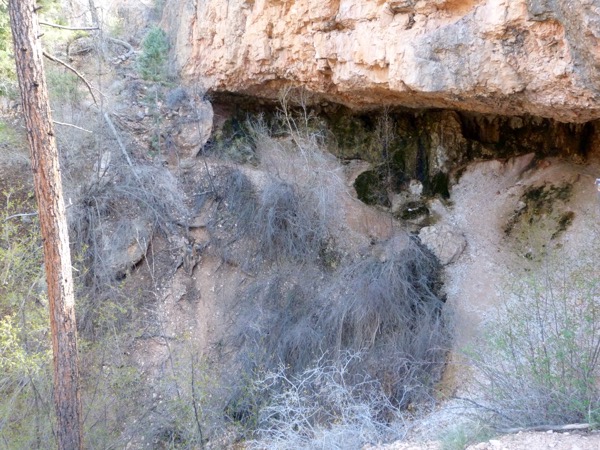
It looks like these rocks are kissing 🙂

We headed back to Tropic around dinner time, ate at the pizza restaurant. AdventureMan did the smart thing, he ordered a pizza. I saw halibut and chips on the menu and the Alaska-girl instincts kicked in, oh, halibut and chips! I got two small heavily breaded pre-frozen little lumps of fish, tasteless, what a waste of halibut. 😦 Learned – re-learned a lesson: if you’re in a pizza restaurant, order pizza.
We slept wonderfully in this cabin 🙂 Every day so far exceeds 10,000 steps 🙂
“You Shall Also Love the Stranger”
In this morning’s lectionary readings from Deuteronomy, I find words of hope this morning:
Deuteronomy 10: 17 – 18
17For the Lord your God is God of gods and Lord of lords, the great God, mighty and awesome, who is not partial and takes no bribe, 18who executes justice for the orphan and the widow, and who loves the strangers, providing them with food and clothing. 19You shall also love the stranger, for you were strangers in the land of Egypt.
I often tell my friends that I encountered very good Christians as I lived among the Moslems; they believe in Christ, and as we differ among ourselves as Christians, they also differ from us. Some of the differences are significant, and at the same time, I am aware that Christians did not agree – and still do not agree – on Christ’s divinity. So I look at the fruits of the spirit, I look at actions, and I look at being faithful to God’s intentions for us as his creation. I welcome the stranger as the stranger so often welcomed us.
Right now, it shames me that our very Christian country is no longer hospitable to the stranger. We were the shining light of hope in the world. Now we are led by a me-first bully, who will rob the poor even of their access to affordable health care to fill his pickets and those of his cronies. He forgets we are all strangers in a strange land, and will have to answer for our misdeeds.
I take courage in the spiritual renewal of resistance; there are those who continue to welcome, clothe and feed the stranger, who are fighting against injustice in the criminal and legal system, who are fighting for a woman’s equal place in this country, who are protecting the widows and orphans, the very things we are called to do. For the first time in my life, I am a member of the ACLU. I continue to receive training as a spirit warrior. We use our increased investments to fund Planned Parenthood. We strive to feed the hungry and clothe those without clothing.
We laugh, as we discuss issues in our classes, at our activities, over lunch, that at this later stage in life, we could be so reactivated 🙂
Grieving for Damascus
“This is a place I would love to retire,” I once told AdventureMan, as we wandered the streets. “It has all the things I love. Beautiful architecture and a rich history. It’s on a river. It gets cold in the winter. You can walk to local stores.”
Today, with great sadness, I read that Damascus is now rated the #1 Most Unlivable City in the World, beating out Douala, Cameroon; Harare, Zimbabwe; Karachi, Pakistan; Algiers, Algeria; Dhaka, Bangladesh; Lagos, Nigeria; and Tripoli, Libya. This is what the report summarized about Damascus:
Damascus has forgotten more than your city will likely ever know-and it has been a battleground for almost its entire existence. The City of Jasmine is a UNESCO World Heritage Site and, according to The Economist Intelligence Unit, the least livable city in the world-for good reason. More than 13 million Syrians require humanitarian aid, 6.5 million have been displaced, and almost half a million have been killed on all sides of the conflict there-government soldiers, opposition soldiers, and civilians. It’s scores are predictably abysmal, with a 15 (out of 100) for stability at the bottom end and a mere 43.3 for culture and environment at the top end.
This is a city which has been at the crossroads of civilization about as long as civilization has been around. This is a city which was refined, and tolerant, a city which was once full of caravans carrying spices, silks and riches to the West.
We were last there in 2007, and we are so glad we went when we did. Damascus was revitalizing, building up a tourism business with grand hotels, and lovely, intimate boutique hotels.
We stayed at the Talisman. We grieve for the fine people we met there, and for all the losses they have suffered.
AdventureMan said “why don’t you do a photo-share, like you did with Doha?” At first, I didn’t want to, but then, I looked at the photos – and once again, I was smitten. I pray for a miracle for Syria, for new, enlightened, tolerant leadership and opportunities for the good Syrian people. For renewed vigor in churches and mosques and synagogues there. (The Talisman is in the old Jewish quarter, where the Greek Orthodox also have their headquarters.)
This is the majlis – sitting area – at the Talisman.


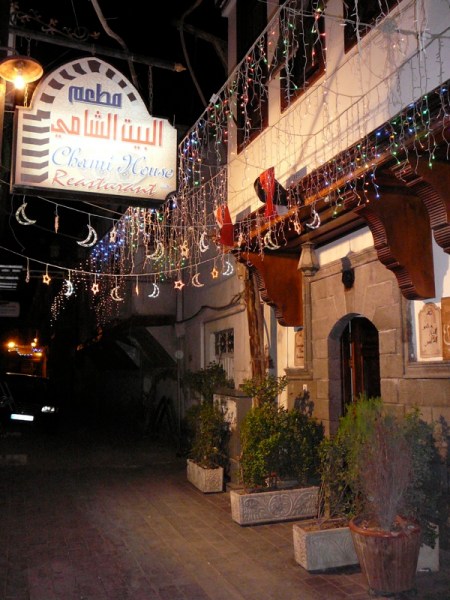
A restaurant nearby the Talisman:
Breakfast at the Talisman:

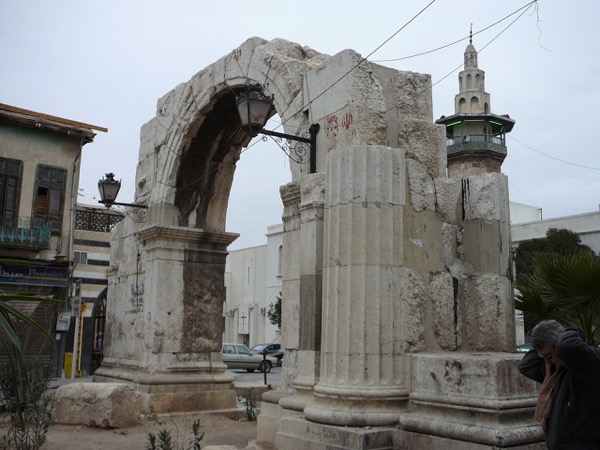
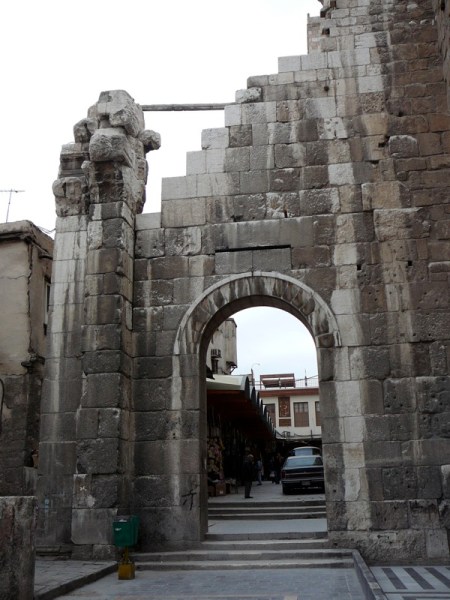
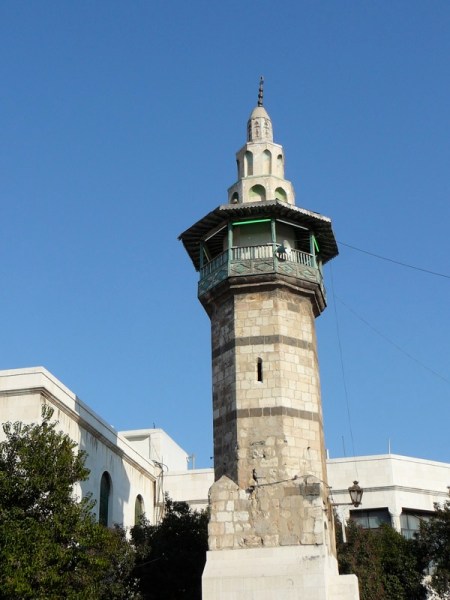
The historical nearby Bab, or gate:
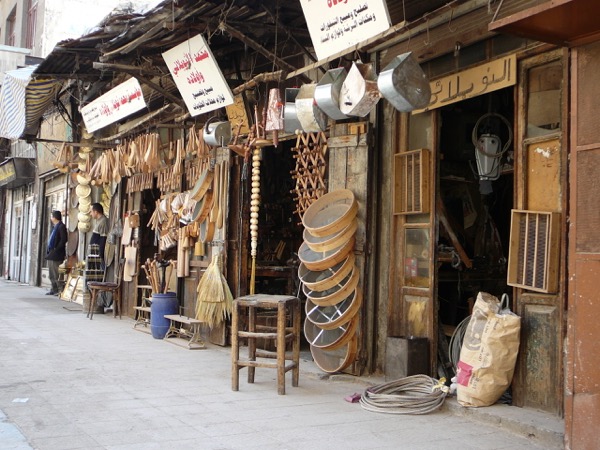
A nearby Tabak and the friendly operator:

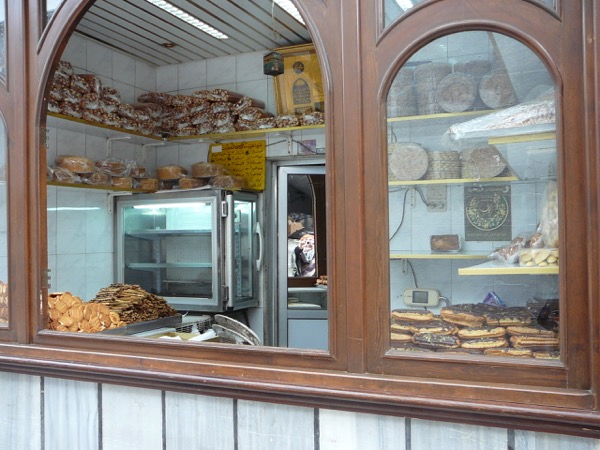
Streetside bakery:
A courtyard restaurant, with lovely dishes. And note the Christmas tree; Christmas decorations and greenery everywhere!

A Christian Shop near Bab Thoma:



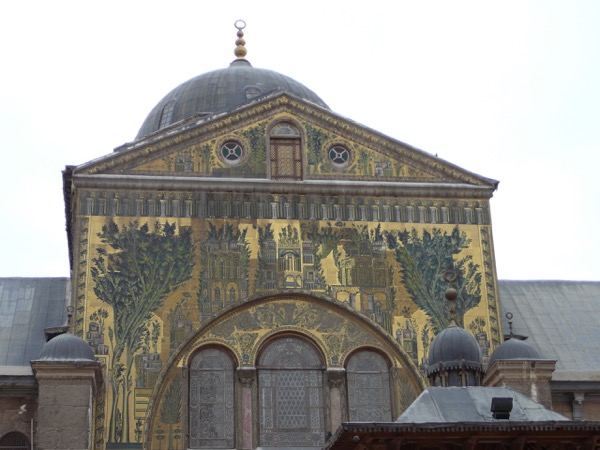
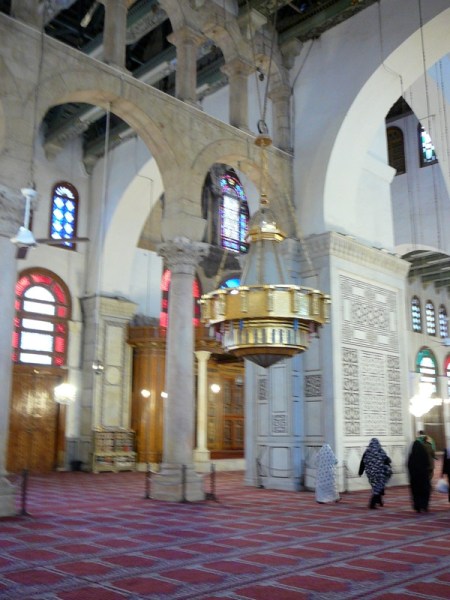
Interior at Umayyad Mosque, all are welcome and abayas provided. You leave your shoes at the door. This is the rear of the Tomb of John the Baptist:


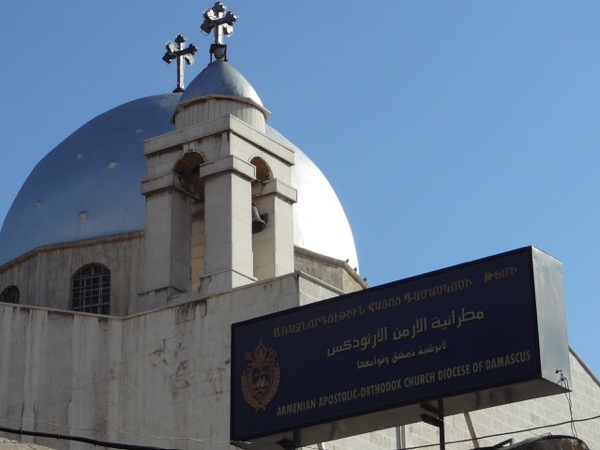


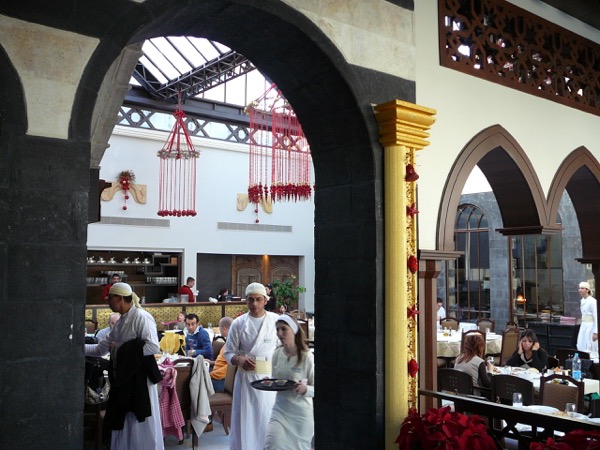
Naranj, our favorite restaurant. I understand branches of Naranj have opened in Gulf Countries, Qatar, Kuwait, as wealthier Syrians take their money out of Syria and wait for more peaceful times. I am betting they will return to Syria as soon as they can.

Inside Naranj


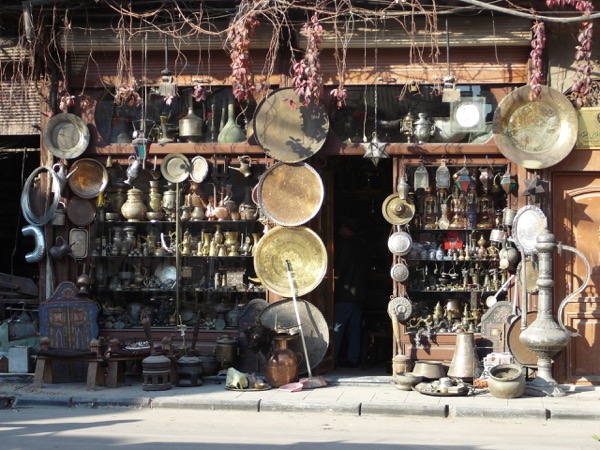
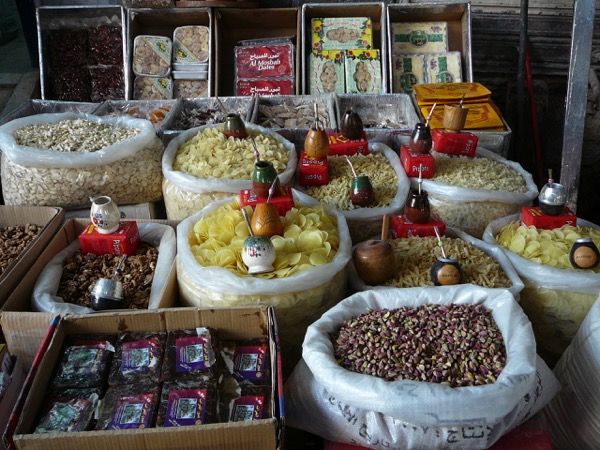
A merchant in the Souk al Hamidiyya



A courtyard restaurant set up for Christmas dinners:


I’ve never met a Syrian who wasn’t educated and working hard to make a good life for his/her family. We wonder if we will ever be able to visit Syria again in our lifetime?
For more photos of Damascus, you can visit my 2007 posts, Walking Old Damascus, by clicking here.
If God Wills It
I’ve always listened to the voice of James carefully, as he is brother to Jesus Christ, or half-brother, and you would think he would be wise in the truth. Finding his particular reading when I was living in the Middle East was like a bolt of lightning. We of the West say “I will do this!” “I will do that!” with never a doubt that we will, but our Islamic hosts would always start or finish “I will do this (or that)” with “InshAllah,” if God wills it.
That’s pretty much precisely what James is saying here.
Living in Jordan, Tunisia, Saudi Arabia, Qatar and Kuwait helped me see my own religion in a new light, shed understanding on our scriptures. I treasure the expat experience having yanked me out of my cultural circle and given me a fresh perspective.
The second part of the reading has a line about held back wages; I remember that the Qur’an also has a line about not letting the sweat dry on the backs of laborers before paying them. Our books have a lot in common.
James 4:13-5:6
13 Come now, you who say, ‘Today or tomorrow we will go to such and such a town and spend a year there, doing business and making money.’14Yet you do not even know what tomorrow will bring. What is your life? For you are a mist that appears for a little while and then vanishes.15Instead you ought to say, ‘If the Lord wishes, we will live and do this or that.’ 16As it is, you boast in your arrogance; all such boasting is evil.17Anyone, then, who knows the right thing to do and fails to do it, commits sin.
5Come now, you rich people, weep and wail for the miseries that are coming to you. 2Your riches have rotted, and your clothes are moth-eaten. 3Your gold and silver have rusted, and their rust will be evidence against you, and it will eat your flesh like fire. You have laid up treasure*for the last days. 4Listen! The wages of the labourers who mowed your fields, which you kept back by fraud, cry out, and the cries of the harvesters have reached the ears of the Lord of hosts. 5You have lived on the earth in luxury and in pleasure; you have fattened your hearts on a day of slaughter. 6You have condemned and murdered the righteous one, who does not resist you.
Deborah: Not a Childrens’ Story
Following the nomination of Hilary Clinton, the first female nominee of a major political party, we have this reading in the Lectionary from Judges. As I read it, I am thinking “I wonder why we don’t have more daughters named Deborah? Or Jael? And I am also thinking this is not – yet – a story for our 6 year old grandson and almost three year old granddaughter.
Love it that the Lord’s general was Barak, blessing in both Aramaic and Arabic, brother languages, brother cultures, divided by a dismal and long lasting fight about inheritance. Alas, there is no fight as bitter as a family fight.
Judges 4:4-23
4 At that time Deborah, a prophetess, wife of Lappidoth, was judging Israel. 5She used to sit under the palm of Deborah between Ramah and Bethel in the hill country of Ephraim; and the Israelites came up to her for judgement. 6She sent and summoned Barak son of Abinoam from Kedesh in Naphtali, and said to him, ‘The Lord, the God of Israel, commands you, “Go, take position at Mount Tabor, bringing ten thousand from the tribe of Naphtali and the tribe of Zebulun. 7I will draw out Sisera, the general of Jabin’s army, to meet you by the Wadi Kishon with his chariots and his troops; and I will give him into your hand.” ’ 8Barak said to her, ‘If you will go with me, I will go; but if you will not go with me, I will not go.’ 9And she said, ‘I will surely go with you; nevertheless, the road on which you are going will not lead to your glory, for the Lordwill sell Sisera into the hand of a woman.’ Then Deborah got up and went with Barak to Kedesh. 10Barak summoned Zebulun and Naphtali to Kedesh; and ten thousand warriors went up behind him; and Deborah went up with him.
11 Now Heber the Kenite had separated from the other Kenites,* that is, the descendants of Hobab the father-in-law of Moses, and had encamped as far away as Elon-bezaanannim, which is near Kedesh.
12 When Sisera was told that Barak son of Abinoam had gone up to Mount Tabor, 13Sisera called out all his chariots, nine hundred chariots of iron, and all the troops who were with him, from Harosheth-ha-goiim to the Wadi Kishon. 14Then Deborah said to Barak, ‘Up! For this is the day on which the Lord has given Sisera into your hand. The Lord is indeed going out before you.’ So Barak went down from Mount Tabor with ten thousand warriors following him. 15And the Lord threw Sisera and all his chariots and all his army into a panic* before Barak; Sisera got down from his chariot and fled away on foot, 16while Barak pursued the chariots and the army to Harosheth-ha-goiim. All the army of Sisera fell by the sword; no one was left.
17 Now Sisera had fled away on foot to the tent of Jael wife of Heber the Kenite; for there was peace between King Jabin of Hazor and the clan of Heber the Kenite. 18Jael came out to meet Sisera, and said to him, ‘Turn aside, my lord, turn aside to me; have no fear.’ So he turned aside to her into the tent, and she covered him with a rug. 19Then he said to her, ‘Please give me a little water to drink; for I am thirsty.’ So she opened a skin of milk and gave him a drink and covered him. 20He said to her, ‘Stand at the entrance of the tent, and if anybody comes and asks you, “Is anyone here?” say, “No.” ’ 21But Jael wife of Heber took a tent-peg, and took a hammer in her hand, and went softly to him and drove the peg into his temple, until it went down into the ground—he was lying fast asleep from weariness—and he died. 22Then, as Barak came in pursuit of Sisera, Jael went out to meet him, and said to him, ‘Come, and I will show you the man whom you are seeking.’ So he went into her tent; and there was Sisera lying dead, with the tent-peg in his temple.
23 So on that day God subdued King Jabin of Canaan before the Israelites.
Recent Comments
ExpatAlien on What Country am I Living … intlxpatr on Yellowstone: Old Faithful to C… Michelle on Yellowstone: Old Faithful to C… Cathy on No Grown-Ups in Charge intlxpatr on Waiting for Snow Wikipedia Donate Button

Amazina


Early Voting in Florida


 Here There and Everywhere