Those of you who have known me since 2006, when Here There and Everywhere started, know that I am a religious woman, so what I am about to say won’t bother you. If discussions of a spiritual nature distress or annoy you, just skip down to the photos.
This journey, through Yellowstone and Glacier National Parks has been one of the most profoundly spiritual journeys I have ever taken. I can understand why our First Nation people consider these places holy ground. There is a majesty, and a grandeur, and a reminder that I am a very small piece of a very large and complex creation.
The temperatures are in the 80’s, but roads are still closed and you have to go around.


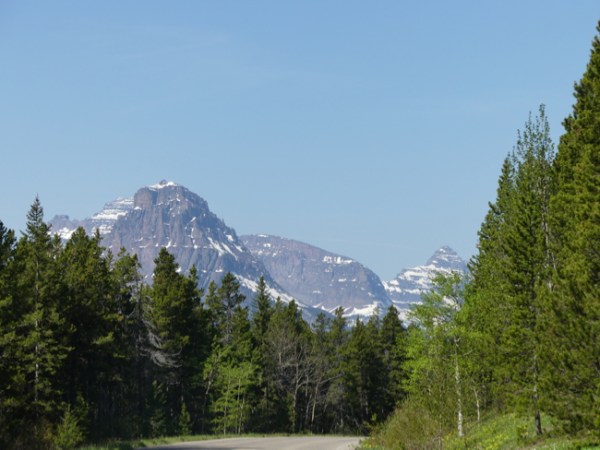


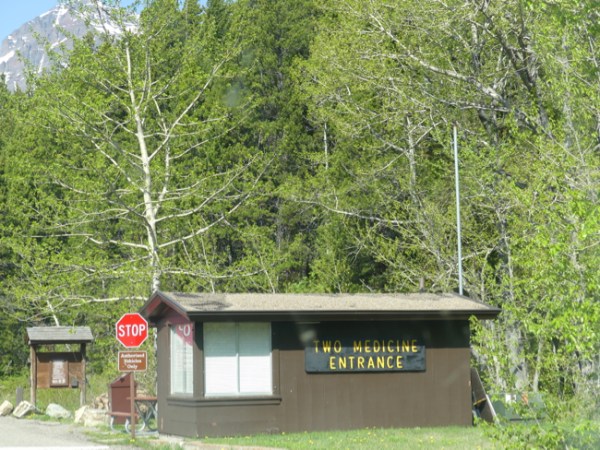
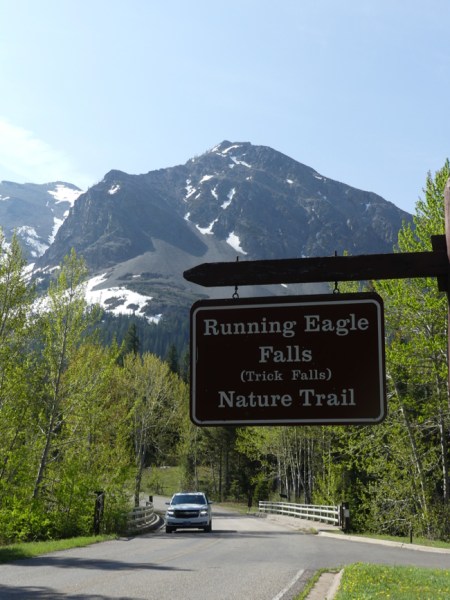
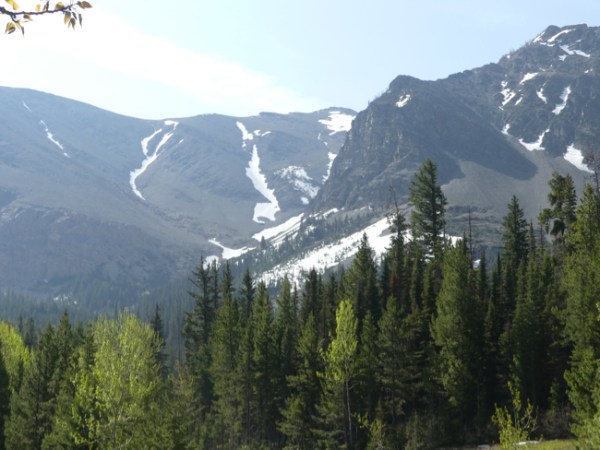


I loved this write-up, and of course we had to take this hike. I didn’t hike to the top of the falls, but I am happy we did the hike to the view point. As an interesting aside, these falls were roaring. I’ve seen other photos of this falls that show it is actually two falls. In the spring, when the melt swells the flow, you can’t see the two, but when the upper fall diminishes, you can see the larger, lower fall.


Running Bear and Running Eagle 🙂
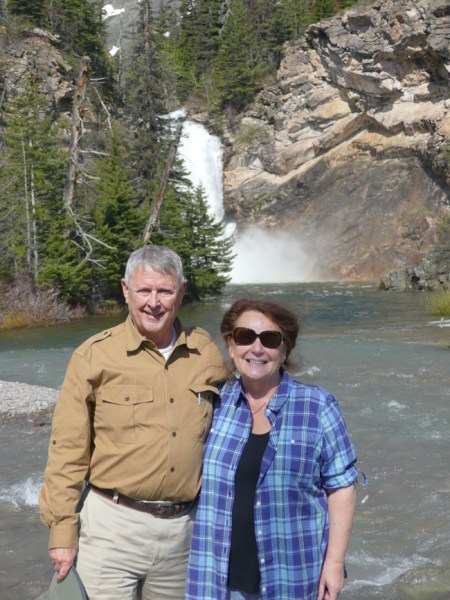
The General Store at Two Medicine Lake

Picnickers at the Lake


June 28, 2019
Posted by intlxpatr |
Adventure, Faith, Road Trips, Travel | Glacier National Park, Two Medicine |
Leave a comment
Mostly I don’t give an attraction a post all it’s own in a travel article, but of all the sights I saw in Yellowstone, Roaring Mountain struck the deepest chord. It was a beautiful morning. We were mostly the only ones there. A couple RVs pulled up and didn’t even bother getting out.
I’ve never seen anything like it in my life. I imagine the earliest explorers coming across it and wonder at the wonder they must have felt. Although there was a breeze, the springs and steam were so continuous that they never fully blew away. You hear a constant rush of steam, a sizzle, bursts.
Sometimes, on this beautiful earth, you get a feeling you are truly standing on Holy Ground. I felt that way at Saint Simeon’s in Syria. I felt that way at sundown on the desert of Sossossvlei in Namibia. And I felt it here. It i beautiful, and eerie, and if you are not filled with the awe of the great Creation, I can’t imagine what will move you.


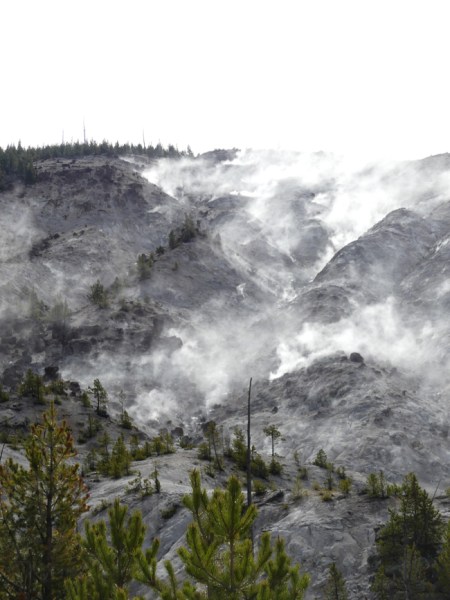
And here is where Roaring Mountain is located:

We joke about Disney-does-Yellowstone, which is sort of what it’s like in some of the more commercialized and traveled places, but there are moments and locations when all the Disney-esque goes away, For me, Roaring Mountain is one of them.
Just north of Roaring Mountain, en route to Mammoth Hot Springs, is an Obsidian Cliff, where you could hike for many years, but the visitors and hikers kept taking obsidian home as a souvenir, and now the site is unmarked and closed to visitors.
June 24, 2019
Posted by intlxpatr |
Adventure, Beauty, Faith, Geography / Maps, Photos, Road Trips, Spiritual, Stranger in a Strange Land, Travel | Roaring Mountain, Yellowstone National Park |
Leave a comment
That this trip would go to Aachen is one of the reasons I eagerly wanted to take this trip. We visited Aachen around twenty years ago, and the minute I walked in the church, I was stunned by this candelabra:

It is huge. It is glorious. This was the church of Charlemagne, and it is a very very old church. I don’t know why it is so special to me, but I love this church. Now I can recognize all the Moorish elements; that could well be a part of its attraction to me.

Wikipedia says the Aachen cathedral was consecrated in 805 AD, and is the oldest cathedral church in Europe.
“It is claimed as one of the oldest cathedrals in Europe and was constructed by order of the emperor Charlemagne, who was buried there after his death in 814. For 595 years, from 936 to 1531, the Palatine Chapel, heart of the cathedral, was the church of coronation for thirty-one German kings and twelve queens. The church has been the mother church of the Diocese of Aachen since 1802.”
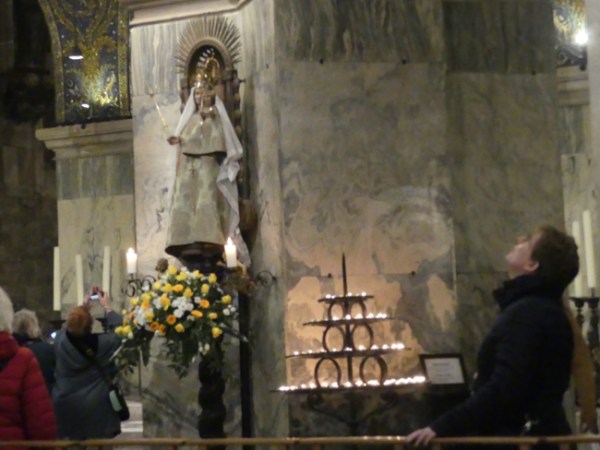
I knew from previous visits that you had to buy a ticket to take photos in this church. You have to find a policeman selling permits, and he puts a permit on your camera. There were a lot of people taking photos and being told they had to pay. There were signs, but they were small and not very visible. I felt sorry for the people who were scolded and told they had to pay.


Looking up int the dome. The black and white arches remind me of the Alhambra in Spain. So simple, so elegant.


Guess I really have a thing for those arches, LOL.

Outside view of the Aachen cathedral / church. What is really funny is that it looks like blue sky, and maybe, just maybe for a few minutes, it was. Mostly what I remember is a very cold day and a very chill rain, so chilly that we only wandered around the Market for maybe half an hour and then found a cozy cafe where AdventureMan could get some hot chocolate for his sore throat.


The Winter Specials!
Hirschsteak! (Deer steak) Gänsekeule! (Goose leg) Muscheln! (Mussels Alsatian style)

Shops full of the Aachen special spice cookies. Love the way they decorate their windows.

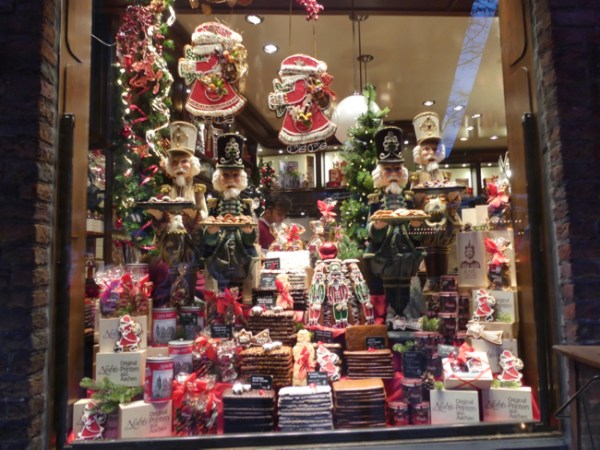
People beginning to gather for their shopping, and for drinking Gluewein with their friends.


I love this statue. I think it is called Greed, or The Love of Money.

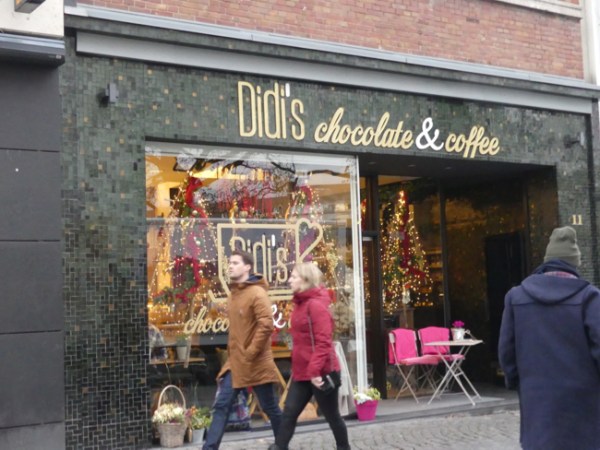
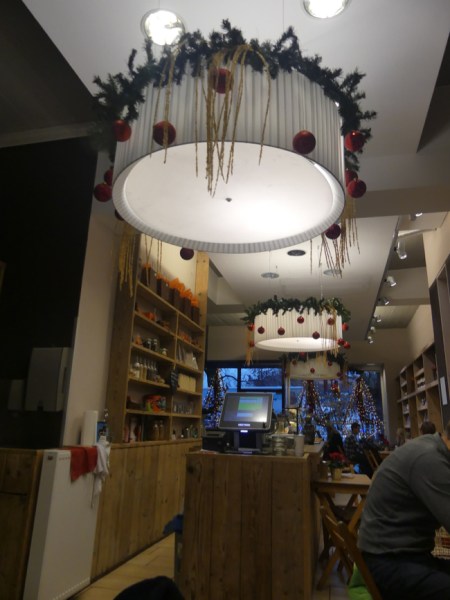
Here is Didi’s Chocolate Shop where we found our tour guides, also having a hot drink and comparing notes while the tour guests shopped. I ordered Mint Tea and got a huge pot of boiling hot water and a bundle of mint leaves. It was lovely, so fresh, so fresh. AdventureMan also loved his hot chocolate.
When we left, we were all to gather at the tourist info stop. We were all there, and nothing was happening so a couple people went inside the tourist place, and then the guides showed up and hurried us down a street. Fortunately the people inside could see the end of the line far off down the street and hurried to catch up with us. We know they would have sent people back for them when they were discovered missing . . . or we think so. It felt like a disaster narrowly averted.
We speak the language. Still, we would not want to be left behind in a strange city and have to find some way to get back to a boat that we don’t really know exactly where it is.
March 19, 2019
Posted by intlxpatr |
Advent, Arts & Handicrafts, Faith, Germany, Hot drinks, Photos, Travel | Aachen, Christmas Markets on the Rhine, Germany, Tauck Tours |
Leave a comment
My problems are probably not your problems, but we all have to carry our own loads.
So yesterday, I was on the way to the YMCA for my water aerobics class; it helps me fight creeping depression. Why would I be depressed? Existentially, the tone of the current regime offends me, offends my values, and I have to fight not only depression, but also angry frustration. So I pray, asking for input which will alter my sour outlook.
At the pool, the first person I run into is one of my long-time pool buddies, and she has her little daughter with her. I ask how she is doing, and she says “I am not happy.” I know this woman, she is a good woman, and a conscientious mother. She goes on to say that she is at an age where other parents are waving their children off into independence, into college and jobs and marriages and children, and that will never happen for her. Her little daughter is 31, with Downs syndrome. She is a sweet, easy woman, but will always be a little girl.
My friend wasn’t complaining. She was just telling me how she saw her life at that moment in time, she was sharing her reality. I hugged her. It wouldn’t change anything, but she knew I was listening.
I left with an entirely changed point of view, going home to help AdventureMan take care of our two little “petites-enfants.” Tropical Storm Gordon is rolling in, their parents have to work and school has closed down in concerns for the safety of the children and their transportation. My problems are so First World. I got the input I needed.
September 5, 2018
Posted by intlxpatr |
Community, Exercise, Faith, Family Issues, Fitness / FitBit, Parenting, Quality of Life Issues, Relationships |
Leave a comment
We are off to Seattle, taking our eight year old grandson, no-longer-baby Q, and his almost-five sister, N, for a great adventure. We have been taking them on trips for several years now, but were waiting for N to reach the magic age of cooperation before we endeavored to make a trip of this length.
I’m excited. These are nice kids, and we have a lot of fun together.
“Will we have to be quiet in the hotel room?” asks N, who is very perceptive, and has a great memory. She remembers our hotel rooms in New Orleans, and we have to keep the volume of our wild rumpuses down, and we can’t be making lots of bumps on the floor or walls.
“Yep,” I respond and give her the eye. N is a lot of fun, and loves figures of speech, as we do. Her latest accomplishment is “shooting daggers.” We can pass a lot of time at lunch helping her to shoot daggers with her eyes, and she has come close to mastering that fine art.
We are concerned about baggage. We will each have a bag, and we want to carry them on. AdventureMan and I will have to be paying attention.
Like Goldilocks, I found myself in the position of having bags that were too small or too big, and nothing that was just right, especially now that TSA is so particular about the exact size of carry-on bags. I found one:
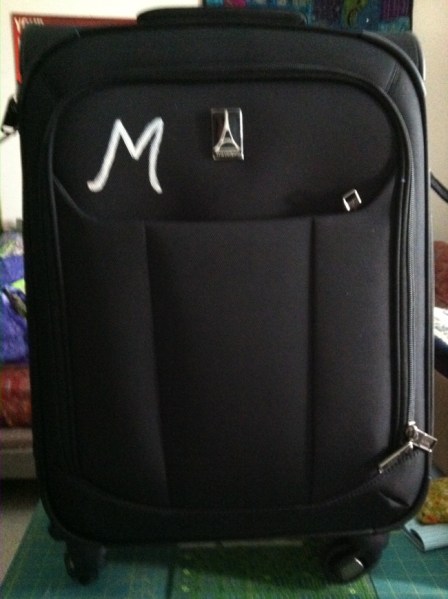
It is exactly the right dimensions, and I added the “M” in silver nail polish to distinguish it from all the other black carry-on bags, in case I am required, after all, to check it. Another friend told me to add ribbons, so I will.
It sent me back in memory, however, years and years. Early years, traveling from Alaska, where the plane had a ladies lounge which even had seating, and cosmetics provided. We carried cosmetic cases with us on the planes. Contrast that with the 15″ ports-potties we are forced to use now, even in business class.
As we began our treks back and forth overseas, there was a baggage “limit” of two bags, and I believe there was – technically – a limit of 77 pounds. My sister and I, en route back and forth across the Atlantic to university had HUGE bags, and the kind people at the check-in never batted an eye, just told us other people were under the limit and it would all average out.
Hauling supplies to our overseas posts – things like chocolate chips, shoes for growing children, levis, all the things we couldn’t get in countries like Tunisia and Jordan in the ’70’s and ’80’s, we used huge Land’s End or LL Bean duffels, packed to bursting and strapped with luggage straps. Some held books; books are really heavy.
It wasn’t until we had retired from the military and began government contracts overseas that things changed. Maybe it was 9-11. Partly, for sure, it was an issue with human rights, and bags that were causing disabilities among baggage workers. Partly, too, I believe it was a matter of greed for additional profits among the airlines. More people squeezed in, less room for baggage.
Thus, my modest little carry-on, and the new adventure of rationing space and clothing to last the whole trip.
Each time we travel, AdventureMan and I try to spot the Arabs. It used to be easy. So many people would come to visit the USA, and we could usually spot them based on facial features and body language as well as clothing. Now, we believe there are fewer visitors, and fewer students, and they have learned to fly way under the radar. They look like us. And then again, We Americans came from someplace else, unless we are First Nation, so why shouldn’t our visitors look a lot like us?
At the YMCA there is a new cleaning lady, who says she is from Hungary, but I think maybe Bulgaria or Albania. She doesn’t speak a lot of English, but told me “the Jews took all her money” so she came to the United States. I don’t even know what to say when someone says something like that to me. What if I were Jewish? I’m still pondering how to react. I was friendly to her at the start, but something inside me turned cold when she said that. I don’t want to be anywhere near her, now. I wanted to say “this is America, we don’t say things like that,” but America has changed, has taken a very divisive turn, and we have a leader who does say things like that.
I think it has to do with the political climate, where we are quick to turn on one another, to call names, to point fingers, to assign blame – whether it is true or not. I find it disheartening. I like the safety of building networks, introducing ourselves, knowing we can count on one another for help when needed. Individually, we are all so vulnerable, but when we unite and care for one another, we are strong.
August 3, 2018
Posted by intlxpatr |
Adventure, Civility, Community, Counter-terrorism, Cultural, ExPat Life, Faith, Family Issues, Living Conditions, Relationships, Seattle, Social Issues, Stranger in a Strange Land, Travel, Values |
Leave a comment

Today in the Lectionary readings, we come to the Gospel and one of my all time favorite verses and personal life guide. If you claim to follow Jesus, there are some basics. You have to follow the old Jewish traditions of loving God with all your heart, and loving your neighbor as yourself. You have to take care of the poor, the widowed (the single mother), the mentally ill, the children. You have to welcome the stranger, for we were strangers in Egypt.
Our national policies today are taking away medical benefits from our poorest citizens, are rolling back protections against pollution and contamination of air and water and even the foods we eat. The callousness of it all appalls me. Spiritually, we pay a price. As a country, I believe we will survive, but it will take a while to undo the damage that is being done, day by day.
As a cold warrior, I am horrified, but that is not a spiritual thing 🙂
Matthew 25:31-46
31 ‘When the Son of Man comes in his glory, and all the angels with him, then he will sit on the throne of his glory. 32All the nations will be gathered before him, and he will separate people one from another as a shepherd separates the sheep from the goats, 33and he will put the sheep at his right hand and the goats at the left. 34Then the king will say to those at his right hand, “Come, you that are blessed by my Father, inherit the kingdom prepared for you from the foundation of the world; 35for I was hungry and you gave me food, I was thirsty and you gave me something to drink, I was a stranger and you welcomed me, 36I was naked and you gave me clothing, I was sick and you took care of me, I was in prison and you visited me.” 37Then the righteous will answer him, “Lord, when was it that we saw you hungry and gave you food, or thirsty and gave you something to drink? 38And when was it that we saw you a stranger and welcomed you, or naked and gave you clothing? 39And when was it that we saw you sick or in prison and visited you?” 40And the king will answer them, “Truly I tell you, just as you did it to one of the least of these who are members of my family,* you did it to me.” 41Then he will say to those at his left hand, “You that are accursed, depart from me into the eternal fire prepared for the devil and his angels; 42for I was hungry and you gave me no food, I was thirsty and you gave me nothing to drink, 43I was a stranger and you did not welcome me, naked and you did not give me clothing, sick and in prison and you did not visit me.” 44Then they also will answer, “Lord, when was it that we saw you hungry or thirsty or a stranger or naked or sick or in prison, and did not take care of you?” 45Then he will answer them, “Truly I tell you, just as you did not do it to one of the least of these, you did not do it to me.” 46And these will go away into eternal punishment, but the righteous into eternal life.’
July 18, 2018
Posted by intlxpatr |
Aging, Character, Civility, Community, Cultural, Faith, fraud, Free Speech, Interconnected, Lectionary Readings, Living Conditions, Social Issues, Spiritual, Stranger in a Strange Land, Values | "the least of these", Mathew 25: 1 - 46 |
Leave a comment
The Psalm from today’s Lectionary readings:
140 Eripe me, Domine
1 Deliver me, O Lord, from evildoers; *
protect me from the violent,
2 Who devise evil in their hearts *
and stir up strife all day long.
3 They have sharpened their tongues like a serpent; *
adder’s poison is under their lips.
4 Keep me, O Lord, from the hands of the wicked; *
protect me from the violent,
who are determined to trip me up.
5 The proud have hidden a snare for me
and stretched out a net of cords; *
they have set traps for me along the path.
6 I have said to the Lord, “You are my God; *
listen, O Lord, to my supplication.
7 O Lord God, the strength of my salvation, *
you have covered my head in the day of battle.
8 Do not grant the desires of the wicked, O Lord, *
nor let their evil plans prosper.
9 Let not those who surround me lift up their heads; *
let the evil of their lips overwhelm them.
10 Let hot burning coals fall upon them; *
let them be cast into the mire, never to rise up again.”
11 A slanderer shall not be established on the earth, *
and evil shall hunt down the lawless.
12 I know that the Lord will maintain the cause of the poor *
and render justice to the needy.
13 Surely, the righteous will give thanks to your Name, *
and the upright shall continue in your sight.
Yesterday, several news sources discussed the rapid growth of the American Civil Liberties Union; this one is from Politicus USA:
Thanks to the election of Donald Trump as President of the United States, the American Civil Liberties Union (ACLU) has more than quadrupled its membership, according to an article in The New York Times.
Before Trump’s election the group had just 400,000 members and most of its actions were out of the public eye. But now, after 15 months of the Trump presidency, the membership is over 1.8 million and it has become one of the most active and visible opponents of Trump’s agenda.
Donations to the nonprofit group have also increased exponentially. The ACLU’s executive director, Anthony Romero, said that the organization has raised over $120 million since the 2016 presidential election. Before that watershed election, he said, donations had been in the range of just $3 million to $5 million annually.
Romero said that concerns over Trump’s attack on constitutional rights and civil liberties have brought a whole new generation of political activists into their group. “Until Trump most of our support came from people who have been with us since we challenged Nixon,” Romero told the Times. “Now we’re kind of cool. Cool’s not a word generally associated with us.”
The surge in membership, coupled with the massive increase in contributions, has for the first time given the ACLU all the resources it needs to fight Trump and other administration officials in court and elsewhere. They have been involved in more than 100 legal actions against Trump administration policies, including the White House’sseries of travel bans on the citizens of several Muslim-majority nations, which happened shortly after he took office.
More recently, the group has been challenging the Justice Department’s family separation policies, Trump’s voter fraud commission and the president’s reversal of an Obama-era contraception mandate.
According to Romero, his group has over 170 times taken what he calls “Trump-related legal actions” since he became president. This number includes the filing of 83 lawsuits, Romero said.
As the Trump administration steps up its attacks on refugees and asylum seekers, the ACLU has been filing class action lawsuits and also seeking injunctions to attempt to make the government stop separating families and incarcerating children. In some cases they have already been successful, and they are continuing to fight for the legal rights of people who may have been illegally detained and deprived of due process.
The large increase in ACLU membership is a good sign for American democracy. It shows that many Americans not only disapprove of Donald Trump’s policies and actions but are willing to support the fight against them. Ultimately this may be what saves our country from becoming a dictatorship and what preserves and protects the Constitution of the United States of America.
I’m one of those people. I used to think the ACLU was extreme, that was until I saw them first to man the tables offering free legal advice to incoming passengers the night Trump implemented his first travel ban. I sent my first check. I was asked why I had joined, and I told them because they are now our front line against thugs with no moral values, oppressors of the poor, led by a heartless, selfish, man who must be reined in. They sent me a sweet little ACLU pin, which I don’t dare wear in Pensacola.
July 6, 2018
Posted by intlxpatr |
Bureaucracy, Character, Civility, Crime, Cross Cultural, Cultural, Faith, Free Speech, Leadership, Lectionary Readings, Lies, Political Issues, Values | ACLU, American Civil Liberties Union |
Leave a comment

clipartxtras.com
AdventureMan is hollering from his office to mine “Can I read you something?”
We all find ways to express our indignation. He writes directly to our president, our representative (he calls him Trump’s butt-boy, to me, not to him), to Pruitt. He tells them, in acceptable language, exactly what he thinks.
“I’d say ( . . . . ), but as a retired army officer, I think I am still subject to the UCMJ (Uniform Code of Military Justice),” he says, and censors himself so that he is within civil boundaries.
How did we come to this, when our own national leader lies, again and again, even in the same day, and we have come to accept this as “normal?” How can we accept his calling people who are brown, and seeking a safer, better way of life “vermin” and their countries as “s-tholes?” The unthinkable has become our daily reality. It is not only the children, separated from their parents, who are becoming traumatized, it is also normal every-day Americans who believe that the American Dream is for everyone.
I think the American president is afraid of a world in which our nation is more brown than white, which it is well on it’s way to becoming. I think the thought of losing power terrifies him. I can’t imagine any other rational reason for his behavior towards the “other,” the stranger, those he labels as enemies.
So while I am startled when AdventureMan tells me he self-censors, I also understand. The unimaginable had manifested itself daily since this man was elected, and he will stop at no ends to complete his agenda. His cronies and fellow thugs will thrive, while we drink polluted water, and watch oil seep on to our shores from the off-shore drilling. We will watch our public schools fail, and our jails overflow. My heart breaks on a daily basis, watching what we, as a nation, are becoming.
I used to think the ACLU were a bunch of wackos. When the first travel ban went into effect, and we watched the stunned travelers arrive only to be told they must go back, the ACLU had tables in the airports offering free legal services. I sent my first check that night. I DO protest, via RESISTBOT (text Resist to 50409) wondering if my voice even matters. Sending checks to those who are resisting successfully gives me greater satisfaction. Reaching out my hands to “the other” gives me greater satisfaction. Building bridges and connections feeds my feelings of resistance, that together we can make a difference.
June 22, 2018
Posted by intlxpatr |
Character, Civility, Community, Counter-terrorism, Cultural, Faith, Family Issues, Free Speech, Interconnected, Leadership, Lies, Living Conditions, Political Issues, Quality of Life Issues, Random Musings, Relationships, Social Issues, Values |
Leave a comment
From today’s Lectionary readings, the Gospel reading fits the daily news. The other readings deal with obeying God and the fate of the arrogant, those who would quote God but live corrupt and vile lives. I know the current times will not go on for long; the cycle will shift and we will try to undo the evil that is being done.
All I can think of is that this is the way terrorists are created – traumatize them early. Separate families, send them in different directions. Many will never recover, many will feel insecure and unstable for the rest of their lives, and be vulnerable. Take away their hope. God forgive us. God have mercy on these families. God have mercy on these little children.
Matthew 18:1-9
18At that time the disciples came to Jesus and asked, ‘Who is the greatest in the kingdom of heaven?’ 2He called a child, whom he put among them, 3and said, ‘Truly I tell you, unless you change and become like children, you will never enter the kingdom of heaven.4Whoever becomes humble like this child is the greatest in the kingdom of heaven. 5Whoever welcomes one such child in my name welcomes me.
6 ‘If any of you put a stumbling-block before one of these little ones who believe in me, it would be better for you if a great millstone were fastened around your neck and you were drowned in the depth of the sea. 7Woe to the world because of stumbling-blocks! Occasions for stumbling are bound to come, but woe to the one by whom the stumbling-block comes!
8 ‘If your hand or your foot causes you to stumble, cut it off and throw it away; it is better for you to enter life maimed or lame than to have two hands or two feet and to be thrown into the eternal fire. 9And if your eye causes you to stumble, tear it out and throw it away; it is better for you to enter life with one eye than to have two eyes and to be thrown into the hell* of fire.
June 20, 2018
Posted by intlxpatr |
Faith, Family Issues, Lectionary Readings, Political Issues |
Leave a comment
From a reading in the Old Testament in today’s Lectionary readings:
17 The quiet words of the wise are more to be heeded
than the shouting of a ruler among fools.
18 Wisdom is better than weapons of war,
but one bungler destroys much good.
In a bright red spot in our country, I have found a sea of purple, we meet together and console one another in the current culture of madness and malevolence. Black and white and brown, rich and poor, we gather and laugh, so that we don’t cry, and we encourage one another to keep the faith. We share our small ways of resisting and our hopes for a brighter tomorrow.
June 13, 2018
Posted by intlxpatr |
Exercise, Faith, Pensacola |
Leave a comment


