Traffic Watch
Never fear, the Qatteri Cat is on traffic watch today. All is well, you can tell by his relaxed stance. Every now and then, he will utter an alarm – birds come by and taunt him because they are flying freely and he is trapped inside. He’s not smart enough to say “yeh, but I get free food, water and medical care in this gilded cage.” All he knows is that he would love to be free to show those birds a thing or two.

Once, in our Qatar villa, a great big pigeon hit a window and then THUNKED to the ground, not 10 feet from QC, who was allowed in the garden as long as someone was with him. The bird was so big and QC was so astounded, that by the time he decided to go investigate, the bird had recovered consciousness, stood up and shook his wings. He was bigger than QC! As QC thought twice about approaching, the pigeon flew off. I am betting that is about the closest QC has been to a real live bird.
One time (one of many) the Qatteri Cat escaped the yard. This time I knew where he was within the first half hour, because I could hear him crying pitifully. I had to ask a neighbor if I could go into her back yard, and there was QC, high up in a tree, scared and unsure how to get down. There was a wind blowing, and the only thing QC could think of, every time the boughs swayed to a strong gust of wind, was to go higher. He had reached the spot where every gust made him sway like a pendulum. He was terrified.
It took me about an hour to talk him down. First, he had to get over his panic, because his terror was paralyzing him. Second, he didn’t know how to climb down, so he had to turn around, to kind of walk down the tree, which, with gravity, was a very scary thing. He kept turning and then turning back.
(How do you teach a cat to back down a tree?)
Finally, I just kept talking. I locked eyes with him, and every time he would look away, I would say his name, get him focused on me again. Slowly, slowly, he worked his way down (he was up very very high, higher than a ladder could reach). He ended up falling the last 20 feet, but I could catch him. His little heart was beating like thunder, his adrenelin was pumping and I had to hold on to him to get him home. He didn’t want to be held, and I have the scars to prove it.
The neighbor thought I was a nut case, I am sure, but I don’t care. A cat can be so paralyzed by fear that they cling to the tree until they are exhausted and drop to their death. Some cats will figure out how to get down, but not all, and not while a wind is blowing and swaying them back and forth.
As much as I love fresh air, we have to keep the windows closed. He’s a sweet cat. His little brain just goes on hold sometimes. If a bird taunted him, he would be out that window in a heartbeat, no second thoughts, just instinct.
Not New News
Just as the Qatteri Cat monitors traffic in front of our place, I monitor my blog traffic – a lot like Qatteri Cat, sort of lazily, desultory.
Yesterday, I got the most hits – a lot – on MOC bans Porno Film Sites, a post I wrote almost a year ago.
80 hits. That’s a lot for a post almost a year old. Why so much interest? Are there new movements afoot in the Ministry of Communication to ban undesirable content? Are there new technologies available that make that possible?

I knew exactly the kind of photo I wanted to include here, so I googled “saudi censorship image” and found this wonderful blog: Your World Today. I really like his blog.
Ethnic Clothes and Mental Health
The studies findings surprised them – they were expecting that people who maintained their own traditions in a foreign country would experience more stress rather than less. BBC Health News reports that the choice to wear traditional clothes probably reflects family support, and strong family ties:
Ethnic clothes mental health link
Teenage girls from some minority communities who stick to their family customs have better mental health, researchers say.
Queen Mary University of London found Bangladeshi girls who chose traditional rather than Western dress had fewer behavioural and emotional problems.
The team said close-knit families and communities could help protect them.
Pressure to integrate fully could be stressful, the Journal of Epidemiology and Community Health reported.
Traditional clothing represents a tighter family unit, and this may offer some protection against some of the pressures that young people face
Professor Kam Bhui, report co-author
Adolescents are particularly vulnerable to mental health problems, and the researchers said that identity, often bound up in friendship choices or clothing, played a role.
They questioned a total of 1,000 white British and Bangladeshi 11 to 14-year-olds about their culture, social life and health, including questions designed to reveal any emotional or mental problems.
Bangladeshi pupils who wore traditional clothing were significantly less likely to have mental health problems than those whose style of dress was a mix of traditional and white British styles.
When this was broken down by gender, it appeared that only girls were affected.
No similar effect was found in white British adolescents who chose a mixture of clothes from their own and other cultures.
Professor Kam Bhui, one of the study authors, said that the result was “surprising” – he had expected that girls who were less fully integrated to show signs of greater strain.
“Traditional clothing represents a tighter family unit, and this may offer some protection against some of the pressures that young people face.
You can read the rest of the article HERE
Qatteri Cat Celebrates Spring
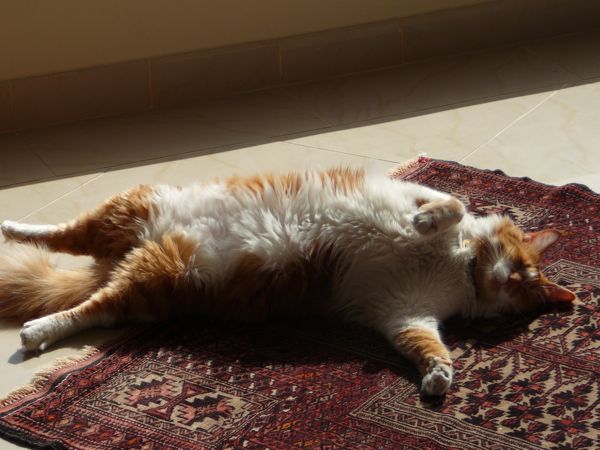
A picture worth a thousand words, hmmm? He is so happy the warm sunny days are back. . . his needs are so few, and he revels in the sweetness of a puddle of warm sunshine.
Un Joyeux Anniversaire
Today is one of those happy-sad days for AdventureMan and I, happy because our son found a sweet, beautiful, smart woman with whom to share his life and with whom he was married two years ago today, and sad, because we can’t be there to take them out to celebrate.

It was a beautiful day, we all had so much fun!

The Event Planner at the Panama City Beach Marriott, when she learned we were coming in from Kuwait, told us she has many Moslem wedding parties at that hotel, and that her biggest problem is finding enough female servers to take care of the bridal parties. Who knew? There is a huge Moslem population in PCB, enough to support private a private, segregated school.
We are missing you too much, and we wish you the happiest celebration!

Housing Collapse and Demographics
From The New York Times:
DUBLIN — The collapse of the housing bubble in the United States is mutating into a global phenomenon, with real estate prices swooning from the Irish countryside and the Spanish coast to Baltic seaports and even parts of northern India.
This synchronized global slowdown, which has become increasingly stark in recent months, is hobbling economic growth worldwide, affecting not just homes but jobs as well.
In Ireland, Spain, Britain and elsewhere, housing markets that soared over the last decade are falling back to earth. Property analysts predict that some countries, like this one, will face an even more wrenching adjustment than that of the United States, including the possibility that the downturn could become a wholesale collapse.
To some extent, the world’s problems are a result of American contagion. As home financing and credit tightens in response to the crisis that began in the subprime mortgage market, analysts worry that other countries could suffer the mortgage defaults and foreclosures that have afflicted California, Florida and other states.
Citing the reverberations of the American housing bust and credit squeeze, the International Monetary Fund last Wednesday cut its forecast for global economic growth this year and warned that the malaise could extend into 2009.
“The problems in the U.S. are being transmitted to Europe,” said Michael Ball, professor of urban and property economics at the University of Reading in Britain, who studies housing prices. “What’s happening now is an awful lot more grief than we expected.”
You can read the entire story HERE
Yes, some banks made loans to a few people who really couldn’t afford the housing, and yes, a small percentage have been foreclosed. Is the entire downturn in the housing market caused by the sub-prime loan debacle?
In the USA, there is a HUGE demographic, the baby boomers, who have already started retiring. As they retire, many are downsizing, looking for a simpler way of life. Could it be that there is more than one factor acting here? Could housing demand be dropping? Wasn’t there a similar post World War II baby boom in Europe? How will the boomers’ retirement effect the US economy?
Kuwait has one long continuous baby boom – seems to me the housing prices here continue to go up!
Election Excitement
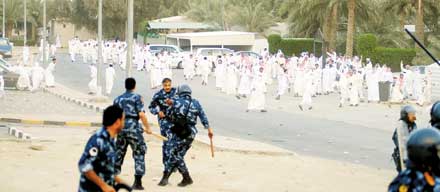
Coming home from church on Friday, we saw a Ministry of Interior Land Rover at a stoplight, with its lights revolving. That got our attention immediately, because if the lights are flashing, it usually means someone is in a hurry, but this guy was waiting patiently for the light to turn. As we noticed him waiting patiently, we also noticed he had his window open, and . . . he was wearing a balaclava, a face mask worn while skiing to keep your face warm but you can still see and breathe. The temperature was at least in the 80’s, and a ski mask to keep your face warm in Kuwait . . . well, that doesn’t make sense. Maybe if he was using his air conditioning, and it was too strong, and hurt his sinuses, well maybe . . .
Saturday we read this article from the Arab Times, which explained a little about what we were seeing:
Two Kuwaitis, officers hurt in Sabahiya clash; ‘Awazem’ battle securitymen
KUWAIT CITY : Two Kuwaitis and a number of securitymen were injured in a violent clash during which the Awazem tribesmen used sticks and stones against security forces, who were trying to stop them holding a primary in Sabahiya. The fighting took place Friday when about 5,000 securitymen from the Special Forces and Riot Police, supported by vehicles and helicopters, surrounded the Diwaniya of former MP and candidate in the upcoming elections from the fifth constituency, Ghanim Al Mei. The securitymen used tear-gas and rubber bullets to disperse the rioters. No arrests were reported. A similar incident some time back had prompted the then Minister of Interior to recall his forces from the Diwaniya of a former MP.
Sources said a large number of securitymen and CID officers were deployed as backup at a nearby cemetery. Security forces and election candidates are exchanging charges, each pinning the blame for the incident on the other. Former MP and candidate from the fifth constituency Abdullah Rai Al-Fahma in a press statement said, “Tribes are an integral part of the Kuwaiti society. They have the right to consult and choose their representatives to the National Assembly like the political blocs and other political organizations.” The government must stop this repressive measure before things take a serious turn, Al-Fahma added. Some observers and a number of candidates have opined the government is exacerbating the issue intentionally to prolong the election indefinitely by issuing ‘emergency decrees.’
My own country is also in an election year this year, and we have our own very strange ways of doing things. We have things like caucuses, and primary elections and delegates, and conventions to choose our candidates.
It is fascinating for me to watch what is going on in Kuwait and to try to figure out what is going on. Even reading reports in the newspapers, even gleaning from the blogs, it is hard for me to figure out why certain things are significant.
So I am guessing here that the tribes/families are acting as political parties and attempting to narrow the field by voting in secret diwaniyyas (diwaniyyas are spaces built in houses for either males or females to gather for visiting back and forth, but not mixed groups, or only very very rarely. They function like the benches on the town square, where people – mostly men – come and discuss issues, often reaching consensus on how an issue should be approached) for candidates that they can agree are electable. Once all the tribe/families have a chance to vote, they will select a slate of candidates to run in that district. This is my guess, based on what I read and see.
But in the districts, there are more than one family/tribe . . . so how do you agree to vote outside your tribal / familial boundaries? It is hard for me to understand how one tribe can gather enough influence to win. I am guessing that these diwaniyya “primaries” are being so actively discouraged because if one family wins too much, then they distribute favors among their own members, and others go without help? Is this a wasta issue? How do the tribes form alliances to win elections?
I would love to tell you that modern western countries don’t have these problems. It would be a lie. We have our own names for “wasta” and one is a term I can never imagine being used in Kuwait, Pork Barrel Legislation which means it doesn’t make sense from a big-picture point of view, it is legislation passed to benefit a few, and to insure that the elected guy can get elected again.
Will banning by-elections make a difference in the outcome of the election? What is the goal of the diwaniyya elections? How do the females get to vote if it is only men attending? What is the government’s goal in banning the by-elections?
Parking Problem
From the Arab Times:
Kuwaiti brothers critically hurt in gang attack over parking row
KUWAIT CITY : Eight persons broke into a Kuwaiti family’s house in Salmiya and attacked three brothers with knives, machetes, sticks and similar weapons just because the brothers did not allow a female student of a nearby institute to park her car opposite their house.
The brothers were critically wounded and had to be admitted to the Intensive Care Unit of Mubarak Al-Kabeer Hospital.
Securitymen, who rushed to the scene after receiving a call from their mother, managed to arrest one of the attackers but the rest of them bolted from the scene.
A case was registered.
By Mizyed Al-Saeedi
Special to the Arab Times
People here can get pretty riled up over parking. One time, my husband and I were attending a social event, and we parked on – well, it looked like a public street to us, and public streets, unless they have numbered, private parking, you are allowed to park on public streets because you are the public. That’s what we thought anyway.
When we came out, we had cars literally blocking us, forward and rear, from getting out. My husband approached the owner of the house in front of whom we were parked, who was around the corner in his diwaniyya (on the public sidewalk) and when my husband said he was sorry, the man said he could put his “assif” (sorry) in his pocket!
Not one to give up easily, AdventureMan schmoozed for a while. The man said he would have his driver take me home, and AM asked him if he would put HIS wife in a car with a strange driver. That got an appreciative grin. Long story short, finally he allowed us to leave. He had some legitimate gripes – the facility where we had attended the performance has people who block his parking access to his house all the time.
My husband visited him again the next day with a parcel of dates to express his appreciation for the guy having let us go, and visited the facility and helped arrange to insure that people would not park in front of this guy’s house again. He and the man became – well, not friends, but cordial acquaintances.
I’ve always been glad AM handled it in a gentlemanly fashion. Imagine, breaking in and stabbing people over a parking spot!
Flea Infestation
Here’s the problem. Life doesn’t come with an instruction manual. OK, OK, we have our holy books, and they give us character guidelines. I am talking about specifics here, when life hands you those lemons, how do you make lemonade? Specifically!
When we move to Florida, we thought we were in Paradise. We had a house with a big pool, surrounded by shady trees, families of racoons, beautiful gardens – what’s not to like?
Paradise came with chamaeleons, lizards, cockroaches, even in the best houses. And fleas. We had to learn how to deal with them.
During our first and only flea infestation, at first we blamed the cats. Being a terrible mother, I asked my son to help, and he went into the walk in shower (No! Not naked! He was wearing swimming trunks!) to bathe the cats with anti-flea shampoo. I would get the cat trapped, put the cat in the shower, he would shampoo them, let one out and I would hand him the next one. Both cats loved him the best; he had chosen them from the litter.
When I saw this photo on LOLCATS, I really had to laugh.

see more crazy cat pics
Just so you will know, the solution is to take the cats to the vet and have them treated for fleas professionally. While the cats are at the vets, pour 20 Mule Team Borax over all your carpets and in all your upholstered furniture, let it stand overnight, and vacuum it all up. After you vacuum, bring the cats back. It really works. The borax creates a saline environment in which the fleas (and cockroaches) can’t survive, but it doesn’t hurt pets.
Moses Learns to Delegate
When I was young, I never would have thought that I would join a bible study on the life of Moses that took a whole year. When I was young, I was a believer, but never dreamed I would really STUDY the word. One day a person invited me in, and I found myself learning things I never would have dreamed.
I remember learning this segment, from Exodus, which is part of the readings for day. Moses listened to his father-in-law, and he had to learn to delegate, so he wouldn’t be worn out:
Exodus 18:13-27
13 The next day Moses sat as judge for the people, while the people stood around him from morning until evening. 14When Moses’ father-in-law saw all that he was doing for the people, he said, ‘What is this that you are doing for the people? Why do you sit alone, while all the people stand around you from morning until evening?’ 15Moses said to his father-in-law, ‘Because the people come to me to inquire of God. 16When they have a dispute, they come to me and I decide between one person and another, and I make known to them the statutes and instructions of God.’ 17Moses” father-in-law said to him, ‘What you are doing is not good. 18You will surely wear yourself out, both you and these people with you. For the task is too heavy for you; you cannot do it alone. 19Now listen to me. I will give you counsel, and God be with you! You should represent the people before God, and you should bring their cases before God; 20teach them the statutes and instructions and make known to them the way they are to go and the things they are to do. 21You should also look for able men among all the people, men who fear God, are trustworthy, and hate dishonest gain; set such men over them as officers over thousands, hundreds, fifties and tens. 22Let them sit as judges for the people at all times; let them bring every important case to you, but decide every minor case themselves. So it will be easier for you, and they will bear the burden with you. 23If you do this, and God so commands you, then you will be able to endure, and all these people will go to their home in peace.’
24 So Moses listened to his father-in-law and did all that he had said. 25Moses chose able men from all Israel and appointed them as heads over the people, as officers over thousands, hundreds, fifties, and tens. 26And they judged the people at all times; hard cases they brought to Moses, but any minor case they decided themselves. 27Then Moses let his father-in-law depart, and he went off to his own country.
Recent Comments
intlxpatr on Shampoo Ginger tigerbutterya0c5ff1d… on Shampoo Ginger intlxpatr on British Soldier Kidnapped, Esc… John on British Soldier Kidnapped, Esc… intlxpatr on British Soldier Kidnapped, Esc… Wikipedia Donate Button

Amazina


Early Voting in Florida


 Here There and Everywhere