Al Fresco in Kuwait
I have had several requests to know what we were eating when we eat in the open courtyard at the Mubarakiya. You Kuwaitis can skip this entry; to you this is not exciting or exotic. To my stateside, European and African readers, this is how it goes:
As soon as you are seated, the waiter brings a little charcoal stove to the table with a steaming hot pot of tea. There is a row of restaurants behind you, one of which has huge gold colored pots of tea brewing at all times. Our Kuwaiti friends tell us that the reason the tea is so strong is that they never wash the pots, just keep brewing tea in them. The tea is STRONG, served in tiny glasses on saucers, and is usually drunk with a good amount of sugar.
Then a plate of greens and onions arrive. The greens taste a lot like basil, very licorice-y, but they don’t look like basil.
You order. We don’t always have the same thing, but what you are seeing here is an order of shish ta-ook (chicken chunks, marinated and grilled, served on a skewer), fresh bread (comes with every order) tabouli ( a salad made mostly of chopped parsley and lemon), muttabel (a salad/dip made of roasted eggplant, tahina and olive oil), roasted lamb with rice, and a sauce made of okra, with a great big ball in it that is some kind of spice we don’t usually use, but enjoy in this sauce.
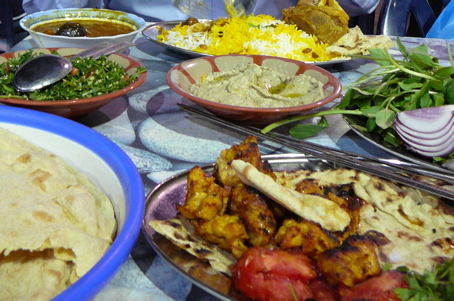
There are people at all the surrounding tables; usually one adult comes first, or maybe two, and tables get moved together or apart, depending on the size of the family coming. Then more women come drifting in, laden with shopping bags. They all greet one another and sit, and finally when the food comes, the children show up, eat a few bites, and then are up playing while the adults finish and drink their tea.
Adventure Man has a little black cat friend who likes the fatty pieces of the lamb he doesn’t eat. When he is finished with one offering, he will pat AM’s leg with his little paw, and AM will give him another piece. This is not a skinny, scrawney little cat, but a plump little cat with shiny fur. Guess he gets enough to eat!
At some point during your meal, you will hear the call to prayer, which we like even better now that we know that the muezzins (the ones who do the call to prayer) are all live, not recorded.
A lavish meal for four – more food than you can eat – with tea, and with excellent service, comes to around 8KD – around $30. How is that for a night on the town?
WoooooHooooooo CO-OP!
It’s hot. It’s humid. I drive to the co-op for a few small things and holy smokes! I see a spot to park, and it’s near the door! I start to park, and I see the handicapped sign, so I go around again, and find another spot about a million miles away. It’s ok, the walk is good for me.
But as I pass the handicapped spots, a car drives in and out pops a perfectly non-handicapped young woman and her two non-handicapped, fully capable daughters!
If looks could kill!
I don’t want to waste a lot of my time on resentment, so I move on.
This week, here is what I see at the co-op:

Wooooo Hoooooooo! Handicapped spots RESERVED for those who have special needs! Blocked off, so as not to tempt the rest of us! Wooooo HOOOOOOOOO, way to go, Co-op!
Accident Aftermath
This time the crunch was different. This time, the initial BLAM crunch was followed by a heart-sickening series of crunches. I was on the phone dialing 777 even before I got to the window.
They have lovely women working for emergency services now, women who can stay calm and switch languages easily. Just hearing her voice calms me down as I report the accident, tell them to send an ambulance. The upside down car door is flipping open, and people are running to help the victim out. It’s a woman, and she is beautiful. She is also bleeding, and once they get her out, she is very still, too still.
The traffic police call me back and I tell them where the accident is, but thank God the woman is still on the phone and when he doesn’t understand, she fills in efficiently and accurately.
It takes them 21 minutes to arrive. The traffic police send one car, and on a busy street, they all gather around the woman and stare. The MOI also send a car. Not one of these police set up any kind of traffic control, cars on both sides of the road are stopping, people come running, just to look.
The ambulances take 22 minutes. When they leave, there are no sirens. I don’t think she survived. The medics appeared knowledgeable and efficient.
It’s the aftermath that bothers me now. On the ground, they left all the medical waste.

The last thing the medic did as he got into the ambulance was to throw his bloodied gloves on the ground:

And then . . .the traffic cops left! There are two wrecks on one of the busiest thoroughfares in town, and no protection from the next speeding car! The wrecks are in the fast lane!
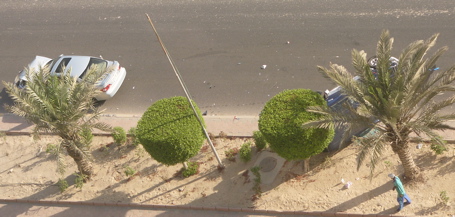
Don’t get me wrong. You know how I feel – police, ambulance medics, firemen – they are all heroes in my book. They risk their lives every day for the common good. The save lives, and they take pride in what they do.
They need a little training in accident management. When there is an accident, there needs to be a priority on getting there fast, and controlling the crowd, and routing traffic by efficiently. The medics need to pick up their waste.
There needs to be after-accident care, ensuring that someone stays until the wreckage is removed.
I had a house guest once who sat in my window and said “Oh my God. Oh my God! Oh! Oh! Oh!”
There are three separate u-turns we can see. Each one is another accident just waiting to happen. When the turn lanes back up, sometimes some people start honking, putting pressure on the lead person to make an unsafe turn. Please – resist the pressure. Take your time. Wait for a safe, truly safe interval.
Please, my friends, do one thing for me. Please, buckle your seat belts. And please, buckle up your children, put them in car-seats made to protect them, teach them from an early age to buckle-up, help it become so automatic they don’t even think about it.
“Can You Help Me Get to Bangladesh?”
I have a dilemma. I don’t know how to handle it.
I carry small bills with me, because I am often asked for money. I keep it so I always have money to give to the people who help me get groceries to my car, the people who deliver propane, people who give good service – I don’t mind. Part of the blessing of having work is the obligation to pass that blessing along to others. We know that God Almighty knows where there is real need, and he moves us to give where giving is needed; he gives us a little shove in our hearts.
Yesterday, a well dressed man with a steady job told me he wants to go home to Bangladesh to see his parents. Could I help him?
I understand about aging parents. I’ve made a few trips myself. I totally understand what it is like to be far away when crises strike. We have always had funds set aside for emergency trips, and, by the grace of God, we haven’t had to dip into those funds often.
“How can I help you?” I asked.
“I need money,” he responded.
Money for a ticket to Bangladesh – that’s not small change. Along with that thought is the thought that were I to “help” this man, word would get around, and I would have many people knocking on my door for serious help with funds.
I don’t think he wants the kind of help I could easily give – showing how to set up an account and contribute to it faithfully, letting the money accumulate until you reach your goal. I don’t think he wants to do what my parents did with me, and what we did with our son – matching funds. (You save up half and we will match your savings dollar for dollar.) He wants an outright big gift.
In our church, we sing a song that says “Freely, freely, you have received, Freely, freely give.” I’ve always believed that with all my heart, it is like a magnified spiritual Locard Exchange Principal especially for blessings; what you have received you give, and it comes back to you doubled, tripled, magnified.
We tend to give larger charitable donations to organizations that make the money work hard – Medicins Sans Frontiers, African schools, our church fund. I consider a ticket to Bangladesh a relatively large charitable donation, large especially for one individual, one individual who is well employed.
So I ask for your prayers for clear guidance. I am not feeling that shove in my heart.
Why Skidboot?
On November 18 of last year, I published a short item, very short, four lines, on Skidboot. At the time, I was so new to blogging, I didn’t even know how to embed a YouTube video in the blog, so I just referred readers to the YouTube site.
For the last two weeks, it has been my top stat getter. I have Googled, I have tried everything I can think of to figure out why Skidboot? Why now, almost a year later?
If anyone coming here to read the Skidboot article will take a minute to tell me why, I would sure appreciate it. It’s not going to kill me not to know, but it is a mystery to me!
Here is the original video:
Three Movies
Most of the time, I work in silence. I have a lot of things I need to think about, and the silence helps me think. When I am ready for some entertainment, I usually listen to BBC. Occasionally, as in the last three days, I turn on the TV, more for background noise than anything else.
Most of the shows I like the best have sharp women as main characters – I love Veronica Mars! I enjoy The Closer, and Crossing Jordan. I love how they overcome their dysfunctions, and how they use their smarts to solve cases. I love it that they screw up from time to time, and have to suffer the consequences, but that they overcome their screw-ups and prevail.
The last three days, I watched parts of three movies. In the first, Braveheart, we were watching Mel Gibson playing Braveheart, but I was constantly distracted by his preening. Have you seen Braveheart? It’s like he is conscious of the camera on him every minute, we the viewers are merely mirrors, absorbing and reflecting his glorious countenance – how annoying! His vanity distracted from a pretty good movie.
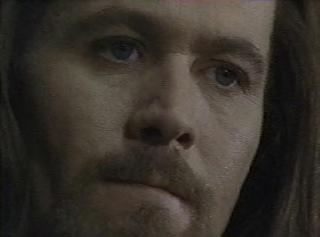
Then I watched segments of Dracula playing Ludwig von Beethoven. I am from a family of movie watchers; my son and husband know all the names and rush to IMDb to check out anachronisms, historical inaccuracies, goofs in continuity, etc. All I know is that every time he went to kiss one of those Viennese women, I wanted to scream “Watch your neck!”
The movie was interesting, and they made good use of all Beethoven’s most loved music, and they used it appropriately. Oldman did a good job of bringing Beethoven to life and making his deafness tragic and believable. He also shows the fickleness and cruelty of the audience for whom he made his music.

Then, yesterday, there was Jack Bauer playing Paul Gauguin! In the early parts of the movie, he lived in a luminously violet painted interior, one I am dying to copy. But that is not the point. Jack Bauer is a stoic. Stoicism is great when it comes to playing a guy who has so many bad things happen to him in the space of 24 hours.
(this is also beside the point, but can you imagine being married to a guy like Jack Bauer? Like he would never tell you what he was really up to, the most exciting times in his life are not with you and his children but off protecting the United States of America, he comes back to you addicted to heroin, or totally burned out and just when you have him all patched up again he gets a call that his services are needed, and you don’t hear from him because he is all caught up in his latest adventure and then after 24 hours he comes home again, a total wreck? What kind of family life is THAT??)
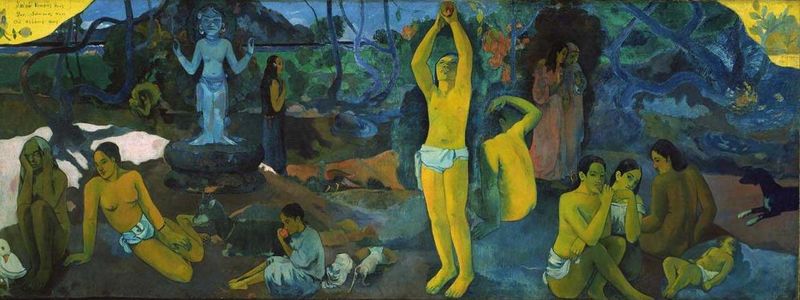
As Paul Gauguin, he leaves his stockbroker existence and becomes a starving painter, then a starving painter who somehow makes it to the South Seas to paint some of the most amazingly colored art every created but his facial expression never changes much. Paul Gauguin was all about passion – and it is just too much a stretch for Jack Bauer. He is not a believable Gauguin. He is not even a believable Frenchman. He barely moves his hands! I would watch the movie again, however, just for a glimpse of those violet colored walls.
It must be a problem for actors, especially TV actors who become too closely associated with one role. I had to look up his real name: Kiefer Sutherland. Fortunately, a new season of 24 starts in just three days. If you ever want to feel sorry for Kiefer Southerland, look at his dad’s resume’ of movies: Donald Sutherland. It wouldn’t be easy to live up to that legend.
The Qatteri Cat Makes the Bed
As quietly as I can, I take the sheets out of the linen closet and into the bedroom. Almost silently, I strip off the old sheets, and pillowcases. I stuff the pillows into new pillowcases, and then quietly, quietly I unroll the bottom sheet. I don’t dare give it a shake and a whip to get the wrinkles out; the Qatteri Cat might hear.
Slowly, I put the first corner on the bed, and move to the second, but it is too late. Although dead in sleep, the Qatteri Cat has detected the sound of sheets, and has made a bee-line for the bedroom.
He wants to help. He jumps into the middle of the bed, then, thankfully, he moves to one corner. I get three corners settled on the mattress, and something intrigues him to move to the center of the bed, so I can get the fourth corner.
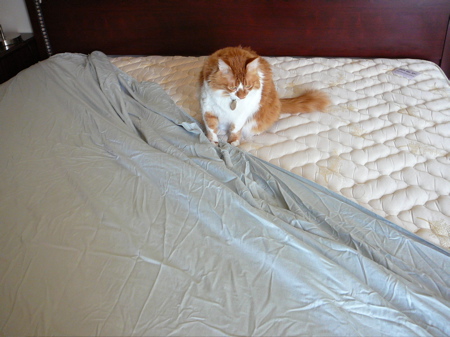
Now, for the part the Qatteri Cat loves the best. The top sheet! I shake the sheet out and it drapes over the Qatteri Cat. He is in ecstacy; “No one can see me!” he purrs.)

He makes a quick dash for safety as I start to put on the quilt, rushing back to the corner of the bed. I arrange the quilt around him and walk away – if I am not there for him to obstruct, he loses interest quickly.

He thinks it is a game we play. He is sad when it is finished. He brings Dolly in to the finished bed and grieves that I won’t play the bed-making-game with him any more.

Older Brother Stunts Your Growth
Scientists just think differently. Who woulda thunk to study how having older siblings affects height? This is from BBC Health.
Having an older sibling, particularly a brother, can stunt growth, work suggests.
Experts said the condition of the womb after the first pregnancy may be a factor.
The study of 14,000 families was presented at the BA Festival of Science.
The research, by David Lawson, of University College London, also showed children in larger families were likely to be shorter than average.
Researchers found that children with three siblings were 2.5cm or one inch shorter than the average height for their age.
If you are one of the younger ones, then you can expect to be shorter than your older siblings
Dr Lawson
It was suggested siblings may dilute resources – time, money or love – that parents are able to invest in children.
The researchers followed children born in the 1990s and who were enrolled on the Avon Longitudinal Study of Parents and Children, one of the largest public health studies to be set up in Britain.
Each year, the children’s height was recorded, along with other details of their development.
While having older siblings of either sex affected a younger child’s development, the effect of older sisters was more mild.
You can read the rest of the article HERE.
A Moment for Mirth
As we complain about traffic, write passionately about the environment, and wonder what on earth is going on with our government(s) (What? you thought it was just Kuwait?) and even worse, as we start to talk about the good old days, back in the day . . . whoa! Oh no! We are starting to sound . . . like our parents!
So, for a moment of fun, take a look at a song from a very old musical, The Music Man, set over a hundred years ago, where he talks about the new phenomenon corrupting the youth of the country. Watch how the parents get all worked up. And remember – it is all part of his agenda.
Staph Fatalities Alarming
This is from AOL Health News but it is also featured on Good Morning America today. The government says there has been “an alarming increase” in staph infections, and the number of deaths due to these common infections could soon be overtake death from AIDs infection.
My own father spent a year dying, fighting of MRSA, which is common in many hospitals – even here in Kuwait. The old are particularly vulnerable, but so are all those with open wounds, recent hospitalizations, and compromised immune systems.
CHICAGO (Oct. 17) – More than 90,000 Americans get potentially deadly infections each year from a drug-resistant staph “superbug,” the government reported in its first overall estimate of invasive disease caused by the germ.
Deaths tied to these infections may exceed those caused by AIDS, said one public health expert commenting on the new study. Tuesdays report shows just how far one form of the staph germ has spread beyond its traditional hospital setting.
The overall incidence rate was about 32 invasive infections per 100,000 people. That’s an “astounding” figure, said an editorial in Wednesday’s Journal of the American Medical Association, which published the study.
Most drug-resistant staph cases are mild skin infections. But this study focused on invasive infections – those that enter the bloodstream or destroy flesh and can turn deadly.
Researchers found that only about one-quarter involved hospitalized patients. However, more than half were in the health care system – people who had recently had surgery or were on kidney dialysis, for example. Open wounds and exposure to medical equipment are major ways the bug spreads.
In recent years, the resistant germ has become more common in hospitals and it has been spreading through prisons, gyms and locker rooms, and in poor urban neighborhoods.
The new study offers the broadest look yet at the pervasiveness of the most severe infections caused by the bug, called methicillin-resistant Staphylococcus aureus, or MRSA. These bacteria can be carried by healthy people, living on their skin or in their noses.
Your best protection? Wash your hands frequently, and stay out of hospitals.
You can read the rest of the article HERE.
Recent Comments
intlxpatr on Shampoo Ginger tigerbutterya0c5ff1d… on Shampoo Ginger intlxpatr on British Soldier Kidnapped, Esc… John on British Soldier Kidnapped, Esc… intlxpatr on British Soldier Kidnapped, Esc… Wikipedia Donate Button

Amazina


Early Voting in Florida


