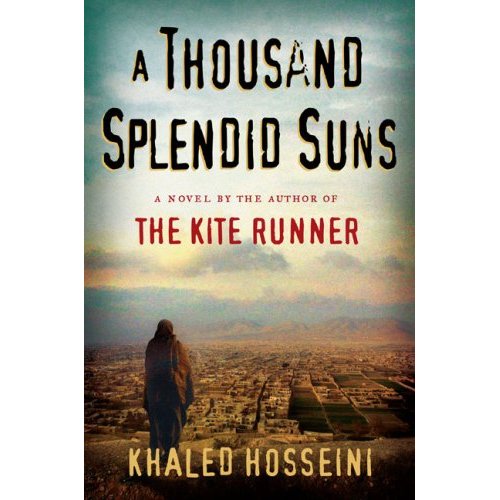
A Thousand Splendid Suns
Once I picked up Khaled Hosseini’s A Thousand Splendid Suns, I barely put it down again until I was finished. I found myself thoroughly involved in the lives of Mariam and Leila, unwilling even to stop to fix dinner! The author of Kiterunner has hit another home run.
There was a time when we would listen to older state department types talk – with enormous longing – about their tours of duty in Afghanistan, pre-Soviet invasion, pre-Taliban, pre-American occupation. Have you ever read James Michener’s Caravan? There are two countries I long to vist, but the countries they are now are not the countries I heard people talk about – Afghanistan and Ethiopia. Our friends loved their times in these two countries.
A Thousand Splendid Suns opens in a small village outside Herat, and then takes us to Kabul. Mariam is born harami, a bastard, of a village cleaning woman in the house of a very wealthy man. Her father builds a small hut for her mother and herself in a remote part of the small village, and visits Mariam every week. Life is simple, and difficult, but also full of kind people who visit and who are concerned with Mariam’s welfare.
After marrying, Mariam goes to Kabul and learns a new way of life with her husband, Rasheed. What fascinates me with Hosseini is that while Rashid is one of the villians of this novel, he is just a man, doing the best he can given his own upbringing and limitations. In a sense, he is “everyman”, the strutting, domineering, sometimes brutal and abusive husband we find in every culture. But Hosseini also gives him transient bouts of kindness which blow through a little less often than the transient bouts of cruelty.
He also gives us good men, in this book, in the person of Jalil, the father of Mariam, who steps up to the plate in acknowledging Mariam and supporting her and her mother, but fails to nurture in the very real way women need nurturing from their fathers in order to reach their full potential in life. Hosseini also gives us a very strong man in the book, Tariq, who, although he has only one leg, is more wholly a man than any other man in the book. I imagine that this is not unintentional. (How Kissingerian is that for a double negative?!)
Written almost entirely in the Afghan world of women, we see through the eyes of Mariam, and later Leila, the transitions in Afghanistan and their impacts on daily life. We experience happiness with them, and peaceful scenes in quiet moments, raising the children, stepping outside into the garden at night to share a cup of tea and a shared bowl of halwa.
Between the moments of peacefulness, we also experience incoming morter rounds, explosions, marauding bands of warlords, and starvation. We go into a women’s hospital under Taliban control, where there are no medications, no running water, no instruments, and an Afghani female doctor does a C-section with no anaesthesia and is required to keep her burqa on. We watch a mother abandon her role and take to her bed when her two sons are killed fighting the Soviets, we experience betrayal and we experience helplessness, and we experience a Kabul women’s prison. A Thousand Splendid Suns is a rich feast of experiences, juxtaposing the everyday chores of women around the world – cooking, raising children, laundry – with events on the world stage.
(Available from Amazon for $14.27 plus shipping.)
“Something More Serious”
I remember clearly the first time I ever felt old.
I had discovered a Lancome product, Renergie, that I loved. I have always been good at trying to keep my face “moisturized,” and had graduated up to Lancome from good old Oil of Olay. We were living in Germany once more, our son was about eight years old, and I think they formulate Oil of Olay differently for different customer bases; the smell was different in Germany (and even more different in Qatar! I think it has a sort of cumin undertone!) but I had found this Renergie stuff that glided on and smelled good and wasn’t oily or sticky, so I liked it. It was expensive, but we had a little more money now and I felt it was a splurge.
My Renergie was running out; I needed a replacement. I happened to stop by the Lancome counter at a time when there was a Lancome representative there who asked what I needed. I told her I was looking for the Renergie that I loved.
Simple question, right?
The Lancome representive stops, and looks at me closely. There is this long, uncomfortable pause as she continues to look at me. I’m frankly annoyed.
“My dear,” she starts, “You need something more serious.”
Something more serious? I’m thirty-five years old! I have not yet got any wrinkles to speak of! My skin is in great shape!
All these thoughts rush into my head as the saleslady continues to look at me seriously, and to move toward some heavier creams, which I HATE. I’m still dealing with that one word – “serious.”
I need something “serious.”
It was so devastating to me that my reaction was almost physical revulsion. I think my legs went week and shakey. Looking back, I suspect that it is part of a sales pitch, a script devised to move the customer up the scale to more and more expensive products. I think I even sensed it then, but the truth is, when someone says something like that to you, it damages a vanity that you didn’t even know you had.
I don’t think I bought anything that day. I think I stumbled out of the store and went to pick up my son from his karate lesson and sneaked back at a time when there was no Lancome lady there and bought what I really wanted – the Renergie.
But the damage had been done. Now, when I put the cream on my face I was looking in the mirror for whatever the saleslady had seen that indicated I needed something more “serious.”
It wasn’t long before I humbled myself and went back and asked what the representative thought I really needed, and we agreed on the light form – the lotion – which also went on nicely and smelled good, because how it smells really matters to me. I don’t care how good it is; if it doesn’t smell good – to me – I can’t wear it.
She moved me up to Primordiale, which I wore for years until the next Lancome representative looked at me and said brightly “I bet you would love Absolue! It will get rid of those little crow’s feet in no time!”
We all have weak spots that we don’t even know we have. If you are a man and you have read this far, you will laugh in your superior way, thinking this is just a piece of fluff. To you I say wait until your son beats you in those family wrestling matches for the first time, beats you fairly. When our son would wrestle with his Dad, I would say “I hear the antlers clanging in the forest!” as they fought for who would be the king. To you I say that the sad day will come when you are no longer the biggest bull moose in the forest, and you, too, will have that sad, humbled feeling I got when I was told I needed something more “serious.”
The advertisers of this world know our weaknesses. I am willing to bet the Lancome ladies have a script they use, to press our buttons, to expose weaknesses we don’t even know we have. My husband brings home a Men’s Health occasionally – have you ever noticed, every one of them is the same? There are articles about making your abs flat, taking vitamins and reviving your sex life – in every issue! They know where we feel bad about ourselves before we even know it, and they are making a lot of money off of our inadequacies!
And no, my friends, I don’t have any answers. Even while I know that these things are the vain, inconsequential things of this world, even while I know that this is all passing vanity, even while I try to resist, I succumb. Sometimes the temptations is too great and my spirit is too weak to stand up to their insistence that I need something “more serious.” This blog entry is merely my meager attempt to fight back.
Peter Bowen: Wolf, No Wolf
“You have to take this. You’ll really like it,” Sparkle insisted as I inwardly groaned, thinking of the TWO stacks of unread-must-reads by the side of my bed, and my already bulging suitcases.

“I know it doesn’t sound like something you’ll like,” she went on, slightly frustrated with me, with herself, “but once you start reading, you’ll get into it.”
Not exactly a ringing endorsement, but good enough for me. I always KNOW what I think she will love, and she has done me many a favor in return, introducing me to authors and series worth reading.
“It’s about Montana. The main character is mixed Indian and French and some other things, a grandfather, and it all takes place in a small town in Montana . . . ” she sort of fizzles out. “I’m really not doing a very good job of making this interesting.”
And she sighs in frustration.
So, about a month later, just because I love my sister, I pick the book up and start reading while waiting for my husband to get home for dinner. As it turns out, he is very very late – and I am very very glad. I don’t want to stop reading!
When you first jump into Wolf, No Wolf by Peter Bowen, it takes you a minute to adjust your ear to the way they talk. These aren’t people most of us have met before. Gabriel DuPre´ is m´etis, a mixed blood. His ancestors are French who came early to the great continent that is now the US, Canada and Mexico, and they trapped and hunted, married native American wives, and developed a culture all their own. His language pattern is similar to that of the Cajun in Louisiana.
He is a cattle brand inspector in this small Montana town. His children are grown, he has so many grandchildren he can’t remember all their names. Every now and then, he pins on his deputy sherrif badge to solve a mystery in the small town of Toussaint, Montana.

Here is how Wolf, No Wolf opens:
Du Pre´ fiddled in the Toussaint Bar. The place was packed. some of Madelaine’s relatives had come down from Canada to visit. It was fall and the bird hunters had come, to shoot partridges and grouse on the High Plains.
The bird hungers were pretty OK. The big game hunters were pigs, mostly. The bird hunters were outdoors people; they loved it and knew it, or wanted to. The big game hungers wanted to shoot at something big, often someone’s cows.
Bart had bought a couple thousand dollars’ worth of liquor and several kegs of beer and there was a lot of food people had brought. Everything was free.
Kids ran in and out. The older ones could have beers. Bart was tending bar. Old Booger Tom sat on one of the high stools, cane leaned up against the front of the bar.
“You do that pretty good for someone the booze damn near killed,” said Booger Tom. “I know folks won’t be in the same room with the stuff.”
“Find Jesus,” said Bart. “It’s not too late to save your life.”
He went down to the far end of the bar and took orders. Susan Klein, who owned the saloon, was washing glasses at a great pace.
One of Madelaine’s relatives was playing the accordion, another an electric guitar. They were very good.
Du Pre´ finished. He was wet with sweat. The place was hot and damp and smoky, so smoky it was hard to see across the room. The room wasn’t all that big, either.
Madelaine got up from her seat, her pretty face flushed from drinking the sweet pink wine she loved. She threw her arms around Du Pre´ and kissed him for a long time.
“Du Pre´,” she said, “you make me ver’ happy, you play those good songs.”
. . …
Someday this fine woman marry me, thought Du Pre´, soon as the damn Catholic church, it tell her OK, your missing husband is dead now so you can quit sinning, fornicating with DuPre´.
I’ve never hung out in a bar in Montana, fiddled, or had a girlfriend named Madeleine (!), but already I feel like I know these people and this life. Peter Bowen is the Donna Leon of Montana, introducing us to the kind of crimes that happen in those sleepy looking towns we drive past on the superhighways, glancing at, or stopping to fill our gas tanks.
DuPre´ is a good man, and, like many a good man, sometimes has to do a bad thing to protect those he is sworn to protect. Policing is not pretty business.
The first story has to do with the re-introduction of wolves back into the Montana highlands, something not at all popular with those who have been raising cattle there. The second book in this two-book collection has to do with serial killers, how they stay under the radar, and how very difficult it is to catch them.
In both books, it is as much about a new way of living and thinking as it is about solving the crime. DuPre´ consults often with his friend Benetsee, the local medicine man, who sees things we don’t see. One of the FBI Agents is Harvey Wallace, also more than half native American, whose real name is Harvey Weasel Fat. The books are about how men and women fight, the nature of male friendships and female friendships, and very much about the human condition wherever we may be.
Life is short. I can never live in all these places long enough to even scratch the surface of the flavor of each variety of life. But these books help, they give us glimpses into another way of thinking, another way of doing things, and stretches our little minds just a little so that we learn to think more flexibly.
So who is going to write the Kuwait detective series? Who will take us into the diwaniyyas seeking information, who will take us out on the shoowi to gather information against those delivering drugs to Kuwait, with whom will we camp in the desert, avoiding explosives left over from the Iraqi invasion? I think his name is Anwar al Kout (the light of Kuwait!) and his wife is Suhail (the Yemeni Star!) – somewhere out there is someone who can take us into Kuwait and bring it alive. Where are you?
(You were right, Sparkle. I loved it!)
Ramadan Date Night
It’s the first night of Ramadan, and it is also Thursday, which is date night for Adventure Man and me. We hustle around all week, involved in our lives, grabbing ten minutes here and a phone call there, sitting down to dinner and that’s about it. But Thursday nights, we have the sweet luxury of time together. We go out to dinner somewhere, and we talk on the way there, we talk all through dinner and we talk on the way home. We both love date night.
Date night on the first night of Ramadan is REALLY special. Here is why:

“What’s so special?” you are asking in puzzlement. “That’s just an empty parking lot.?”
“EXACTLY!” I exclaim, triumphantly. “At seven in the evening, there are PARKING SPACES!” In a mall built for thousands of people that has only forty parking spaces! And we get Rock Star Parking!”
And unlike countries where they start putting up Christmas decorations in October, the Ramadan decorations began going up seriously yesterday, the beginning of Ramadan. They are still finishing up tonight.

I love the crescent moon and stars twirling down from these –


And look at these GORGEOUS lanterns!

There is no one around to object to my photo-taking. All the Westerners are eating or shopping while the mall population is so light.
Traffic is so light that we even stop for gas on the way to dinner, and drive right up to a pump with no wait at all. All the good Muslims are at home, or with friends, breaking the fast together, celebrating their triumph over the first day of fasting.
If you lived in Kuwait, you would know what a triumph it is. The weather is cooling, but still very hot – around 111°F/44°C every day this week. It is dry, and on some days there are sandstorms. Even when you are not fasting, you yearn for a cold drink of water.
The women often cook all day. They do the shopping. Many are around food most of the hours of their fast, so that they might provide a feast for their family when the sun sets, and they resist the temptation, just smile and say “It’s a test.” There is a custom that they can taste the food, to make sure it is OK, but they cannot swallow, or the fast is broken.
Qatari Cat Plays With Adventure Man
When we got the Qatteri Cat, he was about 8 months old, a gangly adolescent. I had been looking at another cat, but the vet showed me this one and said “he looks like you.” It made me laugh, and I took the cat.
He had been adopted by a family where the man in the house really liked him, but his wife and her mother did NOT like him. The Qateri Cat cringed every time I came near, he would hunker down on the floor, his ears would flatten and he would growl.
The minute Adventure Man walked in the door, the Qatari Cat fell in love. He followed AM around the house, rubbing on his legs, looking at him adoringly. As he calmed down and I would pet him, he would allow me 30 seconds and then he would bite me – hard, hard enough to draw blood.
We ran into his former owners at an art exhibit. “Is he still such a naughty boy?” the M-I-L asked us. “Oh no!” we lied, “He is NEVER naughty.”
Qatari Cat would occasionally get out of the house, and I would have to try to find him. All I had to do was to wait a few hours, and then I would hear his plaintive wailing from behind somebody’s wall, and I would have to go knock on the door and ask if I could get my cat. I learned to take his cat cage with me, after being seriously scratched a couple times because he was tired and scared and his natural instincts came into play. I still have scars to prove it.
Slowly, slowly, he came to trust me. Even when he bit and scratched, I never hit him, never kicked him, I would just pick him up and put him in a bathroom for ten minutes or so – or until I got over being angry with him. His little brain couldn’t remember three minutes later why he was in “Time out”, but sometimes I had to keep him there for his own protection!
He still bites when he is scared. He was born on the street, and those instincts will always be with him. I keep him away from little children and people who would move too fast in his direction. For the most part, he is tamed. He hasn’t bitten me for months, and even then, even as he was biting me, hard, he remembered, and let me go without a fight. He even had the decency to look a little ashamed.
Why am I telling you all this? With Adventure Man, he is a totally different cat. He has NEVER bitten Adventure Man. Adventure Man comes home from work and the QC is waiting in the hallway for him. He slings QC over his shoulder and takes him on a walk around our home, then he slings him down on the carpet and give him a big rub on his tummy. The QC never bites, never scratches, just goes belly up and lets his “dad” rough him up. As soon as AM lets go, he does this amazing flip to get back on his feet and he runs away just a little, looking back and saying “C’mon, aren’t you gonna chase me?” and I hear the two of them roaring off down the hallway.
I think the QC thinks AM is another cat, a really fun cat. And I think he thinks I am his mom. Definitely he thinks I am his feeder, waterer and warm spot. But I will never hold the same place in his adoring little heart that Adventure Man holds:

PS Adventure Man didn’t like the photo I posted last week called DementoCat. He said it made the QC look dead, and it hurt his heart to see it. I am sorry, Advenure Man. 🙂
Nemirovsky: Suite Francaise
Within five seconds of starting this book, you are in Paris, flurrying with the Parisians. It’s hot, it’s June, it’s 1940 and the Germans are coming, it is time to get out of town. We are in the middle of preparations to evacuate, with several families, couples and individuals as they make their preparations.
Have you ever been evacuated from a house or hotel due to sudden fire? Have you ever wondered why, in the seconds you had to prepare to leave, you made the choices you did? I groaned as I lived with people carefully packing their linen tablecloths and bird cages; but it’s different when it is not YOU. What I admire so much about Irene Nemirovsky’s book is that you are THERE, you feel so much a part of it. I can tell you what it was like, the desperation as “we” evacuated Paris, and later, as we lived with the enemy using our house for billeting.
The Suite Francaise is two parts, Storm and Dolce. As you reach the end of Dolce, you have a strong feeling that there should be more, and indeed, as you read, seeking satisfaction, the appendices, you discover the book was intended to have four or five sections. The interpreter who put the manuscript together, filling in from Nemirovsky’s notes, has done a masterful job on the two sections that were somewhat complete, but, unfortunately, Nemirovsky, a Catholic, had a Jewish parent, and that was enough to get her arrested, transported to a concentration camp and executed, all within a very short time. The correspondence between her husband had the authorities, in the short time between her arrest and death, is desperate, and chilling.
You can’t help but be heartsick at the loss to this world of such great talent. You can’t help but wonder what this book, as good at it is, might have been as a larger whole?
Nemirovsky, above all, has an acute eye for French thinking, French manners, French mannerisms, and above all, for French class distinctions. The dialogues are SO perfectly believable, as are the depictions of the manner in which people under the worst kind of stress can behave with both inhuman kindness and insensitive cruelty toward one another.
You know how I am always wondering what my cat is thinking. . . I share an excerpt of the book with you. I believe Nemirovsky knows what a cat is thinking!
The cat poked his nose through the fringes of the armchair and studied the scene with a dreamy expression. He was a very young cat who had only ever lived in the city, where the scent of such June nights was far away. Occasionally he had caught a whiff of something warm and intoxicating, but nothing like here, where the smell rose up to his whiskers and took hold of him, making his head spin. Eyes half closed, he could feel waves of powerful, sweet perfume running through him: the pungent smell of the last lilacs, the sap running through the trees, the cool, dark earth, the animals, birds, moles, mice, all the prey, the musky scent of fur, or skin, the smell of blood . . . His mouth gaping with longing, he jumped on to the window sill and walked slowly along the drainpipe. This was where a strong hand had grabbed him the night before and thrown him back . . . but he would not allow himself to be caught tonight.
He eyed the distance from the drainpipe to the ground. It was an easy jump, but he appeared to want to flatter himself by exaggerating the difficulty of the leap. He balanced his hindquarters, looking fierce and confident, swept his long black tail across the drainpipe and, ears pulled back, leapt forward, landing on the freshly tilled earth. He hesitated for a moment, then buried his muzzle in the ground. Now he was in the very black of night, at the heart of it, at the darkest point. He needed to sniff the earth: here, between the roots and the pebbles, were smells untainted by the scent of humans, smells that had yet to waft into the air and vanish. They were warm, secretive, eloquent. Alive. Each and every scent meant there was some small living creature, hiding, happy, edible . . . June bugs, field mice, crickets and that small toad whose voice seemed full of crystallized tears . . . The cat’s long ears – pink triangles tinged with silver, pointed and delicately curly inside like the flower on bindweed – suddenly shot up. He was listening to faint noises in the shadows, so delicate, so mysterious, but, to him alone, so clear: the rustling wisps of straw in nests where birds watch over their young, the flutter of feathers, the sound of pecking on bark, the beating of insect wings, the patter of mice gently scratching the ground, even the faint bursting of seeds opening. Golden eyes flashed by in the darkness. There were sparrows sleeping under the leaves, fat blackbirds, nightingales; the male nightingales were already awake, singing to one another in the forest and along the river banks.
And I imagine that the above all took place in the space of about 15 – 30 seconds!
If Nemirovsky can capture a cat’s thoughts so eloquently, just imagine what she can do with the French!
The second part of the Suite, Dolce, takes place in a small farming village and ties many of the evacuees from Storm loosely with the village and subsequent events. In Dolce, we live with a young married Frenchwoman in the home of her mother-in-law who blames her for enjoying life while her own son, the young woman’s husband, is a prisoner of war in Germany. If that weren’t bad enough, soon a young German officer is sent to live with them.
We have lived among the evacuating Parisians, in Storm, and now, in Dolce, we are living in the provinces, with it’s stultifying conventions. There are whole passages where the restrictions of polite French countryside society make it so suffocating, you almost have trouble breathing. And yet, as they do in every society, the young find ways around the conventions, risk their lives, risk their reputations, and live thinking that no-one sees what they are doing, while the elders bite their lips in horror. Fascinating reading. Nemirovsky’s genius to to make you feel you really are THERE.
Donna Leon: Death in a Strange Country
Recently I discovered, to my disgust, that I have purchased two Donna Leon books I have already read. I bought them from England, and now they have been published in the US under different titles. Aaaarrrgh! I hate it when that happens.
I have a good friend I want to pass these books along to, an amazing woman who has no idea how amazing she is. When she talks about her early years as a private detective, she refers to herself, with a perfectly straight face, as a “Dickless Dick.”
After I read this book, I passed it along to Adventure Man, who loved it. He aloud to me from it late at night, and we both laughed. Here is the the excerpt he liked, he could identify with it:
In their bedroom, he saw that she had placed a long red dress across the bed. He didn’t remember the dress, but he seldom did remember them and he thought it best not to mention it. If it turned out to be a new dress and he remarked on it, he would sound like he thought she was buying too many clothes, and if it was something she had worn before, he would sound like he paid no attention to her and hadn’t bothered to notice it before. He sighed at the eternal inequality of marriage, opened the closed, and decided that the grey suit would be better.
He, of course, is Commissario Guido Brunetti, Donna Leon’s chief investigator, consumately Venetian, very married, and fighting a lonely battle against the louche corruption of the Italian bureaucracy.
And this book is about the death of an American military man in Venice, except that of course, it turns out to be about something much much bigger. Leon has several axes grinding in this one, but the biggest is illegal dumping, and the arrogance of countries who dump their toxic wastes on smaller countries, eyes wide open, knowing full well that horrorific consequences may result – and not caring.
My favorite part is when Commissario Brunetti visits the American base outside of Venice for the first time:
He left the place and went to stand outside, content to get a sense of the post while waiting for his driver to return. He sat on a bench in front of the shops and watched the people walking past.
A few glanced at him as he sat there, dressed in suit and tie and clearly out of place among them. Many of the people who walked past him, men and women alike, wore uniform. Most of the others wore shorts and tennis shoes, and many of the women, too often those who shouldn’t have, wore halter tops. They appeared to be dressed either for war or for the beach. Many of the men were fit and powerful; many of the women were enormously, terrifyingly fat.
Cars drove by slowly, their drivers searching for parking spaces: big cars, Japanese cars, cars with that same AFI number plate. Most had the windows raised, while from the air-conditioned interiors blared rock music in varying degrees of loudness.
They strolled by, amiable and friendly, greeting one another and exchanging pleasant words, thoroughly at home in their little American village here in Italy.
Donna Leon has a sharp eye for detail, doesn’t she? Don’t you feel like you were sitting there on the bench with Commissario Brunetti, seeing through his eyes?
Reading Donna Leon transports you to another world, Venice, and the joy of reading has less to do with solving the crime than being able, for a short time, to stop and drink coffee while tracking down a criminal, eating a meal or two with Brunetti and his family, experiencing the frustrations of the Venetian bureaucracy in all its radiant corruption, walking along the canals so early in the morning that the delivery men haven’t even begun yet making their deliveries . . .
And yet the problems addressed in the Leon books are part of a greater world picture, and Leon has an enormous capability to draw blurry lines with increasing clarity as we watch how international corruption works hand in hand blindly taking profits while dribble by dribble degrading the world for future inhabitants.
Pastor “apologizes”
This story is from yesterday’s Arab Times. I am putting in the whole thing because of what is missing:
A US pastor accused of beating his televangelist wife Joanita Bynum has apologized to all Christians over a case that could see him imprisoned for up to 27 years.
In a statement issued through his lawyers Wednesday, Thomas W. Weeks III, 40, apologized to Christians, his church family and others “having to endure this ordeal.”
Weeks, known to his followers as Bishop Weeks, is accused of beating, stomping, choking and threatening to kill his gospel singer wife during an August 21 argument outside a hotel in Atlanta, Georgia. He has been indicted on felony and misdemeanor charges stemming from the alleged attack.
“Because of the method in which this was handled just hours following the situation, it has not only hurt me, but has damaged the reputation of Christians around the world,” Weeks said.
“It is for this reason that I continue to trust in God while the storm would try to engulf me. Finally, I’m asking every Christian to pray that God’s will be done.”
In his statement, Weeks, the pastor and co-founder of Global Destiny Ministries, also cautioned against rushing to judgement in the case, and said he would give his side of what happened at the appropriate time.
This article makes my blood boil.
He apologizes to everyone – EXCEPT to his wife, whom he beat, stomped, choked and threatened to kill.
This is typical of the cowardly kind of bully who beats up on those smaller than he is and tries to make them believe that it is THEIR FAULT, that they drive him to these vicious rages by . . . oh who knows . . . a tone of voice, a step too loud, one of the kids gets a bad grade. It is always everyone else’s fault, and he is quick to kick the nearest victim, usually his wife. And the saddest thing of all, is that the wife, and sometimes the kids, buy into this jerk’s reasoning. “You made me do it.”
“You made me blacken your eye. You made me break your arm. You made me push you down the stairs. You made me drink. You enraged me. It’s all YOUR fault.”
If you are one of those cowardly, contemptible bullies reading this, I have nothing but scorn for you.
I hope this guys wife leaves him and never looks back. Of course, the problem is, he is one of those self-absorbed imbeciles who might feel she is his property, and might decide to kill her for leaving him. Still, even a moment’s freedom from this abusive lout’s controlling rages is better than another minute in his presence.
In the last line, he says he will give his side in time – yeh, when he can figure out how to present it so that HE is the victim, and his beaten wife the bad guy. I am not going to hold my breath.
Get an Early Lead and Hold It
The title line is from an old joke: a high school football coach tells his team the secret of winning – Get an early lead and hold it.
Many of you have asked about why it even matters to me what the Yemeni Star is all about. So I am going to tell you a secret from my childhood, a secret that got me through school with good grades.
It’s in two parts. The first is about getting an early lead – it’s called The Halo Effect and it is like getting an early lead and holding it. You work really hard and get good grades when you are young, and those early grades influence the later graders to give you the benefit of the doubt as you move up the grades. It doesn’t always work, but often enough that it has been given it’s own name.
The second secret is to develop an area of interest to YOU. For me, it was the stars. I loved (and still love!) stars, constellations, comets, heavenly rhythms, music of the planets, etc. For me it is God’s hand on this vast, cosmic scale. So I first started writing early reports on stars, constellations, etc. You know, how you have to write science projects?
From the constellations, I branched out into mythology – what a great study. So many references in daily life and literature refer to mythical beings and happenings, and if you don’t have a clue, you miss a whole level of richness. Like if someone refers to a Sisyphusian endeavor, you don’t have to run go look it up, you know they are referring to an almost impossible task. Between astronomy and mythology, there was enough material that I could take previous reports every year and ramp ’em up for the next year. I usually learned something, but the most important thing I learned was that I could succeed without having to re-invent the wheel every year.
If you can develop a particular field that interests you, your school life can be a lot more interesting. And believe me, we all know how deadening the school experience can be, unless you have really good teachers who can make it come alive for you. You have the most amazing tools available to you – a world of information, via the ‘net, and GoogleEarth – GoogleSky,, Wikipedia, and all kinds of illustrations available to add depth to your papers and reports. You are truly a generation who can have a lot of fun learning, if you take responsibility for your own education.
(Big hurrahs and shouts out here for Elijah, Swair, Magical Droplets,, MacoholicQ8, and all my other teaching friends, my classroom-warriors friends, heading back to do battle with and enlighten reluctant minds; you are my heroes!)

Rape in Kuwait (2)
There seem to be some misconceptions running around about rape in Kuwait. One misconception is that Kuwaitis commit a lot of rape. If you read the newspapers, however, you will discover that a lot of the rapes committed are nationality on nationality, for example, one senior Phillipina lady will befriend an unhappy domestic worker, will “help” her get away, and the domestic finds herself abducted, gang raped and in sexual slavery. That’s one common story.
Domestics of all nationalities are abducted off the streets, taken to apartments or villas, raped repeatedly by two or more men, and then dropped off on the street (or dropped off a balcony). People don’t seem to be very concerned about domestic servants being people here, having the right NOT to be raped, it sort of seems like business as usual, no matter who is raped or doing the raping. I have yet to read of one single case being prosecuted or sentenced in the Kuwait newspapers, but maybe I missed a day or two.
Another common story is Indian/Bangladeshi/Pakistani on Indian/Bangladeshi/Pakistani, and that can be men abducting/raping men, or men abducting/raping women. Some of these women are also recruited into prostitution, and are found when the police raid the dens of iniquity, catching the men and men or men and women in “uncompromising” positions, or, even better – RED HANDED!
There is a whole catagory of abductions – Kuwaiti, Bedoun or other Gulf or Arab nationality where a man or woman, or men or women, is/are abducted and taken to camps in the desert and raped multiple times. Sometimes they are left naked by the side of the road. Sometimes their dead bodies are found, and occasionally enough clues to guess at the identity of the abductors/rapists.
Then there are the men that rape children. It can be within a family. It can be within a building. It can be within a neighborhood. Many times the child knows the rapist, and is told that if they say anything, the rapist will kill or harm the child’s parents. There was an epidemic of child rape in Hawali, and although the man arrested cries “I didn’t do it!” the fact is that the epidemic of rape in Hawali has stopped. That doesn’t mean that children aren’t being raped, it just means that the Hawali Monster seems to be off the streets of Hawali.
Objectively, if there can be said to be a “good” thing about rape in Kuwait, it is that so few of them are fatal.
What can, accurately, be said about Kuwait is that there seems to be a lot of rape. If you think I exaggerate, I challenge you to read the Kuwait papers every day for a month.
When there is a lot of rape, it means there is a social, legal and political climate that tolerates rape. It means that rape cases are not handled with a lot of attention to gathering evidence. It means that men and women are not encouraged to persue rape charges. It means that the police are not very interested in investigating accusations of rape. It means that the legal system is not very interested in prosecuting rape. It means that the rape victims are not valued highly enough to deserve not to be raped.
Rape happens everywhere. Rape happens in wars, rape happens on the streets. In most places, we are taught, rape isn’t about sex as much as it is about power. Here, in Kuwait, I am inclined to think it may be a little bit of both.
I’ve worked with rape victims in several different locations. Working with the victims gives you so much admiration for women, what they endure, what they survive, and their deeply ingrained sense of priorities and self. You’d think the experience would be devastating, but the women who have experienced rape and overcome it have been anything but devastated – many of them become truly awesome individuals, literally, awe-inspiring. They refuse to be victims. They carry on with their lives. They accomplish. They let their anger fuel and energize them to become incredibly accomplished individuals. It isn’t surprising – wealth and accomplishment also give you additional protection against it ever happening again.
There is another tragedy in Kuwait – male rapes. When men rape another men, like in prison, it is very much a power thing. Me big – you little. Me do what I want with you. Most of the victims I have met, or heard about are young teens. Being raped by a bigger, older male really skews their lives. They begin to question what it was about themself that got them raped, they question whether maybe they are gay and don’t know it, they ask, over and over – Why ME? Young men who were good at school start getting bad grades, they can’t concentrate, they often turn to drugs.
Being forced to have sex, whether you are man, woman, or child, is wrong. And doing nothing to stop this epidemic is also wrong. To look the other way is wrong. To say it isn’t happening is wrong. To become so used to it that your heart becomes calloused is just plain wrong.
I know most of the time my blog is a nice place to visit, and these entries make you uncomfortable. I’m sorry if it makes you uncomfortable. I myself am so uncomfortable that, as Martin Luther said (only he said it in German) “I cannot other. God help me.”
Recent Comments
intlxpatr on Shampoo Ginger tigerbutterya0c5ff1d… on Shampoo Ginger intlxpatr on British Soldier Kidnapped, Esc… John on British Soldier Kidnapped, Esc… intlxpatr on British Soldier Kidnapped, Esc… Wikipedia Donate Button

Amazina


Early Voting in Florida


