Raise Your Voices
My blogging friend Hilaliya raised HIS voice in an article entitled Kuwait ‘Ministry Of Communications’ Attempts To Extort Internet Users and found an elaborated article on the Ministry of Communication ban. You can read his rant, and go to the Arab Times article by clicking here.
It FEELS Personal
A good friend who is also a psychologist often talked about how things FEEL personal even when they are not.
• When your best friend betrays your deep dark secret to another friend because she lacks self confidence and it made her feel important for a couple seconds
• When your young wife sleeps with your brother because after two babies she wants to feel exciting and attractive and young again
• When your brother uses drugs again, after you paid for rehab and he swore up and down he would never never use again
• When your father divorces your mother and leaves her to raise the kids alone
• When your oldest friend in the world stops returning your calls and communicating with you and you later learn that she if fighting a losing battle with cancer
• When your aging husband buys a small red convertible and turns you in for a younger model, too, because he wants to think he’s hot
• When your internet phone service is declared illegal and gets shut down to spare “government wastage”

In every case above, the situation has more to do with personal issues than with you, but man, it sure FEELS personal. The fact that is doesn’t have to do with you is almost insulting, because the impact can be so painful.
And so it is with internet service. This morning, I was missing internet service for a while. It happens sometimes, but rarely longer than three-four minutes. This time it went on and on. Of course my first reaction is “oh no! Am I being penalized for having written about internet phone service being blocked???” But no, this time it wasn’t all about me. It was just an outage, and – for now – just temporary. Alhamdallah!
But this policy is going to impact on all of us painfully. Please, please raise your voices. You know better than I do where it will be the most effective. It’s important that we be able to communicate with our family and friends in a reasonably priced way. The internet phones don’t hurt anybody. Let’s keep them legal.
Internet Phones Blocked in Kuwait
Watching the news lately, I became more and more uneasy as Indian telephone service providers – evidently clandestine – were raided with frequency and shut down. All these men want is a few minutes chatting with their families, without paying an arm and a leg.
We’re all in the same boat.
In a tiny little article in the Kuwait Times yesterday, they announced that ALL internet calling services would be blocked. Those that are not already blocked soon will be.
I had heard rumblings from friends, phones not working, etc. We all subscribe to Vonage, or Skype, or one of the myriad internet phone services; it’s part of what makes living and working in Kuwait DO-ABLE.
This last year, with my father dying, the phone was my lifeline. Because it has the same area code as my family, my Mom felt free to call me anytime and give me an update on how Dad was doing. When I know we are going back for a visit, I can get on that phone and make dental appointments, schedule a doctor’s appointment, harangue my bank when they have made a mistake.
I don’t even have a private land line into our dwelling. There is a phone, but it goes through the desk where the guard doesn’t really understand English that well. All my calls come through my cell phone . . . OR the internet phone. The price of the service was well worth it in terms of my peace of mind, and my mother’s, and my sisters. Our son feels free to call us when he chooses – it is a Godsend.
The land lines here are notorious. I am outraged. The international call rates are extortionate, and the call quality is horrorific.
When we lived Qatar and the internet phone services were blocked, the major international companies in town all went to their ambassadors and had them formally protest to the government. The ambassadors made the case. And the ban was reversed.
Please. If you are Kuwaiti, use your wasta. If you are a guest-worker here in this country, protest to your Ambassador, and ask her or him to get involved, to take this to the highest levels. This ban on internet phone services hurts the morale of ALL people here in Kuwait who have family in other parts of the world. It makes Kuwait look greedy and mean-spirited, and we all know that is not the true nature of Kuwaitis.
Mortgage Crisis Spirals
(My comment: Belief in promises of “easy” money cause problems all over the world. Eventually, there is always a price to pay. Meanwhile, the current crisis presents buying opportunities to those who have saved and wisely invested.)
Mortgage Crisis Spirals, and Casualties Mount
from today’s New York Times
By JULIE CRESWELL and VIKAS BAJAJ
Published: March 5, 2007
Even in affluent Orange County, Calif., the growing wealth of executives and brokers in the booming mortgage industry was hard to miss.
For Kal Elsayed, a former executive at New Century Financial, a large lender based in Irvine, driving a red convertible Ferrari to work at a company that provided home loans to people with low incomes and weak credit might have appeared ostentatious, he now acknowledges. But, he says, that was nothing compared with the private jets that executives at other companies had.
“You just lost touch with reality after a while because that’s just how people were living,” said Mr. Elsayed, 42, who spent nine years at New Century before leaving to start his own mortgage firm in 2005. “We made so much money you couldn’t believe it. And you didn’t have to do anything. You just had to show up.”
Just as the technology boom of the late 1990s turned twenty-something programmers into dot-com billionaires, and leveraged buyouts a decade earlier turned Wall Street bankers into Masters of the Universe, the explosive growth in subprime lending turned mortgage bankers and brokers into multimillionaires seemingly overnight.
Now an escalating crisis in the market, which seemed to reach a new crescendo late last week, is threatening a wide band of people. Foremost are the poor and minority homeowners who used easy credit to buy houses that are turning out to be too expensive for them now that mortgage rates are going up, but the pain is also being felt widely throughout the business world.
Large companies that bought subprime lenders during the boom, like H&R Block and HSBC, are now scrambling to sell them or scale back their exposure. Many investors are also likely to suffer: Wall Street firms made billions in fees, commissions and trading revenue from packaging and selling subprime mortgages to them as bonds.
New Century has emerged as a poster child for the lenders that rode that boom to the top and are now in free fall. The company disclosed on Friday that federal prosecutors and securities regulators were investigating stock sales and accounting errors. The latter could jeopardize billions of dollars in financing for the company, which issued $39.4 billion in subprime loans in the first nine months of last year.
Weakening home prices and rising default rates have rocked the subprime business. But for those who cashed out before the market turned, the ride up was particularly sweet. The three founders of New Century, for example, together made more than $40.5 million in profits from selling shares in the company from 2004 to 2006, according to an analysis by Thomson Financial. They collected millions of dollars more in dividends, salaries, bonuses and perks.
The company said in a statement yesterday that the founders were “still significant shareholders,” noting that they collectively owned about 7 percent of the company at the end of last year.
New Century’s stock price, which seemed to mirror the trajectory of the subprime business, peaked at nearly $66 a share in December of 2004 and traded in the $40s most of last year; on Friday, it was trading at $11 a share after the market closed. In a series of sales from August to November, two of the company’s founders sold shares for an average price of about $40 a share, for a total profit of $21.4 million.
It is not known whether the stock sales by the founders are among the sales being examined by federal investigators. Some of them had been part of scheduled stock sales that are often used by executives to diversify their portfolios. But some of the sales occurred on the same day that the executives entered the plans. A New Century spokeswoman, Laura Oberhelman, said that executives declined further comment.
You can read the rest of the article by clicking here.
Offices Full of Germs: Women the Worst
From – I am not kidding – The Nigerian Tribune.
(A recent) study pointed out that for a woman, her office desk may harbour far more bacteria than the workplace restroom and the office desk of men. In fact, women have three to four times the number of bacteria in, on and around their desks, phones, computers, keyboards, drawers and personal items than men do, the study by University of Arizona Professor Charles Gerba found. Gerba, a Professor of Soil, Water and Environmental sciences, tested more than 100 offices on the UA campus and in New York, Los Angeles, San Francisco, Oregon and Washington, D.C. in a study commissioned by the Clorox Co.
The researchers swabbed the offices of 59 women and 54 men in New York City, Los Angeles, San Francisco, Oregon, and Washington, D.C. They sampled eight sites in each office: the phone, desktop, computer mouse, computer keyboard, exclamation key on the computer keyboard, pen, bottom of desk drawer, and handle of desk drawer. The researchers also swabbed workers’ personal items at the office, including personal digital assistants (PDAs), women’s purses and makeup cases, and men’s wallets and found women have more germs on their office desks than men.
“I thought for sure men would be germier,” Gerba said. “But women have more interactions with small children and keep food in their desks. The other problem is makeup.” The tendency is high to doubt this statement. But much as a woman’s desks may typically look cleaner, the germs are likely to be more abundant. Cosmetics and hand lotions make prime germ-transfer agents, Gerba said. Makeup cases also make fine germ homes, along with phones, purses and desk drawers. Food in desk drawers also harbour lots of microorganisms, and it is more abundant among female office workers to have food in their desks and munch while on an assignment, on the computer or even picking a call.
Then, they tend to be around children more often than men, and we all know how easily kids transmit germs. And finally, they use makeup, which tends to absorb germs. Then it rubs off the face or gets scattered by brushes and sponges. The news was not all negative for females though. Gerba in the study found the worst office germ offender is men’s wallets. The back pocket is nice and warm; it’s a great incubator for bacteria. Another hot spot for bacteria in men’s offices: the personal digital assistant.” Men tend to play with their palm pilots more, thinking they’re playing video games or something,” Gerba said.
The top three bacteria hot spots in women’s offices, in order of germs amount : Makeup case, phone, and purse and in men’s offices starting from the highest to the least: Wallet, personal digital assistant and phone. Though a similar study by the Clorox Company, a manufacturer of disinfectant in February 2006, reported that in a study of nine office-based jobs, teachers had the work space with the highest amount of germs and lawyers had the least, Gerba said everyone should arm their office with a germ arsenal that includes: disinfectant wipes, disinfectant spray, paper towels and fruit (for drawer).
According to Gerba, people should clean cell phones and desk phones to get rid of bacteria. “You need to use a disinfectant wipe, or spray disinfectant on a paper towel, and clean the phone off. Never directly spray disinfectant cleaner on phone,” he said. “Do not use soap and water — that just pushes the germs around.” “We recommend that you use a wallet or purse that can be easily wiped off — like leather. A fabric bag is harder to clean and just holds more germs.”
Finally, Gerba said office knickknacks and accessories should be given the same thorough cleaning as everything else , explaining that “people tend to touch and pick up the germs on their desks. It’s a vicious cycle of germs transferring from hands to objects to desks. Hand sanitizers are great in eliminating the transfer of germs from your hands.” The level of germs on office desktops and telephones came in gender neutral; women had three to four times more germs on their keyboards and computer mice than their male counterparts. Desk drawers at women’s desks contained seven times more germs than men’s. Surprisingly, the research showed that the average office desktop has 400 times more bacteria than the average office toilet seat.
What Gerba found among the bacteria was coliform — intestinal bacteria generally found in human waste — on the restroom handles and faucets, in the kitchen sink and sponge, and even in candy basket. That “indicates to me somebody’s not washing his or her hands after coming back from the bathroom,” Gerba said.
That’s why Gerba found hundreds of thousands of bacteria on hot spots like a printer button and the button for the first floor in the elevator, touched by hundreds of fingers each day. Even though none of the bacteria Gerba found was life-threatening, they could lead to more colds and flu.
Prof Oluwole Adebo, a cardiothoracic surgeon commenting said this is a study Clorox, maker of a disinfectant commissioned and is motivated at helping them sell more of their products.” Without being in an office, the surface of our hand picks up germs throughout the day, but you don’t get infected by them because the skin is a barrier against germs. Some of the germs are not in a state to infect, especially in places that are dry and hot, but where humid, it can incubate bacteria. So when you are to eat, wash your hands because there are bacteria on your hands. These bacteria are not in a position to harm us and therefore these is no reason to clean with disinfectants.
“America is full of studies like that. They study everything and make money out of it. The fact is this, in the air you breathe in, there are bacteria in it. Do you sterilize it? No, the body is sufficient to keep the germs at bay. It is all out to pursue people to buy their product”, he concluded.
My Comment: Remember Lies, Damn Lies and Statistics where we talked about who structures the survey? It works the same for studies. The sponsor of this study is Clorox, who make Clorox bleach and multiple cleaning disinfectants. It is in their interest for Professor Gerba to find a very germy environment. The more disinfectants we buy, the higher their profits soar. Prof Oluwole Adebo is right! Germs are everywhere, and we survive, and even develop immunities to them. This study is purely to sell more Clorox products by convincing us we have an epidemic of uncleanliness.
On the other hand . . . it may be time to clean out the make up case and throw away that candy bar . . . 🙂
Bringing in the Harvest, Kuwaiti Style
Fresh seafood is one of the great blessings of living in Kuwait. Visiting Fehaheel with a friend one morning, I was delighted to see a boat docked, and fish being loaded into trucks.
You have this old old style boat, and everything they are doing is state-of-the-art in terms of hygiene. The fish are all iced as soon as they are caught, and transported with more ice. Some of the fish is delivered straight to the fish market in Fehaheel, where auctions are held almost daily.
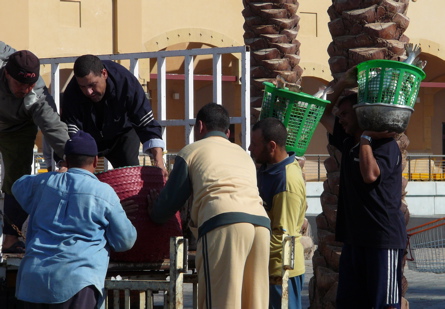


I am only missing Kuwaiti shrimp, which is now out-of-season, to protect the shrimp production for future needs. I am willing to sacrifice for the long-term greater good, and besides, I can still find fresh-frozen Kuwaiti shrimp in my local co-op.
Yesterday I had a new treat – hammour kufte. Have you tried it? I saw it at the Sultan Center, and decided to try it. I sauteed it gently, not sure how it would respond, until it was cooked almost through, then flipped it and cooked the other side. Total WOW. I am a believer! If you haven’t tried it, you are in for a treat. How can anything taste that good AND be good for you?
(Segue) Have you visited the Al Kout Mall in Fehaheel recently? I often take visitors there – it is SO different from Marina Mall and Sharq Mall. There aren’t the bands of teenage marauders there, children are kept under control by their caring parents, and the cafes and restaurants along the fountains are busy day and night, mostly with families and quiet people, not the people who are more concerned with being seen. The stores often have things that are already shopped out at the other malls. There is a serenity in the architecture, and the way it incorporates the waterfront location, and a feeling of everything coming together as it ought.
Sometimes I am the only Westerner I see, outside the Sultan Center.
I took a friend there who had lived in Kuwait a long time ago. She was astounded when I took her there. “This is FEHAHEEL?” she exclaimed. She was in wonder and in shock. She remembered Fehaheel as being at the end of the earth, and a dangerous place to be.
It can still be a dangerous place to be, on a Thursday or Friday night, in competition for a parking place. It will get worse, once the Rotana Hotel opens in the Manshar complex. And the signs for the Villa Moda at the Al Manshar Mall are now disappeared – is Villa Moda NOT coming to the Manshar Mall?
Party Busted
Wouldn’t you love to know the rest of this story? I sure would! From today’s Kuwait Times:
Detectives arrested a group of over 40 Kuwaiti and Western students of private school who were enjoying themselves at a private party in a very luxurious apartment in Salmiya, said security sources. Officials added that some neighbors heard them arguing in the building’s parking area about who would be allowed in and who would not be; for not contributing in the party’s expenses. An hour later, the apartment was busted and the strangely dressed young people (in devilish costumes) were arrested along with the building’s security officer who rented them the apartment.
My comment: Sounds to me like these kids have too much money, and too little sense, a la Risky Business. These are school kids??? And what were the costumes?
Hawally Monster in Custody?
Today’s Kuwait Times, page 2, under National News/Crime:
Children Report Kidnapper
Children on spotting a police patrol asked for help after informing them that two Arabs tried to kidnap them. Police chased the expats and arrested them, and referred them to the relevant authorities. After conducting initial investigations and taking their blood samples, the blood group of one of the men matched that of the Hawally monster.
That’s not exactly a DNA match, but it does help narrow the field. Does the man look like the Hawally victim’s descriptions of their attacker?
Three other things – one, police were patrolling a neighborhood. That’s very cool. Second, the children trust the policement enough to ask for their help. That is also very cool. Third, BIG Hoorah for the parents of the children who reported these two losers and got them off the streets, for teaching their children well.
And meanwhile, even if the Hawally monster is caught, there seem to be a lot of other creeps out there who feel entitled to force sex upon the weak, the small, and the unwilling. Keep your eyes open out there.
Who Knew? Skimmed Milk Affects Fertility
Today’s Kuwait Times 1 March 2007 has a front page on women who drink skimmed milk having reduced fertility, inspiring a whole new category for my blog entries: Who Knew?
Skim milk as been a mainstay for women trying to maintain desired weight, along with non-fat yoghurt, low fat cheeses, and tofu – all which help women maintain bone density by providing calcium in our diets. The study, done in the United States between 1991 and 1999 concluded that non-fat dairy products may well be contra-indicated for women desiring to become pregnant.
When I was pregnant, I got nervous. I’m normally NOT nervous, but the new hormones bombarding my system made me really nervous and a little anxious, and it had a spiral effect. When I talked to the doctor – in Germany, where I was living – she just laughed and patted me and said “drink a little wine, my dear, and you will feel better! Have a glass at lunch and a glass at dinner.”
I followed her instructions. I felt better. I had my glasses of wine religiously. Thank God, my son turned out just fine, because now people react with horror to the very idea of a woman having anything to drink during pregnancy. But then – Who Knew???
The truth about the world as we know it changes daily. Our assumptions are challenged, and we have to be flexible, and move with the times and with the newest information. But I’m happy not to have to give up skimmed milk.
I have an apology to the Kuwait Times, too. I thought they had misused “affect” and should have used “effect”. I was wrong. They were right. I looked it up, and here is the information:
* Note on affect and effect from answers.com: USAGE NOTE Affect and effect have no senses in common. As a verb affect is most commonly used in the sense of “to influence” (how smoking affects health). Effect means “to bring about or execute”: layoffs designed to effect savings. Thus the sentence These measures may affect savings could imply that the measures may reduce savings that have already been realized, whereas These measures may effect savings implies that the measures will cause new savings to come about.
Women in Pakistan
Last but not least from today’s Kuwait Times are two articles from recent news in Pakistan, both involving women and the men who (seem to) own them:
Police Seek Pakistanis Pressing Woman to Hand Over Her Daughter
Karachi: Police are seeking ten men, including several tribal elders, accused of pressuring a Pakistani woman to hand over her teenage daughter as payment for a 16 year old poker debt, officials said yesterday.
In the latest case highlighting how conservative customs threaten women’s rights in Pakistan, Nooran Umrani alleges that despite paying off her late husband’s debt of 10,000 Pakistani rupees, she was threatened with harm if she failed to hand over her daughter, Rasheeda. The 17 year old was to be surrendered as a bride for the son of Lal Haider, the man who won the card game years before, Umrani told reporters . . . Police said yesterday that the mother and daughter were in their protection and that an investigation was opened against Haider, his son, and eight others. . .
Nooran said her husband was a gambler who ran up the debt at a poker game when Rasheeda was 1 year old. He promised Haider that he would get Rasheeda in lieu of payment when she grew up, Nooran said. . . .
President General Pervez Musharraf has vowed to give women more rights in line with his policy to project Pakistan as a moderate, progressive Islamic nation. In December, Musharraf signed into law a bill that makes it easier to prosecute rape cases in the courts, and the country’s ruling party recently introduced a bill to outlaw forced marriages, including under tribal custom in which woman are married off in order to settle disputes.
My comment: The debt was paid. And what was the father thinking?? giving away his daughter to cover his debts? I can’t wrap my mind around it.
Pakistani Sells Wife’s Kidney to Buy Tractor
Karachi: Pakistani police have arrested two men after a village woman complained that her husband and relatives had sold one of her kidneys in order to buy a tractor, police said yesterday. Although her kidney had been removed 18 months earlier, the woman named Safia only learnt it was missing after seeking treatment for a urinary tract problem in January. “She had said she was three months pregnant when her husband, Shakeel Ahmed beat her and then took her to the hospital for treatment,” said Mohammad Akram, duty officer at Noushera Jadeed police station in Punjab province. “But at the hospital, her husband, in connivance with three other people, sold her kidney to buy the tractor,” he said. Unlike many other parts of the world, including neighboring India, there is no law in Pakistan banning the trade in organs. Poverty-ridden Pakistanis living in rural areas sell their kidneys to pay off debts or raise money for their families. Sick but wealthy Pakistanis, and foreigners from the Gulf, Britain and Canada flock to private hospitals in Pakistan for kidney transplants, made possible by these donors.
My comment: Seems his wife is just another revenue-raising resource to Shakeel Ahmed. If asked, she might have even agreed, but it would be nice to be asked, not to discover it 18 months later. The news article says he was arrested. I wonder if he committed a crime under Pakistani law?
Recent Comments
intlxpatr on Shampoo Ginger tigerbutterya0c5ff1d… on Shampoo Ginger intlxpatr on British Soldier Kidnapped, Esc… John on British Soldier Kidnapped, Esc… intlxpatr on British Soldier Kidnapped, Esc… Wikipedia Donate Button

Amazina


Early Voting in Florida


